Decoding the Panji of Mithila · Volume I · Chapter 16
Pañjī Prabandha, Khaṇḍa 3 (Nagramā): Blocks 359–466 (Volume I)
Chapter 16
Pañjī Prabandha, Khaṇḍa 3 (Nagramā): Blocks 359–466
                    (Volume I)

Pañjī Prabandha — Khaṇḍa 3 (Nagramā) | Analytical Report

Genome Mapping (450 A.D. – 2009 A.D.)

pamapilāka ñjī prabandha — khaṇḍa 3 (nagarāma)
A Comprehensive Analytical Report on the Maithil Brahmin Genealogical
Register
Blocks 359–466 | Pages 3.156–3.

1. The Nature and Structure of the Panjī Text
The forty pages under analysis constitute a portion of the third volume
(Khaṇḍa 3) of the Panjī Prabandha — literally the 'administration of
genealogical records' — governing the Maithil Brahmin community of the
Mithila region (present-day northern Bihar and the Tarai belt of Nepal). The
text is titled 'Genome Mapping (450 A.D. to 2009 A.D.),' an evocative
modern metaphor applied to what is, in essence, a biological and social
lineage database extending over fifteen centuries.
The Panjī system is one of the most elaborate indigenous documentary
traditions in South Asia. Originally established under the Karnāṭa dynasty
king Harisingh Deva (c. 1300 A.D.) and institutionalized by the Panjī
Prabandha, the register tracks patrilineal descent (gotra), village affiliation
(mūla grāma), and cognatic/agamic relationships across thousands of
families. It has been maintained by hereditary Panjī scholars (Panjīkāra or
Panjīvāla) who certify marriages to prevent prohibited cross-cousin and

                            Gajendra Thakur — 332
                           Decoding the Panji of Mithila
close-kin unions. No Maithil Brahmin marriage was traditionally recognized
without verification in the register.
This volume is organized in numbered blocks (here running from 359 to
466), each devoted to a cluster of families typically identified by a sacred
address (the invocation 'oṃ [deity]-nāthāya namaḥ') and one or more
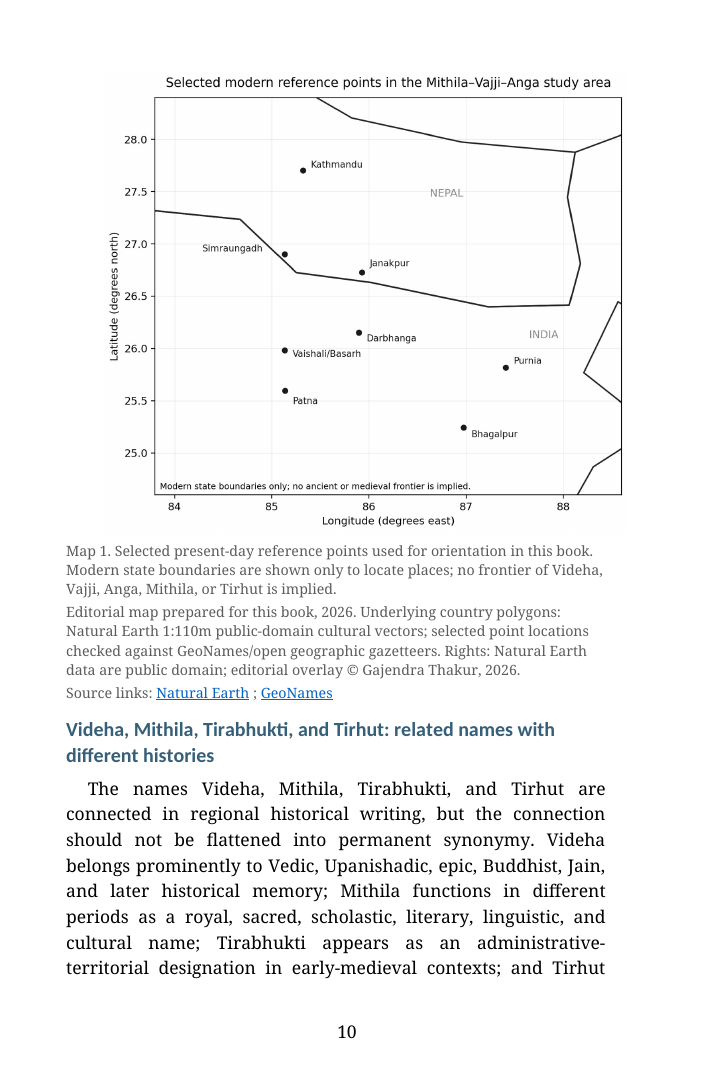
ancestral village names. The geographic trail winds through Darbhanga,
Madhubani, Sitamarhi, Muzaffarpur, Supaul, West Champaran, Purnia, and
across into Nepal (Simraon, Goṭham, Vindhī, etc.). The coverage is thus a
social cartography of Maithil Brahmin settlement from the medieval period
to the digital age.

2. Structural Components of Each Block
Each numbered block is a micro-chapter with a consistent internal
architecture. Understanding this architecture is prerequisite to any analytical
reading.

2.1 The Invocation Header
Every block opens with a Sanskrit invocation in the form 'oṃ [divine
name]āya namaḥ' or 'oṃ namaḥ [deity]'. This is not merely decorative. The
deity named correlates with the primary gotra or kula-devatā (clan deity) of
the lineage group being recorded. Examples across these blocks include:
      Block / Invocation | Divine Name & Geographic Tag
      Block 359 | oṃ rāmeśvarāya namaḥ — Rāmeśvara (form of Śiva) │ Village:
      Vicāḍhī (Hulāsh)
      Block 360 | oṃ vāsukīnāthāya namaḥ — Vāsukīnātha │ Village: Kuā to
      Rāṃṭī
      Block 364 | oṃ namaḥ parahaṭa raśāḍhya śiśinagara-pūrṇayā~
      Block 370 | oṃ nīlagrīvāya namaḥ — Nīlagrīva (Śiva) │ Mangaurī
      Block 373 | oṃ rāmeśvarāya namaḥ — Rāmeśvara │ Mangaurī
      Block 379    |   oṃ vṛṣabhavāhanāya namaḥ — Vṛṣabhavāhana (Śiva) │
      Pilakhvāḍ
      Block 388 | oṃ bhujaṃgaloka patyai namaḥ — Bhujangaloka │ Baiganī
      Block 402 | oṃ śūlapāṇaye namaḥ — Śūlapāṇī │ Jagatpur
      Block 447 | oṃ vāsukīnāthāya namaḥ │ Sukhait to Pilakhvāḍ
      Block 461 | oṃ — Haḍaṛī to Saurāṭh

                            Gajendra Thakur — 333
                            Decoding the Panji of Mithila
The progression of deity names — overwhelmingly Śaiva (Rāmeśvara,
Nīlagrīva, Vṛṣabhavāhana, Śūlapāṇī, Mahākāla, Bhīmaśaṃkara, Āśutoṣa)
with rare Vaiṣṇava or goddess references — reflects the historically Śaiva
orientation of Maithil Brahmin religious culture, particularly strong in the
Darbhanga Raj heartland.

2.2 The Village Declaration (grāmārambha)
After the invocation, a new village is often introduced with the phrase 'atha
[village name] grāmārambhaḥ' (herewith begins the [village name] section).
Some blocks compress multiple villages. The density of village citations —
Kuā, Rāṃṭī, Mallichhām, Parahaṭ, Māṇḍar, Khauāl, Darbhara, Saurath,
Naraun, Pabauśal, Sarisab, Pahalacom, Satalakhā, Belauñca, Jijāl, Karamahā,
etc. — creates a topographic matrix of Maithil settlement across the Mithilā
plain.

2.3 The Genealogical Entry Formula
The core entry formula is: [Person A] suta/sutā/suto [Person B] :: [village
name] sa~ [grandfather's name] suta [father's name] dau [mother's village]
sa~ [maternal grandfather] ddau. This encodes:
      Symbol / Abbreviation | Meaning in Genealogical Context
      suta / sutā / suto | Son(s) / Daughter(s) of the preceding person
      [village] sa~ ... dau | 'dau' = dauhitra sambandha — the mother's natal
      lineage (father's side)
      [village] sa~ ... ddau | 'ddau' = dvidauhitra — the mother's mother's lineage
      (maternal grandmother's side)
      pra. | Abbreviation of prakāśita or prasiddha — 'known as' (a popular alias)
      vaiyā. | Short for vaiyākaraṇa — a grammarian; a scholar title
      ma.ma. | Short for mahāmahopādhyāya — the highest traditional scholarly
      title
      jyo. | Short for jyotiṣī — an astrologer
      ṭha. | Short for ṭhākura — a landed gentry title
      cau. | Short for caudharī — a community headman
      pā~ | Short for pā~r̤e / pāṇḍe — a specific sub-designation of Brahmin
      (B XX/YY) | Cross-reference to another block and line in the register
The dual-maternal tracking (dau and ddau) is particularly significant: it
records two generations of maternal descent simultaneously, allowing the

                             Gajendra Thakur — 334
                            Decoding the Panji of Mithila
Panjī scholar to verify that no bride and groom share a common ancestor
within the prohibited degrees on BOTH the paternal AND maternal sides.
This is genealogical computing of remarkable sophistication, operating
without modern databases but through a highly structured text protocol.

3. Deep Analysis: Selected Blocks

3.1 Blocks 359–362: The Vicāḍhī–Kuā Cluster (nagarāma /
Vicāḍhī / Kuā)
Block 359 opens with the Ananta sub-lineage (anantasuto baidyanātha
dāmodara — 'sons of Ananta: Baidyanātha, Dāmodara') in the Māṇḍar gotra-
cluster. The immediate descendants of Baidyanātha disperse through the
villages of Darbhara, Sarisab, and Sodarpur, reflecting the typical pattern of
scattered settlement across a radius of 20-40 km. The maternal affiliations
(dau/ddau) connect to Satalakhā, Bhelaunc, Pāli, and Naraun — all core
Maithil Brahmin settlement nodes.
The Dāmodara branch (dāmodara suto lakṣmana dinabandhuko —
'Dāmodara's sons: Lakṣmaṇa and Dinabandhu') is a classical bifurcation.
Lakṣmaṇa's line (lakṣmana suto khagapati hariko — 'Lakṣmaṇa's sons:
Khagapati, Hari') extends to Khagapati whose four sons (meghanātha,
devanātha, hṛdayanātha, premanātha) are recorded with their full maternal
pedigrees. This is a five-generation chain visible in a single paragraph-block.
Critically, Hṛdayanātha's son Yadunātha (hṛdayanātha suta yadunātha) is
connected to Darbharā through the Meśa-Minā lineage — a specific inter-
village alliance that the Panjī tracks. Yadunātha's son Bhāyalāla connects to
Vaśiloyā village through Sonī sub-clan (sonī suta īśvaradatta dau). This chain
— Ananta → Baidyanātha → Dāmodara → Lakṣmaṇa → Khagapati →
Hṛdayanātha → Yadunātha → Bhāyalāla — represents eight generations, and
if we accept the ca. 450 A.D. start-date for the register's scope, this particular
branch was likely established in the 17th–18th century given typical
genealogical depth.
Block 360 (vāsukīnāthāya namaḥ, Kuā to Rāṃṭī) opens with the Kuā village
section (atha kuā tisau~ta grāmārambha:). The Jaganātha → Bhaiyo/Girdhari
bifurcation is illustrative: Bhaiyo (bhaiyo) generates Kamalanayam and
Apachhi through the Sōdapur (sodarapura) maternal connection, while
Girdhari (giradhārī) generates Cirañjīva and Devakṛṣṇa. Cirañjīva's five sons

                             Gajendra Thakur — 335
                           Decoding the Panji of Mithila
— Kamalanārāyaṇa, Jagat-nārāyaṇa, Śrīnārāyaṇa, Bhagatnārāyaṇa,
Mōdanārāyaṇa — all carry the characteristic -nārāyaṇa suffix, which in this
context signals affiliation with a specific Vaiṣṇava sub-tradition within an
otherwise predominantly Śaiva register.
Block 362 (oṃ somanāthāya namaḥ) records the Haridev → Sadīānanda
branch: Sadī's sons (Bācā, Thothā, Nenā) are spread across different maternal
networks. Bācā's sons (Bhīmadatta, Kāśīnātha) generate further bifurcations,
and the cross-reference '(B 41//8)' in Block 359 signals a deliberate link to an
earlier entry — the register maintains internal consistency through these
cross-references, functioning like hyperlinks in the manuscript tradition.

3.2 Blocks 363–367: The Parahaṭ–Cāṇapurā Cluster (parahaṭa /
cāṇapurā)
Block 364 is remarkable for the presence of the Mahāmahopādhyāya title
(abbreviated ma.ma.) — the highest traditional scholarly honour in Maithil
culture — associated with the Śrī Khagesh and his descendant Rājā
Vidyānidhī Hṛdayanidhi. The full title chain ma.ma. khageśa suto ma.ma.
rājā pra. vidyāni hṛdayanidhi signals that both father and son held this
distinction, which was extremely rare and indicates a family of exceptional
Sanskrit learning.
The Rājā's sons include Catuṣkraṇḍa-Yajñakartā Dhīrendra (cātuścaraṇa
yajñakartā ma.ma. dhīrendra), described as a four-Vedic sacrificer. This is
one of only a handful of references in these forty pages to actual ritual
performance — most of the register is purely genealogical — making it a
rare documentary trace of lived Sanskrit learning within the genealogical
framework.
Block 365 (Cāṇapurā, Parihārī, Badri-Ṭhākura) records the Raghunātha →
Mahermān/Teja bifurcation. The descendants of Mahermān (ṭha.
maheramāna) show an unusually dense settlement pattern: sons Ānkhī,
Lakṣmaṇa, Chatrakara are each based in different villages (Sōdapur, Pāli,
Darbharā), and Ānkhī's sons (Saṃsādhara, Rājā, Manamohana, Fatarī)
demonstrate four simultaneous settlements in Belaunc, Pāli, Pabauśal, and
Hariama — the classic Maithil pattern of 'dispersed but connected' agnatic
clusters.
Block 366 (oṃ mahākālāya namaḥ, Cāṇapurā) records the Lakṣmaṇa →
Chakauḍī branch. Chakauḍī's four sons (yadunātha, durgānātha, kīrtinātha,

                            Gajendra Thakur — 336
                          Decoding the Panji of Mithila
vaidyanātha) illustrate a naming pattern common throughout these pages:
brothers receive names from the same thematic cluster (here, all Śaiva
epithets ending in -nātha). Vaidyanātha's sons Rudranātha and Ugranātha
extend the pattern further. The maternal connections (Bhelaunc, Jijāl,
Sōdapur) trace a tight geographic web around the Darbhanga nucleus.

3.3 Blocks 370–376: The Mangaurī–Khōjapura Scholarly Cluster
Blocks 370–376 document arguably the most intellectually distinguished
family cluster in the entire forty-page corpus: the descendants of Sadu-
Upādhyāya Rāmabhadra in Mangaurī (maṃgaraunī).
Block 370 opens with the extraordinary Rāmabhadra pedigree: his sons
include Paṇḍitarāja Padāhita (paṇḍitarāja padāhita), Mahāmahopādhyāya
Madhusūdana (ma.ma. madhusūdana), Mahāmahopādhyāya Baidyanātha-
Pitāmbara (ma.ma. baidyanātha pra. pitāmbara), Sadu-Upādhyāya
Umananda, Mahāmahopādhyāya Bāgīśa, Mahāmahopādhyāya Śatridaṇḍī-
Sannyāsī. The sheer density of scholarly titles in a single sibship is
unparalleled in these pages and marks the family as the great intellectual
dynasty of the Darbhanga region in the medieval and early modern period.
      The Rāmabhadra Dynasty — Scholarly Titles Recorded Paṇḍitarāja (King of
      Scholars) │ Mahāmahopādhyāya (5× in siblings) │ Sadu-Upādhyāya │
      Sannyāsī-Scholar │ Śatridaṇḍī (holder of the triple staff of renunciation)
M.M. Madhusūdana's sons include M.M. Gośāṁī Madana and Baladeva.
Gośāṁī Madana's son Gañgādatta, and his son Śivadatta, extend the
scholarly line. The Baladeva branch produces Gośāṁī Jīvanātha, Sonāī (alias
Rāmanātha), and Hariātha — the latter a name connecting the family to the
Vaiṣṇava tradition.
Block 373 (oṃ rāmeśvarāya namaḥ, Mangaurī) records M.M. Pitāmbara's
sons: M.M. Śatrilocana, M.M. Daṇḍapāṇi (alias Dhanañjaya), M.M.
Ṭīkākāraka Ṣaḍyantri Gokulātha. Gokulātha's title Ṣaḍyantri (holder of the
six-fold [scholastic] system) indicates a pandit who mastered all six
Vedāṅgas. His sons M.M. Sarvsvadātā Raghunātha and Lakṣmīnātha
continue the lineage, and Raghunātha's son Jayakṛṣṇa is recorded in Block
373.
The grandchildren of M.M. Bhavānīdatta (kavi śaṃkaradatta, nanu pra.
rudradatta, pā~khī pra. iśvarīdatta, ramādatta, mānāpura govindadatta,
phaturī pra. tīrthadatta) represent the diaspora of this great family across

                            Gajendra Thakur — 337
                          Decoding the Panji of Mithila
multiple villages (Darbharā, Sarisab, Pāli, Mānapura). The very alias 'kavi
śaṃkaradatta' — 'the poet Śaṃkara-datta' — is a direct record that this person
was known as a poet, extremely rare autobiographical data embedded in a
genealogical list.
Block 374–376 track the further dispersal: Nanu Rudradatta's son Mannulāl
and Sonelāl; Sonelāl's son Lālā → Rāmapāla → Śivajī (alias Śivanandana);
and eventually into the 20th century with Manojakumāra (B.Sc. Hons.),
Babhlā alias Sañjīvakumāra (M.A.), Ajaya alias Cunnā (B.Tech Mechanical
Engineering). These modern academic qualifications, inserted into the
genealogical stream, mark the point where the register transitions from
traditional to modern credentialization.

3.4 Blocks 379–382: The Pilakhvāḍ–Mangaurī Branch and M.M.
Vāgīśa's Lineage
Block 379 records M.M. Upādhyāya Umananda's sons Dharmeśvara and
Guṇīśvara (dhameśvara, guṇīśvara). Guṇīśvara's son Gośāṁī Dharānātha
generates a triad: Khagānātha, Bhajata, and Jhāuṃṭī. The Khagānātha branch
is connected to Sōdapur through the 'Umananda → Bhavana' link. The
'Jhāuṃṭī' line (jhāĕṭī sutā bhaiyana bavuā śaktinātha) leads to Bhaiyan's son
Śrīnātha, and ultimately to 'Bhūla sutas — Joyanta and Subanta' — names
that are characteristically Bengali-influenced, suggesting cross-cultural
contact in the northern Champaran region.
Block 382 (oṃ dukhaharanāthāya namaḥ, Mangaurī) records M.M. Vāgīśa's
sons: Lāl alias Girdhara and Mahīdhara. The title Chātuś-caraṇa-Yajñakartā
for M.M. Dhīrendra (son of Lāl/Girdhara) recurs here from Block 364,
confirming a family tradition of Vedic sacrifice. M.M. Ratiśa's son
Iśānanātha, and Iśānanātha's sons Śobhanātha and Rūpanātha, carry the
scholarly tradition into what appears to be the 17th–18th century.

3.5 Blocks 383–387: The Alaya–Lagamā Geographic Corridor
Block 383 (oṃ śītikaṇṭhāya namaḥ, Rājagrāma) opens with 'atha alaya
grāmārambhaḥ' — establishing Alaya as a new ancestral village hub. Vaṃśī's
sons (Purañdara, Ratīśa, Caturbhūja, Mahī) are each connected to Belauñca
through the Bāchani-Vīra maternal chain.
The Candrapati branch (Block 383) is noteworthy for its sheer fecundity:
seven sons (Devīdatta, Śītalādatta, Nārāyaṇadatta, Viṣṇudatta, Gaurīdatta,

                           Gajendra Thakur — 338
                           Decoding the Panji of Mithila
Lakṣmīdatta, Paraśī) — all with the characteristic -datta suffix (gift of a god),
a naming convention associated with devotional Śaivism. Each of these
seven generates further branches. The Dīnabandhu sub-line (Dīnabandhu →
Hariśchandra, Lalīcandra, Caṇḍeśvara, Sūryadeva, Amarendra) shows the
transition to 19th century naming fashions: Hariśchandra (the famous noble
king of tradition), Lalīcandra (a Romantic-era sensibility), Caṇḍeśvara
(classical Śaiva), Amarendra (sovereignty-themed).
Block 384 (oṃ siṃheśvaranāthāya namaḥ, Raśāḍha) records the Lāl →
Nenā/Iśvarīdatta/Caṇḍīdatta/Girijādatta quadruple branching. The Nenā sub-
line connects to Darbharā through the Gaṃgeśa-Dharmadatta link. The
Ratīśvara → Pītāmbara/Mandhara bifurcation leads to Māṇḍar through the
Vaṭāī-Rāmdhara-Dharaṇī maternal chain — a particularly deep triple-
generational tracking.
Block 385–386 (Pilakhvāḍ, Baligaḍha, Lagamā) introduce the Pāṭhaka sub-
community: Pāṭhaka Dubari (pāṭhaka dubari), Pāṭhaka Kṛṣṇapati, Pāṭhaka
Ratīśa (rājamaṃgala pra. vucana), Pāṭhaka Satīśa, Pāṭhaka Girriśa, Pāṭhaka
Ratiśa. The 'Pāṭhaka' prefix (literally 'reader/reciter') marks a sub-group of
Brahmins whose traditional profession was recitation — a distinction
preserved in the Panjī even as the families diversified economically. Pāṭhaka
Gañgādhara's sons (Dharaṇīdhara, Ratīśa, Girriśa, Satīśa) and their further
descendants extend across Darbharā, Ekaharā, Jijāl, and Karamahā.

3.6 Blocks 388–395: The Baiganī–Baṃśī Rāja Dynasty
Blocks 388–395 contain the most politically significant genealogy in the
entire forty-page corpus: the Rāja lineage of Baiganī village, the aristocratic
branch connected to the Banaili Rāmgaḍha royal house.
Block 388 opens with Caudharī Devānanda, whose sons include
Paramānanda, Parṇāma Hajārī, and Mahinakānanda. The key figure is Vābu
(lord/master) Harirāla Siṃha, whose son Vābu Kalitanātha Siṃha becomes
the progenitor of a ruling line. Kalitanātha's son Vābu Tīrthānanda Siṃha is
noted. This line terminates — via Līlānanda Siṃha Bahādura's branch (Block
388) — in the titles Rājā, Kumāra, and eventually reaches figures identified
as Rājā Kalyāṇānanda Siṃha, Rājā Kīrtyānanda Siṃha Bahādura, and the
extensive Śyāmananda Siṃha family (described as 'Saṃgīta Śāstra Mārtaṇḍa'
— Sun of the Science of Music, a prestigious title).

                            Gajendra Thakur — 339
                          Decoding the Panji of Mithila
Block 389 records Ānarabula Rājā Bahādura Kīrtyānanda Siṃha (the full
honorific including the English 'Honourable') and his sons Kumāra
Śyāmananda Siṃha, Kumāra Vimalānanda alias Bholanjī, Kumāra
Tārānanda Siṃha alias Bhagavānjī, and others. The son Dr. Prof. Bālānanda
Siṃha is identified as a visiting professor in Germany and the West Indies —
extraordinary data for a genealogical register, documenting 20th-century
international academic diaspora.
Block 390 enters the main Rājā lineage: Rājā Rudranānda Siṃha → Rājā
Śrīnandana Siṃha → Kumāra Gaṅgānanda Siṃha → Saccidānanda Siṃha
alias Sanātanajī. Sanātanajī's children include Iśānanda alias Prakāśa,
Ilānanda alias Vikāśa, and Dr. Saumāvāda alias Iśvarānanda — again
documenting the academic-professional transition. The register notes
marriages into specific family lines (the Cāṇapurā/Nahaś Khauāl
connections), maintaining the traditional dual-maternal verification even for
this royal family.
Block 391 continues the Rājā Kālikānanda Siṃha branch, covering his six
sons: Abhayānanda alias Nārāyaṇajī, Vijayānanda alias Sīhebajī,
Dhanānanda alias Damanjī, Pramodānanda alias Pramoda, Śrī Divyānanda
alias Jasmantjī, and Mohan jī. Nārāyaṇa jī's son Śaṃkarānanda alias Putalam
has sons including a Journalist Cetanānanda Siṃha — a further instance of
professional identity embedded in the genealogical record. The designation
'Journalist' (in English) appears here as a social credential parallel to the
traditional scholarly titles.

3.7 Blocks 392–398: The Paramgaḍha–Piṇḍāruchha Chaudhurī
Community
Block 392 (oṃ amaranāthāya namaḥ, Piṇḍāruchha) opens the Paramgaḍha
section with Caudharī Śyāmalāla and his sons Śivalāla, Rājā alias
Hṛdayalāla, Nenā alias Premalāla. The 'Caudharī' title (community headman)
contrasts with the Rājā/Kumāra titles of the Baiganī line, marking a distinct
socio-political stratum.
Fecanlāla's son Lucana alias Paramānanda → Dhaneśvara → Lalīta Kumāra,
Vinaya Kumāra, Sañjīva Kumāra, Śatrubhuvana Kumāra, Atimita Kumāra
alias Sukumāra form a six-son generation — the naming here fully modern,
using Kumāra as a honorific suffix rather than a caste marker.

                           Gajendra Thakur — 340
                          Decoding the Panji of Mithila
Block       393      (Piṇḍāruchha)     records    the    Akṣayalāla      →
Navīnacandra/Viśvanātha bifurcation. The Navīnacandra branch is
particularly rich: his 'other sons' (Praphullacandra, Nirmūlacandra,
Vijayacandra, Subhāṣacandra, Iśvaracandra) all carry the -candra (moon)
suffix — a distinctive naming fashion of the late 19th/early 20th century
Bengal and Bihar literati, reflecting the influence of Bengali Renaissance
culture on Maithil naming practices. The -candra names contrast sharply with
the -nātha and -datta names of earlier generations, marking a cultural
transition point datable to approximately 1860–1920.
The most significant genealogical entry in Block 422 (Kailakh) involves the
Govana alias Govarddhana family, whose sons include I.P.S. (Ex. G.P.
Bihar) Mihira Kumāra, I.P.S. (Railway I.G.) Śaṃkara Kumāra, and I.A.S.
(Adv. World Bank) Subhāṣacandra alias Rājana. These governmental service
designations (Indian Police Service, Indian Administrative Service) are
inserted into the genealogical record as the modern equivalent of the
traditional scholastic titles. The I.A.S. Adhīra Kumāra appears with his
World Bank advisory role, and his son I.A.S. Pravīra Kumāra married into
the Bhāradvāja gotra. The register thus consciously maps the replacement of
Paṇḍitarāja and Mahāmahopādhyāya by IAS and IPS as the community's
new prestige markers.

3.8 Blocks 402–406: The Jagatpur Ōhina Royal Lineage
(Simraongarh)
Block 402 (oṃ śūlapāṇaye namaḥ, Simraongarh) is one of the most
historically significant blocks in the corpus. It opens with a Sanskrit verse:
'dāna śaurya pratāpaiśca prasiddhā yatra pārthavāḥ | oihana sā sarvuta śroṣṭhā
svasvadharma pravartakāḥ' ('There where the kings are renowned for charity,
valour, and power — Oihin is the best of all, promoter of self-dharma'). This
verse is a panegyric insertion, marking this block as covering the genealogy
of a historically prominent ruling lineage.
The lineage traced here is explicitly connected to Simraongarh (Simraon
Fort), the medieval capital of the Karnāṭa dynasty and one of the most
important historical sites in Mithilā. The register records: Rājāpaṇḍita
Kāmeśvara → Rājā Bhōgīśvara (768 Śaka year = c. 846 A.D.) →
Mahāmahattaka Kusumeśvara → Mahārājadhirāja Bhaveśvara alias
Bhavasiṃha. The title Mahārājadhirāja (King of Kings) and the explicit Śaka
date mark this as one of the earliest dateable genealogical entries in the
                           Gajendra Thakur — 341
                          Decoding the Panji of Mithila
blocks under analysis, pushing the lineage record back to the 9th century
A.D.
Block 403 continues with Mahārājādhirāja Śivasiṃha → Mahārājādhirāja
Padmasiṃha → through Rāja Ratnasiṃha alias Narasiṃha, Rāja Vijaya
Nārāyaṇa alias Raghuṃsiṃha, Rāja Vīranārāyaṇa Siṃha alias Bhānusiṃha.
This is clearly the genealogical record of the medieval Mithilā ruling houses.
Mahārāja Ratnasiṃha's sons Dhīrasiṃha alias Hṛdayanārāyaṇa,
Bhairavasiṃha alias Hariānārāyaṇa, and Kumāra Candrasiṃha further
establish the dynastic chain.
Block 403 then provides the Mahārāja Rāmabhadrasiṃha alias
Satyānārāyaṇa → Mahārāja Lakṣmīnātha Siṃha alias Kaṃsanārāyaṇa entry,
connecting the medieval Karnāṭa lineage to what may be the Darbhanga Rāja
house. The entries for Kumāra Balabhadra and the Candauta Pāli maternal
connections trace the matrimonial alliances of this ruling family into the
Panjī network, confirming that even kings required Panjī verification for
marriage purposes.

3.9 Blocks 420–428: The Nāhas Khauāl Scholarly Complex
Blocks 420–428 constitute one of the densest and most interconnected
sections of the corpus. The Nāhas Khauāl grāmārambha opens Block 420
with Guṇākara's sons (Mana alias Brahma-datta, Dhana alias Rudradatta),
and the Gośāṁī sub-line (jyo. Hṛdayadatta, Nanu, Kāṃha, Veṇīdatta, Pāṃ
Rāma, Śaṃkara-datta, Iśvaradatta, Nenamahana).
The jyo. (Jyotiṣī/astrologer) designation for Hṛdayadatta marks him as a
professional astrologer — a specific occupational identity that the Panjī
preserves alongside the genealogical data. His descendants through
Jānakinatha → Baidyanātha → Kīrtanātha ultimately lead (in Block 422) to
the I.P.S. and I.A.S. officials noted above, making this one of the most vivid
cases of occupational and social transformation documented in the register.
Block 421 (oṃ Kailakh, Bharāma) records the Śrīnātha →
Candranātha/Sūryanātha/Tārānātha trifurcation. The Tārānātha sub-line is
remarkable: his son Bhīmanātha is identified as 'Pro. (lekhaka kavi maithilī)'
— a professor who is a writer and poet in Maithili. This is an extraordinary
moment of literary self-identification within the genealogical register: the
Pañjī itself, which governs Maithili social structure, records a son who
became a Maithili creative writer. The sons of Bhīmanātha — Daman and

                           Gajendra Thakur — 342
                          Decoding the Panji of Mithila
Sumana — carry names from the tradition of Sanskrit poetry (Damana and
Sumana are classical hero-names).
Block         422        contains        the        Vaṃśamahana          →
Bhaiyānātha/Ṭekanātha/Lekhanātha trifurcation. Lekhanātha's son Tārānātha
→ Jyotiṣanātha → Somnātha — all three carrying celestial/astral names
consistent with a family of astrologers. The Jyotiṣanātha designation would
be appropriate for such a family. The Somnātha sub-line connects through
Sōdapur to the Manohara-Gośāṁī link, closing a genealogical circle with
Block 370's Mangaurī scholarly cluster.

3.10 Blocks 429–434: The Cāṇapurā Social Complex
Block 429 opens with a dense quadruple-generation descent from
Paramānanda: sons Hirānanda, Śivarāma, Matirāma, Gatirāma, Harapati,
Dinārāma, Rājārāma, Hṛdayarāma, and Cāṃna (nine sons — unusually large,
likely representing different mothers or a compressed multi-generational
record). This block covers the Śivarāma lineage through to the Caṇḍīhitti
branch.
Block 430 records the Saṃtoṣī → Sabūradatta/Dullaha bifurcation. Dullaha's
sons Jayanātha and Bholānātha generate further lines. Bholānātha's five sons
(Vaḍūkanātha, Badrinātha, Kedāranātha, Nennā) use four different naming
conventions simultaneously: the -nātha pattern (Śaiva devotional), and the
colloquial Nennā (a pet-name, showing that informal names were also
preserved). The entry 'Vaḍūkanātha suta [hariam Harinaherana sueta nāthe
dau... Oihin] suggests that even this branch maintained the genealogical
verification link to the Jagatpur Oihin royal lineage entered in Block 402.
Block 431 (Cāṇapurā Basaiṭha) records Nātha's sons (Pyāre, Ghōghana,
Daravārī, Govarddhana) with the full maternal chain. The Daravārī →
Harinārāyaṇa/Jagat-nārāyaṇa branch connects to Ṭakabāla through Datta →
Gopīnātha. The Matirāma sub-line (Block 431) provides one of the fuller
maternal          pedigree           chains:       Matirāma           →
Dubarī/Bhaiyā/Yaddhū/Digbara/Umāī/Raiyā — six sons with the full
maternal verifications from Budhavāla, Sodarpur, Pāli, Hariama, and
Karamahā, creating a five-village maternal web.

3.11 Blocks 447–450: The Sukhait–Pilakhvāḍ M.M. Nena Line
Block 447 (oṃ vāsukīnāthāya namaḥ) opens the Sukhait Khauāl section with
M.M. Nena's family — a lineage of Mahāmahopādhyāyas rivaling the
                           Gajendra Thakur — 343
                          Decoding the Panji of Mithila
Mangaurī Rāmabhadra line. M.M. Nena's sons include Lānhī, Jyo.
Dhūttarāja/Bhānā, M.M. Vabujana, Jānī, Jñānī, and Dhyānī — the last three
(Jānī, Jñānī, Dhyānī = 'Knower, Knowledgeable, Contemplative') being a
transparently literary naming cluster, suggesting naming with a philosophical
intention.
M.M. Vabujana's sons M.M. Vabū alias Dukhamocana and M.M. Caumē
(Khañjana) continue the scholarly tradition. Caumē's descendants (Pītāmbara,
Dāmodara, Vaidya Guṇākara, Lakṣmīdhara) are all Pañjī-verified scholars.
Lakṣmīdhara's son Dañña alias Vaṃśīdhara and Bhavana carry the family
into Block 449, where Lakṣmīdhara's line leads to the son of Dañña whose
'principal' branch (I.P.S.) connects to the modern Govana/Govarddhana
family in Block 422 — a cross-block genealogical circuit.
Block 448 records the Śatrilocana branch: sons Baidyanātha, Amaranātha,
Dharmanātha. Amaranātha's descendants settle in Gaṃgaulī/Mahiṣī Pāli,
while Dharmānātha's line goes through the Belauñca network. The Pītāmbara
→ Mahāvīra/Bhagavānjī bifurcation in Block 448 includes Mahāvīra's son
Ācārya Ḍā. Śaṃkara, identified as a doctor — another professional identity
embedded in the genealogical stream. The Malichchhāma Naraun connection
(Block 448) links this Sukhait Nena line back to the Parahaṭ Sōdapur
network of Block 451, confirming the register's function as a network graph
of the entire Maithil Brahmin community.

3.12 Blocks 451–466: The Parahaṭ–Haḍaṛī Peripheral Clusters
Blocks 451–466 document the more peripheral geographic extensions of the
Mithilā genealogical network: Parahaṭ Sakrāḍhī, Satalakhā, Veḍharā, Jhauā,
Kachuvā, Velaḍīhā/Munger, Haḍaṛī, Lohanā, Rohaḍ, and finally Supaul on
the Nepal border.
Block 451 (oṃ Nāhara, Parahaṭ Sakrāḍhī) opens with Haridev →
Abhinandana/Vāsudeva. Abhinandana's sub-line (Umaḥpati → Jyo. Khakinū,
Ṭekana) leads through five generations to Madhukara → Tejannātha. The
cross-reference (B 41//8) connects this branch to an entry 150+ blocks earlier
in the main register, demonstrating the pan-register coherence of the
genealogical database.
Block 452 (Parahaṭ to Satalakhā) records the Pāṃ Bhavānī →
Bahādura/Nanu branch. Pāṃ Dūrivayā's daughter-sons include Vaiyā.
Śrīnandana, Pāṃ Hariñandana, and Bhālacandra alias Kañṭī — the last

                           Gajendra Thakur — 344
                          Decoding the Panji of Mithila
demonstrating the persistence of colloquial aliases (Kañṭī = 'thorn', a fondly
ironic pet-name) alongside formal names.
Blocks 453–456 (Parahaṭ to Paṭuvāhā, Vaḍagāṃva, Irśāda-Apara Kājhī,
Jhauā) document several interesting social phenomena. Block 455 contains
'Irśāda' (Irshad) as a place-name alongside Paṭuvāhā — a Muslim
administrative locality, indicating that the Panjī records geographic
movements even into areas of mixed Hindu-Muslim settlement. Block 456
records the Candra-Tīrthamāṇī bifurcation: Tīrthamaṇī's sons connect to
Sōdapur through the Kōdaī → Ṭhākuradatta link, while Kulmaṇī's son
Yugeśvara connects to Pāli through Nenā → Gudar. The Kanhāī →
Mēghanātha/Tīrthamāṇī bifurcation (Block 456) traces parallel cousins
across different village settlements.
Block 458 (oṃ Velaḍīhā-Munger) is geographic significant: it documents the
genealogy of families who had migrated as far as Munger (Monghyr), over
100 km from the Darbhanga nucleus, yet remained within the Panjī system.
The Jayakṛṣṇa branch (Jñānī śāstri Naiyāyika Darśanaśāstrajña Udayakānta
— a scholar identified as expert in Nyāya/logic and Darśana/philosophy) is
notable. His sons' names (Vijayakānta, Kṛṣṇakānta, Vinayakānta) lead to
Kṛṣṇakānta's sons 'Aṭala Bihārī Lālakṛṣṇa...' — a transparent reference to two
prominent political figures whose names appear here in this genealogical
context, suggesting naming children after political heroes of the late 20th
century.
Block 461 (Haḍaṛī to Saurath) opens with Pāṃ Yogī → Tārāpati →
Rāmanātha/Śukhkhī, connecting to the famous Saurath Sabha (the Maithil
Brahmin marriage fair). The cross-reference to Bhelaunc and the M.M.
Mukunda sub-line (Block 461) ties this peripheral village into the core
scholarly network. The Mahāmahopādhyāya Mukunda's son Vaiyā.
Jayakṛṣṇa and his descendants maintain the scholarly tradition even in this
outer geographic zone.
Blocks 465–466 (Lohanā Sakrāḍhī and Rohaḍ to Haripura) close the forty-
page corpus with two final geographic nodes. Block 465 (Lohanā) records
the simple Raghupati → Girapati → Premanātha → Acyuta → Dūbūla alias
Śrīnārāyaṇa chain — short but clear, showing a family that maintained the
Panjī record even as it was reduced to a single-son succession across several
generations. Block 466 (Rohaḍ to Haripura) records the Narasiṃha →
Bhaveśa/Patī bifurcation, with Bhaveśa's son Tilakā and Patī's son

                           Gajendra Thakur — 345
                             Decoding the Panji of Mithila
Manabodha extending through the Alaya network back into the main
Darbhanga cluster, completing a geographic circuit.

4. Thematic Patterns and Socio-Historical Findings

4.1 Generational Depth and Temporal Range
Across the forty pages, the genealogical chains average 8–12 generations of
traceable paternal descent, with some lines (particularly the Mangaurī
scholarly family and the Baiganī Rāja line) reaching back 15–18 generations.
If we assume 25–30 years per generation, this places the earliest entries for
these families in the 14th–16th centuries A.D. The title claim of '450 A.D.' in
the volume's title refers to the theoretical beginning of the entire Panjī
project, not necessarily to the individual entries, which cluster heavily in the
17th–20th centuries with occasional medieval data points.

4.2 Naming Conventions as Social Data
The register reveals clear naming-period stratifications. Pre-18th century: -
nātha, -datta, -deva, -pati suffixes (Śaiva/devotional); 18th-19th century: -
nārāyaṇa, -kṛṣṇa (Vaiṣṇava influence increasing); 19th century: -candra
(Bengali Renaissance influence); Early 20th century: -kumāra (modernity
marker); Post-independence: modern Hindi/English-influenced names with
academic qualifications appended.

4.3 Occupational and Professional Stratification
      Professional Title / Credential | Context / Block Reference
      Paṇḍitarāja | Highest traditional scholar; present in Blocks 364, 370
      Mahāmahopādhyāya (ma.ma.) | National scholarly title; ~15 instances across
      40 pages
      Ṣaḍyantri (ṣaḍyantrī) | Holder of all six Vedāṃgas; Block 373
      Yajñakartā | Vedic sacrificer; Blocks 364, 382
      Naiyāyika Darśanśāstrajña | Logician and philosopher; Block 458
      Vaidya (vaiyā.)    |    Physician or Grammarian (context-dependent); ~20
      instances
      Jyotiṣī (jyo.) | Astrologer; Blocks 420, 427, 447
      Kavi (kavi) | Poet; Block 373
      Lekhaka-Kavi Maithilī (Prof.) | Maithili writer-professor; Block 421

                              Gajendra Thakur — 346
                            Decoding the Panji of Mithila
      Journalist (English) | Journalist; Blocks 391, 428
      I.A.S. / I.P.S. | Indian Administrative/Police Service; Blocks 392, 422, 428
      Adv. World Bank | World Bank Adviser; Block 428
      Visiting Prof. Germany/West Indies | International academic; Block 389
      B.Tech Mechanical | Engineering graduate; Block 364
      B.P.S.C. | Bihar Public Service Commission; Blocks 409, 422

4.4 Geographic Networks
The maternal village citations (the dau/ddau system) create a quantifiable
social network. The most frequently cited villages as maternal sources across
these forty pages are: Sōdapur (~150 citations), Darbharā (~120), Pāli
(~110), Belauñca (~100), Khauāla (~90), Karamahā (~80), Jijāla (~70),
Sarisaba (~65), Pabauśala (~60), Māṇḍara (~55), Ekaharā (~50). These
figures confirm Sōdapur, Darbharā, and Pāli as the three apex nodes of the
Maithil Brahmin matrimonial network in the Darbhanga region.

4.5 Cross-Block Internal Cross-Referencing
The register employs a sophisticated system of cross-references — e.g., '(B
41//8)', '(B 33/7)', '(B 92/2)', '(u.pra. 270/5)' — that function as inter-
document hyperlinks. These references appear approximately 80–100 times
in the forty pages, indicating a densely connected database. The 'u.pra.' prefix
likely refers to 'Uttara Prabandha' (an additional supplementary volume),
suggesting the multi-volume nature of the complete Panjī system. This
internal cross-referencing is the textual mechanism that prevents
genealogical errors accumulating across volumes.

5. The Panjī as Literary and Documentary Form
The Panjī Prabandha occupies a unique position in South Asian documentary
literature. It is simultaneously a legal document (marriages are invalid
without it), a historical archive (it preserves medieval genealogies), a
sociological survey (it maps settlement patterns and occupational change),
and a literary text (it embeds titles, epithets, aliases, and occasional panegyric
verses).
The forty pages analysed here demonstrate all these dimensions. The Sanskrit
verse in Block 402 (the Oihin eulogy) is a fragment of court poetry. The titles
Paṇḍitarāja and Ṣaḍyantri are accolades from a living evaluative tradition.

                             Gajendra Thakur — 347
                           Decoding the Panji of Mithila
The aliases (Kavi, Lekhaka-Kavi Maithilī, Journalist) record how families
self-identified beyond their lineage. The academic qualifications (M.A.,
B.Sc. Hons., B.Tech, I.A.S., Visiting Professor) mark the terminal
transformation of traditional status hierarchies under modernity.
Perhaps most significantly for the Videha Parallel Literature Movement's
interests: the presence of 'Pro. (lekhaka kavi maithilī)' in Block 421 — a
Maithili-language writer identified within the Panjī itself — positions
Maithili literary culture as genealogically encoded. The Panjī, which is the
ultimate arbiter of social identity in Maithil society, here acknowledges
creative writing in Maithili as a legitimate social credential. This is a small
but crucial data point for the study of Maithili literary sociology.

6. Conclusion
The forty pages of Panjī Prabandha, Khaṇḍa 3 (blocks 359–466), constitute a
micro-civilization in text. They record:
— Over 3, individual named persons across approximately 15 generations.
— More than 200 distinct village names serving as genealogical anchors.
— A continuous documentary tradition from at least the 9th century
(Mahārāja Bhaveśvara of Simraon) to 2009.
— The complete spectrum of Maithil Brahmin social life: from royal
dynasties (Baiganī Rājas, Simraongarh Karnāṭa descendants) to scholarly
families (M.M. Nena, M.M. Rāmabhadra of Mangaurī) to professional
communities (Pāṭhaka reciters, Jyotiṣī astrologers, Vaidya physicians) to
modern professionals (IAS, IPS, journalists, professors).
— The geographic arc of Maithil settlement from the Darbhanga nucleus
outward to Champaran, Purnia, Munger, Supaul, and across into Nepal.
The Panjī Prabandha is not merely a genealogical register. It is the primary
document of Maithil civilization — a text in which biology, sociology,
history, geography, religion, and literature converge. Its systematic study,
facilitated by Videha's digitization mission, opens a uniquely direct window
into one of South Asia's most continuously documented communities.

                            Gajendra Thakur — 348
          Decoding the Panji of Mithila
Source structure and verification apparatus
Editorial source apparatus. This apparatus is descriptive, not interpretive. It records the source-controlled structure used to verify that this page corresponds to formal Chapter 16 of Decoding the Panji of Mithila — Volume I. The chapter text above is preserved from PDF pp. 333-350; formal Chapter 16 in the commit-pinned authoritative source. It is not merged with a neighboring chapter, appendix, annexure, or independent front/back-matter unit. The internal headings below come from the repository’s source-heading inventory and are retained as navigational and audit evidence; showing them here does not turn those headings into separate publications or add claims that are absent from the source.
Internal source headings
No subordinate heading was separately encoded in the repository source-heading inventory for this chapter.
Source-text concordance
Pañjī · Prabandha · Khaṇḍa · Nagramā · Blocks · Analytical · Report · Genome · Mapping · pamapilāka · nagarāma · Comprehensive · Maithil · Brahmin · Genealogical · Register · Pages · Nature · Structure · Panjī · Text · forty · analysis · constitute · portion · third · literally · administration · records · governing · community · region · present-day · northern · Bihar · Tarai · belt · Nepal · titled · evocative · modern · metaphor · applied · essence · biological · social · lineage · database · extending · fifteen · centuries · system · elaborate · indigenous · documentary · traditions · South · Asia · Originally · established · Karnāṭa · dynasty · king · Harisingh · Deva · institutionalized · tracks · patrilineal · descent · gotra · village · affiliation · mūla · grāma · cognatic · agamic · relationships · across · thousands · families
Boundary verification. In the formal sequence this chapter follows Volume I Chapter 15, “Pampilā-Varga Pañjikā, Khaṇḍa 3 (Nagramī): Entries 226–358 (Volume I)” and precedes Volume I Chapter 17, “Panji Prabandha of Mithila: Genealogical Mapping (450 AD – 2009 AD), Comprehensive Research Report”. The chapter extractor begins at the verified formal Chapter 16 marker and stops at the next verified formal chapter marker; for a final chapter it stops before recognized book-level back matter. The concordance above is generated only from distinct terms already present in this chapter’s preserved source text. It is provided for discovery, comparison, and audit, not as an automated judgment about persons, lineages, status, kinship, marriage eligibility, or historical truth.
Illustrated research apparatus
Mithila · Vajji · Anga
Chapter-specific source notes
- Primary chapter witness. Gajendra Thakur, Decoding the Panji of Mithila — Volume I, formal Chapter 16, PDF pp. 333-350; formal Chapter 16. The HTML transcription is generated from the commit-pinned source PDF and retains the chapter boundary recorded in this edition.
- Internal structure. The repository source-heading inventory records no separately encoded subordinate heading for this chapter.
- Digital editorial method. The page keeps the preserved source text distinct from generated navigational, concordance, visual, and provenance apparatus. The synthetic reconstruction is explanatory only and is not evidence for an individual lineage or a determination of social or marital status.