HISTORIES OF THE EASTERN GANGETIC WORLD

Three regions.
One connected history.

A growing research archive for the political, cultural, and intellectual worlds of Mithila, Vajji, and Anga—read across the modern borders of India and Nepal.

REGIONAL DOSSIERS

Begin with a region

Each dossier combines a working chronology, thematic essays, places, people, and a transparent trail back to primary and secondary sources.

01

VIDEHA HEARTLAND

Mithila

c. 1200 BCE — present

Texts, dynasties, learned traditions, and the long cultural geography of the northern Gangetic plain.

  • Videha kingship
  • Maithil scholarship
  • Karnata & Oiniwar courts
Trace in chronology
02

REPUBLICAN CONFEDERACY

Vajji

c. 700 — 400 BCE

The Licchavis, Videhans, and allied clans examined through literary, political, and archaeological evidence.

  • Gana-sangha polity
  • Vaishali
  • Buddhist & Jain traditions
Trace in chronology
03

EASTERN JANAPADA

Anga

c. 800 — 300 BCE

Trade, state formation, and the eastern corridors linking Campa, Magadha, and the wider subcontinent.

  • Campa
  • Riverine exchange
  • Magadhan expansion
Trace in chronology

WORKING CHRONOLOGY

Time, evidence, and change

Dates are working ranges, not claims of false precision. Filters reveal regional strands while retaining the larger connected history.

Filter chronology by region
Mithila

Videha in the later Vedic horizon

Texts associate the eastward movement of Vedic culture with Videha and the courtly world remembered around Janaka.

Anga

Anga emerges in the eastern janapada landscape

Literary traditions place Anga among the important polities of the lower and middle Gangetic east.

Vajji

Formation of the Vajji confederacy

Licchavis, Videhans, and other groups appear within a shared republican or oligarchic political order.

Vajji

Vaishali in Buddhist and Jain traditions

The city becomes a major setting for accounts of Mahavira, the Buddha, monastic institutions, and political debate.

Anga

Anga and Magadha

Traditions of conquest by Bimbisara situate Anga within the expansion of Magadhan power.

Mithila

Karnata rule in Mithila

The Simraungadh-centered polity links the plains north and south of today’s India–Nepal border.

Mithila

Oiniwar courts and scholarly production

Courtly patronage supports distinctive intellectual and literary traditions in Sanskrit and Maithili.

Mithila

Khandavala / Darbhanga Raj formation

A new landed and political order develops through Mughal-era grants and regional consolidation.

Context

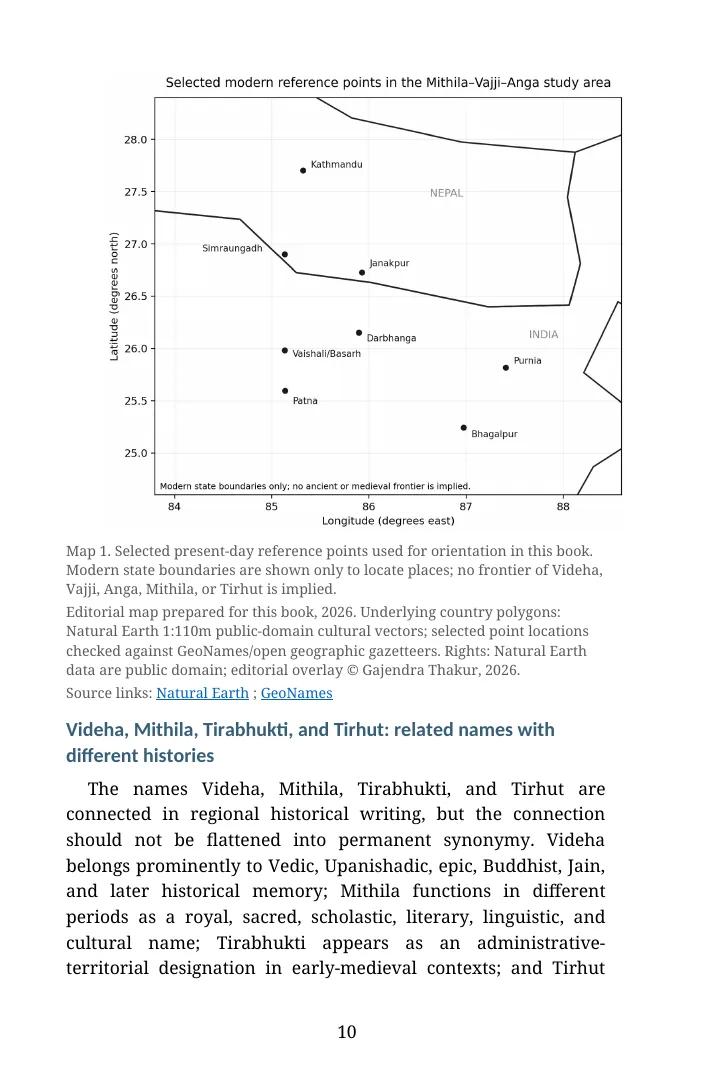
A modern border across an older cultural region

The India–Nepal boundary formalizes political jurisdictions while Maithil networks continue across the Tarai and Bihar.

Editorial note: Entries are concise research signposts. Each should be expanded with citations, competing interpretations, and confidence notes as the archive grows.

CONNECTED GEOGRAPHIES

Before the border,
beyond the border

01

North Bihar

Darbhanga, Madhubani, Sitamarhi, Muzaffarpur, Vaishali, Bhagalpur, and adjoining districts hold distinct layers of the archive.

02

Nepal Tarai

Janakpur and the wider Madhesh are integral to the historical and living geography of Mithila, not a peripheral appendix.

03

Eastern corridors

The Ganga, Kosi, Gandak, and their routes connect courts, monasteries, settlements, and trading centers across the region.

Research principle

Modern boundaries are essential context, but they should not be projected unchanged onto ancient or medieval political and cultural landscapes.

SOURCE ROOM

Claims with a visible trail

A durable historical resource distinguishes source type, date, textual layer, provenance, scholarly interpretation, and uncertainty.

Primary traditions

Vedic, Buddhist, Jain, and epic corpora

Read as layered textual traditions whose composition, transmission, and geography require separate evaluation.

01
Material record

Archaeology, inscriptions, coins, and sites

Use dated material evidence to test, refine, or limit narratives derived from texts and later chronicles.

02
Modern scholarship

Critical editions and historical studies

Record edition, translation, argument, and historiographic context so that every claim remains traceable.

03

BIBLIOGRAPHY FRAMEWORK

Built for citations, not just reading lists

  • Primary source or artefact
  • Edition, translation, or catalogue
  • Modern scholarly discussion
  • Archive note and confidence level
Continue research at Videha

CUMULATIVE HISTORICAL VOLUMES

A shelf designed to grow

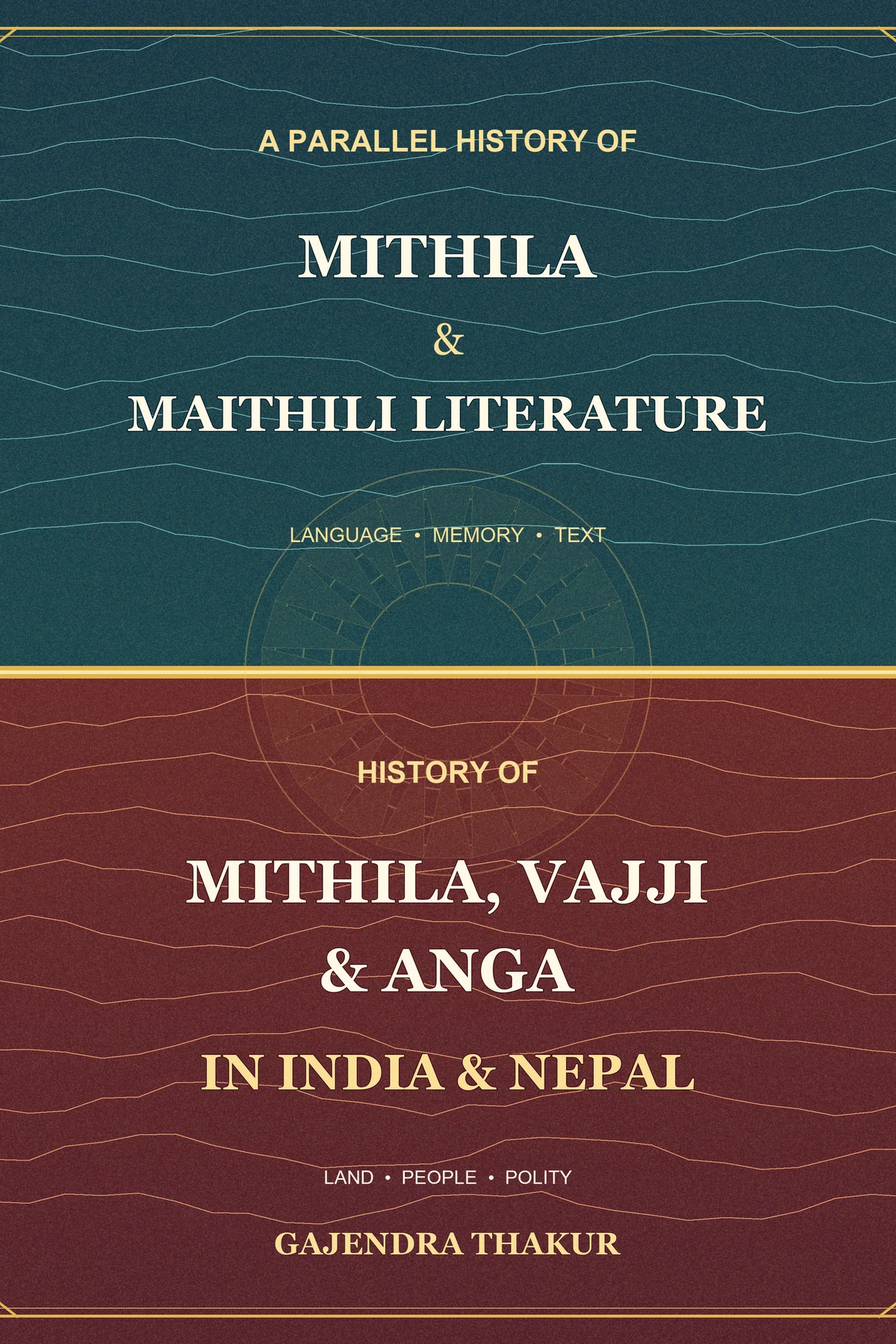
The 2026 edition is a five-volume sequence covering the region from prehistory to the contemporary period through a source-controlled method.

2026 · FIVE-VOLUME WORK

History of Mithila, Vajji & Anga
in India & Nepal

From Prehistory to the Contemporary Period
Author
Gajendra Thakur
Extent
28 chapters · 698-page edition
Research home
Videha eJournal · ISSN 2229-547X

The work separates archaeological, philological, archival, environmental, linguistic, and institutional evidence according to what each source can establish.

VOLUME I · pp. 1–66

Prehistory and Protohistory

Chapters 1–4
  • Archaeology
  • Food production
  • Iron-using horizons
  • Environment & settlement

VOLUME II · pp. 67–203

Ancient Mithila, Vajji and Anga

Chapters 5–11
  • Videha & Janaka
  • Vajji & Vaishali
  • Anga & Champa
  • Licchavi Nepal

VOLUME III · pp. 204–322

Medieval Period

Chapters 12–16
  • Tirabhukti
  • Karnatas & Simraongarh
  • Oiniwar rule
  • Two Vidyapatis

VOLUME IV · pp. 323–441

Modern Period

Chapters 17–21
  • Darbhanga Raj
  • Agrarian society
  • Print & nationalism
  • Nepal Tarai to 1951

VOLUME V · pp. 442–616

Contemporary Period

Chapters 22–28
  • India–Nepal borderland
  • Maithili & Angika
  • Kosi & Madhesh
  • Connected histories

RESEARCH APPARATUS

Navigate the evidence

  • Consolidated chronologyfrom p. 617
  • Glossary & place-name concordancefrom p. 635
  • General source registerfrom p. 654
  • Indexfrom p. 679
Read the source method

NEW TO THE RESEARCH SHELF · VOLUME II

Socio-Cultural-Economic History

From Prehistory to the Contemporary Period

A companion to the political and connected-history work, centred on how people lived, produced, exchanged, worshipped, learned, migrated, created, and negotiated hierarchy and ecological risk across Mithila, Vajji and Anga in India and Nepal.

Completed25 chapters
Approved plan150 chapters
Current file364 pages
Planned extent900–1,200 pages
Chapters 1–25 contain full text and chapter bibliographies. Chapters 26–150 are plan entries, not completed chapters.

COMPLETED PARTS IN THE CURRENT CUMULATIVE MANUSCRIPT

Part I
Chapters 1–5

Land, environment and human landscapes

Physical foundations · settlement · subsistence · food · mobility

Part II
Chapters 6–18

Early historic society

Videha, Vajji and Anga · households · economy · learning · health

Part III
Chapters 19–25

Religion, ritual and cultural formation

Vedic landscapes · Buddhism · Jainism · sacred geography · life-cycle rites

Governing method

Historical-geographical names are treated as overlapping, changing frames. Archaeological, textual, material, archival, oral, ethnographic, and statistical evidence is matched to period and claim type; mythology, memory, ritual tradition, and administrative evidence remain analytically distinct.

ABOUT THE PROJECT

Videha identity, researched with breadth and care.

This portal is conceived as part of the wider Videha historical research ecosystem: regionally rooted, cross-border in scope, and transparent about the difference between evidence, tradition, and interpretation.

Visit videha.co.in