Decoding the Panji of Mithila · Volume II · Chapter 17
Village Clusters and Migration
Chapter 17
  Village Clusters and Migration

1. Why Village Clusters Need Separate Study
   The previous chapter explained the village universe of
Prachin Panji. This chapter moves one step further. It asks how
villages are grouped, how branches spread across them, and
how migration or settlement movement may be detected
without inventing a story that the source does not support.
  The Panji is full of village clusters. A cluster may begin with
अथ and end with एते. It may include several branch names,
several settlements, several वासी entries, and several places
joined by समेत, ओ, dash, or सँ. These clusters are not random
lists. They are organized memories of relation between houses
and places.
   Migration is one possible meaning of such clustering, but it
is not the only meaning. A cluster may show branch dispersal,
residence, marriage connection, maternal link, scholarly
association, or register grouping. The decoder must therefore
read clusters critically.

2. What Is a Village Cluster?
  A village cluster is a group of entries organized around a
place-frame or closed by a place formula. It may be introduced
by अथ + village-name. It may be closed by एते + village-name. It
may also appear through repeated connected place names
without an explicit closure.
  A cluster should be treated as a unit of analysis. The persons
inside it, the relation words, titles, numbers, and secondary
place links should be studied together. If the decoder extracts
only isolated names, the cluster meaning disappears.

                  Decoding the Panji of Mithila - Volume II

  Data rule: every cluster should receive a cluster identifier,
such as Cluster Sarisab-1 or Cluster Gangoli-1.
  Critical caution: do not assume that a cluster is equal to a
modern administrative village. It may represent a historical
register unit.

3. अथ as Cluster Opener

  The word अथ often opens a new cluster. When the source
says अथ सरिसब ग्राम, अथ जजिबाल ग्राम, अथ दरिहरा ग्राम, or similar forms,
the reader should treat the following entries as belonging
under a new geographical frame until another transition
appears.
  This does not always mean that every person in the cluster
originated in that village. The cluster frame may organize
branches associated with the village. Some may be residents;
some may be descendants; some may be linked through
marriage; some may be included settlements.
  Data rule: when अथ + ग्राम appears, begin a new cluster row in
the gazetteer.
  Critical caution: the opener gives a frame, not a complete
explanation of each place relation inside the frame.

4. एते as Cluster Closure

  The word एते often closes a cluster. A phrase such as एते गंगोली
ग्राम or एते सकराढ़ी ग्राम gathers the preceding material into a village
unit. This is one of the strongest signs of clustering in the
source.
   The difficulty is boundary. The closure appears at the end,
but the beginning must be found. The decoder should work
backward to the nearest plausible opener, transition word, or
cluster break. If the boundary remains uncertain, both strict
and wider boundaries should be recorded.

                 Decoding the Panji of Mithila - Volume II

  Data rule: every एते closure should be entered with a strict
boundary and possible wider boundary.
  Critical caution: do not let एते float unattached. It is a
structural signal.

5. समेत and Cluster Expansion

  The word समेत expands a cluster by including another place
or set of places. It tells us that the cluster is not limited to one
named settlement. The included places may be branches, sub-
villages, associated localities, or linked settlements.
  When a line says that a place occurs समेत another place, both
places belong in the cluster table. The second place is not
secondary in the sense of being optional. It is part of the
source’s geographical memory.
  Data rule: every cluster table should have an “included
places” field.
  Critical caution: dropping places after समेत creates a false
narrow village map.

6. ओ and Multi-Place Joining

  The connector ओ joins places or branches. In a village cluster
it can show that two places are linked in one entry. This link
may indicate nearby settlements, branch spread, or combined
identity.
  For example, when the source attaches a branch to two
places joined by ओ, the first reading should preserve the pair.
Only later should the decoder decide whether one is the main
branch-seat and the other a secondary settlement.
  Data rule: place pairs joined by ओ should be stored as linked
place pairs, not split into unrelated entries.

                 Decoding the Panji of Mithila - Volume II

  Critical caution: do not alphabetize away the connector. The
order and connector are part of the evidence.

7. वासी and Settlement Movement

    वासी entries can suggest movement or settlement. If a branch
is called वासी of a place different from its frame village or root
village, the source may be preserving residence outside the
original cluster. This is one of the clues to movement.
    But movement should not be asserted too quickly. वासी may
mean residence, recognized belonging, or local association. It is
evidence of settlement identity, not automatically a migration
narrative.
    Data rule: every वासी entry should be compared with frame
village, मूलग्राम, and attached branch place.

  Critical caution: say “recorded as resident/associated” unless
migration is supported by repeated evidence.

8. डीह and Old Settlement Sites

    डीह may preserve older habitation sites or ancestral seats. A
डीह inside a village cluster can reveal that the cluster has
internal settlement geography. A branch may belong to a broad
village but be identified with a specific डीह.

    This is valuable for migration study because डीह may show
continuity even when later residence changes. It may mark the
remembered seat from which a branch moved or the local base
to which it remained attached.
    Data rule: cluster tables should record डीह separately from
ग्राम.

    Critical caution: do not treat डीह as a modern administrative
village unless evidence supports it.

                 Decoding the Panji of Mithila - Volume II

9. मूलग्राम and Movement

  मूलग्राम is the clearest origin marker. When the source labels a
place as मूलग्राम, it distinguishes root from later placements. If
the same branch or related names appear elsewhere, the मूलग्राम
becomes an anchor for movement analysis.
  The method should be cautious. Start from the मूलग्राम, then
compare वासी, सन्तति-place, अपत्य-place, विवाह-place, मातृक-place, and
दौहित्र-place. A pattern may then emerge.

  Data rule: every migration hypothesis should identify
whether a मूलग्राम anchor exists.

  Critical caution: without मूलग्राम or repeated corroboration,
speak of association rather than migration.

10. पाली and Sub-Cluster Geography

  पाली often points to locality or sub-settlement identity.
Repeated पाली references may reveal internal clusters within
broader village frames. They may also show marriage or
maternal connections through smaller local units.
  A पाली reference should therefore be entered both as a place
element and as a possible sub-cluster marker. It may later help
distinguish two branches that appear under the same larger
village.
  Data rule: build a पाली index inside the village gazetteer.

  Critical caution: do not erase पाली during normalization.

11. Cluster Repetition Across the Source
  A village or cluster may appear in more than one part of the
source. Repetition may suggest continuing importance, branch
spread, later additions, or cross-reference. Repetition is one of
the most important tools for reconstructing movement.

                 Decoding the Panji of Mithila - Volume II

    If a village appears repeatedly with the same ancestor-name,
title, number, or branch marker, the likelihood of connection
increases. If the same village appears with different markers, it
may be a large social center hosting multiple unrelated or
distantly related branches.
  Data rule: every village should have an occurrence count
and a list of linked persons.
  Critical caution: repeated village name alone does not prove
the same family.

12. Branch Dispersal
   Branch dispersal occurs when descendants or associated
lines of one ancestor appear across multiple places. The Panji
may show this through सन्तति, अपत्य, वासी, समेत, or repeated village
links.
  Dispersal is not the same as migration of one individual. It
may indicate that a branch expanded, that descendants settled
in different places, or that the register grouped dispersed
houses under one remembered ancestor.
  Data rule: when one ancestor-name links to multiple places,
create a branch-dispersal map.
  Critical caution: do not convert branch dispersal into a single
migration route unless sequence evidence exists.

13. Marriage as a Cause of Cluster Links
  Some village clusters are connected through marriage rather
than migration. A house may appear linked to another village
because a daughter married there, a wife came from there, or a
daughter’s son is remembered through that place.
  This is why marriage entries, मातृक चक्र, and दौहित्र must be
considered before declaring migration. A place outside the
paternal cluster may be affinal, not residential.

                 Decoding the Panji of Mithila - Volume II

  Data rule: every possible migration link should be checked
against marriage and maternal evidence.
  Critical caution: do not mistake affinal geography for
paternal migration.

14. Scholarly and Title-Based Clusters
  Some villages may appear repeatedly with title-bearing
persons: महामहोपाध्याय, कविराज, वैयाकरण, पण्डित, ठाकु र, बाबू, or other
titles. This may reveal learned or status clusters.
    A scholarly cluster is not necessarily a migration cluster. It
may show that a village was known for a learned house or that
titled branches were preserved more carefully. Such clusters
belong to intellectual geography.
  Data rule: cluster tables should include a title-density field.
  Critical caution: do not read every cluster only through
descent. Some clusters preserve prestige networks.

15. Numbers and Cluster Reconstruction
   Numbers can help reconstruct clusters. If the same or
related numbers appear near a branch across several places,
they may support a connection. If numbers differ sharply, they
may warn against merging entries too quickly.
   The number system is not fully decoded, but its preservation
allows later comparison. A cluster table without numbers loses
this possibility.
  Data rule: include all parenthetical numbers in the cluster
table with their exact forms.
  Critical caution: do not use numbers as proof until their
function is established.

16. How to Detect Migration Carefully
  Migration should be stated only when several forms of
evidence converge. Possible evidence includes: मूलग्राम plus later

                  Decoding the Panji of Mithila - Volume II

वासी; repeated branch-name across places; सन्तति or अपत्य linked
to multiple villages; डीह and later residence; marriage and
maternal connections distinguished from residence; and
chronological or register sequence.
  A single place change is not enough. A cluster may reflect
association, inclusion, marriage, or copying order. The proper
language is important.
  Use “possibly moved,” “recorded in association with,”
“branch appears in,” or “later resident at” when evidence is
incomplete. Use “migrated” only when the structure supports
actual movement.

17. The Cluster-Migration Table
  A cluster-migration table should include: cluster identifier;
opening formula; closure formula; frame village; included
places; branch names; relation words; वासी entries; डीह entries;
मूलग्राम entries; पाली entries; marriage links; maternal links; दौहित्र
links; titles; numbers; repeated occurrences; probable function;
and confidence level.
  This table should be linked with the person index, village
gazetteer, title index, marriage table, maternal-cycle table, and
number table.

18. Critical Analysis: What Clusters Reveal
   Village clusters reveal how Mithila’s society organized
memory geographically. A family was not merely one
household in one place. It could be a remembered branch
spread across settlements, attached to a root village, resident
elsewhere, tied to another village by marriage, and recognized
through titles.
  The cluster form also shows that the Panji is a record of
networks. It records social geography as a living system: roots,
seats, residences, alliances, scholarly centers, and regional

                  Decoding the Panji of Mithila - Volume II

groupings. Migration is one thread in this system, but not the
only thread.
  The critical task is therefore to let the cluster remain
complex. A cluster is not simply a map point. It is a social unit.

19. Common Errors in Reading Village Clusters
  The common errors are: treating cluster headings as
decorative; ignoring एते closures; dropping places after समेत;
splitting linked place pairs without recording the connector;
reading every वासी as migration; reading every affinal village as
residence; erasing पाली; confusing डीह with ग्राम; merging
repeated village names without person                         evidence;   and
narrating migration before proving it.

20. Rules for Village Clusters and Migration
  First, identify the opener and closure.
  Second, preserve all included places.
  Third, distinguish frame village, branch-seat, residence, डीह,
मूलग्राम, पाली, maternal place, and affinal place.

  Fourth, treat वासी as residence or association, not automatic
migration.
  Fifth, use मूलग्राम as an origin anchor where present.

  Sixth, compare repeated occurrences across the source.
   Seventh, check marriage and maternal evidence before
stating migration.
  Eighth, keep titles and numbers in the cluster table.
  Ninth, use confidence levels.
  Tenth, do not simplify clusters into single-point geography.

                 Decoding the Panji of Mithila - Volume II

21. Conclusion: Movement Without Guesswork
  Village clusters and migration clues are among the richest
parts of the Panji. They show how branches spread, how
houses settled, how villages included smaller localities, how
marriages connected distant places, and how titles attached
scholarly memory to geography.
  But this richness must be handled with discipline. The
decoder must not turn every multi-place entry into migration.
The Panji gives evidence; the editor must preserve the evidence
before telling the story.
   Chapter 18 will continue the geographical analysis by
studying डीह, वासी, मूलग्राम, and local identity in more detail. That
chapter will show how settlement words preserve the
difference between root, residence, seat, and social belonging.

                 Decoding the Panji of Mithila - Volume II
Source structure and verification apparatus
Editorial source apparatus. This apparatus is descriptive, not interpretive. It records the source-controlled structure used to verify that this page corresponds to formal Chapter 17 of Decoding the Panji of Mithila — Volume II. The chapter text above is preserved from PDF pp. 196-206; formal Chapter 17 in the commit-pinned authoritative source. It is not merged with a neighboring chapter, appendix, annexure, or independent front/back-matter unit. The internal headings below come from the repository’s source-heading inventory and are retained as navigational and audit evidence; showing them here does not turn those headings into separate publications or add claims that are absent from the source.
Internal source headings
No subordinate heading was separately encoded in the repository source-heading inventory for this chapter.
Source-text concordance
Village · Clusters · Migration · Need · Separate · Study · previous · explained · universe · Prachin · moves · step · asks · villages · grouped · branches · spread · across · settlement · movement · detected · without · inventing · story · support · full · cluster · begin · include · several · branch · names · settlements · entries · places · joined · dash · random · lists · organized · memories · relation · houses · possible · meaning · clustering · show · dispersal · residence · marriage · connection · maternal · link · scholarly · association · register · grouping · decoder · must · therefore · read · critically · group · around · place-frame · closed · place · formula · introduced · village-name · appear · repeated · connected · explicit · closure · treated · unit · analysis · persons · inside
Boundary verification. In the formal sequence this chapter follows Volume II Chapter 16, “The Village Universe of Prachin Panji” and precedes Volume II Chapter 18, “डीह, वासी, मूलग्राम, and Local Identity”. The chapter extractor begins at the verified formal Chapter 17 marker and stops at the next verified formal chapter marker; for a final chapter it stops before recognized book-level back matter. The concordance above is generated only from distinct terms already present in this chapter’s preserved source text. It is provided for discovery, comparison, and audit, not as an automated judgment about persons, lineages, status, kinship, marriage eligibility, or historical truth.
Illustrated research apparatus
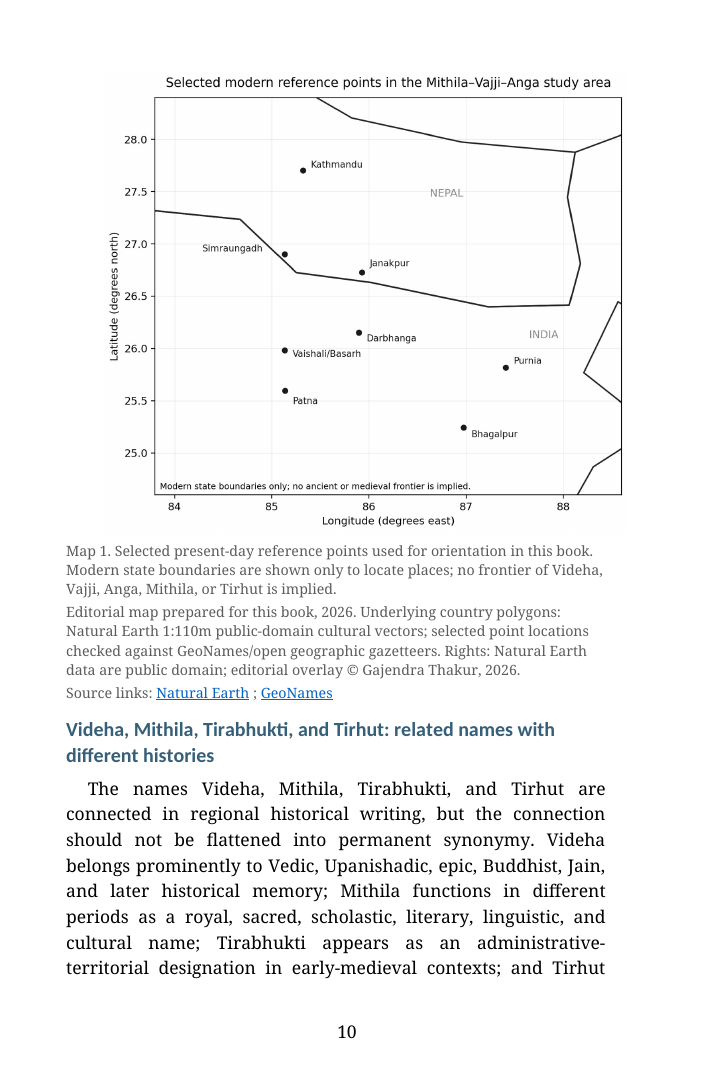
Mithila · Vajji · Anga
Chapter-specific source notes
- Primary chapter witness. Gajendra Thakur, Decoding the Panji of Mithila — Volume II, formal Chapter 17, PDF pp. 196-206; formal Chapter 17. The HTML transcription is generated from the commit-pinned source PDF and retains the chapter boundary recorded in this edition.
- Internal structure. The repository source-heading inventory records no separately encoded subordinate heading for this chapter.
- Digital editorial method. The page keeps the preserved source text distinct from generated navigational, concordance, visual, and provenance apparatus. The synthetic reconstruction is explanatory only and is not evidence for an individual lineage or a determination of social or marital status.