Decoding the Panji of Mithila · Volume II · Chapter 19
Scholars, Poets, Priests, and Specialists
Chapter 19

 Scholars,                 Poets,              Priests,         and
Specialists
1. Why the Panji Is an Intellectual Archive
   Prachin Panji is not only a record of descent, marriage, and
village identity. It is also an intellectual archive. Hidden inside
its compressed entries are scholars, poets, ritual experts,
grammarians, jurists, astrologers, teachers, title-bearing
houses, and specialists whose memory was preserved because
learning itself was part of family identity in Mithila.
  This is why titles such as महामहोपाध्याय, महो, म. म., म.म.उ., कविराज,
वैयाकरण, पण्डित, अग्निहोत्रिक, धर्माधिकारणिक, and related forms must not
be treated as decoration. They are clues to the intellectual
history of the region. A genealogy that omits them becomes
only a list of bodies. The Panji records bodies, houses, villages,
marriages, and minds.
   The purpose of this chapter is to show how scholarly,
literary, priestly, and specialist identities are preserved in the
Panji and how they should be extracted without losing their
connection to lineage and place.

2. Title as Evidence of Learning
   A title in the Panji is evidence. It may indicate recognized
scholarship, ritual authority, poetic accomplishment, legal-
religious function, or social rank. The same name without title
and with title may not carry the same historical meaning. A

                  Decoding the Panji of Mithila - Volume II

title can distinguish one person from another and can identify
a learned branch.
  For example, a person marked महामहोपाध्याय or म. म. stands in a
learned-title environment. A person marked वैयाकरण belongs to
grammatical learning. A कविराज or कवि opens a literary line of
inquiry. An अग्निहोत्रिक points toward ritual practice. A धर्माधिकारी or
धर्माधिकारणिक points toward legal-ritual authority.

   Data rule: every title must be entered as a separate data
element, not absorbed into the personal name.
  Critical caution: do not translate a title and then discard the
original. The original title is the evidence.

3. महामहोपाध्याय, महामहो, महो, and म. म.

  The महामहोपाध्याय family of titles is among the most significant
learned markers in the source. It signals high scholastic
reputation. Shortened forms such as महामहो, महो, म. म., and related
abbreviations may belong to the same title environment,
though each occurrence must be preserved exactly as written.
    Such titles help identify scholarly houses. If the same village
or branch repeatedly contains persons marked by these forms,
the place may have been a center of learned memory. If the
title appears across generations, the branch may have carried
intellectual prestige over time.
  Data rule: normalize these forms under a learned-title
category while preserving the exact source form in every
entry.
  Critical caution: महो, महामहो, म. म., and म.म.उ. should not be
collapsed into one form in the source layer. Their differences
may later prove important.

                 Decoding the Panji of Mithila - Volume II

4. वैयाकरण and the Grammar Tradition

  वैयाकरण means grammarian. In Mithila, grammar was not a
small technical subject. It belonged to the larger world of
Sanskrit learning, textual interpretation, ritual correctness,
and scholastic debate. A person marked वैयाकरण should
therefore be indexed as a specialist, not merely translated and
forgotten.
  When वैयाकरण appears inside a dense genealogical passage
with village links and numbers, it may help distinguish the
person from another of the same name. It may also indicate
that the branch carried a tradition of grammatical learning.
  Data rule: every वैयाकरण entry should be linked to person,
father or branch, village, number, and source location.
  Critical caution: do not detach वैयाकरण from its lineage. The
title belongs to a person within a house.

5. कवि and कविराज

  The titles कवि and कविराज preserve the literary memory of
Mithila. A कवि is not merely a name-bearing individual; the title
points toward poetic identity. A कविराज may indicate literary
distinction, learned status, or a recognized poetic house
depending on context.
   The Panji rarely pauses to narrate literary biography. It does
not need to say, “this man wrote such and such work,” in order
to be useful. The title itself is a signpost. It tells the literary
historian where to look.
  Data rule: create a literary-title index for कवि, कविराज, and
related forms.

                 Decoding the Panji of Mithila - Volume II

  Critical caution: do not dismiss a literary title because the
entry is brief. Brevity is the style of the register, not proof of
insignificance.

6. पण्डित and the Learned House

  पण्डित is a broad title, but its breadth does not make it empty.
In the Panji, पण्डित can mark a house associated with learning,
ritual competence, textual knowledge, or social authority. It
should be preserved wherever it appears.
  A पण्डित entry should be compared with other title-bearing
entries in the same village cluster. If a village contains पण्डित,
महामहोपाध्याय, वैयाकरण, and कविराज references, it may represent a
dense intellectual locality.
  Data rule: index पण्डित under learned titles and cross-link
with village clusters.
  Critical caution: do not treat commonness as insignificance.
A common learned title may still identify the social role of a
branch.

7. अग्निहोत्रिक and Ritual Specialists

  अग्निहोत्रिक points toward ritual fire practice and sacrificial
identity. Such a title is important because the Panji preserves
not only scholastic learning but ritual specialization. A ritual
specialist belonged to a house, village, and social function.
  Ritual titles may explain why a branch was remembered
with particular care. They may also show how certain families
were connected to priestly obligations or ritual prestige.
   Data rule: create a ritual-specialist title category and include
अग्निहोत्रिक and related forms.

   Critical caution: do not merge ritual titles into generic
“scholar.” Ritual identity is distinct.

                Decoding the Panji of Mithila - Volume II

8. धर्माधिकारी and Legal-Ritual Authority

  Titles such as धर्माधिकारी or धर्माधिकारणिक suggest authority in
dharma, social judgment, ritual law, or learned office. In a
marriage-regulating society, such authority mattered. A house
carrying this title may have had recognized power in matters
of rule, custom, or interpretation.
 Such titles should be treated as institutional evidence. They
may reveal the legal-religious side of Mithila’s social structure.
  Data rule: index dharma-authority titles separately from
general learned titles.
  Critical caution: do not reduce these titles to mere honorifics.
They may preserve public authority.

9. ज्योतिर्विद and Calendar Specialists

  Jyotisha-related titles point toward expertise in time,
calendar, astrology, astronomy, or ritual calculation. This
expertise was socially important because marriage, ritual, and
auspicious timing depended on calculation.
  If a jyotisha-related title appears near marriage entries, date
phrases, or title-bearing houses, it should be studied closely. It
may reveal the families that supplied calendrical knowledge to
society.
  Data rule: all jyotisha-related forms should be indexed under
calendar and astrology specialists.
   Critical caution: do not force one modern English label onto
all jyotisha forms. Preserve the original title.

10. Priests and Ritual Houses
  The Panji also preserves priestly memory through terms
connected with पुरोहित, ritual identity, and learned Brahmanical
function. A priestly house may appear through a title, a village,
a branch marker, or a marriage connection.

                 Decoding the Panji of Mithila - Volume II

   Priestly identity is important because it often links genealogy
to ritual service. A family may be remembered not only
because of descent but because it served a particular ritual
role. Such roles could also affect marriage alliances and social
standing.
 Data rule: create a priestly-function field where the source
marks ritual service or priestly identity.
  Critical caution: do not assume all learned houses had the
same function. Priest, grammarian, poet, and dharma authority
are different categories.

11. Specialist Titles and Local Geography
  Every specialist title should be read geographically. A
scholar is not only a scholar; he belongs to a village, डीह, वासी-
place, मूलग्राम, or branch cluster. The title and place together
create intellectual geography.
  A village with multiple learned persons may be a center of
scholastic memory. A title that appears in several villages may
show branch dispersal or the spread of a learned house. A title
in a marriage entry may show alliance between prestigious
families.
  Data rule: the title index must be linked to the village
gazetteer.
  Critical caution: a title without place is incomplete in Panji
analysis.

12. Specialist Titles and Lineage
    A title also belongs to lineage. It may be inherited as prestige,
repeated across generations, or attached to one exceptional
individual. The decoder must therefore examine whether a
title appears once or across several related persons.
  If several generations of one branch carry learned titles, the
branch may represent a scholarly lineage. If only one person

                Decoding the Panji of Mithila - Volume II

carries the title, the title may identify an individual
achievement. Both are important, but they are different.
  Data rule: record title frequency within each branch.
    Critical caution: do not infer hereditary learning from one
titled person alone.

13. Specialists in Marriage Networks
   Scholarly and priestly titles also appear in marriage
contexts. This matters because marriage could join learned
houses. A marriage involving a title-bearing branch may
preserve alliance between intellectual families, ritual houses,
or status groups.
  The title must therefore remain in the marriage table. If the
spouse-side or affinal village is known, the alliance can be
mapped as part of intellectual social history.
  Data rule: every marriage record with a title-bearing person
should be cross-linked to the title index.
  Critical caution: do not strip titles from marriage records for
simplicity.

14. Titles and Numbers
   Numbers near titles may identify the person, branch,
marriage, note, or source location. They are especially useful
when names repeat. A titled person with a number is easier to
distinguish than a name alone.
    The number should be preserved beside the title. If the same
title-name-number cluster appears elsewhere, it may help
confirm identity.
  Data rule: every title record must                   include   nearby
parenthetical numbers exactly as written.
  Critical caution: do not move numbers away from title-
bearing names.

                 Decoding the Panji of Mithila - Volume II

15. Titles and Abbreviations
  Many specialist identities appear in abbreviated form. The
abbreviations must be preserved before expansion. Some may
be clear, such as forms related to महामहोपाध्याय or ठाकु र. Others
may remain uncertain. An uncertain abbreviation is still data.
  The abbreviation table should include exact form, probable
expansion, title category, person, village, number, and
confidence level.
  Data rule: never expand an abbreviation silently.
  Critical caution: dots, spacing, and joined forms may matter.

16. Building the Intellectual Index
  The intellectual index should include all scholars, poets,
priests, specialists, and title-bearing persons. It should not be a
simple list of famous names. The Panji often preserves obscure
persons whose title may be historically valuable precisely
because no other source records them.
   The index should include: exact title, normalized title
category, person, father or branch, village, local marker,
number, marriage context, maternal context, source segment,
line or page, and critical note.
  Data rule: include both famous and obscure titled persons.
  Critical caution: the Panji’s value lies partly in preserving
names outside standard literary histories.

17. Critical Analysis: What the Titles Reveal
   The titles reveal that Mithila’s genealogical memory was
deeply tied to learning. Houses were not remembered only by
biological descent. They were remembered by what they did:
teaching, writing, interpreting, calculating, judging, officiating,
and performing ritual.
  This means that the Panji can support a social history of
knowledge. It can help identify learned villages, scholarly

                 Decoding the Panji of Mithila - Volume II

lineages, literary houses, priestly networks, and title-bearing
marriage alliances. It can also show how learning was
embedded in local identity and family continuity.
   The intellectual history hidden in the Panji is not written as
narrative. It is written as data. The task of the decoder is to
release that data without distorting it.

18. Common Errors in Reading Scholars and Specialists
   The common errors are: treating titles as decoration;
translating titles without preserving the original; merging
different titles into one category; separating title from village;
separating title from number; ignoring titles in marriage
entries; assuming one titled person proves a hereditary
scholarly line; ignoring obscure specialists; flattening ritual
and literary roles into generic scholarship; and failing to build
a dedicated title index.
   Each error reduces the Panji’s intellectual value. The source
is more than a family register. It is a record of Mithila’s learned
society.

19. Rules for Reading Scholars, Poets, Priests, and
Specialists
  First, preserve every title and abbreviation exactly.
  Second, classify the title by function: learned, literary, ritual,
calendrical, legal-ritual, priestly, administrative, or status.
  Third, attach the title to person, branch, village, number, and
source location.
  Fourth, preserve uncertain abbreviations without forcing
expansion.
   Fifth, link title-bearing persons to marriage, maternal, and
village tables.
   Sixth, distinguish individual achievement from title-bearing
lineage.

                Decoding the Panji of Mithila - Volume II

  Seventh, include obscure titled persons in the index.
  Eighth, do not detach intellectual history from local
geography.
  Ninth, preserve numbers beside titles.
  Tenth, read the Panji as a hidden archive of knowledge.

20. Conclusion: Learning as Lineage Memory
   Chapter 19 shows that the Panji preserves intellectual life
inside genealogical form. Scholars, poets, priests, grammarians,
ritual specialists, and dharma authorities appear not in
separate biographies but inside family and village entries.
Their titles are the compressed signals of a learned civilization.
  To decode the Panji is therefore to recover not only descent
but knowledge. The record tells us where learning lived, which
houses carried it, which villages held it, and how it moved
through marriage and branch continuity.
   Chapter 20 will continue this work by reading the Panji as
literary history. It will examine how poetic titles, learned
names, and title-bearing houses can help reconstruct the
literary memory of Mithila.

                   Decoding the Panji of Mithila - Volume II
Source structure and verification apparatus
Editorial source apparatus. This apparatus is descriptive, not interpretive. It records the source-controlled structure used to verify that this page corresponds to formal Chapter 19 of Decoding the Panji of Mithila — Volume II. The chapter text above is preserved from PDF pp. 216-226; formal Chapter 19 in the commit-pinned authoritative source. It is not merged with a neighboring chapter, appendix, annexure, or independent front/back-matter unit. The internal headings below come from the repository’s source-heading inventory and are retained as navigational and audit evidence; showing them here does not turn those headings into separate publications or add claims that are absent from the source.
Internal source headings
- 1. Why the Panji Is an Intellectual Archive
- 2. Title as Evidence of Learning
- 3. महामहोपाध्याय, महामहो, महो, and म. म.
- 4. वैयाकरण and the Grammar Tradition
- 5. कवि and कविराज
- 6. पण्डित and the Learned House
- 7. अग्निहोत्रिक and Ritual Specialists
- 8. धर्माधिकारी and Legal-Ritual Authority
- 9. ज्योतिर्विद and Calendar Specialists
- 10. Priests and Ritual Houses
- 11. Specialist Titles and Local Geography
- 12. Specialist Titles and Lineage
- 13. Specialists in Marriage Networks
- 14. Titles and Numbers
- 15. Titles and Abbreviations
- 16. Building the Intellectual Index
- 17. Critical Analysis: What the Titles Reveal
- 18. Common Errors in Reading Scholars and Specialists
- 19. Rules for Reading Scholars, Poets, Priests, and Specialists
- 20. Conclusion: Learning as Lineage Memory
Source-text concordance
Scholars · Poets · Priests · Specialists · Intellectual · Archive · Prachin · record · descent · marriage · village · identity · Hidden · inside · compressed · entries · ritual · experts · grammarians · jurists · astrologers · teachers · title-bearing · houses · whose · memory · preserved · learning · part · family · titles · related · forms · must · treated · decoration · clues · history · region · genealogy · omits · becomes · list · bodies · records · villages · marriages · minds · purpose · show · scholarly · literary · priestly · specialist · identities · extracted · without · losing · connection · lineage · place · Title · Evidence · indicate · recognized · scholarship · authority · poetic · accomplishment · legal · religious · function · social · rank · name · carry · historical · meaning · Decoding · distinguish
Boundary verification. In the formal sequence this chapter follows Volume II Chapter 18, “डीह, वासी, मूलग्राम, and Local Identity” and precedes Volume II Chapter 20, “Panji as Literary History”. The chapter extractor begins at the verified formal Chapter 19 marker and stops at the next verified formal chapter marker; for a final chapter it stops before recognized book-level back matter. The concordance above is generated only from distinct terms already present in this chapter’s preserved source text. It is provided for discovery, comparison, and audit, not as an automated judgment about persons, lineages, status, kinship, marriage eligibility, or historical truth.
Illustrated research apparatus
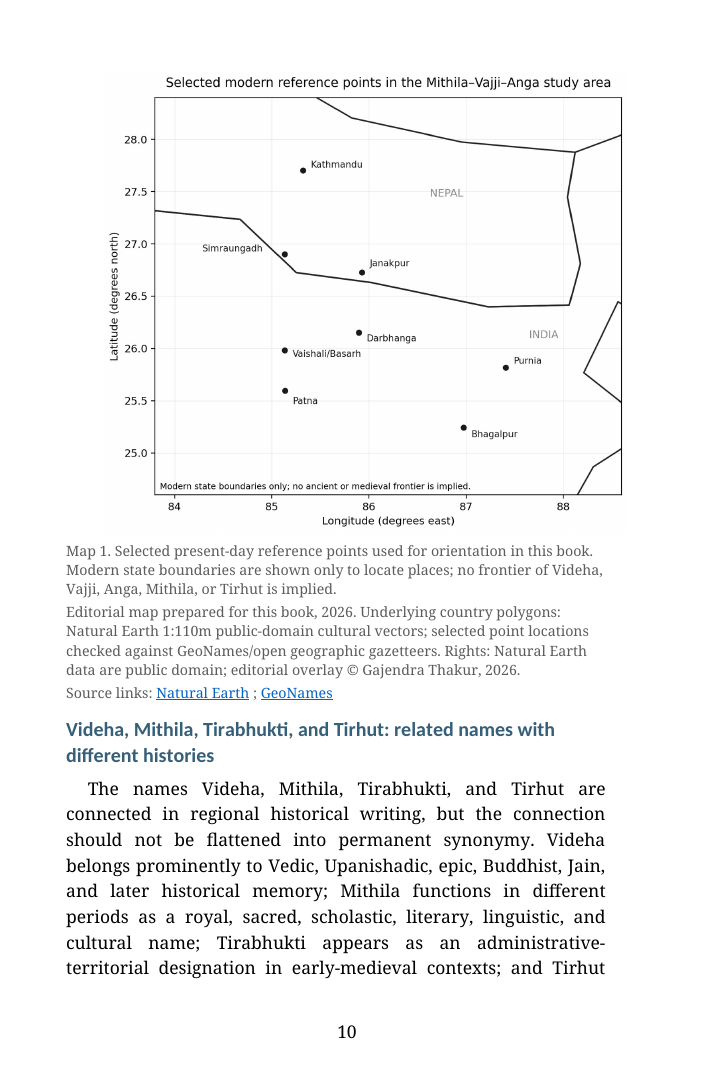
Mithila · Vajji · Anga
Chapter-specific source notes
- Primary chapter witness. Gajendra Thakur, Decoding the Panji of Mithila — Volume II, formal Chapter 19, PDF pp. 216-226; formal Chapter 19. The HTML transcription is generated from the commit-pinned source PDF and retains the chapter boundary recorded in this edition.
- Internal structure. The repository source-heading inventory records 20 subordinate headings for this chapter: “1. Why the Panji Is an Intellectual Archive”; “2. Title as Evidence of Learning”; “3. महामहोपाध्याय, महामहो, महो, and म. म.”; “4. वैयाकरण and the Grammar Tradition”; “5. कवि and कविराज”; “6. पण्डित and the Learned House”; “7. अग्निहोत्रिक and Ritual Specialists”; “8. धर्माधिकारी and Legal-Ritual Authority”; ….
- Digital editorial method. The page keeps the preserved source text distinct from generated navigational, concordance, visual, and provenance apparatus. The synthetic reconstruction is explanatory only and is not evidence for an individual lineage or a determination of social or marital status.