Decoding the Panji of Mithila · Volume II · Chapter 25
How to Decode a मातृक चक्र
Chapter                                                      25
How to Decode a मातृक चक्र

    1. Why a Maternal Cycle Needs Worked Decoding
  The earlier worked chapters showed how to decode a single
entry and a village cluster. A मातृक चक्र requires a different kind
of discipline. It is neither a simple paternal line nor a village
list. It is a maternal and affinal circuit, usually created through
marriage, daughter-line relation, and remembered connection
between houses.
  The word चक्र itself warns the reader that the structure is not
a straight line. A cycle gathers relations around the mother’s
side. It may include daughters, daughter’s sons, spouse-side
villages, paternal names, branch names, and closure formulae.
If it is read as a father-son tree, the central meaning is lost.
  This chapter demonstrates how to decode a मातृक चक्र step by
step: identify the boundary, preserve the closing formula,
locate the female link, classify villages, connect marriage
evidence, chart the daughter-line, and write a cautious
explanation.

               2. The Maternal-Cycle Formula
  The source contains repeated formulae such as एवं ... मातृक चक्र
or similar forms. Such a phrase usually closes or identifies a
maternal unit. The named person before मातृक चक्र may be the
person whose maternal circuit is being recorded, the anchor of
the cycle, or the name through which the cycle is remembered.
  The decoder should not assume the exact role too quickly.
The first step is to mark the phrase as a maternal-cycle marker
and then examine the lines before and after it. The cycle may

                 Decoding the Panji of Mithila - Volume II

begin before the closing phrase. The phrase may gather
preceding material into a maternal structure.
  Data rule: every occurrence of मातृक चक्र should open a
maternal-cycle record, even if the boundary is uncertain.
  Critical caution: do not treat मातृक चक्र as a decorative phrase.
It is a structural marker.

          3. Step One: Preserve the Exact Formula
   The exact wording must be copied first. If the source writes
मातृक चक्रं , मातृक चक्र, or uses a joined or damaged form, that form
must be preserved. If the formula begins with एवं, preserve that
too. The word एवं may show closure, gathering, or transition.

   The original formula should not be modernized in the first
layer. A normalized field can later record “maternal cycle,” but
the source field must remain exact.
  Data rule: keep two fields: original formula and normalized
category.
  Critical caution: never silently change चक्रं to चक्र in the source
layer.

               4. Step Two: Find the Boundary
  The hardest part of मातृक चक्र decoding is boundary. Where
does the cycle begin? Where does it end? The closing formula
may be clear, but the beginning may lie several relationship
units earlier. The decoder must work backward from the
formula to locate the nearest plausible start.
  Signs of boundary include विवाह, सुता, सँ, दौहित्र, अपरा, a new
village frame, a double danda, or another मातृक चक्र formula. If
the beginning remains uncertain, record both a strict boundary
and a possible wider boundary.

                Decoding the Panji of Mithila - Volume II

  Data rule: every maternal-cycle table should include
boundary confidence.
   Critical caution: do not extract only the final phrase and
ignore the relational material before it.

         5. Step Three: Identify the Anchor Person
  A maternal cycle often has an anchor person. This may be
the person named immediately before मातृक चक्र, a person whose
mother’s side is being traced, or a remembered branch figure.
The anchor must be identified carefully.
  If the phrase says एवं कमलापति मातृक चक्र, the first-pass anchor is
कमलापति. But the analysis should still ask: is कमलापति the child
whose maternal network is being described, the branch-holder,
or the closing name of a previous sequence?
  Data rule: mark anchor role as certain, probable, possible, or
uncertain.
  Critical caution: the nearest name is not always the entire
explanation of the cycle.

            6. Step Four: Locate the Female Link
  A मातृक चक्र exists because of a female link: mother, daughter,
wife, sister, or another woman through whom houses are
joined. The source may not name her. Even when unnamed,
the female link must be reconstructed structurally.
  If a daughter’s son appears, the implied daughter must be
recorded. If a marriage entry creates the connection, the wife’s
natal house must be recorded where possible. If सुता introduces
issue, the attachment must be tested.
  Data rule: include a column called “female link named or
implied.”
  Critical caution: do not erase women because their personal
names are not always supplied.

                  Decoding the Panji of Mithila - Volume II

  7. Step Five: Distinguish Paternal and Maternal Lines
  A maternal cycle may contain many male names. This can
mislead the reader into treating the passage as a paternal
genealogy. The correct method is to ask which names belong to
the paternal line and which names belong to the mother’s
house or affinal side.
  Direct terms such as सुत and पुत्र may create paternal links
inside one house. But if they appear inside the maternal-cycle
boundary, they may belong to the spouse-side or maternal-side
house. The function must be determined by context.
  Data rule: every person in a मातृक चक्र passage should have a
line-function field: paternal, maternal, affinal, daughter-line, or
uncertain.
  Critical caution: do not move all male names into the main
paternal tree.

               8. Step Six: Read सुता Carefully

  सुता is often important in maternal-cycle passages. It may
introduce children, issue, or a line through which maternal
relation is formed. In some contexts, it may signal the persons
through whom a maternal or affinal network continues.
  The decoder should not attach a सुता list mechanically to the
nearest male name. First identify the cycle boundary. Then
identify whether the list belongs to the principal house, the
maternal house, the spouse-side, or another subunit marked by
अपरा.

  Data rule: every सुता in a maternal cycle should be entered as
“issue-list in maternal context” until verified.
  Critical caution: false attachment of सुता can destroy the
maternal chart.

                Decoding the Panji of Mithila - Volume II

         9. Step Seven: Read दौहित्र Inside the Cycle

  दौहित्र is one of the strongest indicators that the passage is
crossing through a daughter. A daughter’s son belongs
structurally between two houses. In a मातृक चक्र, दौहित्र may
identify one of the key bridge persons.
  A दौहित्र entry should be charted through the daughter, even if
the daughter is unnamed. The maternal grandfather should not
be treated as the father. The father’s house and mother’s natal
house should be separated.
  Data rule: every दौहित्र inside a मातृक चक्र receives a bridge-
person row.
  Critical caution: never place a दौहित्र as direct son in the
maternal house.

 10. Step Eight: Read सँ as Maternal or Affinal Connector

  The connector सँ is especially sensitive in maternal-cycle
passages. It may indicate origin, residence, marriage link,
mother’s house, daughter’s married house, or affinal
association. In a मातृक चक्र, the first-pass reading should be
neutral: “linked with.”
   Only after the person, marriage, and daughter-line roles are
classified should the editor decide whether सँ marks maternal
house, spouse house, residence, or another function.
  Data rule: use a connector-function field for every सँ in the
cycle.
  Critical caution: do not translate सँ simply as “from” in
maternal passages.

                  Decoding the Panji of Mithila - Volume II

        11. Step Nine: Classify Villages in the Cycle
  A maternal cycle may contain many villages. Some may
belong to the principal paternal house. Some may belong to the
mother’s natal house. Some may be affinal villages. Some may
be daughter-line settlements. Some may be residences or
branch-seats.
  The village table must therefore classify each place by
function. A single place may function differently in another
chapter or cluster. Do not assume that one place always has
one role.
  Data rule: every village in a मातृक चक्र should have a maternal-
place function.
  Critical caution: do not place all maternal-cycle villages into
the paternal-origin column.

         12. Step Ten: Identify Marriage Evidence
  A मातृक चक्र often depends on marriage. If a विवाह entry appears
before, inside, or near the cycle, the marriage may explain the
maternal connection. First and second marriage markers are
especially important because each marriage may produce a
different maternal network.
  The decoder should compare the maternal-cycle boundary
with nearby marriage entries. If the same village, person, title,
or number appears in both, the connection should be recorded
with confidence.
 Data rule: every maternal cycle should have a related-
marriage field.
  Critical caution: do not interpret maternal cycles without
checking nearby marriage records.

                  Decoding the Panji of Mithila - Volume II

             13. Step Eleven: Mark अपरा Subunits

  अपरा inside or near a maternal cycle may introduce another
branch, another wife-line, another daughter-line, or another
reading. It is dangerous to ignore it. A maternal cycle can
contain several subunits.
  When अपरा appears, create a provisional sub-cycle or sub-
entry. Then decide whether it belongs to the same maternal
cycle or a separate related unit.
  Data rule: अपरा creates a new subunit in the maternal-cycle
table.
  Critical caution: merging two अपरा units may create a false
mother-line.

              14. Step Twelve: Preserve Numbers
  Numbers in maternal cycles may identify persons, branches,
marriages, notes, or internal register positions. They should be
preserved exactly with their position. A number near a दौहित्र or
marriage-linked village may later help connect the maternal
cycle with another entry.
  The number should not be treated as a date unless the
source clearly supports that function.
  Data rule: every maternal-cycle number must include
number-as-written and number-position.
  Critical caution: do not drop numbers from maternal tables
because their meaning is uncertain.

                15. Step Thirteen: Include Titles
  Titles inside maternal cycles matter. A maternal or affinal
house may carry learned or social prestige. If a महामहोपाध्याय,
कविराज, वैयाकरण, ठाकु र, बाबू, or other title appears inside the cycle, it

                 Decoding the Panji of Mithila - Volume II

may show that the maternal connection also links intellectual
or status houses.
   A maternal cycle is therefore not only kinship. It may be
intellectual, social, and geographical network evidence.
  Data rule: title-bearing persons in maternal cycles should be
cross-indexed in the title index.
  Critical caution: do not assume that titles inside a maternal
passage belong to the principal paternal line.

    16. Step Fourteen: Build the Maternal-Cycle Table
   A full maternal-cycle table should include: original formula;
normalized formula; anchor person; anchor-role confidence;
strict boundary; wider boundary; female link named or
implied; marriage evidence; person names; line function; सुता
list; दौहित्र bridge; villages; connector सँ function; अपरा subunit;
titles; numbers; source location; related paternal branch;
related marriage event; related village cluster; and critical
note.
  The table should be relational. It should connect to the
person index, village gazetteer, marriage table, daughter’s-son
table, title index, and number table.
  Data rule: do not put maternal-cycle data into only one prose
paragraph.
  Critical caution: a maternal cycle is too complex for a flat list.

     17. Step Fifteen: Draw the Maternal-Cycle Chart
  The chart should not be a simple vertical family tree. It
should show at least two houses: the principal house and the
maternal or affinal house. The female link should stand
between them, named if named and unnamed if implied. A
daughter’s son should be placed below the daughter and
connected to both houses as a bridge.

                 Decoding the Panji of Mithila - Volume II

   Villages should be attached to the correct house or relation.
If uncertain, use dotted or provisional lines. If a second
marriage creates a second maternal link, draw a separate
marriage node.
   Data rule: chart maternal cycles as networks, not straight
lines.
   Critical caution: a clean tree can be wrong if the source gives
a cycle.

  18. Step Sixteen: Write a Cautious Prose Explanation
  After the table and chart, the editor may write a prose
explanation. A safe explanation might say:
  “The passage closes with a मातृक चक्र formula, indicating that
the preceding units belong to a maternal or affinal circuit. The
anchor person is probably the named figure before the
formula. Several persons and villages must be separated by
line function. The presence of सुता, दौहित्र, and सँ suggests crossing
through a female link. The exact female link may be unnamed
and should be marked as implied. The cycle should be charted
as a two-house network, not as a direct paternal descent.”
  Data rule: prose should explain the table, not replace it.
   Critical caution: do not narrate the maternal cycle as if every
link were certain.

         19. Step Seventeen: Write the Critical Note
  Every मातृक चक्र should end with a critical note. The note
should state what is certain, what is probable, and what
remains uncertain. It should also warn against common
misreadings.
  A good critical note may say:
   “The formula confirms a maternal-cycle context. The anchor
is probable but the full boundary requires comparison with the

                Decoding the Panji of Mithila - Volume II

preceding marriage and सुता entries. Villages inside the cycle
cannot be treated as paternal origins without further evidence.
Daughter-line and affinal roles must remain visible.”
  Data rule: every maternal-cycle record needs a critical note.
  Critical caution: the critical note is where uncertainty is
preserved for future work.

   20. Critical Analysis: What Maternal-Cycle Decoding
                           Reveals
  A मातृक चक्र reveals that the Panji’s social memory is not
confined to fathers and sons. It shows how houses are joined
through women, how maternal villages remain important, how
daughter’s sons create bridges, and how marriage continues to
shape memory after the wedding event.
  It also reveals the Panji’s sophistication. The register knew
that social structure required more than descent. It preserved
cycles because marriage regulation and kinship memory
depended on them.
  The maternal cycle is therefore one of the strongest proofs
that the Panji is a network archive.

         21. Common Errors in Decoding मातृक चक्र

  The common errors are: treating मातृक चक्र as an ornamental
closing phrase; failing to find the boundary; assuming the
nearest male name explains the whole cycle; erasing the
unnamed female link; reading दौहित्र as ordinary son; translating
सँ as simple origin; assigning all villages to the paternal line;
ignoring विवाह evidence; merging अपरा subunits; dropping titles
and numbers; and drawing a straight tree where the source
gives a circuit.

                 Decoding the Panji of Mithila - Volume II

              22. Rules for Decoding a मातृक चक्र

  First, preserve the exact formula.
  Second, identify strict and possible wider boundaries.
  Third, mark the anchor person and confidence.
  Fourth, locate the named or implied female link.
  Fifth, separate paternal, maternal, affinal, and daughter-line
functions.
  Sixth, treat सुता and दौहित्र with special care.

  Seventh, read सँ neutrally until its function is clear.

  Eighth, classify every village by role.
  Ninth, cross-link with विवाह entries.

  Tenth, draw a network chart, not a simple tree.

       23. Conclusion: Reading the Circle Correctly
  A मातृक चक्र is a circle of remembered relation. It records the
social consequences of marriage, motherhood, daughters, and
daughter’s sons. It places women at the structural center even
when their personal names are not always supplied.
   To decode it correctly, the editor must resist the habit of
straight-line genealogy. The cycle must remain a cycle: a
network of houses, villages, marriages, and maternal links.
  Chapter 26 will continue the worked-decoding section by
examining how to decode a विवाह entry. That chapter will show
how to separate marriage event, date phrase, spouse-side
village, title, number, and issue assignment.

                 Decoding the Panji of Mithila - Volume II
Source structure and verification apparatus
Editorial source apparatus. This apparatus is descriptive, not interpretive. It records the source-controlled structure used to verify that this page corresponds to formal Chapter 25 of Decoding the Panji of Mithila — Volume II. The chapter text above is preserved from PDF pp. 281-292; formal Chapter 25 in the commit-pinned authoritative source. It is not merged with a neighboring chapter, appendix, annexure, or independent front/back-matter unit. The internal headings below come from the repository’s source-heading inventory and are retained as navigational and audit evidence; showing them here does not turn those headings into separate publications or add claims that are absent from the source.
Internal source headings
No subordinate heading was separately encoded in the repository source-heading inventory for this chapter.
Source-text concordance
Decode · Maternal · Cycle · Needs · Worked · Decoding · earlier · chapters · showed · single · entry · village · cluster · requires · different · kind · discipline · neither · simple · paternal · line · list · affinal · circuit · usually · created · marriage · daughter-line · relation · remembered · connection · houses · word · warns · reader · structure · straight · gathers · relations · around · mother’s · side · include · daughters · daughter’s · sons · spouse-side · villages · names · branch · closure · formulae · read · father-son · tree · central · meaning · lost · demonstrates · step · identify · boundary · preserve · closing · formula · locate · female · link · classify · connect · evidence · chart · write · cautious · explanation · Maternal-Cycle · contains · repeated · similar · forms
Boundary verification. In the formal sequence this chapter follows Volume II Chapter 24, “How to Decode a Village Cluster” and precedes Volume II Chapter 26, “How to Decode a Marriage Entry”. The chapter extractor begins at the verified formal Chapter 25 marker and stops at the next verified formal chapter marker; for a final chapter it stops before recognized book-level back matter. The concordance above is generated only from distinct terms already present in this chapter’s preserved source text. It is provided for discovery, comparison, and audit, not as an automated judgment about persons, lineages, status, kinship, marriage eligibility, or historical truth.
Illustrated research apparatus
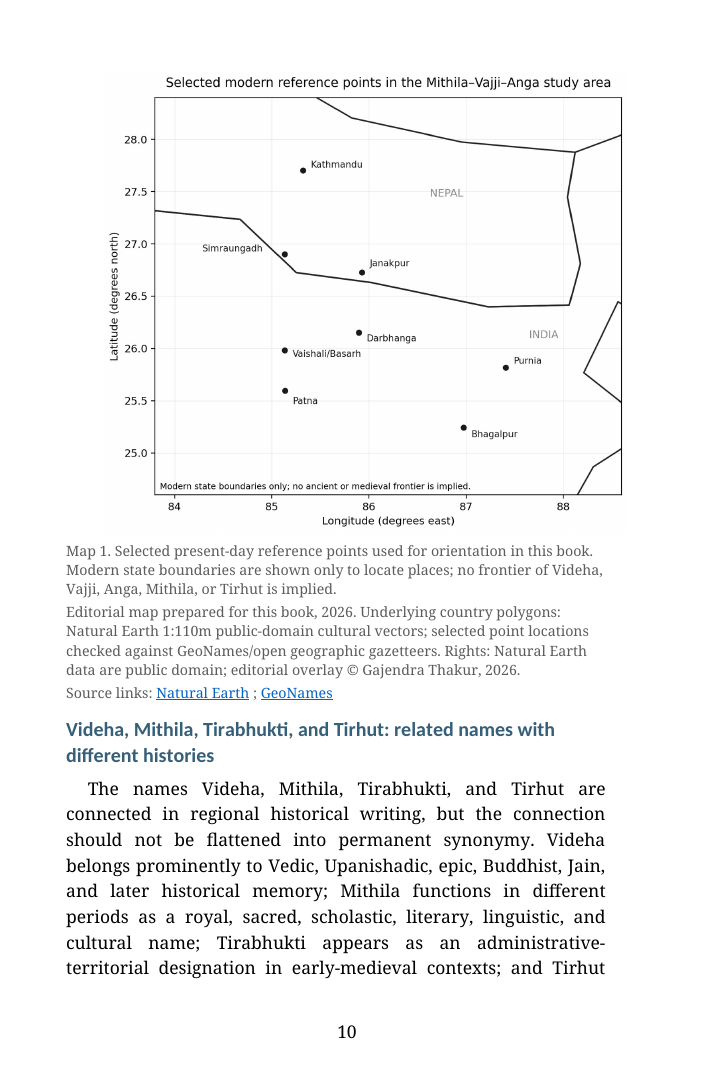
Mithila · Vajji · Anga
Chapter-specific source notes
- Primary chapter witness. Gajendra Thakur, Decoding the Panji of Mithila — Volume II, formal Chapter 25, PDF pp. 281-292; formal Chapter 25. The HTML transcription is generated from the commit-pinned source PDF and retains the chapter boundary recorded in this edition.
- Internal structure. The repository source-heading inventory records no separately encoded subordinate heading for this chapter.
- Digital editorial method. The page keeps the preserved source text distinct from generated navigational, concordance, visual, and provenance apparatus. The synthetic reconstruction is explanatory only and is not evidence for an individual lineage or a determination of social or marital status.