Decoding the Panji of Mithila · Volume IV · Chapter 19
Khangur, Khojpur, Pilkhwar, Kailakh, and the Transition to Sakuri
Chapter 19
Khangur, Khojpur, Pilkhwar, Kailakh, and the
Transition to Sakuri
  This chapter continues the exclusive coverage of the
Khangur section after the Saurath and suspended Khangur
material treated in the previous chapter. The source sequence
covered here is confined to entries (49) to (54). It begins with
the heading “Khangur Khojpur Kamalakant Jha” and its
Kailakh association; passes through an explicitly empty entry;
resumes with Khangur to Pilkhwar in the Krishnamohan and
Sukh Sena lines; then moves to Khangur to Kailakh under
Bhup Jha; records another empty entry; and finally turns to
the next major Sarisab-linked branch, “Sakuri to Rashadh,
Rudradhar Jha.” This is therefore not a general chapter on
Khangur as a whole, but a precise bridge chapter: it closes one
Khangur subdivision and opens the Sakuri subdivision.
  1. Source span and chapter boundary

   The boundary of this chapter is important because the
Khangur material is long and internally segmented. Entries
(49) to (53) remain within the Khangur field, while entry (54)
introduces Sakuri as a new Sarisab-associated branch. The
chapter is deliberately restricted to this span so that the
decoding remains sequential and auditable. Entry (49) is
headed through Khangur, Khojpur, Kamalakant Jha, and
Kailakh; entry (50) is recorded as empty; entry (51) gives
Khangur to Pilkhwar with Krishnamohan and related persons;
entry (52) gives Khangur to Kailakh under Bhup Jha; entry (53)
is again empty; and entry (54) begins “Sakuri to Rashadh,
Rudradhar Jha.”
  This arrangement shows the compiler’s habit of preserving
sectional gaps instead of smoothing them over. The empty
entries are part of the record. They act as placeholders for
known but unavailable, lost, or unfilled genealogical material.
A modern editor should therefore not delete them, merge
them into surrounding entries, or treat them as typographical
accidents. Their presence marks the archival shape of the
Panji.
  2. Entry (49): Khangur, Khojpur, Kamalakant Jha, and
Kailakh
   Entry (49) opens with Khangur and Khojpur, naming
Kamalakant Jha and linking the cluster to Kailakh. The entry
begins with Indramani and then branches through Ghoghi,
Ramji, Damodar, Jayakant, Lakshmikant, Kamalakant,
Harshadatta, Bhairavadatta, Hally, Narayanadatta, Feku,
Kapileshwar, Divakant, Harikant, and related descendants.
The repeated village references are not incidental. They
include Sakararhi, Karmaha, Darihara, Khoa l, Pabouli, Ghusa
ut, Ali/Ala, Soderpur, Pali, Belounch, Jajiwal, Satlakha, and
Takwal. This is a typical Panji pattern: one named line is made

legible through a lattice of moolgram and marriage-route
markers.
   The Kamalakant section is genealogically dense because it
carries both a named person and a place transition.
Kamalakant is not merely an individual in the entry; he
becomes a point through which Khojpur, Kailakh, and the
Khangur-Sarisab framework are connected. Ghoghi appears as
an earlier branch-holder; Kamalakant is placed under Ghoghi;
Kamalakant then gives rise to further relations through
Darihara and Ghusa ut. The entry does not use a modern
diagram, but its logic is diagrammatic. The reader must move
from father to son, from son to affiliated village, from village
to another lineage-contact, and then back to the next named
branch.
   Harshadatta’s line is especially useful for decoding because
it lists Bhairavadatta, Hally, and Narayanadatta, after which
the branches unfold separately. Bhairavadatta leads toward
Shridatta and Vilat; Hally is connected through Karmaha;
Narayanadatta leads toward Feku and Kapileshwar. Feku then
produces Vishwanath, while Kapileshwar produces Divakant
and Harikant. The editorial lesson is that names placed side by
side in the source are not always equal in genealogical level.
Some are brothers, some are sons, some are sub-branches, and
some are route-linked descendants. The term-by-term
decoding must therefore follow the sequence of relation
markers rather than the visual length of the line.
  3. Entry (50): the empty marker
  Entry (50) is explicitly marked as empty. It carries the
number and the section sign but no developed lineage. In the
index-based method, this entry must still be counted. Its
function is to preserve the numerical order between the
Kamalakant-Khojpur-Kailakh cluster and the subsequent
Khangur-Pilkhwar entry. The empty marker may indicate that

the compiler expected a branch to be inserted here, or that the
manuscript tradition from which the copy was made
contained a numbered space without surviving detail. The
safest treatment is to record the entry as a deliberate blank
and not to absorb it into entry (49) or entry (51).
  4. Entry (51): Khangur to Pilkhwar, Krishnamohan, Sukh
Sena, and the Mohan series
   Entry (51) returns to active genealogy with the heading
“Khangur to Pilkhwar,” naming Krishnamohan and related
persons, along with Sukh Sena and Suryamohan. The entry
begins with Harikant and Vishwanath, then shifts into
Rudradatta, Dullah, Visuni, Chhakor i, Munnan or
Madhusudan, Bhup, Gundar, Mukund or Bhutai, Shrimohan,
Chandramohan,          Krishnamohan,        Dhairyamohan,
Anandamohan or Chunchun, and Suryamohan. The repeated
Mohan-ending names are important: they mark a later,
internally styled family sequence in which Chandramohan,
Krishnamohan,       Dhairyamohan,    Anandamohan,      and
Suryamohan are grouped as a recognizable naming pattern.
  The entry uses many incomplete spaces. Krishnamohan,
Dhairyamohan, and Anandamohan are followed by dotted or
missing relation fields. This is not a reason to omit them. It
means that the Panji preserved their position in the sequence
even where their full marriage or descendant information had
not been supplied. In an index-controlled book, such cases
should be noted explicitly: a name can be present
genealogically even when its outgoing branch is incomplete.
   The Sukh Sena and Suryamohan portion is especially
significant because it points to the way Khangur branches
move toward Pilkhwar and then toward other later
affiliations. The source does not present a smooth narrative. It
gives a compressed set of relational fragments. The decoding
must therefore state what can be safely known: Harikant and

Vishwanath carry the preceding line forward; Rudradatta and
Dullah create the next active subdivisions; Visuni’s
descendants build a sub-branch; Shrimohan’s sons form a
modernizing name-set; and Suryamohan opens an incomplete
but preserved later continuation.
  5. Entry (52): Khangur to Kailakh under Bhup Jha
   Entry (52) is headed “Khangur to Kailakh, Bhup Jha.” It
begins by continuing the Suryamohan line, then introduces
Shiv, Mandarnath, Mukund, Bhup, Buchan, Yogadhar,
Shridhar, Chitradhar, Kameshwar, Maheshwar, Muchkund,
Gudar, Balabhadra, Subhadra, and the Shankaradatta-
Premnath continuation. The entry is not a single straight line
from Bhup alone; rather, Bhup functions as the named index-
point for a larger Kailakh-associated branch.
   Bhup’s descendants show a familiar Panji device: one
branch is given through Buchan, another through Yogadhar
and Shridhar, and another is attached to the line through
Chitradhar. Kameshwar and Maheshwar are then attached
through Katayi and Soderpur; Muchkund is linked through
Nahas Khoa l and Soderpur; Gudar brings Balabhadra and
Subhadra; and the Shankaradatta-Premnath line returns
through Pali, Hariamb, and Khoa l. The chapter therefore
treats this entry as a web of Kailakh-oriented relationships
rather than as a narrow biological list.
   The index logic matters here because Kailakh is not merely
a place-name. In the Genome Mapping framework, branches
are repeatedly stabilized by linking a person, a moolgram, and
a route reference. The same method is visible in this Panji
entry: Khoa l, Pali, Baliyas, Mandar, Budhwal, Soderpur,
Belounch, Katayi, Nahas, Karmaha, Pabouli, Hariamb, and
Sarisab all help to locate the branch within the wider
structure of Maithil genealogical memory.
  6. Entry (53): the second empty marker

   Entry (53) is marked empty. Its placement between the
Bhup Jha Kailakh entry and the Sakuri-Rashadh entry is
important. It closes a numbered space within the Khangur
sequence before the manuscript turns toward Sakuri. As with
entry (50), the editor should preserve the empty entry in the
chapter’s coverage list. It is part of the numbered architecture
of the Panji, and the final index should include it as a blank or
rikta item.
  7. Entry (54): Sakuri to Rashadh and the Rudradhar Jha
transition
  Entry (54) begins a new subsection: “Sakuri to Rashadh,
Rudradhar Jha.” The source explicitly introduces the Sakuri-
Sarisab village record. This is a major transition because the
previous chapters have been working through Khangur as a
Sarisab-linked branch; now the Panji turns to Sakuri, another
branch named under the Sarisab framework. The entry begins
with Paramanand and his descendants Shyamram, Rajaram,
and Mahatha. It proceeds through Harpati, Rudradhar, Tula,
Revatiraman, Baun, Jagannath, Kalar, Kanhaiya, Kalikadatta,
Vanshamani, and other associated branches.
   Rudradhar Jha gives the entry its named emphasis. Yet, as
usual, the named heading does not exhaust the entry. The
material is a section opener for Sakuri. It gives Paramanand’s
family, then develops the Harpati-Rudradhar line, then
connects to Mahatha, Tula, Revatiraman, Jagannath, Dev
idatta, Nageshwar, Gokulnath, Shulpani, Bhavanidatta,
Hardatta, Kalikadatta, Vanshamani, and Chhatramani. The
internal movement shows that the Panji is shifting from one
Sarisab-derived branch to another. The transition should be
made visible in the chapter rather than hidden under a broad
Khangur label.
 The index confirms why Sakuri belongs here. The Genome
Mapping source places Sakuri within the Sarisab group,

alongside Khangur and Jonki. Thus the transition from
Khangur to Sakuri is not a break from the Sarisab field; it is a
movement inside the same larger gotra-mool-moolgram
framework. This is the key index logic of the chapter. Khangur
and Sakuri are separate branches, but both are controlled
under the Sarisab-associated classification. The Panji’s
sequence therefore makes structural sense.
  8. Index logic and coverage control
   The index-control framework for this chapter has four
levels. First, Khangur and Sakuri are both read as Sarisab-
related branches. Second, the entries are separated by number
and not merged even where the source is fragmentary. Third,
the empty entries (50) and (53) are recorded as deliberate
coverage items. Fourth, the transition from Khangur to Sakuri
is treated as a move from one Sarisab branch to another, not
as a random change of subject.
   The most important cross-check item in this span is the
Sarisab-Khangur-Sakuri relationship. The index places
Khangur and Sakuri within the Sarisab field, and the Panji
itself confirms this through the headings and village formulas.
A later final audit should therefore test whether Khangur,
Khojpur, Kailakh, Pilkhwar, Sakuri, Rashadh, Rudradhar Jha,
Kamalakant Jha, Bhup Jha, Krishnamohan, Suryamohan, and
the two empty entries are all indexed separately.
  9. Coverage note for final index
  For the final book index, this chapter should generate
entries for Khangur, Khojpur, Kamalakant Jha, Kailakh,
Indramani, Ghoghi, Harshadatta, Bhairavadatta, Kapileshwar,
Harikant, Krishnamohan, Sukh Sena, Suryamohan, Bhup Jha,
Buchan, Yogadhar, Shridhar, Chitradhar, Sakuri, Rashadh,
Rudradhar Jha, Paramanand, Rajaram, Mahatha, Harpati,
Tula, Revatiraman, Jagannath, Shulpani, Bhavanidatta, and
the two blank entries. These names should not be treated as a

complete family tree by themselves; they are index anchors
for the decoded source span.
   Chapter 19 therefore completes the immediate post-Saurath
Khangur material and opens the Sakuri branch. It preserves
both the filled and blank entries, keeps Kailakh and Pilkhwar
distinct, and uses the Genome Mapping index to explain why
Khangur and Sakuri belong to a shared Sarisab-controlled
genealogical field.
Source structure and verification apparatus
Editorial source apparatus. This apparatus is descriptive, not interpretive. It records the source-controlled structure used to verify that this page corresponds to formal Chapter 19 of Decoding the Panji of Mithila — Volume IV. The chapter text above is preserved from PDF pp. 229-236; formal Chapter 19 in the commit-pinned authoritative source. It is not merged with a neighboring chapter, appendix, annexure, or independent front/back-matter unit. The internal headings below come from the repository’s source-heading inventory and are retained as navigational and audit evidence; showing them here does not turn those headings into separate publications or add claims that are absent from the source.
Internal source headings
No subordinate heading was separately encoded in the repository source-heading inventory for this chapter.
Source-text concordance
Khangur · Khojpur · Pilkhwar · Kailakh · Transition · Sakuri · continues · exclusive · coverage · section · Saurath · suspended · material · treated · previous · sequence · covered · confined · entries · begins · heading · Kamalakant · association · passes · explicitly · empty · entry · resumes · Krishnamohan · Sukh · Sena · lines · moves · Bhup · records · another · finally · turns · next · major · Sarisab-linked · branch · Rashadh · Rudradhar · therefore · general · whole · precise · bridge · closes · subdivision · opens · span · boundary · important · long · internally · segmented · remain · within · field · introduces · Sarisab-associated · deliberately · restricted · decoding · remains · sequential · auditable · headed · recorded · gives · related · persons · arrangement · shows · compiler’s · habit · preserving · sectional
Boundary verification. In the formal sequence this chapter follows Volume IV Chapter 18, “Khangur to Yamsam, Kakraud, Saurath, and the Noane-Gopinath Continuation” and precedes Volume IV Chapter 20, “Sakuri, Sarisab-Sakuri, and the Badhiyam- Parvapalli Branches This chapter continues from the Khangur-Khojpur and”. The chapter extractor begins at the verified formal Chapter 19 marker and stops at the next verified formal chapter marker; for a final chapter it stops before recognized book-level back matter. The concordance above is generated only from distinct terms already present in this chapter’s preserved source text. It is provided for discovery, comparison, and audit, not as an automated judgment about persons, lineages, status, kinship, marriage eligibility, or historical truth.
Illustrated research apparatus
Mithila · Vajji · Anga
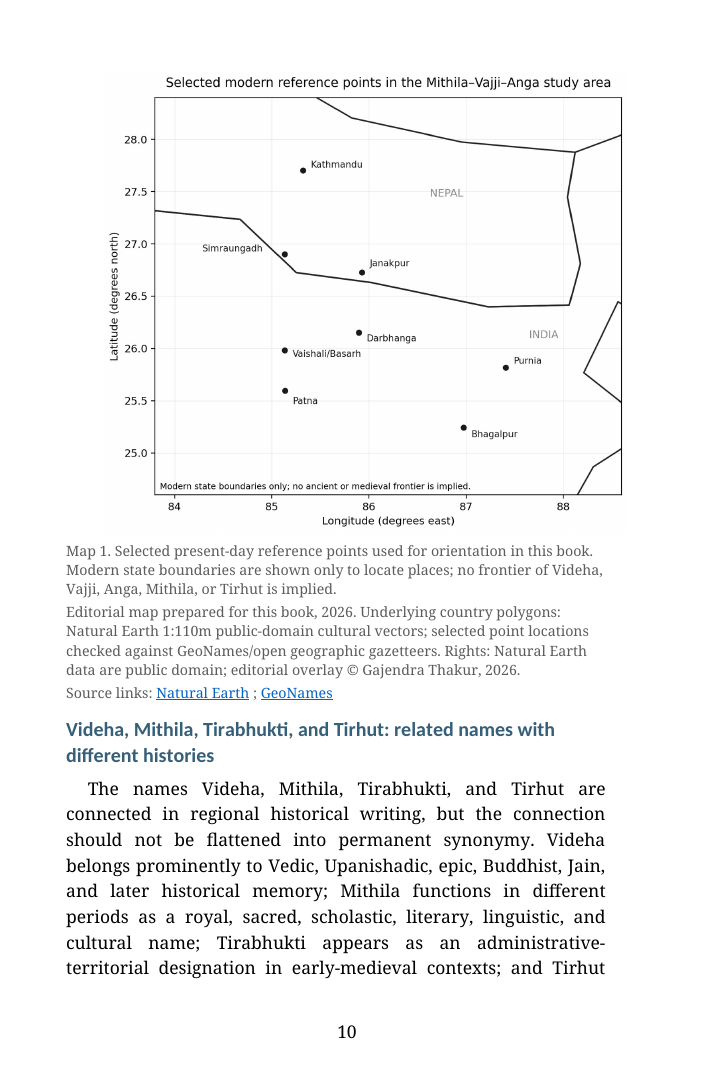
Chapter-specific source notes
- Primary chapter witness. Gajendra Thakur, Decoding the Panji of Mithila — Volume IV, formal Chapter 19, PDF pp. 229-236; formal Chapter 19. The HTML transcription is generated from the commit-pinned source PDF and retains the chapter boundary recorded in this edition.
- Internal structure. The repository source-heading inventory records no separately encoded subordinate heading for this chapter.
- Digital editorial method. The page keeps the preserved source text distinct from generated navigational, concordance, visual, and provenance apparatus. The synthetic reconstruction is explanatory only and is not evidence for an individual lineage or a determination of social or marital status.