Decoding the Panji of Mithila · Volume V · Chapter 1
How to Read Volume II Panji: Script, Abbreviations, Lineage Logic, and Marriage Authority
Chapter 1
 How to Read Volume II Panji: Script, Abbreviations, Lineage Logic, and
Marriage Authority

  1. The first difficulty: the Panji is not a story, but a
compressed map
   The reader who opens Volume II Panji for the first time may feel that he
has entered a forest without a footpath. Names follow names. Sons,
daughters, wives, fathers, grandfathers, villages, mools, gotras, old titles,
new occupations, and migration-places are packed into short lines. One
phrase may carry three generations. A second phrase may suddenly turn
from a son to a daughter. A third phrase may give a marriage alliance. A
fourth may record a village of origin, a present residence, a gotra, a mool, a
scholarly title, a nickname, or a doubtful reading.
   This is why Volume V must begin not with the first genealogy, but with
the method of reading. Without method, the Panji appears to be only an
endless list. With method, the same text becomes a social atlas of Mithila. It
is not merely a register of who begot whom. It is a record of lawful
marriage, scholarly authority, clan memory, village identity, migration,
regional prestige, and the continuity of Maithil society across many
centuries.
   The Panji is genealogical mapping. Its title itself gives the scope:
genealogical mapping from 450 A.D. to 2009 A.D. The very phrase is
important. A genealogy is a descent-line. A map is a spatial and relational
arrangement. The Panji combines both. It places a person in a family, a
family in a branch, a branch in a mool, a mool in a gotra, a gotra in a
marriage field, and that marriage field in the wider cultural geography of
Mithila and its extensions.
  Therefore, the correct reader must ask six questions at every line:
  Who is the person being named?
  Whose son, daughter, wife, or descendant is that person?
  Which village, mool, gotra, or branch is attached to the person?
  Is the line recording descent, marriage, migration, title, or status?
  Is the entry continuing a previous branch or beginning a new one?
   Is any part uncertain, abbreviated, damaged, repeated, or cross-referenced
elsewhere?
  Only after these six questions are asked can the Panji be decoded.

                   Decoding the Panji of Mithila - Volume V | 8
  2. The Panji as social memory
   In an ordinary modern family tree, the aim is usually to show descent. The
Panji has a larger aim. It preserves social memory in order to regulate social
life. It records paternal descent, but it also remembers maternal ancestry. It
names sons, but it also records daughters and their marriages. It lists
villages, but also shows movement from one village to another. It names
learned men, but also indicates why learning mattered for authority and
marriage.
   The Panji is therefore both a memory-book and a rule-book. It remembers
lineage so that society may know which marriages are proper, which are
doubtful, and which are forbidden. It remembers mool and gotra so that
descent can be located in the wider sacred and social order. It remembers
villages so that identity can be tracked even when people migrate. It
remembers women because marriage cannot be judged only through the
male line. It remembers scholarly titles because learned authority was central
to deciding lineage, ritual standing, and matrimonial eligibility.
  In this sense, the Panji is an institution. It is not a casual family chronicle
written for pride. It is a disciplined archive meant to preserve lawful
continuity.

  3. Why the text is so compressed
   The compression of the Panji is deliberate. A Panji writer had to record
immense material within limited space. Hundreds of families, thousands of
names, multiple villages, and complicated marriage relations had to be
placed in a form that trained readers could understand. The result is a style
that is neither ordinary prose nor a table. It is a genealogical shorthand.
  For example, a line may run in this pattern:
  “X सुत Y, Z; Y सुत A; A सुता B, C; B फलाँ मूल सँ फलाँ सुतक पत्नी; C
अमुक ग्राम सँ अमुक सुत दौ.”
  In expanded English this might mean:
   “X had sons Y and Z. Y had son A. A had daughters B and C. B was
married into the family of the son of so-and-so from such-and-such mool. C
was connected through marriage or descent to another person from another
village.”
  The source line may look like a rapid succession of names. But the Panji
writer expects the reader to know how kinship grammar works. The reader
must supply the structure hidden inside the shorthand.

                   Decoding the Panji of Mithila - Volume V | 9
  4. The grammar of “सुत,” “सुता,” and “सुतौ”
  The most common key is the word “सुत,” meaning son. But the Panji uses
several related forms:
  सुत — son of.
  Example pattern: “राम सुत श्याम” means Shyam, son of Ram, or in some
compressed cases, Ram’s son Shyam.
  सुता — sons of , or children / descendants of , depending on context. It
may introduce a list of sons.
  Example: “फलाँ सुता अमुक, तमुक, कमुक” means the sons of that named
person are Amuk, Tamuk, and Kamuk.
  सुतौ — two sons, or a dual form indicating two male descendants.
 Example: “फलाँ सुतौ अमुक तमुकौ” means that the person had two sons,
Amuk and Tamuk.
   सुताच / सुताश्च — and daughters / children , often introducing daughters
or other children. It may also function as “and his / her children include.”
Context decides.
  पुत्र / पुत्रा / पुत्री — son , sons , daughter. The Panji often mixes
Sanskritic and Maithili forms. “पुत्र” and “सुत” may both appear in the same
broad genealogical style.
   The reader must not mechanically translate every “सुता” as daughter. In
ordinary Sanskrit, “सुता” may mean daughter, but in these Panji records,
“सुता” frequently introduces sons or descendants. The context—names,
gender markers, wife references, and marriage formulae—must decide the
meaning.

  5. The grammar of daughters and wives
  The Panji’s handling of women is one of its most important features. A
careless reader may think women are secondary because male names
dominate the surface. In reality, the Panji cannot function without women.
Marriage regulation depends on knowing where daughters went and from
where wives came.
  Several forms are central:
  पत्नी — wife.
   When the line says “फलाँ ग्राम सँ अमुक सुत पत्नी,” it generally means
that a woman became the wife of the son of that named person from that
village or branch.

                  Decoding the Panji of Mithila - Volume V | 10
  आद्या — first, usually first wife or first marriage connection.
  When a man had more than one marriage, “आद्या” introduces the first.
  अपरा — another, later, second, or additional wife/marriage/branch.
  A single person may have “आद्या” and several “अपरा” entries.
  प्रथम विवाह / दोसर विवाह — first marriage / second marriage.
   Later parts of the Panji sometimes use clearer modern wording, especially
in more recent entries.
   सुताच — may introduce daughters, especially when the following names
are female or are followed by marriage details.
  दाय / दायवती / हेमवती / कमलिनी / रूपवती / सलक्षणवती — women’s
names often appear as mothers , wives , or daughters connected to a branch.
These names are not decorative. They may indicate maternal descent ,
marital alliance , or the branch through which later children belong.
   A Panji reader must give women full interpretive value. If a line records a
daughter’s marriage, it is not a side note. It is a genealogical bridge. It tells
us how two houses became connected and helps determine future marriage
eligibility.

 6. “आद्या” and “अपरा”: the architecture of multiple
marriages
   The words “आद्या” and “अपरा” are especially important. They organize
many entries where one person had more than one wife, or where a daughter
or female descendant entered different allied houses through marriage.
  “आद्या” generally marks the first wife or first marital entry. “ अपरा”
marks another wife, another daughter’s marriage, another branch, or another
connected line. Sometimes a series of “अपरा” entries shows multiple
marriages of one person; at other times it shows multiple daughters and their
separate marriage destinations.
  A line may say:
  “आद्या X ग्राम सँ Y सुत पत्नी। अपरा Z ग्राम सँ A सुत पत्नी।”
  This should be decoded as:
  “The first marriage was with the daughter / woman connected to X village
and Y’s son. The other marriage was with the woman connected to Z village
and A’s son.”
  Where the grammar is compressed , one must avoid hasty reconstruction.
The safe rule is : first identify the preceding person , then identify whether

                  Decoding the Panji of Mithila - Volume V | 11
the “आद्या / अपरा” belongs to him , to his daughter , or to a female
descendant already named.

  7. “प्र0”: nickname, popular name, or practical identifier
   The abbreviation “प्र0” appears frequently. In many contexts it seems to
introduce a popular name, alias, abbreviated form, or practical identifying
name. For example, a person may be named formally, then “प्र0” gives the
name by which he was locally known. In modern genealogical writing this
might be “also known as” or “popularly called.”
   It should not be expanded mechanically every time. Depending on the
line, it may indicate:
  प्रचलित नाम — commonly known as.
  प्रसिद्ध नाम — known by the name.
  प्रायः नाम — practical or familiar name.
  a nickname used to distinguish two persons of similar formal name.
  a local form of a longer Sanskritic name.
  In the decoded chapters, “प्र0” will usually be rendered as “also known as”
unless the context suggests a more precise meaning.

  8. “म0म0उ0” and scholarly titles
  One of the distinguishing features of these Panji records is the frequent
mention of learned titles. The abbreviation “ म0म0उ0” usually points to
महामहोपाध्याय, a high scholarly title. The Panji also records titles and
descriptors such as:
  महामहोपाध्याय
  महोपाध्याय
  सदुपाध्याय
  वैयाकरण
  ज्योतिषी / ज्योतिर्विद
  पौराणिक
  धर्माधिकरणिक
  आचार्य
  पंडित
  चौधरी
  ठाकु र

                  Decoding the Panji of Mithila - Volume V | 12
  मिश्र
  झा
  पाठक
  ओझा
   These titles are not merely honorific. They show the learned ecology of
Mithila. A family’s scholarly status could affect its social prestige, ritual
authority, and marriage standing. A Mahamahopadhyay was not simply a
learned man; he was part of the intellectual authority structure through
which genealogy, dharma, marriage, and social rank were understood.
   Some entries also preserve professional or modern educational markers:
B.A., B.Ed., M.A., engineer, doctor, bank officer, teacher, administrator.
This is a sign that the Panji tradition did not stop in the premodern period. It
absorbed modern life while retaining the older grammar of mool, gotra,
village, and descent.

  9. “दौ” and “दु दौ”: the most difficult recurring marker
   The words or markers “दौ” and “दु दौ” occur throughout the text. They
are among the most difficult elements for a modern reader. They appear after
names , often after a village - and - father formula , and seem to mark a
completed relational entry. In many contexts “ दौ” functions almost like a
genealogical closing sign : “connected to , ” “given through , ” “descended /
recorded through , ” or “married into the line of.”
   “दु दौ” appears where an additional or secondary relational link is
recorded, often after a second village, branch, or alliance. It may mark
another connected line, a second relational confirmation, or an additional
genealogical reference.
  Because the exact local scribal convention may shift by passage, this book
will follow a cautious editorial rule:
  “दौ” will not be forced into one English word.
  In prose decoding, it will be treated as a marker of completed
genealogical connection.
  Where it clearly follows a marriage formula , it will be explained as a
marriage / affinal connection.
  Where it follows descent, it will be explained as a recorded descent-link.
   Where it follows a village and another ancestor, it will be explained as a
cross-house or cross-village genealogical link.

                  Decoding the Panji of Mithila - Volume V | 13
  “दु दौ” will be treated as a secondary or additional such link unless the
context shows a more exact meaning.
   This is important because a wrong expansion of “दौ” can distort the
lineage. It is better to preserve the function than to invent a false translation.

  10. “नी0”: absence, extinction, no issue, or uncertain
continuation
  The abbreviation “नी0” appears in many genealogical records. In several
contexts it seems to indicate absence of issue, no continuation, or a line not
proceeding in the record. But it must be handled carefully. It may mean
“निःसंतान” in some places, but a responsible editor should not expand it
automatically unless the surrounding text confirms it.
  The rule in this volume will be:
  If “नी0” clearly follows a person with no later descendants, it will be
explained as “no recorded issue” or “no continuation recorded.”
  If it appears in a damaged or unclear line, it will be preserved as “ नी0”
with a note.
   It will not be converted into a full claim of biological childlessness unless
the record clearly supports that reading.

  11. “देशे ,” “वासी,” and the geography of identity
   Panji geography is layered. A person may be linked to an old mool, a
gotra, a village of origin, a later settlement, and a present residence. The
terms “देशे ” and “वासी” help organize this.
   देशे means “in the region / country / territorial field of.” It often
introduces a regional or settlement cluster.
   वासी means “resident of” or “settled in.” It may show present or later
residence rather than original mool.
  A person may be of one mool but resident in another village. A marriage
may connect a woman from one village to a man from another. A family
may originally belong to Mithila but later settle in Purnea, Malda, Jalpaiguri,
Nepal, or elsewhere. The Panji preserves both memory and movement.
  Therefore, when reading a place-name, one must ask:
  Is this the ancestral village?
  Is it the mool village?
  Is it the wife’s village?
  Is it the present residence?

                   Decoding the Panji of Mithila - Volume V | 14
  Is it the place of migration?
  Is it the village of the person’s father-in-law?
  Is it a branch label rather than a simple residence?
   Many errors in Panji interpretation arise from treating every place-name
as a birthplace. That is not safe.

  12. Mool, gotra, and pravar
   The Panji repeatedly uses categories such as मूल, गोत्र, and प्रवर. These
are central to Maithil Brahmin marriage regulation.
  गोत्र is the larger lineage affiliation associated with a Vedic rishi. It is a
sacred descent-category.
  प्रवर refers to the group of ancestral rishis invoked in ritual identity. It
helps define ritual lineage.
  मूल is a Maithil social-genealogical root. It is often tied to a village or
founding ancestor and is crucial in marriage discussions.
   The Panji does not merely say, “This man was from this family.” It
locates him within a regulated structure. Marriage rules depend on knowing
not only the immediate father and grandfather, but the wider mool and gotra
relations. This is why a Panji entry may carry more information than a
modern civil birth register. It is built for social decision-making.

  13. “ग्रामारम्भ”: beginning a village-root section
   The word “ग्रामारम्भ” means the beginning of a village section or village-
root entry. When a section says “अथ फलाँ ग्रामारम्भ,” the reader is being
told that a new organized block begins here. It may be a mool-village, a
settlement branch, or a major genealogical unit.
   The word “अथ” marks transition: “now begins.” It is a traditional
Sanskritic opening marker. It signals that the previous genealogy has ended
or paused and a new block is being introduced.
   Therefore, in this volume, every “अथ” heading will be treated with care.
It may mark:
  a new mool,
  a new village,
  a new gotra section,
  a continuation from an earlier file,
  a supplement,

                   Decoding the Panji of Mithila - Volume V | 15
  a relocated branch,
  or a cross-reference to a previous volume.

  14. “पूर्व परिचय,” “देखू,” and cross-references
   Some entries say “पूर्व परिचय … देखू,” meaning that the earlier
introduction should be seen elsewhere. This is important because Volume II
Panji is not a sealed, linear narrative. It refers backward and sideways. Some
branches are introduced in one place and continued later. Some sections tell
the reader to see an earlier part of Genealogical Mapping or another volume.
   For this reason, Volume V will not decode the files mechanically one
page at a time. It will preserve file order, but it will also identify cross-
references. If one branch is continued later, the later chapter will point back
to the earlier appearance. If a passage says the previous introduction is
elsewhere, this volume will not pretend that the full genealogy is present in
that line. It will say: “The record here resumes or supplements an earlier
account.”
  This is necessary to avoid false completeness.

  15. Old titles and modern titles in one record
  The Panji begins with old learned titles and continues into modern
professions. This continuity is one of the most valuable features of the
source.
  A medieval or early modern entry may say:
  महामहोपाध्याय,
  वैयाकरण,
  ज्योतिष,
  पौराणिक,
  धर्माधिकरणिक.
  A modern entry may say:
  B.A.,
  B.Ed.,
  M.A.,
  engineer,
  doctor,
  bank officer,
  teacher,

                  Decoding the Panji of Mithila - Volume V | 16
  administrator,
  computer-trained,
  political worker.
   The presence of modern occupational details does not make the record
less traditional. It shows that the Panji tradition continued to update itself. It
absorbed the changing social world while preserving its older categories. A
man could be a bank officer and still be recorded through mool, gotra,
father, village, wife, and marriage network. A woman could be noted
through her father’s house and husband’s house. A family could migrate to
Nepal or Bengal and still remain legible within Maithil genealogy.

  16. How one line may contain a whole social event
  A Panji line often records more than descent. Consider the structure:
  “फलाँ सुत अमुक; अमुक सुता तमुक, कमुक; तमुक फलाँ ग्राम सँ फलाँ सुत
दौ; कमुक अमुक मूल सँ अमुक दु दौ.”
  This may contain:
  one named ancestor,
  one son,
  two grandsons,
  a marriage link,
  a village link,
  a mool link,
  and a secondary genealogical reference.
  A modern prose expansion may require five or six sentences. The Panji
compresses it into one line.
   Therefore, decoding must expand, not merely translate. To translate word
by word is to fail. The duty of Volume V is to unfold the compressed entry
into readable structure while preserving its original uncertainty wherever
uncertainty exists.

  17. The role of mothers and maternal lines
   The Panji often names women after a male descent line, for example
“फलाँ पुत्र,” “फलाँ पुत्रा,” or a woman’s name followed by “पुत्र.” This may
indicate the maternal line of the children. The names of mothers are not
casual insertions. They help distinguish branches that might otherwise be
confused.

                    Decoding the Panji of Mithila - Volume V | 17
   Where a man had multiple wives, his children may be grouped by mother.
This is why a line may name a wife or mother, then list children after her. If
the editor ignores the mother’s name, half the structure is lost.
   In the decoded chapters, when a mother’s name appears, the children after
her will be treated as belonging to her branch unless the grammar shows
otherwise. If the line is uncertain, the note will say so.

  18. Daughters as genealogical bridges
   Daughters in the Panji often appear with their marriage destinations. This
is because they connect one mool or village to another. A daughter’s
marriage may determine whether two later families are too closely
connected for marriage. It may also explain why a later family has maternal
ties to a scholarly or prestigious house.
  Thus, a daughter’s entry must be read as a bridge:
  from her father’s mool,
  to her husband’s mool,
  through a specific village,
  across a known lineage,
  creating future memory for both houses.
   In Volume V, daughter-lines will not be omitted. They will be explained
as part of the working architecture of the Panji.

  19. Migration: the Panji as a map of movement
   The uploaded files do not remain within a narrow geographic area. They
show movement through Mithila, eastern Mithila, Purnea, Katihar, Araria,
Madhubani, Darbhanga, Nepal, Bengal, Malda, Jalpaiguri, and other
settlement zones. The closing Bengal section especially shows how Maithil
Brahmin scholarly families moved eastward and settled in Bengal while
preserving their mool and village memory.
   Migration in the Panji is not merely relocation. It affects marriage,
identity, and authority. A family settled in Bengal may still remember its
Mithila mool. A family resident in Nepal may still be linked through Maithil
marriage rules. A family in Purnea may preserve western Mithila scholarly
ancestry. The Panji allows identity to travel without becoming rootless.
  Therefore, every migration note will be read in two ways:
  as geographic movement;
  as continuity of lineage identity.

                  Decoding the Panji of Mithila - Volume V | 18
  20. The eastern movement of learned families
   Several passages indicate that learned families moved eastward under
changing political, social, and religious circumstances. Some moved to
regions like Purnea; others later moved toward Bengal. The Panji preserves
not only the fact of movement, but the prestige attached to learned
settlement.
   This is important for understanding Mithila’s intellectual history.
Learning did not remain confined to one capital or one district. Scholars
carried grammar, ritual law, logic, astrology, Puranic learning, and Panji
expertise across regions. Their movement created new centers of authority.
When marriage decisions became difficult because families were dispersed,
the need for accurate Panji records increased.
  Thus, Volume II Panji is also a record of intellectual migration.

  21. The Panji and the problem of authority
   Who had the authority to say whether a marriage was proper? Who knew
the descent lines? Who knew the forbidden degrees? Who could remember
whether a family had a connection through a mother, grandmother, or earlier
daughter-line?
  The Panji system arose to answer these questions. The record gave
authority a written basis. It did not eliminate learned judgment; rather, it
supported it. A Panjikār or learned authority had to interpret the entries,
compare branches, and decide whether a proposed marriage was valid.
   This is why the Panji records father, grandfather, mool, gotra, village,
mother, wife, and daughter-lines. Marriage cannot be judged by surname
alone. Many persons named Jha, Mishra, Pathak, or Thakur may belong to
different mools and villages. Conversely, families with different surnames
may be linked by maternal or marital lines. The Panji provides the deeper
structure.

  22. How to read a typical genealogical cluster
  A full cluster should be read in layers.
  First layer: identify the main ancestor.
  Second layer: list his sons.
  Third layer: identify which son continues the main line.
  Fourth layer: separate daughters from sons.
  Fifth layer: mark wives, mothers, and marriage links.
  Sixth layer: note villages and mools.

                  Decoding the Panji of Mithila - Volume V | 19
  Seventh layer: record titles and occupations.
  Eighth layer: observe whether any branch is marked as ended, doubtful, or
continued elsewhere.
   For example , when a line says that a person had several sons and then
immediately gives a village and another father’s name , the reader must
decide whether the village belongs to a son’s marriage , the branch’s
residence , or a cross - reference. The grammar usually provides clues.
Words like “पत्नी , ” “वासी , ” “देशे , ” “सॅ , ” “सुत , ” “सुता , ” “आद्या , ”
and “अपरा” must be read together.

  23. “सॅ ” as the connector of origin, relation, and movement
   The Maithili postposition “सॅ ” or “सँ ” appears constantly. It may mean
“from , ” “through , ” “by , ” “with reference to , ” or “of the line of.” In
Panji context it frequently links a person to a village , mool , father ,
marriage house , or branch.
   It is dangerous to translate every “ सॅ ” as simple “from.” A phrase like
“फलाँ ग्राम सॅ अमुक सुत” may mean “connected with the son of Amuk
from such village , ” not necessarily “born in that village.” The context
decides.
   In this volume , “सॅ ” will usually be decoded as “from / through the house
of” when it links marriage and descent. When it clearly marks residence , it
will be rendered as “resident of” or “from.” When uncertain , the original
relation will be preserved in explanation.

 24. The layered place-name: village, mool, residence, and
marriage-house
  One person may carry several places in one entry:
  ancestral mool village,
  current residence,
  wife’s village,
  mother’s village,
  father-in-law’s village,
  later settlement,
  regional desh,
  migration site.

                    Decoding the Panji of Mithila - Volume V | 20
  A line may mention Darhiara, Pawauli, Mander, Sodarpur, Khaual,
Belauch, Karmah, Sakaradhi, Nikhuti, Kujouli, Gangora, Budhwal, or
Malda. These cannot be flattened into one category.
   The chapters of Volume V will therefore maintain place distinctions as far
as possible. If a place is clearly a mool, it will be called a mool. If it is
clearly a residence, it will be called a residence. If it is clearly a marital
connection, it will be explained as such. If it is ambiguous, the wording will
remain cautious.

  25. The Panji’s time-depth
  The source title gives a broad chronological span. But the internal entries
do not always provide exact dates. Some persons have dates; many do not.
Some entries preserve medieval scholarly memory; others contain modern
professions. This mixture is not a defect. It is a natural feature of
genealogical tradition.
   The Panji does not move like a modern history book: year by year, reign
by reign, event by event. It moves by descent, branch, and marriage. Time is
embedded inside genealogy. A modern reader must learn to detect time
through:
  historical titles,
  known rulers,
  migration notices,
  modern degrees,
  professional labels,
  place changes,
  and references to earlier or later Panji sections.
  Where dates are not given, Volume V will not invent them. It will say
“earlier,” “later,” “modern,” “medieval,” “early modern,” or “uncertain”
only when supported by context.

  26. The problem of OCR, copying, and damaged text
  Some passages contain damaged or uncertain readings. There are dotted
omissions, broken words, unusual spellings, repeated syllables, inconsistent
names, and what appear to be scanning or typing distortions. The editor must
be both bold and restrained: bold enough to explain the structure, restrained
enough not to fabricate missing content.
  This volume will follow these editorial principles:
  Do not silently correct a name unless the correction is obvious.

                       Decoding the Panji of Mithila - Volume V | 21
  Do not invent missing fathers, wives, or sons.
  Preserve doubtful names with a note.
   If a dotted passage shows omission, say that the source is incomplete
there.
  If a spelling variant is common, record both forms.
  If a place-name appears in more than one form, identify the likely place
but preserve the variant.
  If a title is abbreviated, expand it only when the expansion is secure.
  If the gender of a name is uncertain, avoid forcing the entry.
  If two branches appear duplicated, compare them before merging.
  If a later chapter clarifies an earlier uncertainty, note the cross-reference.

  27. Why not modernize everything?
  A temptation in decoding is to modernize the whole text. This would be a
mistake. The Panji’s old grammar is part of its evidence. If all terms are
converted into modern English, the reader loses the structure of Maithil
genealogical thinking.
  Therefore, Volume V will preserve key terms such as:
  सुत,
  सुता,
  सुतौ,
  आद्या,
  अपरा,
  पत्नी,
  म0म0उ0,
  प्र0,
  दौ,
  दु दौ,
  मूल,
  गोत्र,
  प्रवर,
  ग्रामारम्भ,
  देशे ,

                  Decoding the Panji of Mithila - Volume V | 22
  वासी,
  पूर्व परिचय,
  देखू.
   Each chapter will explain the terms when needed, but the terms
themselves will remain visible. The aim is not to erase the Panji’s language,
but to make it readable.

  28. Surname is not enough
  Modern readers often think in terms of surname: Jha, Mishra, Thakur,
Pathak, Chaudhary, Ojha. The Panji thinks more deeply. A surname alone
does not determine marriage eligibility or genealogical identity. Two
families with the same surname may have different mools. Two families
with different surnames may be connected through maternal or marital lines.
A person’s true genealogical position depends on the full set of markers.
  A decoded entry must therefore include:
  personal name,
  father,
  grandfather or earlier ancestor where available,
  mool,
  gotra if given,
  village,
  marital links,
  maternal indications,
  titles,
  later residence,
  branch continuation.
  Only this full combination can reveal the person’s place in the Panji.

  29. The importance of branch continuity
   A Panji branch may begin in one file and continue in another. It may be
interrupted by another village section. It may resume with a phrase such as
“शेषांश,” “पूर्व परिचय,” or “देखू.” It may also appear under a related mool
because of marriage or migration.
  Therefore, the chapters of Volume V will not treat the eight uploaded
documents as eight isolated books. They are source segments of one large

                     Decoding the Panji of Mithila - Volume V | 23
genealogical body. The decoding must follow the internal logic of branches,
not merely the external file division.

  30. A working example of expansion
  Suppose the Panji gives this compressed structure:
  “फलाँ सुता अमुक तमुक । अमुक सुत चंद्रनाथः फलाँ ग्राम सॅ रामनाथ सुत
दौ । अपरा तमुक सुतौ हरिनाथ गोपीनाथौ अमुक मूल सॅ जगदीश दु दौ । ”
  A readable expansion would be:
  “Falā̃ had two sons, Amuk and Tamuk. Amuk’s son was Chandranath.
Chandranath was connected through the house of Ramnath’s son from the
named village. The other branch, through Tamuk, had two sons, Harinath
and Gopinath. That branch was connected with Jagdish of the named mool,
and the record marks this as an additional genealogical link.”
  This expansion does not erase uncertainty. It shows the structure and
preserves the relational logic.

  31. Why the Panji records prestige
   Names such as Mahamahopadhyay, Vaiyakaran, Jyotishi, and Pauranik
are not merely praise. They locate families in the learned order of Mithila. In
a society where ritual, marriage, law, and learning were deeply connected,
scholarship carried social authority.
  A learned family could become a center of marriage consultation. A Panji
expert could resolve disputes. A scholar’s descendants might be remembered
not only for bloodline but for intellectual service. Therefore, when a title
appears, it should be decoded as part of the family’s social role.

  32. The Panji and kingship
   Some passages connect learned families with rulers, ministers, royal
houses, or regional patrons. This is not accidental. Genealogy often
flourishes under patronage. A ruler may support scholars; scholars may
preserve ritual legitimacy; Panji records may stabilize marriage networks
among high-status families.
   The opening link to Bengal’s Vallal Sen and learned authority sets a tone:
the Panji remembers the relation between political power and scholastic
authority. Later references to regional rulers and eastern patrons show that
this relationship continued in different forms.
  Volume V will therefore read political references not as decorative
background, but as clues to institutional history.

                  Decoding the Panji of Mithila - Volume V | 24
  33. Bengal and the extended Maithil world
   The closing Bengal material is especially important. It shows that Maithil
Brahmin genealogy did not end at the borders of present-day Mithila.
Families moved to Bengal, including Malda, Jalpaiguri, Araidanga, and
related regions. The Panji preserves their mool and village affiliations even
after settlement outside the central homeland.
   This means the Panji’s geography is civilizational, not merely
administrative. It maps a Maithil world that includes migration, settlement,
memory, and continuity. A family may live in Bengal and still remain
legible through Maithil mool, gotra, and marriage identity.

  34. The danger of over-explanation
   To decode is not to over-explain. A responsible commentator must
distinguish between:
  what the text says,
  what the structure implies,
  what is historically likely,
  and what remains uncertain.
   If the text says a person is son of another, that is direct. If the grammar
suggests a marriage connection, that is an interpretation. If a place-name
resembles a modern district or village, that is a geographical identification. If
a damaged word looks like a known name, that is a proposed reading.
  Volume V will keep these levels separate. This is essential for trust.

  35. The chapter method used in this volume
  Each later chapter will use the following method:
  Step 1: Identify the source section.
  The chapter will begin by naming the mool, gotra, village, or heading.
  Step 2: Establish the principal ancestor.
  The first securely identifiable figure will be treated as the root of that
section.
  Step 3: Separate sons and branches.
  Each son will be followed as far as the text permits.
  Step 4: Mark women and marriages.
  Daughters, wives, mothers, and multiple marriages will be decoded
carefully.

                  Decoding the Panji of Mithila - Volume V | 25
  Step 5: Record places.
  Each village, mool, desh, and residence will be classified where possible.
  Step 6: Explain titles and status.
  Scholarly, ritual, administrative, or modern professional titles will be
explained.
  Step 7: Note uncertainty.
  Damaged, doubtful, or abbreviated readings will be recorded honestly.
  Step 8: Summarize the branch.
  At the end of each major section, a concise lineage summary will be
provided.
  Step 9: Prepare index markers.
  Names, villages, mools, gotras, and marriage links will be marked for the
master indexes.

  36. Terms that will remain untranslated
  Some terms will be preserved because they carry Panji-specific meaning.
They may be explained in English, but not replaced entirely. These include:
  मूल — root lineage or mool identity.
  गोत्र — Vedic lineage affiliation.
  प्रवर — ritual ancestral rishi-line.
  ग्रामारम्भ — beginning of a village or mool-village section.
  आद्या — first wife or first marital entry.
  अपरा — another wife, later entry, or additional branch.
  प्र0 — popular/known name or alias marker.
  दौ — genealogical connection marker.
  दु दौ — additional/secondary connection marker.
  नी0 — no recorded continuation or uncertain absence marker, depending
on context.
  वासी — resident of or settled at.
  देशे — in the region or settlement field of.
  पूर्व परिचय — previous introduction or earlier account.
  देखू — see, cross-reference.

                  Decoding the Panji of Mithila - Volume V | 26
  37. How readers should use this volume
   This book should be read in two ways. A general reader may read it as a
history of Maithil genealogical society. A family researcher may use it as a
guide to trace branches. A scholar may use it to understand the structure of
mool, gotra, migration, and marriage. A Panji specialist may compare this
decoding with other Panji manuscripts.
   But no reader should use a decoded passage as the sole authority for a
present-day marriage decision without consulting living Panji experts and
full family records. This volume explains the historical and textual structure;
it does not replace the living social institution where it still operates.

  38. The ethical duty of decoding
   Genealogy is sensitive. It concerns families, names, marriages, ancestry,
and identity. A careless reading may create false claims. A missing “ अपरा”
may erase a wife. A misunderstood “ सुता” may turn sons into daughters or
daughters into sons. A misread place-name may attach a family to the wrong
village. A forced expansion of “नी0” may wrongly declare a line extinct.
   Therefore, this volume will follow an ethical principle: clarity without
invention. It will explain everything that can be explained, but it will not
pretend certainty where the source is uncertain.

  39. Why Volume V must be larger than earlier volumes
  The source material for this volume is vast. It contains not only early
genealogies but also extensive branch expansions, regional migrations,
modern updates, scholarly titles, cross-references, women’s marriage-links,
Bengal settlement notices, and classifications by mool, gotra, and village. A
small chapter would leave too much unexplained.
   Therefore, every chapter in this volume must be longer and fuller. It must
decode not only names but the system beneath the names. It must explain the
social meaning of the record. It must protect the reader from misreading. It
must preserve uncertainty. It must make the Panji usable without flattening it
into a simplified family chart.

  40. The promise of Volume V
  Volume V will proceed from this principle: every name matters, but every
name must be read in relation. A person belongs to a father, a mother, a
wife, a daughter, a village, a mool, a gotra, a branch, a migration path, a title,
and a memory-system. The Panji records that network in compressed form.
This volume will unfold it.

                   Decoding the Panji of Mithila - Volume V | 27
   The first genealogy will begin in the next chapter with the opening high-
status scholarly line associated with Bengal’s Vallal Sen and
Mahamahopadhyay Halayudh. But before entering that line, the reader must
carry the key given here: do not read the Panji as a list. Read it as a map.
  It is a map of descent.
  It is a map of marriage.
  It is a map of learning.
  It is a map of migration.
  It is a map of memory.
  And above all, it is a map of Mithila’s disciplined social continuity.

                  Decoding the Panji of Mithila - Volume V | 28
Source structure and verification apparatus
Editorial source apparatus. This apparatus is descriptive, not interpretive. It records the source-controlled structure used to verify that this page corresponds to formal Chapter 1 of Decoding the Panji of Mithila — Volume V. The chapter text above is preserved from PDF pp. 9-29; formal Chapter 1 in the commit-pinned authoritative source. It is not merged with a neighboring chapter, appendix, annexure, or independent front/back-matter unit. The internal headings below come from the repository’s source-heading inventory and are retained as navigational and audit evidence; showing them here does not turn those headings into separate publications or add claims that are absent from the source.
Internal source headings
- 2. The Panji as social memory
- 3. Why the text is so compressed
- 4. The grammar of “सुत,” “सुता,” and “सुतौ”
- 5. The grammar of daughters and wives
- 6. “आद्या” and “अपरा”: the architecture of multiple marriages
- 7. “प्र0”: nickname, popular name, or practical identifier
- 8. “म0म0उ0” and scholarly titles
- 9. “दौ” and “दु दौ”: the most difficult recurring marker
- 10. “नी0”: absence, extinction, no issue, or uncertain continuation
- 11. “देशे,” “वासी,” and the geography of identity
- 12. Mool, gotra, and pravar
- 13. “ग्रामारम्भ”: beginning a village-root section
- 14. “पूर्व परिचय,” “देखू,” and cross-references
- 15. Old titles and modern titles in one record
- 16. How one line may contain a whole social event
- 17. The role of mothers and maternal lines
- 18. Daughters as genealogical bridges
- 19. Migration: the Panji as a map of movement
- 20. The eastern movement of learned families
- 21. The Panji and the problem of authority
- 22. How to read a typical genealogical cluster
- 23. “सॅ” as the connector of origin, relation, and movement
- 24. The layered place-name: village, mool, residence, and marriage-house
- 25. The Panji’s time-depth
- 26. The problem of OCR, copying, and damaged text
- 27. Why not modernize everything?
- 28. Surname is not enough
- 29. The importance of branch continuity
- 30. A working example of expansion
- 31. Why the Panji records prestige
- 32. The Panji and kingship
- 33. Bengal and the extended Maithil world
- 34. The danger of over-explanation
- 35. The chapter method used in this volume
- 36. Terms that will remain untranslated
- 37. How readers should use this volume
- 38. The ethical duty of decoding
- 39. Why Volume V must be larger than earlier volumes
- 40. The promise of Volume V
Source-text concordance
Read · Script · Abbreviations · Lineage · Logic · Marriage · Authority · first · difficulty · story · compressed · reader · opens · time · feel · entered · forest · without · footpath · Names · follow · Sons · daughters · wives · fathers · grandfathers · villages · mools · gotras · titles · occupations · migration-places · packed · short · lines · phrase · carry · three · generations · second · suddenly · turn · daughter · third · give · alliance · fourth · record · village · origin · present · residence · gotra · mool · scholarly · title · nickname · doubtful · reading · must · begin · genealogy · method · appears · endless · list · text · becomes · social · atlas · merely · register · begot · lawful · clan · memory · identity · migration · regional · prestige
Boundary verification. In the formal sequence this chapter follows the beginning of this volume’s formal chapter sequence and precedes Volume V Chapter 2, “The Opening Line: Vallal Sen, Mahamahopadhyay Halayudh, and the First Genealogical Frame”. The chapter extractor begins at the verified formal Chapter 1 marker and stops at the next verified formal chapter marker; for a final chapter it stops before recognized book-level back matter. The concordance above is generated only from distinct terms already present in this chapter’s preserved source text. It is provided for discovery, comparison, and audit, not as an automated judgment about persons, lineages, status, kinship, marriage eligibility, or historical truth.
Illustrated research apparatus
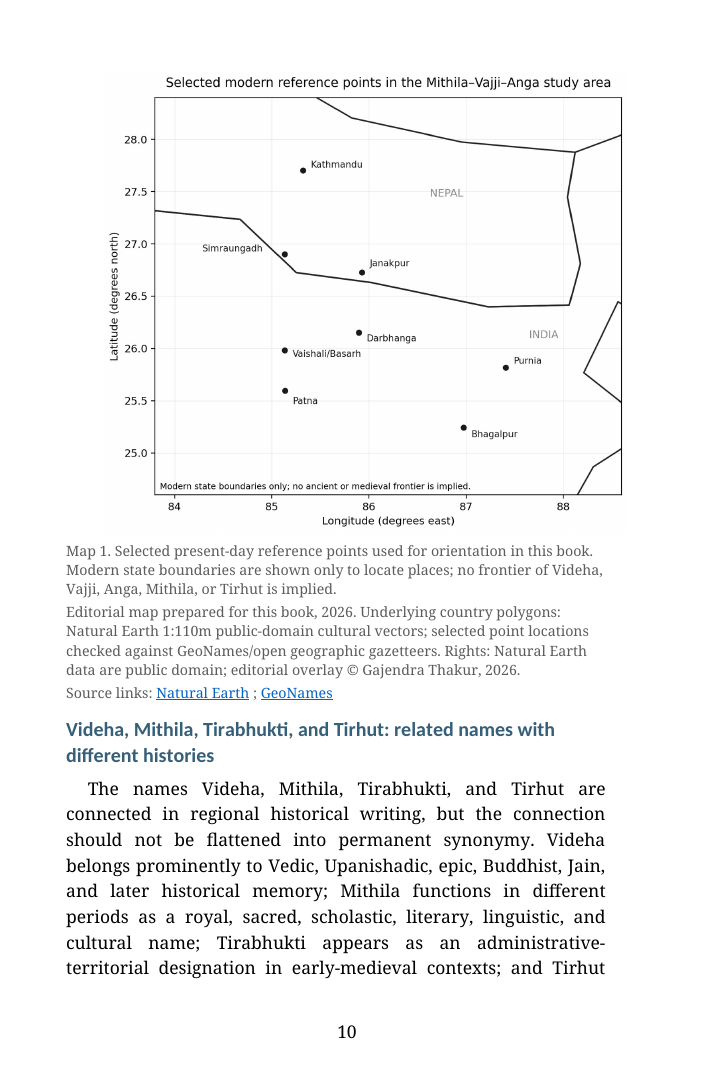
Mithila · Vajji · Anga
Chapter-specific source notes
- Primary chapter witness. Gajendra Thakur, Decoding the Panji of Mithila — Volume V, formal Chapter 1, PDF pp. 9-29; formal Chapter 1. The HTML transcription is generated from the commit-pinned source PDF and retains the chapter boundary recorded in this edition.
- Internal structure. The repository source-heading inventory records 39 subordinate headings for this chapter: “2. The Panji as social memory”; “3. Why the text is so compressed”; “4. The grammar of “सुत,” “सुता,” and “सुतौ””; “5. The grammar of daughters and wives”; “6. “आद्या” and “अपरा”: the architecture of multiple marriages”; “7. “प्र0”: nickname, popular name, or practical identifier”; “8. “म0म0उ0” and scholarly titles”; “9. “दौ” and “दु दौ”: the most difficult recurring marker”; ….
- Digital editorial method. The page keeps the preserved source text distinct from generated navigational, concordance, visual, and provenance apparatus. The synthetic reconstruction is explanatory only and is not evidence for an individual lineage or a determination of social or marital status.