Decoding the Panji of Mithila · Volume I · Chapter 1
Genome Mapping of Mithila: The Pañjī System — Genealogical Theories Study (Volume I)
Chapter 1
    Genome Mapping of Mithila: The Pañjī System —
        Genealogical Theories Study (Volume I)

GENOME MAPPING OF MITHILA
450 A.D. – 2009 A.D.

The Mithila Pañjī System: A Complete Study from the Perspective
of Genealogical Theories
*Based on: Intro_1.pdf (Gajendra Thakur, Nagendra Kumar Jha&Vidyanand
Jha)*

PREFATORY NOTE & ABSTRACT
The Mithila Pañjī system — literally 'Genome Mapping' of Mithila from 450
A.D. to 2009 A.D. — is one of the most remarkable genealogical institutions
in the history of human civilisation. Spanning over fifteen hundred years, it
constitutes a continuously maintained, professionally administered, and
socio-legally binding register of patrilineal and matrilineal descent lines of
Maithili Brahmin families, later extended to Karna-Kayastha communities.
This study examines the Pañjī system exhaustively through the lens of
modern and classical genealogical theories: descent theory, kinship algebra,
exogamy logic, genome mapping analogies, social memory theory,
institutional genealogy, and the epistemology of genealogical knowledge. It
also places the system comparatively within world genealogical traditions.
      Primary Text | Jīnoma Maipiṃga (450 A.D.–2009 A.D.) — Mitilāka Pañjī
      Prabandha
      Period Covered | 450 A.D. – 2009 A.D. (over 1,550 years of continuous
      record)

                            Gajendra Thakur — 7
                           Decoding the Panji of Mithila
      Founder Institution | Mahārāja Harisimhadeva, Kāṇāṭa dynasty, Śaka 1248 /
      1326 C.E.
      First Pañjīkāra | Sudupādhyāya Guṇākara Jhā (of Paṇḍua Mūla)
      Register Type    |   Patrilineal descent (Gotra) + Matrilineal prohibitions
      (Sapiṇḍa)
      Covering Communities | Maithili Brahmin (Śrotriya, Yogya, Pañjībaddha) +
      Karna Kayastha
      Genealogical Scope | 32-ancestor Uṭheṛha; 16-Ṣaṣṭhī kinship computation
      Surviving Record Volume | 185 Pañjīs; 32 Śrotriya + 153 Yogya/Vaṃśaja

I. THEORETICAL FRAMEWORK: GENEALOGY AS A
FIELD

1.1 Definitions and Disciplinary Background
Genealogy, derived from the Greek genealogia (family history), is the study
of the lines of descent from an ancestor. As an academic discipline it draws
on anthropology, history, law, genetics, demography, and semiotics. Modern
genealogical theory operates across three major paradigms:
•Descent Theory (social anthropology): How societies construct and deploy
lineal identity through patrilineal, matrilineal, or cognatic descent systems.
•Kinship Algebra (structural anthropology): The formal, mathematical
mapping of kinship relationships and marriage prohibition rules.
•Social Memory & Archival Theory: How genealogical knowledge is
produced, stored, contested, and transmitted across generations.
The Mithila Pañjī is uniquely significant in all three paradigms. It is not
merely a family history archive but a living legal-administrative instrument, a
computational kinship device, and a social memory repository
simultaneously.

1.2 Classical Indian Genealogical Theory
Indian genealogical thought has ancient roots in three traditions:
•Vaṃśāvalī (genealogical narrative): Linear royal and Brahminic genealogies
from the Purāṇas, listing descent from cosmogonic ancestors.
•Gotra-Pravara system: The Vedic attribution of Ṛgvedic Ṛṣis as ancestral
identity markers for exogamy management.

                              Gajendra Thakur — 8
                          Decoding the Panji of Mithila
•Sapiṇḍa computation: The Dharmaśāstra-based calculation of shared bodily
substance across generations for marriage prohibition.
The Pañjī system synthesises all three. It begins with Gotra (Vedic Ṛṣi-
lineage), adds Mūla-village identity (akin to Vaṃśāvalī), and encodes
Sapiṇḍa rules in the operative 32-ancestor Uṭheṛha document. It is thus a
total genealogical system integrating narrative, juridical, and computational
dimensions.

II. DESCENT SYSTEM ANALYSIS

2.1 Patrilineal Descent Architecture
The Pañjī system is fundamentally patrilineal. Gotra — the primary identity
unit — is defined explicitly: 'All members of a Gotra are descendants of a
single ancient known Mahāpuruṣa.' The text states that in Maithili Brahmin
society, Gotra is 'vaṃśa-bodhaka' (lineage-indicating), with each Gotra
named after its earliest known patrilineal ancestor.
The twenty Gotras enumerated are: Śāṇḍilya, Vatsa, Sāvarṇa, Kāśyapa,
Rāśada, Bhāradvāja, Kātyāyana, Garga, Kauśika, Alāmbukākṣa, Kṛṣṇātreya,
Gautama, Maudgalya, Vasiṣṭha, Kauṇḍinya, Upamanya, Kapila,
Viṣṇuvṛddhi, Daṇḍī, and Jātūkarṇa.
Of these, seven Gotras are numerically predominant and socially organised:
Śāṇḍilya, Vatsa, Kāśyapa, Sāvarṇa, Rāśada, Bhāradvāja, Kātyāyana. The
remaining thirteen are documented but smaller in population.

2.2 Mūla: The Sub-Lineage Unit
Below the Gotra level, the system deploys 167 Mūlas (primary villages/sub-
lineage units). The Mūla is the operationally crucial unit for marriage
prohibition calculations. Within a single Gotra, there may be dozens of
Mūlas — for instance, Śāṇḍilya Gotra alone contains Mūlas including
Didhauṣa, Sarisaba, Mahuvā, Baulī, Khaṇḍabalā, Gaṅgolī, Jajalvāl, and many
others.
The document specifies 35 primary Mūlas (34 + the Khanāma branch of
Fananda Mūla), organised in three tiers: Ayānta Śreṣṭha (13 elite), Dvitīya
Śreṇī (13 second-rank), and Madhyama Mūla (8 middle). This hierarchical
stratification is genealogically significant: it maps social rank onto descent
categories.

                            Gajendra Thakur — 9
                           Decoding the Panji of Mithila
2.3 Bījī Puruṣa: The Founding Ancestor
Each Mūla traces descent to a Bījī Puruṣa (seed-ancestor), the earliest known
male ancestor in that line. The text offers a detailed example: for Kāśyapa
Gotra, 74 branches survive in Mithila, all traceable to an ancestor resident in
Māṇḍara village. The genealogical reconstruction shows that even branches
settled in different villages (Gaṛha, Maṅgauraunī) are shown by Pañjī
evidence to be branches of the same Kula with a common Bījī Puruṣa.
This concept of Bījī Puruṣa is the precise Indian analogue of what Western
genealogical theory calls the 'progenitor' or 'founder ancestor' — the
individual at the root of a documented descent tree. The Pañjī system is
extraordinary in maintaining documented chains from Bījī Puruṣas dated as
early as 400 C.E. (e.g., the mention of Mahāmahopādhyāya Tinayana Bhaṭṭa
of Māṇḍara Mūla, circa 400 A.D.).

2.4 Cognatic Descent in Matrilineal Sapiṇḍa Computation
While the Pañjī is structurally patrilineal, it incorporates cognatic elements
through the matrilineal Sapiṇḍa prohibition. The Pañcamī-Saptamī rule (from
Manusmṛti) requires that the bride not be within five generations on the
mother's side and seven generations on the father's side of the groom. This
makes the system a bilateral or 'double descent' system for the purpose of
marriage prohibition, even if only the patrilineal line is used for identity.
This is theoretically important: the system operates as a patrilineal identity
system plus a bilateral prohibition system. The 32-ancestor Uṭheṛha
document, which maps 16 kinship nodes (Ṣaṣṭhī) from both patrilineal and
matrilineal ancestors, is the technical instrument that operationalises this
bilateral computation.

III. KINSHIP ALGEBRA AND EXOGAMY
COMPUTATION

3.1 The 32-Ancestor Uṭheṛha: A Kinship Matrix
The Uṭheṛha is the genealogical working document prepared for each
prospective marriage. It maps 32 ancestors (hence 'battīsa mūlaka uṭheṛha')
across seven patrilineal and five matrilineal generations. In contemporary
genealogical and genetic terms, this is equivalent to a 5-generation pedigree
chart covering all 32 great-great-great-grandparents.

                             Gajendra Thakur — 10
                           Decoding the Panji of Mithila
The 16 Ṣaṣṭhī (kinship prohibition nodes) are computed from this chart. The
text provides a complete enumeration: the 1st Ṣaṣṭhī is the bride's Vṛddha
Prapitāmaha (great-great-great-grandfather); subsequent ones trace through
all 16 specific kinship paths (paternally and maternally across patrilineal and
matrilineal branches).

3.2 Formal Rules of Exogamy
The system encodes four formal rules for marital eligibility:
•Rule 1 (Sapiṇḍa): The bride and groom must not share any of 16 Ṣaṣṭhī
ancestors through the groom's patrilineal side. If they share one through the
matrilineal side, marriage is permitted.
•Rule 2 (Gotra): The bride and groom must not belong to the same Gotra.
•Rule 3 (Pravara): The bride and groom must not share the same Pravara
(Ṛgvedic Ṛṣi-cluster).
•Rule 4 (Vipiāmātā): The bride must not be the daughter of the groom's
maternal uncle.
These rules constitute a formal prohibition algebra. The marriage space is
defined as the set of all women who satisfy all four conditions
simultaneously. The Pañjī system automates this computation through the
Uṭheṛha document and the Pañjīkāra's verification.

3.3 Pravara System: A Genetic-Lineage Marker
The Pravara system classifies Gotras by their Ṛgvedic Ṛṣi-cluster. The text
divides Maithili Brahmin Gotras into Tripravara (three-Ṛṣi ancestry) and
Pañcapravara (five-Ṛṣi ancestry). The key rule: even if two Gotras share
identical Pravara ancestors (as Vatsa and Sāvarṇa do — both deriving from
Aurva, Cyavana, Bhārgava, Jamadagni, and Āplava), they cannot intermarry
despite being distinct Gotras.
From the standpoint of genealogical theory, this is a case of overlapping
descent-group membership: two named Gotras with partially shared ancestral
attribution. The prohibition is maintained because the shared Pravara implies
closer-than-permitted common ancestry at the Ṛṣi level, even if the social
Gotra designation differs.

                             Gajendra Thakur — 11
                         Decoding the Panji of Mithila
3.4 Parallel with Population Genetics
The document's title 'Genome Mapping' (Jīnoma Maipiṃga) is deliberately
chosen. The authors argue that the Ṛṣi-genealogical system encoded in the
Pañjī is functionally equivalent to chromosome mapping. Just as genetic
science maps chromosomes to identify relatedness and prohibit
consanguineous unions, the Pañjī maps genealogical 'chromosomes' (Gotra +
Mūla + Sapiṇḍa chains) to identify biologically and socially too-close
matches.
This analogy has substance: the Pañcamī-Saptamī rule maps closely to what
population geneticists call avoidance of second-degree (R = 0.) and third-
degree (R = 0.) consanguinity. Five maternal generations back reaches the
5th degree of relatedness; seven paternal generations back reaches the 7th
degree. This is well within the range of modern recommended minimum
genetic distance for human marriage.

IV. INSTITUTIONAL GENEALOGY: THE PAÑJĪ AS
ADMINISTRATION

4.1 Founding Event (1326 C.E.) and Legal Charter
The institutional origin is precisely documented. In Śaka 1248 (1326 C.E.),
under Mahārāja Harisimhadeva of the Kāṇāṭa dynasty, the Maithili Brahmin
learned community collectively resolved that genealogical records could no
longer be left to individual family memory. The catalyst was a scandal:
Thaṃharinā Upādhyāya, a celebrated author of Dharmaśāstra texts including
Smṛtisāra, committed an unknowing incestuous marriage (Svajana-vivāha)
by marrying his own brother's daughter — precisely because his genealogical
knowledge had lapsed.
The solution was institutional: a royal decree creating a class of state-
appointed genealogists (Pañjīkāras) with the authority to issue 'Siddhānta
Patra' (eligibility certificates) without which no Maithili Brahmin marriage
could proceed. This was a state intervention in genealogical record-keeping
without precedent in the ancient world outside of royal succession records.

4.2 The Guṇākara Jhā Commission
Sudupādhyāya Guṇākara Jhā of Paṇḍua Mūla (Śāṇḍilya Gotra) was
appointed as the first chief Pañjīkāra. He and his team of Parichetās (field

                           Gajendra Thakur — 12
                           Decoding the Panji of Mithila
collectors) traversed the entire Mithila region, interviewing the senior
member of each family and recording their genealogical knowledge. The
collected data was cross-referenced to identify Bījī Puruṣas and Mūla
villages. The resulting corpus became the authoritative genealogical
database.
This founding act closely resembles what institutional archival theory
describes as a 'record-creation event' — the moment when tacit social
knowledge is converted into formal documentary record. The Pañjī system is
thus an early example of what contemporary genealogical archivists call a
'genealogical information management system' (GIMS).

4.3 The Pañjīkāra as Professional Genealogist
The Pañjīkāra is a certified professional genealogist appointed by royal
authority. The text is explicit about both the role's dignity and its ethical
obligations. It warns against corruption, excessive fee extraction, and
genealogical fabrication. The system creates 185 Pañjī records maintained by
distinct Pañjīkāra families, operating as hereditary custodians.
The document provides a striking ethical norm: 'The Pañjīkāra is a protector
of culture, not a fee-extracting businessman.' It criticises Pañjīkāras who
demand payment before issuing eligibility certificates, and calls for
transparent succession planning to train the next generation.

4.4 Record Format: Palm-Leaf to Digital
The Pañjī books were originally written in Mithilākṣara (Tirhuta script) on
palm-leaf (tāla patra). The text provides detailed instructions for manuscript
preservation: protect from water, oil, and tight binding; sun-dry annually
when the sun is in Leo (mid-August to mid-September). Each book could
contain 500–600 palm-leaves bound with wooden covers and tied with cord
('brahmagranthī' binding style).
By 2000 C.E., a systematic digitisation project was launched: transcription of
all surviving Pañjī manuscripts into Devanagari, with digital imaging of the
palm-leaf originals onto DVD. This represents the full archival lifecycle: oral
knowledge → formal manuscript → digitised preservation, spanning 1, years
of genealogical record management.

                             Gajendra Thakur — 13
                          Decoding the Panji of Mithila
V. GENEALOGICAL STRATIFICATION AND SOCIAL
RANK

5.1 The Three-Tier Brahmin Classification
The Pañjī system classifies Maithili Brahmins into three genealogically
defined tiers:
•Śrotriya: The highest-rank Vedic scholars. Defined by Matṛkṣa (maternal
side) of five generations and Pitṛkṣa (paternal side) of seven generations of
maintained Vedic study. Divided into 8 Chaugolā (sub-ranks) with 32 Pañjīs.
•Yogya ('Eligible'): The intermediate class. Fifteen sub-ranks with 153
Pañjīs.
•Pañjībaddha ('Registered'): All who are registered in the Pañjī. This is the
baseline of legitimate genealogical standing.
The text notes that those not registered (Jayavāt or 'fallen out') could not
claim Vedic-hereditary marriage rights. This makes Pañjī registration a de
facto citizenship document in Mithila's Brahminic legal order.

5.2 Downward Mobility Through Misalliance
A crucial genealogical-sociological feature: rank is not permanently fixed but
can decline through mésalliance (marriage below one's rank). The text notes
that 'Pañjī and rank descend downward' — a family's rank can fall if
marriage alliances with lower-ranked families accumulate over generations.
The first and second Śrotriya sub-ranks have already become extinct due to
this mechanism.
This is a powerful illustration of what sociologists call 'status attrition
through hypogamy.' The genealogical record becomes the instrument of
rank-tracking: the Pañjī does not merely record who one's ancestors were, but
determines what social position one currently occupies based on the
cumulative marriage record.

5.3 Śākhā Pañjī: The Branch Record Innovation
Under Mahārāja Mādhava Siṃha of Darbhanga (circa 1760 C.E.), a new
genealogical instrument was introduced: the Śākhā Pañjī (branch register),
which recorded separate sub-ranks within the broader Yogya and
Pañjībaddha categories. The text is critical of this innovation, arguing it
introduced social stratification and hierarchical abuse that were not part of
                            Gajendra Thakur — 14
                          Decoding the Panji of Mithila
the original Pañjī's spirit — which was purely genealogical (vaṃśāvalī), not
socially ranking.
This historical critique parallels debates in genealogical theory about the
distinction between 'pure' descent recording and social ranking systems. The
Śākhā Pañjī represents the moment when a genealogical archive was
converted into a social stratification instrument.

VI. SOCIAL MEMORY THEORY AND THE PAÑJĪ

6.1 Oral to Written Genealogical Memory
Before the institutionalisation of the Pañjī, genealogical knowledge was
maintained by oral tradition within families. The text references Kumārila
Bhaṭṭa's 7th-century Tantravārttika (commentary on Mīmāṃsā Sūtras of
Jaimini) as the earliest reference to 'Samūha Lekhya' — written collective
genealogical records maintained by noble families. This gives a
chronological anchor: written genealogical record-keeping pre-dates the
Pañjī system by at least seven centuries.
Maurice Halbwachs's concept of 'collective memory' is directly applicable
here. The Pañjī is not individual family memory but a socially constructed
and institutionally validated collective memory. It transforms private
genealogical knowledge into public authoritative record.

6.2 The Pañjī as Counter-Memory
The document reveals a remarkable feature: the Pañjī records social 'dirt' —
marriages with women of uncertain or mixed lineage, inter-caste unions,
children of courtesans (Devadāsī), and unions with Muslims, leather-workers
(Carmakāra), and women from distant non-Brahmin communities. These are
recorded not suppressed.
The text provides examples numbered 1 through 97 in a table, showing:
marriages with Yavana (Muslim) women (Daulatijahāṃ, number 11–12),
marriages with Rājput women, marriages with Kocha (Assamese) royal
family (example 9: 'Kocha Rāja Patnī'), marriages with 'parm Brahmin' (non-
Maithili Brahmin) women, and even unions with Ḥaḍinī Rudrāmaṭī.
These records — what the text calls 'dūṣaṇa pañjī' (defect registers) —
function as what Foucault would call counter-memory: records that preserve
what normative genealogical narrative would erase. The document argues

                            Gajendra Thakur — 15
                           Decoding the Panji of Mithila
that after six generations, such 'impurities' cease to affect descent status — a
form of genealogical limitation period.

6.3 Genealogy as Historical Archive
The Śākhā Pañjī's capacity as historical archive is illustrated by the
Āryabhaṭṭa genealogy preserved within it. The text quotes a Pañjī entry
tracing: Tinavana Bhaṭṭa (fl. 400 C.E.) → Udayabhaṭṭa → Vijayabhaṭṭa →
(chain of descendants) → Āryabhaṭṭa (the mathematician-astronomer) →
Udayabhaṭṭa → ... → Mahāmahopādhyāya Narasiṃha.
Similarly, the lineage of Caitanya Mahāprabhu is traced: 'Tarapati
Upādhyāya of Karamahā Taraunī Mūla went to Bengal; his disciple was
Caitanya Mahāprabhu.' And the Gaṅgeśa Upādhyāya entry (founder of
Navya-Nyāya philosophy) records: 'Father died five years before Gaṅgeśa's
birth' — a social fact preserved only in the genealogical record. These are
unique historical data points not available from any other source.

VII. COMPARATIVE GENEALOGICAL THEORY

7.1 The Pañjī Among World Genealogical Systems
The text makes a bold claim: 'This type of book has not been found in any
country, any community, or any class in the world.' While this may be
contested at the margins, the Pañjī system does present a unique combination
of features unmatched by any other known genealogical institution. A
comparative analysis:
      Feature | Pañjī System │ Comparable World Systems
      Duration of Continuous Record       |   1,550+ years │ Medieval European
      heraldic records: 600-800 yrs
      Geographic Coverage | All of Mithila region │ National archives cover
      entire countries but not a single ethnic group
      Bilateral Computation | Yes (both paternal and maternal sides) │ Most:
      patrilineal only
      Legal Binding Power | Marriage without Siddhānta Patra invalid │ Only
      royal genealogies have comparable legal force
      Professional Custodians | Hereditary Pañjīkāras; state-appointed │ European
      heralds; state genealogists (limited)
      Social Stratification Use | Yes (Śrotriya/Yogya/Pañjībaddha) │ European
      armorial bearings; Chinese Clan registers
                             Gajendra Thakur — 16
                            Decoding the Panji of Mithila
      Script/Medium | Tirhuta Mithilākṣara on palm-leaf; later paper │ European:
      parchment/paper; Chinese: wood block/paper
      Digitisation   |   Completed 2000-2009 C.E. │ European archives largely
      digitised

7.2 Chinese Genealogical Tradition (Zúpǔ)
The Chinese Zúpǔ (clan genealogy) tradition is the closest global parallel.
Chinese clan registers maintained multi-generational patrilineal descent
records for elite families, including biographical notices, property records,
and ritual obligations. However, the Chinese system typically lacked a
formal bilateral exogamy computation mechanism as sophisticated as the
Pañjī's Ṣaṣṭhī system, and was not state-administered in the same juridical
sense.

7.3 European Heraldic Genealogy
European heraldic genealogy, maintained by Heralds' Colleges from the 12th
century onward, shares the Pañjī's concern with descent authentication and
rank determination. However, European genealogy was primarily patrilineal
(with exceptions in some royal succession laws), covered a much shorter
time depth, and was not linked to exogamy computation. The European
'Prohibition of Consanguinity' in canon law (to the 4th degree, later relaxed)
is functionally analogous to the Pañcamī-Saptamī rule, though computed
differently.

7.4 Jewish Genealogy and the Cohen Gene
The Jewish genealogical tradition of Kohanic descent (Kohanim claiming
descent from Aaron, brother of Moses) presents an interesting parallel to the
Gotra-Pravara system. In both cases, patrilineal descent from a named
ancestor (Āroṇ / specific Ṛṣis) confers religious status and
endogamy/exogamy implications. Remarkably, genetic studies of Kohanim
have confirmed that a specific Y-chromosome haplotype (the 'Cohen Modal
Haplotype') is shared at high frequency, suggesting genuine patrilineal
descent from a common ancestor. Similar genetic validation of Gotra-based
Y-chromosome clustering has been explored in Indian genetic studies.

                              Gajendra Thakur — 17
                           Decoding the Panji of Mithila
VIII. EPISTEMOLOGY OF GENEALOGICAL
KNOWLEDGE

8.1 The Problem of Knowledge Decay
The founding narrative of the Pañjī system is itself a story about genealogical
knowledge failure. Thaṃharinā Upādhyāya — a learned Dharmaśāstrin —
committed an incestuous union because genealogical knowledge had been
lost. The institutional response was precisely to address the epistemological
vulnerability of oral and individual memory.
The text explicitly describes a typical family's genealogical knowledge at the
time of the first Pañjī survey: 'Normally, six generations were known; some
knew more; some knew only two or three generations.' The Pañjī system
addresses this patchy knowledge by cross-referencing family accounts and
reconstructing chains from Bījī Puruṣas upward and downward.

8.2 The Archive-First Rule and Fabrication Risk
The text contains a warning that has direct relevance to contemporary
genealogical practice: Pañjīkāras are admonished to base all genealogical
determinations on the actual archive, not on personal knowledge or
improvised reconstruction. The document records a historical fabrication
case and insists: 'The Pañjīkāra should abandon his burden of ignorance and
narrow tendencies; [he] should follow the canonical injunctions earnestly,
not his own invented rules.'
This epistemological caution — privileging archival record over oral claim
— is the central methodological principle of modern professional genealogy
as codified by the Genealogical Proof Standard (GPS) of the Board for
Certification of Genealogists (BCG, USA). The requirement for exhaustive
search, complete citations, analysis of all evidence, and reasoned conclusions
precisely mirrors the Pañjī system's insistence on archival primacy.

8.3 Indexing, Cross-Reference, and the Notation System
The Pañjī's notation system is a sophisticated information retrieval
mechanism. Each entry is keyed by page number and line number (e.g., '3/2'
= page 3, line 2). Cross-references are made using the notation of source
location: 'Pull name X from page Y, line Z and bring to current entry.' This is

                             Gajendra Thakur — 18
                          Decoding the Panji of Mithila
functionally equivalent to relational database linking — records in different
volumes linked by key identifiers.
The Bījī Puruṣa lists in the Devānanda (Choṭī Jhā) Pañjī provide a
remarkable index of founding ancestors by Mūla-village: 'From Gaṅgolī, Bījī
Gaṅgādhara 1/3; from Khaṇḍabalā, Bījī Saṃkarṣaṇa 1/4; from Ekamā
Valiyāsa, Bījī Dharaṇīdhara 1/12...' extending to hundreds of entries. This is
effectively a master index of all Mūla-line progenitors in the database.

IX. THE PAÑJĪ AND MODERN GENETICS: GENOME
MAPPING ANALOGY

9.1 The Authors' Explicit Genome Mapping Framework
The document is titled 'Jīnoma Maipiṃga' (Genome Mapping) deliberately.
The concluding theoretical passage states: 'In the current age of science, the
determination of Chromosomes [guṇa-sūtra] is of this very form, and our Ṛṣi
ancestors had already placed this [system] in a scientific Śāstric framework.'
This is a significant claim: that the Gotra-Pravara-Sapiṇḍa system constitutes
an early form of genetic relatedness avoidance. The claim merits serious
genealogical-genetic analysis:
•Gotra endogamy prohibition = avoidance of Y-chromosome identity
(paternal haplotype): men of the same Gotra share a common male-line
ancestor, and prohibiting Gotra-endogamy prevents close Y-chromosome
relatedness.
•Pravara prohibition = extension of patrilineal prohibition to shared Ṛgvedic
ancestor-clusters: a more conservative form of the same Y-lineage
avoidance.
•Sapiṇḍa computation = avoidance of shared autosomal DNA within 5-7
generations: both sides (maternal and paternal) mapped to detect excess
identity-by-descent (IBD) at the autosomal level.

9.2 Genetic Distance and the Ṣaṣṭhī System
The 16 Ṣaṣṭhī nodes cover kinship relationships that in modern genetic
notation correspond to:
•1st Ṣaṣṭhī (Vṛddha Prapitāmaha): 5th degree ancestor. Expected IBD = 1/64
≈ 1.6%

                            Gajendra Thakur — 19
                           Decoding the Panji of Mithila
•16th Ṣaṣṭhī (Mātāmahī's Mātṛmātāmaha): Similarly removed by 5+ degrees
on maternal side.
The rule that any shared Ṣaṣṭhī through the paternal side prohibits marriage,
while a shared Ṣaṣṭhī through the maternal side permits marriage, reflects the
asymmetric treatment of patrilineal and matrilineal descent in the system.
From a genetic standpoint, both sides contribute equally to autosomal IBD —
but the Sapiṇḍa system's logic is social as much as biological.

9.3 Population Endogamy and Heterozygosity
The Mithila Brahmin community's strict exogamy rules within a
geographically bounded region would, from a population genetics standpoint,
create a structured metapopulation with defined local endogamy (within the
community) and regulated exogamy (between descent groups). This is
precisely the type of marriage system that population geneticists model as
'subdivided populations' — maintaining diversity through regulated gene
flow between Gotras while restricting it within Gotras.
The 20 Gotras with 167 Mūlas, spread across the Mithila region (roughly the
Darbhanga-Madhubani-Sitamarhi-Saharsa districts of Bihar plus Terai
Nepal), constitute a human population structured in a way that sustained
genetic diversity while preventing deleterious consanguineous combinations
— precisely the outcome that modern evolutionary genetics predicts for
optimal fitness.

X. THE PAÑJĪ AS LIVING SYSTEM: MODERN
CHALLENGES

10.1 Script as Genealogical Barrier
The document identifies the biggest existential threat to the Pañjī system: the
progressive loss of Mithilākṣara (Tirhuta) script literacy. All Pañjī
manuscripts are written in Tirhuta; Pañjīkāras trained in Tirhuta can read
them. But as fewer young people learn Tirhuta, the interpretive community is
shrinking. Clients who appear before Pañjīkāras to verify marriage eligibility
cannot read or interpret the records they are presented with.
This is a classic case of what archival theorists call 'interpretive community
breakdown' — the social network capable of reading and contextualising an
archival corpus is dissolving. The authors' urgent advocacy for Devanagari

                             Gajendra Thakur — 20
                          Decoding the Panji of Mithila
transliteration (already undertaken for the major Pañjī manuscripts by 2009)
is the correct archival response.

10.2 Child Marriage, Polygamy, and Genealogical Anomaly
The text candidly notes that the scientifically sound Pañjī system is
compromised when child marriage and polygamy 'sit within it.' When a man
simultaneously relates to another as both father-in-law and step-father
through multiple marriages across families, the Ṣaṣṭhī computation becomes
paradoxical. The text says the Pañjīkāra becomes 'helpless' — because such
arrangements are technically Śāstra-approved yet genealogically anomalous.
This identifies the limits of rule-based genealogical computation when social
practices deviate from the system's assumptions. Modern computational
genealogy faces analogous challenges with blended families, assisted
reproduction, and legal versus biological parentage.

10.3 Kshatriya Genealogical Loss
The text notes that while the Pañjī was originally also maintained for
Kshatriya (Gandharvatiyā Rājputs) — and the Varṇaratnākara of Jyotirísvara
Thakura records 64 to 72 Rājpūt lineages — the Kshatriya Pañjī has now
become extinct. They compensate by maintaining village-level exogamy
rules ('not marrying into the grandfather's maternal village') without formal
genealogical documentation.
This illustrates the fragility of genealogical institutions: once the
administrative machinery (Pañjīkāra appointment, royal patronage)
disappears, the formal system collapses into informal rule-of-thumb
practices. The Maithili Brahmin Pañjī has survived because of continuous
professional custodianship; the Kshatriya system did not.

10.4 Digital Future: From Palm-Leaf to Database
The 2000-2009 digitisation project described in the document represents the
system's entry into the digital genealogical age. The comprehensive digital
imaging of palm-leaf manuscripts, combined with Devanagari transliteration,
positions the Pañjī corpus for conversion into searchable genealogical
databases. The DVD archive mentioned as an appendix to the book is the
first step toward what could become a comprehensive relational genealogical
database covering 1, years of Maithili Brahmin descent records.

                            Gajendra Thakur — 21
                          Decoding the Panji of Mithila
The correspondence address provided (ggajendra@gmail.com) and the
appeal to Pañjīkāras across Saurāṭha, Kakurauṛa, Naṃnaura, Baṃnaula
(Nepal), and other centres to coordinate through the internet signals the
authors' vision of a networked digital genealogical infrastructure maintaining
the system's social function while expanding its accessibility.

XI. UNIQUE CONTRIBUTIONS OF THE PAÑJĪ TO
GENEALOGICAL THEORY

11.1 Systemic Innovations
The Pañjī system makes several innovations that are genuinely novel in the
global history of genealogy:
•1. Bilateral computation with asymmetric rules: The Uṭheṛha computes both
patrilineal and matrilineal ancestry, but applies different prohibition depths
(seven paternal vs. five maternal). No other pre-modern genealogical system
has this precise bilateral asymmetric structure.
•2. State-regulated professional genealogists: The appointment of Pañjīkāras
by royal decree, with authority to issue legally binding marriage eligibility
certificates, is unparalleled in pre-modern genealogical administration.
•3. Mandatory registration as social citizenship: Pañjī registration
(pañjībaddha) as the precondition for legitimate social standing within the
community prefigures modern civil registration systems.
•4. Integrated social-historical archive: The Pañjī simultaneously records
genealogical data, social rank, educational qualifications (titles like
Mahāmahopādhyāya, Kavīndra, etc.), geographical migration, and social
anomalies — making it a comprehensive social history database.
•5. Bibliographic genealogy: The explicit recording of scholarly titles, works
authored, and royal appointments within genealogical entries (e.g., 'Gaṅgeśa
Upādhyāya: Author of Tattvacintāmaṇi') creates a unique fusion of bio-
bibliography and genealogy.

11.2 Theoretical Implications
The Pañjī system challenges several assumptions commonly made in
comparative genealogical theory:
•That sophisticated genealogical institutions require literacy: The Pañjī
emerged from oral traditions and was institutionalised before widespread
                            Gajendra Thakur — 22
                            Decoding the Panji of Mithila
literacy. Its survival required script expertise, but its social logic predates the
script.
•That state genealogical administration is a modern phenomenon: The Pañjī's
royal founding in 1326 C.E. shows that state-administered mandatory
genealogical registration is at least seven centuries old in South Asia.
•That genetically informed exogamy rules require genetic science: The
Pañjī's computations anticipate modern population genetics conclusions
about optimal consanguinity avoidance, achieved through a social-religious
framework.

XII. CONCLUSION
The Mithila Pañjī system, spanning 450 A.D. to 2009 A.D. and continuously
maintained across this entire period, stands as one of the most sophisticated
genealogical institutions in human history. Examined through the multi-lens
framework of descent theory, kinship algebra, social memory theory,
archival science, comparative genealogy, and population genetics, it reveals a
level of genealogical engineering that was simultaneously scientifically
sound, socially functional, historically significant, and institutionally
resilient.
Its core theoretical achievement is the integration of three genealogical
functions that most systems separate: identity assignment (Gotra/Mūla/Bījī
Puruṣa), exogamy computation (Sapiṇḍa/Ṣaṣṭhī/Pravara rules), and social
rank tracking (Śrotriya/Yogya stratification). This integration, maintained
through a hereditary professional class of Pañjīkāras operating under state
authority, created a genealogical institution that outlasted the state that
founded it, survived colonial disruption, and is now transitioning to digital
preservation.
The authors' framing of the Pañjī as 'Genome Mapping' is not merely
metaphorical. The system encodes, through social-religious categories, the
same information that modern population genetics seeks through molecular
analysis: who is too closely related to whom for healthy reproduction, and
how that relatedness is traced through time. The Pañjī system achieved this 1,
years before the discovery of DNA.
For genealogical theorists, the Pañjī system demands recognition as a distinct
and advanced genealogical tradition — neither reducible to European
heraldic genealogy, Chinese Zúpǔ traditions, nor modern civil registration,
                              Gajendra Thakur — 23
                       Decoding the Panji of Mithila
but standing alongside them as a third archetype of institutionalised
genealogical knowledge management, with its own unique logic,
methodology, and civilisational achievement.

                         Gajendra Thakur — 24
                          Decoding the Panji of Mithila
Source structure and verification apparatus
Editorial source apparatus. This apparatus is descriptive, not interpretive. It records the source-controlled structure used to verify that this page corresponds to formal Chapter 1 of Decoding the Panji of Mithila — Volume I. The chapter text above is preserved from PDF pp. 8-26; formal Chapter 1 in the commit-pinned authoritative source. It is not merged with a neighboring chapter, appendix, annexure, or independent front/back-matter unit. The internal headings below come from the repository’s source-heading inventory and are retained as navigational and audit evidence; showing them here does not turn those headings into separate publications or add claims that are absent from the source.
Internal source headings
No subordinate heading was separately encoded in the repository source-heading inventory for this chapter.
Source-text concordance
Genome · Mapping · Pañjī · System · Genealogical · Theories · Study · Complete · Perspective · Based · Intro · Gajendra · Thakur · Nagendra · Kumar · Vidyanand · PREFATORY · NOTE · ABSTRACT · literally · remarkable · institutions · history · human · civilisation · Spanning · fifteen · hundred · years · constitutes · continuously · maintained · professionally · administered · socio-legally · binding · register · patrilineal · matrilineal · descent · lines · Maithili · Brahmin · families · later · extended · Karna-Kayastha · communities · examines · exhaustively · lens · modern · classical · theory · kinship · algebra · exogamy · logic · analogies · social · memory · institutional · genealogy · epistemology · knowledge · places · comparatively · within · world · traditions · Primary · Text · Jīnoma · Maipiṃga · Mitilāka · Prabandha · Period · Covered · continuous · record
Boundary verification. In the formal sequence this chapter follows the beginning of this volume’s formal chapter sequence and precedes Volume I Chapter 2, “Mithila's Pañjī-Prabandha: Genealogical Theories Study (Volume II)”. The chapter extractor begins at the verified formal Chapter 1 marker and stops at the next verified formal chapter marker; for a final chapter it stops before recognized book-level back matter. The concordance above is generated only from distinct terms already present in this chapter’s preserved source text. It is provided for discovery, comparison, and audit, not as an automated judgment about persons, lineages, status, kinship, marriage eligibility, or historical truth.
Illustrated research apparatus
Mithila · Vajji · Anga
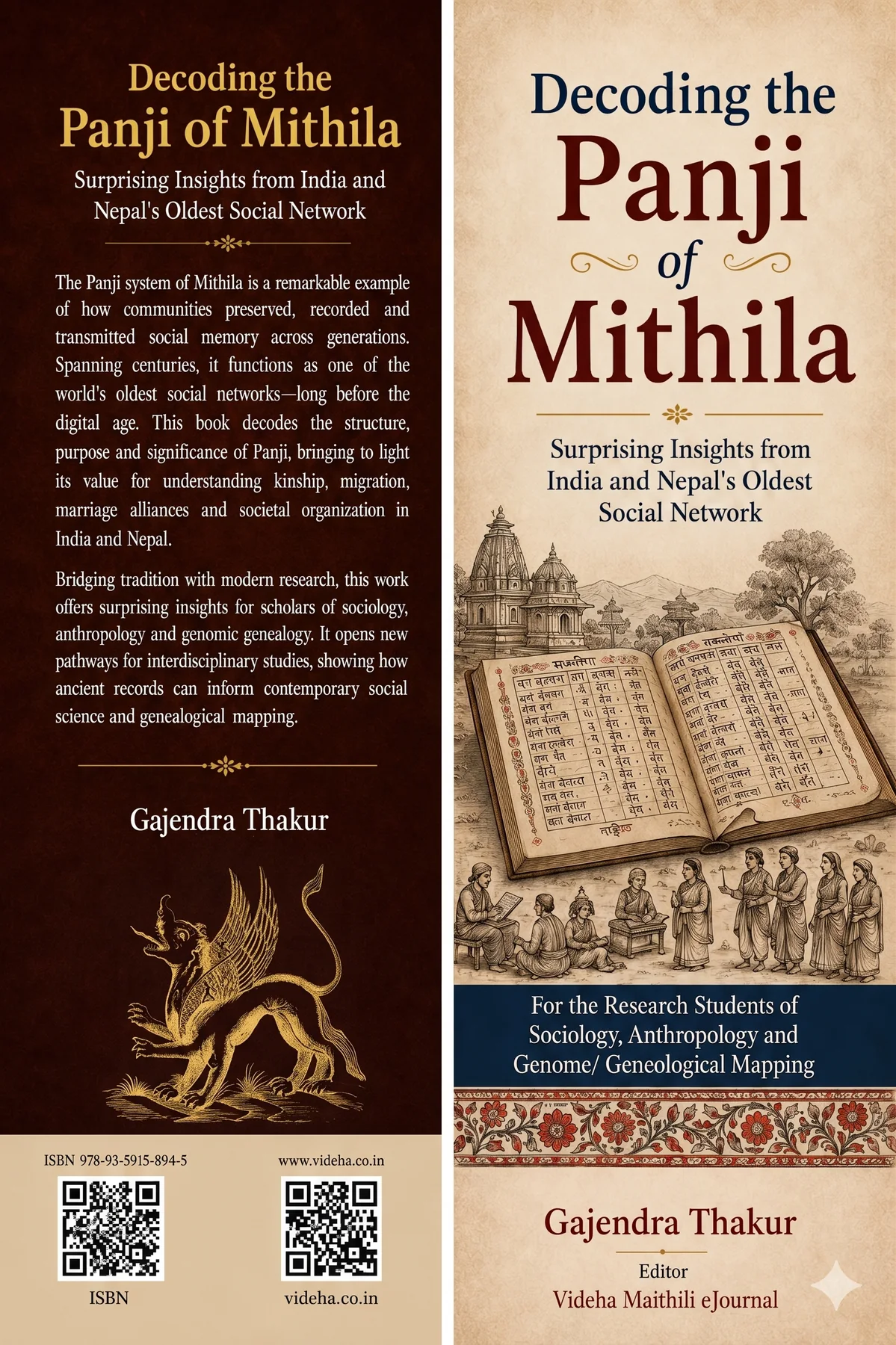
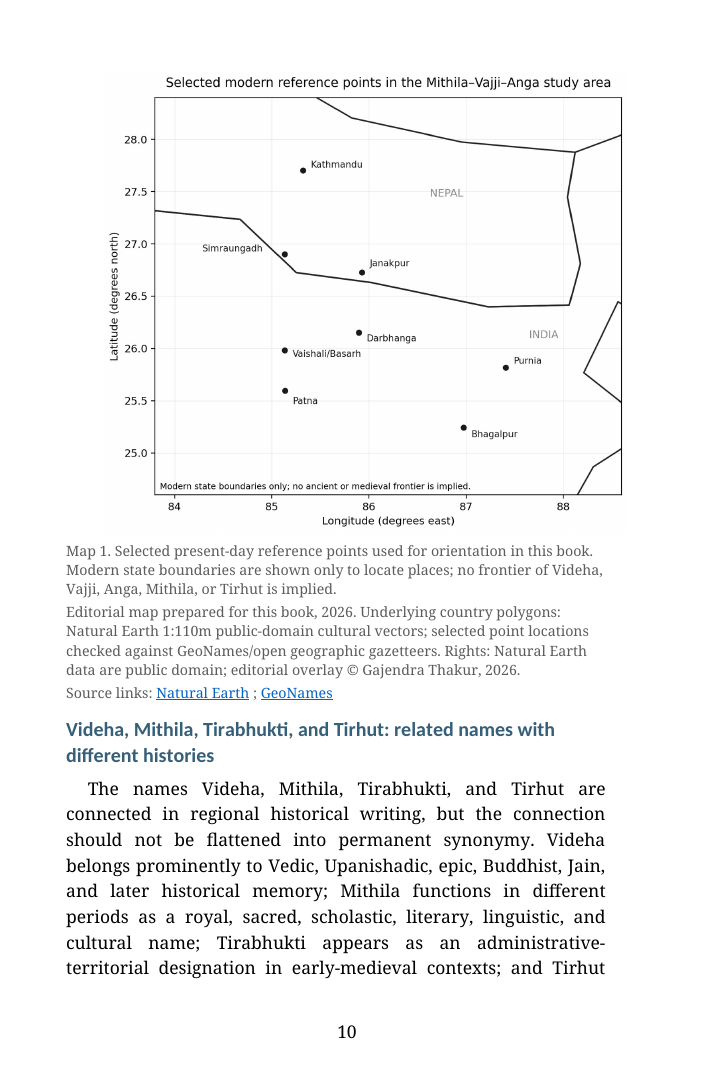
Chapter-specific source notes
- Primary chapter witness. Gajendra Thakur, Decoding the Panji of Mithila — Volume I, formal Chapter 1, PDF pp. 8-26; formal Chapter 1. The HTML transcription is generated from the commit-pinned source PDF and retains the chapter boundary recorded in this edition.
- Internal structure. The repository source-heading inventory records no separately encoded subordinate heading for this chapter.
- Digital editorial method. The page keeps the preserved source text distinct from generated navigational, concordance, visual, and provenance apparatus. The synthetic reconstruction is explanatory only and is not evidence for an individual lineage or a determination of social or marital status.