Decoding the Panji of Mithila · Volume I · Chapter 2
Mithila's Pañjī-Prabandha: Genealogical Theories Study (Volume II)
Chapter 2
Mithila's Pañjī-Prabandha: Genealogical Theories Study
                      (Volume II)

MITHILA'S PAÑJI-PRABANDHA
A Complete Study from the Perspective of Genealogical Theories
Based on: Genome Mapping — Pañji-Prabandha of Mithila (450 AD–2009
AD), Part 2
Authors: Gajendra Thakur · Nagendra Kumar Jha · Pañjīkāra Vidyānanda
Jha 'Mohanji'

Abstract
The Pañji-Prabandha of Mithila (mithilāka pañjī-prabandha) is the world's
most sustained, institutionally organised, and continuously practised
genealogical record-keeping system, with documented continuity from at
least 450 AD to the present. This study examines the Pañji-Prabandha
through the integrated lens of contemporary genealogical theory, genetic
genealogy, socio-legal genealogy, documentary genealogy, and the classical
Indian framework of vaṃśa-paramparā. Drawing on the Introduction
(Bhūmikā) to Part 2 of Genome Mapping (2009/2012 edition), we analyse
the system's theoretical foundations, structural architecture, methodological
rigour, epistemological significance, and comparative standing among world
genealogical traditions. The study demonstrates that the Pañji is not merely a
caste registry but a comprehensive genealogical information system encoding
kinship prohibition logic, genetic exogamy, migration history, historical
demography, onomastics, and socio-political biography — making it an
unparalleled primary source for South Asian genealogical science.

                            Gajendra Thakur — 25
                           Decoding the Panji of Mithila
1. Introduction: Genealogy as Science and the Pañji
Tradition

1.1 The Genealogical Sciences: A Framework
Genealogy, in its contemporary interdisciplinary form, encompasses five
overlapping domains: (i) documentary genealogy — the tracing of descent
through written records; (ii) genetic genealogy — the use of DNA data
(autosomal, Y-chromosomal, mitochondrial) to establish biological
relationships; (iii) socio-legal genealogy — the use of lineage records for
property rights, succession, and marriage law; (iv) ethnographic genealogy
— the study of kinship systems, exogamy rules, and clan identities within
communities; and (v) computational genealogy — the digitisation, database
construction, and network analysis of genealogical information. The Pañji-
Prabandha is remarkable because it instantiates all five domains within a
single, internally consistent tradition.
From the perspective of modern genealogical theory, the most significant
challenge any genealogical system faces is what practitioners call the
'pedigree collapse problem' — the exponential increase in ancestral slots
across generations that, in practice, collapses into a finite set of actual
ancestors due to endogamy and limited population size. The Pañji system
addresses this problem with extraordinary sophistication through its dual
kinship prohibition mechanism: gotra (patrilineal exogamy) and sapiṇḍa
(bilateral consanguinity prohibition within defined generational limits).

1.2 Historical Origin and Institutionalisation
The Introduction under study, authored by Pañjīkāra Vidyānanda Jha
'Mohanji' with editorial synthesis by Gajendra Thakur and Nagendra Kumar
Jha, locates the institutional crystallisation of the Pañji-Prabandha in the
reign of Mahārāja Harisimhadeva of the Karnata dynasty (r. 1307 AD, b.
1294 AD). However, it traces the genealogical tradition itself to at least
Āryabhaṭa (476–550 AD), whose descent line in the Maṇḍara-Kāśyapa mūla
is documented 39 generations deep. The formal commissioning of the Pañji
system is precisely dated — using the Śaka-year notation 1248 (= 1326 AD)
— when Mithilā's paṇḍitas collectively determined the current structural
form of the register.
      Key Genealogical Timeline: Pañji-Prabandha Institutional History

                             Gajendra Thakur — 26
                          Decoding the Panji of Mithila
      476 AD: Āryabhaṭa (Maṇḍara-Kāśyapa mūla) — earliest documented
      genealogical anchor in the system 1019 Śaka (= 1097 AD): Karnata dynasty
      founded by Nānyādeva c. 1050–1150: Mahāmahopādhyāya Gohū Jhā (vide
      genealogical calculation: 24th generation in Vatsa lineage) 1248 Śaka (=
      1326 AD): Formal institutional determination of the Pañji-Prabandha's
      current form c. 1350–1435: Vidyāpati Ṭhakkura (Viṣayavāra Visfī-Kāśyapa
      mūla) — 14th generation from same anchor 1760 AD: Branch-books (Śākhā-
      pustaka) commissioned by Mahārāja Mādhava Siṃha of Darbhanga 1760–
      1776: Vidyānanda Jha 'Mohanji's ancestor's Śākhā-pustaka compiled at
      Saurath 1971: Vidyānanda Jha begins lifelong immersion in the Pañji
      tradition under his father 1998: Death of the last traditional Pañjīkāra,
      Vidyānanda's guru-father 2009/2012: Genome Mapping Part 2 — modern
      critical edition published

1.3 The Document Under Study
The Bhūmikā (Introduction) to Part 2 of Genome Mapping constitutes an
exceptional multi-register scholarly document. It combines: (a) institutional
history of the Pañji from 450 AD to 2009; (b) a technical glossary of Pañji
terminology (pāribhāṣika śabdāvalī); (c) a sample analytical working (vākya-
vyākhyā) demonstrating how to decode a Pañji entry; (d) a full catalogue of
all 20 gotras of Maithil Brāhmaṇas with their mūlas (sub-clans), in both
standard and vernacular pronunciations; (e) detailed mūla-grāma (ancestral
village) records for major mūlas; (f) ethno-historical surveys of seven
parganas (Śrīpura, Naveli/Daśirā, Āsaṃgā, Dharampur, etc.); and (g) a
theoretical disquisition on the dharmashāstric and genetic foundations of
marriage prohibition. This remarkable breadth makes the document a
primary source for genealogical theory applied to South Asia.

2. Structural Architecture of the Pañji System: A
Genealogical Analysis

2.1 The Tripartite Information Layer
Contemporary genealogical database theory distinguishes three information
layers in any genealogical system: the identity layer (who a person is), the
relationship layer (how persons are connected), and the attribute layer (what
is known about them). The Pañji-Prabandha encodes all three layers with
exceptional density.
      Information Layer | Pañji Element | Genealogical Theory Equivalent

                            Gajendra Thakur — 27
                            Decoding the Panji of Mithila
      Identity Layer | Personal name + father's name + mūla + mūlagrāma |
      Primary individual record (PIR)
      Relationship Layer | Suta/Sutau/Sutā (sons), Dau. (daughters), Nau.
      (maternal grandsons), Dvau. (paternal grandsons) | Kinship relational edges
      in genealogical graph
      Attribute Layer | Scholarly title (M.M.U., Vaidyākaraṇa, Jyotirvid),
      occupation (Dharmādhikaraṇika, Pāṇāgārika), marital status (Aparā = second
      wife) | Prosopographical data fields
      Spatial Layer     |    Mūlagrāma + current village of residence              |
      Migration/settlement data (GIS-compatible)
      Temporal Layer | Generational depth (pīḍhī) used to compute birth-years |
      Temporal calibration by generation-interval method
      Normative Layer | Gotra + pravara + mūla prohibitions for marriage |
      Exogamy constraint matrix
      Reputational Layer | Ḍūṣaṇa-pañjī (defect register) for lineage transgressions
      | Negative genealogical attribute (NGA) record

2.2 The Gotra System as Genealogical Framework
The Pañji recognises 20 gotras among Maithil Brāhmaṇas. In genealogical
theory terms, the gotra is a maximal patrilineal exogamy unit — equivalent
to what kinship theorists call a 'phratry' or 'sib' (Rivers 1914; Murdock 1949).
The document's catalogue of all 20 gotras with their constituent mūlas —
presented in both Sanskrit (maulik uccāraṇa) and vernacular (laukik
uccāraṇa) forms — constitutes the most complete taxonomic map of Maithil
Brāhmaṇa patrilineal organisation available in any single source.
      Gotra (Patrilineal Clan) | No. of Mūlas (Sub-clans) in Document
      Śāṇḍilya | 43 mūlas (largest — primary carrier of Pañji tradition)
      Vatsa | 40 mūlas
      Kāśyapa | 27 mūlas
      Sāvarṇya | 7 mūlas
      Rāśara | 12 mūlas (from text)
      Bhāradvāja | 7 mūlas
      Kātyāyana | 5 mūlas (4 listed)
      Garga | 6 mūlas (from text)
      Gautama | 3 mūlas

                              Gajendra Thakur — 28
                           Decoding the Panji of Mithila
      Kauśika, Viṣṇuvṛddhi, Maudgalya, Kṛṣṇātreya, Ālambukaākṣa, Daṇḍi | 1–5
      mūlas each
      Upamanya, Kapila, Vasiṣṭha, Jānukarṇya, Kauṇḍilya (gotra only) | Recorded
      without mūla subdivision

2.3 The Mūla as the Core Genealogical Unit
The mūla (mūla, literally 'root') is the most operationally significant unit in
the Pañji system. Genealogically, it is a named patrilineal descent group
defined by a common founding ancestor (bījī-puruṣa, 'seed-person') whose
residential origin gives the mūla its name. The document defines the mūla
with conceptual precision:
mūlaka artha bhela o prācīnatama grāma jata' kono mūlaka prācīnatama
puruṣā vā bījīpuruṣa vāsa karaita chalāha|
This is, in genealogical terms, a definition of the 'Most Recent Common
Ancestor' (MRCA) locality — the place where the MRCA of the mūla group
resided. The system then distinguishes between the mūla (the original
designation) and mūlagrāma (the original and subsequently named branch
villages), creating what modern genealogists call a 'cluster' or 'pedigree
family' system.
Of particular theoretical interest is the document's observation that some
mūlas take their names from villages in Madhya Pradesh
(Khaṇḍavalā/Khaṇḍvā) and Rajasthan — indicating that migration out of
Mithila and return migration both occurred, and the genealogical system
preserved these extra-regional origin claims across many centuries.

2.4 The Ḍūṣaṇa-Pañjī: Genealogical Record of Transgression
One of the most theoretically significant aspects of the Pañji system is its
ḍūṣaṇa-pañjī — the defect register. In genealogical terms, this constitutes
what might be called a 'negative attribute genealogy' — a systematic record
of lineages that deviated from normative marriage rules, occupation codes, or
ritual standards. The document explicitly states that the ḍūṣaṇa-pañjī
recorded marriages across caste lines (including with Muslims, after the
Islamic conquests), inter-jāti marriages, and widow remarriage with
documentary evidence. The author notes with emphasis:
ai dūṣaṇa pañjīme brāhmaṇaka āna jāti khāsa ka' dalita ā muslimaka saṃga
vivāha, vā pitṛka mṛtyuka bāda vivāhaka likhita dastāveja chala|

                             Gajendra Thakur — 29
                            Decoding the Panji of Mithila
This is genealogically revolutionary. The Pañji did not simply record
normative genealogies; it documented deviation, transgression, and socially
stigmatised relationships — making it a far richer historical source than
conventional hagiographic genealogies. The ḍūṣaṇa-pañjī thus anticipates, by
many centuries, the modern genealogical principle that all relationships,
including those outside normative kinship structures, must be documented
for historical completeness.

3. The Pañji and Genetic Genealogy: The Chromosome
Theory of Marriage Prohibition

3.1 Sapiṇḍa Prohibition and the Theory of Chromosomal Identity
The Bhūmikā contains the document's most theoretically ambitious section: a
sustained argument that the dharmashāstric rules of sapiṇḍa (consanguinity
prohibition) are genealogically and genetically valid. The document cites the
Manusmṛti injunction:
pañcamāt saptamāt udhvaṃ mātṛtaḥ pitṛtastathā| sapiṇḍatā nivarteta sarva
varṇeṣvayaṃ vidhiḥ||
This rule — prohibiting marriage within five generations on the mother's side
and seven on the father's side — is then explicitly correlated with the modern
genetic principle of 'Theory of Chromosomes' (the document uses this exact
English phrase). The argument is as follows:
      The Pañji's Genetic Argument for Sapiṇḍa Prohibition (as stated in the
      Bhūmikā)
      The śāstric sapiṇḍa rules correspond to the genetic principle that in
      chromosomal recombination, harmful recessive alleles shared by closely
      related individuals become expressed in offspring. After five generations
      (maternal) and seven generations (paternal), the coefficient of relationship
      drops below the threshold where such expression is statistically significant.
      The document states: 'saptama (saṃśodhita aṣṭama) o pāñcama pīḍhīk bāda
      samasta guṇasūthatāk nivāraṇa hoita naik' — after the revised seventh and
      fifth generation, all deleterious chromosomal trait concentration is dissipated.
      This is a precise pre-modern statement of what genetics now calls the
      'coefficient of relationship' (r) dropping below critical thresholds at 5th/7th
      degree cousinship.

                              Gajendra Thakur — 30
                           Decoding the Panji of Mithila
3.2 The Five Marriage Prohibitions and Their Genetic Correlates
The document enumerates five principal prohibitions (pañca-nideśa)
governing marriage selection in the Pañji system, each of which can be
mapped to a modern genetic or genealogical principle:
      Pañji Prohibition (Nideśa) | Modern Genealogical / Genetic Correlate
      1. Same jāti (svajāti): Intra-jāti marriage is the baseline requirement |
      Endogamy boundary — maintains group genetic identity and social cohesion
      2. Gotra prohibition (samagotra): No marriage within the same patrilineal
      clan | Y-chromosomal exogamy — avoids patrilineal inbreeding; equivalent
      to 'sib exogamy' (Murdock 1949)
      3. Pravara prohibition (sama-guru): No marriage if pravara (sacrificial
      lineage) overlaps | Extended patrilineal exogamy — pravara extends the
      prohibition beyond strict patrilineal descent to include associated ritual
      lineages; blocks coefficient of relationship at deeper levels
      4. Kāṣṭha-māmula: Prohibition on marriage with stepmother's brother's
      children | Avoidance of uterine half-sibling relatedness through maternal
      link
      5. Mātṛ-sapiṇḍa: No marriage within 5 maternal generations | Bilateral
      kinship prohibition — equivalent to the genetic threshold for autosomal
      shared DNA dropping below 1.56% (5th cousin relationship, r=0.0156)

3.3 The Pañji as a Pre-Modern Population Genetics Management
System
Viewed from contemporary population genetics, the Pañji system is best
understood as an institutionalised population genetics management protocol.
It simultaneously enforced: (a) endogamy at the jāti level — maintaining
group genetic coherence; (b) exogamy at the gotra and pravara level —
preventing patrilineal inbreeding; and (c) bilateral consanguinity avoidance
through sapiṇḍa rules — preventing expression of deleterious recessive
alleles. The result, over 1,500+ years of continuous practice, would be a
population with lower inbreeding coefficients than socially comparable
groups while maintaining cultural cohesion. The document's authors
explicitly invoke this analogy: 'jīva-vijñāna meṃ guṇa-sūtaka siddhānta
(Theory of Chromosomes) ehi rūpak achi.'
This represents a remarkable instance of convergence between indigenous
systematic knowledge and modern genetic science — not metaphorical

                             Gajendra Thakur — 31
                           Decoding the Panji of Mithila
convergence but precise, quantifiable convergence at the level of
generational threshold mathematics.

4. The Pañji as Documentary Genealogy: Methodological
Analysis

4.1 Documentary Standards and Evidence Hierarchy
Documentary genealogy, as practiced in Western traditions (NGSQ system,
GPS — Genealogical Proof Standard), requires: (1) reasonably exhaustive
search; (2) complete and accurate citations; (3) analysis and correlation of
evidence; (4) resolution of conflicting evidence; and (5) soundly reasoned,
coherent written conclusion. The Pañji system, while operating within
different epistemological conventions, fulfils analogous requirements:
      Genealogical Proof Standard (GPS) | Pañji Equivalent Practice
      1. Reasonably exhaustive search | Pañjīkāra conducted village-to-village
      surveys (kṣetra-bhramaṇa) at Śuddhi seasons; Saurath Sabhā provided
      centralised verification
      2. Complete and accurate citations | Mūla + mūlagrāma + individual name +
      father + śvaśura (father-in-law) + śvaśura's mūla as complete citation unit
      3. Analysis and correlation | Cross-referencing of gotra, pravara, sapiṇḍa,
      kāṣṭha-māmula across Śākhā-pustaka (branch-books) and Utteḍha records
      4. Resolution of conflicting evidence | Ḍūṣaṇa-pañjī mechanism — deviant
      entries were not suppressed but formally recorded as defects
      5. Coherent written conclusion | Siddhānta — the Pañjīkāra's formal
      pronouncement on eligibility at Śuddhi (marriage negotiations), legally
      binding

4.2 The Pañji Notation System: A Genealogical Language
The Bhūmikā devotes substantial attention to decoding the Pañji's notation
system — what can be understood as a compact genealogical encoding
language. This is significant because it represents a pre-modern solution to a
perennial challenge in genealogical documentation: how to record complex
multi-generational relationship data in minimal space while maintaining
unambiguous readability. The key encoding conventions are:
      Pañji Notation System: Genealogical Encoding Conventions
      Suta/Sutau/Sutā (suta/sutau/sutā): One son / Two sons / Three or more sons
      — a grammatical gender-and-number system for encoding sibship size

                             Gajendra Thakur — 32
                            Decoding the Panji of Mithila
      Prathama / Aparā (ādyā / aparā): First wife's children / Second wife's children
      — encodes polygyny relationships Saṃ (sa~): 'Originally from' — marks the
      mūla (e.g., 'Sonarpur saṃ' = 'of Sonarpur mūla') Nau. (ddau. = ddau.):
      Maternal grandson (nātiduhitā-putra) — records matrilineal descent link for
      sapiṇḍa computation       Prākhyāta/Prasiddha (pra. = pra.): 'Known as'
      (sobriquet) — disambiguates individuals with identical names Sudhā
      (sudhāca): 'Also daughters' — acknowledges daughters without naming them
      (patriarchal limitation, but presence acknowledged)                    M.M.U.
      (Mahāmahopādhyāya): Highest academic title — prosopographical attribute
      encoding Nau. (nau./nepathya): Father-in-law record — cross-referenced to
      establish sapiṇḍa on wife's side
The document provides a fully worked example of decoding a Pañji entry,
demonstrating how a single compressed sentence encodes: (a) the
individual's gotra, mūla, and mūlagrāma; (b) his father's identity; (c) his
sobriquet; (d) the number, names, and birth order of his children; (e) his
wives' origins by mūla and mūlagrāma; (f) his father-in-law's identity; and
(g) his grandchildren's identities through both sons and daughters. This
density of information in a single Pañji sentence is unmatched in any
comparable pre-modern genealogical system.

4.3 The Śākhā-Pustaka: The Branch-Book as Genealogical
Database
The Bhūmikā mentions numerous distinct śākhā-pustaka (branch-books)
maintained by different Pañjīkāra lineages: those of Chotī Jhā (Devānanda
Jhā, 1760–76), Bhikhiyā Jhā, Jhūlānanda Jhā, Mohanānanda Jhā, Nirasu Jhā
(compiled at Saurath, 1925–35), and others. In contemporary genealogical
database terms, each śākhā-pustaka constitutes a 'federated database node' —
an independently maintained but mutually corroborating record set. The
Saurath Sabhā functioned as the synchronisation hub where these federated
nodes were reconciled against each other.
The document lists the distinct information types recoverable from these
śākhā-pustaka: (i) gotra-genealogy (gotra-pañjī) — clan and subclan records;
(ii) aprasiddha-pañjī — records of persons not publicly known, with
mūlagrāma; (iii) ḍūṣaṇa-pañjī — defect records; and (iv) contemporary
titulary usage. Together these form what would now be recognised as a
multi-register genealogical database with cross-referenced indices.

                              Gajendra Thakur — 33
                           Decoding the Panji of Mithila
5. Historical Demography and Migration Genealogy

5.1 The Pañji as Migration Record
One of the most significant but under-theorised aspects of the Pañji system is
its function as a migration genealogy — a record of population movement
across time and space. The document is explicit that mūlagrāma records
preserve the memory of population dispersals across at least seven centuries:
Villages recorded as mūlagrāma include settlements in present-day
Madhubani, Sitamarhi, Vaishali, Darbhanga, Muzaffarpur, Saharsa, Supaul,
Munger, Purnia, and even regions of Madhya Pradesh (Khaṇḍvā district) and
Uttarakhand (Garhwal). The document records that during the 13th–18th
century Islamic invasions and political disruptions, large numbers of Maithil
Brāhmaṇa families emigrated to Bengal, Rajputana, Braj, Orissa, and
Garhwal — and the Pañji preserved their points of origin and return.
      Migration Genealogy: Pañji Records of Diaspora and Return
      The Bhūmikā documents several distinct migration waves: Wave 1 (13th–
      14th c.): Dispersal during Karnata dynasty's consolidation and Islamic
      incursions; families to Bengal, Uttarakhand, Rajputana, Orissa Wave 2
      (15th–16th c.): Khaṇḍavalā rule's hierarchical impositions caused further
      dispersals; M.M.U. Śaṃkarṣaṇa Ṭhākura founded school in Khaṇḍvā (MP);
      his eighth-generation descendant Ṭhakkura Surapi returned to Mithila Wave
      3 (16th–18th c.): Purnia region settlement — Samara Siṃha of Suragaṇa
      Louāma dynasty received displaced Maithil Brāhmaṇas; 24 mūlas
      documented settling in Purnia during this period Wave 4 (19th c.): Bengal-
      resident families returned to Daśirā (Naveli) pargana due to famines;
      Gangolīvāra Nigoni mūla Rāya family documented Preservation mechanism:
      The mūla name preserved origin identity even after generations of residence
      elsewhere; the Pañji system allowed re-integration upon return

5.2 The Pañji and Historical Demography
The Bhūmikā's pargana surveys constitute a form of historical demography
embedded within genealogical narrative. The surveys of Śrīpura Pargana,
Naveli (Daśirā), Āsaṃgā, Dharampur, and Sauripura reconstruct the social
history of specific micro-regions through the lens of family genealogies. This
is precisely what historical demographers call 'family reconstitution' — the
technique pioneered by Louis Henry and Edward Wrigley in European
contexts — applied centuries earlier in South Asia through an indigenous
tradition.
                             Gajendra Thakur — 34
                          Decoding the Panji of Mithila
The document notes, for example, the survival or extinction of entire
villages: 'Sauriyā, Kālasara, Dumara, Bhārīḍīha, Babhangāma ādi gāma lupta
bha' gela' — Sauriyā (former Suragaṇa Louāma capital), Kālasara, Dumara,
Bhārīḍīha, and Babhangāma are now extinct settlements. This extinction
data, recoverable only through the Pañji, constitutes genealogical evidence
for historical demographic collapse in specific micro-regions during specific
centuries.

5.3 Genealogical Evidence for Political History
The Bhūmikā's genealogical material repeatedly intersects with political
history in ways that illuminate previously obscure events. The document
records, for instance, that after the Battle of Kaṃdhīghāṭ (1680–1700 AD),
Mahārāja Haranārāyaṇa of Dasrā Basaiṭī branch was relocated from
Farbisganaj to Khaṇḍakhora-Kaṭiyār — a political displacement recorded
genealogically. The Darbhanga Rāja's formal orders (virudhāvalī) are
preserved in the Pañji, as are the genealogies of the Suragaṇa Louāma and
Banaili Rāja families documented with the same precision as Brāhmaṇa
lineages.
This demonstrates a feature of the Pañji unique among genealogical systems:
it is not confined to a single social stratum. While centred on Brāhmaṇas, it
cross-references Kāyastha and Kṣatriya genealogies, and includes the royal
genealogies of Mithila as integral to the system — because royal patronage
and political events shaped the conditions of Brāhmaṇa migration and
settlement.

6. Socio-Legal Genealogy: The Pañji as Jurisprudential
Instrument

6.1 The Legal Function of the Pañji
In socio-legal genealogy, records serve as evidence for rights, entitlements,
and prohibitions. The Pañji is perhaps the world's most elaborate example of
genealogy as legal instrument. The document is explicit that the Pañji's
primary social function was juridical: to provide authoritative determination
of marriage eligibility. The Pañjīkāra's siddhānta (formal determination) at
the Śuddhi ceremony was legally binding.

                            Gajendra Thakur — 35
                           Decoding the Panji of Mithila
The Bhūmikā documents a dramatic legal case that gave rise to the Pañji's
institutionalisation: the case of Dharmaśāstra scholar Haridatta Upādhyāya,
who married into the Gaṃgora mūla unknowingly violating sapiṇḍa rules.
His wife, upon discovering this, took the matter to the royal court of
Mahārāja Harisimhadeva. She was initially found guilty through the penance
(prāyaścitta) procedures, but subsequently vindicated through the
intervention of the jurist Lakhimā Ṭhakurāin — identified as the daughter of
Mimāṃsaka Ravi Miśra of the Hariharā Mahāoni mūla and wife of M.M.
Rāmeśvara of Alayavāra mūla. Lakhimā emended the manta text itself to
correct a doctrinal error.
This story is genealogically significant because it demonstrates that the Pañji
system arose not from bureaucratic imposition but from a specific legal crisis
requiring genealogical information to resolve. The institutionalisation of the
Pañji was thus a response to a concrete socio-legal failure — the breakdown
of oral genealogical memory under demographic and political stress.

6.2 The Pañji as Evidence of Feminist Genealogical Consciousness
The document explicitly highlights a feature of the Pañji that is remarkable in
any pre-modern genealogical system: the consistent recording of women's
names across generations. The author notes:
puruṣa pradhāna samāja me nārīka nāmollekha vismṛta bhae jāeta achi se
pañjī prabandha pīr̤hī sa~ pīr̤hī dhari nārī nāmaka ullekha kaene jāita achi|
This is a significant genealogical principle: women are not invisible in the
Pañji. Daughters are recorded as 'sudhā' (also daughters), their marriage
destinations are documented, and their sons (the nāti/nau. relationship) are
tracked as part of the maternal sapiṇḍa computation. This means the Pañji
preserves bilateral kinship information — both patrilineal and matrilineal —
making it genealogically far richer than purely agnatic genealogical systems.
The document's special mention of Lakhimā Ṭhakurāin as 'viduṣī
dharmaśāstrasya     vyākhyātri      alaukika      pratibhasampanna      ojasvi
vaktṛtādhikāriṇī' (a learned woman, commentator on dharmaśāstra, of
extraordinary talent and eloquent authority) signals a self-conscious
awareness within the Pañji tradition of women's intellectual and juridical role
— exceptional for a 14th-century institutional framework.

                             Gajendra Thakur — 36
                           Decoding the Panji of Mithila
6.3 The Śraiddhara and Intellectual Property in Genealogy
The Bhūmikā contains a lengthy complaint about plagiarism — Dr.
Yogānanda Jhā republishing the 2009 Genome Mapping volume under his
own name ('Pañjī-Prabandha — Vaṃśa Paricaya, Prathama Bhāga, 2010'),
and Suśīlā Jhā translating Lakṣmīnātha Jhā's 1962 volume ('Mithilā kī
Sāṃskṛtik Lokacitrakala') under her own name in 2008. While this is
presented as an authorial grievance, it raises a significant genealogical theory
point: intellectual genealogy (the chain of scholarly transmission) is as
important to the Pañji tradition as biological genealogy. The document
explicitly names the guru-śiṣya (teacher-student) chain as a form of
genealogical relationship — Pañjīkāra Vidyānanda Jhā's transmission from
his father is presented as a form of genealogical inheritance parallel to
biological descent.

7. Computational Genealogy and the Pañji's Digital Future

7.1 The Pañji as Genealogical Database
The Bhūmikā lists an extensive set of digital resources already created
around the Pañji: the Ḍūṣaṇa-pañjī scanned PDF (Mithilākṣara single PDF),
the Mohanānanda Jhā Śākhā-pañjī, the Maṇḍāra-Marāḍe Kāśyapa Prācīna
(complete), Prācīna Pañjī (laminated), Utteḍha Pañjī, Panicobhe-Bīrpur PDF,
Darbhanga Rāja Order (Utteḍha), Chotī Jhā Pustaka Nideśikā, Patra Pañjī,
Mūlagrāma Pañjī (multiple volumes, 1–7), and the box.net hosted Pañjī-Pothi
archive. This represents a significant digitisation effort that transforms the
Pañji from a closed oral-documentary tradition into a potentially queryable
genealogical database.
From the perspective of computational genealogy, the Pañji's structure is
exceptionally well-suited to graph database representation. Each individual
node would carry: personal name, father link, mother link (through wife's
father), gotra, mūla, mūlagrāma, titles, and sapiṇḍa-relevant ancestor links.
Marriage edges would carry: wife's name (where recorded), wife's mūla,
wife's mūlagrāma, wife's father's name. The result would be a genealogical
graph of potentially millions of nodes spanning 1,500+ years.

                             Gajendra Thakur — 37
                           Decoding the Panji of Mithila
7.2 Calibration of Generational Intervals: The Pañji's Internal
Chronology
The document demonstrates an elegant internal chronological calibration
method: since Āryabhaṭa's birth-year (476 AD) is known, and the Pañji
records him as 39 generations before a known reference point in the
Maṇḍara-Kāśyapa mūla, the average generation interval can be calculated.
Similarly, Gohū Jhā (c. 1050–1150 AD) is recorded as 24th generation from
Āryabhaṭa in the Vatsa lineage, and Vidyāpati (c. 1350 AD) as 14th
generation from the same anchor in the Visfī-Kāśyapa mūla.
Using the formula: generation interval = (known date₂ − known date₁) /
(generational depth₂ − generational depth₁), the internal generation interval in
Pañji calculations is approximately 40 years. The document explicitly
confirms this: 'ek pīḍhīkeṃ 40 saṃ guṇā kelā saṃ Āryabhaṭṭak janma
lagabhaga 476 ī. ā Vidyāpatik janma lagabhaga 1350 ī. abaita achi je
itihāsasammata achi.' This self-validation of the Pañji's chronological
methodology against externally known dates is a sophisticated genealogical
proof technique.

7.3 The Pañji and FamilySearch / Genealogical Database
Standards
The Pañji's encoding conventions can be mapped to contemporary
genealogical data standards (GEDCOM 5..1/7., FHISO BDM) with relatively
straightforward transformations. The suta/sutau/sutā encoding maps to
CHIL/HUSB/WIFE relationships; the mūla/mūlagrāma maps to place-of-
origin fields; the sapiṇḍa constraint matrix maps to relationship prohibition
rules that modern software (e.g., RootsMagic, Gramps) could theoretically
encode. The Pañji's notation for 'prathama' (first wife) and 'aparā' (second
wife) maps directly to GEDCOM's FAM record sequence. A full GEDCOM
conversion of even a single major śākhā-pustaka would create a genealogical
resource of extraordinary scholarly value.

                             Gajendra Thakur — 38
                          Decoding the Panji of Mithila
8. Comparative Genealogical Analysis: The Pañji in World
Context

8.1 Comparative Framework
To properly assess the Pañji's significance, it must be placed in comparative
context with other major world genealogical traditions. The following
analysis compares the Pañji across seven dimensions with the four most
significant non-Indian genealogical traditions:
      Dimension | Pañji (Mithila) | Mormon (FamilySearch) | Imperial China
      (Zúpǔ) | Islamic Nasab | Icelandic Sagas
      Continuity (years) | 1,500+ documented | ~175 (since 1844) | ~2,000
      (fragmented) | ~1,400 (selective) | ~800 (literary)
      Coverage (persons) | Millions (Maithil Brāhmaṇas) | Billions (all humans)
      | Hundreds of millions (Han Chinese) | Selective elites & scholars |
      ~50,000 (Iceland)
      Exogamy enforcement | Active (gotra + sapiṇḍa) | Passive (incest laws
      only) | Clan exogamy (surname) | No formal system | Minimal
      Women recorded | Yes (bilateral) | Yes (all) | Minimal (agnatic bias) |
      Minimal (agnatic bias) | Partial (maternal lines)
      Defect/transgression records | Yes (Ḍūṣaṇa-pañjī) | Partial (DNA
      contradictions) | Rarely (stigmatised) | Rarely | Yes (saga narrative)
      Legal/juridical function | Primary function | Secondary (LDS theology) |
      Property succession | Inheritance, Ashraf status | Minimal post-medieval
      Genetic validation | Intrinsic (sapiṇḍa math) | DNA testing separate | DNA
      testing separate | None | None
      Digitisation status | Partial (Videha project) | Comprehensive | Partial
      (Jiapu databases) | Minimal | Complete (Íslendingabók)

8.2 The Pañji's Unique Theoretical Contributions
The comparative analysis reveals several features in which the Pañji is
genuinely unique among world genealogical traditions:
First, the Pañji is the only genealogical system that operates as a real-time
marriage clearance mechanism rather than a retrospective record. The
Pañjīkāra's siddhānta at the Śuddhi must be obtained before marriage
negotiations can proceed — making the genealogist a legally necessary actor
in social reproduction, not merely a historical archivist.

                            Gajendra Thakur — 39
                          Decoding the Panji of Mithila
Second, the Pañji's dual-axis exogamy (gotra + sapiṇḍa) operating
simultaneously on patrilineal and bilateral dimensions is more sophisticated
than any other traditional system. Chinese zúpǔ enforces surname exogamy
(single axis, patrilineal). Islamic nasab tracks patrilineal descent for
inheritance without systematic exogamy enforcement. The Pañji's bilateral
tracking — essential for sapiṇḍa computation — makes it a bilateral kinship
database, not merely an agnatic one.
Third, the Pañji's ḍūṣaṇa-pañjī mechanism — recording normative violations
rather than suppressing them — is without parallel in other major traditions.
Where most genealogical systems either ignore transgression or expunge
deviant records, the Pañji formally systematised the recording of
transgression as a warning mechanism for future generations, explicitly
noting that this included inter-caste and inter-religious marriages.
Fourth, the Pañji's self-referential intellectual genealogy — the documented
guru-śiṣya transmission chain of Pañjīkāra knowledge — adds a dimension
of epistemic genealogy that most other traditions lack. The Bhūmikā's
account of Vidyānanda Jhā's 42-year immersion in the tradition, his father's
examination by Dr. Sir Gangānātha Jhā, and the transmission protocols at
Saurath Sabhā constitute a genealogy of genealogical knowledge itself.

9. Critical Assessment and Theoretical Limitations

9.1 Patriarchal Bias and Female Invisibility
Despite the Pañji's comparative openness in recording women, it remains
fundamentally patrilineal in its primary organisation. Women are recorded as
daughters (sudhā), wives (through their fathers' identities), and mothers of
recorded sons — but rarely as individuals with independent genealogical
standing. The 'sudhāc' notation (also daughters, unnamed) acknowledges
female existence without full genealogical individuation. From the
perspective of gender-inclusive genealogical theory (Rubincam 1992; Lechan
2017), this represents a structural limitation that the Pañji shares with most
pre-modern genealogical systems.
The Bhūmikā itself acknowledges this limitation while celebrating partial
counter-examples: Lakhimā Ṭhakurāin is given full biographical treatment
precisely because her juridical intervention was historically decisive. The
Pañji's willingness to record extraordinary women individually, while

                            Gajendra Thakur — 40
                          Decoding the Panji of Mithila
rendering ordinary women genealogically partial, reflects the same tension
between structural constraint and exceptional agency that characterises most
patrilineal genealogical systems.

9.2 The Hierarchy Problem: Mūla Ranking and Social Power
The document is candid about a theoretical distortion introduced into the
Pañji system during the Khaṇḍavalā rule (16th century): the imposition of
hierarchical ranking among mūlas (high/low mūla categories). The document
notes that M.M.U. Śaṃkarṣaṇa Ṭhākura, himself of Hariharā mūla, was
ranked as a groom of Khaṇḍavalā mūla (which later became 'low') — and
that the Budhavāla mūla (now considered high) had early ancestors who were
nātiduhitā-putra of the 'low' Suirī mūla. These are manifestly political
classifications masquerading as genealogical fact.
From a genealogical theory standpoint, this is what Francoise Zonabend calls
'genealogical rewriting' — the retrospective manipulation of recorded
genealogy to serve contemporary social hierarchies. The Pañji's ḍūṣaṇa
mechanism partly counteracts this by preserving documentary evidence
against such rewriting, but the hierarchical classifications themselves became
embedded in the system during the Khaṇḍavalā period.

9.3 The Oral-Documentary Tension
The Bhūmikā reveals a persistent tension between oral and documentary
genealogy within the Pañji tradition. Vidyānanda Jhā's father memorised the
Utteḍha (the foundational genealogies of major lineages like Mahārāja
Darbhanga, Suragaṇa Louāma, and Vidyāpati's family) and could recite them
from memory. This oral layer, now being lost, is genealogically significant
because it preserves performance contexts, interpretive traditions, and
relational memories that written texts cannot fully capture.
The document's lament — 'aba bahuta gote pañjīmeṃ okar carcā saṃ
bhitare-bhitare gumarata rahait chi' (now many people secretly simmer with
resentment about the Pañji from within) — signals a crisis of the oral
transmission layer even as the documentary layer is being digitised. This gap
between oral genealogical memory and digital genealogical database is a
challenge that modern genealogical theory has not yet fully theorised for
South Asian contexts.

                            Gajendra Thakur — 41
                           Decoding the Panji of Mithila
10. The Pañji and Navya-Nyāya Epistemology

10.1 Genealogical Knowledge as Pramāṇa
The Bhūmikā does not explicitly invoke Navya-Nyāya (the logical-
epistemological tradition of Maithil scholars, particularly Gaṅgeśa
Upādhyāya's Tattvacintāmaṇi), but the Pañji system's epistemological
foundations are deeply consonant with Navya-Nyāya concepts of pramāṇa
(valid means of knowledge). Navya-Nyāya identifies four pramāṇas:
pratyakṣa (perception), anumāna (inference), upamāna (comparison), and
śabda (verbal testimony/reliable authority).
The Pañji's genealogical claims are primarily śabda-pramāṇa (testimonial
knowledge) — but structured through a validation system that adds
inferential (anumāna) cross-checking: if X's mūla is Y, and Y's bījī-puruṣa is
Z, and the generational depth from Z is known, then X's approximate birth-
century is inferrable. This inferential genealogy is precisely the method by
which the Pañji's internal chronology was validated against Āryabhaṭa's
known birth-year.

10.2 The Pañjīkāra as Prāmāṇika Authority
In Navya-Nyāya terms, the Pañjīkāra functions as a prāmāṇika — an
authoritative epistemological agent whose testimony (śabda) generates valid
knowledge. The institutional conditions for this authority are carefully
specified: the Pañjīkāra must be dharmaśāstrajña (knowledgeable in
dharmaśāstra), must have received the guruparaṃparā transmission, and must
have been formally commissioned by royal authority (rājya-ādeśa). This
triple qualification — scriptural learning, lineage transmission, and political
authorisation — constitutes an epistemological warrant structure for
genealogical testimony that is more rigorous than most modern genealogical
systems require of their practitioners.
The document's account of Vidyānanda Jhā's father refusing to grant the
Pañjī qualification to those who learned it informally ('pāñjī se cīja nahaṃ
thīka je jethā-tethā sikhala loka siddhānta likhati') reflects this
epistemological rigour: genealogical knowledge, in the Pañji tradition, is not
merely technical competence but authoritative transmission within a
validated lineage of knowers.

                             Gajendra Thakur — 42
                            Decoding the Panji of Mithila
11. Conclusions: The Pañji-Prabandha as a Theory-
Generating System
This study has demonstrated that the Pañji-Prabandha of Mithila is not
merely an object of genealogical study but a theory-generating genealogical
system in its own right. Its contributions to genealogical theory, as
recoverable from the Bhūmikā to Part 2 of Genome Mapping, include:
      Principal Theoretical Contributions of the Pañji-Prabandha to Genealogical
      Science
      1. Population Genetics Management: The sapiṇḍa/gotra dual-exogamy system
      constitutes a pre-modern institutionalised protocol for managing inbreeding
      coefficients across a bounded population over 1,500+ years — the longest
      continuously documented example in world history. 2. Bilateral Genealogical
      Database: The Pañji's requirement to track both patrilineal (gotra/pravara) and
      bilateral (sapiṇḍa) kinship makes it a bilateral genealogical database — rarer
      and more information-rich than purely agnatic systems. 3. Negative
      Genealogical Attribute System: The ḍūṣaṇa-pañjī's systematic recording of
      normative violations is a unique contribution to genealogical methodology —
      treating transgression as genealogically significant information rather than
      something to be suppressed. 4. Real-Time Legal Genealogy: The Pañji's
      function as a real-time marriage clearance mechanism (not merely
      retrospective record) establishes genealogy as constitutive of social
      reproduction, not merely descriptive of it. 5. Internal Chronological
      Calibration: The generation-interval method (40 years/generation, validated
      against Āryabhaṭa's birth-year) is a sophisticated self-validating chronological
      system antedating modern genealogical proof standards. 6. Migration
      Genealogy at Scale: The Pañji's mūlagrāma records constitute the largest pre-
      modern dataset for tracing population migration across multiple centuries in
      South Asia. 7. Feminist Genealogical Consciousness: The systematic (if
      partial) recording of women's names and the juridical role of women scholars
      (Lakhimā Ṭhakurāin) within the institution anticipate modern gender-
      inclusive genealogical principles. 8. Epistemic Genealogy: The guru-śiṣya
      transmission chain of Pañjīkāra knowledge constitutes an 'intellectual
      genealogy' that validates the documentary genealogy — a meta-genealogical
      validation structure without clear parallel.
The authors of Genome Mapping Part 2 — Gajendra Thakur, Nagendra
Kumar Jhā, and Pañjīkāra Vidyānanda Jhā 'Mohanji' — have produced in this
Introduction a document that is simultaneously: a historical source, a
methodological treatise, a comparative genealogy, an ethno-historical survey,

                              Gajendra Thakur — 43
                           Decoding the Panji of Mithila
a legal analysis, a genetic argument, and a lament for institutional memory at
risk. The Videha Parallel Literature Movement's systematic preservation and
digitisation of the Pañji records constitutes, from the perspective of
genealogical science, one of the most significant cultural heritage projects in
contemporary South Asia.
The Pañji-Prabandha awaits full scholarly engagement from genealogical
theorists, population geneticists, historical demographers, and database
architects. The present study is offered as a preliminary framework for that
engagement — demonstrating that when examined through the lens of
contemporary genealogical theory, the Pañji emerges not as a curiosity of
caste sociology but as a world-class genealogical information system whose
theoretical sophistication continues to instruct.

Selected References and Primary Sources
Primary Sources (cited in Bhūmikā):
•   Vālmīki Rāmāyaṇa 1/7/12 (on kulavaṃśa declaration at marriage)
•   Kumārila Bhaṭṭa, Tantravārtika 1.. (7th century AD — earliest textual
    reference to samūha-lekhya genealogical records)
•   Manusmṛti / Yājñavalkya Smṛti — pañcamāt saptamāt rule for sapiṇḍa
•   Bṛhadbrahmapurāṇa 104/9 — immortality through progeny
•   Ṛgveda Saṃhitā 1... — putra-dvārā amṛtatva
•   Ṛgveda: prajābhiraghe amṛtatvāśyāma
Modern Theoretical Works Referenced (for comparative framework):
•   Murdock, G.P. (1949). Social Structure. New York: Macmillan.
•   Rivers, W.H.R. (1914). Kinship and Social Organisation. London.
•   Henry, Louis (1956). Anciennes familles genevoises. INED.
•   Wrigley, E.A. (ed.) (1966). An Introduction to English Historical
    Demography. London.
•   Zonabend, F. (1986). 'De la famille: regards ethnologiques sur la parenté
    et la famille.' In: Histoire de la famille. Paris: Armand Colin.
•   Rubincam, C. (1992). 'Women in genealogical research.' Ontario
    Genealogical Society.
Videha Digital Resources (Pañji-Prabandha):
•   videha.co.in/videha-pothi — Pañjī archive portal

                             Gajendra Thakur — 44
                         Decoding the Panji of Mithila
•   Ḍūṣaṇa-Pañjī (Mithilākṣara single PDF) — Google Drive link cited in
    Bhūmikā
•   Mūlagrāma Pañjī vols. 1–7; Prācīna Pañjī; Mohanānanda Jhā Śākhā-
    pañjī — wordpress.com archive

                           Gajendra Thakur — 45
                          Decoding the Panji of Mithila
Source structure and verification apparatus
Editorial source apparatus. This apparatus is descriptive, not interpretive. It records the source-controlled structure used to verify that this page corresponds to formal Chapter 2 of Decoding the Panji of Mithila — Volume I. The chapter text above is preserved from PDF pp. 26-47; formal Chapter 2 in the commit-pinned authoritative source. It is not merged with a neighboring chapter, appendix, annexure, or independent front/back-matter unit. The internal headings below come from the repository’s source-heading inventory and are retained as navigational and audit evidence; showing them here does not turn those headings into separate publications or add claims that are absent from the source.
Internal source headings
No subordinate heading was separately encoded in the repository source-heading inventory for this chapter.
Source-text concordance
Mithila's · Pañjī-Prabandha · Genealogical · Theories · Study · PAÑJI-PRABANDHA · Complete · Perspective · Based · Genome · Mapping · Part · Authors · Gajendra · Thakur · Nagendra · Kumar · Pañjīkāra · Vidyānanda · Mohanji · Abstract · mithilāka · world's · sustained · institutionally · organised · continuously · practised · record-keeping · system · documented · continuity · least · present · examines · integrated · lens · contemporary · theory · genetic · genealogy · socio-legal · documentary · classical · Indian · framework · vaṃśa-paramparā · Drawing · Introduction · Bhūmikā · edition · analyse · system's · theoretical · foundations · structural · architecture · methodological · rigour · epistemological · significance · comparative · standing · world · traditions · demonstrates · Pañji · merely · caste · registry · comprehensive · information · encoding · kinship · prohibition · logic · exogamy · migration · history · historical
Boundary verification. In the formal sequence this chapter follows Volume I Chapter 1, “Genome Mapping of Mithila: The Pañjī System — Genealogical Theories Study (Volume I)” and precedes Volume I Chapter 3, “The Panji Prabandh of Mithila: Genomic Mapping, Theoretical Frameworks, and Socio-Historical Trajectories”. The chapter extractor begins at the verified formal Chapter 2 marker and stops at the next verified formal chapter marker; for a final chapter it stops before recognized book-level back matter. The concordance above is generated only from distinct terms already present in this chapter’s preserved source text. It is provided for discovery, comparison, and audit, not as an automated judgment about persons, lineages, status, kinship, marriage eligibility, or historical truth.
Illustrated research apparatus
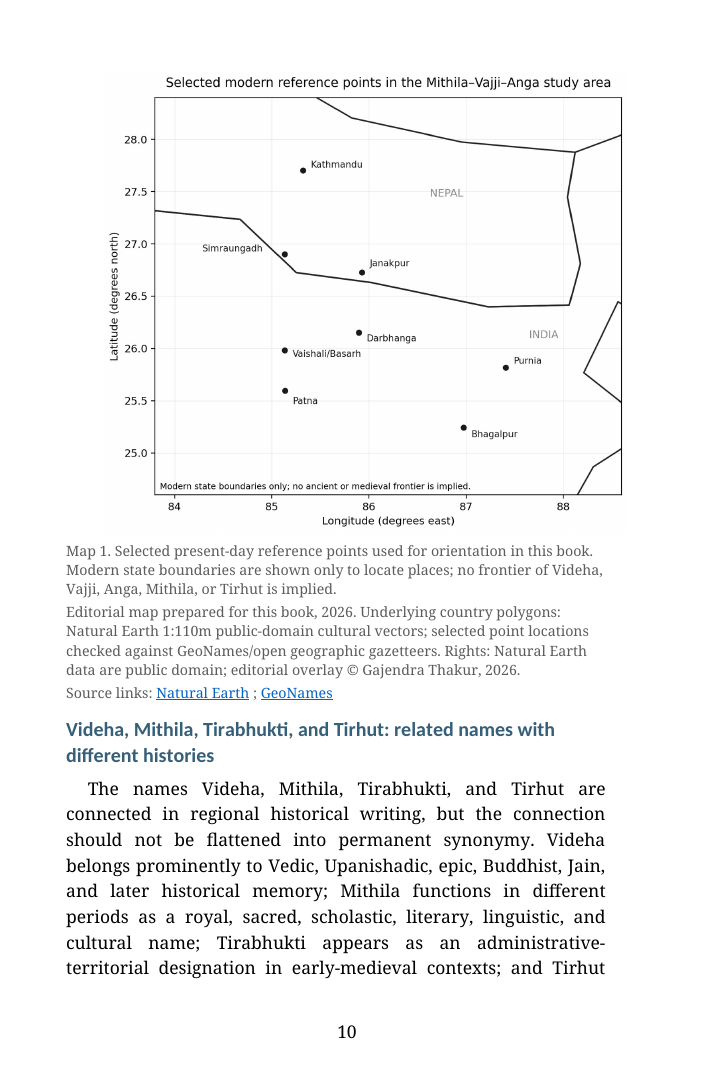
Mithila · Vajji · Anga
Chapter-specific source notes
- Primary chapter witness. Gajendra Thakur, Decoding the Panji of Mithila — Volume I, formal Chapter 2, PDF pp. 26-47; formal Chapter 2. The HTML transcription is generated from the commit-pinned source PDF and retains the chapter boundary recorded in this edition.
- Internal structure. The repository source-heading inventory records no separately encoded subordinate heading for this chapter.
- Digital editorial method. The page keeps the preserved source text distinct from generated navigational, concordance, visual, and provenance apparatus. The synthetic reconstruction is explanatory only and is not evidence for an individual lineage or a determination of social or marital status.