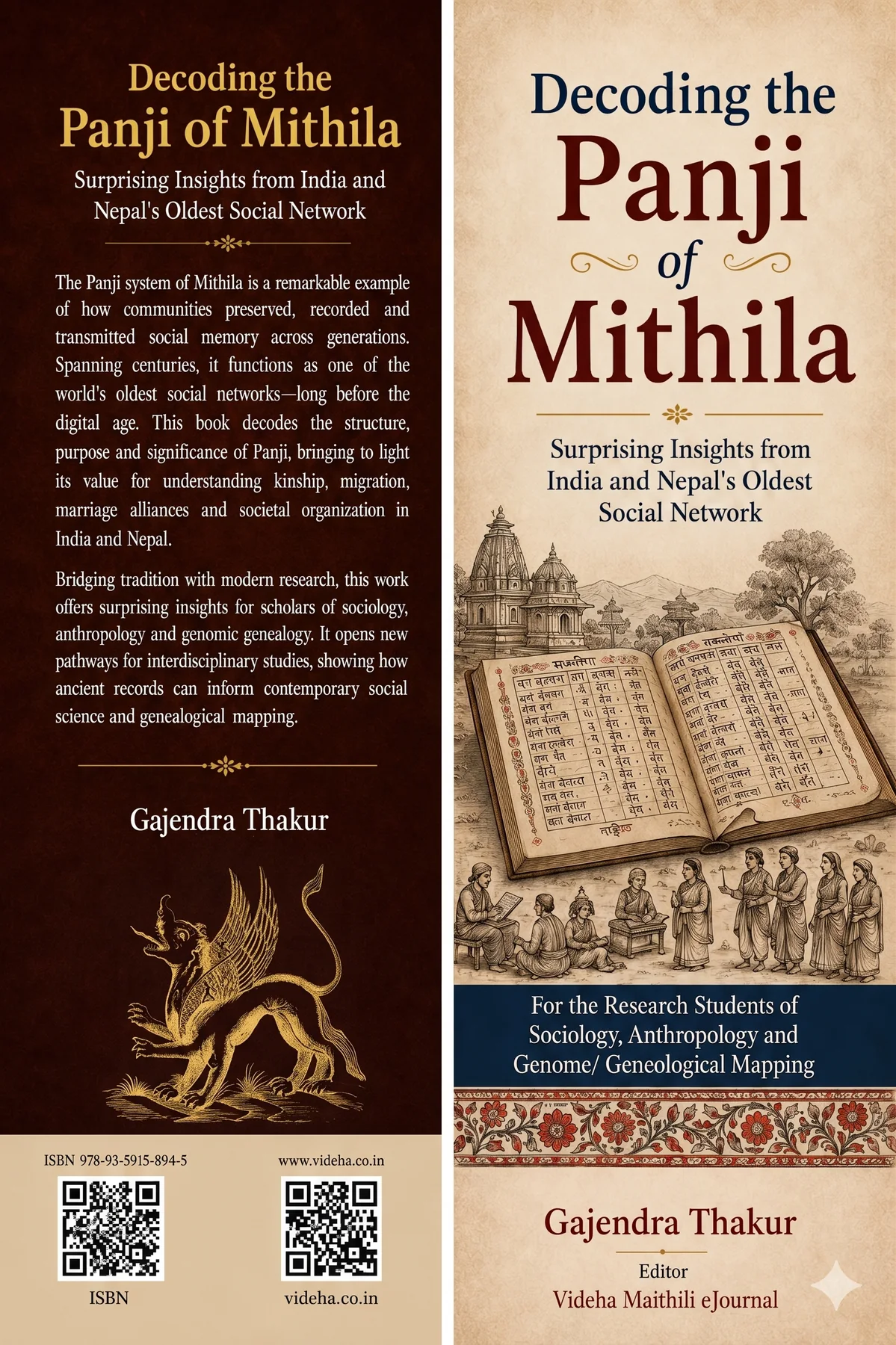
Decoding the Panji of Mithila · Volume I · Chapter 14
Pampilā Pañjī, Khaṇḍa 3 — Nāgarāma: Comprehensive Analytical Report (Volume I)
Chapter 14
Pampilā Pañjī, Khaṇḍa 3 — Nāgarāma: Comprehensive
            Analytical Report (Volume I)

Comprehensive Analysis: Nāgarāma Panji Prabandh (Khanda 3) Videha
Parallel Literature Series

Comprehensive Analytical Report
Nāgarāma Khanda (Khanda 3) of the
Pampilā Panji Prabandh (Genome Mapping 450 AD – 2009 AD)

jīnoma maipiṃga (450 e.ḍī. sa~ 2009 e.ḍī.) – pampilā ñjī
prabandha

Prepared by: Gajendra Thakur, Founder-Editor, Videha
(videha.co.in)
Videha Parallel Literature Movement | A Counter-Canonical Analysis

I. Document Identity and Nature of the Source
The document under analysis is Khanda 3 (khaṇḍa 3), the Nāgarāma section,
of the Pampilā Panji Prabandh — a monumental Maithil Brahmin
genealogical register stretching from circa 450 AD to 2009 AD. The full title
rendered in the document itself reads: 'jīnoma maipiṃga (4 e.ḍī. sa~ 2 e.ḍī.) –
pampilāka ñjī prabandha', which the compilers have imaginatively translated
as 'Genome Mapping', acknowledging the panji system's function as a
biological and social record of descent lines across fifteen-plus centuries.
The panji is not simply a genealogical tree. It is simultaneously a legal
instrument (marriage eligibility is determined by consulting it), a sociological
archive (recording village affiliations, professional titles, and marital
alliances), a linguistic record (preserving old Maithili orthography and place-
                            Gajendra Thakur — 292
                           Decoding the Panji of Mithila
name forms), and a political document (reflecting the distribution of learned
Brahmin families across the Mithila region and its diasporas extending to
Bengal, Nepal, Purnea, Muzaffarpur, Munger-Banka, Saharsa, Madhubani,
Darbhanga, and Champaran). This Khanda covers the 'Nāgarāma' territorial
cluster — a web of villages in the Madhubani-Darbhanga belt — and
contains 225 numbered blocks spread across pages 3. to 3. of the printed
edition.

1.1 The Panji System: An Institution
The Pampilā Panji tradition is traced to Harisingh Deva, king of Mithila (fl.
14th century), who commissioned a systematic registration of Maithil
Brahmin families under five Panji offices, each responsible for a territorial
cluster. The Nāgarāma Panji was one of these five, covering the central and
northern Madhubani region. The register was maintained orally and in
manuscript form, updated by hereditary Panji officers (panjikāra). The
present printed edition represents a modern consolidation and 'genome
mapping' of those records — cross-referenced, indexed by serial number, and
extended to living individuals as of approximately 2005–2009.
The social function is critical: no Maithil Brahmin marriage is considered
legitimate without panji consultation. The register determines whether a
proposed alliance would violate the rules of sapinda (common ancestor
within seven generations) or sagotra (same clan/lineage). The document thus
continues to have immediate legal-social force for the Maithil Brahmin
community worldwide, including in diaspora settings.

1.2 Layout Conventions and Reading Grammar
The document follows a formulaic grammar that the reader must decode to
extract meaning. Every block is structured around a chain of descent
expressed through the following grammatical particles in Maithili:
      suta / sutā / suto | son/s / daughter/s / two sons — the subject of the main
      descent line
      dau (dauhitra) | grandson through a daughter = maternal uncle-nephew
      linkage, indicating the person's mother's natal family
      ddau (dauhitrīdauhitra) |    two generations maternal; marks the second
      maternal cross-reference
      ṭha. (ṭhākura) | honorific prefix; denotes a male head of household of high
      standing

                            Gajendra Thakur — 293
                            Decoding the Panji of Mithila
      pā~ (pā~ca = paṃcāṃga) | prefix indicating a scholar-astrologer family or
      learned Brahmin
      jyo. (jyotiṣī) | jyotiṣī — hereditary astrologer; professional title retained as
      prefix
      vaiyā. (vaiyākaraṇa) | grammarian; indicates formal training in Sanskrit
      Vyākaraṇa
      maho. (mahopādhyāya) | mahopādhyāya — an honorific Sanskrit title for
      senior scholars
      ma.ma. (mahāmahopādhyāya) | the highest traditional Sanskrit scholar's title
      pra. (prasiddha nāma) |       'known as'; marks an alternate/popular name
      following the formal name
      karamahā, valiyāsa, sakarāḍhī… | village names — the key geographic
      cross-references in every block
      aparā | another; marks a second or subsequent wife's lineage or son
The reading direction is: Personal name → titles/aliases → village of bride's
family → her father's name → her father's father's name → marker 'dau' →
maternal cross-link village → maternal grandfather's name → 'ddau'. Each
such unit describes one marriage alliance. Multiple 'aparā' sections describe
polygamous or subsequent alliances.

II. Territorial Geography of the Nāgarāma Cluster
The Nāgarāma Khanda is named for the central hub village of Nāgarāma,
which functions as the nodal reference point for this cluster's panji office.
The territorial extent documented in this Khanda is vast, encompassing
villages across at minimum five modern districts of Bihar and beyond. The
following geography is decoded from the block headings:

2.1 Core Villages (Primary Settlement Zones)
The primary genealogical villages — those whose male lines are traced as
the 'main' descent — include: Sandahpur (sandahapura), Shishpur (śiśapura),
Katka (kaṭakā), Khāngud (khā~gur̤a), Sakurī (sakurī), Sarisab (sarisaba),
Bhad-gāma (bhar̤agāma), Gaur Sodarpur (gaura sodarapura), Raiyan
(raiyāma), Digaundh (digaundha), Mahishī (mahiṣī), Kanhaulī (kanhaulī),
Suvai (sakurī pallī), Phūldāhā (phūladāhā), Jamdaulī (jamadaulī), Harisauli
(hasaulī), Jagaur (jagaura), Khorrī (khorara), Rohand (rohār̤a), Pāchadī
(pacār̤hī), Parahi (parahī), Haripur (haripura), Samaiyā (samayā), and Sukhait

                             Gajendra Thakur — 294
                          Decoding the Panji of Mithila
(sukhaita). These are the villages whose Brahmin families' descent lines form
the structural backbone of the Khanda.

2.2 Alliance Villages (Cross-Reference Matrix)
The marriage-alliance villages — cited in the 'dau/ddau' positions —
constitute a far broader network. Recurring alliance villages mentioned
across hundreds of blocks include: Karamahā (karamahā), Valiyās (valiyāsa),
Sarisab (sarisaba), Pandua (paṇḍuā), Khauāl (khauāla), Pālī (pālī), Saurath
(saurāṭha), Sodarpur (sodarapura), Bhauralī (bhaura-khaṇḍabalā), Dandapāṇi
(daṇḍapāṇi), Darihara (dariharā), Ekahara (ekaharā), Pabauli (pabaulī),
Māṇḍar (māṇḍara), Kusaut (gusauta), Jajiwāl (jajjivāla), Bhelauṃc
(belau~ca), Narauṇ (narauna), Pahilwārā (pahalavārā), Kujaulī (kujaulī),
Uchit (ucita), Bharatpurā, Gusaut, Saktihā (satalakhā), and dozens more.
This network extends geographically beyond the core Madhubani district
into: Darbhanga (villages like Valiyās, Pandua, Sodarpur), Sitamarhi
(Narauṇ), Muzaffarpur (Bachha-kotā area, Machakanautā), Purniyā (Nāhar,
Banaili, Rāṇiṭol), Saharsa-Supaul (Dātha, Berāhī), Champaran (Canapur,
Pacadhī), and Nepal (Janakpur belt). The diaspora reach documented
includes Bhagalpur, Munger, and even references to urban postings.

2.3 Village Name Standardisation Issues
A significant research challenge in this document is the variable spelling of
village names. The same village appears under multiple orthographic forms:
'valiyāsa / baliyāsa / valiyāma' are all the same Valiyās; 'bhelau~ca /
belau~ca / velau~ca' are all Bhelauṃca. This reflects the organic, oral
transmission of the panji tradition and the multiple hands involved in
compilation. Cross-referencing requires a normalisation map of
approximately 60–80 village name variants.

III. Deep Structural Analysis of Selected Blocks
The following section provides close analytical readings of specific
numbered blocks. Each block is treated as a unit of genealogical, linguistic,
sociological, and historical data. The blocks are selected to represent
different types of lineage structures, title clusters, geographic zones, and
temporal depths.

                           Gajendra Thakur — 295
                           Decoding the Panji of Mithila
3.1 Blocks 1–4 (Pages 3.2–3.3): Sandahpur–Sishpur Cluster
Block 1 — (nagarāma sandahapura sa~ sihavār̤a, Page 3.2)
This is the opening block of the Khanda and encodes one of the most
structurally complex lineage chains, beginning from a reference point coded
as (270/2), which is a cross-index to another Panji register. The genealogical
chain opens:
      ṭha. ā~khī sutā lāla pra. guṇākara udana paraśmani hīrākā karamahā sa~ nanū
      sūta gaṃgeśa dau (270/5) paḍuā sa~ pā~ paśupati dau ṭha. lāla suto
      nagaradhārī abadha nabahārī kau hariama sa~ bhavakṛṣṇa sūta prānnātha dau
      dariharā sa~ śivadatta dau
Decoding this opening chain reveals several layers simultaneously:
NAME STRUCTURE: The first named individual is 'ṭha. ā~khī' (Thākur
Āṃkhī) — 'Āṃkhī' is an informal/affectionate name (literally 'eyes'),
extremely common in Mithila's folk naming tradition where body-part
names, nature names, and auspicious syllable combinations are used. His
children are listed: 'lāla pra. guṇākara' (Lāl, known as Guṇākar), 'udana',
'paraśmani', and 'hīrā'. The 'pra.' abbreviation (prasiddha = popular name)
indicates that 'lāla' was the formal panji name but 'guṇākara' was how he was
actually known — a crucial distinction showing the gap between registration
names and living identities.
ALLIANCE STRUCTURE: 'karamahā sa~ nanū sūta gaṃgeśa dau' tells us
that the daughters of Āṃkhī married into the Karamahā village, specifically
into the family of Gaṃgeśa, son of Nanū. The name 'gaṃgeśa' (Gaṃgeśa) is
significant — it is a Navya-Nyāya philosopher's name, specifically borne by
Gaṃgeśa Upādhyāya of Navadvīpa (Darbhanga origin, fl. c. 1325 AD), the
founder of the Tattvacintāmaṇi school. This raises the question of whether
this entry records an early alliance with the philosopher's family or a
namesake tradition honouring him. The cross-reference '(270/2)' suggests the
full lineage pre-dates this section and can be found in another Khanda.
DESCENT CONTINUITY: 'ṭha. lāla suto nagaradhārī abadha nabahārī kau'
— Lāl (= Guṇākar) had two sons: Nagardhārī and Avadhnavahārī. The
coupling 'suto...kau' (suton...kau) is the dual form, indicating exactly two
male heirs. 'hariama sa~ bhavakṛṣṇa sūta prānnātha dau' — Nagardhārī's
family sought a bride from Hariam village, from the family of Prānnātha, son
of Bhavakṛṣṇa. This is then counter-linked: 'dariharā sa~ śivadatta dau' — the
maternal counter-link goes to Darihara village, specifically Śivadatta.

                            Gajendra Thakur — 296
                          Decoding the Panji of Mithila
What this complex four-village network (Sandahpur origin → Karamahā
alliance → Hariam bride → Darihara maternal link) in a single opening
paragraph reveals is the principle that Maithil Brahmin marriage alliances
operated as a quadrilateral system: one does not simply note a marriage, but
records the full four-node genealogical context that determines future
marriage eligibility for all descendants.

Block 2 — Second Branch from Sandahpur (Page 3.2)
Block 2 continues the Sandahpur–Sishvad lineage but focuses on a different
sub-branch beginning with 'ṭha. udana' (Udana), a brother of Āṃkhī's
children. The critical entry reads:
      ṭha. harṣamani pra. naharā suto bācāka: karamahā sa~ citradhara suta ṛddhi
      dau dariharā sa~ binū dau ṭha. bācā sutā bālāmukunda rājā gānā chedīkā
Here 'harṣamani pra. naharā' (Harṣamaṇi, known as Naharā) has one son
Bācā. The name 'naharā' is an interesting informal name from the Maithili
folk lexicon, and 'harṣamani' is a compound of 'Harṣa' (joy/delight) + 'maṇi'
(gem) — a style of naming reflecting the 'gem of joy' sentiment. Bācā's four
children are: Bālāmukunda, Rājā, Gānā, and Chedī — note that 'Rājā' is used
as a personal name, not a title. This is characteristic of Mithila naming
practice where royal epithets (Rājā, Rāṇā, Thākur) circulate as given names,
especially in high-status Brahmin families.
'ṭhe. bāla mukunda sutā paṇḍuā sa~ pā~ buddhinātha suta pā~ thāḍū dau
karamahā sa~ śyāmanātha dau' — Bālāmukunda's family is identified
through double alliance: bride from Pandua (family of Thādū, son of
Buddhinātha, himself a 'pā~' = learned Brahmin) and maternal link to
Karamahā (Śyāmanātha). The title 'pā~' on both 'pā~ buddhinātha' and 'pā~
thāḍū' indicates this was a hereditary scholarly family of the Pandua cluster.

Block 5 — Sandahpur to Shishpur Lineage (Page 3.2–3.3)
Block 5, headed 'sandahapura sa~ śiśapura (367/2)', is structurally rich
because it shows the branching of a single ancestral line into multiple
geographically dispersed sub-families over several generations. The entry
opens:
      ṭha. bandhu suto madhurāpati narapati pālī sa~ nandana suta manahara dau
      khauāla sa~ vidyāpati dau ṭha. madhurāpati suto vācha śivānandano belau~ca
      sa~ lālā suta bālacandra dau karamahā sa~ vaṃśīdhara dau

                            Gajendra Thakur — 297
                          Decoding the Panji of Mithila
The name 'narapati' (Narapati = lord of men) alongside 'madhurāpati'
(Madhurāpati = lord of sweetness/Mathura) in the same sibling set shows the
poetic naming conventions of the period. 'ṭha. bācha sutā citradhara
caṇḍīdatta phatura rāma lakṣmaṇa' — four sons with markedly different
naming styles: Citradhara (pictorial/artistic name), Caṇḍīdatta (gift of
goddess Caṇḍī), Phaturam (vernacular Maithili-Hindi compound), and
Lakṣmaṇa (Rāmāyaṇa epic name). This mixture of Śākta names (Caṇḍīdatta),
Vaiṣṇava-epic names (Lakṣmaṇa), and folk Maithili names (Phaturam) in
one sibling set reflects the religious pluralism of 17th–18th century Mithila
households.
'sakarāḍhī sa~ devakṛṣṇa suta śyāmalāla dau hariama sa~ ramānātha dau' —
The bride for Citradhara's line comes from Sakrādī village, family of
Śyāmalāl son of Devakṛṣṇa, with maternal link at Hariam (Ramānātha). This
is the first appearance in Khanda 3 of the Sakrādī cluster, which emerges as
one of the most frequently cited alliance villages across the entire Nāgarāma
Khanda.
The most significant entry in Block 5 is the sub-branch 'muktinātha sutā
vighneśa dineśa bhaveśa maheśā' — four sons of Muktinaātha all bearing
names ending in '-eśa' (lord), a poetic symmetry in naming that marks a
cultivated literary family. The subsequent generation: 'ṭha. vidhneśa sutā
vaccā pra. umeśa pīlū nareśa pūranā' shows the next generation using more
informal names alongside formal ones — 'pīlū' is an extremely
informal/affectionate diminutive.

3.2 Block 33 (Page 3.11): Khāngud to Padahiyā — A Three-
Generation Scientific Profile
Block 33 is one of the most intellectually significant in the entire Khanda
because it records a lineage containing a professional scientist (yaṃtrajña =
mechanical/instrument engineer) alongside traditional scholarly designations.
      yaṃtrajñadayānātha sutā tārānanda candrānandau sakarāḍhī sa~ lānhā suta
      gokulānanda dau pālī sa~ pā~ curmana dau (tārānanda suto narendra
      amarendro
The prefix 'yaṃtrajña' (Yantrajna = one who knows/works with
machines/instruments) applied to Dayānātha is a remarkable intrusion of
modern professional vocabulary into the ancient panji genre. The panji
traditionally used titles like 'vaiyākaraṇa', 'jyotiṣī', 'mahopādhyāya'. The
appearance of 'yaṃtrajña' signals that this individual was an engineer or
                           Gajendra Thakur — 298
                           Decoding the Panji of Mithila
technical professional in the colonial or early post-independence period. The
panji officer preserved this designation as part of identity, just as it had
preserved 'pāṭhaka', 'jyotiṣī', and 'vaidya' for generations.
Dayānātha's two sons: Tārānanda and Candrānanda. The alliance for this
generation: 'sakarāḍhī sa~ lānhā suta gokulānanda dau' — from Sakrādī, the
family of Gokulānanda son of Lānhā. Tārānanda's two sons Narendra and
Amarendra represent the generation born roughly in the 1930s–1950s. The
subsequent entry reveals a further evolution:
      candrānanda suto sañjaya: mahiṣī budhavāla sa~...harivaṃśa dau sakurī
      valiyāsa...sa~...dau saṃjaya suto...cainapura (baluā)...
Candrānanda's son Sañjaya (Sanjay) represents the generation of the 1960s–
70s. His marriage alliance extends to Chainpur (Balua) — a location in
Saharsa/Supaul district — demonstrating how the Nāgarāma panji network
by the late 20th century spanned an increasingly wide geographic radius.
'jayanātha suto sadācārī arthaudyamī ramānanda sūryamanando' — this entry
is extraordinary. The name 'arthaudyamī' (Arthaudyamī = economic
entrepreneur/businessman) is used as a personal designation alongside the
formal name 'ramānanda', indicating that by the time this person was being
registered, the panji had extended its professional title vocabulary to include
modern economic categories. This family shows the complete arc from
'yaṃtrajña' (engineer-grandfather) to 'arthaudyamī' (businessman-son) across
two generations.
Further in Block 33: 'lalana pra. śyāmānanda suto varuṇa| ānahila hariama
sa~ guṇānanda suta nāgeśvara dau śrīmān guṇānanda suto sadāvattī
nāgeśvara (pra. a.) ḍā. pro. arthaśāstrī (lakṣmeśvaro)' — here 'ḍā. pro.
arthaśāstrī' (Dr. Professor, Economist) is inserted as a professional
designation before a formal name. The full title cluster on one individual —
Dr., Professor, Economist (Artha-śāstrī) — followed by the personal name
Lakṣmeśvara shows how the panji adapted to absorb modern academic
credentials as identity-defining markers. This professor-economist's lineage
goes back to the 'yaṃtrajña' engineer in the same block, giving us three
professional generations visible within the genealogical record.

                            Gajendra Thakur — 299
                          Decoding the Panji of Mithila
3.3 Block 122 (Page 3.35): Kanhaulī to Māṃgaraunī — The
Justice, the IAS Officer, and the C.P.M. M.P.
Political and Administrative Professions in the Panji
Block 122 contains one of the most politically significant clusters in the
entire Khanda. It is headed 'kanhaulī sa~ māṃgaraunī (62)' and contains an
extraordinary concentration of high modern public offices recorded within a
single genealogical sequence:
      dūtakhī pra. lūṭaneśvara sutā bhaiyā candrā pra. sadde jāge hīṃgū nagirajā
      rājendrā: pālīsa~ nityānanda suta bholānātha dau pabaulī sa~ nārāyaṇadatta
      ddau śītala sutā jasṭisa amaranātha kamalanātha pro: trilokanātha I.A.S.
      vindunāthā dariharā sa~ digambara suta vaiyā. śivaśaṃkara dau didhosa~
      muktinātha ddau
Śītala's four children are listed: Justice Amarnātha, Kamalnātha, Prof.
Trilokanātha (I.A.S.), and Vindunātha. The designation cluster here is
unprecedented: a High Court Justice ('jasṭisa'), a Professor who is also an
IAS officer (the rare combination of academic and administrative civil
service), all within one sibling set.
The marriage-alliance entry for this generation reads 'dariharā sa~ digambara
suta vaiyā. śivaśaṃkara dau didhosa~ muktinātha ddau' — the bride came
from Darihara village, family of Vaidyākaraṇa (Sanskrit grammarian)
Śivaśaṃkara son of Digambara. This pairing of a Justice/IAS family in the
groom's line with a traditional 'vaiyākaraṇa' family in the bride's line
illustrates the social dynamics of mid-20th century Maithil Brahmin marriage
alliances: modern credentials were valued, but traditional scholarly lineages
remained prestigious marriage targets.
Earlier in the same block: 'jyotiramaṇa sutā paṇḍuā sa~ guṇānanda suta
mejara kṛṣṇānanda dau karamahā sa~ narasiṃha ddau' — the maternal
alliance cites 'mejara kṛṣṇānanda' (Major Krishnānanda), a military officer
from Pandua village. Military rank as a genealogical identifier appearing in
the panji marks the early 20th century period of Maithil participation in the
British Indian Army.
Still further in Block 122: 'vakīla śaṃkarānanda sutā ambikānanda
vivekānanda śitalānanda mitrānandā: narauna sa~ śarmabhunātha suta phuccī
pra. śaktinātha dau' — 'vakīla śaṃkarānanda' (Advocate/Lawyer
Śaṃkarānanda) is another modern professional title inserted as a
genealogical identifier. His children all bear '-ānanda' suffixed names:

                            Gajendra Thakur — 300
                          Decoding the Panji of Mithila
Ambikānanda, Vivekānanda, Śītalānanda, Mitrānanda — all spiritually
charged names, the selection of 'Vivekānanda' being particularly notable as it
echoes the name of the great 19th-century Vedānta reformer, suggesting the
family's intellectual-spiritual orientation in the nationalist period.
The climactic entry in Block 122 comes near the end: 'kālikānanda suto
kulānanda: lakhanaura jhuṃjhārapura karamahā sa~ devānanda suta
khagendra dau... vakīla śaṃkarānanda suto tulānanda C.P.M. (M.P.)
caturānandā:' — here 'C.P.M. (M.P.)' — Communist Party of India (Marxist)
Member of Parliament — appears as a political designation in the panji.
Tulānanda served as a CPI(M) Member of Parliament, and this fact is
recorded in the genealogical register as a defining identity marker for future
marriage consultation purposes, just as 'jyotiṣī' or 'mahopādhyāya' had been
recorded for previous generations. This is arguably the most ideologically
startling entry in the document: a communist parliamentarian's credentials
enshrined in a Brahmin genealogical register that governs marriage eligibility
through descent and purity calculations.

3.4 Block 148 (Page 3.42): Raiyan to Rājahad̤ā — The Allahabad
University Connection
The Most Concentrated Academic Cluster
Block 148 is exceptional for its concentration of academic credentials in a
single family unit. It documents the 'Jigdev' (jayadeva) family of the Raiyan
Sodarpur village:
      ma.ma. jayadeva sutā (EX.V.C. ALLAHABAD UNIVERSITY) ma.ma. pā.
      ḍā. umeśa rameśo khauāla sa~ yadunātha suta janaka dau sodarapura sa~
      hanumāna ddau
The full credential string attached to Jayadeva is breathtaking: 'ma.ma.'
(Mahāmahopādhyāya — the highest traditional Sanskrit title) + 'EX.V.C.
ALLAHABAD UNIVERSITY' (former Vice-Chancellor of Allahabad
University, one of India's premier institutions). The fusion of the medieval
Sanskrit honorific 'mahāmahopādhyāya' with the modern academic
administrative title 'Ex. Vice Chancellor' on a single individual embodies the
Maithil Brahmin ideal of being simultaneously rooted in the Sanskritic
tradition and achieving distinction in the modern Western-educated
administrative framework.

                           Gajendra Thakur — 301
                           Decoding the Panji of Mithila
His sons: 'ma.ma. pā. ḍā. umeśa' (Dr. Umesh, also a Mahāmahopādhyāya and
'pā.' scholar) and 'rameśa'. Dr. Umesh's children: 'pro. jayakānta (Writer
Hist.ry of Maithile Literature) pro. kṛṣṇakāṃta bhūgarbhaśāstrī vijayakānta
prabhākānta pro. sudhākānta' — five children. 'Writer History of Maithile
Literature' is recorded in parentheses in Roman script as a distinguishing
attribute — indicating that Prf. Jayakānta had published a history of Maithili
literature, perhaps one of the early systematic studies of the field.
'bhūgarbhaśāstrī' (Bhūgarbhaśāstrī = geologist) appears as a professional
designation for Vijayakānta — geology as a modern science entering the
panji vocabulary.
The marriage alliance for this generation: 'narauna sa~ taskara ke śava suta
surendra dau dariharā sa~ lakṣmīkānta ddau' — the bride's family from
Narauṇ is identified with 'taskara' (Taskara) as a personal name before
'keśava'. 'taskara' literally means 'thief/smuggler' but functions here purely as
a personal name — Maithili folk naming includes deliberately inauspicious
or 'anti-name' conventions (just as parents sometimes named children 'Chor',
'Bikhāri', or similar words as protective amulets against evil eye or early
death).
The geographical reach of this family is also significant: 'Dr. Jayakānta
suta...Phandaha sân son Parmananda dau...Pandua sân pâṃ Shivnandin d'dau'
— the marriage went to Phandaha and Pandua villages, extending the
alliance network across three distinct territorial clusters of the Nāgarāma
Panji zone.

3.5 Block 183 (Page 3.54–3.55): Rohad to Bhavānīpur — A
Political Dynasty
The Chaudhary (cau.) Baccū Dynasty and Regional Political Power
Block 183 presents what is arguably the most politically concentrated lineage
in the entire Khanda. Beginning with 'cau. baccū' (Chaudhary Baccū), it
documents five generations of a family in which regional political power is
explicitly recorded as genealogical identity:
      cau. baccū sutā ānanda kiśora yugala kiśora navala kiśora nagaravara kiśora
      nandana kiśora paravana kiśorā: valiyāsa sa~ suphala suta rājā dau (09/17)
      karamahā sa~ śītalādatta ddau
Chaudhary Baccū had six sons, all bearing names ending in '-kiśora' (Young
Lord): Ānanda Kiśora, Yugala Kiśora, Navala Kiśora, Nagaravara Kiśora,

                            Gajendra Thakur — 302
                           Decoding the Panji of Mithila
Nandana Kiśora, and Paravana Kiśora. The repetition of the suffix creates a
naming system within the family — a signature pattern that allows instant
identification of siblings and establishes a strong family brand. The 'cau.'
(Chaudhary) prefix indicates zamindari/landed gentry status.
The son Dharmanarayaṇa's descendants are then catalogued with remarkable
specificity: 'harinārāyaṇa suvendra nārāyaṇa mapendra nārāyaṇa śobhendra
nārāyaṇa surendra nārāyaṇā' — five sons again using a suffix-repetition
system with '-nārāyaṇa'. Then: 'surendra nārāyaṇa suto śailendra vijayendra
mahendra...vuārā' — 'vuārā' is an informal/family nickname. The names
'śailendra' (Śailendra), 'vijayendra' (Vijayendra), 'mahendra' (Mahendra) are
all Indra-compound names, another systematic family naming convention.
The entry 'harinārāyaṇa sutā suśīla indra vinoda aśoka manojā' shifts to
entirely modern, colloquial names — Sushil, Vinod, Ashok, Manoj —
marking a generational break in naming convention that correlates with post-
independence urbanisation. The Indra-Nārāyaṇa compounds give way to
single-syllable Bollywood-era names.
Block 184 continues this lineage and records: 'yugala kiśora suto upendra
nārāyaṇa: valiyāsa sa~ raghuvīra suta gayādatta dau (B 57//5) sarisaba sa~
batahana ddau' — noting '(B 57//5)' as a cross-reference to another register
entry. 'upendra nārāyaṇa sutā rāmamohana śyāmanareśa' — the progression
from 'nārāyaṇa' compound names to simple 'rāmamohana' and the adjective-
style 'śyāmanareśa' (Śyāma-Naresh = dark lord, also evocative of Kṛṣṇa)
shows the continuing evolution of naming conventions within the same
bloodline.
Block 185 then enters the explicitly political sphere: 'parabala kiśora suto
devendra nārāyaṇa: hāṭī pālī sa~ yadurāī suta prayāgadatta dau khauāla sa~
ugranātha ddau' and then 'jagadīśa nārāyaṇa sutā...gusauta sa~ kumarasuta
śrīpati dau jajjivāla sa~ bhaiu ddau'. The final entry in Block 185 records:
'(389//8) pati suto manīka: alaya sa~ janādamana suta anātha dau (330/2)
sodarapura sa~ lakṣamana ddau' — cross-references '(389/8)' and '(330/2)'
point to entries in other Panji Khandas, indicating this dynasty's descent is
documented in at least three separate territorial registers, signalling its pan-
Mithila importance.

                            Gajendra Thakur — 303
                               Decoding the Panji of Mithila
IV. Evolution of Professional Titles: A Longitudinal Analysis
One of the most historically valuable analytical layers of the Nāgarāma Panji
is the sequential record of professional designations across generations.
Unlike modern genealogical records that note only names and dates, the panji
preserved occupational identity as an intrinsic component of a person's
genealogical signature. The following analysis traces the arc from traditional
to modern professional titles across the 225 blocks:

4.1 Traditional Scholarly Titles (Pre-1800)
      pā~ (pā~cāṃgika) | Hereditary almanac-maker / astro-calendar specialist.
      Appears in Blocks 1, 5, 16, 26 etc.
      jyo. (jyotiṣī) | Hereditary jyotiṣī / astrologer. One of the most common titles.
      Blocks 5, 14, 22, 38, 65, 91 etc.
      vaiyākaraṇa (vaiyā.) | Sanskrit grammarian. Blocks 27, 28, 55, 66, 91, 109,
      117, 148, 196 etc.
      mahopādhyāya (maho.) | Senior teacher/scholar, higher than 'paṃḍit'. Blocks
      11, 38, 65, 91, 126, 136 etc.
      ma.ma. (mahāmahopādhyāya) | Highest traditional Sanskrit title. Blocks 38,
      51, 91, 112, 148, 190 etc.
      paurāṇika | Specialist in the Purāṇas; hereditary Kathā-performer. Blocks 66,
      106, 166 etc.
      nalatriśāstrācārya   |    Expert in three traditional sciences. Block 72, rare
      specialist title.
      tāṃtrika śiromaṇi | Crown of tantric practitioners. Block 196, very rare.

4.2 Legal and Administrative Titles (Colonial Period, c. 1858–
1947)
      vakīla / Vakīl | Lawyer/Advocate. Blocks 48 (Brigadier Brajamohana), 66,
      122, 139 etc.
      mejara / Major | Military officer, British Indian Army. Block 120, 122 etc.
      ukīla harikānta | 'Ukīl' variant for Advocate. Block 1, very early use.
      dīvāna bhavānīdatta | Dīvān (revenue minister/administrator). Block 186.
      phaujadāra | Military/police officer. Block 97, early modern term.
      bhūgabhaṃśāstrī | Geologist. Block 148, post-independence professional
      science term.

                                Gajendra Thakur — 304
                            Decoding the Panji of Mithila
4.3 Modern Professional and Academic Titles (Post-1947)
      yaṃtrajña | Engineer/Mechanical technician. Block 33. Earliest modern
      professional title.
      ḍā. / Dr. | Medical doctor or PhD. Blocks 33, 34, 35, 36, 100, 120, 148, 174,
      196, 222 etc.
      pro. / Prof. | University Professor. Blocks 120, 122, 148 etc.
      Ex.V.C. | Former Vice-Chancellor (Allahabad University). Block 148.
      Unique entry.
      arthaśāstrī | Economist (academic designation). Block 33.
      arthaudyamī | Economic entrepreneur/businessman. Block 33. Extraordinary
      entry.
      I.A.S. | Indian Administrative Service officer. Block 122.
      C.P.M. (M.P.) | Communist Party of India (Marxist) Member of Parliament.
      Block 122.
      jasṭisa | High Court Justice / Judge. Block 122.
      M.B.B.S. M.D. | Medical degrees recorded as genealogical identifiers. Block
      174.
      bhūgabhaṃśāstrī | Geologist (professional science). Block 148.
      Writer Hist.ry of Maithile Literature | Literary-historical authorship. Block
      148.
      L.L.B. | Law degree. Block 72.
      E.E. (abhiyaṃtā) | Executive Engineer (civil service). Block 62.
      bhūgarbha abhiyaṃtā-ravuni nideśaka | Mining Director/Engineer. Block 62.
      rabha.pū.pavahāra pava.sa.adhyakṣa | State Legislative Assembly Member.
      Block 174.
      ke.ndriya grāmīṇa rājya maṃtrī | Central Minister for Rural Affairs. Block
      174.
The full arc from 'pā~' (almanac-specialist, pre-1400 AD) to 'C.P.M. (M.P.)'
(Communist parliamentarian, post-1952) recorded within the same
genealogical register, under the same formatting conventions, for the same
functional purpose of marriage eligibility, is one of the most striking
examples of institutional continuity and adaptive capacity in South Asian
intellectual history.

                             Gajendra Thakur — 305
                           Decoding the Panji of Mithila
V. Naming Conventions: A Linguistic and Cultural Analysis
The Nāgarāma Panji is a treasure trove for onomastics — the study of
naming practices. Across 225 blocks, thousands of personal names are
recorded, allowing systematic analysis of naming conventions across roughly
15 centuries and across different social strata within the Maithil Brahmin
community.

5.1 Compound Name Patterns
The most common Maithil Brahmin naming patterns involve compounding
with divine/cosmic elements. The following patterns are observed
consistently:
      -nātha suffix | Lord, protector. E.g.: Gaṃgenātha, Śivanātha, Devnātha,
      Rāmnātha, Chandrannātha. Extremely common.
      -datta suffix | Gift of (a deity). E.g.: Śivadatta, Bhavānīdatta, Rāmdatta,
      Gaṃgādatta. Brahminic tradition.
      -ānanda suffix | Bliss of (a deity/concept). E.g.: Vivekānanda, Śītalānanda,
      Tārānanda. Post-19th c. increase.
      -kānta suffix | Dear to / beloved of. E.g.: Mithilākānta, Kāśīkānta,
      Kamalākānta. Aesthetic naming.
      -nārāyaṇa suffix | Vishnu-compound. E.g.: Śrīnārāyaṇa, Kṛṣṇanārāyaṇa.
      High Vaishnava influence.
      -kiśora suffix | Young-lord compound. E.g.: Yugala Kiśora, Ānanda Kiśora.
      Often in sibling sets.
      maṇi- / -maṇi        |     Gem/jewel. E.g.:          Harṣamaṇi,   Candramaṇi,
      Bhuvaneśvarimaṇi. Both prefix and suffix.
      Informal/folk names | Āṃkhī (eyes), Naharā (canal), Pīlū (diminutive),
      Baucā, Ghonghī. Parallel naming system.
      Dual-name (formal + pra.) | Formal panji name + popular name. E.g.:
      'harṣamani pra. naharā', 'rāma pra. raghudeva'. Standard structure.
      Anti-names | Taskara (thief), Bikhārī (beggar), Garibnātha (lord of the poor).
      Protective folk convention.

5.2 Temporal Shifts in Naming
The panji reveals distinct chronological layers in naming conventions. In the
early generations (inferred pre-1700 based on generation counting), Sanskrit
Śaiva names predominate: Śivadatta, Śivanātha, Candraśekhara, Maheśvara,

                             Gajendra Thakur — 306
                            Decoding the Panji of Mithila
Nīlakaṇṭha. Moving into the 18th–19th centuries, Vaiṣṇava names increase
sharply: Lakṣmīnārāyaṇa, Govarddhana, Kṛṣṇadeva, Rādhākānta. The Bhakti
movement's influence on Mithila naming is traceable through the panji with
greater precision than through any literary source.
Post-1857, names reflecting colonial contact appear: 'Phaujadār' (military
officer-name), 'Vakīl' as a given name rather than just a title prefix. Post-
1947, short, simple, modern names increase: Sanjay, Vijay, Arun, Manoj,
Ashok, Sunil, Anita. By the 1980s–2000s entries, the naming patterns are
virtually indistinguishable from general north Indian middle-class practice,
reflecting acculturation to the national mainstream.

5.3 Women's Names in the Panji
Women are not recorded as individuals in the panji — they appear only as
the axis of marriage alliances (village name + father's name = bride's
identification). However, occasionally a woman's name surfaces in the text
through the 'patnī anītā' (wife Anita) formula in Block 14 or similar
parenthetical insertions. The near-total absence of women's names is itself a
structural feature of the panji as a patrilineal instrument, reflecting the deeply
asymmetric genealogical epistemology of the tradition. The Videha Parallel
Literature Movement's critique of exactly this erasure is thus documented in
the very source material this analysis examines.

VI. Geographic Dispersal and Diaspora Patterns
One of the most historically significant data-sets embedded in the Nāgarāma
Panji is the record of geographic dispersal. The panji was designed to track
family movement, since a man who moved to another region remained
registered under his original village's panji but had to have his new location
noted so that marriage eligibility could be correctly calculated across
distance.

6.1 Within-Bihar Dispersal
The most common migration pattern visible in the text is movement from the
Madhubani-Darbhanga core to Purniyā (Purnia) district, especially the
Banaili estate area. Numerous blocks end with '...pūrṇiyā~' or '...banailī
pūrṇiyā~', indicating that branches of core Nāgarāma families had settled in
the Purnea region, likely attracted by the Banaili Raj's patronage of Maithil

                             Gajendra Thakur — 307
                          Decoding the Panji of Mithila
scholars and pandits. Block 16, 21, 29, and 39 all document such Purnea
branches explicitly.
Muzaffarpur district appears repeatedly, especially the Machakanautā
(Machakanauta) and Viṣṇudattapur areas in Blocks 80–82. Bhagalpur-
Munger area appears in Block 71 (Teladīhā). Saharsa-Supaul areas appear in
Blocks 64, 65 (Rāntī, Dīhā). Champaran (Camparān) appears in Blocks 217–
218. This indicates a systematic eastward and westward dispersal from the
core Madhubani cluster.

6.2 Nepal and Trans-Border Dispersal
Several blocks document families settled in Nepal. Block 33 mentions
'cainapura (baluā)' and the Madheshī belt locations. Block 35 references
'navagar̤hā naḍuāra karamahā' — 'Naḍuāra' and 'Navagaḍhā' are Nepal Tarai
locations. Block 217 mentions 'Champarāndesh' (Champaran-Nepal border
zone). The Nepal Tarai ('Madheshī') diaspora of Maithil Brahmins is thus
documented in the panji alongside their Indian cousins, with marriage
alliances crossing the border in both directions.

6.3 Urban Professional Migration
By the later entries (Blocks 120–225), a new migration pattern appears:
families settling in named urban locations for professional reasons. Block 34
mentions 'Śivanagara' (a town colony). Block 71 references 'capāhī gusauta'
which is near Darbhanga city. Block 100 mentions 'cānapurā samīpe
śivanagara'. Block 33 has 'khamagar̤ā ratipār̤a belau~ca sa~...' indicating
settlement near specific urban nodes. By Blocks 174 and 183, entries
reference 'rabha.pū.pavahāra' (state government posting), 'ke.ndriya...maṃtrī'
(Central Government Minister) — indicating families that had fully entered
the Delhi-national administrative sphere while retaining their panji
registration in Madhubani.

VII. The Cross-Reference System: Decoding the Numerical
Codes
The Nāgarāma Khanda deploys an extensive numerical cross-reference
system that links it to other Khanda volumes of the same Panji Prabandh.
These codes appear in parentheses throughout the text: '(270/2)', '(333)', '(B
45//4)', '(A 19//8)', '(naga. 3.92//3)', 'na. (341/3)', 'ug. (17//3)' etc.

                           Gajendra Thakur — 308
                             Decoding the Panji of Mithila
7.1 Types of Cross-References
      (270/2), (333)… | Bare numbers = cross-reference to another entry within
      the same Panji system by page/entry number
      (B 45//4) | B-prefix = cross-reference to a specific named sub-volume or
      Bayāna register
      (A 18//2) | A-prefix = cross-reference to another Panji Khanda (likely
      Khanda 1 or Khanda 2)
      (naga. / na.) | Abbreviation of 'Nāgarāma' = self-reference within this
      Khanda at given number
      (ug. / u.) | Possibly 'Ugana' or another territorial sub-cluster code
      (D. 82/5) | D-prefix = possibly 'Darbhanga' sub-register or a different panji
      office
      (J.E.) | Possibly 'Junior Engineer' — a modern professional credential code
      (śā. / ba.) | Possibly 'Śāka' era reference or Brahmin sub-group code
The cross-reference system reveals that the Nāgarāma Panji is not a
standalone document but part of a multi-volume, multi-office genealogical
network. A family appearing in Block 14 of Nāgarāma Khanda 3 may have
their deeper ancestral line recorded in entries (270/2) of another volume,
requiring the panji officer to consult multiple registers before delivering a
marriage eligibility ruling. This constitutes a genuinely complex information
management system, maintained for centuries before the age of databases,
through a combination of numbered manuscript folios and expert memory.

IX. Significance Within the Videha Parallel History
Framework
The Videha Parallel Literature Movement, founded by Gajendra Thakur,
explicitly positions itself as a counter-canonical alternative to Sahitya
Akademi institutional authority. From this perspective, the Nāgarāma Panji
Prabandh occupies a complex and somewhat paradoxical position: it is
simultaneously an instrument of brahminic social control (governing
marriage through patrilineal descent tracking, rendering women invisible as
genealogical subjects, encoding caste hierarchy in every entry) AND an
extraordinary repository of subaltern, folk, and vernacular data that
institutional literary history has completely ignored.
The panji records the 'vaidya' (doctor/physician) tradition alongside the
'mahopādhyāya' tradition — local medical practice alongside high Sanskrit
                              Gajendra Thakur — 309
                           Decoding the Panji of Mithila
learning. It records the 'yantrajna' engineer, the 'C.P.M. M.P.', the folk names
like 'Pīlū', 'Ghongī', 'Āṃkhī' that never appear in the canonical literary
tradition. It preserves place-name forms ('Nāhar', 'Raiyan', 'Digaundh') in
their living Maithili pronunciations rather than their Sanskritised or
Persianised official forms. It documents the existence and location of dozens
of villages that no other historical record preserves.
The Videha framework's 'four-fold methodology' — Indian Rasa-Dhvani-
Vakrokti Aesthetics, Western Critical Theory, Navya-Nyāya Epistemology
of Gaṃgeśa Upādhyāya, and the Videha Parallel History Framework — is
directly applicable to this document. Through the Navya-Nyāya lens, the
panji itself performs a kind of 'anumāna' (inference) logic: from the stated
genealogical propositions (A is son of B, B married daughter of C from
village X), one derives the inference (therefore A is eligible/ineligible to
marry Y). The panji officer is functioning as a Naiyāyika logician applied to
social epistemology. This connection between the panji tradition and the
Navya-Nyāya tradition of Mithila — both arising from the same geographic,
cultural, and intellectual milieu — deserves systematic scholarly attention.
From the Western Critical Theory perspective, the panji's structural erasure
of women's names and identities, its implicit hierarchy of gotras and śākhās,
and its recording of 'purity' calculations as genealogical data all constitute
what Gayatri Spivak might term the 'epistemic violence' embedded in
archival practice. Yet the same document's organic absorption of communist
parliamentarians, women scientists (fragmentary references), and modern
professionals into its framework also demonstrates the system's remarkable
adaptive resilience — not unlike the way the Brahminic tradition has
historically absorbed heterodox elements into its own categories.

X. Conclusions and Research Directions
The Nāgarāma Khanda of the Pampilā Panji Prabandh is one of the most
complex and data-rich genealogical documents in the Maithil literary
tradition. Its 225 blocks, spanning an inferred timeline of roughly 600–700
years of genealogical memory (with some reference points extending to the
450 AD founding date), constitute an irreplaceable primary source for:
53. DEMOGRAPHIC HISTORY — family sizes, marriage patterns,
    polygamy rates, migration patterns, mortality inference (through absent
    generations).

                            Gajendra Thakur — 310
                          Decoding the Panji of Mithila
54. PROFESSIONAL AND SOCIAL HISTORY — the evolution of
    occupational categories from Sanskritic scholarly titles through colonial
    administrative designations to modern academic and political credentials.
55. ONOMASTICS — systematic naming convention analysis across 15+
    generations and c. 600 years, revealing Śaiva-Vaiṣṇava religious shifts,
    Bhakti movement influence, colonial contact effects, and post-
    independence cultural changes.
56. HISTORICAL GEOGRAPHY — village network reconstruction,
    diaspora mapping, and identification of settlements not recorded in
    official land records or colonial gazetteers.
57. LINGUISTIC HISTORY — preservation of archaic Maithili vocabulary,
    place-name forms, title systems, and grammatical structures that have
    been lost from the literary register.
58. NAVYA-NYĀYA GENEALOGY — the Gaṃgeśa name appearing in
    Block 1 invites systematic investigation of the panji's connections to the
    Tattvacintāmaṇi philosophical tradition of Mithila.
Critical editions of the panji, combined with the methodology of the Videha
Parallel History Framework, would constitute a landmark contribution to
Maithili studies, South Asian social history, and the history of knowledge-
management systems in pre-modern India.
*This report was prepared as part of the ongoing Videha Parallel History of
Mithila&Maithili Literature project. For the complete critical appreciation
series covering 142 Maithili authors, see videha.co.in.*

                           Gajendra Thakur — 311
                            Decoding the Panji of Mithila
Source structure and verification apparatus
Editorial source apparatus. This apparatus is descriptive, not interpretive. It records the source-controlled structure used to verify that this page corresponds to formal Chapter 14 of Decoding the Panji of Mithila — Volume I. The chapter text above is preserved from PDF pp. 293-313; formal Chapter 14 in the commit-pinned authoritative source. It is not merged with a neighboring chapter, appendix, annexure, or independent front/back-matter unit. The internal headings below come from the repository’s source-heading inventory and are retained as navigational and audit evidence; showing them here does not turn those headings into separate publications or add claims that are absent from the source.
Internal source headings
No subordinate heading was separately encoded in the repository source-heading inventory for this chapter.
Source-text concordance
Pampilā · Pañjī · Khaṇḍa · Nāgarāma · Comprehensive · Analytical · Report · Analysis · Prabandh · Khanda · Videha · Parallel · Literature · Series · Genome · Mapping · jīnoma · maipiṃga · prabandha · Prepared · Gajendra · Thakur · Founder-Editor · Movement · Counter-Canonical · Document · Identity · Nature · section · monumental · Maithil · Brahmin · genealogical · register · stretching · circa · full · title · rendered · reads · pampilāka · compilers · imaginatively · translated · acknowledging · system's · function · biological · social · record · descent · lines · across · fifteen-plus · centuries · simply · tree · simultaneously · legal · instrument · marriage · eligibility · determined · consulting · sociological · archive · recording · village · affiliations · professional · titles · marital · alliances · linguistic · preserving · Maithili · orthography · place · Decoding · name
Boundary verification. In the formal sequence this chapter follows Volume I Chapter 13, “Genome Mapping Volume I: Analytical Report on Mithilak Pañjee Prabandha” and precedes Volume I Chapter 15, “Pampilā-Varga Pañjikā, Khaṇḍa 3 (Nagramī): Entries 226–358 (Volume I)”. The chapter extractor begins at the verified formal Chapter 14 marker and stops at the next verified formal chapter marker; for a final chapter it stops before recognized book-level back matter. The concordance above is generated only from distinct terms already present in this chapter’s preserved source text. It is provided for discovery, comparison, and audit, not as an automated judgment about persons, lineages, status, kinship, marriage eligibility, or historical truth.
Illustrated research apparatus
Mithila · Vajji · Anga
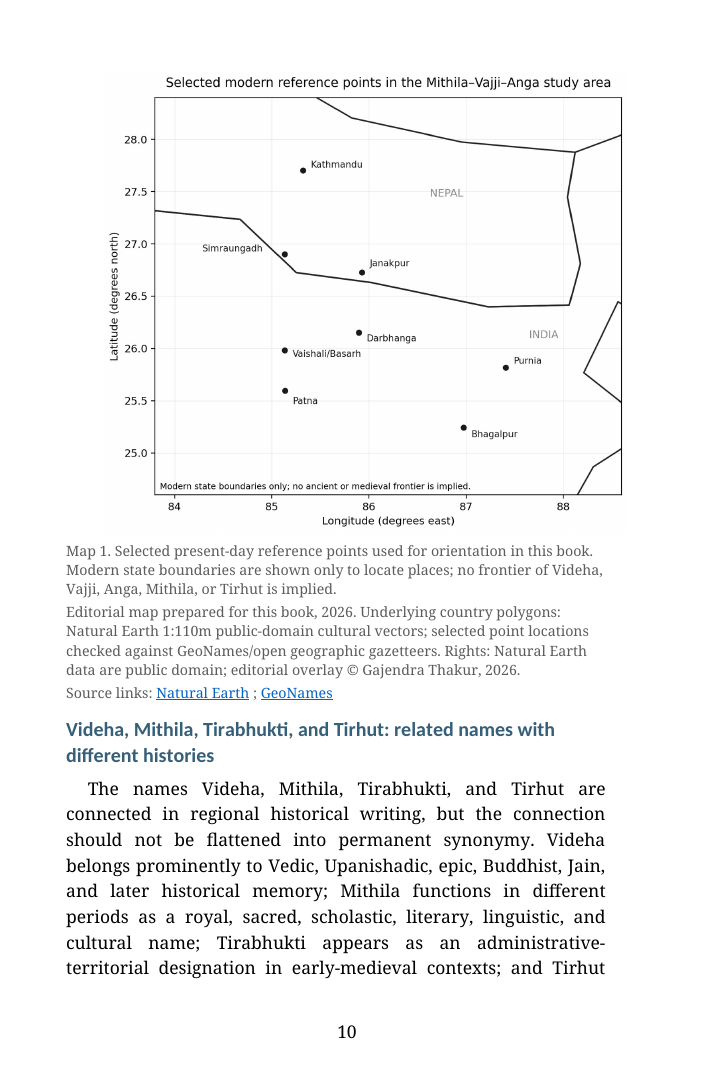
Chapter-specific source notes
- Primary chapter witness. Gajendra Thakur, Decoding the Panji of Mithila — Volume I, formal Chapter 14, PDF pp. 293-313; formal Chapter 14. The HTML transcription is generated from the commit-pinned source PDF and retains the chapter boundary recorded in this edition.
- Internal structure. The repository source-heading inventory records no separately encoded subordinate heading for this chapter.
- Digital editorial method. The page keeps the preserved source text distinct from generated navigational, concordance, visual, and provenance apparatus. The synthetic reconstruction is explanatory only and is not evidence for an individual lineage or a determination of social or marital status.