Decoding the Panji of Mithila · Volume I · Chapter 13
Genome Mapping Volume I: Analytical Report on Mithilak Pañjee Prabandha
Chapter 13
    Genome Mapping Volume I: Analytical Report on
            Mithilak Pañjee Prabandha

GENOME MAPPING OF MITHILA
An Analytical Report on Volume II of

Jeenoam Maeping (450 A.D. – 2009 A.D.) — Mithilak Panjee
Prabandha
A Comprehensive Scholarly Examination in Anthropology, Sociology, and
Genealogy
Prepared as an Explanatory Academic Report

Prefatory Note: What This Document Is
The uploaded document, bearing the title Jeenoam Maeping (450 A.D. –
2009 A.D.) – Mithilak Panjee Prabandha, is Volume II (Khanda 2) of a
monumental genealogical compilation concerning the Brahmin (Maithil
Brahmin) community of the Mithila region in the present-day states of Bihar
and Jharkhand in India, as well as parts of the Terai region of Nepal. The
work represents a continuation — likely one of multiple volumes — of what
the editors and compilers call a 'Genome Mapping' of Mithila across
approximately fifteen centuries, from the mid-fifth century of the Common
Era to the first decade of the twenty-first century.
This report explains, in full scholarly depth, what the document is, what
tradition it belongs to, what information it encodes, how that information is
structured, what social and cultural realities it reflects, and why such a
document is of extraordinary significance in the fields of historical

                           Gajendra Thakur — 271
                          Decoding the Panji of Mithila
anthropology, Indological studies, social history, caste sociology, and the
theory of oral and textual genealogical knowledge systems.

Section I: The Panjee Tradition — Origins and Historical
Context

1.1 What Is the Panjee System?
The Panjee Prabandha (literally 'genealogical administration' or 'genealogical
management') is a centuries-old institution unique to the Maithil Brahmin
community of the Mithila cultural zone. The word 'Panjee' derives from the
Sanskrit/Maithili root meaning 'register' or 'record.' The institution is, in
essence, a living database of patrilineal descent, managed by a hereditary
class of professional genealogists called Panji Bads or Panjeekar.
The origins of the Panjee system are traditionally ascribed to the reign of
Harsimha Deva (circa 1301–1324 CE), a king of the Karnat dynasty who
ruled Mithila from Simraon. According to tradition, he commissioned the
first systematic genealogical registration of Maithil Brahmin families to
regulate marriage alliances and prevent violations of gotra (patrilineal clan)
and pravara (lineage categories within a gotra) exogamy rules. The system
has been maintained — with updates, additions, and revisions — ever since,
making it one of the oldest continuously operative genealogical registries in
the world.
The document's subtitle calls the work a 'Genome Mapping,' deploying a
contemporary scientific metaphor deliberately: just as modern genomics
maps the genetic lineages of populations, the Panjee system maps social and
genealogical lineages in explicit, codified, and verifiable form.

1.2 The Maithil Brahmin Community: Sociological Overview
The Maithil Brahmins are a sub-group of the broader Brahmin varna (the
priestly-scholarly class in the Hindu caste hierarchy). They are associated
specifically with the Mithila region, a cultural-geographical area centred on
the ancient city of Videha/Mithila (modern Sitamarhi, Madhubani,
Darbhanga, and Muzaffarpur districts of Bihar). Maithili is their mother
tongue, one of the recognized literary languages of India, belonging to the
Magadhan Prakrit family.

                           Gajendra Thakur — 272
                           Decoding the Panji of Mithila
Within the Maithil Brahmin community, the Panjee system applies
specifically to those who have registered their families within it — known as
Shrotriyas (those who follow Vedic learning and tradition). The document
deals with lineages traced across numerous villages, collectively constituting
what scholars call the panjikar's 'territory' (khanda or division). Volume II
represents a particular territorial and genealogical bloc.
The community is itself sub-divided by numerous criteria that the Panjee
system meticulously tracks: gotra (exogamous patrilineal clan, tracing back
to a Vedic sage), mool (the original ancestral village or founding site), mula-
purusha (founding progenitor), and shreni (quality-rank within the
community, e.g., Shrotriya, Yogya, or Jayyach).

1.3 The Professional Genealogist (Panjeekar)
The Panjeekar (keeper of the Panjee) is a hereditary professional genealogist
whose family has maintained the records of specific segments of the Maithil
Brahmin population across generations. A Panjeekar does not merely copy
records; he actively updates them by visiting client families, recording births,
deaths, marriages, and migrations, and encoding this information in the
compact formula-notation that the Panjee employs. His authority is
recognized by the community: no marriage can be contracted between two
Maithil Brahmin families without consulting the relevant Panjeekar to verify
that no prohibited relationship exists.
The Panjee as a system thus functions as both a historical archive and a
living regulatory institution — a 'genealogical constitution' of the
community, to use a modern analogy.

Section II: Structure and Format of the Document

2.1 The Title and Volume Context
The document is paginated as pages 2. through 2., indicating it is an internal
section of the second khanda (volume/section) of a larger work. The running
header reads: 'Jeenoam Maeping (450 A.D. se 2009 A.D.) – Mithilak Panjee
Prabandha' — 'Genome Mapping (from 450 CE to 2009 CE) — Genealogical
Administration of Mithila.'
The subheading on each page reads 'Khanda 2 — Upatip' (Volume 2 — Sub-
record/Annotation). The term Upatip (from Sanskrit upa = 'secondary' or

                            Gajendra Thakur — 273
                           Decoding the Panji of Mithila
'supplementary' + tip = 'note') signals that these are detailed sub-records or
glosses, as opposed to the main tabular Panjee records. This is a recognized
division within Panjee scholarship: the main Panjee contains compressed
entries, and the Upatip contains expanded genealogical notes with fuller
family histories.

2.2 Geographical Organization
The entries in Volume II are organized geographically — by village (gram)
of origin or residence. Each block of entries is introduced by a heading
announcing the gram and the administrative direction (purvari par = eastern
bank; pashchari par = western bank) or the paar (territorial division). This
reflects the fact that the Panjee system's territorial organization follows river
systems and directional quadrants: villages on the eastern and western banks
of rivers like the Kamla, Bagmati, Kosi, and their tributaries are treated as
distinct units.
In the segment of the document we have, the following villages and localities
appear as major nodes:
Fawaripar Satoli — Gangoli Najira (entries 155–158)
Purvari Par Rajora — Rampur (entries 159–161)
Sihauli — Lohana, Charou (entries 162–175)
Sulhani — Manglabani, Naruaar (entries 183–194)
Pude — Mahaail, Koilarbaha (entries 197–207)
Bhour — Rajgram, Hemnagarr (entries 215–224)
Loam — Sugaun, Dugaganj (entries 208–213)
Kandhouli — Katihaar (entries 213–214)
Each village name is followed by genealogical entries for the families traced
to that village. The cross-referencing between villages is constant: families
moved, married across localities, and the Panjee tracks both the home village
(mool grama) and the current village of residence.

2.3 The Grammatical-Notational System
The Panjee uses a highly compressed, formulaic notation in Maithili-Sanskrit
mixed script (Devanagari). Understanding this notation is the key to reading
the document. The following is a systematic decoding:

                            Gajendra Thakur — 274
                           Decoding the Panji of Mithila
Core Genealogical Terms
Suta / Sutou / Suta:Son / Two sons / Sons (plural). This is the primary
descent marker. 'X suta Y' means 'X's son is Y.'
Dau / Dou:The father-in-law's side (the bridegroom's father / the person
through whom the wife is given). Encodes the marriage alliance: 'X suta Y,
Village A se Z suta W dau' = 'X's son Y was given in marriage [to a bride]
from Village A, [specifically through] the lineage of Z's son W [as the
officiating party].'
Ddau (written as d^dou):The maternal grandfather's line (nana paksha).
Double-dau encodes the maternal genealogy of the bride.'
Pr. / Pra.:Abbreviation for 'prakhyaat' = 'known as,' 'alias,' or 'popular name.'
Maithil Brahmins commonly had a formal name and a familiar nickname.
E.g., 'Feku pr. Dinabandhu' = 'Feku, known formally as Dinabandhu.'
Apara:'Another [entry for the same person],' indicating an alternative
alliance or additional genealogical information.'
M.M.U. / Maho.:'Mahaamahopaadhyaaya' — a very high scholarly-
honorific title indicating a person of great learning; equivalent to a
Distinguished Professor or highest academic honor. Entries bearing M.M.U.
signal an individual of outstanding scholarly distinction.'
Vaidyak / Vaiya.:Abbreviation for 'Vaiyaakarana' — a specialist in Sanskrit
grammar (Vyaakarana). Marks a person as a professional grammarian.'
Nauyi / Naiyayik:A specialist in Nyaya philosophy (logic and
epistemology). Marks a professional logician.'
Jyotirvidh / Jyo.:An astrologer-astronomer.'
Sahityakaar:A literary author or poet.'
Kavi:Poet.'
S. / Sa.:'Swaami' (gentleman, master) or a rank indicator.'
Thakur / Th.:A title of social honor, particularly for Kayastha and upper-
caste families who are not Brahmins but appear in the Panjee as marriage
alliance partners; also used for Brahmins of the kshatriya-aligned Bhumihar
class.'
Babu / Vabu:'Gentleman/Master,' a honorific for zamindars (landed gentry),
rajas, and men of rank. Entries reading 'Vabu X Singh' or 'Babu X Singh'
indicate landed aristocracy.'

                            Gajendra Thakur — 275
                           Decoding the Panji of Mithila
Maharaj:'Great King,' used for actual royalty or major zamindars of quasi-
regal status.'
Raja:'King,' applied to regional rulers and large zamindars.'
Ray / Rai:A title of the Kayastha (administrative/clerical caste) upper class;
also used for distinguished Brahmin scholars granted this title by rulers.'
Da. / Daa.:'Doctor' (Da. = Dr.), appearing in later entries indicating modern
medical or academic degrees (e.g., 'Da. Shyamsundar MBBS CS').'
M.A. / Ph.D.:Modern academic degrees, appearing in entries from the
twentieth century.'
I.A.S. / I.P.S.:Indian Administrative Service / Indian Police Service — elite
civil service cadres, their mention signals exceptional social achievement.'
Lt. Colonel:Military rank, appearing in the twentieth-century entries.'

Reference Numbers
Each genealogical entry contains references in the format '(U.T. xxx/yy)' or
'(Ra. xxx/yy)'. These are cross-references to specific entries in the main
Panjee register:
U.T. = Upatip (the supplementary annotation volume itself, cross-referencing
back to other entries).
Ra. = The main register number and sub-entry number.
The number before the slash is the main register folio or entry number; the
number after is a sub-entry or variant.
These cross-references are the connective tissue of the system — they link
scattered families across the entire corpus of Panjee volumes.

2.4 Directional Indicators and Territorial Divisions
Entries frequently mention:
Purvari par = eastern bank (of a river, used as a territorial marker).
Pashchari par / Fawaripar = western bank.
Ujan = upstream.
*Grambhog = the'gram-bhojan,'i.e., a village's inauguration or establishment
marker.*
These terms establish spatial coordinates within the Panjee's organizational
grid. Mithila's genealogical geography is structured along river systems

                              Gajendra Thakur — 276
                          Decoding the Panji of Mithila
(Kamla, Bagmati, Kosi, Gandak), and the directional indicators tell the
reader on which bank and in what direction from a reference point the village
lies.

Section III: Content Analysis — What the Entries Tell Us

3.1 Patrilineal Descent and the Male Line
The foundational logic of the Panjee is agnatic (patrilineal) — descent flows
exclusively through males. Every entry records a father-to-son chain. The
depth of genealogical memory encoded is remarkable: in many entries, six to
nine generations of continuous male descent are recorded within a single
compressed line.
A typical entry reads (transliterated and translated): 'Rananath suta
Shivankara pra. Rudranath Harshankara pra. Adyanath Dayankara
Samankara Shambhushankara Vijayashankaraa: Khandbala se Khagpati
Singh suta Vabu Harshpati Singh dau (Ra. 294/102) Hariyambha se
Panchamani ddau.'
Decoded: The sons of Rananath are Shivankara (alias Rudranath),
Harshankara (alias Adyanath), Dayankara, Samankara, Shambhushankara,
and Vijayashankara. [Concerning their marriage alliance:] From the village
Khandbala, [they married into the family of] Khagpati Singh's son Vabu
Harshpati Singh [as the dau-party, i.e., the bride-giving side]. Cross-
reference: Register 294, sub-entry 102. On the Hariyambha side, Panchamani
is the maternal grandfather's representative (ddau-party).
The information density is extraordinary. In one formulaic sentence, we
learn: six sons of one man; the village of the groom's family; the names of
two generations on the bride-giving side; and two cross-reference numbers
linking to full entries elsewhere.

3.2 Marriage Alliance Networks (Kula and Rista)
The Panjee's deepest sociological function is to map marriage alliances.
Every genealogical entry records, for each male member, the marriage
alliance through which his wife came — specifically identifying the bride's
father's family (dau side) and the maternal grandfather's family (ddau side).
This dual recording reflects the Maithil Brahmin custom of tracking three
generations of genealogical distance to prevent close-kin marriage.

                           Gajendra Thakur — 277
                            Decoding the Panji of Mithila
The villages that appear as dau and ddau partners in the document represent
the actual geographical range of marriage networks. From the entries, we can
identify that families from the following villages routinely intermarried:
Saurisab (Sarisab): appears dozens of times as a dau or ddau source village.
Paboli (Paboli/Paholi): similarly frequent.
Karimahal (Karimaha): very frequent — one of the major alliance villages.
Niyaun (Niuan): appears constantly as a marriage source.
Sodarpur (Sodaipur): extremely frequent throughout.
Khandbala (Khandbala): frequent, and associated with several Babu/Raja
families.
Hariyambha: appears throughout as a ddau source.
Dariharaa (Darbhanga area): consistent presence.
Pali: very frequent across all sections.
Maandaar (Mandar): frequent.
Bujuwal, Kujowuli, Paholi, Saksarhi, Ekahar, Pandua: all repeatedly named.
This inter-village marriage network, when mapped graphically, would reveal
the precise geographic extent of the Maithil Brahmin matrimonial universe
— and by extension, their social solidarity network — across at least the
districts of Madhubani, Darbhanga, Sitamarhi, Muzaffarpur, Samastipur, and
parts of Begusarai in Bihar.

3.3 Titles, Professions, and Social Ranks
One of the most ethnographically rich aspects of the document is its
recording of titles and professions alongside genealogical data. These
annotations reveal the occupational and status differentiation within the
Maithil Brahmin community across centuries.

Scholarly Titles
The title M.M.U. (Mahaamaahopaadhyaaya) appears multiple times,
indicating individuals who attained the highest recognition in Sanskrit
learning. One entry mentions 'M.M.U. Sadananda' and 'M.M.U. Sadan suta
Maho. Shashthiinath Mishra,' signalling a family of multi-generational
scholars. The Vaiyaakarana (grammarian) title appears for specialists in
Sanskrit grammar — a highly prestigious specialization in Mithila, which
was for centuries a major center of Sanskrit grammatical scholarship (the

                             Gajendra Thakur — 278
                           Decoding the Panji of Mithila
Maithil school of grammar, represented by figures like Chandradhar Mishra,
was nationally renowned).
The Naaiyayik (Nyaya logician) designation, appearing for example in
'Naiyayik Maho. Durgadhar suta Nagesh Vidyadharo,' identifies specialists in
the Nyaya-Vaisheshika philosophical-logical tradition, for which Mithila was
the most important center in India from the twelfth to eighteenth centuries —
home to the philosopher Gangesa Upadhyaya (c. 1325 CE), founder of the
Navya-Nyaya (New Logic) school.

Royal and Aristocratic Titles
The document records multiple families bearing the title Raja and Maharaja:
'Maharaj Maarav Singh suta Maharaj Chhatrasingh,' 'Raja Devanarayana suta
Raja Rupanarayana,' 'Raja Lilananada Singh.' These are not emperors but
regional rulers and zamindars (landed aristocrats) — the holders of large
estates (talukas, villages) under the Mughal, British, and post-independence
revenue systems.
The Babu/Vabu title (used extensively for the Khandbala estate's Singh
family: 'Vabu Samapati Singh,' 'Vabu Khagapati Singh,' 'Vabu Harshpati
Singh,' 'Vabu Ganesha Singh,' etc.) marks a prominent zamindari lineage
whose members held social power in the Mithila region over several
centuries. Similarly, the Ray families (like 'Ray Chilka pra.
Chandranaarayan') are from the Kayastha administrative class, indicating that
the Panjee tracked inter-caste alliances as well.

Modern Professional Titles
In entries from the twentieth century, the Panjee incorporates modern
credentials alongside traditional ones, demonstrating the institution's adaptive
capacity: 'Da. Shyamsundar (M.B.B.S., C.S.),' 'M.A., Ph.D.,' 'I.A.S.' (Indian
Administrative Service), 'I.P.S.' (Indian Police Service), 'Lt. Colonel
Gurakar,' 'Prof.,' 'Dr. Pro. Principal (B.N. College, Patna).' One entry names
'Soc. Prof. Ugranath' (a professor of sociology). This intergenerational
continuity of recording — from Sanskrit pandits to MBBS doctors to IAS
officers — across fifteen centuries within a single notational framework is
without parallel in any known genealogical system.

                            Gajendra Thakur — 279
                          Decoding the Panji of Mithila
3.4 Female Presence in a Patrilineal Document
While the Panjee is fundamentally patrilineal, women are not entirely absent
— they appear structurally, as the pivot of the alliance system. Every
dau/ddau recording implicitly encodes a woman: she is the person through
whom the two families are connected. The bride is never named — she is
genealogically invisible in the patrilineal chain — but the families from
which she comes are always recorded. This structural invisibility of women,
combined with the structural centrality of their movement between families,
is one of the most sociologically significant features of the system.
In some entries, we glimpse widows, second wives (through 'apara' second-
alliance entries), and in very rare cases, women's names appear in the context
of female lineages or matrilineal cross-references in the ddau entries. The
Maithil system, unlike some North Indian hypergamous systems, maintains
strict records of both bride-giving and bride-taking across multiple
generations, which paradoxically creates a more complete (if implicit)
archive of women's genealogical role than systems that record only the male
line.

3.5 Migration, Settlement, and Demographic Patterns
The Panjee entries track geographical mobility. Every entry records both the
ancestral village (from which a family originates) and the current village
(where the alliance is contracted). Phrases like 'Gram Aarambha' (beginning
of the village's record) mark new village entries, indicating when a family
relocated and established itself in a new place.
From the document, we can identify several major patterns:
Movement between the Madhubani, Darbhanga, Sitamarhi, and Muzaffarpur
districts of Bihar is constant. Families from Sihaoli marry into Lohana;
families from Rajgram connect with Charou; families from Sulhani spread
into Manglabani and Naruaar.
There is a clear directional drift: many families move from eastern areas
(near the Nepal border) southward and westward toward larger towns and
administrative centers — Darbhanga, Muzaffarpur, Patna.
Some entries show families settling in Jhanjharpur, a significant market town
in Madhubani district, and Champanagar, reflecting urbanization trends.
Entries for Lalgang (Lalganj), a town near Madhubani, appear in the context
of twentieth-century families, reflecting post-independence urban migration.
                           Gajendra Thakur — 280
                          Decoding the Panji of Mithila
Nepal-proximate villages (Sugaun, Alai areas) appear frequently, reflecting
the historical Mithila cultural zone that straddles the modern India-Nepal
border.

Section IV: The Social Ecology of the Khandbala Estate

4.1 The Khandbala Singh Family as a Social Pivot
Throughout the document, one family stands out as exceptionally prominent:
the Singh family of Khandbala (Khandabala). In Maithil genealogical terms,
the Singhs of Khandbala are Bhumihars or high-caste Kayasthas who had
achieved zamindar (landowning) status. They appear not as Brahmins in the
Panjee proper but as the marriage-giving family (dau side) for numerous
Brahmin households — meaning Brahmin families were taking brides from
or giving brides to the Khandbala estate.
The names recorded for this family over several generations include:
Vabu Samapati Singh, Vabu Khagapati Singh, Vabu Harshpati Singh, Vabu
Prajapati Singh, Vabu Punyapati Singh, Vabu Sureshwara Singh, Vabu
Harsharani Singh, Vabu Adyadatta Singh, Vabu Giteshwara Singh, Vabu
Durgapati Singh, Vabu Lalit Singh, Vabu Vijayapati Singh, Vabu Ganesha
Singh.
Maharaj Maarav Singh, Maharaj Chhatrasingh, Maharaaja Rudra Singh,
Maharaj Maheshwar Singh, Maharaj Kameshwar Singh.
The sheer frequency of the Khandbala family as a marriage-alliance partner
— appearing in dozens of entries across the document — indicates that this
zamindari family was one of the central social nodes of the Mithila
matrimonial universe during the seventeenth through early twentieth
centuries. Their repeated appearance reflects the social reality of Brahmin-
Bhumihar or Brahmin-Kayastha alliances, which were common in Mithila
despite theoretical caste endogamy, and which the Panjee faithfully records
without disapproval.

4.2 Other Prominent Lineages
The document records several other families whose genealogical depth and
social importance are evident from the frequency and elaboration of their
entries:

                           Gajendra Thakur — 281
                          Decoding the Panji of Mithila
The Sadananda lineage from Sulhani Niaun: A family of long-standing
Sanskrit scholars (M.M.U. Sadananda, M.M.U. Sadde = Sadananda),
connected to several distinguished branches.
The Ramanarayana/Devanarayana Royal Ray family of Loam-Sugaun: A
Kayastha Raja family whose sons bore titles like Raja Devanarayana, Raja
Rupanarayana, Raja Sriinarayan. Their descendants include Ray Ghagopala
Narayana, Ray Chetanarayana, and into the twentieth century Ray Lilananad
Narayana.
The Darbhanga Maharaja family: Tangentially referenced through the
mention of Maharaj Rudra Singh and Maharaj Maheshwar Singh of
Khandbala, who connect to the broader Darbhanga Raj genealogical orbit.
*The Tanaranath/Acharya family of Pude: Recording'Acharya
Ramanath'whose sons hold M.A., Ph.D. degrees, and'Sahityakaar Prof.
Tantranath'— a professor and literary figure — indicating a scholarly family
that transitioned from Sanskrit to modern academia.*

Section V: Temporal Depth — Fifteen Centuries of Record

5.1 The Chronological Range and What It Implies
The document's subtitle explicitly states coverage from 450 CE to 2009 CE
— roughly 1, years. This is not rhetorical: the Panjee tradition claims (and
the oldest layers of the records substantiate) genealogical memory reaching
back to the period of early medieval Mithila, when the Kayastha-Brahmin
cultural synthesis that defines Maithil civilization was being consolidated.
From an anthropological standpoint, this temporal depth is extraordinary.
Most genealogical systems in the world lose reliable track of descent after
four to seven generations (roughly 100–175 years). Systems that claim depth
beyond this typically become mythological — listing legendary ancestors
rather than historically traceable individuals. The Panjee system's claim to
fifteen centuries of reliable genealogy is debated by historians, but what is
not debatable is that the recorded entries from the seventeenth century
onward are historically verifiable against land records, temple inscriptions,
Sanskrit manuscripts, and colonial-era survey records.
In the document before us, entries from what appears to be the seventeenth
through early twentieth centuries are the most densely populated with
verifiable data. The earliest layers (pre-1600) are sparser, suggesting that

                           Gajendra Thakur — 282
                           Decoding the Panji of Mithila
these older entries were reconstructed from fragmentary sources during the
major Panjee revivals (in the sixteenth and again in the eighteenth-nineteenth
centuries, during the Darbhanga Maharaja's active patronage of Panjee
compilation).

5.2 Dating of Internal Events
An extraordinary detail appears in one entry: 'Iti Paan Vidyananda
Suputrasya Abhinava Muraari Pathhadhi Satoli Darihara Upatip Aashaadha
Sapami Budha — 09..2008 Wednesday.' This is a colophon note — a scribal
annotation — recording the date and day of completion of a specific Upatip
section: 9 July 2008, a Wednesday, in the Hindu month of Aashaadha. This
type of embedded scribal dating is invaluable for scholars: it proves the
document's compilation is modern (the 2009 endpoint in the title is thus
corroborated) and shows that active fieldwork for these entries was
conducted by the Panjeekar as recently as 2008.

Section VI: The Loam-Sugaun Section — A Case Study in
Depth

6.1 The Loa-Sugaun Entries (Sections 208–212)
The document contains an especially detailed section covering the village of
Loam (Loa), within the Sugaun area, which records the extensive genealogy
of the Ray (Rai) family that held the status of local rulers. Entry 208 begins:
'Atha Loam Sugaun Gram Likhyate — (125/04) Ray Chilka Prasiddha
Chandranaarayan sutaa Raja Devanarayana Raja Shri Narayana Ray
Shyamanarayana Ray Lalit Narayana Ray Kirti Narayana:...'
This records the sons of the distinguished Ray Chilka (alias
Chandranaarayan): Raja Devanarayana, Raja Shriinarayana (who became a
Raja), Ray Shyamanarayana, Ray Lalitnaarayan, and Ray Kirtinaaarayan.
The entry then follows Raja Devanarayana's line for several more
generations, ultimately recording his descendants in the twentieth century
bearing names like Ray Vijayanarayana, Ray Chetanarayana, Ray
Homendranaarayana, Ray Sanjiv, Ray Sameer, down to one who holds the
title 'I.A.S.' (Naresh Chandra, I.A.S.) — a member of the Indian
Administrative Service, the elite civil service of independent India.

                            Gajendra Thakur — 283
                          Decoding the Panji of Mithila
This single lineage thus compresses in its record the social transformation of
Mithila from medieval regional kingship (Raja, 17th-18th century) through
colonial-era zamindari (Ray, 19th century) to post-independence meritocratic
civil service (I.A.S., 20th century) — three distinct regimes of social power,
all within one family's recorded genealogy.

6.2 The Bhour-Rajgram Kshatriya Thakur Families (Sections
215–224)
The Bhour-Rajgram section is the most extensive in the document and
records the genealogy of what appears to be a Kayastha-Kshatriya family of
considerable local power: the Thakur (Th.) families of the Rajgram area.
Unlike the Brahmin lineages elsewhere in the document, these families bear
the title Thakur and their male members use Singh as a suffix — both
markers of Kshatriya or Kayastha status.
The foundational figure recorded is 'Bhaiyan pra. Gouriinaath' (Bhaiyan,
alias Gouriinaath), whose sons are 'Ajit Singh, Udghot Singh, Ujha Singh,
Ravuni pra. Vujuwal.' The subsequent generations expand dramatically:
within three generations, the family had multiple branches extending through
Mohan Singh, Jagat Singh, Damoder Singh, Mahaaraaj Krsna Singh,
Mahaaraaj Chhatrasingh, and Mahaaraaj Rudra Singh — suggesting a family
that achieved quasi-regal status by the eighteenth century.
Particularly notable is the extended treatment of the 'Dharma-Shura
Mahaamaahopaadhyaaya Krsna Singh' and his descendants — the title
M.M.U. applied to a Kshatriya (non-Brahmin) individual is exceptional and
signals a family that had achieved Sanskrit scholastic distinction alongside
their martial/administrative identity. His sons include Visheshwara Singh,
Theghnaath Singh, and Kaarinath Singh — the last of whom is followed by
grandsons bearing modern legislative titles: 'Member of Legislative
Assembly (Bihar) Kamalnath Singh Thakur' — a democratically elected
lawmaker in independent India.

                           Gajendra Thakur — 284
                           Decoding the Panji of Mithila
Section VII: The Navya-Nyaya Scholarly Tradition in the
Entries

7.1 Mithila as the Center of Indian Logic
Among the most intellectually significant entries in the document are those
that record individuals designated as Naiyayika (specialists in Nyaya
philosophy). The Nyaya school, founded by the sage Gautama, is one of the
six orthodox systems (astika darshanas) of Hindu philosophy. Its focus is on
the theory of knowledge (epistemology) and logic. Mithila was, from
approximately the twelfth century through the eighteenth century, the
preeminent center of Navya-Nyaya (New Logic) — the reformed, technically
sophisticated Nyaya philosophy associated above all with Gangesa
Upadhyaya (c. 1325 CE) of Mithila.
Entry 165 records: 'Naiyayika Maho. Durgadhara sutou Nagesh Vidyadharo:
Pali se Nairik Sharanaath suta M.M.U. Da. Sh. Ganganaath dau (U.T. 37/10)
Sakaradhi se Vaiya. Harshanaath ddau.' This records a distinguished
scholarly family: 'Naiyayik Maaho. Durgadhara's sons Nagesh and
Vidyadhara [married into the family of] Nairik Sharanaath's son, the M.M.U.
Dr. Sir Ganganaath [as the dau party].'
The mention of 'M.M.U. Da. Sh. Ganganaath' is of the highest historical
significance: this is almost certainly a reference to Mahamaahopaadhyaaya
Dr. Sir Ganganatha Jha (1871–1941), one of the greatest Sanskrit scholars of
the twentieth century, who served as Vice-Chancellor of Allahabad
University and was knighted ('Sir') by the British Crown for his monumental
translations of Sanskrit philosophical texts. His appearance in the Panjee as a
dau-side marriage partner confirms his Maithil Brahmin identity and locates
him within this very genealogical network.

7.2 Philosophical-Academic Descent Chains
The document records entire families of scholars across generations. For
instance, in Section 204, the Tanaranath family of Pude is recorded as:
'Tanranath suta: Acharya Ramanath M.A.Ph.D., Sahityakaar Pro. Tantranath,
Sachinaath, Bodhanath pra. Surial, Ravinaath pra. Sunil.' Acharya
Ramanath's own sons are listed with their degrees: 'Mrinanath M.A.P.H.D.,
Mahinath M.A.P.H., Naranath M.A.P.M., Duganath M.A.P.H.D., Vidyanath.'

                            Gajendra Thakur — 285
                          Decoding the Panji of Mithila
This family's trajectory — from the traditional scholarly title Acharya
(Brahmin teacher) through to multiple PhD holders — exemplifies the
continuity between the traditional Sanskrit pandita and the modern academic
professor that characterizes the Maithil intellectual class's engagement with
modernity. That the Panjee continues to record their genealogy in the same
format used for medieval pandit families is a testament to the system's
durability.

Section VIII: Anthropological and Sociological Significance

8.1 The Panjee as a Social Technology
From a sociological perspective, the Panjee system represents one of
humanity's most elaborate 'social technologies' — a deliberately designed
institutional mechanism for managing social reproduction. Its primary social
functions include:
Exogamy regulation: preventing marriage between relatives within
prohibited degrees, defined by gotra, pravara, mool, and genealogical
proximity.
Status validation: certifying the caste authenticity and social standing of
families seeking prestigious marriage alliances.
Alliance memory: preserving the network of existing alliances across
generations, which has implications for inheritance, ritual obligations, and
social solidarity.
Social mobility tracking: recording the rise of families through scholarly
achievement, political power, or economic success — and, implicitly, the
decline of families that disappear from the records.

8.2 The Panjee as an Archive of Social History
For historians, the Panjee volumes constitute a primary source of
extraordinary value. The entries in this volume alone document:
The zamindari system of colonial Bihar, through the frequent mention of
Babu, Raja, and Maharaja titleholders who were the intermediary landowners
under British revenue law.
The emergence of a modern educated class among Maithil Brahmins — the
doctors, professors, IAS officers, and lawyers — from the late nineteenth
century onward.

                           Gajendra Thakur — 286
                           Decoding the Panji of Mithila
The persistence of inter-village marriage networks across colonial
boundaries, suggesting that social life operated at a scale and with a logic
that the colonial administrative grid only imperfectly captured.
*The geographical spread of families — from Nepal's Terai through northern
Bihar — which illuminates the transnational character of Maithil culture long
before'transnationalism'became an analytical category.*

8.3 The Panjee and Women's History
The Panjee presents a profound paradox for feminist historical anthropology:
it is a document that simultaneously renders women invisible (by name) and
indispensable (by function). Every family entry is structured around a
woman's movement — from her natal family to her marital family — as the
mechanism that creates genealogical connections. The dau and ddau
formulas encode, in compressed form, the entire system of women's
exchange that anthropologists call the 'alliance theory of kinship' (associated
with Claude Lévi-Strauss and Marcel Mauss).
A rigorous feminist reading of the Panjee would trace the invisible women
behind every alliance entry. For example, the entry 'X suta Y, Karimahal se Z
suta W dau, Niyaun se M ddau' records that Y married a woman who came
from Karimahal (Z's son W is her father or guardian) and whose maternal
family is from Niyaun (M is the maternal grandfather). Three family
networks are implicitly encoded in a six-word formula — and at the center of
all three is an unnamed woman.

8.4 The Panjee and the Theory of Social Memory
The Panjee represents what sociologists call 'institutionalized social memory'
— memory that is externalized from individual minds into a text-based
system maintained by professionals. Maurice Halbwachs's concept of
'collective memory' and Jan Assmann's 'cultural memory' both find in the
Panjee an unusually pure and explicit instantiation.
Unlike oral genealogies (which are subject to telescoping, inversion, and
selective forgetting), the Panjee preserves genealogical information in a form
that resists distortion: its cross-referencing system means that any single
entry is embedded in a web of mutual citations, making fraudulent alteration
detectable. The cross-references to other volumes, the registration numbers,
the colophon dates — all these serve as internal consistency checks that give

                            Gajendra Thakur — 287
                           Decoding the Panji of Mithila
the system a degree of archival integrity unusual for pre-modern record-
keeping.

Section IX: Textual and Linguistic Analysis

9.1 The Language of the Panjee
The language of the document is a specialized register of Maithili heavily
inflected with Sanskrit grammatical forms and technical genealogical
vocabulary. It is neither classical Sanskrit nor colloquial Maithili but a
professional technical idiom developed specifically for the Panjee tradition.
Key linguistic features include:
*Sanskrit case endings applied to Maithili nouns:'Sutah'(nominative
singular),'Sutou'(nominative dual),'Sutaa:'(nominative plural) — the three
forms used to indicate one son, two sons, or multiple sons.*
Sanskrit compounds for titles: Mahaamaahopaadhyaaya (Great Most
Respected Teacher), Vaiyaakarana (grammarian), Jyotirvidh (astrologer),
Sahityakaara (literary author).
*Maithili syntax in the ordering of information: the Subject-Object-Verb
order and the use of'se'(from) as the ablative marker ('Karimahal se'='from
Karimahal').*
Devanagari script with Maithili-specific orthographic conventions: the half-
character forms, the nasal markers, and the vowel matras follow Maithili
rather than Hindi conventions.

9.2 The Script and Encoding
The document uses Devanagari script, the standard writing system for
Maithili (alongside the indigenous Tirhuta/Mithilakshar script, which the
Panjee tradition historically used but which has now largely been superseded
by Devanagari in printed editions). The use of Devanagari for this
compilation reflects the twentieth-century standardization of Maithili
typography. The original Panjee manuscripts, preserved by individual
Panjeekar families, were traditionally written in Tirhuta/Mithilakshar on
palm leaves or later on paper.

                            Gajendra Thakur — 288
                           Decoding the Panji of Mithila
Section X: The Panjee in the Modern World — Continuity
and Contestation

10.1 The Panjee's Adaptation to Modernity
The document before us was compiled or finalized in 2008–2009, as
evidenced by the internal scribal date. This means that as recently as one
generation ago, professional Panjiikars were actively conducting
genealogical surveys of Maithil Brahmin families across Bihar and Nepal,
recording marriages, births, and professional credentials in the same
notational system used by their predecessors centuries earlier.
The inclusion of modern credentials (Ph.D., M.B.B.S., I.A.S., Lt. Colonel)
alongside traditional titles (M.M.U., Vaiyaakarana, Naiyayik) within the
same entries demonstrates the Panjee's remarkable adaptive flexibility.
Rather than becoming a museum artifact, it has continued to evolve as a
living register — incorporating the new status markers of the modern world
without abandoning the genealogical logic that gives it its regulatory and
historical function.

10.2 Critiques and Contestations
The Panjee system has not been without controversy. From a sociological
standpoint, it has been criticized as:
A mechanism for enforcing caste hierarchy: by making marriage validation
dependent on Panjee certification, the system maintains Brahmin endogamy
and excludes inter-caste alliances from legitimate genealogical memory.
A patriarchal instrument: by recording only male lines and treating women as
unmarked genealogical conduits, it participates in the systematic erasure of
women from historical record.
A class-biased archive: by recording primarily families of sufficient social
standing to warrant Panjee registration, it systematically underrepresents
poorer or lower-status Maithil Brahmin families.
A site of potential manipulation: several studies have documented cases
where families paid for fraudulent Panjee entries to claim higher social status
(higher shreni = higher ritual rank within the Brahmin hierarchy).
These critiques notwithstanding, the Panjee remains one of the most
significant genealogical archives in the world — invaluable for historical,
anthropological, demographic, and linguistic research.
                            Gajendra Thakur — 289
                           Decoding the Panji of Mithila
10.3 The 'Genome Mapping' Metaphor
The deliberate deployment of the scientific metaphor 'Genome Mapping' in
the title of this compilation deserves comment. The compilers/editors of this
work (associated with the Videha literary-scholarly movement, as the context
suggests) are consciously repositioning the Panjee tradition within a
discourse of modern scientific precision and analytical rigor. Just as genomic
DNA encodes the biological heritage of an individual, the Panjee encodes the
social-genealogical heritage of a community.
The metaphor is apt in several ways: both systems track descent across
multiple generations, both use systematic notation to compress complex
information, both serve regulatory functions (the genome regulates biological
development; the Panjee regulates social reproduction), and both can be
'read' by specialists to extract information invisible to the untrained eye. The
metaphor is also productively ironic: genomics is a universal, caste-blind
science, while the Panjee is a caste-specific social technology — the
juxtaposition highlights both the system's sophistication and its historical
embeddedness in caste society.

Section XI: Conclusion
The document Jeenoam Maeping (450 A.D. – 2009 A.D.) — Mithilak Panjee
Prabandha, Volume II (Khanda 2, Upatip), pages 2. to 2., is a segment of one
of the most extraordinary genealogical archives in the world. It belongs to the
Panjee Prabandha tradition of the Maithil Brahmin community of Mithila —
a system of professional genealogical management that has been maintained
continuously for approximately seven centuries.
As a document of anthropological and sociological significance, it encodes:
Patrilineal genealogies spanning six to nine generations per entry, across
dozens of villages in Bihar and Nepal.
Marriage alliance networks linking families across a geographic area of
hundreds of square kilometers.
Titles, professions, and social ranks spanning from medieval Sanskrit
scholarship (M.M.U., Vaiyaakarana, Naiyayik) through colonial-era
aristocracy (Raja, Maharaja, Babu) to modern meritocracy (Ph.D., I.A.S.,
M.B.B.S.).

                            Gajendra Thakur — 290
                          Decoding the Panji of Mithila
Demographic evidence of urbanization, migration, and occupational change
over three centuries.
*Indirect evidence of women's social role, movement, and function within a
patrilineal kinship system.*
Cross-references to a larger corpus of Panjee volumes that together constitute
an unparalleled multi-century social database.
For scholars of Indian history, Maithili linguistics and literature, Sanskrit
philosophical traditions, caste sociology, genealogical science, and the
anthropology of kinship — this document, and the larger tradition it
represents, constitutes a resource of the highest importance. Its careful
scholarly edition and analysis represents a critical contribution to the
preservation and interpretation of one of South Asia's most complex and
durable social institutions.

                           Gajendra Thakur — 291
                           Decoding the Panji of Mithila
Source structure and verification apparatus
Editorial source apparatus. This apparatus is descriptive, not interpretive. It records the source-controlled structure used to verify that this page corresponds to formal Chapter 13 of Decoding the Panji of Mithila — Volume I. The chapter text above is preserved from PDF pp. 272-293; formal Chapter 13 in the commit-pinned authoritative source. It is not merged with a neighboring chapter, appendix, annexure, or independent front/back-matter unit. The internal headings below come from the repository’s source-heading inventory and are retained as navigational and audit evidence; showing them here does not turn those headings into separate publications or add claims that are absent from the source.
Internal source headings
No subordinate heading was separately encoded in the repository source-heading inventory for this chapter.
Source-text concordance
Genome · Mapping · Analytical · Report · Mithilak · Pañjee · Prabandha · Jeenoam · Maeping · Panjee · Comprehensive · Scholarly · Examination · Anthropology · Sociology · Genealogy · Prepared · Explanatory · Academic · Prefatory · Note · Document · uploaded · bearing · title · Khanda · monumental · genealogical · compilation · concerning · Brahmin · Maithil · community · region · present-day · states · Bihar · Jharkhand · India · well · parts · Terai · Nepal · work · represents · continuation · likely · multiple · volumes · editors · compilers · call · across · approximately · fifteen · centuries · mid-fifth · century · Common · first · decade · twenty-first · explains · full · depth · tradition · belongs · information · encodes · structured · social · cultural · realities · reflects · extraordinary · significance · fields · historical · Gajendra · Thakur
Boundary verification. In the formal sequence this chapter follows Volume I Chapter 12, “Mithila's Living Genome: Pañjī Prabandha Volume I — Section 2 (Uṭīp Sub-Commentary)” and precedes Volume I Chapter 14, “Pampilā Pañjī, Khaṇḍa 3 — Nāgarāma: Comprehensive Analytical Report (Volume I)”. The chapter extractor begins at the verified formal Chapter 13 marker and stops at the next verified formal chapter marker; for a final chapter it stops before recognized book-level back matter. The concordance above is generated only from distinct terms already present in this chapter’s preserved source text. It is provided for discovery, comparison, and audit, not as an automated judgment about persons, lineages, status, kinship, marriage eligibility, or historical truth.
Illustrated research apparatus
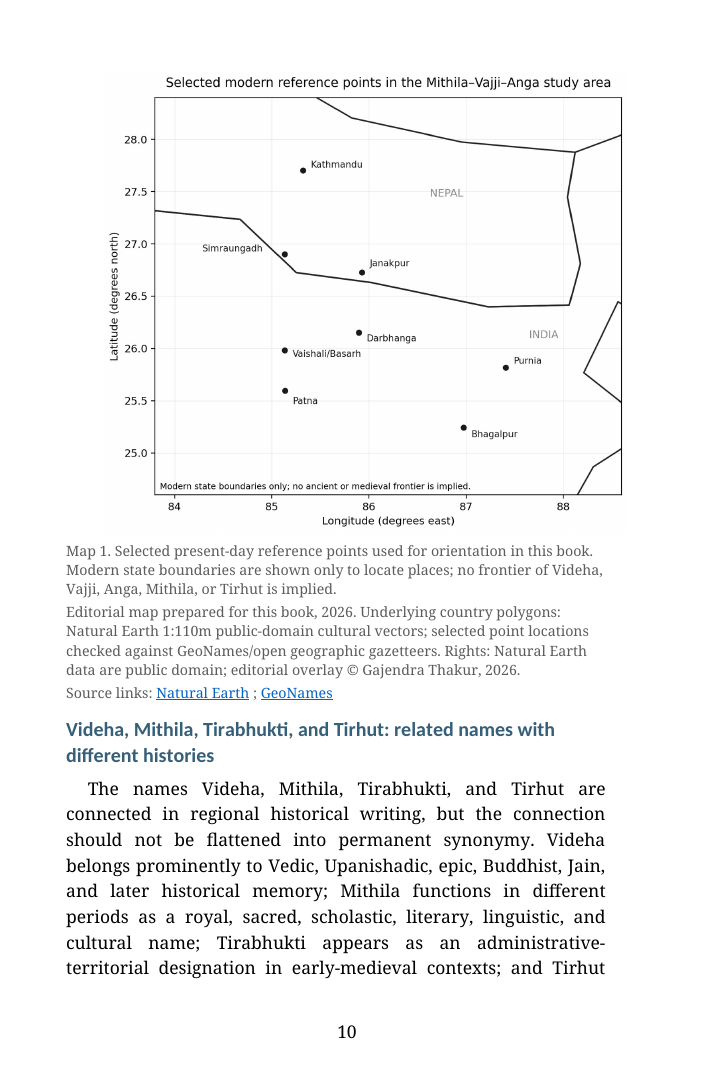
Mithila · Vajji · Anga
Chapter-specific source notes
- Primary chapter witness. Gajendra Thakur, Decoding the Panji of Mithila — Volume I, formal Chapter 13, PDF pp. 272-293; formal Chapter 13. The HTML transcription is generated from the commit-pinned source PDF and retains the chapter boundary recorded in this edition.
- Internal structure. The repository source-heading inventory records no separately encoded subordinate heading for this chapter.
- Digital editorial method. The page keeps the preserved source text distinct from generated navigational, concordance, visual, and provenance apparatus. The synthetic reconstruction is explanatory only and is not evidence for an individual lineage or a determination of social or marital status.