Decoding the Panji of Mithila · Volume I · Chapter 18
The Dooshan Pañjī of Mithila: A Comprehensive Scholarly Report
Chapter 18
     The Dooshan Pañjī of Mithila: A Comprehensive
                   Scholarly Report

THE DOOSHAN PAÑJĪ OF MITHILA: A COMPREHENSIVE
SCHOLARLY REPORT
Reference: Gajendra Thakur's Dooshan Pañjī / "The Black Book" (2023)

I. PRELIMINARY ORIENTATION: WHAT IS THE PAÑJĪ
SYSTEM?
To understand the Dooshan Pañjī, one must first understand the broader Pañjī
system within which it operates — one of the most extraordinary
genealogical institutions in world history.
The Pañjī (Pañjī-Prabandha) is the genealogical record system of the Maithil
Brahmin, Karna Kayastha, and Kshatriya communities of the Mithila region
(roughly corresponding to the Tirhut/North Bihar and the Terai belt of
Nepal). It is not merely a family tree in the Western sense. It is a living,
institutionally maintained, continuously updated archive of lineage, marriage,
ritual status, caste transgression, and social history — maintained in
Mithilaksara (Tirhuta script) on palm-leaf (talpatra) and birch-bark
manuscripts across centuries.
The document under examination was created by Gajendra Thakur, founder-
editor of Videha, based on his transcription and transliteration of original
Pañjī manuscripts — work that began in Chaitra 2000 CE and involved the
conversion of approximately 11, palm-leaf manuscript images from
Mithilaksara into Devanagari.

II. TYPOLOGY OF THE PAÑJĪ: THE SEVEN SPECIES

                           Gajendra Thakur — 366
                           Decoding the Panji of Mithila
The document opens with a taxonomic statement of immense importance for
understanding the system's internal logic. It states that the Pañjī is of seven
types:
1. Mūla Pañjī (Root/Primary Record)— The foundational genealogical
register, common to all, which traces every family's origins from a defined
ancestral stock. Before the reforms instituted under Madhav Singh, all Pañjīs
were structured uniformly in this mode.
2. Shākhā Pañjī (Branch Record)— A later subdivision, created when
Darbhanga ruler Madhav Singh (18th century, around 1760 CE /
approximately 1800 CE by revised dating) ordered the Pañjīkāras (hereditary
genealogists) to compile branch-specific registers. This gave rise to the
Shrotriya sub-caste distinction (see Section VII below). Sub-divisions
include:
•   Upa-Tīp ("sub-note" registers, as in the Sotipura records)
•   Nagraam (western-border village) records
3. Gotra Pañjī (Lineage-Clan Record)— Records the gotra (Vedic
exogamous clan designation, named after ancient Rishis) and traces its
ancient primordial origin. This serves the exogamy regulation function: no
two persons of the same gotra may marry.
4. Patra Pañjī (Leaf/Generation Record)— In circulation for
approximately 500 years. It introduces the Mūlagrāma (ancestral home
village) as a permanent identifying tag attached to each individual's record.
This is the reference most commonly invoked during marriage negotiations.
5. Dooshan Pañjī (Defect/Taint Record)— The subject of this document.
Dooshan means "defect," "blemish," or "pollution." This register records
every transgression, anomaly, or departure from endogamous norm in a
family's lineage: inter-caste marriages, unions with women of unknown
lineage, Devadāsī mothers, births from widows, unions with Muslims, births
after a father's death, and so on. This is the "Black Book" of the system.
6. Utedhā Pañjī (Sapiṇḍa Release Record)— Records the Sapiṇḍa
relationships (those related through the offering of funeral rice balls up to six
generations of paternal ancestors), which determine within which boundary
marriages are prohibited. It lists six generations of ancestors to establish
when the kinship bar (sapiṇḍa nivṛtti) ceases and marriage becomes
permissible.

                            Gajendra Thakur — 367
                          Decoding the Panji of Mithila
7. Asvājanya-Patra Pañjī (Non-natural/Irregular Lineage Record)— A
catch-all register for irregular, unverifiable, or contested genealogical
situations.
A significant sub-note:The document mentions that only the Rasarh-Araria
Pañjī contains the names of women (strī-gaṇaka nāma) within the
genealogical record. This is a remarkable sociological observation: across the
vast system, women are ordinarily recorded only functionally — as mothers,
daughters, wives — rather than by name. The Rasarh-Araria branch is an
anomaly in this respect, preserving female nominal identity.

III. HISTORICAL FOUNDATION OF THE PAÑJĪ SYSTEM
The document provides an invaluable historiographical account of the
system's origins:
Harasimhadeva (1294–post-1324 CE), a ruler of the Karnat dynasty of
Mithila, was the official founder of the Pañjī-Prabandha. He was born in
1294 CE and ascended the throne in 1307 CE. He was descended
fromNanyadeva, who founded the Karnat dynasty in 1019 Śaka
(approximately 1097 CE), as recorded in the verse Nanda-Indu-Shunya-
Shashi Shaka Varshe.
Harasimhadeva appointed three inaugural genealogists:
•   Gunakar Jha — for the Maithil Brahmins
•   Shankardatt — for the Karna Kayasthas
•   Vijaydatt — for the Kshatriyas
The current form of the system was formally inaugurated in1248 Śaka / 1326
CE. This followed Harasimhadeva's flight to Nepal after his defeat
byGhiyasuddin Tughlaqin 1324–25 CE.
This dating places the Pañjī system at approximately700 yearsof continuous
operation as a formal institution — though the document itself claims the
total recorded tradition encompassesover 1, yearsof genealogical memory,
reaching back well before the Karnat-period formalization. When considered
from that longer perspective, it constitutes what the document correctly
identifies as "the most extensive record of human lineage in world history"
— genealogies of populations spread across a large geographic region,
maintained honestly and continuously under conditions of poverty, foreign
rule, and social disruption.

                           Gajendra Thakur — 368
                           Decoding the Panji of Mithila
The1760 CE reform under Madhav Singh(Mithilesh Maharaja, a
permanent settlement zamindar under the British Cornwallis system) ordered
the Pañjīkāras to compile Shākhā Pustaks (branch-record books). The
document makes an important claim here: the Shrotriya sub-caste as a
distinct social categorydid not exist before approximately 1800 CEin the
British India part of Mithila. Before this, "Shrotriya" simply referred to one
engaged in Vedic study — an educational designation, not a caste sub-
identity. This distinction between the Indian and Nepali portions of Mithila is
crucial: in the Nepal portion, Shrotriya retains its original meaning
(educational stream), while in British India it became a hereditary sub-caste
designation, partly through the upgradation-for-cash system of which the
book provides documentary evidence in its annexures.

IV. THE DOOSHAN PAÑJĪ: ITS NATURE, PURPOSE, AND
SOCIAL LOGIC

A. What Is "Dooshan"?
Dooshan (Sanskrit: dūṣaṇa) literally means "that which contaminates,
pollutes, or taints." In the genealogical context, it refers to any marriage
alliance or birth circumstance that introduces an element of jāti-bhedī (caste-
crossing), anapekṣita (unverifiable lineage), or dharma-bahirāgata (normative
transgression) into a Brahmin family line.
The Dooshan Pañjī is, in the words of the document itself, "the record of the
erosion (kṣaraṇa) that has occurred in a lineage." This is an important
framing: kṣaraṇa means a gradual wearing away or leakage, suggesting the
system's metaphor is one of genealogical purity as an integrity to be
maintained over time, with recorded "breaches."

B. Why Record Transgressions at All?
This is perhaps the most intellectually striking feature of the Dooshan Pañjī.
The obvious function of a genealogical system in a caste society is to enforce
endogamy — to prevent inter-caste marriage. Why, then, record what one
wishes to prevent?
The document offers a sophisticated answer: the recording happenslong after
the event(bahut bādame ekara charca sambhava hoita achi), precisely when
the tainted lineage has been "laundered" through successive generations of
endogamous marriage and when its descendants are now fully integrated into

                            Gajendra Thakur — 369
                          Decoding the Panji of Mithila
Brahmin society. The example ofDevadhar(Table 1) is paradigmatic:
Gunawati Himsha, a woman of "another caste," married Chamaru of
Valiyasa lineage; their union produced Gangadhar. Through the nextsix
generationsof daughters and sons-in-law drawn entirely from recognized
Brahmin Mūlas (Sarisav, Sakaradhi, Panichobh, Darihara, Pali, Narwal), the
family was considered purnatah shuddha — completely purified. Only at that
point is the historical record, previously suppressed, published in the
Dooshan Pañjī.
The sociological function is thereforeforward-looking, not punitive.The
document states explicitly: the purpose is that related lineages might avoid
the dupariṇāma (bad consequence) of unknowingly marrying back into a
lineage whose taint has not yet completed the six-generation purification
cycle. It is, in modern terms, a form of genealogical epidemiology — a
tracking system for recessive social "risk factors" in marriage networks.

C. The Paradox of Social Liberalism and the Dooshan Pañjī
The document makes a culturally significant and counterintuitive argument:
the existence of the Dooshan Pañjī is evidence not of Mithila's casteism but
of its relativesocial openness and reformability. The argument runs as
follows:
In a society of total, rigid, unforgiving caste orthodoxy, inter-caste unions
would either be completely suppressed (and thus invisible to any
documentary record) or would result in permanent, hereditary ostracism with
no mechanism for reintegration. The Dooshan Pañjī demonstrates that
Mithila society had:
•   A formal mechanism for eventual reintegration — the six-generation
    purification protocol
•   An honest documentary impulse — a willingness to record rather than
    erase
•   No permanent hatred (vidveṣa) as a lasting social disposition — the
    document states that even "burning questions" (dalmalaita karaewāli
    ghaṭanā) become kālātīta (time-transcendent, obsolete) and are forgotten
The document frames Mithila society as udāra (liberal) and namanaśīla
(flexible) in comparison with other Indian civilizations of the same period,
noting the absence of dhārmika kaṭṭarapana (religious fundamentalism) as a
permanent feature of the Maithil social character.

                           Gajendra Thakur — 370
                         Decoding the Panji of Mithila
V. SOCIAL CONTENT OF THE DOOSHAN PAÑJĪ: THE 97
TABLES
The heart of the document consists of 97 genealogical tables, each recording
a specific "tainted" marriage event or lineage anomaly, followed by the
subsequent generational chain. These tables are not random — they
constitute a structured typological survey of every kind of normative
transgression recorded in the broader Pañjī corpus.
The following categories of "dooshan" (transgression type) emerge from
analysis of all 97 tables:

A. Inter-Caste Marriage with Specific Named Communities
1. Charmakārī/Charmakāriṇī (Cobbler/Tanner women):This is the most
extensively documented category in the Dooshan Pañjī, and it carries world-
historical significance because it includes the genealogy ofGaṅgeśa
Upādhyāya, the founder of the Navya-Nyāya (New Logic) school of Indian
philosophy (see Section VI below).
Table 24 (Entry 211/1): Records "Ānandā Charmakārī" (ānandā 211/1) — a
Cobbler-community woman — whose lineage extends through Talhanapur,
Takwal, Darihara, Panchobh, Merandi, Brahmapur, connected to the lineage
of "Baiju."
Tables 49–51 (Entries 188/2, 189/1, 189/II): These are the Gaṅgeśa entries
— recording that the wife (Vallabhā) of Gaṅgeśa, author of the
Tattvachintāmaṇi, was a Charmakāriṇī (a woman of the tanner/cobbler
community), and that Gaṅgeśa was born pitṛ-parokṣe pañca-varṣa-vyatīte —
five years after the death of his father.
Tables 50, 51 (189/1, 189/II): Another lineage involving Charmakāriṇī
Medhā — her descendants extend through Sodarpur, Alay, Mandar, Naraun,
Panichobh, Khandvala, Deeh Darihara, Brahmapur, and Korai.
Tables 63, 78 (195/II, 203/II): Record Hiruā Charmakār (a male cobbler-
caste individual) whose daughter married a Brahmin of Pali Mūla, producing
a lineage extending through Budwal, Sakradhi, Mandar, Fanandah, Pakliya,
Alay, Belmohon.
2. Rājaka (Washerman community) women:Tables 29–30 (207/1, 207/II):
Record marriages in Rajak (rājaka dharma / rājaka mānakī) tradition, with
lineages extending through Khandvala, Budwal, Mandar, Takwal, Valiyasa,
Brahmapur, and Meranda. A particularly notable detail: Table 30 records
                           Gajendra Thakur — 371
                           Decoding the Panji of Mithila
Rājaka Paramparā (washerman tradition) with the note "rājaka parivārā
mātrikā" — the maternal lineage is explicitly from a washerman family.
Tables 54–55 (191/I, 191/II), 64–65 (196/I, 196/II): Record Haḍiṇī
Rudramatī Rājaka paramparā — a woman named Rudramati from the
washerman (Rājaka) tradition. The Brahmin lineage from Khauwal
(Sadhukar–Shrikar–Vibhakar) married into this line. The records track
subsequent generations through Mandar, Valihara, Didhoi.
3. Caṇḍāla / Chamar (Untouchable castes) — general:Several entries
involve unions with persons described simply as niṣiddha-kula ("prohibited
lineage") or classified in the Gadahā Paṇḍoli village category, which appears
as a terminal designation for progeny of such unions in multiple tables (35–
43, spanning 181/1 through 183/2). The repeated appearance of "Arvind —
Nidhi — niṣiddha-kula" in Gadahā Paṇḍoli across many entries suggests this
village served as a settlement zone for such socially ambiguous lineages.
4. Gopa / Ahir (Cowherd caste) women:Table 52 (190/1, Haḍiṇī
Rudramatī): Records Jagnath–Rudramati marriage as goṅga (ceremonially
marked, irregular) — a specific vocabulary for inter-caste unions.
Table 56 (192/I): Lagārī Gopāī — "Gopāī of the Lagari (shepherd/cowherd)
community." Records Gopaputrī (cowherd's daughter) marriage in Sodarpur-
Karmahe lineage.
5. Taṃtī / Tāntī (Weaver community) women:Table 48 (188/1):
Shrinathasuta — a daughter of Shrinath who married into the Tāṃtī jāti
(weaver community). The table records the lineage through Tantani,
Sodarpur, Sakradhi, Jalwal, Khandvala, Bharathi.
6. Tailika (Oil-presser community):Table 61 (194/II): Tailika Devāī — an
oil-presser woman named Devai. The lineage involves Khandvala, Tisounta,
Pandol, Khajuri, Sakradhi, with the note tailika Devāī antaḥjātīya (inter-caste
with Tailika Devai).
7. Dhīvara (Fisherman community) women:Table 96 (221/1): Dhīvara
Dāsī — "Fisherman-community servant woman." Mandan's wife is noted as
belonging to this category. The lineage extends through Kujjauli, Mandar,
Naraun, Suragan, Nikhuti.
8. Kocha / Assam Royal lineage:Table 9 (208/1): Kocha-rāja patnī Sohāgo
— "Sohago, wife of a Koch (Assamese) raja." The Koch (Kochrajvanshi)
were a northeast India royal dynasty. This entry records a Brahmin lineage
(Khandvala, Bhauwal, Bhauwal, Mandar, Takwal, Valiyasa, Brahmapur,
                            Gajendra Thakur — 372
                         Decoding the Panji of Mithila
Merandi, Korthwa) with a connection to the Koch royal house. Entry says
explicitly: "Puttrikā nāma Sohāgo" — daughter named Sohago from the
Assam Koch royal lineage.

B. Muslim/Yavana Lineage Entries
1. Yavana Daulatijahān:Tables 11–12 (196/7, 216/1): Dagara kī māta
(Dagara's mother) is Yavana Daulatijahāṃ — a Muslim woman named
Daulatijahan. Her lineage is carefully tracked through Pali–Satlakha–
Gangoli–Nadam. The Brahmin lineage (from Pavauli, Ekahra, Jagati,
Sodarpur, Pali, Satlakha, Gangoli) has a Muslim maternal ancestor.
Table 20 (213/1): Jānika (place), Babhniyal Mūla — the entry records
Shrīrāmaka-māta (Devadāsī) in the Valiyasa column, meaning Ram's mother
was a Devadāsī, and also involves a Yavana connection.
2. Pashchim Desha āgata (Arrivals from the West — unidentified
lineage):Tables 22–23 (212/1, 212/2): These are genealogically enigmatic
entries: persons who came from Pashchim Desha (western regions —
possibly referring to Awadh, Rajputana, or even further west) with ajñāta
kula-śīla — unknown or unverifiable lineage and character. The table records
Mandar-Horai-Madhusudana-suta (entry: "Madhusudana's daughter of
unknown lineage") in one case, and in the second case a person from
Pashchim Desha whose lineage is tracked through Mandar, Khandvala,
Darihara, Vaheradhi, Khauwal, and Jalaya.
3. Chāṃpo Yavana (Muslim woman named Champo):Table 66 (197/I):
Chāmpo Yavana — a Muslim woman named Champo. The Brahmin lineage
(Mandar, Pachahi, Pavauli, Pakliya, Tirlathi, Karnaitha) has a Muslim
maternal ancestor, specifically as the wife of a person of the Koiyara Mūla.

C. Devadāsī Lineage Entries
The Devadāsī (temple-dancer/courtesan) entries are among the most
sociologically significant in the document, as they reveal a formally
documented interface between the Brahmin genealogical system and the
temple-service community. Tables 16–21 (215/1 through 213/2) form a
coherent cluster all labeled Jānika Devadāsa (servant of the divine /
Devadasa) — a specific category within the Pañjī.

                           Gajendra Thakur — 373
                          Decoding the Panji of Mithila
Table 16 (215/1):Records Harihara kī māta (Devadāsī) — Harihara's mother
was a Devadasi. Connected to Sodarpur, Khauwal, Sodarpur, Darihara,
Panichobh, Chando, Tilay, and Khauwal.
Table 17 (215/2):Records Vidyāpati kī māta (Devadāsī) — Vidyāpati's
mother was a Devadasi. Connected to Budwal, Khauwal, Jaliwal, Mandar,
Kurhan, Tilay.
Table 18 (214/1):Records Lākhū kī māta (Devadāsī) — Lakhu's mother was
a Devadasi. From Sodarpur, Pali, Suragan, Darihara, Tilay-Shripati,
Khauwal, Sodarpur.
Table 19 (214/2):Records Jāge kī māta (Devadāsa) — Jage's mother was a
Devadasi. From Sodarpur, Mandar, Hariam, Mandar, Karmahe, Khauwal,
Sodarpur.
Table 20 (213/1):Jānika Devadāsa — Records Shrīrāmaka māta (Devadāsī)
in Valiyasa. The father's name for this entry's child is listed as Babhniyal.
Table 21 (213/2):Jānika Devadāsa — Records Vidyāpati kī māta (Devadāsī)
via Tilay-Shripati–Khauwal route.
There is also a fascinating sub-cluster in Table 16: the Tilaya Shripati
column across multiple Devadasi entries consistently links to a woman
identified only as Vidyāpati kī māta (Devadāsī) — raising the possibility that
this refers to the mother of the legendary poet Vidyāpati (ca. 1352–1448 CE),
though the document does not make this claim explicitly.
The broader point: the Devadasi entries document a systematic, recurring
interface between Brahmin scholarly families and the temple-arts community
of Mithila, particularly in the Tilay, Khauwal, Sodarpur, and Jaliwal areas.
This is not the record of isolated lapses but of an institutional pattern.

D. Widow Remarriage / Vidhavā Union Entries
Table 28:Vidhavā (widow) — the lineage of a son born of a widow is
tracked through Sodarpur–Mandar–Gaul–Valiyasa–Monari–Pali–Kurisama–
Kewtaram Pandoli. The mother is not named; she is identified only by
marital status.
Table 94 (220/1):Vārtinī Vidhavā (a wandering widow / vārtinī suggests a
woman who engages in occupational work, i.e., economically active) —
records the descendants of her son Ganpati-Chand from Pali, Pavauli,
Mandar, Purisama, Pandauli lineages.

                           Gajendra Thakur — 374
                           Decoding the Panji of Mithila
E. Guru-Patnī (Teacher's Wife) Union
Table 82 (205/1):Guru-patnī — Records Bhaṭṭabhūṣaṇa of the Marrar Mūla
who "married a guru's wife" (guru-patnī se vivāha kala). This represents one
of the gravest categories of moral transgression in the dharmaśāstra
framework (violation of the teacher-disciple relationship's sexual taboo). Yet
here it is documented, with the lineage tracked through Khandvala, Karmahe,
Naraun, Terhota, Kujjauli, without permanent erasure. The lineage is simply
noted, and descendants are tracked.

F. Patha Patitā (Fallen Woman / Woman of Ill Repute) Entries
Tables 85, 93 (206/2, 219/2):Patha Patitā — literally "fallen on the road," a
woman of morally compromised status (prostitute or equivalent). Two
separate entries record Lakshesvara Hore who is described as having married
a Gangoli path patitā kanyā (a fallen woman from Gangoli). One of these
entries (206/2) is cross-referenced with a Parambrāhmaṇa (highest Brahmin)
lineage connection, creating a particularly stark juxtaposition.

G. Parambrāhmaṇa (Mahāpātra) / Higher Brahmin
Transgressions
Tables 79–81, 84 (203/1, 204/1, 204/II, 206/1):The Parambrāhmaṇa
(Mahāpātra) entries record that Lakshesvara Hore, of a "highest Brahmin"
status, married into various compromised lineages including the Gangoli
fallen woman. The Parambrāhmaṇa designation in this context appears to be
a title given to a lineage, perhaps associated with the Mahāpātra community
of ritual specialists whose function involved contact with death pollution.

H. Antaḥjātīya (Inter-caste, General)
The term antaḥjātīya or antarjātīya (literally "between-caste" — i.e., inter-
caste) appears as a general-purpose notation in multiple tables (Tables 41, 45,
47, 54, 60, 61, 64, 65) where the specific caste of the non-Brahmin partner is
not named but the inter-caste nature of the union is recorded. This suggests
the Pañjīkāras did not always have detailed information about the partner's
caste identity, but recorded the fact of transgression nonetheless.

I. Ajñāta (Unknown Lineage) Entries
A recurring formula across dozens of tables is ajñāta — "unknown" or
"unknowable." This appears most often for maternal lineages: "Rāmaka
                            Gajendra Thakur — 375
                         Decoding the Panji of Mithila
mātṛka ajñāta" (Ram's maternal lineage unknown), "Harikarakī māta ajñāta"
(Harikar's mother unknown), and so on. The ajñāta designation is itself a
category of "dooshan" — uncertainty about maternal origin is treated as a
form of genealogical taint, since the Pañjī system requires bilateral
verification of lineage for a "clean" marriage alliance.
This is anthropologically significant: it means that the Dooshan Pañjī
preserves evidence of alarge class of womenin Mithila society — from
Devadāsīs to unmarried mothers to women from communities that kept no
genealogical records — who could not be fully documented within the
Brahmin genealogical framework. Their descendants are tracked but their
own identities are rendered as ajñāta, a sociological ghost.

VI. THE GANGESA UPADHYAYA ENTRIES: A CASE STUDY
OF GENEALOGICAL SUPPRESSION AND SCHOLARLY
INJUSTICE
The most explosive content of the Dooshan Pañjī concernsGaṅgeśa
Upādhyāya(approximately 13th–14th century CE), the founder of Navya-
Nyāya — the New Logic school of Indian philosophy, headquartered at
Mithila, which produced the most technically sophisticated epistemological
system in the history of Indian thought. His magnum opus, the
Tattvachintāmaṇi ("Jewel of Reflection on the Truth"), is the foundational
text of the school.

A. What the Pañjī Records
Table 49 (188/2):The entry reads: Charmakāriṇī (woman of the
cobbler/tanner community) → Chhadan Mūla → Gaṅgeśa, author of
Tattvachintāmaṇi. His wife (Vallabhā) was from the Chhadan Mūla. The
entry in the Dooshan Pañjī records her origin as Charmakāriṇī — a Dalit
woman of the leather-working community.
Entry 21//10 (Mūla Pañjī):"Chhādan-sañ Jagadguru Gaṅgeś — author of
Tattvachintāmaṇi. From the Chhadan lineage, the wife (Vallabhā) of
Gaṅgeśa, author of Tattvachintāmaṇi, was a Charmakāriṇī. It is recorded that
Gaṅgeśa was born pitṛ-parokṣe pañca-varṣa vyatīte — five years after the
passing of his father."
The expression pitṛ-parokṣe pañca-varṣa vyatīte Gaṅgeśotpattiḥ ("Gaṅgeśa's
birth came five years after [his] father's absence/death") is noted as an

                           Gajendra Thakur — 376
                          Decoding the Panji of Mithila
"prāchīn lekhaniyaḥ kutrāpi" — an ancient scribal marginal note found in
various places in the old Pañjī manuscripts.
Table 50 (189/1):Records Charmakāriṇī Medhā — another Dalit woman
named Medha — whose descendants are tracked through ten lineage stops
(Sodarpur, Alay, Mandar, Naraun, Panichobh, Khandvala, Deeh Darihara,
Brahmapur, Korai, Mandar).
Devānand Pañjī 339-3:Records Gaṅgeśa's son Supan (also called Hariśarma
in some branches), who married into the Bhandarisam lineage, producing a
son Harāditya, whose daughter Gorā married Jīve of Jajivāl village, with
their son located at Sandagahi (Bhaveśvara). This establishes a verified
multi-generation descendant trail.
Devānand Pañjī 30-5:Records Gaṅgeśa's grandson — his son
Varddhamāna's daughter married Śivanātha son of Viśvanātha from
Khandvala.

B. What Was Suppressed and by Whom
The document launches a detailed scholarly critique of two figures:
Prof. Ramanath Jha(20th century Maithil Sanskrit scholar): Despite being a
leading authority on the Pañjī system, Ramanath Jha provided information
about Gaṅgeśa toDinesh Chandra Bhattacharyafor the latter's History of
Navya-Nyāya in Mithila (1958) that was deliberately incomplete.
Bhattacharya, working from Ramanath Jha's inputs, wrote that "Gangesa's
family is completely ignored and we are not expected to know even his
father's name," that "the family which was inferior in social status is now
extinct in Mithila," and that all descendants of the family "dwindled into
insignificance again and became extinct soon after his son's death." The
document characterizes this as a total falsehood — made possible only
because Ramanath Jha withheld the Dooshan Pañjī evidence, which was
known to him.
Udayanath Jha 'Ashok'(recipient of Sahitya Akademi's Bhasha Samman):
His Sahitya Akademi monograph on Gaṅgeśa (2016) similarly failed to
engage with the genealogical record despite its availability since 2009. The
document characterizes this as a continuation of the same casteist agenda
under a new institutional banner.
The charge is specific and serious: both scholars were aware (or should have
been aware, post-2009) that Gaṅgeśa married a woman of the Charmakāra

                           Gajendra Thakur — 377
                          Decoding the Panji of Mithila
(Dalit cobbler) community, and that this fact was recorded in the Pañjī. They
suppressed or avoided this fact, which the author terms an"honour
killing"— the posthumous social erasure of Gaṅgeśa's identity and lineage in
order to protect the narrative of Navya-Nyāya as the pure product of high-
caste Brahmin intellectual culture.

C. The Wider Philosophical-Historical Stakes
The document sets the Gaṅgeśa entries in a wider context of significance:
•   Gaṅgeśa held the title Jagadguru AND Paramguru — the highest
    possible academic honorific in medieval India, equivalent in function (as
    the document notes) to "Distinguished University Professor." The
    document notes that only Nutan Vāchaspati later shared this dual honor.
•   The transmission of Navya-Nyāya to Bengal: Vasudev of Bengal came to
    Mithila for study, memorized the Tattvachintāmaṇi, and returned to
    Bengal. Pakshadhar Mishra and other Mithila scholars refused to allow
    the text to be copied — a deliberate act of intellectual protectionism.
    Vasudev's disciple Raghunath Shiromani eventually established Navya-
    Nyāya in Navadvipa (Bengal) after defeating his guru Pakshadhar in a
    shāstrārtha (scriptural debate). This transfer of Navya-Nyāya out of
    Mithila into Bengal, where it flourished independently, is framed in the
    document as the "revenge of nature" against the honour-killing of
    Gaṅgeśa's family — the school lost its homeland because Mithila's
    scholarly establishment prioritized caste purity over intellectual
    inheritance.
•   Gangesa's Descendant Chain (Authenticated): The document provides
    multiple cross-references from the Devānand Pañjī proving that the
    family did not go extinct as Bhattacharya/Ramanath Jha claimed. Supan
    (son), Harāditya (grandson through daughter), Bhaveśvara at Sandagahi,
    Varddhamāna (direct son), Varddhamāna's daughter's children — these
    are all documented.
•   The literary reflex: Gaṅgeśa's son Varddhamāna addressed his father as
    sukavikairavakananenduh — "the moon to the white-lotus garden of
    good poets" — a phrase that suggests Gaṅgeśa was also a poet of
    distinction, though the conspiracy of social erasure has resulted in none
    of his poetry surviving in accessible form.
•   International scholarship: The document cites Stephen H. Phillips
    (University of Texas), who completed the first full English translation of
                           Gajendra Thakur — 378
                           Decoding the Panji of Mithila
    all four sections of the Tattvachintāmaṇi (Bloomsbury Academic, 2020),
    and V.P. Bhatta, who completed another full four-volume translation by
    2025 (Eastern Book Linkers, Delhi). Both works validate the
    international significance of Gaṅgeśa's contribution — but neither was
    possible to fully contextualize without the genealogical background that
    was suppressed for over a century. The document quotes Phillips's
    Stanford Encyclopedia of Philosophy entry, noting that genealogical
    records suggest Gaṅgeśa "had a wife and three sons and a daughter. One
    child was the famous Nyaya author, Vardhamana."
D. TheShabdashāstramConnection
The author (Gajendra Thakur) wrote a Maithili short story Shabdashāstram
("The Science of Words") based on the Pañjī records of Gaṅgeśa, specifically
on the relationship with Ānandā Charmakāriṇī. The story was translated into
English as "The Science of Words" and published in Indian Literature
(Sahitya Akademi journal), Vol. 58, No. 2 (March/April 2014), pp. 78–93.
This is a remarkable case of genealogical data generating literary fiction that
was then published in the very journal of the institution accused of
suppressing the underlying historical truth.

VII. THE SHROTRIYA QUESTION: CASTE SUB-IDENTITY
AND COLONIAL GENEALOGY
The document contains an important socio-historical argument about
theShrotriya sub-castewhose implications reach beyond Mithila:
Before approximately 1800 CE (after Madhav Singh's reforms, which were
formalized under British permanent settlement), the term Shrotriya in Maithil
Brahmin contexts meant someone engaged in Vedic education — an
educational-occupational designation. There was no Shrotriya as an inherited
caste sub-identity.
The innovation of Shrotriya as a heritable sub-caste was:
•   Triggered by Madhav Singh's 1760 CE order for Shākhā Pañjī
    compilation
•   Formalized under British permanent settlement (Cornwallis era)
•   Operationalized through upgradation-for-cash — the document mentions
    that the Pañjī book's annexure contains copies of "genealogy-based
    upgradation orders (proof of upgradation for cash)," meaning that

                            Gajendra Thakur — 379
                           Decoding the Panji of Mithila
    families could purchase their elevation to Shrotriya sub-caste status
    through the genealogical bureaucracy
This means the Shrotriya/non-Shrotriya distinction within Maithil
Brahminism is acolonial-era construction, not an ancient social reality. In
Nepal's portion of Mithila, where the British permanent settlement system
did not apply, "Shrotriya" retains its educational meaning to this day.
This finding has profound implications for understanding how caste identities
in general were hardened, formalized, and made heritable through the
intersection of indigenous genealogical systems and colonial administrative-
legal frameworks.

VIII. WOMEN IN THE DOOSHAN PAÑJĪ: A FEMINIST
ANTHROPOLOGICAL READING
The Dooshan Pañjī, despite being a record of male lineages, provides —
precisely through its catalog of "defects" — one of the richest archives of
female social experience in pre-modern Mithila.

The Categories of Documented Women
Devadāsī Women:At least seven entries (Tables 16–21 and cross-referenced
in the summary tables) document women who were temple
performers/courtesan-class artists. Their sons are named and tracked; their
own names are occasionally preserved (Vidyāpati kī māta, Harikara kī māta),
though often they are identified only by function. The document notes that
women like Devadāsī Santati in multiple entries were the mothers of children
"now honored in society."
Widow Mothers (Vidhavā):Tables 28 and 94 specifically mark lineages of
widows' sons — a significant fact because widow remarriage (or widow
sexual activity leading to birth) was a major social transgression in upper-
caste north Indian society of the medieval period. The Pañjī records these not
for condemnation but for genealogical accuracy.
Wandering/Working Widows (Vārtinī Vidhavā):The vārtinī designation
suggests a widow who engaged in vārtā (economic activity, trade) for
livelihood. This is a woman who, by definition, moved in public economic
space — unusual for upper-caste women.
Women of Unknown Identity (Ajñāta Māta):Dozens of entries record
children whose mothers are simply ajñāta — unknown. These women left no

                            Gajendra Thakur — 380
                          Decoding the Panji of Mithila
documentary trace except the children they bore. The system required
bilateral documentation for marriage purity, so any child whose maternal
lineage could not be verified was automatically placed in the Dooshan
register.
The Rājaka Rudramatī:Rudramatī (from the washerman community)
appears in multiple entries (Tables 52–55, 64–65) as a named individual
whose descendants are extensively tracked. She is one of the few non-
Brahmin women in the document who is consistently identified by name
rather than only by community designation.
The Charmakāriṇī Medhā:Another named Dalit woman (Table 50, 189/1)
whose lineage extends across ten genealogical stops — a breadth of
documented impact that rivals many Brahmin women in the mainstream
Pañjī.
The Rasarh-Araria Anomaly:As noted, only this regional sub-tradition of
the Pañjī records women's names systematically. The contrast underscores
how profoundly women were rendered genealogically invisible in the main
system — present as biological conduits but absent as named social agents.

What This Tells Us
The Dooshan Pañjī, inadvertently, preserves a counter-archive of female
social diversity in Mithila: cobblers, tanners, washerwomen, temple
performers, wandering widows, Muslim women (Daulatijahāṃ, Chāmpo),
and the unnamed mothers of an entire Brahmin genealogy. None of these
women appear in the canonical literary or historical records of Mithila. They
exist only because the genealogical system needed to explain anomalies in
male Brahmin lineages.

IX. THE NADAM–YAVANA CONNECTION AND INTER-
RELIGIOUS GENEALOGY
The Yavana (Muslim/foreigner) entries in the Dooshan Pañjī deserve
particular attention as a window into the social history of Hindu-Muslim
coexistence at the village and family level in medieval Mithila.
Daulatijahāṃappears twice (Tables 11–12, 196/7 and 216/1) as the maternal
ancestor of Brahmin lineages. She is called Yavana Daulatijahāṃ —
Daulatijahan the Muslim woman — and identified as Dagara kī māta (mother
of Dagara), connected to Nadam village in one entry and the Gangoli–

                           Gajendra Thakur — 381
                          Decoding the Panji of Mithila
Khauwal region in another. This means that at some point (the generation
before the entry's earliest recorded ancestor), a Brahmin man had a child with
a Muslim woman named Daulatijahan. That child's descendants married back
into Brahmin society and, by the time the Dooshan Pañjī records them, are
themselves Brahmins — though the maternal Muslim origin is documented.
Chāmpo Yavana(Table 66, 197/1) is the patnī (wife) of a Koiyara lineage
man from the Mandar-Pachahi-Pavauli region. Her children are tracked into
Brahmin society.
Pashchim Desha āgataentries (Tables 22–23, 212/1, 212/2): Two separate
families who "came from the west" with unknown lineage (ajñāta kula-śīla)
are documented. The west may refer to Mughal-administered territories or to
communities outside the Maithil genealogical network entirely.
The document contextualizes these entries within its broader argument about
Mithila's social liberalism: the entries document what happened, they do not
prescribe condemnation. The fact that descendants of Daulatijahan are now
part of Brahmin society — without the Muslim origin erasing their Brahmin
status after six generations — mirrors exactly the purification logic that
applies to all other "tainted" lineages.

X. KARTOGRAPHY OF THE DOOSHAN PAÑJĪ: THE MŪLA-
GRĀMA NETWORK
The 97 tables together function as an involuntary social geography of
Mithila, mapping the genealogical network of approximately 50–60 named
Mūla (ancestral home villages) across the region. These include:
Core Maithil Brahmin Mūla villagesthat appear as the primary nodes of the
genealogical network: Sodarpur, Sarlakha, Khandvala, Darihara, Khauwal,
Mandar, Pali, Budwal (Budhwal), Valiyasa, Hariam, Karmahe, Sakradhi,
Panauli (Pavauli), Ghusaut, Panichobh, Naraun, Sarisav, Ekahra, Jagati,
Alay, Takhwal, Fakandah (Fanandah), Simsim, Tirladi, Kujjauli, Sargana,
Pachahi.
Peripheral or "defect-associated" terminal nodes: Gadahā Paṇḍoli,
Belmohana, Korai, Nadam, Sinhasrama, Jalayal, Gorhini, Suiri, Pakliya,
Simbhunam, Bhringi — these appear repeatedly as the endpoints of lineages
that have absorbed the "tainted" element and are tracked until purification or
integration is documented.

                           Gajendra Thakur — 382
                           Decoding the Panji of Mithila
This geography is not static. The document records migrations (pravaas-
āpravaas) — people who moved from their ancestral villages and whose new
locations are tracked. The Pañjī thus also functions as a migration record,
documenting how Mithila's Brahmin population dispersed and reconcentrated
across the region over centuries.

XI. CRITICAL ASSESSMENT: THE PANJI AS WORLD
HERITAGE DOCUMENT

Uniqueness in World Genealogical History
The document makes the claim — and it is well-supported — thatno other
known society in world historyhas produced a genealogical record of
comparable scope, duration, and geographic spread maintained under
comparable conditions of adversity. The key parameters:
•   Duration: 700 years of formal institutional record (1326 CE to present),
    with genealogical memory reaching back to approximately 450 CE in the
    oldest strata
•   Geographic scope: Hundreds of villages across Bihar and Nepal
•   Population coverage: Every Maithil Brahmin, Karna Kayastha, and
    Kshatriya family in the region
•   Conditions: Maintained under Muslim sultanate rule (Tughlaq, later
    Mughal), British colonial rule, extreme agrarian poverty, social
    disruption, and without institutional state support for centuries
•   Intellectual integrity: The honest recording of transgressive material (the
    Dooshan Pañjī itself being the clearest example) rather than a sanitized
    genealogy

The 2009 Digitization and Release
Gajendra Thakur began transcription work in Chaitra 2000 CE, converting
Mithilaksara manuscripts to Devanagari. In 2009, the Dooshan Pañjī was
released publicly — both in book form (Pañjī Prabandha, parts I and II,
available at videha.co.in/pothi.htm) and as DVDs containing 11, palm-leaf
image JPEGs. The release caused intense controversy: the document
mentions verbal abuse (in person and by phone), ongoing resentment, and the
phenomenon of people becoming angry when the Dooshan Pañjī's contents
are mentioned — described vividly as "jeno khūna pībi jeta" ("as if they
would drink blood").

                            Gajendra Thakur — 383
                           Decoding the Panji of Mithila
A complete PDF of the Dooshan Pañjī is available at the Internet Archive:
ia601402.us.archive.org/31/items/maithili_202209/Gajendra_Thakur_Doosh
an_Panji_The_Black_Book.pdf
The manuscripts were also uploaded to Google Books in 2009 and to the
Videha website.Anshuman Pandey(University of Michigan, doctoral
dissertation 2014: Recasting the Brahmin in Medieval Mithila: Origins of
Caste Identity among the Maithil Brahmins of North Bihar) acknowledges
receiving a complete digitized set of Pañjī records from Gajendra Thakur in
2007, noting that Pañjīkāras (hereditary genealogists) are usually reluctant to
allow outside access to these records.

XII. THEORETICAL FRAMEWORKS FOR
UNDERSTANDING THE DOOSHAN PAÑJĪ

Anthropological
The Dooshan Pañjī represents what Victor Turner would recognize as a
record of liminality — the tracking of individuals and lineages in a threshold
state, between categories, neither fully inside nor outside the social structure.
The six-generation purification protocol is a formal rite of passage for
lineages, not individuals, operating across multiple human lifetimes.
Claude Lévi-Strauss's analysis of kinship systems would recognize the Pañjī
system as a unique empirical database for the study of alliance theory: it
documents not just who married whom, but every case where the marriage
rules were broken, and the subsequent genealogical management of those
breaches.

Sociological
In terms of Weberian sociology, the Pañjī represents a form ofrationalized
status management— a bureaucratic system for the social construction and
maintenance of honor (Ehre) as a collective property of lineages. The
Dooshan Pañjī is the "negative ledger" in this honor-accounting system.
From a Durkheimian perspective, the system's persistence through centuries
of political disruption demonstrates the extraordinary power ofcollective
representation— the Pañjī as a shared social fact that transcends individual
memory and reproduces the community's self-understanding across time.

Genealogical/Historical

                            Gajendra Thakur — 384
                           Decoding the Panji of Mithila
The document's argument about Shrotriya as a colonial-era construction
resonates strongly withNicholas Dirks'sthesis in Castes of Mind (2001): that
caste as a rigid, heritable, administratively manageable category was partly a
product of British colonial enumeration and governance rather than an
unchanged ancient institution. The Pañjī evidence here is particularly
valuable because it is indigenous, pre-colonial documentation that shows
caste categories in process, permeable, and subject to reformulation.

XIII. CONCLUSION: THE SIGNIFICANCE OF THE
DOOSHAN PAÑJĪ
The Dooshan Pañjī of Mithila is simultaneously:
A genealogical documentof extraordinary scope and duration — the most
ambitious sustained project of human lineage-recording in recorded history.
A social historyof Mithila across 700+ years, documenting the lived reality
of caste transgression, inter-community contact, social mobility, female
agency, and community resilience that official histories have systematically
ignored.
A philosophical archive— its most explosive entry concerns the founder of
India's most technically sophisticated epistemological tradition, and reveals
that Navya-Nyāya was born not in the rarefied atmosphere of high-caste
Brahmin exclusivity but from a man whose wife was a Dalit cobbler-woman,
born five years after his father's death — a biography that only the Dooshan
Pañjī preserves.
A political document— its 2009 release triggered immediate controversy
because it challenges the caste hierarchies and purity narratives that continue
to organize Maithil Brahmin social life. The suppression of the Gaṅgeśa
entries by Ramanath Jha and Udayanath Jha is not merely an intellectual
failure but an act of what the author correctly names "honour killing" — the
posthumous erasure of an identity because it does not conform to the social
hierarchy.
A document of social healing— in its own terms, the Dooshan Pañjī is not
an instrument of shaming but of liberation. Its logic is that recorded
transgressions, once they have become kālātīta (time-transcended), lose their
social toxicity. The publication of the Dooshan Pañjī is the act of declaring
all its records kālātīta — consigning them to history rather than allowing
them to remain as suppressible secrets used to police social hierarchies.

                            Gajendra Thakur — 385
                         Decoding the Panji of Mithila
The last word belongs to the document itself: no society anywhere has
maintained such a comprehensive, honest record of human lineage —
including its contradictions, transgressions, and impurities — across such a
span of time, across such a breadth of population, under such conditions of
adversity. That is the achievement of the Pañjī system, and the Dooshan
Pañjī is its most honest chapter.

                           Gajendra Thakur — 386
                         Decoding the Panji of Mithila
Source structure and verification apparatus
Editorial source apparatus. This apparatus is descriptive, not interpretive. It records the source-controlled structure used to verify that this page corresponds to formal Chapter 18 of Decoding the Panji of Mithila — Volume I. The chapter text above is preserved from PDF pp. 367-388; formal Chapter 18 in the commit-pinned authoritative source. It is not merged with a neighboring chapter, appendix, annexure, or independent front/back-matter unit. The internal headings below come from the repository’s source-heading inventory and are retained as navigational and audit evidence; showing them here does not turn those headings into separate publications or add claims that are absent from the source.
Internal source headings
No subordinate heading was separately encoded in the repository source-heading inventory for this chapter.
Source-text concordance
Dooshan · Pañjī · Comprehensive · Scholarly · Report · Reference · Gajendra · Thakur's · Black · Book · PRELIMINARY · ORIENTATION · SYSTEM · understand · must · first · broader · within · operates · extraordinary · genealogical · institutions · world · history · Pañjī-Prabandha · record · Maithil · Brahmin · Karna · Kayastha · Kshatriya · communities · region · roughly · corresponding · Tirhut · North · Bihar · Terai · belt · Nepal · merely · family · tree · Western · sense · living · institutionally · maintained · continuously · updated · archive · lineage · marriage · ritual · status · caste · transgression · social · Mithilaksara · Tirhuta · script · palm-leaf · talpatra · birch-bark · manuscripts · across · centuries · document · examination · created · Thakur · founder · editor · Videha · based · transcription · transliteration · original · work
Boundary verification. In the formal sequence this chapter follows Volume I Chapter 17, “Panji Prabandha of Mithila: Genealogical Mapping (450 AD – 2009 AD), Comprehensive Research Report” and precedes Volume I Chapter 19, “Dūṣaṇa Pañjī — The Black Book: A Complete Study from Genealogical Theories”. The chapter extractor begins at the verified formal Chapter 18 marker and stops at the next verified formal chapter marker; for a final chapter it stops before recognized book-level back matter. The concordance above is generated only from distinct terms already present in this chapter’s preserved source text. It is provided for discovery, comparison, and audit, not as an automated judgment about persons, lineages, status, kinship, marriage eligibility, or historical truth.
Illustrated research apparatus
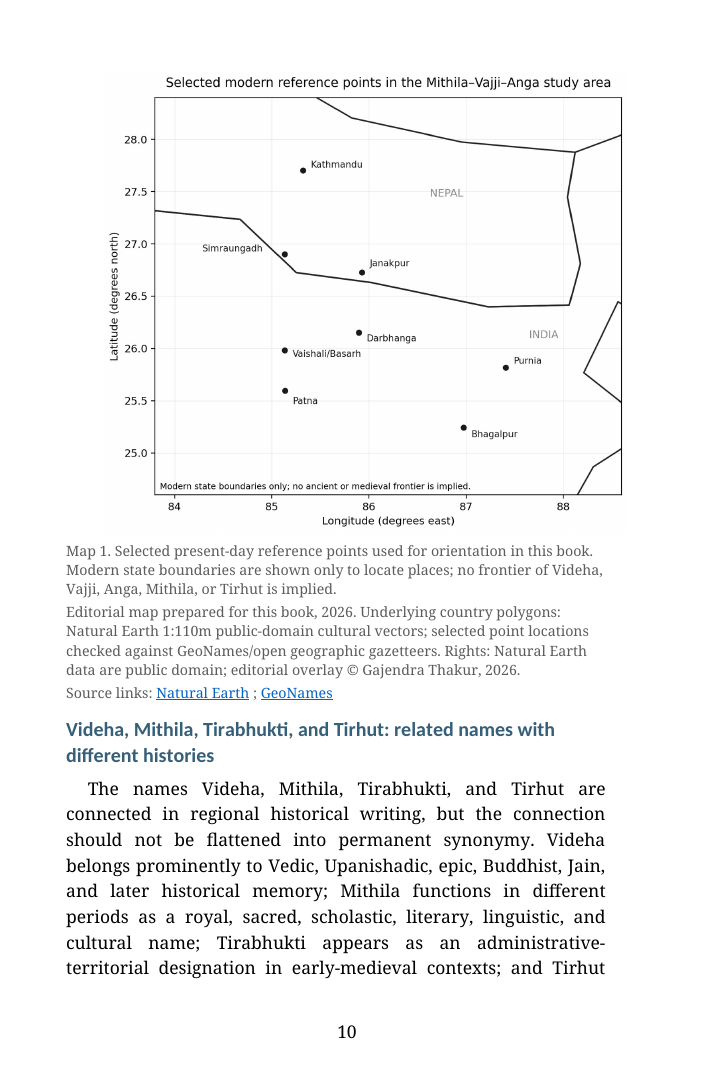
Mithila · Vajji · Anga
Chapter-specific source notes
- Primary chapter witness. Gajendra Thakur, Decoding the Panji of Mithila — Volume I, formal Chapter 18, PDF pp. 367-388; formal Chapter 18. The HTML transcription is generated from the commit-pinned source PDF and retains the chapter boundary recorded in this edition.
- Internal structure. The repository source-heading inventory records no separately encoded subordinate heading for this chapter.
- Digital editorial method. The page keeps the preserved source text distinct from generated navigational, concordance, visual, and provenance apparatus. The synthetic reconstruction is explanatory only and is not evidence for an individual lineage or a determination of social or marital status.