Decoding the Panji of Mithila · Volume I · Chapter 19
Dūṣaṇa Pañjī — The Black Book: A Complete Study from Genealogical Theories
Chapter 19
  Dūṣaṇa Pañjī — The Black Book: A Complete Study
             from Genealogical Theories

DŪṢAṆA PAÑJĪ / THE BLACK BOOK

dūṣaṇa pañjī
Gajendra Thakur | Videha Maithili Literature Movement

A COMPLETE STUDY FROM THE PERSPECTIVE OF
GENEALOGICAL THEORIES
Methodology · Systems Analysis · Comparative Framework · Subaltern
Dimensions
*"Do not judge each day by the harvest you reap but by the seeds that
you plant."*
— Robert Louis Stevenson

I. Introduction: The Pañjī System as Genealogical
Architecture
Gajendra Thakur's Dūṣaṇa Pañjī / The Black Book is not merely a historical
compendium. It is the most sustained and rigorous engagement with a living
genealogical system in South Asian scholarship — one that has recorded
Maithila society's kinship networks without interruption for over 1, years.
Published under the aegis of the Videha Maithili Literature Movement, this
237-page work functions simultaneously as a primary source anthology, an
institutional history, and a theoretical intervention in how genealogical
knowledge is constituted, preserved, and deployed.

                           Gajendra Thakur — 387
                           Decoding the Panji of Mithila
The document's subtitle, 'Genome Mapping: 450 A.D. to 2009 A.D.,' signals
Thakur's intent: to read the Pañjī not as a pre-modern curiosity but as a proto-
scientific genealogical database that anticipates modern biological and
demographic frameworks. This study examines the text from the full
spectrum of genealogical theories — from classical kinship anthropology and
biogenealogy to oral/documentary genealogy, subaltern genealogical
critique, and digital archival theory.

II. The Pañjī Typology: A Seven-Fold Genealogical System
The Pañjī system is not monolithic. The text identifies seven distinct types,
each serving a different genealogical function:

1. Mūla Pañjī (Root Register)
The foundational document tracing each family to its original settlement
(mūlagrāma). The Mūla Pañjī embodies what genealogical theorists call
'place-based lineage' — the encoding of identity through territorial origin.
Before the reign of Maharaja Mādhava Siṃha of Darbhanga, all Pañjīs were
structured uniformly as Mūla registers. Theoretically, this corresponds to
Fortes's concept of the 'lineage span' — the territorial extent and generational
depth over which kinship relations are tracked.

2. Śākhā Pañjī (Branch Register)
Commissioned by Maharaja Mādhava Siṃha (c. 1760 CE), the Śākhā Pañjī
records the branching of families as they migrated from their origin villages.
It captures what Pierre Bourdieu theorizes as 'social genealogy' — the
documented legitimation of status as families dispersed across the Mithilā
landscape. Thakur notes critically that the Śākhā Pañjī's introduction also
inaugurated the hierarchical Śrotriya classification system, converting a
scientific record into an instrument of social stratification.

3. Gotra Pañjī (Lineage-Clan Register)
This register maps the 20 gotra (patrilineal descent groups) and 167 mūlas
(sub-clans) of Maithil Brahmin society. Genealogical theory classifies this as
a 'segmentary lineage' system of the type analyzed by Evans-Pritchard among
the Nuer: a hierarchical nesting of identity from the widest Vedic gotra
(Śāṇḍilya, Vatsa, Kāśyapa, etc.) down to the specific village sub-clan.

                            Gajendra Thakur — 388
                           Decoding the Panji of Mithila
4. Patra Pañjī (Leaf/Progeny Register)
Dating from approximately 500 years before the text's composition, the Patra
Pañjī records individual lineages (apatya) with their mūlagrāma. This
corresponds precisely to what genealogists call 'vertical genealogy' — the
diachronic tracing of a single line of descent across generations.

5. Dūṣaṇa Pañjī (Defect/Blemish Register)
The eponymous register of the work. The Dūṣaṇa Pañjī records instances of
genealogical 'corruption' (kṣaraṇa) in a lineage: marriages outside prescribed
boundaries, unknown parentage, cross-caste unions, and other departures
from the normative system. Critically, the text argues that these records are
disclosed only long after the events — after sufficient time has passed for the
associated stigma to dissipate — serving as a genealogical corrective rather
than a punitive instrument.

6. Uteḍha (Ancestral Mapping Document)
The Uteḍha is the operational tool of the Pañjī system: a genealogical matrix
of 32 ancestors (sixteen on the bride's side, sixteen on the groom's side)
constructed to determine marriage eligibility. It is the system's primary
algorithm for sapiṇḍa prohibition — the prohibition of marriage between
those sharing common ancestry. Theoretically, this is the closest analog in
any world genealogical system to what modern genetics calls a 'kinship
coefficient' calculation.

7. Asvājanya-patra Pañjī / Siddhānta-patra (Certificate of Non-
Consanguinity)
The formal written certificate issued by the Pañjīkāra (registrar) affirming
that a proposed marriage does not violate sapiṇḍa rules. This document
institutionalizes the genealogical system's social function: the transformation
of archival genealogical data into actionable social certification.

III. Institutional Genealogy: The Pañjī-Prabandha as State-
Sanctioned Archive
From the perspective of institutional genealogical theory — concerned with
how genealogical knowledge becomes formalized into state and social
apparatus — the Pañjī-Prabandha represents a landmark case.

                            Gajendra Thakur — 389
                          Decoding the Panji of Mithila
3.1 The 1326 CE Institutionalization
The text documents that prior to the 14th century, individuals maintained
their own genealogical records (samūha-lekhya). By the 13th century, this
practice had declined to the point where Paṇḍita Harinatha Upādhyāya, the
great Dharmaśāstra scholar, unknowingly contracted a prohibited marriage
with his own paternal cousin's granddaughter. This failure of private
genealogical memory precipitated a structural crisis.
In 1326 CE (Śāka 1248), under the impetus of Maharaja Harasiṃhadeva of
the Karṇāṭa dynasty, the Maithil pandits resolved to transfer genealogical
record-keeping from private households to a state-sanctioned corps of
specialists — the Pañjīkāras. This institutionalization corresponds closely to
what anthropologist Jack Goody theorizes as the transition from 'oral
genealogy' to 'written genealogy' — a shift that fundamentally alters the
nature and authority of genealogical claims.

3.2 Harasiṃhadeva's Scientific Framework
Harasiṃhadeva's system was remarkable for its egalitarian design: all
Brahmin, Kāyastha, and Kṣatriya families were recorded identically. The text
states explicitly: 'Harasiṃhadeva's Pañjī was scientifically grounded
(vaijñānika ādhāra) and constituted a pure genealogy (śuddha vaṃśāvalī
paricoaya). All Brahmins, Kāyasthas, and Kṣatriyas were equal in their
respective Pañjīs.' It was only under Maharaja Mādhava Siṃha (1760 CE)
that hierarchical ranking (Śrotriya, Yogya, Pañjībaddha, Jayavāra) was
introduced — a social corruption of a scientific record.

3.3 The Pañjīkāra as Genealogical Professional
The text devotes substantial attention to the Pañjīkāra as a professional
genealogist. 185 Pañjīkāras are documented: 32 serving the Śrotriya stratum
and 153 serving Yogya and Vaṃśaja strata. The text decries the
commercialization of the profession and calls for its ethical reform: 'The
Pañjīkāra is a guardian of culture, not a petty trader.' This resonates with
contemporary debates in professional genealogical ethics about the
responsibilities of record-keepers.

                           Gajendra Thakur — 390
                           Decoding the Panji of Mithila
IV. Kinship Theory and the Sapiṇḍa Algorithm
The Pañjī system's marriage-eligibility algorithm — the Uteḍha with its 16
Naṭṭha (ancestral positions) — constitutes one of the most mathematically
precise kinship prohibition systems in pre-modern social organization
anywhere in the world.

4.1 The 32-Ancestor Matrix
The Uteḍha requires mapping 32 ancestors for both bride and groom: 16
patrilineal and 16 matrilineal for each party. The candidate must be in the
'sixth position' (ṣaṭha sthāna) or more removed from all 16 of the Naṭṭha on
the paternal side; matrilineal Naṭṭha are calculated separately. This
corresponds mathematically to a prohibition covering a 5-generation
matrilineal and 7-generation (later 6-generation) patrilineal exclusion zone
— a formula enshrined in Manu and Yājñavalkya and refined by Maheśa
Ṭhākura.

4.2 Comparison with Alliance Theory
Lévi-Strauss's alliance theory posited that marriage prohibition systems are
fundamentally about the exchange of women between groups to create social
solidarity. The Pañjī system operates differently: its prohibitions are framed
in terms of sapiṇḍa (shared ritual body) rather than alliance, and are bilateral
(covering both maternal and paternal lines), making it closer to what Goody
calls 'diverging devolution' systems than to the classic prescriptive alliance
systems of Lévi-Strauss.
Yet the Pañjī's social function does produce alliance: the 16 Naṭṭha of each
family become, in effect, a web of known relationships, and the Pañjīkāra's
Siddhānta-patra certifies the absence of sapiṇḍa as a precondition for forming
new alliances. The system thus governs alliance through the management of
descent records — an elegant inversion of Lévi-Strauss's model.

4.3 The Chromosomal Analogy
The text invokes a striking analogy, comparing the Uteḍha's 32-ancestor
matrix to chromosomal mapping: 'In the current age of science, the
determination of chromosomes (guṇasūtra) is of this type — our forebears
(Ṛṣis) placed this in a systematic manner long before.' This is not naive
scientism. The comparison is apt: the sapiṇḍa prohibition is, at its biological

                            Gajendra Thakur — 391
                          Decoding the Panji of Mithila
base, a mechanism for reducing inbreeding coefficients. The 5th/7th
generation prohibition corresponds roughly to a kinship coefficient below
1/128, approaching the threshold at which most genetic concerns about
consanguinity become negligible.
This anticipation of population-genetic logic — articulated through
Dharmaśāstra centuries before modern genetics — is among the most
theoretically significant aspects of the Pañjī system.

4.4 The Four Prohibition Rules
The Pañjī system encodes four explicit marriage prohibition rules, grounded
in Manusmṛti and Yājñavalkya:
•   Rule 1 (Sapiṇḍa): The bride and groom must not share any of the 16
    Naṭṭha in the groom's patrilineal descent.
•   Rule 2 (Gotra): They must not belong to the same gotra.
•   Rule 3 (Pravara): They must not share the same pravara (ancestral Ṛṣi).
•   Rule 4 (Vimatā): The bride must not be the daughter of the groom's
    stepmother's brother.
These rules form a multi-layered prohibition system covering genetic, ritual,
and social dimensions simultaneously — a sophistication unmatched in
comparative systems.

V. Documentary vs. Oral Genealogy: The Pañjī's Textual
Architecture
Genealogical theory distinguishes between oral genealogies (transmitted
through memory, recitation, and performance) and documentary genealogies
(preserved in written archives). The Pañjī system is unusual in being both
simultaneously.

5.1 The Transition from Samūha-Lekhya to Institutional Archive
Kumārila Bhaṭṭa's 7th-century Tantravārttika records the existence of
samūha-lekhya — collective written genealogical records maintained by elite
families. The 1326 CE institutionalization transformed this private practice
into a public archive. The text's account of this transition — from individual
family records to the Pañjīkāra-managed corpus — tracks precisely what
Clanchy (in 'From Memory to Written Record') identifies as the key
medieval transition in record culture.
                           Gajendra Thakur — 392
                           Decoding the Panji of Mithila
5.2 The Tirhuta Script as Genealogical Medium
All Pañjī manuscripts are written in Tirhutā (Maithilī) script — a fact of
immense significance for understanding the relationship between script,
community, and genealogical knowledge. The text argues that the Pañjī is
effectively the lifeblood of Tirhutā script: 'The Pañjī is the prana (vital
breath) of Tirhutā script.' The inaccessibility of the script to outsiders has
simultaneously preserved the Pañjī and limited its scholarly reception — a
classic paradox of archival exclusivity.

5.3 The Palm-Leaf Corpus
The physical archive consists of palm-leaf manuscripts (tālapatra), each book
comprising 500-600 leaves. The text describes in precise detail the
preparation, preservation, and organization of these manuscripts — including
the annual sun-drying ritual (when the sun is in Siṃha Rāśi, approximately
August 16 - September 15) and the injunction to protect manuscripts from
water, oil, and physical binding. The oldest surviving manuscripts referenced
include Pā. Raghudev Jhā's Māṇḍar mūla book (1690-1710 CE) and Pā.
Devānanda Jhā's 'Nhoṭī' branch book (c. 1770-1780 CE).
The work begun in 2000 CE (Chaitra month) to digitize and transliterate this
corpus — converting Tirhutā script into Devanagari — represents a critical
archival intervention: the first systematic transfer of the Pañjī's genealogical
data from a restricted manuscript tradition into a publicly accessible digital
medium.

5.4 The Śākhā Pañjī as Genealogical Literature
The text claims that the Śākhā Pañjī is 'an unprecedented book — no such
book has been found in any country, in any sect, or in any class anywhere in
the world.' This claim invites comparison with the Welsh bardic genealogies,
the Irish Book of Leinster, the Polynesian 'aro (genealogical recitations), and
the Japanese kakochō. While none of these match the Pañjī's scale (1, years
of continuous documentation across an entire region's population), the
comparison illuminates the Pañjī's distinctiveness: it is not a dynastic
genealogy but a total societal genealogy.

                            Gajendra Thakur — 393
                           Decoding the Panji of Mithila
VI. The Genome Mapping Framework: Genealogy as Bio-
Social Science
The text's most ambitious theoretical move is its framing of the Pañjī as a
form of 'Genome Mapping' — a term Thakur uses deliberately and with
precision.

6.1 Two-Phase Mapping
The text distinguishes between Genome Mapping (Phase 1, covering the
three Khaṇḍas of the ancient Pañjī corpus) and 'Genealogical Mapping'
(Phase 2), which constitutes 'Family History' — the foundation of any
genomic study. This two-phase structure maps onto contemporary genomic
methodology: population-level genetic data requires individual family history
as its baseline.

6.2 Chronological Calibration via Generational Count
One of the text's most impressive achievements is its use of the Pañjī's
generational records to calibrate historical chronology. Using a 40-year
generation length, the text demonstrates:
•   Āryabhaṭṭa (Ādibbhaṭṭa, of Māṇḍar-Kāśyapa gotra) is placed at
    generation 39 from the compilation point, yielding a birth date of
    approximately 476 CE — matching historical consensus.
•   Goṇū Jhā (Karmahe Sonkariyām, Vatsa gotra) is placed at generation 24,
    yielding approximately 1050-1150 CE.
•   Vidyāpati Ṭhakkura (Viṣaevara, Bisfī-Kāśyapa) is placed at generation
    14 from compilation, yielding approximately 1350-1435 CE — again
    matching historical consensus.
This use of generational depth to independently date historical figures is a
sophisticated application of what genealogists call 'computational genealogy'
— cross-validating documentary and demographic methods.

6.3 The Pañjī as Population Database
The text's claim that 'no human genealogy spread over such a vast territory
has been recorded so comprehensively for more than 1, years, in the way the
people of Mithilā have done' is substantiated by its statistics: 20 gotras, 167
mūlas (principal mūlas: 35, organized in three hierarchical tiers), 185
Pañjīkāras, spanning a territory from Nepal to Bangladesh. By any measure,

                            Gajendra Thakur — 394
                           Decoding the Panji of Mithila
the Pañjī constitutes one of the largest continuous human genealogical
databases in world history.

VII. The Dūṣaṇa Pañjī: A Counter-Archive and Subaltern
Genealogy
The titular Dūṣaṇa Pañjī — the Register of Defects — is theoretically the
most subversive component of the system. Its 97 tabulated entries constitute
a genealogical counter-archive that documents what the normative system
sought to suppress.

7.1 What the Dūṣaṇa Pañjī Records
The tabulated entries in the Dūṣaṇa Pañjī record marriages across class,
caste, and community boundaries:
•   Marriages into 'unknown' lineages (ajñāta vaṃśa) — families whose
    ancestry could not be verified.
•   Marriages into Dalit communities (e.g., Camār, specified directly in
    entries such as 'Valliyāsa Camaru suta Gaṅgādhar kī kanyā meṃ').
•   Marriages with Devadāsī women (explicitly documented in entries 17-21
    — Jānika Devadāsa records).
•   Marriages into Muslim families ('Daulatijahāṃ' appearing in entries 11-
    12).
•   Marriages with women of unknown or inter-caste origin ('aṃtajātīya').
•   Marriages into Koch Rajvanshi and other non-Maithil royal families.
The text provides specific genealogical tables for 97 such cases, each tracing
the descent from the 'transgressive' union across multiple generations to show
the contemporary family members descended from it.

7.2 The Politics of Disclosure
The Dūṣaṇa Pañjī's political logic is articulated explicitly: disclosure of these
unions is postponed until 'kālātīta' — after the events have become
temporally remote enough that their disclosure will not harm the living
descendants. As the text states: 'When an event becomes kālātīta, it will have
no adverse effect on any lineage; rather, it will serve as guidance for what
decision should be taken in a similar situation.'

                            Gajendra Thakur — 395
                           Decoding the Panji of Mithila
From the perspective of subaltern genealogical theory, this temporal logic is
double-edged. On one hand, it protects Dalit and marginalized women and
their descendants from contemporary stigma. On the other, it defers the full
disclosure of Brahminic social mixing indefinitely, allowing the normative
system to maintain the fiction of purity while quietly absorbing transgressive
unions into its documented history.

7.3 Thakur's Subaltern Reading
Thakur foregrounds the Dūṣaṇa Pañjī's evidence of inter-caste mixing as
proof of what he calls the fundamental liberalism of Maithil society: 'The
society that is described as Jayavāra has, since ancient times, been more
liberal and tolerant compared to the other civilizations and cultures of India.
No form of religious fanaticism has been a permanent feature here.'
This reading deploys the genealogical archive against Brahminic self-
representation: the same Pañjī system that codified caste purity also
documented, with ethnographic fidelity, the pervasive reality of caste
transgression. The Dūṣaṇa Pañjī is thus a deconstructive genealogy — an
archive that, in recording the exceptions to the rule, undermines the rule's
claim to absolute authority.

7.4 Devadāsī Genealogy and Female Erasure
A significant sub-theme of the Dūṣaṇa Pañjī concerns Devadāsī women and
their children. Entries 17-21 document the children of Devadāsīs who are
'ajñāta mānala gelīh' (considered unknown/unnamed) yet whose descendants
are 'samādṛta' (respected) in contemporary society. This pattern — the
deliberate erasure of the mother's identity while preserving the patriline's
record — reflects what Gerda Lerner identifies as the foundational
mechanism of patriarchal genealogy: the invisibility of women's reproductive
labor within the official record.
Critically, the text notes that 'only in the Rasāḍha-Arrariyā Pañjī are women's
names recorded.' This single exception illuminates the rule: the Pañjī system
is structured around paternal descent, with women appearing only as
relational terms (māna, mātrika, dou — daughter-in-law, mother's lineage,
daughter). The Dūṣaṇa Pañjī's documentation of Devadāsī mothers is thus a
partial recovery of erased female genealogy — partial because the mothers'
names are still suppressed.

                            Gajendra Thakur — 396
                         Decoding the Panji of Mithila
VIII. The Gotra-Pravara System: Vedic Genealogy and Its
Classification
The Pañjī's classification of Maithil Brahmins through gotra and pravara
represents a Vedic genealogical taxonomy that predates the Pañjī-Prabandha
by millennia.

8.1 The 20 Gotras
The text enumerates all 20 gotras of Maithil Brahmin society, each named
after a primordial Vedic sage (Śāṇḍilya, Vatsa, Sāvarṇa, Kāśyapa, Parāśara,
Bhāradvāja, Kātyāyana, Garga, Kauśika, Alāmbukākṣa, Kṛṣṇāneya,
Gautama, Maudgalya, Vaśiṣṭha, Kauṇḍinya, Upamanyū, Kapila,
Viṣṇuvṛddhi, Taṇḍi, and Jātūkarṇa). This system represents a genealogical
taxonomy in which all members of a gotra claim descent from a common
primordial ancestor — precisely the 'segmentary lineage' structure theorized
by Evans-Pritchard.

8.2 Pravara: The Sub-Lineage System
Pravara further subdivides gotras by identifying the 2-5 Ṛṣi ancestors who
composed Ṛgvedic hymns. Dvipravara families (those with 2 ancestral Ṛṣis)
and Pañcapravara (5 ancestral Ṛṣis) families cannot intermarry even if their
gotras differ — since Vātsa and Sāvarṇa share the same Ṛṣi ancestors (Ova,
Cyavana, Bhārgava, Jāmadagnya, Āplāvāna), marriages between them are
prohibited despite their nominal gotra distinction.
The text provides the complete pravara list for all 20 gotras — a taxonomic
resource of exceptional genealogical precision.

8.3 The Pañca Gauḍa Classification
The macro-genealogy of Brahmin communities across India is organized into
two groups: Pañca Gauḍa (north of the Vindhyas: Utkal, Kānyakubja, Gauḍa,
Maithil, Sārasvata) and Pañca Draviḍa (south of the Vindhyas: Kārnāṭa,
Gujara, Tailaṅga, Draviḍa, Māhārāṣṭrīya). Maithil Brahmins are thus located
within this macro-taxonomy as one of the five northern sub-groups — a
classification that reflects the political-geographical organization of
Brahminic culture in the post-Vedic period.

                           Gajendra Thakur — 397
                           Decoding the Panji of Mithila
IX. Comparative Genealogical Theory: The Pañjī in Global
Context
Situating the Pañjī within the global history of genealogical systems
illuminates both its uniqueness and its theoretical significance.

9.1 Comparison with Medieval European Genealogy
Medieval European genealogical systems (Carolingian royal genealogies, the
Welsh Triads, Domesday Book entries) served primarily dynastic and
property functions. The Pañjī differs fundamentally: it is a total population
genealogy covering all social strata (not just elites), maintained for
ritual/marriage purposes rather than political legitimation, and organized
around the principle of sapiṇḍa prohibition rather than inheritance.

9.2 Comparison with Chinese Genealogy (Zupu)
Chinese clan genealogies (zupu) are the closest global parallel to the Pañjī in
terms of scope and continuity. Like the Pañjī, they record multiple
generations of a clan's patrilineal descent. Unlike the Pañjī, they are
maintained by the clans themselves rather than by an independent
professional corps, and they do not function as a real-time marriage
eligibility certification system. The Pañjī's institutional structure — with
state-appointed Pañjīkāras issuing legally recognized Siddhānta-patra — has
no parallel in the Chinese system.

9.3 Comparison with Polynesian Genealogy
Polynesian genealogical recitations (like the Hawaiian Kumulipo) share the
Pañjī's ambition of total genealogical coverage, but are primarily oral and
cosmogonic — tracing descent from divine origins. The Pañjī is explicitly
empirical and terrestrial, beginning its documented record from
approximately 450 CE with named, historically verifiable individuals.

9.4 The Pañjī's Unique Features
In comparative perspective, the Pañjī system is distinguished by four features
that have no global parallel in combination:
•   Continuous documentation spanning 1,500+ years across an entire
    regional population.

                            Gajendra Thakur — 398
                           Decoding the Panji of Mithila
•   Independent professional genealogists (Pañjīkāras) functioning as state-
    authorized certifiers.
•   A mathematically precise kinship coefficient algorithm (the 32-ancestor
    Uteḍha) for marriage eligibility.
•   A counter-archive (the Dūṣaṇa Pañjī) that simultaneously documents
    transgression against and within the normative system.

X. Critical Perspectives: Genealogy, Power, and Reform
A complete genealogical study of the Pañjī cannot avoid its implication in
structures of social power. Thakur's text is itself a critical intervention, and
its critique must be incorporated into the theoretical framework.

10.1 The Brahminic Capture of a Scientific System
Thakur's most sustained critique concerns the transformation of
Harasiṃhadeva's egalitarian genealogical system into a vehicle for
Brahminic social stratification. The introduction of the Śrotriya-Yogya-
Pañjībaddha-Jayavāra hierarchy by Maharaja Mādhava Siṃha and court
Brahmins converted the Pañjī from a scientific record into a ranking
instrument. 'The classification of Śrotriya and others,' the text argues, 'began
from the era of Maharaja Mādhava Siṃha and the practice of Śākhā Pañjī,
and the harmful social practices arising from this ranking hierarchy began.'

10.2 Commercialization and Ethical Decay
The text denounces the commercialization of the Pañjīkāra's function:
demanding advance payment before issuing eligibility determinations,
charging each person separately for a single group task, and prioritizing
revenue over accuracy. This critique maps onto Bloch's analysis of how
genealogical specialists across cultures face the tension between their civic
function (as custodians of public knowledge) and their private interests (as
holders of a specialized, monetizable skill).

10.3 The Reform Program
Thakur proposes a reform of the Pañjī system grounded in its original
Dharmaśāstra logic. He argues that the Uteḍha's 16 Naṭṭha are equally
weighted — no Naṭṭha has special priority over another — and that the
asymmetry between the Śrotriya's full Śākhā recitation and the ordinary

                            Gajendra Thakur — 399
                           Decoding the Panji of Mithila
person's Naṭṭha-based eligibility determination is a post-facto social
invention with no Dharmaśāstra basis. The reform program calls for
returning to the system's original scientific function: genealogical
certification of marriage eligibility based on sapiṇḍa calculation alone.

10.4 Digital Archival Theory and the Pañjī's Future
The text's account of the digitization project begun in 2000 CE raises
questions central to digital archival theory. The transliteration of Tirhutā
manuscripts into Devanagari Maithili represents a script-crossing that
changes the Pañjī's semiotic register: from a specialist's script accessible only
to trained Pañjīkāras, to a common Devanagari text accessible to any literate
person. This democratization of access is simultaneously a
decontextualization — separating the genealogical data from the specialized
knowledge tradition that made it interpretable.
The text advocates for the digital availability of the Pañjī in 'the script most
widely used among the majority of people' — recognizing that the system's
survival in the age of globalization requires its translation into publicly
accessible formats, even at the cost of some specialist knowledge.

XI. Navya-Nyāya Epistemology of the Pañjī: Genealogy as
Inference
Gajendra Thakur's broader scholarly engagement with Navya-Nyāya
philosophy — particularly the epistemology of Gaṅgeśa Upādhyāya —
provides a distinctive theoretical lens for reading the Pañjī system. From the
Navya-Nyāya perspective, genealogical knowledge is a form of anumāna
(inference) structured by specific rules of evidence and certification.

11.1 Pratyakṣa and Anumāna in the Pañjī
The Pañjī system distinguishes between direct testimony (the Pañjīkāra's
personal knowledge of a lineage), recorded evidence (the written Pañjī texts),
and inferred eligibility (the Siddhānta-patra issued on the basis of this
evidence). This structure maps onto Navya-Nyāya's epistemological
categories: pratyakṣa (direct perception), anumāna (inference), and śabda
(testimony). The Pañjīkāra's function is precisely anumāna: from the written
record of 32 ancestors, the eligibility of a marriage is inferred.

                            Gajendra Thakur — 400
                           Decoding the Panji of Mithila
11.2 The Uteḍha as Logical Schema
The Uteḍha's 16-Naṭṭha calculation can be formalized as a logical schema in
Navya-Nyāya terms. Each Naṭṭha is a vyāpti (universal relation) of kinship;
the Siddhānta-patra is the conclusion (sādhya) derived from the absence of
any such vyāpti in the groom's patrilineal descent. The Pañjīkāra performs
what Gaṅgeśa would recognize as a pramāṇa — a valid means of knowledge
— grounded in documented genealogical evidence.

XII. Conclusion: The Pañjī as a Theoretical Paradigm
Gajendra Thakur's Dūṣaṇa Pañjī / The Black Book presents the Maithila
Pañjī system as a complete genealogical paradigm — one that integrates
biological, social, institutional, documentary, and epistemological
dimensions into a single coherent system. From the perspective of
genealogical theory, it constitutes:
•   A kinship system of exceptional mathematical precision, anticipating
    modern genetic understanding of consanguinity.
•   An institutional archive of unparalleled continuity and scope, rivaling
    any documentary genealogical system in world history.
•   A counter-archive (the Dūṣaṇa Pañjī) that documents the reality of inter-
    caste mixing, functioning as a subaltern genealogical record within and
    against the normative system.
•   A site of ongoing social critique: Thakur's text uses the Pañjī's own
    evidence to contest the Brahminic hierarchy that has accumulated around
    it.
•   A model for digital genealogical archival, as the ongoing transliteration
    project attempts to transfer 1, years of manuscript genealogy into a
    publicly accessible digital format.
The Pañjī is not a relic. It remains a living institution — issuing marriage
eligibility certificates to contemporary Maithil families, recording new births
and marriages, and continuing the unbroken genealogical record that began,
according to the text's earliest traced entries, with Niniyana Bhaṭṭa
(approximately 400 CE). Its theoretical significance for comparative
genealogical studies, kinship anthropology, population genetics, archival
science, and subaltern history has been systematically undervalued in
scholarship outside the Maithila tradition.

                            Gajendra Thakur — 401
                           Decoding the Panji of Mithila
Thakur's work is a corrective to that neglect. In framing the Pañjī as 'Genome
Mapping,' he insists on its place not only in South Asian social history but in
the global history of human attempts to know, record, and regulate the
connections between generations.
Videha Maithili Literature Movement | videha.co.in
ISSN 2229-547X

                            Gajendra Thakur — 402
                           Decoding the Panji of Mithila
Source structure and verification apparatus
Editorial source apparatus. This apparatus is descriptive, not interpretive. It records the source-controlled structure used to verify that this page corresponds to formal Chapter 19 of Decoding the Panji of Mithila — Volume I. The chapter text above is preserved from PDF pp. 388-404; formal Chapter 19 in the commit-pinned authoritative source. It is not merged with a neighboring chapter, appendix, annexure, or independent front/back-matter unit. The internal headings below come from the repository’s source-heading inventory and are retained as navigational and audit evidence; showing them here does not turn those headings into separate publications or add claims that are absent from the source.
Internal source headings
No subordinate heading was separately encoded in the repository source-heading inventory for this chapter.
Source-text concordance
Dūṣaṇa · Pañjī · Black · Book · Complete · Study · Genealogical · Theories · Gajendra · Thakur · Videha · Maithili · Literature · Movement · PERSPECTIVE · Methodology · Systems · Analysis · Comparative · Framework · Subaltern · Dimensions · judge · harvest · reap · seeds · plant · Robert · Louis · Stevenson · Introduction · System · Architecture · Thakur's · merely · historical · compendium · sustained · rigorous · engagement · living · South · Asian · scholarship · recorded · Maithila · society's · kinship · networks · without · interruption · years · Published · aegis · 237-page · work · functions · simultaneously · primary · anthology · institutional · history · theoretical · intervention · knowledge · constituted · preserved · deployed · Decoding · document's · subtitle · Genome · Mapping · signals · intent · read · pre-modern · curiosity · proto · scientific
Boundary verification. In the formal sequence this chapter follows Volume I Chapter 18, “The Dooshan Pañjī of Mithila: A Comprehensive Scholarly Report” and precedes Volume I Chapter 20, “Dooshan Panji: An Interdisciplinary Research Report through Anthropological, Sociological, and Genealogical Lenses”. The chapter extractor begins at the verified formal Chapter 19 marker and stops at the next verified formal chapter marker; for a final chapter it stops before recognized book-level back matter. The concordance above is generated only from distinct terms already present in this chapter’s preserved source text. It is provided for discovery, comparison, and audit, not as an automated judgment about persons, lineages, status, kinship, marriage eligibility, or historical truth.
Illustrated research apparatus
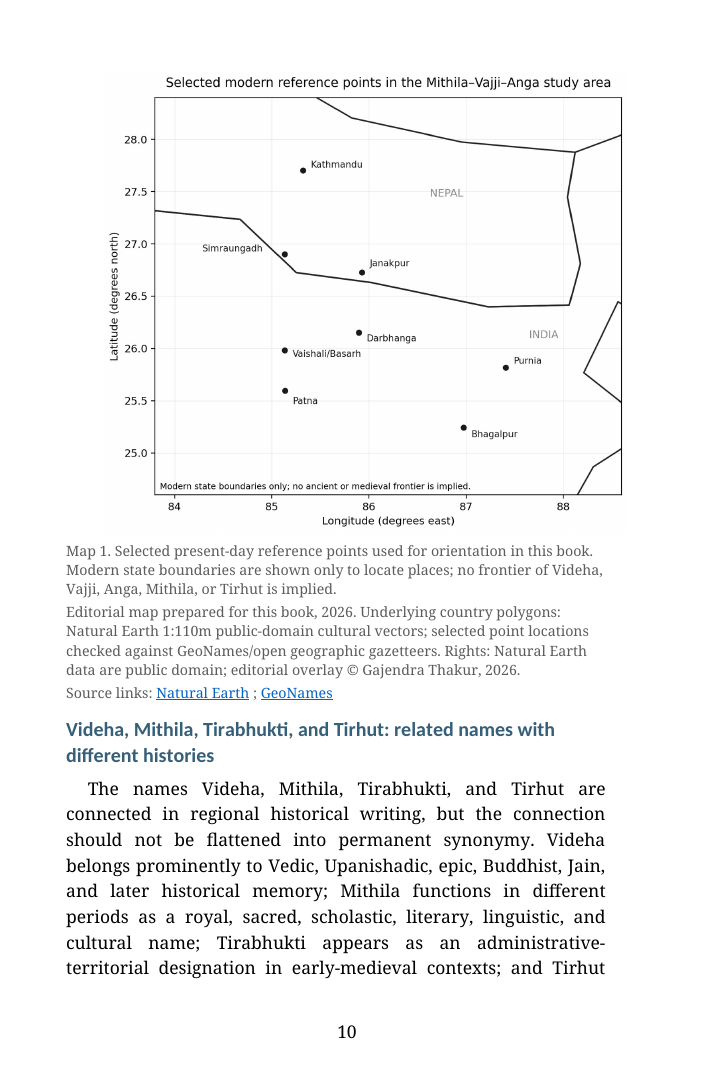
Mithila · Vajji · Anga
Chapter-specific source notes
- Primary chapter witness. Gajendra Thakur, Decoding the Panji of Mithila — Volume I, formal Chapter 19, PDF pp. 388-404; formal Chapter 19. The HTML transcription is generated from the commit-pinned source PDF and retains the chapter boundary recorded in this edition.
- Internal structure. The repository source-heading inventory records no separately encoded subordinate heading for this chapter.
- Digital editorial method. The page keeps the preserved source text distinct from generated navigational, concordance, visual, and provenance apparatus. The synthetic reconstruction is explanatory only and is not evidence for an individual lineage or a determination of social or marital status.