Decoding the Panji of Mithila · Volume I · Chapter 20
Dooshan Panji: An Interdisciplinary Research Report through Anthropological, Sociological, and Genealogical Lenses
Chapter 20
 Dooshan Panji: An Interdisciplinary Research Report
through Anthropological, Sociological, and Genealogical
                       Lenses

Dooshan Panji: An Interdisciplinary Research Report        Videha       Parallel
Literature Movement

DOOSHAN PANJI
The Black Book of Mithila

A Comprehensive Research Report
through Anthropological, Sociological, and Genealogical Lenses
Primary Source: Dooshan Panji (Dooshan.pdf / Dooshan.docx)
Edited, Transliterated & Published by Gajendra Thakur
Videha eJournal | ISSN 2229-547X | videha.co.in

I. Introduction and Nature of the Source
The Dooshan Panji — literally the 'Defect Register' or 'Black Book' — is one
of the most remarkable archival documents in the history of Indian
genealogical traditions. It constitutes the fifth of seven canonical types of
Panji (genealogical register) maintained among Maithil Brahmin
communities of the Mithila region (modern Bihar and the Tarai of Nepal).
Unlike the primary Mool Panji (root register), the Shakha Panji (branch
register), the Gotra Panji (lineage register), the Patra Panji (issue register),
and the Utedh Panji (sapinda-extinction register), the Dooshan Panji served
the specific function of recording departures from normative endogamy —
inter-caste unions, sexual irregularities, widow remarriage, marriages with

                            Gajendra Thakur — 403
                         Decoding the Panji of Mithila
devadasi or artisan-caste women — and tracking the generational
consequences for lineage status.
The document made available for this research is the Mithilakshar-to-
Devanagari transliteration undertaken from the year 2000 CE onwards by
Gajendra Thakur, editor of Videha eJournal. This transliteration drew upon
palm-leaf and bark manuscripts (tarapatra and basaha patra) maintained by
professional genealogists (Panjikar families) over approximately 1, years.
The archive comprises upwards of 11, palm-leaf images (available on DVD
and digitally at videha.co.in). The Dooshan Panji section relevant here was
released publicly in 2009, with the Tables (1–97) constituting the primary
empirical dataset examined in this report.
The document is simultaneously a genealogical archive, a sociological
record, a caste-mobility ledger, and — as demonstrated through its central
case study — a suppressed biographical record of Gaṅgeśa Upādhyāya (c.
13th–14th century CE), the founding philosopher of the Navya-Nyāya school
of Indian logic. Its significance extends far beyond the regional: it is a
primary source document for the history of Indian philosophy, caste, and the
sociology of knowledge.

II. The Panji System: Structure and Historiography

II.1 Institutional Origins
The Panji-Prabandha system was formally institutionalised under King
Harasimhadeva (born 1294 CE, acceded 1307 CE) of the Karnat dynasty of
Mithila. As recorded in Jyotirishwar Thakur's Varna-Ratnakara,
Harasimhadeva appointed Gunakar Jha as the first genealogist (Panjikar) for
Maithil Brahmins, Shankardatt for Karna Kayasthas, and Vijaydatt for
Kshatriyas. Following Harasimhadeva's flight to Nepal in 1324–25 CE after
defeat by Ghiyasuddin Tughlaq, Mithila scholars fixed the commencement of
the current Panji-Prabandha at 1248 Shaka / 1326 CE. This date is
corroborated by internal Panji evidence.
A later and decisive restructuring occurred when Mithilesh Maharaja
Madhav Singh, around 1760 CE, ordered the compilation of Shakha Pustaks
(branch books). This event precipitated the emergence of the Shrotriya sub-
caste — a crucial sociological datum: as demonstrated by Gajendra Thakur's
analysis of authentic Panji files, the Shrotriya sub-caste did not exist in

                           Gajendra Thakur — 404
                            Decoding the Panji of Mithila
British India before approximately 1800 CE and does not exist among
Maithil Brahmins in the Nepal portion of Mithila even today. This
demolishes retrospective claims of immemorial Shrotriya identity.

II.2 Typology of Panji Registers
The seven canonical types illuminate the system's comprehensive scope:
      Mool Panji | Primary genealogical register; uniform in original form across
      all branches
      Shakha Panji | Branch registers for Sochhat, Jog, and Panjibadhha sub-
      groups; includes Uptip (Sochhatpura) and Nagram (Pachiwar Par)
      Gotra Panji | Records all gotras (exogamous lineage groups) and their
      ancient Mool (root villages)
      Patra Panji | Records descendants (apatya); in use approximately 500 years;
      introduces Mool-gram reference
      Dooshan Panji | Records genealogical 'defects' (ksharan) — the central
      subject of this report
      Utedh Panji    |   Records sapinda extinction and known ancestors across
      generations
      Aswajan-ya Patra Panji | Supplementary register for affinal kin; sole register
      (Rasadh-Araria) to record women's names
The Dooshan Panji's revelatory character lies in its documentation that inter-
caste liaisons, marriages outside varna, and relationships with devadasi,
artisan, and Dom communities were sufficiently frequent to require a
dedicated institutional record. The very existence of the register proves that
Mithila's Brahmin community was neither as endogamous nor as caste-rigid
as later canonical historiography — and Sahitya Akademi-sanctioned
scholarship — has claimed.

II.3 Anshuman Pandey's Independent Corroboration
The significance and reliability of these records are corroborated by
independent academic use. Anshuman Pandey (University of Michigan,
doctoral dissertation 2014: 'Recasting the Brahmin in Medieval Mithila:
Origins of Caste Identity among the Maithil Brahmins of North Bihar')
received a complete digitised set of Panji records from Gajendra Thakur in
2007, noting that Panjikar families — who regard these records as
intellectual property — are typically reluctant to share them. Pandey's
dissertation deployed these records to reconstruct the historical formation of

                             Gajendra Thakur — 405
                          Decoding the Panji of Mithila
Maithil Brahmin caste identity in the medieval period, providing an
independent scholarly validation of the archive's authenticity and analytical
value.

III. Anthropological Analysis

III.1 The Panji as a Total Social Institution
In Marcel Mauss's sense of a 'total social fact' — one that simultaneously
expresses religious, juridical, moral, economic, aesthetic, and morphological
dimensions — the Panji system constitutes what may be called a Total Social
Institution. It is not merely a genealogical register but the constitutive
framework of social personhood in Mithila. Membership in the Panji is the
condition of possibility for marriage, religious participation, property
inheritance, and judicial standing within the community.
The Dooshan Panji, in particular, functions as what Erving Goffman would
term a stigma register: a master document that attaches spoiled identity to
lineages across generations. However — and this is the document's most
anthropologically surprising feature — it simultaneously provides the
mechanism for purification: the Tables systematically track the generational
restoration of ritual status (the concept of Purnatah Shuddha, 'completely
pure,' achieved by the sixth generation in the primary case studied, namely
Example 1 in Table 1).

III.2 Kinship Analysis: Cross-Caste Marriages and Hypogamy
The 97 tables of the Dooshan Panji constitute a dataset of inter-caste and
socially transgressive marriages documented over approximately 1, years.
The following patterns emerge from a systematic reading:
•   Hypogamic unions (Brahmin men with lower-caste women) are recorded
    but relatively rare; hypergamic unions (lower-caste men with Brahmin
    women) are also present.
•   Marriages with Charmakar (leather-worker / tanner) women: most
    prominently in the case of Gaṅgeśa Upādhyāya's mother and, crucially,
    his wife (see Section V).
•   Unions with devadasi (temple-dancers): multiple entries record maternal
    lineages connected to devadasi women; Examples 16, 17, 18, 20, 21

                           Gajendra Thakur — 406
                           Decoding the Panji of Mithila
    document children of devadasi mothers across the Shodarpura, Khowal,
    Tilaya, and Budwal Mool lineages.
•   Marriages with Rajak (washerman-caste) women: Tables 54, 55, 64, 65,
    66, 67 document inter-marriages between Brahmin men and Rajak
    women, with their genealogical ramifications tracked through multiple
    generations.
•   Marriages with artisan castes (Charmakar/Charmakarin): Tables 49–51
    explicitly name Charmakarin as maternal ancestor, with the lineage of
    Gaṅgeśa directly implicated.
•   Unions with 'Antajatiya' persons (those of the lowest birth): Tables 45,
    46, 47 record such unions without stigmatising them as final; the
    documents continue to track the lineages.
•   A unique entry (Table 49, Entry 188/2) records a woman identified as
    Charmakarin from Babhaniyam (Bhabanipur) as the wife of a man
    identified with the Chhadan Mool — the lineage entry immediately
    preceding the explicit naming of Gaṅgeśa.
•   Unions with Muslim women and widows who remarried: the editorial
    commentary in the document explicitly states this is among the
    categories the Dooshan Panji records.
From an anthropological standpoint, what is most significant is not the
transgression itself but the institutional response: the Dooshan Panji neither
condemns nor excommunicates. It tracks, it records, it projects forward. It is
an instrument of social memory that maintains knowledge while managing
the social distance required to prevent permanent ritual pollution. The
mechanism of generational purification (Shuddhi in six generations) reflects
a sophisticated, flexible caste logic — far more adaptive than later colonial-
period rigidification of caste identity would suggest.

III.3 The Question of 'Burning Questions' (Dalilit Karnewali
Ghatna)
The Dooshan Panji's editorial apparatus — reflected in Gajendra Thakur's
framing — explicitly deploys the concept of a 'Burning Question': an event
so socially disturbing that it agitates society and intellect for a brief period
before being forgotten (kaalatit bhay vismart hoit rahal). The document
argues that Mithila's social memory was paradoxically both long (sustained
by Panji archives for 1, years) and systematically amnesiac (events forgotten
once the social crisis passed). This is a precise articulation of what Maurice
                            Gajendra Thakur — 407
                          Decoding the Panji of Mithila
Halbwachs would call the selective mechanism of collective memory, and
what Paul Connerton calls 'forgetting as a social performance.'
The Panji system thus preserves what social forgetting seeks to erase. The
Dooshan Panji is, in Connerton's terms, an 'inscribed memory' that survives
the 'incorporated memory' (bodily, social, habitual) of the communities
whose practices it records.

IV. Sociological Analysis

IV.1 Caste as Dynamic Process: Against the Colonial-Static Model
The dominant model of Indian caste — inherited from colonial ethnography
(Risley, Blunt, Hutton) and its successors — treats caste as a fundamentally
static, ascriptive, and hypergamically closed system. The Dooshan Panji
fundamentally challenges this model. The document reveals caste in Mithila
as a dynamic, processual, and negotiable social category in which:
•   Inter-caste unions were sufficiently common to require dedicated
    institutional documentation across 97 cases.
•   The consequences of such unions were tracked not as permanent
    excommunication but as generational trajectories capable of restoration.
•   The genealogical record itself served as a form of social insurance,
    protecting the main lineage from 'ill-effects' (dushparinaam) while
    preserving knowledge of the departed branch.
•   Knowledge of past 'defects' enabled communities to make informed
    judgements about contemporary social situations — a form of what we
    might call genealogical risk management.
This dynamic model resonates with Louis Dumont's recognition in Homo
Hierarchicus (1966) that the opposition of pure and impure is not a fixed
binary but a relational gradient — what matters is relative position, not
absolute pollution. The Dooshan Panji institutionalises precisely this
relational, processual understanding of purity.

IV.2 Gender and the Register: Women's Bodies as Genealogical
Sites
The Dooshan Panji reveals a gendered sociology of genealogical recording.
The document notes that only the Rasadh-Araria Panji records women's
names at all — the other registers trace patrilineal descent and identify

                           Gajendra Thakur — 408
                           Decoding the Panji of Mithila
women primarily as maternal roots (matrik) of their sons. This androcentrism
is structurally significant: the 'defect' in genealogical terms is always defined
in relation to the male line, yet it is the female body — the mother, wife, or
daughter — through whom transgression enters and purification must work.
The repeated formula 'Mata Agyat' (Mother Unknown) — appearing in
dozens of entries across the 97 tables — is sociologically revealing. It
signifies not ignorance but deliberate suppression: the identity of mothers
from lower castes or devadasi backgrounds was systematically withheld from
the main genealogical record while being preserved in the Dooshan register.
This is a gendered double inscription: the main register erases; the Dooshan
register preserves.
The devadasi entries deserve particular attention. Examples 16–21 in the
Tables document multiple lineages where the maternal grandmother or great-
grandmother was a devadasi. The document neither pathologises this
connection nor erases it — it records it with the same precision applied to all
other genealogical facts. This suggests that the Mithila devadasi institution
(connected, as elsewhere in India, to temple service) was not regarded as
placing women entirely outside the sphere of genealogically significant
social relationships.

IV.3 Mobility, Migration, and the Sociology of 'Paschhim Desh Se
Agata'
Several entries in the Dooshan Panji record individuals described as arriving
'from the Western direction' (Paschim Desh se Aagat) — a formula
indicating migration into the Mithila genealogical territory from outside.
These entries pose a significant sociological question: how were outsiders
incorporated into the Panji system? The document suggests that
incorporation required tracing descent (or acknowledging its absence) and
that certain transgressive unions were precisely with persons of unclear
lineage — 'unknown caste and community' (Agyat Vansh O Jati me).
This mobility dimension connects the Dooshan Panji to larger questions in
the sociology of Indian caste: the role of the frontier, migration, and political
disruption (particularly the Tughlaq invasion and the Karnat dynasty's
displacement) in reshaping caste boundaries and generating new social
categories. The Shrotriya sub-caste itself — demonstrably created around
1800 CE through genealogical certification for cash — is the most dramatic

                            Gajendra Thakur — 409
                           Decoding the Panji of Mithila
evidence that caste 'tradition' in Mithila was actively manufactured through
the Panji apparatus.

IV.4 The Sociology of Knowledge: Honour Killing and
Institutional Suppression
The document's most explosive sociological claim concerns the deliberate
suppression of information from the Dooshan Panji by 20th-century scholars
— specifically by Ramanath Jha and, subsequently, Udayanath Jha 'Ashok'
— working within the institutional framework of Sahitya Akademi. Gajendra
Thakur's editorial framework frames this suppression as an 'honour killing' of
Gaṅgeśa Upādhyāya: the posthumous erasure of a philosopher's Charmakar
wife and the circumstances of his birth from the authoritative scholarly
record.
This sociological claim is specific and documentable. Dinesh Chandra
Bhattacharya (1958, History of Navya-Nyaya in Mithila) — writing that the
family connected to Gaṅgeśa 'dwindled into insignificance' and became
'extinct soon after his son's death' — did so on the basis of information
provided by Ramanath Jha, who demonstrably knew of the Dooshan Panji
evidence but withheld it. Bhattacharya further notes that 'the family which
was inferior in social status is now extinct in Mithila' — a sentence that, read
against the Dooshan Panji evidence, constitutes a statement about the
Charmakar lineage connection that Ramanath Jha was unwilling to make
explicit.
This is a textbook case of what Robert Merton called the sociology of
knowledge operating within an institutional framework of power: knowledge
production shaped not by empirical inadequacy but by caste ideology
operating through scholarly authority. The Sahitya Akademi monograph by
Udayanath Jha 'Ashok' (post-2009, therefore with full access to the Dooshan
Panji evidence released that year) perpetuates this suppression, which Thakur
documents with precision.

V. Genealogical Analysis: The Case of Gaṅgeśa Upādhyāya

V.1 Primary Evidence from the Dooshan Panji
The Dooshan Panji contains multiple overlapping records of Gaṅgeśa
Upādhyāya's family. The key entry is:

                            Gajendra Thakur — 410
                          Decoding the Panji of Mithila
Chhadan-sañ Tattva Chintāmaṇi kāraka Gaṅgeśak Vallabhā Charmakāriṇī
pitṛ parokṣe pañca varṣa vyatīte Tattva Chintāmaṇi kāraka Gaṅgeśotpatti
[Charmakāriṇī Medhāk santānak lāgime chalanhi]
Translation: 'From the Chhadan lineage, the wife (Vallabha) of Gaṅgeśa, the
author of Tattvacintāmaṇi, was Charmakāriṇī [a woman of the Charmakar /
tanner caste]. Five years after the passing (Pitri Parokshe Panch Varsh
Vyatite) of [Gaṅgeśa's] father, Gaṅgeśa, the author of Tattvacintāmaṇi, was
born. [The lineage continues through the descendants of Charmakāriṇī
Medhā.]'
Three additional Devānand Panji entries corroborate and extend this
information:
*Devānand Pañjī 39-2:'Chhādan-sañ Jagadguru Guru Gaṅgeś sutāy
Babhaniyām-sañ Jayāditya sut Sādhukar patnī.'*
*Devānand Pañjī 339-3:'Jagadguru Gaṅgeś sut Supan dau Bhaṇḍārisam-sañ
Harāditya dau. Putra sutā-cha Gorā Jajivāl sañ Jīve patnī e sut Sandagahi
Bhaveśvar...'*
*Devānand Pañjī 30-5:'Chhādan-sañ Upāyakāraka Ma.Ma. Pā. Varddhamān
sutā-cha Khaṇḍavalā-sañ Viśvanāth sut Śivanāth patnī Gaṅgeś—Ma.Ma.
Varddhamān / Supan / Hariśarmma.'*

V.2 Genealogical Reconstruction
From the combined evidence of the Dooshan Panji and Devānand Panji, the
following genealogical reconstruction can be made:
      Generation | Individual | Mool / Village | Panji Note
      Paternal (unknown) | Father of Gaṅgeśa | Chhadan Mool | Died 5 years
      before Gaṅgeśa's birth
      Mother | Charmakāriṇī Medhā | Charmakar community                 |   Wife of
      Gaṅgeśa's father; Gaṅgeśa born posthumously
      G (Philosopher) | Gaṅgeśa Upādhyāya | Chhadan / Chhadan Gram |
      Jagadguru; Mahamahopadhyaya; author of Tattvacintāmaṇi
      G+1 | Vallabha (wife)      |   Charmakāriṇī origin      |   Wife of Gaṅgeśa;
      Charmakar caste
      G+1 | Vardhamāna | Son of Gaṅgeśa | Mahamahopadhyaya; called father
      'sukavikairavakananenduh'
      G+1 | Supan / Hariśarmma | Sons of Gaṅgeśa | Devānand Panji 339-3
      G+2 | Gorā | Son of Supan | Married into Jajivāl lineage

                            Gajendra Thakur — 411
                           Decoding the Panji of Mithila
      G+2 | Bhaveśvar | Sandagahi | Son of Gorā / Jīve lineage

V.3 Genealogical Implications for the Navya-Nyāya Tradition
The genealogical evidence has direct philosophical-historical implications.
Gaṅgeśa was posthumously born — this accounts for the absence of
information about his father in subsequent records and explains Dinesh
Chandra Bhattacharya's (1958) puzzling comment that 'there is no other
reference to Gangesa' and that his family 'dwindled into insignificance.' The
family's subsequent Charmakar connections rendered it genealogically
'impure' in the dominant Brahmin record — a social marginalisation that the
Dooshan Panji precisely documents while the main Panji records suppress.
The transmission history of the Tattvacintāmaṇi illuminates the consequence.
Pakshadhar Mishra — himself a contemporary of Vidyapati II (distinct from
the Padavali poet) — refused to allow copies of the Tattvacintāmaṇi to be
made in Mithila. It was Vasudeva of Bengal, a visiting student who
memorised the text, and his disciple Raghunath Shiromani who established
the Navya-Nyāya school at Navadvipa in Bengal. The displacement of
Navya-Nyāya from Mithila to Bengal — standardly attributed to intellectual
factors — is revealed by the Dooshan Panji evidence as at least partly a
consequence of caste-based suppression: 'the extinction of the Navya-Nyāya
School from Mithila was a revenge of nature against the honour killing of
Gaṅgeśa Upādhyāya and his family.'
Stephen Phillips (Stanford Encyclopedia of Philosophy, 2020) corroborates
that genealogical records in Mithila 'suggest that he had a wife and three sons
and a daughter' — and that Gaṅgeśa's son Vardhamāna describes his father as
'jagad-guru,' equivalent to 'Distinguished University Professor.' This Stanford
SEP entry, based on independent scholarship, is consistent with but does not
reference the Dooshan Panji's fuller evidence — evidence that Gajendra
Thakur has now placed in the public domain.

VI. The Dooshan Panji as World Heritage Document

VI.1 Comparative Genealogical Traditions
The Dooshan Panji's claim to world significance rests on a comparative
genealogical argument made explicitly in Gajendra Thakur's editorial
apparatus: 'In no society in the world has the genealogy of humans spread
over such a vast geographical area been recorded in this way for more than 1,
                            Gajendra Thakur — 412
                           Decoding the Panji of Mithila
years as the people of Mithilanchal have continuously preserved — honestly
recording the education of their ancestors, the so-called attrition, and
relationship details, artistic sensibility, migration and immigration; this is
extraordinary.'
This claim, while expressed with regional pride, has empirical support. The
closest comparanda are:
•   Icelandic Sagas (9th–13th century): genealogically rich but covering a
    much smaller population and geography.
•   Chinese Zupu (clan genealogies): vast in scope but far less systematically
    inter-caste in their recording.
•   Jewish Yichus (pedigree) records: emphasise scholarly and rabbinic
    lineage but do not document transgressive unions.
•   European nobility peerage records (Burke's Peerage, Almanach de
    Gotha): extensive but focused on elite lineages only.
The Mithila Panji system is exceptional in combining: (a) a span of 1,500+
years; (b) comprehensive coverage of an entire regional Brahmin
community; (c) structured documentation of transgressive unions alongside
normative genealogy; and (d) a mechanism for tracking cross-generational
restoration of status. No comparable archive exists in world genealogical
tradition.

VI.2 The Epistemological Status of the Panji
From a Navya-Nyāya epistemological standpoint — appropriately invoked
given Gaṅgeśa's own connection to the document — the Panji constitutes a
form of Shabda pramāṇa (testimony-based knowledge). Its reliability rests on
the institutional continuity of the Panjikar families and the cross-referencing
between multiple registers (Mool, Gotra, Patra, Dooshan, Devānand). The
transliteration work undertaken by Gajendra Thakur from 2000 CE onward
— and the publication of 11, palm-leaf images — constitutes a crucial
epistemic upgrade: the transformation of oral/inscribed testimony into
digitally verifiable evidence.
The academic use of the Panji evidence by Anshuman Pandey (2014) and its
acknowledgement by Stephen Phillips (2020) in the Stanford Encyclopedia
of Philosophy represent stages in the authorisation of this knowledge within
Western academic epistemology — a process the Dooshan Panji itself would

                            Gajendra Thakur — 413
                          Decoding the Panji of Mithila
recognise as a form of Shuddhi: the progressive validation of knowledge
previously held to be impure or inadmissible.

VII. Political and Ethical Dimensions

VII.1 Caste Violence in Scholarship
The Dooshan Panji document is not merely an archival object but an active
site of scholarly contestation. Gajendra Thakur's framing — the 'honour
killing' of Gaṅgeśa Upādhyāya — deploys a contemporary vocabulary of
caste-based violence to describe what is, in scholarly terms, a case of
epistemic suppression: the deliberate withholding of genealogical evidence
that would complicate the dominant, upper-caste narrative of Navya-Nyāya's
founding figure.
The Sahitya Akademi's institutional role in this suppression deserves specific
attention. As Gajendra Thakur documents, the Bhasha Samman awarded to
Udayanath Jha 'Ashok' by the same body that published his monograph on
Gaṅgeśa creates a circular system of validation in which the suppression of
uncomfortable evidence is rewarded rather than corrected. This is not merely
an academic dispute but a political economy of knowledge in which caste
ideology operates through institutional channels.

VII.2 Dalit and Subaltern Stakes
The Dooshan Panji's explicit documentation of Brahmin men's unions with
Charmakar (Dalit), Rajak, devadasi, and Muslim women — and the
genealogical tracking of their descendants — constitutes primary evidence
for the historical presence and social participation of subaltern communities
in Mithila's cultural and intellectual life. The mother of Gaṅgeśa Upādhyāya
was a Charmakāriṇī; his wife was a Charmakāriṇī. The Tattvacintāmaṇi —
perhaps the most sophisticated work of logical epistemology in pre-modern
world philosophy — was composed by a man whose family was by Panji
standards genealogically compromised.
This has implications for Dalit intellectual history. The recovery of this
evidence through the Dooshan Panji release (2009) and its inclusion in
Gajendra Thakur's published research (including the short story
'Shabdashastram,' translated as 'The Science of Words,' Indian Literature,
Sahitya Akademi, Vol. 58, No. 2, 2014) represents a small but significant

                           Gajendra Thakur — 414
                           Decoding the Panji of Mithila
contribution to the rewriting of Indian intellectual history from a subaltern
perspective.

VII.3 Mithila's Tolerance and Adaptive Social Logic
The document's editorial apparatus makes a broader sociological argument:
that Mithila's society, despite being superficially categorised by the 'Jaivara'
designation (implying caste privilege), demonstrated a historically
documented pattern of tolerance, reform-openness, and non-permanent caste
hostility. The Brahmin of Mithila, as the document argues, was 'more liberal
and flexible compared to the other civilisations and cultures of India from
ancient times; there was no permanent religious bigotry here. The scope for
reform was continuously kept open.'
Whether one accepts this self-assessment or regards it with the critical
distance appropriate to community self-representation, the Dooshan Panji
evidence provides empirical grounding for at least a modified version of the
claim: that Mithila's caste system was characterised by a managed fluidity
unavailable under the rigidly endogamous model that colonial census-taking
and subsequent scholarship imposed on Indian social history.

VIII. Methodological Reflections

VIII.1 Limits of Textual Extraction
This research report is based on the Mithilakshar-to-Devanagari
transliteration of the Dooshan Panji and its English-language framing by
Gajendra Thakur. The primary source (palm-leaf and bark manuscripts) is
available digitally but requires specialised palaeographic expertise in
Mithilakshar script for direct verification. Tables 1–97 present data in a
compressed genealogical format in which individual identities are rendered
as abbreviated syllables arranged in columnar trees — a format that reflects
the oral and inscribed traditions of Panjikar practice rather than the
conventions of modern scholarship.
Future research should engage directly with: (a) the Mithilakshar originals;
(b) the Panjikar family traditions of interpretation; (c) the full Devānand
Panji corpus (of which only selected entries are reproduced here); and (d) the
archaeological and epigraphic record of the Karnat dynasty and early Mithila,
against which the Panji's dating claims can be independently verified.

                            Gajendra Thakur — 415
                          Decoding the Panji of Mithila
VIII.2 Archive, Memory, and Community
The Panji system raises fundamental questions about the relationship
between community and archive. As Pierre Nora argues in his analysis of
lieux de mémoire (sites of memory), the shift from milieu de mémoire
(environments of memory, where memory is lived) to lieux de mémoire
(where memory is deliberately preserved and commemorated) signals the
death of living memory and the birth of history as archive. The Mithila Panji
system occupies an intermediate position: it is an archive that has remained,
for centuries, a living institution — a milieu de mémoire that has also always
been a lieu de mémoire.
The digital release of 2009 — the transformation of palm-leaf images into
downloadable JPEGs and Devanagari text on videha.co.in — represents a
second-order archivisation: the archive of an archive, the inscription of a
living genealogical system into the public record of global digital culture.
This creates new possibilities for research and new risks of
decontextualisation that future scholarship must navigate carefully.

IX. Conclusions
The Dooshan Panji is a document of exceptional world significance. Its
contributions span multiple disciplines:
•   In genealogical studies: it constitutes perhaps the most comprehensive
    inter-caste genealogical archive in world history, spanning 1, years and
    covering a regional population in extraordinary detail.
•   In anthropology: it demonstrates the dynamic, processual, and negotiated
    character of caste in pre-colonial Mithila, challenging static colonial
    models and revealing sophisticated mechanisms for managing social
    transgression and restoring lineage status.
•   In sociology: it exposes the political economy of knowledge production
    in which caste ideology operates through institutional channels (Sahitya
    Akademi) to suppress primary source evidence inconvenient to dominant
    social narratives.
•   In the history of philosophy: it provides primary genealogical evidence
    for the social origins of Gaṅgeśa Upādhyāya and his family, with direct
    implications for the history of the Navya-Nyāya school and the
    displacement of that tradition from Mithila to Bengal.

                           Gajendra Thakur — 416
                          Decoding the Panji of Mithila
•   In gender studies: it reveals a gendered double inscription — the
    systematic erasure of women's names and social identities from main
    genealogical registers while their presence is preserved in the suppressed
    Dooshan register.
•   In Dalit intellectual history: it provides primary evidence for the
    contribution of Charmakar, devadasi, and other subaltern communities to
    the social and intellectual history of Mithila.
The decision by Gajendra Thakur and the Videha Parallel Literature
Movement to release this archive publicly in 2009 — and to place it in the
context of a sustained critique of Sahitya Akademi's institutional casteism —
represents an act of what we might call archival activism: the deployment of
genealogical evidence in the service of a more inclusive and more truthful
history of Mithila and Indian intellectual culture.
The Dooshan Panji deserves recognition as a primary source document of
global scholarly significance and as a model of community-driven archival
preservation. Its systematic study — with the full apparatus of
anthropological, sociological, genealogical, palaeographic, and philosophical
method — is among the most important scholarly tasks facing the field of
Maithili and Mithila studies in the coming decades.

X. Select Bibliography and Primary Sources

Primary Sources
•   Dooshan Panji [Mithilakshar originals, palm-leaf and bark manuscripts;
    digitised JPEGs: 11,000+ images]. Released 2009. Available:
    videha.co.in/pothi.htm.
•   Devānand Panji [Entries 30-5, 39-2, 339-3 cited]. Maithil Brahmin
    genealogical register.
•   Gajendra Thakur (ed.), Panji Prabandh, Vols. I & II. Videha
    Publications, videha.co.in.
•   Gajendra Thakur, 'Table (1–97) of the Dooshan Panji, The Black Book.'
    2023.

Secondary Scholarship
•   Bhattacharya, Dinesh Chandra. History of Navya-Nyaya in Mithila.
    1958. [Chapter III, pp. 96–99.]

                            Gajendra Thakur — 417
                         Decoding the Panji of Mithila
•   Pandey, Anshuman. 'Recasting the Brahmin in Medieval Mithila: Origins
    of Caste Identity among the Maithil Brahmins of North Bihar.' Ph.D.
    dissertation, University of Michigan, 2014.
•   Phillips, Stephen. 'Gangesa.' Stanford Encyclopedia of Philosophy
    (Summer 2020 Edition), ed. Edward N. Zalta.
•   Phillips, Stephen. Jewel of Reflection on the Truth about Epistemology:
    A Complete and Annotated Translation of the Tattva-cinta-mani.
    Bloomsbury Academic, 2020.
•   Bhatta, V.P. Tattvacintamani (complete translation in 4 volumes):
    Sabdakhanda (2005); Pratyaksakhanda (2012); Anumanakhanda (2021);
    Isvaranumana and Upamana khanda (2025). Eastern Book Linkers,
    Delhi.
•   Jyotirishwar Thakur. Varna-Ratnakara. [Historical source on
    Harasimhadeva.]
•   Gajendra Thakur. 'Shabdashastram' [The Science of Words]. Indian
    Literature, Sahitya Akademi, Vol. 58, No. 2 (280), March/April 2014,
    pp. 78–93.

Theoretical Frameworks
•   Dumont, Louis. Homo Hierarchicus: The Caste System and Its
    Implications. University of Chicago Press, 1970.
•   Goffman, Erving. Stigma: Notes on the Management of Spoiled Identity.
    Prentice-Hall, 1963.
•   Halbwachs, Maurice. On Collective Memory. University of Chicago
    Press, 1992.
•   Connerton, Paul. How Societies Remember. Cambridge University
    Press, 1989.
•   Mauss, Marcel. 'Essai sur le don.' L'Année Sociologique, 1925.
•   Merton, Robert K. The Sociology of Science. University of Chicago
    Press, 1973.
•   Nora, Pierre (ed.). Les Lieux de Mémoire. 3 vols. Gallimard, 1984–1992.

                          Gajendra Thakur — 418
                            Decoding the Panji of Mithila
Source structure and verification apparatus
Editorial source apparatus. This apparatus is descriptive, not interpretive. It records the source-controlled structure used to verify that this page corresponds to formal Chapter 20 of Decoding the Panji of Mithila — Volume I. The chapter text above is preserved from PDF pp. 404-420; formal Chapter 20 in the commit-pinned authoritative source. It is not merged with a neighboring chapter, appendix, annexure, or independent front/back-matter unit. The internal headings below come from the repository’s source-heading inventory and are retained as navigational and audit evidence; showing them here does not turn those headings into separate publications or add claims that are absent from the source.
Internal source headings
No subordinate heading was separately encoded in the repository source-heading inventory for this chapter.
Source-text concordance
Dooshan · Interdisciplinary · Research · Report · Anthropological · Sociological · Genealogical · Lenses · Videha · Parallel · Literature · Movement · Black · Book · Comprehensive · Primary · docx · Edited · Transliterated · Published · Gajendra · Thakur · eJournal · ISSN · 2229-547X · Introduction · Nature · literally · Defect · Register · remarkable · archival · documents · history · Indian · traditions · constitutes · fifth · seven · canonical · types · maintained · Maithil · Brahmin · communities · region · modern · Bihar · Tarai · Nepal · Unlike · Mool · root · Shakha · branch · Gotra · lineage · Patra · issue · Utedh · sapinda-extinction · served · specific · function · recording · departures · normative · endogamy · inter-caste · unions · sexual · irregularities · widow · remarriage · marriages · Decoding · devadasi · artisan-caste · women · tracking
Boundary verification. In the formal sequence this chapter follows Volume I Chapter 19, “Dūṣaṇa Pañjī — The Black Book: A Complete Study from Genealogical Theories” and precedes the end of this volume’s formal chapter sequence. The chapter extractor begins at the verified formal Chapter 20 marker and stops at the next verified formal chapter marker; for a final chapter it stops before recognized book-level back matter. The concordance above is generated only from distinct terms already present in this chapter’s preserved source text. It is provided for discovery, comparison, and audit, not as an automated judgment about persons, lineages, status, kinship, marriage eligibility, or historical truth.
Illustrated research apparatus
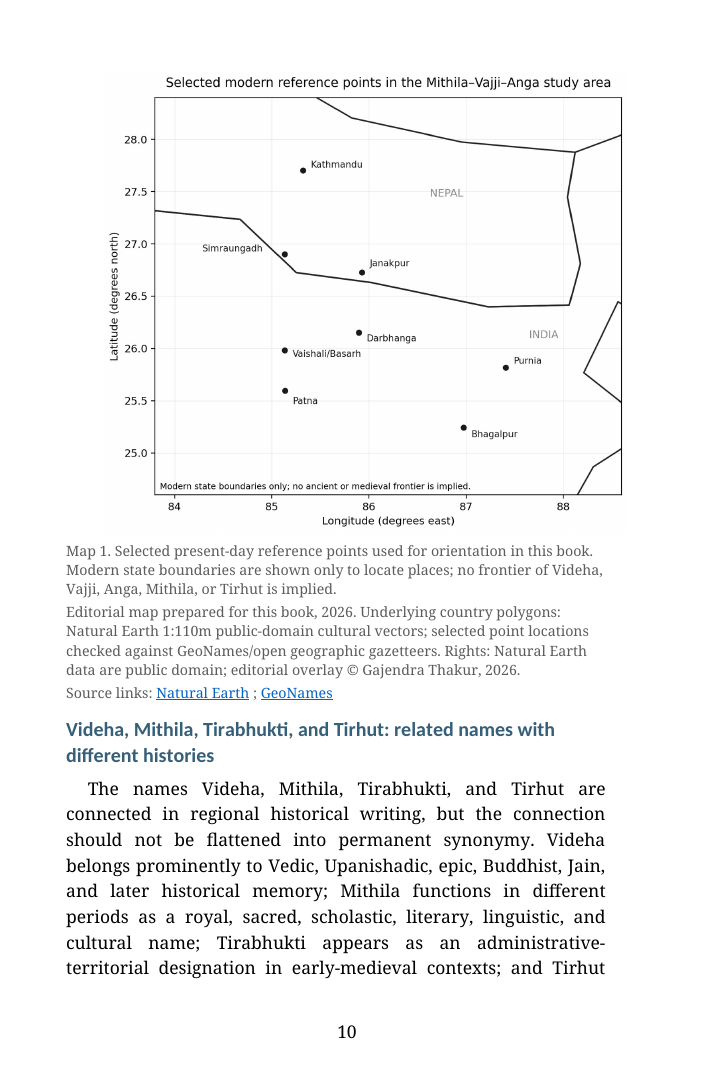
Mithila · Vajji · Anga
Chapter-specific source notes
- Primary chapter witness. Gajendra Thakur, Decoding the Panji of Mithila — Volume I, formal Chapter 20, PDF pp. 404-420; formal Chapter 20. The HTML transcription is generated from the commit-pinned source PDF and retains the chapter boundary recorded in this edition.
- Internal structure. The repository source-heading inventory records no separately encoded subordinate heading for this chapter.
- Digital editorial method. The page keeps the preserved source text distinct from generated navigational, concordance, visual, and provenance apparatus. The synthetic reconstruction is explanatory only and is not evidence for an individual lineage or a determination of social or marital status.