Decoding the Panji of Mithila · Volume II · Chapter 2
What “Prachin Panji” Contains
Chapter 2
What “Prachin Panji” Contains
1. The Visible Beginning of the Source
The source before us begins under the heading “खण्ड १” and
“प्राचीन पञ्जी.” This opening is important. It tells the reader that
the material belongs to an older register tradition and that the
present section is not a modern explanatory essay. The source
begins with the dignity of a record. It does not say, “This is how
you should read me.” It simply begins.
The first substantial line opens with a formula: “अथ … ग्राम.”
The word “अथ” is a marker of beginning or transition. It tells us
that a new section is being taken up. The word “ग्राम” tells us
that the unit being opened is a village-cluster. In other words,
the Panji first asks us to enter through place.
This is the key to the structure of Prachin Panji. It is not
arranged only by individual biography. It is arranged through
villages, descent-lines, titles, and marriage networks. A reader
who searches only for one name will miss the structure. A
reader who studies the village frame will begin to understand
how the record is built.
2. The Opening Pattern: Village, Ancestor, Branch
At the beginning, the source names a village and then gives a
chain of persons and branches attached to it. The pattern is
compact. It may give an ancestor followed by “अपत्य,” a descent-
line followed by “सन्तति,” or a person followed directly by a
place. These are not random fragments. They are register-units.
A typical cluster may contain several kinds of information:
the village being discussed;
the ancestor or remembered house;
Decoding the Panji of Mithila - Volume II
the descendant branch;
the place where that branch is found;
whether the branch includes more than one place;
whether the branch is continued under another
name;
and whether the cluster is closed before the next
village begins.
The reader must therefore learn to recognize the sequence.
A name before “अपत्य” usually functions as a descent-source. A
name before “सन्तति” often functions as the ancestor of a line. A
place after a dash or after the relationship marker may identify
where that branch is known. A word such as “समेत” indicates
inclusion. A phrase such as “एते … ग्राम” may close the group and
mark that the listed branches belong to that village-cluster.
This is why the first pages should be read as a map of
branch-distribution. They are not merely a list of names. They
are the foundation of the Panji’s geographical genealogy.
3. Letter and Section Markers
The source contains internal markers such as “अ,” “आ,” and
“उ.” These may look like alphabetical headings, but they also
function as section dividers within the register. They help
organize long stretches of names and village-groups.
A modern editor should preserve such markers. Even if their
full original indexing logic is not immediately obvious, they are
part of the source’s internal arrangement. Removing them
would flatten the structure and make later cross-reference
harder.
The same is true for page numbers, serial numbers, and
visible section labels. Some entries carry numbers in
parentheses. Some page headers carry the larger title of the
source. Some passages show internal divisions with double
Decoding the Panji of Mithila - Volume II
punctuation marks. All these features must be preserved
during decoding because they may later help align one passage
with another.
4. The Village Clusters
The most visible structural unit in the early part of Prachin
Panji is the village cluster.
A village cluster is not merely a geographical paragraph. It is
a record of houses associated with a place. It may begin with
“अथ” and a village name. It may then list multiple descent-lines,
each attached to a known ancestor or branch. At the end, the
source may use a closing expression to mark that the group
belongs to that village.
For example, the source moves from Sarisab to Jajival, from
Khandbala to Gangoli, from Pabouli to Sodarpur, and then to
other clusters. In each case, the village gives the frame through
which the lineages are arranged.
A reader should treat each village cluster as a file folder.
Inside that folder are names, branches, titles, and settlement
links. Some names may later reappear in another folder
because the same house may be connected through marriage,
movement, or descent to more than one village. That does not
mean the source is confused. It means the source is relational.
5. “सन्तति” and “अपत्य” as Structural Words
Two of the most important words in the source are “सन्तति”
and “अपत्य.”
“सन्तति” means progeny, descendants, or continuation of a
line. In the Panji, it often marks a descent-group. If the text says
that a certain person’s “सन्तति” is associated with a place, the
record is preserving the continuity of that person’s house or
branch in that location.
Decoding the Panji of Mithila - Volume II
“अपत्य” also indicates offspring or descent, but it often
appears in a more compact form. A name followed by “अपत्य”
may identify a branch descended from that named person. The
word is therefore not merely biological. It is archival. It
attaches the listed house to a remembered ancestor.
The difference between these two terms should not be
overstated mechanically. In actual Panji usage, their meanings
may overlap. The wise reader asks: what work is the word
doing in this passage? Is it identifying a family line? Is it
attaching a branch to an ancestor? Is it connecting a place to a
descent-group? Is it preserving a recognized house-name?
This book will return to these terms in detail, but the basic
rule is simple: whenever “सन्तति” or “अपत्य” appears, stop and
identify the descent-source, the branch, and the place.
6. “सुत,” “सुता,” and the Genealogical Chain
As the source progresses, entries increasingly show father-
son chains. The words “सुत,” “सुतो,” and “सुता” appear repeatedly.
They are essential for reconstructing genealogies.
In many passages, “सुत” means “son of.” “सुतो” may function
similarly in the register style, often linking the named person
to his father or to his own descendants. “सुता” can be more
complex. In Sanskritic usage, it may indicate sons or offspring
in plural contexts; in Panji register practice, it must be read
from context. It may introduce the children of a person, or it
may join a name to a subsequent branch-list.
The danger is to translate every occurrence mechanically.
The Panji does not always follow modern prose order.
Sometimes a line reads like a compressed equation: X son of Y,
connected with village Z, whose son or descendant A appears
in another village. The reader must expand the equation into
complete prose.
Decoding the Panji of Mithila - Volume II
A safe method is to mark the chain before translating it:
Person A;
relation word;
Person B;
village or place marker;
next descendant;
number;
title;
closing punctuation.
Only after this should the entry be converted into readable
English.
7. The Function of “सँ”
The small word “सँ” is one of the most powerful words in the
Panji.
In ordinary Maithili, “सँ” can mean “from,” “with,” “by,” or
“through.” In the Panji, it can mark origin, residence, marriage
connection, maternal relation, or association with a house. It
may say that a person is from a village. It may say that a
daughter was married into a village. It may say that a
descendant is connected through a certain family. It may say
that a branch is known through a particular settlement.
Therefore “सँ” must be decoded, not merely translated.
For example, when the source says that a person or branch
is connected “माण्डर सँ,” the reader must ask: Is Mandar the
origin? Is it the marital house? Is it the place of residence? Is it
a known branch-seat? Is the sentence about a son, a daughter,
or a maternal cycle? The answer depends on the surrounding
words.
The word “सँ” is the hinge of the Panji. It joins persons to
places and houses to houses.
Decoding the Panji of Mithila - Volume II
8. “अथ,” “अपरा,” “एवं ,” and “एते”
Several small words organize the flow of the record.
“अथ” opens a new section. It is often used when the source
moves to another village or another cluster.
“अपरा” introduces another branch, another case, another
wife-line, another reading, or another related entry. It should
never be ignored. If “अपरा” appears, the reader must ask:
another what? Another son? Another marriage? Another
branch? Another entry for the same person? Another line from
the same ancestor?
“एवं” often means “thus” or “in this way.” In the Panji, it may
close or summarize a cycle, especially in phrases such as “एवं …
मातृक चक्र.” It tells us that the preceding set of names and
relations forms a recognized unit.
“एते” means “these.” In village clusters, it may close a list by
saying that the preceding branches belong to that village
group.
These words are not ornamental. They are the source’s
punctuation of thought.
9. Punctuation and Separator Marks
The Panji uses marks such as “।।”, dashes, colons, and
occasional punctuation-like spacing to separate units. These
marks are not always consistent in the modern printed or OCR
form, but they are still important.
A double danda “।।” often marks the end of a register unit. A
dash may link a descent-source to a place. A colon may
introduce a list or clarify a relation. A period in the OCR text
may not always belong to the original source; it may reflect
modern processing. A broken word or joined word may be a
scanning or OCR issue.
Decoding the Panji of Mithila - Volume II
The decoder must use punctuation but not depend on
punctuation alone. The real structure is determined by relation
words, names, titles, place markers, and repeated formulae.
10. The Role of Numbers
The source contains many numbers in parentheses: simple
numbers, numbers with one slash, numbers with double
slashes, numbers with zero, and numbers attached to “टीप.”
These numbers are part of the record.
At this stage, it is not safe to assign one universal meaning to
all numbers. In some contexts they may point to entry
numbers, generational markers, note references, register
references, or internal chronology. In some cases, the same
pattern appears repeatedly enough to invite comparison. In
other cases, the number must simply be preserved.
The correct editorial method is conservative:
copy the number exactly;
place it near the name or event to which it belongs;
do not silently delete slashes or zeros;
note when “टीप” indicates a comment or note;
compare repeated numbers across related entries;
and avoid inventing certainty.
Later chapters will build a fuller number key. For now, the
reader should understand that the numbers are not
decoration. They are anchors.
11. Titles and Learned Identities
Prachin Panji contains titles and learned identities. Some are
abbreviated. Some are written in full. Some attach to a person’s
scholarly status, some to ritual function, some to poetic
distinction, and some to social rank.
Decoding the Panji of Mithila - Volume II
The title “महामहोपाध्याय” marks high scholarly standing. The
abbreviated forms “म. म.” or similar spellings may point to the
same honorific. “ठ.” may mark Thakur or a status-bearing
designation depending on context. “ज्यो.” points toward
jyotirvid or astrologer-astronomer contexts. “वैयाकरण” marks a
grammarian. “कवि” and “कविराज” mark literary identity. “पौराणिक”
marks a specialist in Purana-related learning or narration.
“मीमांसक” marks a scholar of Mimamsa. “पण्डित” marks learned
status.
These titles must be indexed. A person’s title may be the clue
that distinguishes him from another person with the same
name. It may also show why a branch became prominent.
12. मातृक चक्र
One of the most important recurring structures in the source
is “मातृक चक्र.” It should be translated not as a casual phrase but
as a technical unit. It means a maternal cycle or maternal-link
circuit.
The maternal cycle records relationships that cannot be
captured by a simple father-son chart. It may show how
daughters, mothers, marriage houses, and related lineages
create a circle of connection. In many cases, a “मातृक चक्र”
passage follows a set of names and relations and then closes
with the statement that this is the maternal cycle of a
particular person or branch.
This is why the Panji must be read as a marriage network as
well as a genealogy. Without the maternal cycles, the social
map of Mithila remains incomplete.
Decoding the Panji of Mithila - Volume II
13. विवाह Entries
The later part of the source contains explicit marriage
entries marked with “विवाह.” Some entries mention first, second,
or later marriage. Some include a date-formula, such as a lunar
day. Some connect two houses through specific persons and
villages.
A marriage entry must be decoded in layers:
whose marriage is being recorded;
which house the person belongs to;
which village is connected;
whether the entry concerns a first or later
marriage;
whether a date is given;
which descendants arise from that marriage;
and how the marriage affects the maternal or
affinal network.
A marriage entry is not a side note. In the Panji, marriage is
one of the main reasons genealogy is preserved.
14. दौहित्र and the Daughter’s Line
The word “दौहित्र” means daughter’s son, maternal grandson.
In the Panji, this word is especially important because it shows
how memory passes through daughters. A daughter’s son
belongs to another paternal house, but he also preserves a
connection to his mother’s lineage.
When a passage marks someone as “दौहित्र,” the reader must
not treat him as a simple son in the paternal line. He stands
between two houses. He is a bridge-person. His presence in the
record tells us that the maternal link mattered enough to be
preserved.
Decoding the Panji of Mithila - Volume II
This is one reason the Panji is a social map. It remembers
crossings, not only straight lines.
15. टीप and Notes
The word “टीप” indicates a note, annotation, or reference.
When it appears beside a number or entry, it should be
preserved carefully. It may point to an explanatory note, a
variant reading, an internal correction, or a register reference.
A modern edition should never erase “टीप.” Even when the
related note is not immediately visible, the marker shows that
the source itself recognized an additional layer of explanation.
In this book, “टीप” entries will be treated as evidence of
annotation. Where the note can be identified, it will be
explained. Where it cannot yet be identified, it will be marked
as unresolved rather than ignored.
16. The Three Source Segments
The present working source is divided into three document
segments. The first begins with the opening of “खण्ड १ / प्राचीन
पञ्जी” and the early village clusters. The second continues the
dense genealogical register with page and entry numbers
already deep inside the sequence. The third continues still later
entries and includes more developed marriage, note, title, and
affinal references.
These three segments should be treated as parts of one
continuous working source, not as three unrelated books. Their
file division is practical. The internal register continues across
them.
This matters for decoding. A person or village appearing in
the first segment may reappear in the second or third. A term
introduced early may become clearer later. A number or title
may acquire meaning only after comparison across segments.
Therefore the index must be cumulative.
Decoding the Panji of Mithila - Volume II
17. What the Source Does Not Give Us
Prachin Panji does not give modern chapter explanations. It
does not define every term. It does not tell us the life story of
every person. It does not always explain why one village is
followed by another. It does not always separate paternal,
maternal, and marital links in modern prose.
The absence of explanation does not mean absence of
meaning. It means the source belongs to a trained register
tradition. Its original users knew how to read the formulas. The
modern reader must recover that training.
This book will supply that missing readerly apparatus.
18. What Must Be Built from the Source
To decode Prachin Panji fully, several tools must be built:
a glossary of technical terms;
a list of abbreviations;
a village gazetteer;
a person index;
a title index;
a number and note register;
a table of maternal cycles;
a table of marriage entries;
and sample genealogical charts.
Without these tools, the reader will remain dependent on
isolated passages. With them, the Panji becomes navigable.
19. Editorial Caution
The source contains old forms, variant spellings, joined
words, broken words, OCR complications, and possible scribal
variations. A modern editor must not over-correct too quickly.
For example, a village name may appear in more than one
spelling. A title may be abbreviated differently in different
places. A person’s name may appear in Sanskritic form in one
Decoding the Panji of Mithila - Volume II
entry and Maithili register form in another. A number may
appear with one slash in one place and double slash in
another. These differences should be recorded first and
regularized only after comparison.
The safest rule is: preserve first, interpret second, normalize
only with evidence.
20. Rules for Reading Prachin Panji
The chapter may be summarized in the following rules:
1. Begin with the village frame.
2. Identify whether the entry is a village list, descent line,
maternal cycle, marriage entry, or note.
3. Mark every relationship word before translating.
4. Treat “सँ” as a contextual connector, not a fixed
English preposition.
5. Preserve numbers exactly.
6. Preserve titles and abbreviations.
7. Do not merge repeated names without evidence.
8. Treat “मातृक चक्र” as a major structure.
9. Treat “विवाह” and “दौहित्र” as essential social links.
10. Record uncertainty openly.
11. Build indexes as you read.
12. Remember that the Panji is a network, not a
simple list.
Prachin Panji contains more than genealogy. It contains the
grammar of Mithila’s remembered society. To read it is to
move through names, villages, marriages, scholarship, and
Decoding the Panji of Mithila - Volume II
memory. The next chapter will explain why the Panji is
difficult to read and how those difficulties can be turned into a
disciplined method of decoding.
Decoding the Panji of Mithila - Volume IISource structure and verification apparatus
Editorial source apparatus. This apparatus is descriptive, not interpretive. It records the source-controlled structure used to verify that this page corresponds to formal Chapter 2 of Decoding the Panji of Mithila — Volume II. The chapter text above is preserved from PDF pp. 17-30; formal Chapter 2 in the commit-pinned authoritative source. It is not merged with a neighboring chapter, appendix, annexure, or independent front/back-matter unit. The internal headings below come from the repository’s source-heading inventory and are retained as navigational and audit evidence; showing them here does not turn those headings into separate publications or add claims that are absent from the source.
Internal source headings
No subordinate heading was separately encoded in the repository source-heading inventory for this chapter.
Source-text concordance
Prachin · Contains · Visible · Beginning · begins · heading · opening · important · tells · reader · material · belongs · older · register · tradition · present · section · modern · explanatory · essay · dignity · record · read · simply · first · substantial · line · opens · formula · word · marker · transition · taken · unit · opened · village-cluster · words · asks · enter · place · structure · arranged · individual · biography · villages · descent-lines · titles · marriage · networks · searches · name · miss · studies · village · frame · begin · understand · built · Pattern · Ancestor · Branch · names · gives · chain · persons · branches · attached · compact · give · followed · descent · person · directly · random · fragments · register-units · typical · cluster · contain · several
Boundary verification. In the formal sequence this chapter follows Volume II Chapter 1, “The Panji as Memory, Record, and Social Map” and precedes Volume II Chapter 3, “Why the Panji Is Difficult to Read”. The chapter extractor begins at the verified formal Chapter 2 marker and stops at the next verified formal chapter marker; for a final chapter it stops before recognized book-level back matter. The concordance above is generated only from distinct terms already present in this chapter’s preserved source text. It is provided for discovery, comparison, and audit, not as an automated judgment about persons, lineages, status, kinship, marriage eligibility, or historical truth.
Illustrated research apparatus
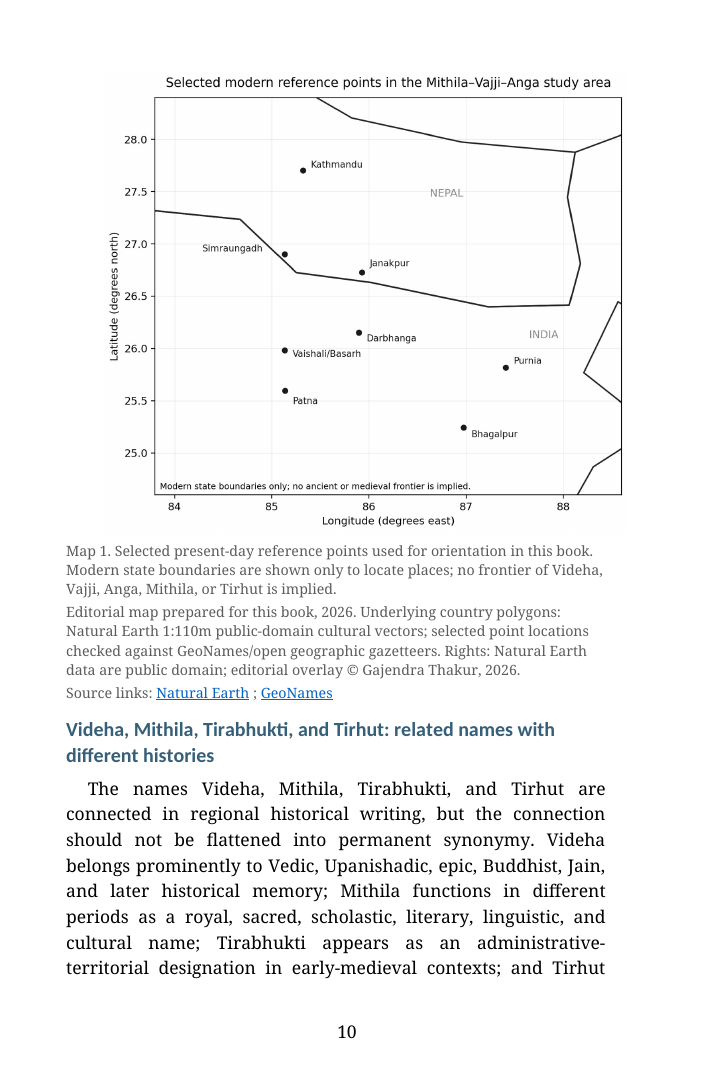
Mithila · Vajji · Anga
Chapter-specific source notes
- Primary chapter witness. Gajendra Thakur, Decoding the Panji of Mithila — Volume II, formal Chapter 2, PDF pp. 17-30; formal Chapter 2. The HTML transcription is generated from the commit-pinned source PDF and retains the chapter boundary recorded in this edition.
- Internal structure. The repository source-heading inventory records no separately encoded subordinate heading for this chapter.
- Digital editorial method. The page keeps the preserved source text distinct from generated navigational, concordance, visual, and provenance apparatus. The synthetic reconstruction is explanatory only and is not evidence for an individual lineage or a determination of social or marital status.