Decoding the Panji of Mithila · Volume II · Chapter 3
Why the Panji Is Difficult to Read
Chapter 3

  Why the Panji Is Difficult to Read

1. Difficulty Is Built into the Form
   The Panji is difficult not because it is careless, but because it
belongs to a compact archival form. It was not composed as a
modern explanatory book. It was shaped as a working register
for people who already understood the conventions of lineage,
village, marriage, title, and note. The difficulty therefore comes
from the form itself.
   A modern paragraph expands meaning. A Panji entry
compresses meaning. A modern historian may write: “The
descendants of a certain ancestor were settled in this village,
while another branch moved to another place and became
connected by marriage with a third house.” The Panji may
reduce that whole explanation to a chain of names, one
relation word, one village marker, and a closing sign.
   This does not mean that the Panji lacks order. It means that
its order is internal. The reader must learn that order before
attempting interpretation. Without that training, a line looks
like a pile of names. With training, it becomes a structured
record.
  The first principle of decoding is therefore this: do not expect
the Panji to explain itself in modern prose. The reader must
supply the expansion that the old register assumes.

2. The Problem of Compression
  Compression is the central difficulty. The Panji often gives
only the necessary signs: a name, a relationship, a village, a
branch, a title, a number, or a note. These signs may stand in
for a full genealogical statement.

                    Decoding the Panji of Mithila - Volume II

  For example, a sequence may contain an ancestor marked
by “अपत्य,” a descent-line marked by “सन्तति,” a son marked by
“सुत,” and a place marked by “सँ.” The source may not state in
modern order who lived where, who descended from whom,
and which connection is paternal or maternal. The old reader
was expected to know how to expand the formula.
   Modern reading habits create difficulty here. We expect
subject, verb, object, explanation, and punctuation. The Panji
often gives relationship, name, place, and closure. A sentence
may have no modern verb at all. The verb must be supplied by
context: “belonged to,” “was descended from,” “was connected
with,” “was married into,” “was resident at,” or “gave rise to.”
   A decoder should never rush from compact formula to
finished translation. First separate the signs. Then identify
their function. Only then write the expanded meaning.

3. The Problem of Joined Words
   Many Panji passages contain joined forms. Words that a
modern editor would separate are often written together or
appear together because of manuscript transmission, print
style, or OCR processing. A relationship word may join with a
name. A village name may attach to the preceding expression.
An abbreviation may appear without space. A number may sit
inside the flow of the name-chain.
   This creates false words. A reader may think that a joined
cluster is one name when it is actually a name plus a
relationship marker. Or the reader may separate one personal
name into two persons. Both errors are dangerous.
   The correct method is to look for known particles: सुत, सुता,
सुतो, सन्तति, अपत्य, ग्राम, वासी, समेत, अपरा, अथ, एवं, चक्र, विवाह, दौहित्र, टीप.
These words are the joints of the sentence. Once they are
identified, the joined line begins to open.

                Decoding the Panji of Mithila - Volume II

  A modern edition may later normalize spacing, but decoding
must first preserve the original cluster. If spacing is corrected
too early, the editor may accidentally decide the meaning
before understanding the structure.

4. The Problem of Repeated Names
  The Panji uses a traditional name-world. The same names
recur across villages and generations: Ram, Raghunath, Ganga,
Govind, Keshav, Madhav, Narayan, Vishwanath, Harinath,
Maheshwar, Lakshminath, Bhagirath, Shankar, and many
others. Repetition is natural in genealogical culture, but it
creates a major difficulty for the decoder.
   A repeated name is not proof of the same person. It is only a
possible clue. One Raghunath may be the son of one father in
one village; another Raghunath may belong to a different
branch; a third may be known through a marriage connection;
a fourth may appear in a maternal cycle.
   To avoid confusion, every person must be identified by a
cluster of markers: name, father, sons, village, title, number,
maternal cycle, marriage connection, and surrounding branch.
Only when several markers agree should two occurrences be
joined.
  This rule saves the reader from one of the gravest errors in
Panji work: collapsing separate persons into one figure because
the names are similar.

5. The Problem of Village Names
   Village names are not always stable in spelling. A place may
appear in a Sanskritic form, a Maithili form, an abbreviated
form, or a form affected by scribal or OCR distortion. Some
villages have variant spellings. Some have attached hamlets, डीह
references, or associated settlements. Some appear as origin in
one passage and marriage connection in another.

                  Decoding the Panji of Mithila - Volume II

   A village name must therefore be treated as evidence, not
decoration. It must be indexed exactly as found. Later, variant
spellings can be grouped cautiously. If a place appears as
“दरिहरा” in one entry and with a shortened or joined form
elsewhere, the editor should note the relation but preserve
both forms until evidence is strong.
  The Panji’s geography is not only physical geography. It is
genealogical geography. A village name may indicate where a
branch is remembered, where a marriage took place, where a
descendant settled, or where an ancestral house is located. The
same word “सँ” may connect the person to the village in
different ways.
  For this reason, every place entry should be classified:
origin, residence, marriage-house, maternal connection,
branch-seat, or uncertain association.

6. The Problem of “सँ”

  The word “सँ” is small but highly flexible. It may mean
“from,” “with,” “through,” “by,” or “connected with.” In Panji
decoding, it cannot be translated mechanically.
  If the entry concerns a son, “सँ” may point to a village of
residence or origin. If the entry concerns a daughter or
marriage, “सँ” may point to the house into which marriage
occurred. If the entry concerns a maternal cycle, “सँ” may
indicate the maternal or affinal connection. If the entry
concerns a title-bearing person, the place may identify where
that person was known.
  The same connector therefore carries several possible
meanings. The interpreter must ask what kind of entry is being
read before translating it.
  A useful practice is to mark “सँ” temporarily as “linked with”
during the first pass. Only after the surrounding structure is

                Decoding the Panji of Mithila - Volume II

clear should it be rendered as “from,” “of,” “through,” “married
into,” or “resident at.”

7. The Problem of Register Grammar
  The Panji follows register grammar, not conversational
grammar. It often omits verbs, articles, explanatory phrases,
and modern syntactic transitions. It may place names one after
another because the relationship is understood through case,
order, or formula. It may use Sanskritic endings beside Maithili
particles.
   This register grammar is not broken grammar. It is
compressed professional grammar. Just as a legal deed, ritual
manual, or astronomical table follows its own form, the Panji
follows the form of genealogical registration.
  The decoder must therefore read it like a technical
document. The question is not “Why does this not sound like
ordinary prose?” The question is “Which technical function
does each word perform?”
  Once the function is identified, the prose can be supplied.

8. The Problem of Sanskrit and Maithili Mixture
  The Panji belongs to Mithila’s Sanskrit-Maithili learned
environment. It uses Sanskritic relationship words, honorifics,
and grammatical traces, while also using Maithili place
particles, local names, and regional forms. This mixture is
natural for the tradition, but it can confuse modern readers
who expect one uniform language.
  For example, a title may be Sanskritic, a village may be
Maithili, a relationship word may be inherited from Sanskrit
usage, and a connector may be Maithili. The result is a layered
register. One must not force the whole text into only Sanskrit
grammar or only modern Maithili grammar.
  A good decoder recognizes layers: Sanskritic lineage
vocabulary, Maithili relational particles, local village names,

                Decoding the Panji of Mithila - Volume II

scholastic titles, and scribal formulae. Meaning emerges only
when all layers are allowed to stand together.

9. The Problem of Titles and Abbreviations
 Titles and abbreviations are often small, but they carry large
meaning. A brief “म. म.” may stand for महामहोपाध्याय. “ज्यो.” may
indicate a jyotirvid. “प्र.” may indicate a named alias, a prior
marker, a reference, or another function depending on context.
“ठ.” may mark Thakur or a status-bearing designation. “ब.” or
similar abbreviations may need careful contextual reading.
  The problem is that abbreviations are not always expanded
in the source. The original reader knew them. The modern
reader must reconstruct them through repetition and
comparison.
   An abbreviation should never be guessed once and then
applied everywhere mechanically. It should be entered into an
abbreviation table with examples. The table should include the
exact form, probable expansion, evidence, and uncertainty
level. If the same abbreviation behaves differently in different
contexts, that difference must be recorded.

10. The Problem of Numbers
   The numbers in parentheses are among the hardest
elements of the source. Some are simple; some contain one
slash; some contain double slashes; some include zero; some
appear beside “टीप”; some stand near marriage entries; others
stand near personal names or titles.
  The danger is twofold. One reader may ignore the numbers
entirely, treating them as noise. Another may overinterpret
them, forcing every number into one system. Both approaches
are unsafe.
  The better method is to preserve first. Each number should
be copied exactly. Its position should be recorded: after a

                Decoding the Panji of Mithila - Volume II

name, after a title, after a marriage, after a branch, after a
village, or before a note. Only after repeated patterns are
collected should interpretation be attempted.
   Numbers are clues. They may be keys to internal registers,
notes, chronological hints, generation markers, or cross-
references. Until the system is fully mapped, they must remain
visible.

11. The Problem of मातृक चक्र

 A simple father-son genealogy is easier to read than a
maternal cycle. The Panji becomes more difficult when it
moves into “मातृक चक्र” because the structure becomes circular
rather than vertical.
  In a paternal line, one usually asks: who is the father, who is
the son, and where does the branch go? In a maternal cycle,
one must ask: whose maternal link is being recorded, which
daughter or mother creates the connection, what village or
house is involved, and how does the marriage network
complete the circle?
  If a reader treats a maternal cycle as a paternal descent-list,
the entire passage may be misread. This is why “मातृक चक्र” must
be marked before decoding begins. It changes the logic of the
passage.
  The maternal cycle is one of the greatest strengths of the
Panji. It is also one of its greatest difficulties.

12. The Problem of Marriage Entries
  Marriage entries may contain names, villages, dates,
numbers, and branch-links in compressed form. A marriage
may be first, second, or later. It may be attached to a tithi or
day. It may involve two known houses and then lead into
descendants.

                Decoding the Panji of Mithila - Volume II

   The difficulty is that a marriage entry is not merely a family
event. It is a structural link between houses. If the reader treats
it as an incidental note, the later genealogy may become
unclear. A marriage changes the network: it explains why a
maternal cycle exists, why a daughter’s son appears, why a
branch is attached to a second village, and why a future
marriage may be permitted or prohibited.
   Therefore every marriage entry should be decoded as a
bridge: house A, house B, person, date if given, number if
given, resulting branch, and later references.

13. The Problem of दौहित्र

  The word “दौहित्र” marks a daughter’s son. This is a small
word with large genealogical consequence. A daughter’s son
belongs to another paternal house, but he preserves the blood-
connection of his mother’s house. In a society where marriage
regulation depended on remembered relation, such a marker
could be vital.
   The difficulty is that a modern reader may expect genealogy
to follow only the surname or father-line. The Panji does not do
this. It remembers crossings. A daughter’s son is a crossing-
point between two lineages.
  Whenever “दौहित्र” appears, the reader must stop and change
the frame. The person is not to be placed simply as a son in the
paternal line being discussed. He must be recorded as an
affinal or maternal descendant link.

14. The Problem of Notes and टीप

  “टीप” indicates that the source contains or points toward an
annotation. The note may clarify a reading, correct a branch,
preserve an alternate form, or refer to another register
position. It may also mark an editorial intervention.

                Decoding the Panji of Mithila - Volume II

  The difficulty is that the note itself may not always be
immediately visible in the same passage. The word “टीप” may
appear with a number, leaving the reader to search elsewhere.
This creates a layered source: main entry plus note plus
possible cross-reference.
  A responsible edition should never delete the marker. Even
unresolved notes must be preserved. They are signs that the
source has another layer of authority or explanation.

15. The Problem of OCR and Modern Transcription
   The files used for the present work show the further
difficulty of modern transmission. OCR may join words, break
words, confuse similar letters, or insert stray symbols.
Devanagari conjuncts, old spellings, punctuation, and ligatures
are especially vulnerable.
   A word may appear damaged. A village name may be split. A
number may be malformed. A danda may be lost. A Roman or
punctuation mark may intrude. A reader who treats the OCR
text as perfect will produce errors.
  The solution is not to reject the OCR, but to use it carefully.
OCR text is a working layer. It must be checked against context,
repeated patterns, and, when possible, page images or
manuscript evidence. If a reading is uncertain, the uncertainty
should be marked rather than hidden.

16. The Problem of Modern Expectations
   Perhaps the deepest difficulty is that modern readers expect
modern books. They expect chapters, explanations, complete
sentences, punctuation, standardized spelling, fixed names,
and dates in familiar format. The Panji belongs to a different
textual culture.
   Its purpose was not to entertain. Its purpose was to preserve.
Its compactness was a strength. It allowed many generations,
villages, marriages, and scholarly titles to be stored in a small

                 Decoding the Panji of Mithila - Volume II

space. What appears difficult today was efficient for its trained
users.
  The modern decoder must therefore change expectations.
The goal is not to make the Panji into something it never was.
The goal is to explain its own system faithfully.

17. Turning Difficulty into Method
  Every difficulty in the Panji can become a method.
  Compression teaches us to expand formulae.
  Repeated names teach us to build identification tables.
  Variant spellings teach us to create a village gazetteer.
  Flexible “सँ” teaches us to classify the type of link.

  Abbreviations teach us to build a title key.
   Numbers teach          us     to        preserve   evidence   before
interpretation.
  मातृक चक्र teaches us to map maternal networks.

  विवाह entries teach us to map alliance.

  दौहित्र teaches us to respect the daughter’s line.

  टीप teaches us to preserve annotations.

  OCR difficulty teaches us editorial caution.
   Thus the obstacles are not merely obstacles. They are
instructions. The Panji itself tells us how it must be read, if we
listen carefully to its repeated forms.

18. The Working Rules for Decoding Difficult Passages
  When a passage is difficult, the following procedure should
be followed:

   1. Copy the passage exactly as found.

   2. Mark every punctuation break, even if uncertain.

                        Decoding the Panji of Mithila - Volume II

   3. Underline relationship words: सुत, सुता, सन्तति, अपत्य, पौत्र,
   प्रपौत्र, दौहित्र.

   4. Circle place markers: ग्राम, वासी, डीह, मूलग्राम, समेत, तत्रैव.

   5. Mark connectors such as “सँ” without translating
   them too early.

   6. Identify titles and abbreviations.

   7. Preserve numbers exactly.
    8. Check whether the passage belongs to a paternal line,
   maternal cycle, marriage entry, village cluster, or note.

   9. Separate each person into a table.

   10. Only after tabulation, write the expanded prose
   meaning.

   11. Record uncertainty openly.

   12. Compare the passage with later and earlier
   entries.
  This method is slower than ordinary reading, but it prevents
serious mistakes.

19. The Ethical Duty of Decoding
   The Panji contains names of families, ancestors, villages,
teachers, daughters, sons, and marriage connections. To
decode it badly is not only an academic error. It may distort
living memory. A wrong connection can misplace a person. A
careless translation can erase a branch. A guessed village can
mislead future readers.
  For this reason, the decoder has an ethical duty: never hide
uncertainty; never invent a clean reading where the source is
unclear; never merge branches without evidence; never delete

                 Decoding the Panji of Mithila - Volume II

a number because it is inconvenient; never ignore a maternal
or marriage marker; never treat a title as meaningless.
  The aim is not to simplify the Panji by removing its
complexity. The aim is to make the complexity understandable.

20. Conclusion: Difficulty as the Doorway
  The difficulty of the Panji is the doorway into its value. If it
were only a simple list, it would tell us little. Because it is
dense, it preserves much. Because it is compressed, it holds
generations. Because it is technical, it records social rules.
Because it is full of villages, it maps Mithila. Because it records
maternal cycles and marriages, it reveals the web of society.
Because it preserves titles, it carries intellectual history.
   To read the Panji, therefore, is to learn a disciplined
language of memory. Chapter 4 will now move from difficulty
to structure. It will explain the basic unit of a Panji entry and
show how one compact entry can be opened into a full
genealogical statement.

                  Decoding the Panji of Mithila - Volume II
Source structure and verification apparatus
Editorial source apparatus. This apparatus is descriptive, not interpretive. It records the source-controlled structure used to verify that this page corresponds to formal Chapter 3 of Decoding the Panji of Mithila — Volume II. The chapter text above is preserved from PDF pp. 30-42; formal Chapter 3 in the commit-pinned authoritative source. It is not merged with a neighboring chapter, appendix, annexure, or independent front/back-matter unit. The internal headings below come from the repository’s source-heading inventory and are retained as navigational and audit evidence; showing them here does not turn those headings into separate publications or add claims that are absent from the source.
Internal source headings
No subordinate heading was separately encoded in the repository source-heading inventory for this chapter.
Source-text concordance
Difficult · Read · Difficulty · Built · Form · careless · belongs · compact · archival · composed · modern · explanatory · book · shaped · working · register · people · already · understood · conventions · lineage · village · marriage · title · note · therefore · comes · paragraph · expands · meaning · entry · compresses · historian · write · descendants · certain · ancestor · settled · another · branch · moved · place · became · connected · third · house · reduce · whole · explanation · chain · names · relation · word · marker · closing · sign · mean · lacks · order · means · internal · reader · must · learn · attempting · interpretation · Without · training · line · looks · like · pile · becomes · structured · record · first · principle · decoding · expect · explain
Boundary verification. In the formal sequence this chapter follows Volume II Chapter 2, “What “Prachin Panji” Contains” and precedes Volume II Chapter 4, “The Basic Unit of a Panji Entry”. The chapter extractor begins at the verified formal Chapter 3 marker and stops at the next verified formal chapter marker; for a final chapter it stops before recognized book-level back matter. The concordance above is generated only from distinct terms already present in this chapter’s preserved source text. It is provided for discovery, comparison, and audit, not as an automated judgment about persons, lineages, status, kinship, marriage eligibility, or historical truth.
Illustrated research apparatus
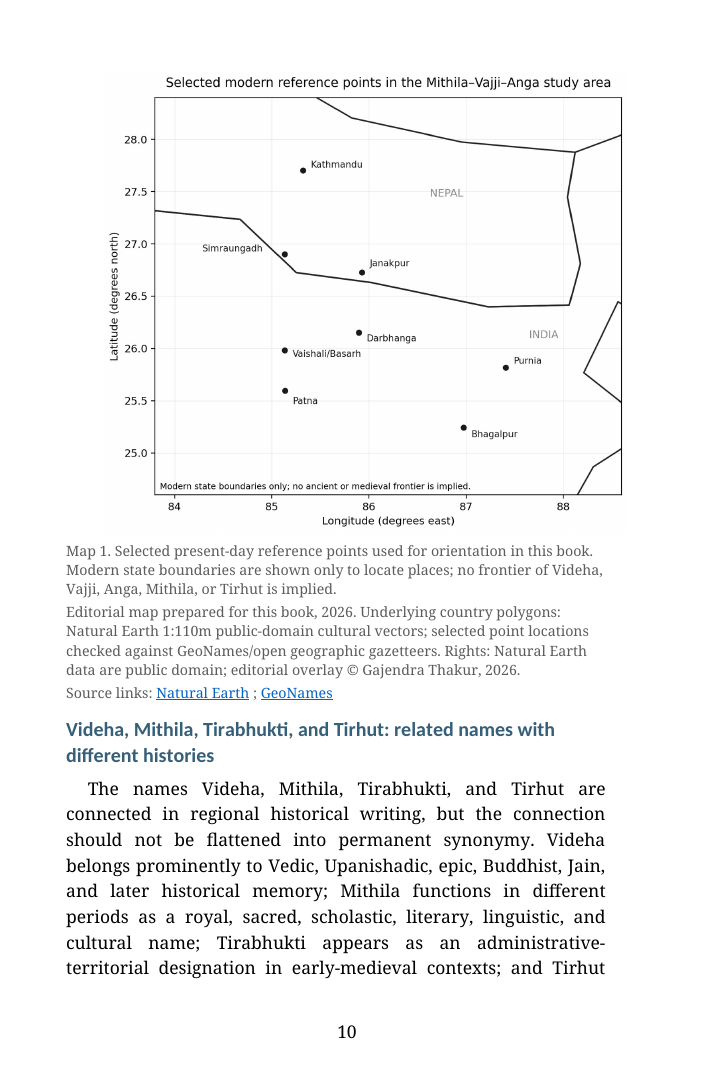
Mithila · Vajji · Anga
Chapter-specific source notes
- Primary chapter witness. Gajendra Thakur, Decoding the Panji of Mithila — Volume II, formal Chapter 3, PDF pp. 30-42; formal Chapter 3. The HTML transcription is generated from the commit-pinned source PDF and retains the chapter boundary recorded in this edition.
- Internal structure. The repository source-heading inventory records no separately encoded subordinate heading for this chapter.
- Digital editorial method. The page keeps the preserved source text distinct from generated navigational, concordance, visual, and provenance apparatus. The synthetic reconstruction is explanatory only and is not evidence for an individual lineage or a determination of social or marital status.