Decoding the Panji of Mithila · Volume II · Chapter 15
Multiple Marriages and Secondary Links
Chapter 15
  Multiple Marriages and Secondary Links

1. Why Multiple Marriages Need Special Treatment
   Multiple marriages are one of the places where the Panji
becomes most difficult and most valuable. A single marriage
joins two houses. A second marriage may join the same person
or branch to another house. A later marriage may create still
another affinal link, another maternal line, another group of
issue, and another set of villages that must be remembered.
  The source contains explicit forms such as प्रथम विवाह and द्वितीय
विवाह. These labels prove that the record distinguishes marriage
order. The distinction must not be erased. A first marriage and
a second marriage are not two descriptions of the same social
fact. They are separate events with separate genealogical
consequences.
 The purpose of this chapter is to explain how multiple
marriages and secondary links should be decoded without
merging them into one confused family unit.

2. विवाह as Event, द्वितीय विवाह as Separate Event

  When the source says विवाह, it marks a marriage event. When
it says द्वितीय विवाह, it marks a second marriage event. This must
be entered as a separate record. The second marriage may
involve another spouse, another village, another house, and
another issue-list.
  The decoder should therefore create one marriage-event
table, not one general marriage note. If a person has two
marriages, the table should have two rows. Each row must
preserve the marriage-order label exactly as written.

                   Decoding the Panji of Mithila - Volume II

  Data rule: every marriage record should receive a marriage-
event identifier: Marriage 1, Marriage 2, later marriage,
unspecified marriage, or uncertain.
  Critical caution: do not merge the issue of two marriages
unless the source clearly says that the same issue belongs to
both contexts.

3. प्रथम विवाह

   प्रथम विवाह means first marriage. When the source uses this
phrase, it gives a clear order marker. The entry should be
treated as the first recorded marriage of the named person or
titled house.
   The first marriage may be followed by issue, numbers,
villages, and later branches. Those following details may
belong to the first marriage, but only when the structure makes
the attachment clear. If an अपरा marker appears after the first-
marriage entry, it may introduce another branch or marriage-
related subunit.
   Data rule: mark प्रथम विवाह as marriage-order evidence and
preserve all following material with attachment confidence.
  Critical caution: the first marriage is not automatically the
only important marriage. Later marriage entries may change
the maternal and affinal map.

4. द्वितीय विवाह

   द्वितीय विवाह means second marriage. It is a direct warning to
the decoder that a previous marriage has already existed or is
understood by the register. A second marriage creates a new
affinal relation. It may also create issue whose maternal house
differs from the issue of the first marriage.
   When द्वितीय विवाह appears, open a new marriage-event row. Do
not attach preceding children to the second marriage unless

                  Decoding the Panji of Mithila - Volume II

they appear after the second-marriage marker or are
otherwise clearly connected. Likewise, do not attach later
children to the first marriage without evidence.
  Data rule: issue after द्वितीय विवाह should be marked as
belonging to the second-marriage context only if structural
evidence supports it. Otherwise mark “possible second-
marriage issue.”
  Critical caution: false issue assignment is one of the most
damaging errors in multiple-marriage reconstruction.

5. The Role of अपरा in Multiple-Marriage Contexts

  अपरा is especially important when multiple marriages are
involved. It may mean another branch, another spouse-line,
another issue-group, another reading, or another related case.
Near प्रथम विवाह or द्वितीय विवाह, अपरा should be treated as a possible
signal of another marital or affinal unit.
  A passage may record a second marriage and then use अपरा
before listing names and villages. This should not be merged
into the preceding material without analysis. The word may
introduce a different sub-branch connected to the marriage
event.
  Data rule: every अपरा near marriage records should create a
provisional sub-entry in the marriage table.
  Critical caution: ignoring अपरा may combine two spouse-lines
or two issue-groups into one.

6. Secondary Links
   A secondary link is a relation that is not the main paternal
line but is created by marriage, maternal descent, daughter’s
son, sister’s son, alternate spouse-line, or affinal village.
Secondary does not mean unimportant. It means that the
relation is not the primary father-son chain.

                Decoding the Panji of Mithila - Volume II

 Examples of secondary links include: a daughter’s son
marked by दौहित्र; a sister’s son or nephew-type relation; a wife’s
natal village; an affinal house introduced through सँ; issue from
a second marriage; and an अपरा sub-branch after a marriage
marker.
  Data rule: secondary links should be placed in linked tables,
not forced into the paternal chart.
  Critical caution: secondary links often explain why a village
or person appears where a purely paternal reading would not
expect it.

7. Multiple Marriage and मातृक चक्र

   Multiple marriages can generate multiple maternal cycles. A
first wife may connect the house to one village. A second wife
may connect it to another. The children of each marriage may
carry different maternal affiliations. Later daughter’s-son
entries may preserve those differences.
  If a मातृक चक्र appears near a multiple-marriage section, the
decoder should examine whether the cycle belongs to the first
marriage, second marriage, or another affinal branch.
Sometimes the source may not make this fully clear. In such
cases, the uncertainty must be preserved.
  Data rule: every मातृक चक्र near a multiple-marriage passage
should be cross-linked to the relevant marriage-event rows
with a confidence level.
  Critical caution: do not assume that one maternal cycle
covers all marriages of a person.

8. Multiple Marriage and दौहित्र

  Daughter’s-son entries become more complex when multiple
marriages are present. A daughter’s son may belong to the
daughter of the first marriage or the daughter of the second

                Decoding the Panji of Mithila - Volume II

marriage. If the wrong marriage is assigned, the maternal
house will be wrong.
  The decoder should therefore examine where the दौहित्र entry
appears relative to the marriage markers. If it appears after a
second-marriage section, it may belong to that context, but the
relation must still be checked through names, villages, and
issue lists.
  Data rule: every दौहित्र entry in a multiple-marriage passage
must carry a marriage-context field.
 Critical caution: do not attach a daughter’s son to the wrong
mother-line for the sake of completing the chart.

9. Multiple Marriage and सुता

  सुता lists are difficult even in simple paternal passages. In
multiple-marriage passages they are more difficult because the
issue may belong to different marriages. A list of children after
द्वितीय विवाह may identify issue of the second marriage, but the
source may also shift to another branch or use अपरा.

   The safe method is to record the list exactly, then assign
issue only with stated confidence: certain, probable, possible,
or uncertain. The table should show which marriage event the
issue is attached to, if known.
  Data rule: every सुता list in a multiple-marriage passage
should be tagged with marriage-event attachment.
   Critical caution: do not let the order of text alone replace
structural analysis.

10. Multiple Marriage and Villages
  Each marriage may connect a house with a different village.
The first marriage may link to one affinal village, the second to
another. A later issue-list may show residence in a third village.

                 Decoding the Panji of Mithila - Volume II

A daughter’s-son entry may introduce a fourth. This is why
multiple marriages are crucial for the village gazetteer.
  The village function must be marked carefully. A village in a
second-marriage entry may be the spouse’s natal village, not
the principal person’s origin. Another village in the same
passage may belong to a child or branch.
  Data rule: in multiple-marriage records, the village table
should include marriage order and place function.
  Critical caution: never treat all villages in a marriage
passage as one family’s residence.

11. Multiple Marriage and Titles
  Many multiple-marriage entries involve titled persons: ठo,
बाबू, महाराजाधिराज, वैयाकरण, कवि, पण्डित, and others. The title must
remain attached because it may identify the person whose
marriage is being recorded. It may also show social rank and
the prestige of the alliance.
   If a titled person has a first and second marriage, the title
should be repeated or carried in each marriage-event row. This
prevents confusion when the same personal name appears
elsewhere without title.
    Data rule: every marriage-event row should preserve the
title exactly as written.
  Critical caution: do not remove titles from marriage tables
for compactness. They are identity markers.

12. Multiple Marriage and Numbers
   Numbers near multiple-marriage entries may identify the
marriage event, person, branch, issue group, or note. When
first and second marriages occur, numbers can help
distinguish the two events. They may also help connect the
marriage entry to another passage.

                   Decoding the Panji of Mithila - Volume II

   The number must be preserved exactly, including slash,
double slash, zero, or date-like form. It should be stored with
its position relative to विवाह, प्रथम विवाह, द्वितीय विवाह, अपरा, and issue-
list.
   Data rule: the marriage table should include both number-
as-written and number-position fields.
 Critical caution: do not merge numbers from the first-
marriage row into the second-marriage row.

13. Explicit Dates in Later Marriage Records
   Some later marriage entries may include explicit date-like
statements, including year-like forms or modern calendar
expressions. These must be kept distinct from parenthetical
register numbers. A modern-looking date is not the same as a
register code. A traditional lunar date phrase is not the same as
a page reference.
    If the entry gives a precise modern date, it may help place
the record chronologically. If it gives a traditional date,
conversion requires calendar knowledge and year information.
If it gives both, each should be entered in its own field.
  Data rule: create separate fields for traditional date, modern
date, register number, and source note.
   Critical caution: do not convert date systems casually.

14. Issue Assignment Across Marriages
   Issue assignment is the central problem in multiple-
marriage decoding. A man may have children from one
marriage, another marriage, or both. The Panji may list issue
after the marriage marker, but the exact mother may still be
uncertain unless the structure makes it explicit.
   A responsible editor should avoid false certainty. If the issue
is clearly attached to a second marriage, mark it as such. If it

                 Decoding the Panji of Mithila - Volume II

only appears nearby, mark probable or possible. If an अपरा
marker intervenes, open a new subunit.
  Data rule: issue assignment must always include confidence.
  Critical caution: a beautiful chart with wrong mothers is
worse than an unfinished chart with honest uncertainty.

15. Secondary Links and Future Marriage Eligibility
   Secondary links matter because future marriage decisions
depended on them. A second marriage creates another affinal
relation. A daughter from that marriage creates another
maternal path. A daughter’s son from that path becomes
another remembered connection. If such links are erased, the
marriage map becomes unsafe.
   The Panji therefore stores not only the main union but the
consequences of unions. This is why multiple marriages appear
in the record and why they must be decoded with care.
  Critical analysis should treat secondary links as part of the
working legal-social memory of Mithila.

16. The Multiple-Marriage Data Table
  A full multiple-marriage table should include: source
segment; page or line reference; original phrase; principal
person; title; marriage order; first marriage marker; second
marriage marker; spouse-side clue; affinal village; date phrase;
register number; number position; issue-list; issue assignment
confidence; अपरा sub-entry; related मातृक चक्र; related दौहित्र;
related village links; related titles; and critical note.
  This table should be connected to the person index, village
gazetteer, marriage table, maternal-cycle table, and daughter’s-
son table.

17. Charting Multiple Marriages
  Multiple marriages should be charted with separate spouse
boxes or marriage-event nodes. The principal person should

                Decoding the Panji of Mithila - Volume II

not be connected to one undifferentiated spouse line. Each
marriage should have its own node: Marriage 1, Marriage 2,
later marriage, or unspecified marriage.
  Children should be placed under the correct marriage only
when evidence permits. If uncertain, they should be placed in
an issue box marked “attachment uncertain.” Affinal villages
should be connected to the relevant marriage node, not to the
whole paternal line.
   Data rule: chart marriage events separately before attaching
issue.
 Critical caution: do not let chart neatness erase second
marriages.

18. Critical Analysis: What Multiple Marriages Reveal
  Multiple marriages reveal that the Panji was built to handle
social complexity. It did not pretend that every person had one
simple line. It recorded additional unions because they
changed the map of houses. A second marriage could alter
maternal networks, produce different issue, and connect the
family to another village.
  This reveals the practical intelligence of the register. It
preserved enough detail to prevent confusion in future
marriage negotiations. It also preserved social history: titles,
dates, villages, affinal houses, and issue groups connected with
each marriage.
   Multiple-marriage entries therefore show the Panji as a
living instrument of social order.

19. Common Errors in Reading Multiple-Marriage Entries
  The common errors are: treating द्वितीय विवाह as a minor note;
merging first and second marriages; assigning all children to
one wife; ignoring अपरा after a marriage marker; treating
affinal villages as paternal origin; separating numbers from

                  Decoding the Panji of Mithila - Volume II

marriage events; confusing modern dates with register
numbers; failing to connect second marriage with maternal
cycles; failing to connect daughter’s-son entries to the proper
marriage context; and making one simplified chart where the
source gives several linked units.

20. Rules for Reading Multiple Marriages and Secondary
Links
  First, preserve प्रथम विवाह and द्वितीय विवाह exactly.

  Second, create a separate row for each marriage event.
  Third, keep principal house and affinal house separate.
  Fourth, record issue only with confidence level.
  Fifth, treat अपरा as a possible new subunit.

  Sixth, classify villages by function and marriage order.
  Seventh, preserve numbers and dates separately.
  Eighth, cross-link marriage events with मातृक चक्र and दौहित्र.

  Ninth, chart multiple marriages as separate nodes.
  Tenth, leave uncertainty visible rather than forcing one
family line.

21. Conclusion: Secondary Does Not Mean Small
   The term secondary link should never be understood as
minor. A secondary link may be the key to the whole marriage
network. A second marriage may explain a village. A daughter
from that marriage may explain a maternal cycle. A daughter’s
son may preserve the memory of an alliance. A title or number
may identify the correct branch.
  The Panji is powerful because it preserves these details. It is
not a simple list of fathers and sons. It is a record of marriages,
remarriages, affinal houses, maternal crossings, and social
consequences.

                Decoding the Panji of Mithila - Volume II

   Chapter 16 will now begin Part IV, the geography of the
Panji. It will examine the village universe of Prachin Panji and
show how the names of villages form the social map on which
all these genealogical and marriage relations are placed.

                Decoding the Panji of Mithila - Volume II
Source structure and verification apparatus
Editorial source apparatus. This apparatus is descriptive, not interpretive. It records the source-controlled structure used to verify that this page corresponds to formal Chapter 15 of Decoding the Panji of Mithila — Volume II. The chapter text above is preserved from PDF pp. 173-184; formal Chapter 15 in the commit-pinned authoritative source. It is not merged with a neighboring chapter, appendix, annexure, or independent front/back-matter unit. The internal headings below come from the repository’s source-heading inventory and are retained as navigational and audit evidence; showing them here does not turn those headings into separate publications or add claims that are absent from the source.
Internal source headings
No subordinate heading was separately encoded in the repository source-heading inventory for this chapter.
Source-text concordance
Multiple · Marriages · Secondary · Links · Need · Special · Treatment · places · becomes · difficult · valuable · single · marriage · joins · houses · second · join · person · branch · another · house · later · create · still · affinal · link · maternal · line · group · issue · villages · must · remembered · contains · explicit · forms · labels · prove · record · distinguishes · order · distinction · erased · first · descriptions · social · fact · separate · events · genealogical · consequences · purpose · explain · decoded · without · merging · confused · family · unit · Event · says · marks · entered · involve · spouse · village · issue-list · decoder · therefore · marriage-event · table · general · note · rows · preserve · marriage-order · label · exactly · written · Decoding
Boundary verification. In the formal sequence this chapter follows Volume II Chapter 14, “Daughter’s-Son and Affinal Links” and precedes Volume II Chapter 16, “The Village Universe of Prachin Panji”. The chapter extractor begins at the verified formal Chapter 15 marker and stops at the next verified formal chapter marker; for a final chapter it stops before recognized book-level back matter. The concordance above is generated only from distinct terms already present in this chapter’s preserved source text. It is provided for discovery, comparison, and audit, not as an automated judgment about persons, lineages, status, kinship, marriage eligibility, or historical truth.
Illustrated research apparatus
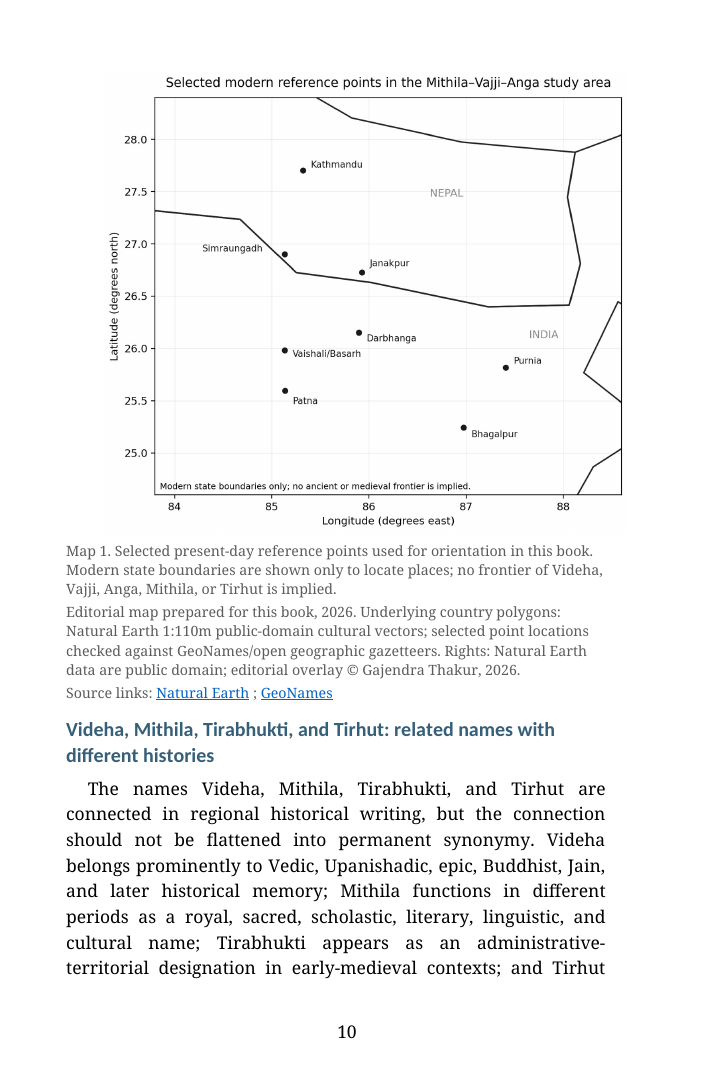
Mithila · Vajji · Anga
Chapter-specific source notes
- Primary chapter witness. Gajendra Thakur, Decoding the Panji of Mithila — Volume II, formal Chapter 15, PDF pp. 173-184; formal Chapter 15. The HTML transcription is generated from the commit-pinned source PDF and retains the chapter boundary recorded in this edition.
- Internal structure. The repository source-heading inventory records no separately encoded subordinate heading for this chapter.
- Digital editorial method. The page keeps the preserved source text distinct from generated navigational, concordance, visual, and provenance apparatus. The synthetic reconstruction is explanatory only and is not evidence for an individual lineage or a determination of social or marital status.