Decoding the Panji of Mithila · Volume II · Chapter 14
Daughter’s-Son and Affinal Links
Chapter 14

  Daughter’s-Son and Affinal Links
1. Why Daughter’s-Son and Affinal Links Matter
   The Panji cannot be decoded by following only fathers and
sons. A large part of its social intelligence lies in the crossings
between houses: daughters who marry into another lineage,
sons born from those daughters, wives who bring one house
into relation with another, and affinal villages that become
part of family memory. These crossings are not secondary.
They are necessary for understanding marriage eligibility,
maternal cycles, and the real social map of Mithila.
  The key word in this chapter is दौहित्र, the daughter’s son.
Related terms and structures include भगीनेय, maternal houses,
affinal houses, विवाह entries, सुता in marriage context, अपरा
branches, and सँ used as a marriage or maternal connector.
Together these terms show that the Panji remembers not only
where a man stands in his father’s line, but also how houses
are connected through women.
  A daughter’s-son entry is therefore a bridge entry. It
connects two lineages without making one a direct paternal
continuation of the other. This distinction must be protected
carefully.

2. The Meaning of दौहित्र

  दौहित्र means daughter’s son, or maternal grandson. In a
genealogical register, it is a precise term. It does not mean
ordinary son, and it should not be reduced to vague
descendant. A दौहित्र belongs to his father’s paternal line, but he
also carries a remembered connection to his mother’s natal
house.

                      Decoding the Panji of Mithila - Volume II

  This is why the word is so important in the Panji. It
preserves the continuing relevance of a daughter after
marriage. Even when the daughter herself is not fully named,
her son may be recorded as a bridge between houses.
   Data rule: every दौहित्र entry must be entered in both the
person index and the maternal-affinal index.
   Critical caution: never place a दौहित्र directly under the
maternal grandfather as if he were a son. The relation passes
through a daughter.

3. The Structural Position of a Daughter’s Son
   A daughter’s son stands between two houses. By paternal
descent he belongs to his father’s house. By maternal relation
he belongs to his mother’s natal network. The Panji records
this double position because it mattered socially.
   If a daughter’s son is connected with a village through सँ, the
village may indicate the maternal house, the father’s house, the
affinal house, or the location through which the relation is
remembered. The decoder must not decide too quickly.
  A correct chart should show the daughter’s son as a bridge-
person. One line should connect him to his father’s house if
known. Another line should connect him to the mother’s house
through an unnamed or named daughter.
   Data rule: chart दौहित्र with a maternal bridge, not a direct
paternal line.
  Critical caution: if the daughter is unnamed, mark her as
“unnamed daughter linking House A and House B.” Do not
invent a name.

4. दौहित्र and “सँ”

   Many daughter’s-son entries appear with सँ. This small
connector must be read with special caution. In a दौहित्र entry, सँ

                       Decoding the Panji of Mithila - Volume II

may not mean simple origin. It may mean “through the house
of,” “linked with the village of,” “from the maternal side of,” or
“connected by marriage with.”
   The first-pass translation should therefore remain neutral:
“linked with.” Only after the surrounding marriage and
maternal data are mapped should the editor decide whether
the link is maternal, affinal, residential, or uncertain.
   Data rule: every दौहित्र entry with सँ should have a connector-
function column.
   Critical caution: translating सँ as “from” in a daughter’s-son
entry can move the person into the wrong lineage.

5. दौहित्र and विवाह

  A daughter’s-son relation is often the later consequence of a
marriage. Marriage joins two houses; the daughter’s son
preserves the memory of that joining. Therefore दौहित्र entries
should be compared with nearby विवाह entries and मातृक चक्र
passages.
   If a marriage entry records a union between two houses, a
later दौहित्र entry may show how that union continued into the
next generation. The relation may not be explained in full
narrative form, but the register gives enough markers to
reconstruct the connection carefully.
   Data rule: all दौहित्र entries should be cross-linked with
possible marriage entries in the same cluster.
   Critical caution: do not isolate दौहित्र from विवाह. Daughter’s-son
evidence often completes a marriage network.

6. दौहित्र and मातृक चक्र

   A मातृक चक्र is a maternal circuit. A दौहित्र entry is one of the
clearest pieces of evidence inside such a circuit. The daughter’s

                  Decoding the Panji of Mithila - Volume II

son proves that the record is moving across the daughter’s line,
not only down the father’s line.
  When दौहित्र appears near a मातृक चक्र closure, the decoder
should treat it as part of the maternal structure unless
evidence shows otherwise. It may help identify where the cycle
begins or which houses are being connected.
  Data rule: दौहित्र entries inside or near a maternal cycle must
be included in the मातृक चक्र table.

  Critical caution: never extract a दौहित्र entry from a maternal
cycle and place it in a separate paternal tree without
preserving its cycle context.

7. भगीनेय and Related Collateral-Affinal Terms

  Terms such as भगीनेय, meaning sister’s son or nephew in
many Sanskritic contexts, also preserve non-direct paternal
relationships. Such words show that the Panji records
collateral and maternal-side crossings, not only father-son
descent.
  A भगीनेय-type entry may connect a person through his sister
rather than through his son. This is structurally different from
सुत. It should be mapped as a collateral maternal link.

  Data rule: all nephew, sister’s-son, and related terms should
be tagged as collateral-affinal or maternal-collateral evidence.
  Critical   caution:    do     not    flatten    भगीनेय      into   ordinary
descendant. It has a distinct relational path.

8. Affinal Links: The Wife’s House and the Husband’s
House
   Affinal relation means relation by marriage. In the Panji,
affinal links often appear through village names, विवाह entries,
सुता lists, दौहित्र markers, and मातृक चक्र closures. The record may

                 Decoding the Panji of Mithila - Volume II

not always say “wife’s house” in modern prose, but the
structure often reveals it.
  A woman marries from one house into another. Her children
belong to the husband’s paternal line, but her natal house
remains socially relevant. The Panji preserves this relevance
through maternal and affinal markers.
  Data rule: every marriage-linked entry should distinguish
natal house, husband’s house, wife’s house, and later issue
where possible.
   Critical caution: if the woman is unnamed, the affinal link
still exists. Do not erase it.

9. सुता in Affinal Context

  The word सुता may appear in passages that are not simple
paternal lists. In an affinal or maternal context, सुता can
introduce issue related to a marriage or maternal link. The
decoder must therefore treat it carefully.
  If सुता follows a marriage marker or appears inside a
maternal-cycle passage, the children or issue listed after it may
belong to a marriage network. The relation should not be
assigned automatically to the nearest male name without
structural analysis.
  Data rule: सुता in affinal context should be marked as “issue-
list, attachment to be verified.”
  Critical caution: false attachment of सुता names can corrupt
both the paternal chart and the maternal network.

10. अपरा in Daughter-Line and Affinal Records

  अपरा often introduces another branch, another case, or
another marriage-related unit. In daughter-line and affinal
passages, it may mark a second marriage, another spouse-line,
another daughter’s connection, or another issue group.

                Decoding the Panji of Mithila - Volume II

  When अपरा appears near दौहित्र, विवाह, or मातृक चक्र, the decoder
should open a new provisional sub-entry. This prevents the
next relation from being merged into the previous one.
  Data rule: mark every अपरा near affinal material as a possible
new sub-unit.
  Critical caution: do not merge two affinal branches because
they share a nearby name or village.

11. Affinal Villages
  Affinal villages are villages connected through marriage
rather than direct origin. They are crucial for understanding
why a person or branch appears linked with a place outside
the paternal line. A daughter may marry into one village; her
son may be remembered through that village; a later maternal
cycle may preserve the connection.
  The village gazetteer must therefore include place function.
A village in a दौहित्र entry may not have the same meaning as a
village in a सुत entry. The same place can function as origin in
one entry and affinal link in another.
   Data rule: in the village gazetteer, include a category called
“affinal village.”
   Critical caution: do not treat all village references as origin
or residence.

12. Daughter’s Son and Marriage Eligibility
   The daughter’s-son relation mattered because marriage
eligibility depended on remembered connections. A house
could not be judged only by its male-line ancestry. The
mother’s house and the daughter’s line also mattered. दौहित्र
entries helped preserve these cross-house memories.
  A future marriage might be affected by a maternal link
several generations back. The Panji therefore records

                 Decoding the Panji of Mithila - Volume II

daughter’s sons not as biographical curiosities but as necessary
social data.
  Critical   analysis   should      therefore      connect   दौहित्र   with
marriage regulation. The term belongs to the working logic of
the Panji.

13. The Gendered Structure of Memory
   The Panji often records women indirectly. A daughter may
appear through her son; a wife may appear through the village
into which she married; a mother may appear through a मातृक
चक्र. This indirectness should not be mistaken for insignificance.

  Women create the crossings that the Panji must remember.
The fact that the record preserves maternal cycles and
daughter’s-son relations proves that women are structurally
central to the genealogical system, even when the text names
men more frequently.
   Critical analysis must therefore read women through
structure as well as through names.

14. How to Chart Daughter’s-Son Relations
   A daughter’s-son chart should use a bridge format. The
mother’s natal house should appear on one side. The husband’s
house should appear on the other. The daughter stands
between them, named if the source names her and unnamed if
it does not. The daughter’s son appears below the married
couple or as a bridge-person connected to both houses.
 If the father is not named, mark him as unknown. If the
mother is not named, mark her as unnamed daughter of the
maternal house. If the village link is uncertain, mark it as
maternal or affinal probable rather than certain.
   Data rule: use dashed or bridge lines for daughter’s-son
relations.

                 Decoding the Panji of Mithila - Volume II

  Critical caution: do not draw a daughter’s son as the direct
son of his maternal grandfather.

15. The Daughter’s-Son and Affinal Data Table
  A full table for दौहित्र and affinal links should include: source
segment; page or line; original phrase; relationship word;
named daughter’s son; maternal house; paternal house; father
if named; mother if named; unnamed female link if required;
village before सँ; village after सँ; connector function; associated
marriage entry; related मातृक चक्र; number; title; issue following
the entry; confidence level; and critical note.
  This table should be linked to the person index, village
gazetteer, marriage table, and maternal-cycle table.

16. Critical Analysis: What Daughter’s-Son Entries Reveal
   Daughter’s-son entries reveal that the Panji preserves social
relation beyond agnatic descent. It knows that a family is not
made only through men of one line. It is also made through
daughters who marry, sons born through those daughters, and
villages joined by alliance.
  The presence of दौहित्र shows that the daughter’s natal house
continues to matter after marriage. The presence of भगीनेय and
related collateral terms shows that sister-lines and nephew-
links also mattered. The presence of affinal village markers
shows that geography and marriage were inseparable.
   Thus the Panji’s social map is wider than a paternal tree. It is
a network of descent and alliance.

17. Common Errors in Reading Daughter’s-Son and
Affinal Links
  The common errors are: translating दौहित्र as ordinary
descendant; placing a daughter’s son as a direct son in the
maternal grandfather’s line; ignoring the unnamed daughter

                  Decoding the Panji of Mithila - Volume II

through whom the relation passes; reading सँ as simple origin
in affinal context; detaching दौहित्र from nearby विवाह records;
detaching दौहित्र from मातृक चक्र; ignoring भगीनेय and collateral
terms; treating affinal villages as paternal origin; assigning सुता
lists without confidence levels; and erasing uncertainty for the
sake of a neat chart.

18. Rules for Reading दौहित्र and Affinal Links

  First, preserve the word दौहित्र exactly.

  Second, read it as daughter’s son, not ordinary son.
  Third, chart it as a bridge relation.
  Fourth, record the unnamed daughter if the relation
requires her.
  Fifth, classify सँ in such passages as maternal or affinal until
proven otherwise.
  Sixth, cross-link दौहित्र with विवाह and मातृक चक्र.

   Seventh, distinguish paternal house, maternal house, and
affinal village.
  Eighth, preserve numbers and titles near the entry.
  Ninth, assign issue with confidence levels.
   Tenth, do not simplify the network into a straight paternal
tree.

19. Conclusion: The Crossings That Hold the Panji
Together
  Daughter’s-son and affinal links show the Panji at its most
socially intelligent. They record the crossings between houses
that paternal descent alone cannot show. Through daughters,
marriage houses, maternal cycles, and daughter’s sons, the
Panji preserves the living web of Mithila’s society.

               Decoding the Panji of Mithila - Volume II

  The next chapter will examine multiple marriages and
secondary links. That chapter will show how first, second, and
additional marriage relations create separate branches,
separate issue groups, and complex affinal networks that must
be decoded without collapsing them into one line.

                 Decoding the Panji of Mithila - Volume II
Source structure and verification apparatus
Editorial source apparatus. This apparatus is descriptive, not interpretive. It records the source-controlled structure used to verify that this page corresponds to formal Chapter 14 of Decoding the Panji of Mithila — Volume II. The chapter text above is preserved from PDF pp. 163-173; formal Chapter 14 in the commit-pinned authoritative source. It is not merged with a neighboring chapter, appendix, annexure, or independent front/back-matter unit. The internal headings below come from the repository’s source-heading inventory and are retained as navigational and audit evidence; showing them here does not turn those headings into separate publications or add claims that are absent from the source.
Internal source headings
No subordinate heading was separately encoded in the repository source-heading inventory for this chapter.
Source-text concordance
Daughter’s-Son · Affinal · Links · Matter · cannot · decoded · following · fathers · sons · large · part · social · intelligence · lies · crossings · houses · daughters · marry · another · lineage · born · wives · bring · house · relation · villages · become · family · memory · secondary · necessary · understanding · marriage · eligibility · maternal · cycles · real · word · daughter’s · Related · terms · structures · include · entries · context · branches · used · connector · Together · show · remembers · stands · father’s · line · connected · women · entry · therefore · bridge · connects · lineages · without · making · direct · paternal · continuation · distinction · must · protected · carefully · Meaning · means · grandson · genealogical · register · precise · term · mean · ordinary · reduced
Boundary verification. In the formal sequence this chapter follows Volume II Chapter 13, “Marriage Records” and precedes Volume II Chapter 15, “Multiple Marriages and Secondary Links”. The chapter extractor begins at the verified formal Chapter 14 marker and stops at the next verified formal chapter marker; for a final chapter it stops before recognized book-level back matter. The concordance above is generated only from distinct terms already present in this chapter’s preserved source text. It is provided for discovery, comparison, and audit, not as an automated judgment about persons, lineages, status, kinship, marriage eligibility, or historical truth.
Illustrated research apparatus
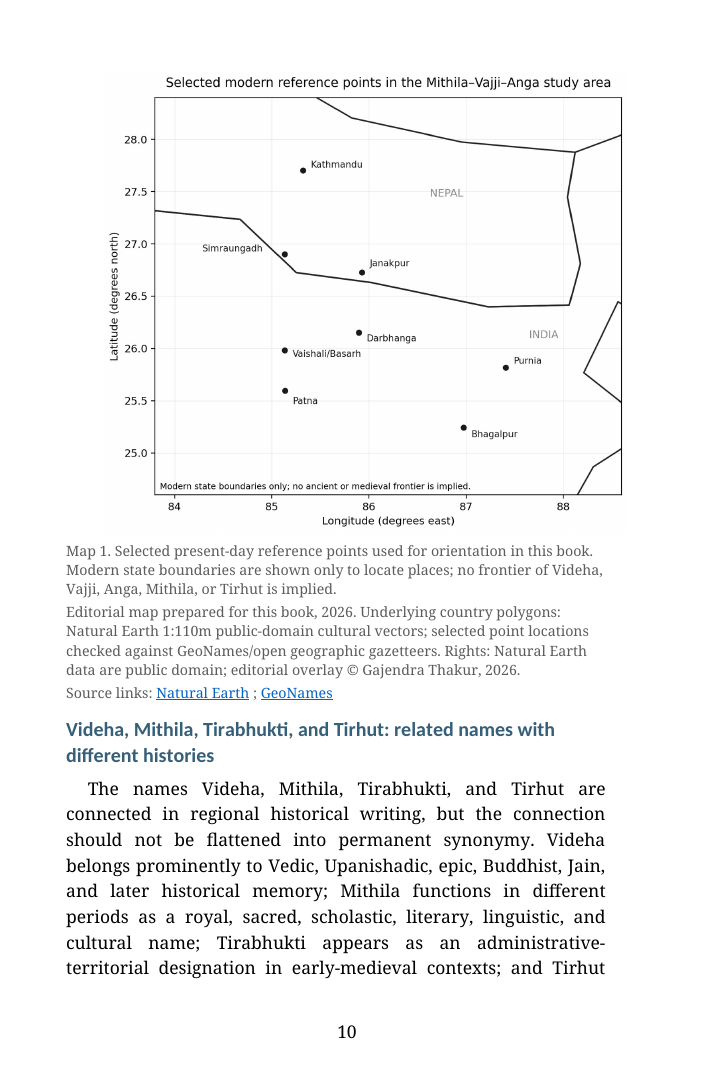
Mithila · Vajji · Anga
Chapter-specific source notes
- Primary chapter witness. Gajendra Thakur, Decoding the Panji of Mithila — Volume II, formal Chapter 14, PDF pp. 163-173; formal Chapter 14. The HTML transcription is generated from the commit-pinned source PDF and retains the chapter boundary recorded in this edition.
- Internal structure. The repository source-heading inventory records no separately encoded subordinate heading for this chapter.
- Digital editorial method. The page keeps the preserved source text distinct from generated navigational, concordance, visual, and provenance apparatus. The synthetic reconstruction is explanatory only and is not evidence for an individual lineage or a determination of social or marital status.