Decoding the Panji of Mithila · Volume II · Chapter 21
Panji as Social Structure
Chapter 21

  Panji as Social Structure
1. Why Social Structure Must Be Read from the Panji
   The Panji is not only a record of names. It is a record of
social order. Its entries preserve descent, village identity,
marriage rules, maternal connections, titles, rank, learning,
settlement memory, and the terms by which houses recognized
one another. To read the Panji only as genealogy is therefore to
read only one layer of the source.
   Social structure appears in the way the Panji arranges data.
It places persons inside houses, houses inside villages, villages
inside clusters, marriages inside regulated networks, and titles
inside systems of prestige. It distinguishes direct descent from
branch descent, paternal line from maternal circuit, residence
from root village, scholar from poet, and ordinary marriage
from second marriage.
   This chapter explains how the Panji functions as social
structure and how the decoder can extract that structure
without simplifying it into a modern family tree.

2. The House as Social Unit
   The basic social unit in the Panji is not the isolated
individual. It is the house or branch. A name matters because it
belongs to an ancestor, a descendant group, a marriage
network, a village, and often a title-world. The person is the
visible point; the house is the social unit behind him.
  Markers such as सन्तति, अपत्य, सुत, सुता, पौत्र, प्रपौत्र, and मातृक चक्र
show how the house is extended through descent and alliance.
A house can be remembered through sons, daughters,
daughter’s sons, residents, scholars, and marriage branches.

                  Decoding the Panji of Mithila - Volume II

   Data rule: reconstruct houses as linked social units, not only
as vertical chains of individuals.
   Critical caution: do not treat every person as socially
isolated. The Panji nearly always places a person in relation.

3. Descent and Rank
  Descent is central to social structure. The Panji preserves
who descends from whom, but it also shows that descent alone
was not enough. A branch could carry rank, learning, office,
residence, and marriage prestige. Titles such as ठाकु र,
महामहोपाध्याय, कविराज, वैयाकरण, पण्डित, धर्माधिकारी, and बाबू show that
descent and status interact.
  A person may be a son in the paternal line, but his social
position may be clarified by title and village. A branch may
descend from an ancestor, but its standing may be marked by
repeated learned titles or marriage with another known house.
   Data rule: every descent table should include title and place
fields.
  Critical caution: a bare father-son chart removes much of the
social meaning.

4. The Paternal Line as Social Spine
   The paternal line gives the spine of the Panji. It provides
continuity through father, son, grandson, and great-grandson.
It stabilizes house memory and gives a framework for branch
identification.
   But the paternal line is not the whole social body. It becomes
meaningful only when connected with village, title, marriage,
maternal cycle, and local identity. A paternal line without these
attached fields cannot explain why the branch mattered
socially or how it was regulated in marriage.
  Data rule: draw the paternal line first, but do not stop there.

                Decoding the Panji of Mithila - Volume II

  Critical caution: a paternal line is a structural spine, not the
entire social structure.

5. The Maternal Line as Social Web
  The maternal line creates the social web. Through मातृक चक्र,
daughters, wives, daughter’s sons, and affinal villages connect
houses across paternal boundaries. This is why the Panji
repeatedly preserves maternal cycles and दौहित्र entries.

   A society that regulated marriage could not depend on
paternal descent alone. It had to remember maternal and
affinal links. The maternal line therefore represents social
caution, alliance memory, and marriage intelligence.
 Data rule: every social-structure reconstruction must include
maternal and affinal tables.
   Critical caution: omitting the maternal line turns the Panji
into a false male-line register.

6. Marriage as Social Regulation
  Marriage is the engine of the Panji’s social structure. The
register preserves marriages because marriage determines
which houses are joined, which lines become related, and
which future unions may be restricted. Marriage is not private
biography; it is public social data.
  The presence of प्रथम विवाह, द्वितीय विवाह, date phrases, titles,
numbers, and affinal villages shows that marriage records had
to be precise. A second marriage could create a second social
network. A daughter from one marriage could create a
different maternal line from a daughter of another marriage.
  Data rule: every marriage must be treated as a structured
social event.
  Critical caution: do not merge marriages or issue groups for
convenience.

                  Decoding the Panji of Mithila - Volume II

7. Village as Social Location
   The Panji locates every house socially by village. A village is
not merely geography. It is identity, origin, residence,
settlement, branch-seat, marriage link, learned center, and
local memory. Terms such as ग्राम, वासी, डीह, मूलग्राम, पाली, समेत, and
तत्रैव show that place is layered.

   A person’s social identity may include frame village, root
village, residence, house-site, and affinal village. These may
differ without contradiction. Together they form local
belonging.
  Data rule: every social entry should include place function,
not only place name.
 Critical caution: do not reduce layered local identity to one
modern location.

8. Title as Social Rank and Function
  Titles reveal social rank and social function. Some titles
show scholarship, some ritual authority, some literary identity,
some administrative or status position. The Panji preserves
these titles because they mattered to how a house was known.
  A महामहोपाध्याय marks high learning. A कविराज marks literary
prestige. A वैयाकरण marks grammatical specialization. A धर्माधिकारी
marks legal-ritual authority. A ठाकु र or बाबू may mark social rank
or later status. These are not ornaments; they are social facts.
  Data rule: titles must be classified by function and linked to
persons, houses, villages, and marriages.
  Critical caution: translating titles without indexing them
destroys social evidence.

9. Learning as Social Capital
  In the Panji, learning is social capital. A learned title does not
belong only to an individual; it may elevate a house, identify a

                Decoding the Panji of Mithila - Volume II

village, influence marriage alliances, and preserve intellectual
prestige. A branch with repeated learned titles becomes a
scholarly house in social memory.
  This matters because Mithila’s learned culture was not
outside society. It was embedded in lineage and locality.
Scholarship gave status; status influenced marriage; marriage
connected scholarly houses.
  Data rule: intellectual titles should be studied as part of
social structure, not only literary history.
   Critical caution: do not separate knowledge from rank and
alliance.

10. Priestly and Ritual Structure
  Priestly and ritual terms show another layer of social
organization. Families connected with ritual service, अग्निहोत्र,
पुरोहित identity, dharma authority, or calendrical calculation
were not merely learned. They carried functions needed by
society.
  These functions may explain why certain branches were
carefully remembered. Ritual authority could shape marriage,
rank, and village identity. The Panji preserves the people who
maintained ritual order as part of the wider social record.
  Data rule: ritual and priestly titles should be indexed under
social function.
  Critical caution: do not merge all religious titles into one
vague learned category.

11. Numbers as Social Anchors
   Numbers in the Panji are archival anchors. Their exact
meaning may vary, but their presence stabilizes entries. They
can distinguish repeated names, attach records to branches,
link marriage events, and preserve internal register order.

                  Decoding the Panji of Mithila - Volume II

   In social-structure analysis, numbers should remain
attached to persons, titles, villages, and marriage entries. A
number may later help identify which person or event belongs
to which social unit.
  Data rule: every social table should include the exact
parenthetical number and its position.
  Critical caution: do not discard numbers because their
function is not yet fully decoded.

12. अपरा and the Social Multiplicity of Branches

  अपरा shows that the Panji often records another case, another
branch, another spouse-line, or another relational unit. It is a
sign of social multiplicity. One house may have several
branches, several marriages, several issue groups, or several
local identities.
  In social analysis, अपरा should be respected as a structural
marker. It prevents the decoder from merging separate units
into one artificial line.
  Data rule: every अपरा should create a provisional subunit
until its function is clear.
  Critical caution: ignoring अपरा flattens the social structure.

13. सन्तति and अपत्य as Social Continuity

  सन्तति and अपत्य preserve continuity. They may show
descendant branches, offspring-lines, or ancestor-linked house
identity. They are social words as much as genealogical words.
A सन्तति group is a remembered continuation; an अपत्य group is a
branch attached to an ancestor.
  These words help define house membership. They show
which persons are remembered as belonging to which line,
even when direct father-son links are not supplied.

                 Decoding the Panji of Mithila - Volume II

  Data rule: chart सन्तति and अपत्य as branch continuity unless
direct generational evidence is present.
  Critical caution: do not turn branch continuity into
immediate sonship.

14. Social Structure and Repetition
   The Panji repeats names, titles, villages, and branch
markers. Repetition is not noise. It is one of the ways social
structure becomes visible. Repeated titles may identify prestige
houses. Repeated villages may identify clusters. Repeated
marriage links may show alliance patterns. Repeated numbers
may help connect records.
   The    decoder    should    therefore   study     repetition
systematically. Repetition can show continuity, distinction, or
warning. Sometimes the same name repeats because it is the
same person. Sometimes it repeats because naming patterns
run through a house. Sometimes it repeats because two
different branches share a name.
  Data rule: use repetition as evidence, but confirm with
surrounding markers.
  Critical caution: repeated name alone is never enough for
identity.

15. Social Structure and Gender
  The Panji names men more often, but its structure depends
on women. Marriage, मातृक चक्र, दौहित्र, affinal villages, and issue
assignment all require women’s roles. A daughter may be
unnamed, but her social function is visible through her son or
the village she connects.
   This means that the Panji’s gender structure must be read
carefully. Women may be less visible as named persons, but
they are central as connectors. They create alliances, maternal
lines, and future marriage restrictions.

                 Decoding the Panji of Mithila - Volume II

   Data rule: record unnamed female links wherever the
structure requires them.
  Critical caution: absence of a woman’s personal name is not
absence of her social role.

16. Social Structure and Time
  Social structure changes over time. The Panji preserves older
scholastic titles, village roots, later social titles, modern-looking
dates, second marriages, and evolving local identities. It is not
one flat chronological layer.
  A title such as बाबू may belong to a later social register than
an older scholastic title. A modern date in a marriage entry
belongs to a later layer than a traditional genealogical cluster.
These layers should be preserved and compared.
  Data rule: mark temporal clues without forcing exact dates
where none are supplied.
  Critical caution: do not assume that all entries belong to the
same historical moment.

17. Social Tables Needed for Reconstruction
  A proper social reconstruction requires linked tables: person
table, paternal line table, maternal-cycle table, marriage table,
daughter’s-son table, village gazetteer, title index, number
table, local-identity table, and branch-continuity table.
   No single table can hold the Panji’s social structure. The
source itself is relational; the reconstruction must also be
relational. The value lies in linking tables without losing the
original wording.
  Data rule: use relational tables, not one flattened list.
   Critical caution: a simplified spreadsheet can silently destroy
structure.

                 Decoding the Panji of Mithila - Volume II

18. Critical Analysis: What the Social Structure Reveals
   The Panji reveals Mithila as an ordered society built through
descent, marriage, learning, settlement, and remembered
status. The order was not simple. It contained paternal lines,
maternal cycles, multiple marriages, village clusters, titles,
residence markers, root villages, and daughter-line bridges.
   This structure shows that genealogy served social regulation.
It helped identify houses, judge marriage, preserve rank, locate
families, and remember learned functions. It also shows that
intellectual life and social structure were inseparable: scholars
belonged to houses, houses belonged to villages, villages
belonged to networks, and networks were renewed through
marriage.
  The Panji is therefore a social archive in compressed form.

19. Common Errors in Reading Social Structure
   The common errors are: reading the Panji only as genealogy;
treating titles as decoration; treating villages as simple
locations; erasing मातृक चक्र; placing दौहित्र in the paternal line;
merging first and second marriages; ignoring अपरा; flattening
सन्तति and अपत्य into father-son relations; ignoring numbers; and
forgetting that     women       structure      alliances     even   when
unnamed.
  Each error makes the record easier but less true. The
decoder’s duty is not to make the Panji simple. It is to make its
complexity intelligible.

20. Rules for Reading Panji as Social Structure
  First, treat every entry as relational.
 Second, distinguish person, house, branch, village, title,
marriage, and maternal link.
  Third, preserve original wording before interpretation.
  Fourth, separate paternal line from branch continuity.

                 Decoding the Panji of Mithila - Volume II

  Fifth, include maternal and affinal networks.
  Sixth, classify local identity carefully.
  Seventh, preserve titles and numbers.
  Eighth, use separate rows for separate marriages and अपरा
units.
  Ninth, mark uncertainty openly.
 Tenth, read the Panji as social order, not only family
memory.

21. Conclusion: The Panji as Social Order
   The Panji is a map of social order. It records who descends
from whom, who marries whom, which house belongs to
which village, which branch carries which title, which
daughter creates which bridge, which village functions as root
or residence, and which learned or ritual identity gives
prestige to a house.
   The source is difficult because society itself was layered. But
the difficulty is also the value. The Panji preserves the structure
of Mithila in a form that can still be decoded if each marker is
treated with discipline.
  Chapter 22 will turn to time. It will examine how the Panji
records chronology through generations, numbers, date
phrases, social layers, and later additions, while warning
against false precision.

                Decoding the Panji of Mithila - Volume II
Source structure and verification apparatus
Editorial source apparatus. This apparatus is descriptive, not interpretive. It records the source-controlled structure used to verify that this page corresponds to formal Chapter 21 of Decoding the Panji of Mithila — Volume II. The chapter text above is preserved from PDF pp. 237-247; formal Chapter 21 in the commit-pinned authoritative source. It is not merged with a neighboring chapter, appendix, annexure, or independent front/back-matter unit. The internal headings below come from the repository’s source-heading inventory and are retained as navigational and audit evidence; showing them here does not turn those headings into separate publications or add claims that are absent from the source.
Internal source headings
- 2. The House as Social Unit
- 3. Descent and Rank
- 4. The Paternal Line as Social Spine
- 5. The Maternal Line as Social Web
- 6. Marriage as Social Regulation
- 7. Village as Social Location
- 8. Title as Social Rank and Function
- 9. Learning as Social Capital
- 10. Priestly and Ritual Structure
- 11. Numbers as Social Anchors
- 12. अपरा and the Social Multiplicity of Branches
- 13. सन्तति and अपत्य as Social Continuity
- 14. Social Structure and Repetition
- 15. Social Structure and Gender
- 16. Social Structure and Time
- 17. Social Tables Needed for Reconstruction
- 18. Critical Analysis: What the Social Structure Reveals
- 19. Common Errors in Reading Social Structure
- 20. Rules for Reading Panji as Social Structure
- 21. Conclusion: The Panji as Social Order
Source-text concordance
Social · Structure · Must · Read · record · names · order · entries · preserve · descent · village · identity · marriage · rules · maternal · connections · titles · rank · learning · settlement · memory · terms · houses · recognized · another · genealogy · therefore · layer · appears · arranges · data · places · persons · inside · villages · clusters · marriages · regulated · networks · systems · prestige · distinguishes · direct · branch · paternal · line · circuit · residence · root · scholar · poet · ordinary · second · explains · functions · decoder · extract · without · simplifying · modern · family · tree · House · Unit · basic · isolated · individual · name · matters · belongs · ancestor · descendant · group · network · often · title-world · person · visible · point · behind
Boundary verification. In the formal sequence this chapter follows Volume II Chapter 20, “Panji as Literary History” and precedes Volume II Chapter 22, “Panji and Time”. The chapter extractor begins at the verified formal Chapter 21 marker and stops at the next verified formal chapter marker; for a final chapter it stops before recognized book-level back matter. The concordance above is generated only from distinct terms already present in this chapter’s preserved source text. It is provided for discovery, comparison, and audit, not as an automated judgment about persons, lineages, status, kinship, marriage eligibility, or historical truth.
Illustrated research apparatus
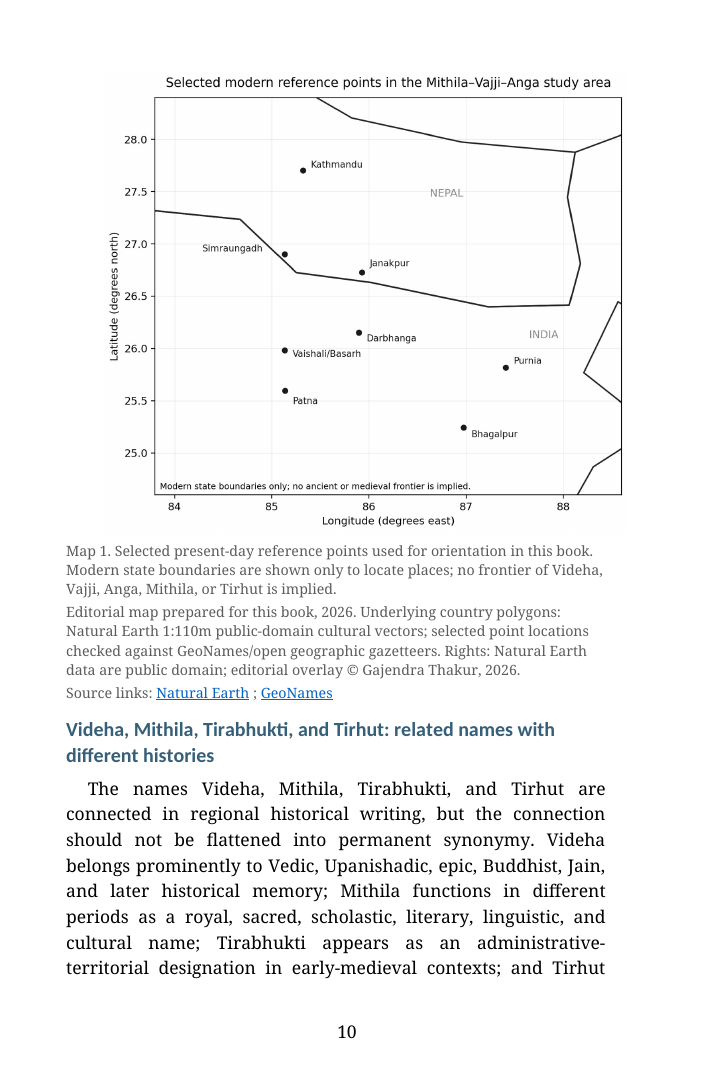
Mithila · Vajji · Anga
Chapter-specific source notes
- Primary chapter witness. Gajendra Thakur, Decoding the Panji of Mithila — Volume II, formal Chapter 21, PDF pp. 237-247; formal Chapter 21. The HTML transcription is generated from the commit-pinned source PDF and retains the chapter boundary recorded in this edition.
- Internal structure. The repository source-heading inventory records 20 subordinate headings for this chapter: “2. The House as Social Unit”; “3. Descent and Rank”; “4. The Paternal Line as Social Spine”; “5. The Maternal Line as Social Web”; “6. Marriage as Social Regulation”; “7. Village as Social Location”; “8. Title as Social Rank and Function”; “9. Learning as Social Capital”; ….
- Digital editorial method. The page keeps the preserved source text distinct from generated navigational, concordance, visual, and provenance apparatus. The synthetic reconstruction is explanatory only and is not evidence for an individual lineage or a determination of social or marital status.