Decoding the Panji of Mithila · Volume II · Chapter 22
Panji and Time
Chapter 22

  Panji and Time
1. Why Time Is Difficult in the Panji
  Time in the Panji is not presented in one simple form. The
source does not always give a year, a date, or a chronological
paragraph. Instead, time appears through many signs:
generational order, words such as सुत, पौत्र, and प्रपौत्र,
parenthetical numbers, marriage dates, later dated notes, titles
belonging to different periods, village movement, and the
layering of old and new social vocabulary.
   This makes the Panji difficult but also powerful. It contains
chronological evidence, but that evidence must be decoded. A
person may be placed in relative time through his father and
son. A marriage may be placed in calendrical time through a
date phrase. A later addition may be marked by a modern-
looking date. A title may suggest a social layer. A village
movement may imply sequence. None of these forms should be
confused with the others.
  The purpose of this chapter is to explain how time should be
read without creating false precision.

2. Relative Time and Calendar Time
   The first distinction is between relative time and calendar
time. Relative time tells us who came before whom. Father
precedes son; grandfather precedes grandson; great-
grandfather precedes great-grandson. Calendar time gives a
date, month, tithi, weekday, year, or modern date.
  The Panji often gives relative time through genealogical
language. It may give calendar time only occasionally,
especially in marriage entries or later notes. Therefore a

                   Decoding the Panji of Mithila - Volume II

reconstructed chronology must keep these two kinds of time
separate.
  Data rule: create separate fields for generational sequence
and calendar date.
  Critical caution: do not convert generational order into exact
years unless the method is clearly stated and supported.

3. Generational Time
  Generational time is the most common time structure in the
Panji. A chain of सुत, सुतो, पुत्र, पौत्र, and प्रपौत्र creates a sequence. It
tells the reader that one person belongs after another in
descent.
   But generational time is not the same as a year. It gives
order, not duration. One generation may be short or long. A
person may have children early or late. Branches may overlap.
Brothers may belong to the same generation but appear at
different positions in the register.
  Data rule: record generation level separately from estimated
date.
  Critical caution: do not assign fixed year intervals to every
generation without evidence.

4. सुत, पौत्र, and प्रपौत्र as Time Markers

   Relationship words are also time markers. सुत or पुत्र indicates
the next generation. पौत्र indicates the grandson level. प्रपौत्र
indicates the great-grandson level. These words create a
vertical order inside the house.
  If the source gives A, then B as son, then C as grandson, the
editor can place B after A and C after B. If an intermediate
generation is missing, the chart should show a gap rather than
invent a name or date.

                Decoding the Panji of Mithila - Volume II

  Data rule: use relationship words to build                relative
chronology before attempting calendar chronology.
  Critical caution: do not collapse पौत्र or प्रपौत्र into vague
descendant language. Their generational distance matters.

5. Branch Time in सन्तति and अपत्य

  सन्तति and अपत्य also carry time, but their time is branch time
rather than direct one-generation time. They show
continuation from an ancestor into a branch. The exact
number of intervening generations may not be given.
  A branch marked by सन्तति may belong several generations
after the ancestor. An अपत्य group may preserve an offspring-
line without naming every link. Therefore such terms establish
historical continuity, not precise generational distance.
  Data rule: classify सन्तति and अपत्य as branch-continuity time
unless direct generational markers are present.
  Critical caution: do not make a branch marker into a one-
generation link.

6. Marriage Dates
  Marriage entries are among the most important sources of
calendrical time. A विवाह entry may give a month, fortnight,
tithi, weekday, or later date-like statement. Such evidence
should be preserved exactly.
  A phrase naming a traditional date must not be treated like a
parenthetical number. A date phrase belongs to calendar time.
A parenthetical number may belong to a register system, entry
number, branch marker, or other internal classification.
  Data rule: separate date phrase, register number, marriage
event, and person identifier.

                Decoding the Panji of Mithila - Volume II

  Critical caution: do not convert a traditional lunar date to a
modern Gregorian date unless the year and calendar system
are known.

7. Traditional Calendar Phrases
   Traditional calendar phrases may include month, paksha,
tithi, and weekday. These phrases are valuable because they
give a precise ritual-calendar frame. Yet they may still be
incomplete if the year is not given.
   For example, a phrase like Phalguna Krishna Chaturdashi on
Wednesday identifies a ritual-calendar point, but without the
year it may not yield a unique modern date. It should therefore
be copied in the original form and translated or explained only
in the analysis layer.
  Data rule: preserve traditional calendar phrases exactly as
source text.
   Critical caution: do not pretend that an undated tithi phrase
gives a complete modern date.

8. Modern-Looking Dates and Later Layers
  Some later entries may contain modern-looking dates or
recent calendar forms. These are important because they show
that the Panji was not frozen in one ancient period. It
continued to absorb later material.
   A modern-looking date should be entered in a separate field.
It may mark the date of marriage, record, पाठार्थम्, copying, or
note. The function must be read from context.
  Data rule: distinguish event date, record date, note date, and
reading/copying date.
  Critical caution: a modern date in one passage does not date
the whole surrounding tradition.

                 Decoding the Panji of Mithila - Volume II

9. Parenthetical Numbers and Time
  Parenthetical numbers sometimes look like dates, but they
should not be treated as dates automatically. The source
contains simple numbers, slash numbers, double-slash
numbers, zero forms, and paired numbers. Their function may
vary.
   A number may help organize the register. It may identify a
person, branch, marriage, note, or source location. It may also
help compare entries. But unless the source clearly uses it as a
date, it should remain in the number field, not the calendar
field.
  Data rule: create a number field separate from all date fields.
  Critical caution: false dating from numbers can distort the
entire chronology.

10. Numbers as Relative Anchors
  Even when numbers are not dates, they can still help
chronological analysis. If the same person, title, village, and
number recur, the number may support identity. If a number
appears near a marriage and then near an issue group, it may
help connect the record internally.
  Numbers can therefore act as relative anchors. They do not
necessarily tell us the year, but they can help organize the
sequence of records and distinguish repeated names.
   Data rule: preserve number position exactly: before name,
after name, after relation, after village, after विवाह, or after टीप.

  Critical caution: use numbers for comparison before using
them for chronology.

11. Time Through Titles
  Titles can suggest time layers. A title such as महामहोपाध्याय may
belong to an older scholastic world. A title such as बाबू or a

                  Decoding the Panji of Mithila - Volume II

modern administrative marker may belong to a later social
layer. A modern occupational clue may belong later still.
  This does not mean that a title alone gives a date. It means
that titles should be used as temporal clues when combined
with other evidence: date phrases, numbers, villages, family
sequence, and historical context.
   Data rule: record title as a possible temporal clue but not as
a date.
  Critical caution: do not date a person only from title style.

12. Time Through Village Movement
   Village movement may also suggest time. If a branch has a
मूलग्राम in one place and later appears as वासी elsewhere, the
sequence may indicate settlement movement. If a branch
appears in several villages through सन्तति, अपत्य, विवाह, or दौहित्र, the
spread may show social development across generations.
   But movement evidence must be handled cautiously. A
village link may be maternal, affinal, residential, or branch-
based rather than migration. Chronology must be built only
after place function is classified.
   Data rule: use village movement as temporal evidence only
after distinguishing root, residence, branch-seat, maternal, and
affinal functions.
  Critical caution: do not turn every multi-village entry into a
migration timeline.

13. Time Through Marriage Order
  First and second marriage markers create sequence. प्रथम विवाह
precedes द्वितीय विवाह for the same person or house. This is direct
relative time. The second marriage occurs after the first,
though the exact interval may not be known.

                Decoding the Panji of Mithila - Volume II

   Marriage order becomes especially important for assigning
issue. Children may belong to one marriage or another. The
chronology of marriage events therefore affects both genealogy
and maternal network reconstruction.
  Data rule: record marriage order as relative chronological
evidence.
   Critical caution: do not assign children to a marriage event
only because they appear nearby. Use structure and confidence
levels.

14. Time Through मातृक चक्र

  A मातृक चक्र may preserve time across marriage generations. A
maternal cycle may include a daughter, her married house, her
son, and later links. The cycle is not only a kinship network; it
also implies sequence.
   However, the sequence inside a maternal cycle may not be
fully linear. It may gather several related maternal links into
one circuit. The decoder should identify probable sequence but
avoid forcing a straight timeline where the source gives a
network.
  Data rule: separate maternal network structure from
chronological order.
  Critical caution: not every cycle is a timeline.

15. Time Through दौहित्र

  दौहित्र also implies time. A daughter’s son belongs one
generation below the daughter. He also belongs after the
marriage that produced the daughter’s line. Therefore a दौहित्र
entry can help place maternal and affinal relationships in
sequence.
  But the daughter may be unnamed, and the father of the
daughter’s son may not be fully specified. The decoder must

                  Decoding the Panji of Mithila - Volume II

therefore mark the implied female link and the uncertain parts
of the sequence.
  Data rule: every दौहित्र entry should include an implied-
generation note.
  Critical caution: do not put the daughter’s son directly into
the paternal line of the maternal grandfather.

16. Time Through टीप and Notes

  टीप   entries    and     note     markers       may         preserve   later
commentary, correction, confirmation, or register handling. A
टीप may belong to a different time layer from the main entry. It
may clarify, update, or annotate earlier material.
  Therefore notes should not be absorbed into the main line
without marking them. They may be evidence of later reading
and editing.
  Data rule: every टीप should be dated or layered separately if
possible, and marked as note material if not.
  Critical caution: do not treat a note as if it were
automatically part of the original entry.

17. Layered Time in the Source
   The Panji is layered. It contains old genealogical memory,
scholastic title memory, village memory, marriage records,
later social titles, modern-looking dates, and notes. These
layers coexist. A page may contain material whose origins
differ in time.
  A responsible chronology must therefore allow layering. It
should not assume that every word in a cluster was written at
the same time or belongs to the same historical depth.
   Data rule: create a source-layer field: original genealogical
layer, marriage layer, note layer, later addition, or uncertain.
  Critical caution: do not flatten the source into a single date.

                Decoding the Panji of Mithila - Volume II

18. Building a Chronology Table
   A chronology table should include: original phrase; person;
relation word; generational level; marriage marker; marriage
order; date phrase; modern date if supplied; parenthetical
number; number position; title; village function; maternal or
affinal link; note marker; source layer; confidence level; and
critical comment.
   This table should not replace the person table or village
gazetteer. It should link them. Chronology in the Panji is
relational; it is made from many data fields together.
   Data rule: build chronology from linked evidence, not from
isolated names.
   Critical caution: a chronology table must show uncertainty
as clearly as sequence.

19. Critical Analysis: What Time Reveals
   Time in the Panji reveals how memory was organized. The
source remembers deep ancestry through generational terms.
It remembers branch continuity through सन्तति and अपत्य. It
remembers social events through विवाह. It preserves ritual-
calendar time in some date phrases. It preserves later record
activity through modern-looking dates and notes. It anchors
entries through numbers.
   This layered time shows that the Panji is both old and living.
It is not a single-time document. It is a register that carries
earlier memory forward through later use.
   The critical reader must therefore respect both depth and
layering. The Panji is ancient in memory, but it also contains
later hands, later marriages, later titles, and later social
realities.

                 Decoding the Panji of Mithila - Volume II

20. Common Errors in Reading Time
   The common errors are: treating all parenthetical numbers
as dates; converting traditional date phrases without sufficient
data; assigning fixed years to generations; making सन्तति and
अपत्य into direct generation markers; ignoring marriage order;
assigning issue to the wrong marriage; treating notes as
original entries; dating persons only by title; turning village
association into migration chronology; and flattening layered
material into one historical moment.
   Each error creates false precision. The correct method is
slower but safer: preserve first, classify second, date third.

21. Rules for Reading Time in the Panji
  First, distinguish relative time from calendar time.
  Second, use सुत, पौत्र, and प्रपौत्र for generational sequence.

  Third, treat सन्तति and अपत्य as branch-continuity time unless
direct markers appear.
  Fourth, preserve marriage date phrases exactly.
  Fifth, keep parenthetical numbers separate from dates.
  Sixth, use titles as temporal clues, not dates.
  Seventh, read village movement only after classifying place
function.
  Eighth, keep notes and टीप in a separate layer.

  Ninth, mark uncertainty openly.
  Tenth, never prefer false precision over faithful evidence.

22. Conclusion: Time as Layered Memory
  The Panji does not give time in one form because Mithila’s
memory did not live in one form. Time appears as generation,
branch continuity, marriage event, maternal circuit,
daughter’s-son link, village movement, title layer, number,

               Decoding the Panji of Mithila - Volume II

note, and date phrase. Together these forms create the
temporal structure of the source.
   To decode time in the Panji is therefore to decode layered
memory. The editor must resist the temptation to assign neat
modern dates too quickly. The first duty is to preserve each
time-marker in its own form.
   Chapter 23 will now begin Part VI, Worked Decoding. It will
demonstrate how to decode one entry step by step, moving
from original transcription to segmentation, table-making,
interpretation, and cautious historical explanation.

                     Decoding the Panji of Mithila - Volume II
Source structure and verification apparatus
Editorial source apparatus. This apparatus is descriptive, not interpretive. It records the source-controlled structure used to verify that this page corresponds to formal Chapter 22 of Decoding the Panji of Mithila — Volume II. The chapter text above is preserved from PDF pp. 247-258; formal Chapter 22 in the commit-pinned authoritative source. It is not merged with a neighboring chapter, appendix, annexure, or independent front/back-matter unit. The internal headings below come from the repository’s source-heading inventory and are retained as navigational and audit evidence; showing them here does not turn those headings into separate publications or add claims that are absent from the source.
Internal source headings
- 2. Relative Time and Calendar Time
- 3. Generational Time
- 4. सुत, पौत्र, and प्रपौत्र as Time Markers
- 5. Branch Time in सन्तति and अपत्य
- 6. Marriage Dates
- 7. Traditional Calendar Phrases
- 8. Modern-Looking Dates and Later Layers
- 9. Parenthetical Numbers and Time
- 10. Numbers as Relative Anchors
- 11. Time Through Titles
- 12. Time Through Village Movement
- 13. Time Through Marriage Order
- 14. Time Through मातृक चक्र
- 15. Time Through दौहित्र
- 16. Time Through टीप and Notes
- 17. Layered Time in the Source
- 18. Building a Chronology Table
- 19. Critical Analysis: What Time Reveals
- 20. Common Errors in Reading Time
- 21. Rules for Reading Time in the Panji
- 22. Conclusion: Time as Layered Memory
Source-text concordance
Time · Difficult · presented · simple · form · always · give · year · date · chronological · paragraph · Instead · appears · many · signs · generational · order · words · parenthetical · numbers · marriage · dates · later · dated · notes · titles · belonging · different · periods · village · movement · layering · social · vocabulary · makes · powerful · contains · evidence · must · decoded · person · placed · relative · father · calendrical · phrase · addition · marked · modern · looking · title · suggest · layer · imply · sequence · None · forms · confused · others · purpose · explain · read · without · creating · false · precision · Calendar · first · distinction · tells · came · precedes · grandfather · grandson · great · great-grandson · gives · month · tithi · weekday
Boundary verification. In the formal sequence this chapter follows Volume II Chapter 21, “Panji as Social Structure” and precedes Volume II Chapter 23, “How to Decode One Entry: A Demonstration”. The chapter extractor begins at the verified formal Chapter 22 marker and stops at the next verified formal chapter marker; for a final chapter it stops before recognized book-level back matter. The concordance above is generated only from distinct terms already present in this chapter’s preserved source text. It is provided for discovery, comparison, and audit, not as an automated judgment about persons, lineages, status, kinship, marriage eligibility, or historical truth.
Illustrated research apparatus
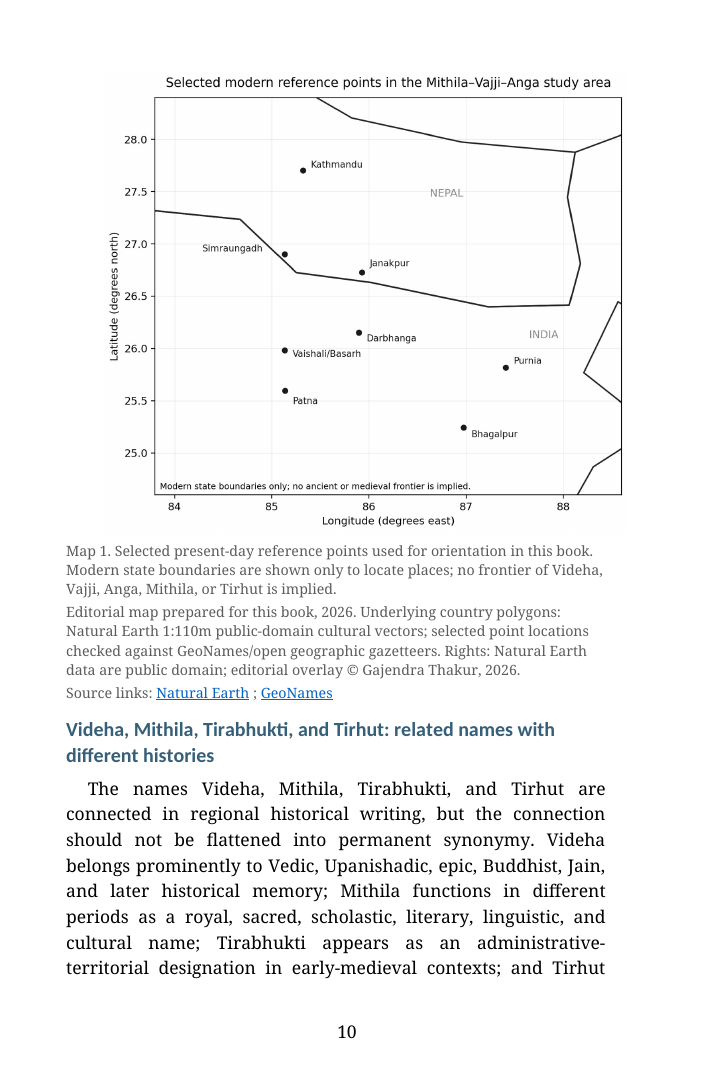
Mithila · Vajji · Anga
Chapter-specific source notes
- Primary chapter witness. Gajendra Thakur, Decoding the Panji of Mithila — Volume II, formal Chapter 22, PDF pp. 247-258; formal Chapter 22. The HTML transcription is generated from the commit-pinned source PDF and retains the chapter boundary recorded in this edition.
- Internal structure. The repository source-heading inventory records 21 subordinate headings for this chapter: “2. Relative Time and Calendar Time”; “3. Generational Time”; “4. सुत, पौत्र, and प्रपौत्र as Time Markers”; “5. Branch Time in सन्तति and अपत्य”; “6. Marriage Dates”; “7. Traditional Calendar Phrases”; “8. Modern-Looking Dates and Later Layers”; “9. Parenthetical Numbers and Time”; ….
- Digital editorial method. The page keeps the preserved source text distinct from generated navigational, concordance, visual, and provenance apparatus. The synthetic reconstruction is explanatory only and is not evidence for an individual lineage or a determination of social or marital status.