Decoding the Panji of Mithila · Volume II · Chapter 23
How to Decode One Entry: A Demonstration
Chapter 23
How to Decode One Entry: A
Demonstration
1. Why a Worked Demonstration Is Necessary
The earlier chapters explained the grammar of the Panji:
relationship words, village formulae, numbers, titles, marriage
markers, maternal cycles, local identity, and time. This chapter
now demonstrates the method on one compact source passage.
The purpose is not to produce a final historical biography from
a single line. The purpose is to show how a difficult entry
should be opened without damaging the data.
The Panji is compressed. A short phrase may contain a
village frame, an ancestor, a branch term, a place link, a
closure, and the beginning of another branch. If the reader
translates too quickly, the structure disappears. If the reader
segments first, the line becomes usable.
This chapter therefore moves step by step: original phrase,
transcription, segmentation, data extraction, table
construction, cautious interpretation, and critical note.
2. The Entry Chosen
For this demonstration, we begin with the opening style of
the source: a village frame followed by ancestor-line and
branch-place formulae. The passage begins with a formula like:
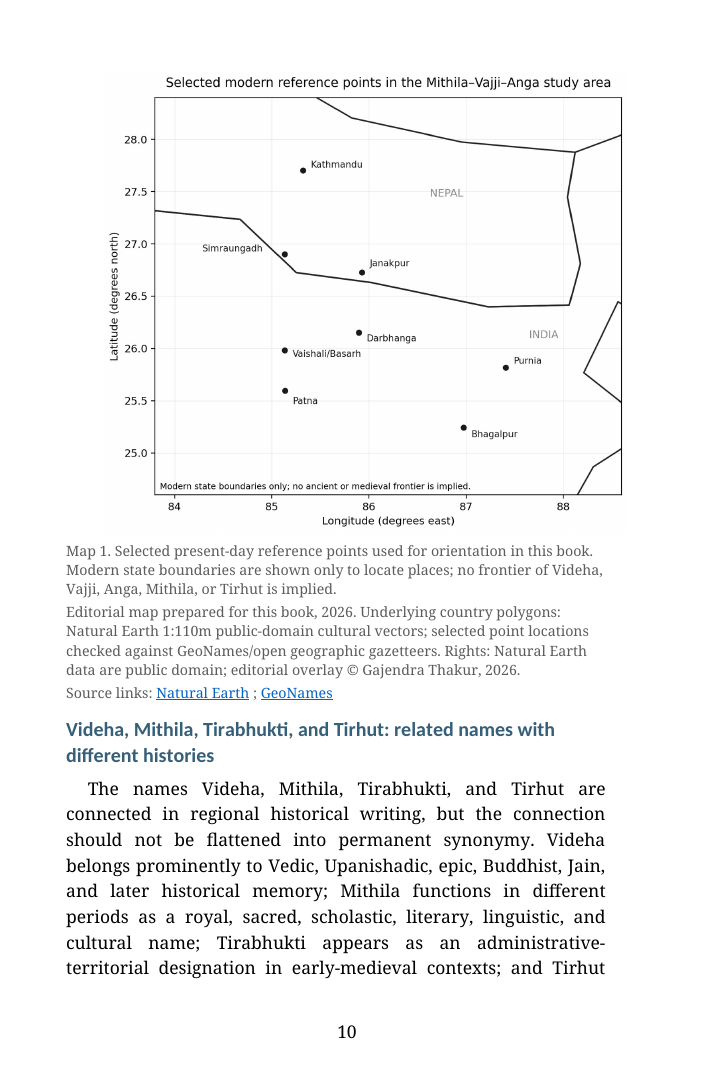
अथ सरिसब ग्राम, followed by names such as देवादित्य, रत्नाकर, प्रज्ञाकर,
नितिकर, के शव, गंगेश्वर, गौरि, शौरि, कु लपति, महिपाणि, ग्रहेश्वर, गणेश्वर, सोने, and
several place names attached through dash, अपत्य, सन्तति, and
समेत.
This is an ideal entry for demonstration because it contains
the core grammar of the Panji without requiring a full
Decoding the Panji of Mithila - Volume II
marriage or maternal-cycle reconstruction. It shows how a
village frame governs several branch statements.
Data rule: choose a compact passage first. Do not begin
training with the longest and most tangled cluster.
Critical caution: the demonstration is a method, not a final
edition of the whole Sarisab cluster.
3. Step One: Preserve the Original Phrase
The first step is to preserve the phrase exactly as given. Do
not normalize spellings immediately. Do not expand
abbreviations silently. Do not modernize village names. Do not
decide too early whether a word is a person or a place.
The original phrase is the evidence. All later tables and
explanations must be able to point back to it. If the editor
changes the form too early, later readers cannot check the
decision.
Data rule: create an “Original Source Phrase” field before
any interpretation.
Critical caution: a polished translation without the original
phrase is not a scholarly decoding.
4. Step Two: Identify the Frame
The phrase अथ सरिसब ग्राम gives the frame. अथ marks a new
opening. सरिसब is the village name. ग्राम identifies the unit as a
village frame. Therefore the following material must first be
read under the Sarisab village frame.
This does not mean that every place after it is Sarisab itself.
It means that the register has opened a Sarisab cluster. Inside
that cluster, other places may appear as branch-seats, included
localities, settlements, or associated villages.
Data rule: write “Frame village: Sarisab” or “Frame village:
सरिसब” in a separate field.
Decoding the Panji of Mithila - Volume II
Critical caution: do not confuse the frame village with every
later attached place.
5. Step Three: Break the Entry into Units
A compressed Panji line should be divided at structural
signs: double danda, dash, relationship words, ग्राम, सन्तति, अपत्य,
समेत, and shifts in name-place sequence. The purpose of
segmentation is not to rewrite the source but to reveal its
internal units.
A possible first segmentation of the opening cluster is:
1. अथ सरिसब ग्राम 2. देवादित्य रत्नाकरापत्य-छादन 3. प्रज्ञाकरापत्य-बनौली नम समेत
4. नितिकर सन्तति के शवापत्यदनाद गंगेश्वरापत्य गौरि शौरि कु लपति-बधवास 5. महिपाणि
सन्तति-खांगुड़ गयड़ा समेत 6. ग्रहेश्वरापत्य-जोंकी 7. गणेश्वरापत्य-सकु री 8. सोने सन्तति-
कटमा ओ सकु री
This segmentation is provisional. It is useful because it
separates the frame from the branch statements.
Data rule: label segmentation as provisional until checked
against surrounding lines.
Critical caution: do not let segmentation become
interpretation too early.
6. Step Four: Identify Relationship Words
The relationship words in this passage include अपत्य and
सन्तति. These are not ordinary fillers. They are the grammar of
the entry. अपत्य marks an offspring-line or descendant
attachment. सन्तति marks continuity or descendant branch.
Therefore देवादित्य रत्नाकरापत्य should not be reduced to two
unrelated names. It likely indicates a relation in which रत्नाकर is
attached as an अपत्य-line in the context of देवादित्य, followed by a
place or branch marker. Likewise, महिपाणि सन्तति-खांगुड़ गयड़ा समेत
Decoding the Panji of Mithila - Volume II
indicates a branch-continuity statement connected with places
or localities.
Data rule: enter अपत्य and सन्तति in separate relationship
columns.
Critical caution: do not treat अपत्य and सन्तति as decorative
Sanskrit words.
7. Step Five: Separate Persons from Places
The most delicate work is distinguishing persons from
places. In the opening cluster, some terms are clearly personal
names, some clearly place names, and some require
comparison with the wider source.
Names such as देवादित्य, रत्नाकर, प्रज्ञाकर, नितिकर, के शव, गंगेश्वर, गौरि, शौरि,
कु लपति, महिपाणि, ग्रहेश्वर, गणेश्वर, and सोने may be treated first as person
or ancestor names, subject to confirmation. Forms such as छादन,
बनौली, बधवास, खांगुड़, गयड़ा, जोंकी, सकु री, कटमा may function as places or
branch localities in this structure.
The dash after अपत्य or सन्तति often helps. A dash followed by a
known village-like form usually points toward a place
attachment.
Data rule: classify uncertain words as “person probable,”
“place probable,” or “uncertain.”
Critical caution: do not force every unfamiliar word into the
person column.
8. Step Six: Understand the Dash
The dash in the Panji often links a relationship statement to
a place or branch marker. It is not punctuation only. In a
phrase like अपत्य-छादन or सन्तति-खांगुड़, the dash may mean that the
line is attached to the place following the dash.
Decoding the Panji of Mithila - Volume II
The dash should therefore be preserved in the original
phrase and represented in the data table as a connector.
Data rule: include a connector field: dash, सँ, समेत, ओ, वासी, तत्रैव,
or none.
Critical caution: if the dash is removed, the relation between
person and place may become invisible.
9. Step Seven: Read समेत
The word समेत expands the unit. In a phrase such as बनौली नम
समेत or खांगुड़ गयड़ा समेत, the word shows inclusion or association. It
tells the reader that more than one place or element belongs to
the same branch statement.
The included element must not be dropped. If one place is
indexed and the place after समेत is omitted, the cluster becomes
incomplete.
Data rule: create an “included places” field for every समेत
phrase.
Critical caution: समेत often preserves the breadth of a branch.
Do not reduce it to the first place only.
10. Step Eight: Read ओ
The connector ओ joins two items. In the phrase कटमा ओ सकु री,
the two place names are linked. The pair should be preserved
as a linked pair before any attempt to decide whether one is
primary and the other secondary.
Data rule: store ओ-linked items as linked elements in the
same unit.
Critical caution: alphabetizing the two places separately
without recording ओ erases the source relation.
Decoding the Panji of Mithila - Volume II
11. Step Nine: Build a Minimal Data Table
From the opening demonstration, the editor can build a
minimal table:
Frame village: सरिसब
Unit 1: देवादित्य / रत्नाकर / अपत्य / छादन / connector dash
Unit 2: प्रज्ञाकर / अपत्य / बनौली / नम समेत / connector dash and
समेत
Unit 3: नितिकर / सन्तति / के शवापत्य / गंगेश्वरापत्य / गौरि / शौरि / कु लपति /
बधवास
Unit 4: महिपाणि / सन्तति / खांगुड़ / गयड़ा समेत
Unit 5: ग्रहेश्वर / अपत्य / जोंकी
Unit 6: गणेश्वर / अपत्य / सकु री
Unit 7: सोने / सन्तति / कटमा ओ सकु री
This table is still preliminary, but it preserves the structure.
Data rule: the first table should protect all words, even when
interpretation is uncertain.
Critical caution: never discard a word because it does not fit
the first table design.
12. Step Ten: Mark Certainty and Uncertainty
A responsible decoding must show certainty levels. The
village frame is certain. The presence of अपत्य and सन्तति is
certain. The connector dash is certain where present. Some
person-place distinctions may be probable but should be
checked against the full source and the gazetteer.
The table should therefore include confidence categories:
certain, probable, possible, uncertain. This is not weakness. It
is discipline.
Data rule: every interpretation should have a confidence
level.
Decoding the Panji of Mithila - Volume II
Critical caution: false certainty is more dangerous than
visible uncertainty.
13. Step Eleven: Create a Prose Expansion
After segmentation and table-making, the editor may create
a cautious prose expansion. A safe expansion might say:
“Under the Sarisab village frame, the source records several
ancestor-linked branch statements. Deवादitya is connected with
a Ratnakara अपत्य-line attached to Chhadan. Prajnakara’s अपत्य-
line is attached to Banauli and an included element marked by
समेत. Nitikara’s सन्तति is connected with a more complex
sequence involving Keshava, Gangeshwara, Gauri, Shauri,
Kulpati, and Badhavas. Mahipani’s सन्तति is associated with
Khangur and Gayara included with it. Graheshwara and
Ganeshwara are each followed by अपत्य-place attachments.
Sone’s सन्तति is connected with Katma and Sakuri.”
This prose is intentionally cautious. It does not claim more
than the segmented structure supports.
Data rule: write expansion after table-making, not before.
Critical caution: avoid turning a cautious branch statement
into a complete family narrative.
14. Step Twelve: Prepare a Genealogical Sketch
A genealogical sketch can now be attempted, but it must be
limited. The sketch may show ancestor or branch names and
attached places. It should not force a full father-son chain
unless सुत, पुत्र, पौत्र, or another direct relation supports it.
For the demonstration entry, the better sketch is a branch
map rather than a vertical family tree. Place Sarisab as frame.
Under it, create branch units for Deवादitya-Ratnakara,
Prajnakara, Nitikara, Mahipani, Graheshwara, Ganeshwara,
and Sone. Attach the relevant places to each unit.
Decoding the Panji of Mithila - Volume II
Data rule: choose chart type according to evidence.
Critical caution: do not draw a direct lineage tree where the
source gives branch formulae.
15. Step Thirteen: Prepare a Village Sketch
The same entry should also generate a village sketch. Sarisab
is the frame village. Chhadan, Banauli, Badhavas, Khangur,
Gayara, Jonki, Sakuri, Katma, and Sakuri again appear as
attached places or branch localities. The repetition of Sakuri is
important and should be preserved.
The village sketch shows that the entry is as much
geographical as genealogical. The places are not background.
They are part of the branch identity.
Data rule: build a place list from every worked entry.
Critical caution: do not leave village extraction for later.
Place evidence is embedded in the entry.
16. Step Fourteen: Check for Titles and Numbers
The chosen opening unit has fewer obvious title and number
markers than later passages, but the method still requires
checking. If a title such as महामहो, ठo, कविराज, वैयाकरण, पण्डित, or बाबू
appears nearby, it must be added to the title table. If a number
appears in parentheses, it must be preserved exactly with its
position.
The absence of a title or number in one unit should be
recorded as “not supplied,” not ignored.
Data rule: every worked entry should have title and number
fields even when blank.
Critical caution: blank fields should mean “not supplied in
this unit,” not “irrelevant.”
Decoding the Panji of Mithila - Volume II
17. Step Fifteen: Check for Marriage or Maternal Context
The opening demonstration is primarily a village-branch
entry, not a marriage record or मातृक चक्र passage. Still, the
decoder must check whether later lines in the same cluster
introduce विवाह, सुता, दौहित्र, or मातृक चक्र. If so, the branch map must
be linked to the marriage or maternal table.
Data rule: every entry should be tested for connection to
nearby marriage and maternal material.
Critical caution: a branch entry may later become important
because of a marriage or maternal cycle.
18. Step Sixteen: Check Against the Wider Gazetteer
After the first reading, every place should be checked against
the wider village gazetteer. If Sakuri appears elsewhere, the
editor should compare whether it is the same place, a repeated
branch seat, or a different occurrence. If Katma appears in
another cluster, the relation should be noted but not merged
prematurely.
Data rule: after decoding one entry, update the gazetteer
immediately.
Critical caution: repeated place name alone does not prove
identical branch relation.
19. Step Seventeen: Write the Critical Note
Every worked entry should end with a critical note. For this
demonstration, the note may say:
“The entry is governed by the Sarisab village frame. Its main
grammar is branch-continuity through अपत्य and सन्तति. The
dash links branch statements to place names. समेत expands
certain place units, and ओ links Katma with Sakuri. The
passage should be charted first as a village-branch map, not as
a strict father-son genealogy. Person-place classification is
Decoding the Panji of Mithila - Volume II
partly certain and partly probable; final normalization
requires comparison with the larger gazetteer.”
Data rule: the critical note should state what the entry
proves and what it does not prove.
Critical caution: a critical note is not commentary for
decoration. It prevents misuse of the data.
20. Step Eighteen: The Full Decoding Protocol
The complete protocol for one entry is:
1. Copy the original phrase. 2. Identify the frame. 3. Segment
the line. 4. Mark relationship words. 5. Separate probable
persons and places. 6. Preserve connectors. 7. Record included
places. 8. Build the person table. 9. Build the village table. 10.
Build the relationship table. 11. Check title and number fields.
12. Check marriage and maternal context. 13. Assign
confidence levels. 14. Write cautious prose expansion. 15. Draw
the correct chart type. 16. Update the gazetteer. 17. Write a
critical note. 18. Preserve uncertainty.
This method can be repeated for any dense entry in the
Panji.
21. Critical Analysis: What the Demonstration Reveals
The demonstration reveals the basic truth of the Panji: one
entry is many records at once. It is a village frame, a branch
register, a place map, a relationship formula, and a social
memory unit. It cannot be understood by translating words
one by one.
The entry also shows why data preservation is essential. If
the editor keeps only personal names, the village system
disappears. If the editor keeps only places, the branch
structure disappears. If the editor removes अपत्य and सन्तति, the
relation disappears. If the editor removes connectors, the
internal architecture disappears.
Decoding the Panji of Mithila - Volume II
A good decoding therefore does not simplify first. It
preserves first, separates second, explains third.
22. Common Errors in Decoding One Entry
The common errors are: ignoring the village frame; treating
अपत्य and सन्तति as direct father-son markers; deleting the dash;
omitting places after समेत; splitting ओ-linked places without
noting the connector; converting every uncertain word into a
person; writing a family tree before making a branch map;
normalizing place names too early; leaving titles and numbers
unrecorded; and writing a confident narrative from a
provisional segmentation.
23. Rules for Worked Decoding
First, preserve the original phrase.
Second, identify the frame before the names.
Third, segment before translating.
Fourth, mark all relationship words.
Fifth, classify each item as person, place, title, number,
connector, or uncertain.
Sixth, build tables before prose.
Seventh, choose chart type according to evidence.
Eighth, update the gazetteer.
Ninth, write a critical note.
Tenth, keep uncertainty visible.
24. Conclusion: From One Entry to the Whole Panji
This chapter has shown how one compact entry can be
opened. The same method will be used in the following
chapters for village clusters, मातृक चक्र, विवाह entries, and long
dense passages. The goal is always the same: protect the
source, reveal the structure, and explain only what the
evidence permits.
Decoding the Panji of Mithila - Volume II
A single Panji entry is small, but it contains the grammar of
the whole register. Once the reader learns to decode one entry
carefully, the larger archive begins to open.
Decoding the Panji of Mithila - Volume IISource structure and verification apparatus
Editorial source apparatus. This apparatus is descriptive, not interpretive. It records the source-controlled structure used to verify that this page corresponds to formal Chapter 23 of Decoding the Panji of Mithila — Volume II. The chapter text above is preserved from PDF pp. 258-270; formal Chapter 23 in the commit-pinned authoritative source. It is not merged with a neighboring chapter, appendix, annexure, or independent front/back-matter unit. The internal headings below come from the repository’s source-heading inventory and are retained as navigational and audit evidence; showing them here does not turn those headings into separate publications or add claims that are absent from the source.
Internal source headings
No subordinate heading was separately encoded in the repository source-heading inventory for this chapter.
Source-text concordance
Decode · Entry · Demonstration · Worked · Necessary · earlier · chapters · explained · grammar · relationship · words · village · formulae · numbers · titles · marriage · markers · maternal · cycles · local · identity · time · demonstrates · method · compact · passage · purpose · produce · final · historical · biography · single · line · show · difficult · opened · without · damaging · data · compressed · short · phrase · contain · frame · ancestor · branch · term · place · link · closure · beginning · another · reader · translates · quickly · structure · disappears · segments · first · becomes · usable · therefore · moves · step · original · transcription · segmentation · extraction · table · construction · cautious · interpretation · critical · note · Chosen · begin · opening · style · followed · ancestor-line
Boundary verification. In the formal sequence this chapter follows Volume II Chapter 22, “Panji and Time” and precedes Volume II Chapter 24, “How to Decode a Village Cluster”. The chapter extractor begins at the verified formal Chapter 23 marker and stops at the next verified formal chapter marker; for a final chapter it stops before recognized book-level back matter. The concordance above is generated only from distinct terms already present in this chapter’s preserved source text. It is provided for discovery, comparison, and audit, not as an automated judgment about persons, lineages, status, kinship, marriage eligibility, or historical truth.
Illustrated research apparatus
Mithila · Vajji · Anga
Chapter-specific source notes
- Primary chapter witness. Gajendra Thakur, Decoding the Panji of Mithila — Volume II, formal Chapter 23, PDF pp. 258-270; formal Chapter 23. The HTML transcription is generated from the commit-pinned source PDF and retains the chapter boundary recorded in this edition.
- Internal structure. The repository source-heading inventory records no separately encoded subordinate heading for this chapter.
- Digital editorial method. The page keeps the preserved source text distinct from generated navigational, concordance, visual, and provenance apparatus. The synthetic reconstruction is explanatory only and is not evidence for an individual lineage or a determination of social or marital status.