Decoding the Panji of Mithila · Volume II · Chapter 30
Creating a Person Index
Chapter 30
  Creating a Person Index
1. Why the Person Index Is Necessary
   A Panji person index is not a simple list of names. It is a
system for distinguishing persons who may share the
same name, appear in several contexts, carry different
titles, belong to different villages, or be linked through
paternal, maternal, marriage, and daughter-line relations.
Without such an index, the reader will either merge
separate persons or scatter one person into several false
identities.
  The Panji repeatedly uses common names. Names such
as Ganga, Keshav, Madhav, Raghunath, Harinath, Govind,
Narayan, Maheshwar, Vishwanath, Shankar, and many
others may occur in different houses and generations. A
person cannot be identified by name alone. He must be
identified by a cluster: relationship word, father or
branch, village, title, number, marriage context, maternal
context, and source position.
  This chapter explains how to create a person index that
preserves    the   source   while     allowing   reliable
reconstruction.

2. Preserve the Name as Written
   The first field in a person index should be the exact
name as written in the source. Do not modernize first. Do
not correct spelling first. Do not standardize vowel forms
first. A name may appear in an older, local, abbreviated,
Sanskritic, Maithili, or scribal form. That form is
evidence.

              Decoding the Panji of Mithila - Volume II

  A normalized name field may be added later for search.
But the original form must remain visible. If the source
has several variants, each variant should be linked to the
same candidate person only when supporting evidence
permits.
  Data rule: every person entry must include original
name, normalized name, and normalization confidence.
 Critical caution: replacing the original name with a
modern form can destroy identification evidence.

3. One Name Is Not One Person
  The most important rule is that one repeated name
does not automatically mean one person. The same name
may occur in several villages, several branches, several
generations, and several marriage contexts. The person
index must therefore be occurrence-based before it
becomes identity-based.
  First, create a row for every name occurrence. Then
compare occurrences. Only after comparison should two
or more occurrences be grouped into a single person
identity.
  Data rule: build occurrence records before merged
identity records.
  Critical caution: premature merging is the greatest
danger in person indexing.

4. One Person May Have Several Occurrences
  The opposite danger is also real. One person may
appear in several parts of the Panji. He may appear as
someone’s son in one passage, as a title-bearing person in

                     Decoding the Panji of Mithila - Volume II

another, as a marriage figure in another, and as part of a
maternal or daughter-line context elsewhere.
  The index should therefore allow one person identity to
have many source occurrences. These occurrences should
be linked by evidence, not by assumption. A good index
shows both the individual occurrence and the proposed
identity group.
  Data rule: create an occurrence identifier and a person-
identity identifier.
  Critical caution: do not split one person into many
persons merely because he appears in different contexts.

5. Relationship Words as Identification Evidence
  Relationship words are the strongest aids to
identification. सुत, पुत्र, सुतो, सुता, पौत्र, प्रपौत्र, सन्तति, अपत्य, दौहित्र, and
other terms place a person in relation. A name with a
relationship word is more identifiable than a bare name.
  For example, a Harinath marked as son of one person is
not automatically the same as another Harinath in a
different village. A person marked as पौत्र or प्रपौत्र must be
placed at the correct generational level. A दौहित्र must be
indexed as a daughter-line bridge, not as direct son in the
maternal house.
 Data rule: relationship word and relationship target
must be fields in every person occurrence.
  Critical caution: ignoring relationship words turns the
index into a misleading name list.

6. Father, Ancestor, and Branch Fields

                     Decoding the Panji of Mithila - Volume II

  The person index must distinguish father, ancestor, and
branch. A सुत relation may identify a father. An अपत्य or
सन्तति relation may identify an ancestor or branch, not an
immediate father. A person may therefore need separate
fields: direct father, named ancestor, branch-holder, and
branch-marker.
  If the source does not give the direct father, do not
invent one. If it gives only branch continuity, mark that
honestly.
  Data rule: keep direct-parent fields separate from
branch-continuity fields.
  Critical caution: do not place every ancestor-like name
into the father column.

7. Titles as Identification Markers
   Titles are central to person indexing. A person marked
महामहोपाध्याय, म. म., कविराज, वैयाकरण, पण्डित, ठाकु र, बाबू, ज्योतिर्विद, धर्माधिकारी,
or another title can often be distinguished from another
person of the same name.
   The title should be preserved exactly as written and
also normalized in a title category. If the same name
appears with the same title, village, and number, the
likelihood of identity increases. If the title differs, the
occurrence may still be the same person, but it must be
tested.
  Data rule: every person occurrence should include title-
as-written, title category, and title confidence.
  Critical caution: titles should not be removed from
names for alphabetical neatness.

8. Village Context as Identification Evidence

               Decoding the Panji of Mithila - Volume II

  Village context is one of the strongest identifying fields.
A name attached to Sarisab is not automatically the same
as a name attached to Gangoli, Sakuri, Katma, or another
locality. But village context must be classified by function.
A place may be frame village, residence, root village,
marriage village, maternal village, or branch-seat.
   Therefore the person index should not have only one
village column. It should have place-function fields linked
to the village index.
  Data rule: each person occurrence must link to a village
occurrence, not merely a normalized village name.
  Critical caution: a village in marriage context should
not be treated as the person’s paternal origin without
evidence.

9. Numbers as Identification Anchors
  Parenthetical    numbers     are    often  useful for
distinguishing persons. A repeated name with the same
number, same title, and same village may be a strong
identity candidate. A repeated name with different
numbers may represent different persons or different
references to one person; the context must decide.
  Numbers should be preserved as written, with slash,
double slash, zero, and position. The person index should
not convert them into dates unless clearly supported.
  Data rule: every person occurrence should include
nearby number and number-position.
  Critical caution: dropping numbers removes one of the
best tools for distinguishing repeated names.

10. Marriage Context in the Person Index

               Decoding the Panji of Mithila - Volume II

  A person may appear as principal person in a marriage
entry, spouse-side figure, title-bearing witness-like figure,
father of spouse, or member of an affinal house. The
index must preserve these roles.
  A marriage entry should create links between the
person index and the marriage table. If the person
appears in a first marriage and also in a second marriage
context, the roles must be separated. If the spouse is
unnamed but the spouse-side house is visible, the index
should record a house-level link.
  Data rule: include marriage-role fields: principal,
spouse-side, father-of-spouse, issue, affinal, or uncertain.
  Critical caution: do not index every name in a marriage
passage as a direct member of the principal paternal line.

11. Maternal Context in the Person Index
  Names inside a मातृक चक्र must be indexed with maternal
role. A person may be anchor, maternal-side person,
affinal-side person, daughter’s son, spouse-side figure, or
uncertain. These roles are different from ordinary
paternal descent.
   If the person’s role is uncertain, mark it. If a female link
is implied but unnamed, create an implied female-link
record. The person index must support such structural
persons because the maternal cycle cannot be charted
without them.
  Data rule: person occurrences inside मातृक चक्र should
include maternal-role fields.
  Critical caution: do not move all maternal-cycle names
into the paternal tree.

                Decoding the Panji of Mithila - Volume II

12. दौहित्र in the Person Index

  A दौहित्र occurrence needs special handling. The person
marked as daughter’s son must be indexed as a bridge
person. His mother’s line and father’s line are different
categories. The index should show the maternal
grandfather or maternal house, the implied daughter, and
the daughter’s son.
  If the daughter is unnamed, create an implied daughter
node. If the daughter’s husband or father’s house is
unknown, mark it unknown. Do not invent it.
  Data rule: every दौहित्र occurrence must link to a
daughter-line table.
  Critical caution: never index a दौहित्र as direct son of the
maternal grandfather.

13. Women and Implied Persons
 A person index should not include only named men. It
must include named women where present and implied
women where the structure requires them. Marriage, सुता,
मातृक चक्र, and दौहित्र often require female-link records.

  Such records should be clearly marked: named,
unnamed but implied, inferred from marriage, inferred
from दौहित्र, inferred from मातृक चक्र, or uncertain. This allows
the family tree to remain structurally accurate without
pretending to know names not supplied by the source.
  Data rule: include implied-person records with clear
labels.
  Critical caution: omitting unnamed women makes the
index structurally false.

              Decoding the Panji of Mithila - Volume II

14. Repeated Names and Disambiguation
  Repeated names should be disambiguated through a
comparison set. The set should include original name,
normalized name, father, branch, village function, title,
number, marriage role, maternal role, generation level,
and source location. The more fields match, the stronger
the identity proposal.
   If only the name matches, keep the occurrences
separate. If name, village, father, and number match,
grouping may be probable. If name, title, village, branch,
and marriage context match, grouping may become
strong.
  Data rule: identity grouping must state the evidence
used.
  Critical caution: do not merge names silently.

15. Variant Names and Alias Records
  A person may appear with variant spelling, shortened
name, title-name combination, or honorific form. The
index should allow alias records. An alias should not be
merged with a main name unless there is supporting
evidence.
   For uncertain aliases, use “possible alias” or “probable
alias.” If the source itself provides a known alternative,
mark it as source-supported alias. If the connection is
editorial, mark it as editorial hypothesis.
  Data rule: keep alias type and confidence level.
  Critical caution: aliasing is useful only when it remains
auditable.

16. Generation Level in the Person Index

                Decoding the Panji of Mithila - Volume II

  The person index should include generation level when
the source supports it. सुत gives one level below father. पौत्र
gives grandson level. प्रपौत्र gives great-grandson level. सन्तति
and अपत्य give branch continuity but may not give exact
level.
  Generation level should therefore be stored as exact,
implied, branch-level, or uncertain. This helps prevent
incorrect tree drawing.
  Data rule: generation level must be linked to the
relationship word that supports it.
  Critical caution: do not assign generation numbers
from sequence alone.

17. Source Location and Segment Number
  Every person occurrence should have source location
and segment number. Without location, the index cannot
be checked. Without segment number, the person cannot
be connected to the exact part of a dense passage.
  The source location may include file, page, line, entry,
cluster, or segment. Even if exact pagination is difficult, a
stable internal identifier should be created.
  Data rule: no person occurrence should enter the index
without source location.
  Critical caution: an unlocated person index becomes
unusable for verification.

18. The Person Index Table
  A complete person index table should include:
occurrence identifier; person-identity identifier; original
name; normalized name; variant form; alias status; title-

               Decoding the Panji of Mithila - Volume II

as-written; title category; relationship word; direct father;
named ancestor; branch marker; generation level; village
occurrence; place function; marriage role; maternal role;
दौहित्र role; implied female link; number-as-written;
number-position; source location; segment                  number;
identity confidence; and critical note.
   This table should link to the family tree, village index,
title index, marriage table, maternal-cycle table,
daughter’s-son table, and number table.
  Data rule: one row should represent one occurrence;
identity grouping should be a separate layer.
  Critical caution: one row per modern person will hide
source complexity.

19. Creating the Alphabetical Index
  After the occurrence table is built, an alphabetical
index can be created. The alphabetical index should not
replace the analytical table. It should point to occurrence
identifiers and person-identity identifiers.
  Each alphabetical entry may include the original forms,
normalized form, title, village, relationship role, and
cross-references. For repeated names, list separate entries
with disambiguating labels.
  Data rule: the alphabetical index should be generated
from the occurrence table, not typed independently.
  Critical caution: an alphabetical name list without
disambiguation is dangerous.

20. Cross-References in the Person Index
  Cross-references are essential. A person entry should be
able to point to: father, sons, branch, village, title,

               Decoding the Panji of Mithila - Volume II

marriage, maternal cycle, daughter’s son, note, and
possible alias. A printed index may use “see also,” while a
digital index may use linked identifiers.
  Cross-references should also be used for uncertain
identity: “possibly identical with,” “distinct from,” “not to
be confused with,” or “same name, different village.”
  Data rule: include cross-reference type and confidence.
  Critical caution: cross-references must clarify, not
conceal uncertainty.

21. Critical Analysis: What the Person Index Reveals
  A person index reveals the Panji’s method of identity. A
person is not identified only by name. Identity is made
from relation, house, village, title, number, marriage,
maternal connection, and source position. The Panji’s
world is relational; therefore its index must also be
relational.
  The person index also reveals the density of social
memory. Some persons matter because of descent. Some
matter because of title. Some matter because they create
marriage links. Some matter because they stand in a
maternal or daughter-line bridge. Some matter because
their name is a key to a village cluster.
  A good person index therefore becomes one of the main
interpretive tools of the whole book.

22. Common Errors in Creating a Person Index
   The common errors are: treating one repeated name as
one person; splitting one person into many entries
without comparison; losing original spellings; dropping
titles; ignoring relationship words; placing branch

                Decoding the Panji of Mithila - Volume II

ancestors in father columns; erasing women; misplacing
दौहित्र; ignoring village function; treating numbers as
optional; failing to record source location; and creating an
alphabetical list before building occurrence records.
  Each error weakens the whole reconstruction.

23. Rules for Creating a Person Index
  First, preserve every name as written.
  Second, create occurrence records before identity
groups.
  Third, never identify a person by name alone.
   Fourth, attach relationship words, titles, numbers,
villages, and source location.
  Fifth, separate direct father from branch ancestor.
  Sixth, record marriage and maternal roles.
  Seventh, include implied women when the structure
requires them.
  Eighth, treat दौहित्र as a daughter-line bridge.

  Ninth, use confidence levels for identity grouping.
  Tenth, generate the alphabetical index from the
analytical table.

24. Conclusion: Names as Relational Evidence
  The person index is the Panji’s name-memory in
disciplined form. It protects the reader from two opposite
errors: merging different persons because they share a
name, and separating one person into many persons
because he appears in different contexts.
  A name in the Panji is never enough by itself. It
becomes meaningful only through relation, village, title,

                      Decoding the Panji of Mithila - Volume II

number, marriage, maternal cycle, and source position. A
proper person index preserves all these layers.
   Chapter 31 will turn to the term glossary. It will show
how to build a reference list of Panji terms without
flattening specialized words such as सन्तति, अपत्य, सँ , वासी, डीह,
मूलग्राम, मातृक चक्र, विवाह, दौहित्र, अपरा, एते , and टीप.

                      Decoding the Panji of Mithila - Volume II
Source structure and verification apparatus
Editorial source apparatus. This apparatus is descriptive, not interpretive. It records the source-controlled structure used to verify that this page corresponds to formal Chapter 30 of Decoding the Panji of Mithila — Volume II. The chapter text above is preserved from PDF pp. 336-349; formal Chapter 30 in the commit-pinned authoritative source. It is not merged with a neighboring chapter, appendix, annexure, or independent front/back-matter unit. The internal headings below come from the repository’s source-heading inventory and are retained as navigational and audit evidence; showing them here does not turn those headings into separate publications or add claims that are absent from the source.
Internal source headings
No subordinate heading was separately encoded in the repository source-heading inventory for this chapter.
Source-text concordance
Creating · Person · Index · Necessary · simple · list · names · system · distinguishing · persons · share · name · appear · several · contexts · carry · different · titles · belong · villages · linked · paternal · maternal · marriage · daughter-line · relations · Without · reader · either · merge · separate · scatter · false · identities · repeatedly · uses · common · Ganga · Keshav · Madhav · Raghunath · Harinath · Govind · Narayan · Maheshwar · Vishwanath · Shankar · many · others · occur · houses · generations · cannot · identified · alone · must · cluster · relationship · word · father · branch · village · title · number · context · position · explains · create · preserves · allowing · reliable · reconstruction · Preserve · Written · first · field · exact · modernize · correct · spelling
Boundary verification. In the formal sequence this chapter follows Volume II Chapter 29, “Creating a Village Index” and precedes Volume II Chapter 31, “Creating a Term Glossary”. The chapter extractor begins at the verified formal Chapter 30 marker and stops at the next verified formal chapter marker; for a final chapter it stops before recognized book-level back matter. The concordance above is generated only from distinct terms already present in this chapter’s preserved source text. It is provided for discovery, comparison, and audit, not as an automated judgment about persons, lineages, status, kinship, marriage eligibility, or historical truth.
Illustrated research apparatus
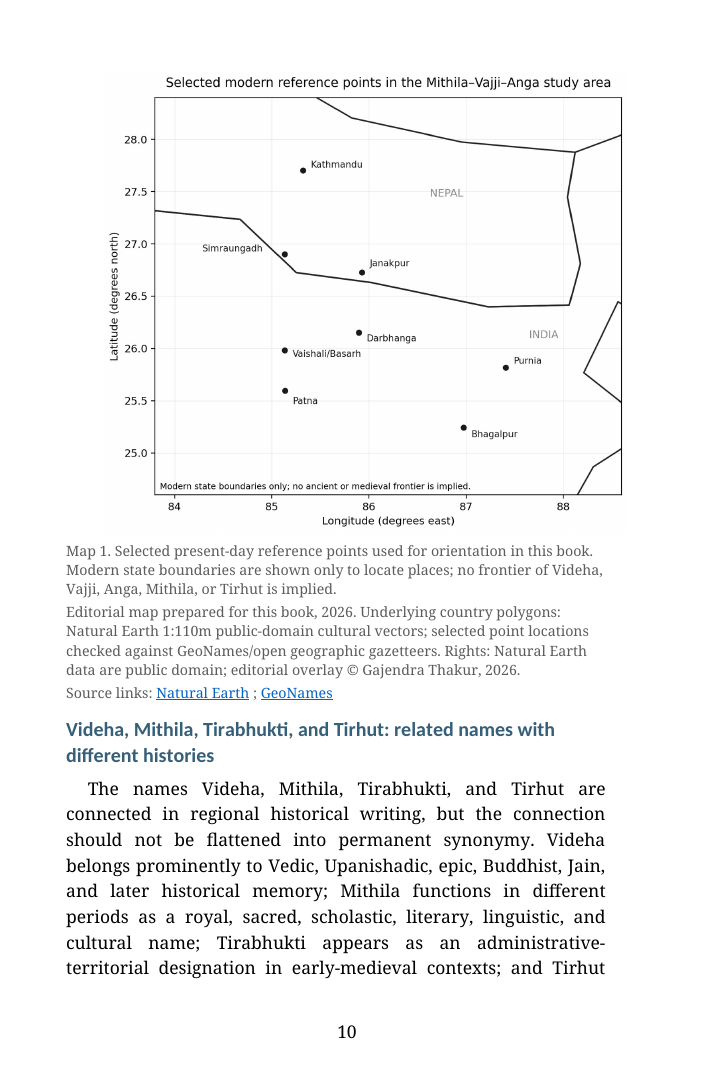
Mithila · Vajji · Anga
Chapter-specific source notes
- Primary chapter witness. Gajendra Thakur, Decoding the Panji of Mithila — Volume II, formal Chapter 30, PDF pp. 336-349; formal Chapter 30. The HTML transcription is generated from the commit-pinned source PDF and retains the chapter boundary recorded in this edition.
- Internal structure. The repository source-heading inventory records no separately encoded subordinate heading for this chapter.
- Digital editorial method. The page keeps the preserved source text distinct from generated navigational, concordance, visual, and provenance apparatus. The synthetic reconstruction is explanatory only and is not evidence for an individual lineage or a determination of social or marital status.