Decoding the Panji of Mithila · Volume II · Chapter 31
Creating a Term Glossary
Chapter 31

   Creating a Term Glossary
1. Why the Term Glossary Is Necessary
   A Panji glossary is not a simple word list. It is a guide to the
technical language of the register. Words such as सन्तति, अपत्य, सँ,
वासी, डीह, मूलग्राम, मातृक चक्र, विवाह, दौहित्र, अपरा, एते, अथ, समेत, तत्रैव, सुता, सुत,
पौत्र, प्रपौत्र, टीप, and title abbreviations cannot be translated once
and then forgotten. Their meaning depends on function,
position, and context.
   The purpose of a glossary is therefore not merely to give
English equivalents. It must preserve the original term, identify
its grammatical role in the Panji, list its possible functions,
show examples of use, warn against misreadings, and link the
term to relevant tables. A good glossary teaches the reader how
to read, not merely what a word means.
   This chapter explains how to create such a glossary.

2. Preserve the Term as Written
   Every glossary entry should begin with the exact form found
in the source. If the source uses चक्रं rather than चक्र, or प्रo rather
than a fully expanded word, preserve the written form. If a
term appears in several spellings or abbreviations, list all
source forms before giving a normalized heading.
   The source form matters because variant forms may reveal
scribal habits, printed conventions, Sanskritized endings,
Maithili usage, or abbreviation patterns. Glossary-making
should not erase these differences.
  Data rule: every term glossary entry should include source
form, normalized form, and variant forms.

                  Decoding the Panji of Mithila - Volume II

  Critical caution: never replace a source form with a modern
equivalent in the glossary headword field.

3. Do Not Translate Too Quickly
  A term such as सँ may look simple, but it can function as
origin, residence, marriage connection, maternal link, affinal
association, or general connector. A term such as सन्तति may
mean continuation or descendant branch, but it does not
always prove direct sonship. A term such as अपत्य points toward
offspring-line, but its exact force depends on the entry.
   Therefore the glossary should not give one rigid translation.
It should give a functional range. The first line may supply a
short English gloss, but the full entry must explain how the
term works in the Panji.
  Data rule: separate literal gloss from Panji function.
  Critical caution: one-word translation can mislead more
than it helps.

4. Structure of a Glossary Entry
   A complete glossary entry should contain: headword; source
forms; normalized form; part of Panji grammar; literal
meaning; functional meaning; common contexts; related
terms; table fields affected; examples of source use; decoding
rule; common error; and cross-references.
  For example, सन्तति should be linked to अपत्य, सुत, branch
continuity, family tree, person index, and village clusters. विवाह
should be linked to प्रथम विवाह, द्वितीय विवाह, मातृक चक्र, दौहित्र, date
phrases, marriage table, and issue assignment.
  Data rule: every glossary entry should point to the data
tables affected by the term.
   Critical caution: a glossary entry without data consequences
is incomplete.

                   Decoding the Panji of Mithila - Volume II

5. सुत and पुत्र

   सुत and पुत्र are direct descent markers. They usually identify
sonship and are central to building the paternal spine. In a
family tree, these terms can support a father-son line when the
surrounding grammar confirms the relation.
  The glossary should explain that these terms are stronger
than सन्तति and अपत्य for direct generational linkage. However,
even a direct term must be read within its segment. In dense
passages, a sonship term may belong to a subunit, marriage
context, or different branch.
   Data rule: सुत and पुत्र entries should link to paternal-line
tables and person-index generation fields.
   Critical caution: do not detach सुत from its local segment.

6. सुतो

   सुतो appears as a chain-like marker in many genealogical
contexts. It may continue the sonship sequence and can help
establish a line of descent. The glossary should treat it as a
form requiring careful segmentation, especially where several
names follow one another.
   The key is not to translate सुतो mechanically but to observe
where the chain begins and ends. The term may help connect
names, but punctuation, numbers, and other relationship
words may interrupt the sequence.
   Data rule: every सुतो occurrence should be indexed with
segment number and preceding name.
   Critical caution: do not extend a सुतो chain beyond its
evidence.

7. सुता

                 Decoding the Panji of Mithila - Volume II

   सुता is an issue marker and must be handled carefully. It may
introduce children, issue groups, or lists within a family or
marriage context. It can appear near विवाह, मातृक चक्र, or branch
records. Its function depends on surrounding terms.
   In a glossary, सुता should not be defined only as “daughter” or
“children” without context. The Panji use often requires a
broader issue-list reading. The term may be crucial for
assigning children to a particular marriage or subunit.
   Data rule: सुता entries should link to issue tables, marriage
entries, and maternal-cycle analysis.
  Critical caution: do not assign all following names to the
nearest male without checking structure.

8. सन्तति

   सन्तति is one of the most important terms in the Panji. It
marks continuation, descendant line, or branch continuity. It
may point to a remembered house or lineage branch rather
than an immediate father-son relation.
   The glossary must warn that सन्तति is not the same as सुत. It
should usually be represented as branch continuity unless
direct generational markers are present. It is central to family-
tree design and branch mapping.
   Data rule: सन्तति should be linked to branch-continuity fields,
family tree branch boxes, and person index ancestor fields.
   Critical caution: do not translate सन्तति as direct “son of.”

9. अपत्य

   अपत्य points to offspring-line or descendant attachment. Like
सन्तति, it often works as a branch marker. It may attach a
person, ancestor, or line to a place or branch. In many entries
it appears with a dash and a place name.

                         Decoding the Panji of Mithila - Volume II

   The glossary should distinguish अपत्य from direct पुत्र or सुत. It
should also show how अपत्य interacts with place attachment,
especially where the formula is अपत्य + dash + village.

   Data rule: अपत्य occurrences should link person, branch,
ancestor, connector, and attached place.
   Critical caution: do not make every अपत्य into an immediate
child relation.

10. पौत्र, प्रपौत्र, and वृद्ध प्रपौत्र

   पौत्र, प्रपौत्र, and वृद्ध प्रपौत्र are generational terms. They are
essential for preserving generational distance. पौत्र indicates
grandson level. प्रपौत्र indicates great-grandson level. वृद्ध प्रपौत्र is a
qualified extended generational term that must not be
flattened.
   The glossary should instruct the editor to create implied
unnamed nodes when the intermediate generation is not
named. These terms belong to the chronology of the family
tree.
  Data rule: link these terms to generation-level fields in the
person index and family-tree table.
   Critical caution: do not collapse पौत्र or प्रपौत्र into vague
“descendant.”

11. सँ

   सँ is the most flexible connector in the Panji. It may indicate
from, through, with, connected to, belonging to, by marriage
with, resident at, or linked through maternal or affinal
relation. Its meaning cannot be fixed without context.
   The glossary should treat सँ as a functional connector, not
merely a preposition. It should list possible functions and

                    Decoding the Panji of Mithila - Volume II

require the editor to classify each occurrence after studying the
surrounding words.
   Data rule: every सँ occurrence should have a connector-
function field.
   Critical caution: do not translate सँ automatically as “from.”

12. विवाह

   विवाह marks a marriage event. It may appear alone or with
प्रथम विवाह, द्वितीय विवाह, date phrases, titles, numbers, villages, issue-
lists, अपरा subunits, or maternal consequences. It is one of the
central social markers of the Panji.
   The glossary entry should explain that विवाह opens a
marriage-event row. It is not merely a note beside a person’s
name. It may create spouse-side links, maternal cycles,
daughter-line bridges, and future marriage restrictions.
   Data rule: every विवाह occurrence should be indexed in the
marriage table.
   Critical caution: do not absorb विवाह into ordinary biography.

13. प्रथम विवाह and द्वितीय विवाह

   First and second marriage markers establish sequence. प्रथम
विवाह and द्वितीय विवाह must be treated as separate marriage events.
Each may have its own spouse-side village, issue group,
maternal consequences, and related numbers.
  The glossary should warn that second marriage entries are
not minor additions. They may change the structure of the
family tree and the maternal-cycle network.
  Data rule: create separate marriage nodes for first and
second marriages.

                 Decoding the Panji of Mithila - Volume II

   Critical caution: never merge first and second marriages for
visual convenience.

14. मातृक चक्र

   मातृक चक्र is a maternal-cycle marker. It identifies a circuit of
maternal or affinal connection. The phrase may close a unit,
gather preceding material, or identify the maternal network of
an anchor person. Its boundary must be determined carefully.
   The glossary should treat मातृक चक्र as a structural term. It
should cross-reference सुता, विवाह, दौहित्र, सँ, अपरा, and village
functions. It should also instruct the editor to chart maternal
cycles as networks rather than simple paternal lines.
   Data rule: every मातृक चक्र occurrence creates a maternal-cycle
record.
   Critical caution: do not read मातृक चक्र as a decorative closing
phrase.

15. दौहित्र

   दौहित्र means daughter’s son and is one of the most important
bridge terms in the Panji. It connects a person to a house
through a daughter. It therefore belongs to daughter-line and
maternal-affinal analysis.
   A दौहित्र must not be placed as the direct son of his maternal
grandfather. The family tree must include the female link,
named or implied. The glossary should make this warning
explicit.
   Data rule: every दौहित्र occurrence should link to a daughter-
line table and an implied or named daughter node.
   Critical caution: misplacing दौहित्र is a major structural error.

16. अपरा

                 Decoding the Panji of Mithila - Volume II

   अपरा indicates another unit: another branch, another spouse-
line, another issue group, another reading, or another related
entry. Its exact function depends on context. In marriage and
maternal passages, it is especially important.
   The glossary should define अपरा as a structural shift marker.
It should require the editor to open a provisional subunit
whenever the term appears.
   Data rule: every अपरा occurrence creates a subunit identifier.

   Critical caution: ignoring अपरा merges separate structures.

17. अथ and एते

   अथ often opens a new unit, especially a village frame. एते
often closes or gathers a cluster, as in formulas that close a
village section. These terms are boundary markers.
   The glossary should explain that अथ and एते are not merely
literary particles. They affect segmentation, cluster boundary,
and village indexing. They are especially important in building
the village index.
   Data rule: index अथ and एते in cluster boundary fields.

  Critical caution: do not begin a cluster with the first personal
name when अथ marks the frame.

18. ग्राम

   ग्राम marks a village frame or village identity. It may appear
as a separate word or joined with the village name. The
glossary should explain that ग्राम is not always merely a
geographic label; it can define the governing frame of a cluster.
   The term should be linked to the village index, opener and
closure fields, and frame-village classification.

                       Decoding the Panji of Mithila - Volume II

   Data rule: every ग्राम occurrence near a place name should be
tested for frame function.
   Critical caution: do not treat ग्राम-marked frames as ordinary
attached places.

19. वासी

   वासी indicates residence or recognized belonging. It may
show that a person or branch is resident at a place, associated
with it, or socially known through it. It is not identical with
origin.
   The glossary should distinguish वासी from मूलग्राम and डीह. A वासी
place may be later residence, branch settlement, or social
recognition.
   Data        rule:   every     वासी   occurrence        should   link   to   a
residence/belonging field.
   Critical caution: do not translate वासी as original village.

20. डीह

   डीह is a local identity term. It may indicate house-site,
ancestral settlement seat, habitation memory, or local base. It
is more specific than a general village name and must be
indexed separately.
   The glossary should preserve डीह in the original form and
link it to the village index, local-identity table, and family-tree
place-function labels.
   Data rule: डीह should have its own field, separate from
general village.
   Critical caution: do not reduce डीह to ग्राम.

21. मूलग्राम

                  Decoding the Panji of Mithila - Volume II

  मूलग्राम means root village or original village. It is a strong
marker of local identity. It may differ from residence, marriage
village, maternal village, or later branch settlement.
  The glossary should instruct the editor to treat मूलग्राम as root
evidence but still preserve context. If a branch later appears
elsewhere as वासी, the distinction becomes important.

  Data rule: every मूलग्राम occurrence should be marked as root-
village evidence.
  Critical caution: do not confuse root village with present
residence.

22. पाली

  पाली may indicate a locality, sub-settlement, or part of a
place-name. It should not be erased during normalization. If
the source writes a place with पाली, the full source form must
remain in the village index.
   The glossary should cross-reference village index, sub-
locality, and place-variant fields.
  Data rule: preserve पाली as locality marker and original place
component.
  Critical caution: deleting पाली may merge distinct places.

23. समेत, ओ, and तत्रैव

  समेत indicates inclusion. ओ joins items. तत्रैव refers to the same
place already mentioned. These small words are essential in
village and branch indexing.
  The glossary should treat them as connectors with data
consequences. समेत creates included-place fields. ओ creates
joined-place links. तत्रैव creates implied-place records.

                     Decoding the Panji of Mithila - Volume II

   Data rule: every समेत, ओ, and तत्रैव occurrence should be
represented in the village or relationship table.
   Critical caution: omitting these connectors breaks the
internal structure of a cluster.

24. टीप

   टीप marks a note. A note may belong to a later layer, a
clarification, a reference, or an internal register addition. It
should not be absorbed into the main entry without marking
its note status.
   The glossary should explain that टीप creates a note field and
may require separate source-layer classification. Numbers
near टीप should be preserved exactly.

   Data rule: every टीप occurrence should create a note record.

  Critical caution: do not treat note material as if it were
automatically part of the original entry.

25. Titles and Abbreviations
   The glossary must include title and abbreviation entries: ठo,
प्रo, म. म., म.म.उ., महामहो, महामहोपाध्याय, कवि, कविराज, वैयाकरण, पण्डित,
ज्योतिर्विद, धर्माधिकारी, पौराणिक, मीमांसक, अग्निहोत्रिक, बाबू, ठाकु र, and related
forms.
   Each title entry should include source form, probable
expansion, functional category, person-index field, title-index
field, and cautions. Some abbreviations may remain uncertain
and should be marked as such.
   Data rule: titles and abbreviations should be indexed as
terms and as person/title data.
   Critical caution: do not expand abbreviations silently.

26. The Glossary Table

                  Decoding the Panji of Mithila - Volume II

   A complete term glossary table should include: term
identifier; source form; normalized headword; variant forms;
literal gloss; functional meaning; Panji category; common
contexts; related terms; affected tables; example source phrase;
decoding rule; common error; source locations; confidence
level; and editorial note.
  The glossary should be relational. A term should point to
examples, examples should point to source segments, and
source segments should point back to the tables.
   Data rule: the glossary must be linked to the person index,
village index, marriage table, maternal-cycle table, title index,
number table, and family-tree table.
  Critical caution: a glossary isolated from the data system is
not enough.

27. Cross-References Inside the Glossary
 Terms in the Panji work together. Therefore the glossary
must use cross-references. सन्तति should point to अपत्य, सुत, and
branch continuity. विवाह should point to प्रथम विवाह, द्वितीय विवाह, सुता,
मातृक चक्र, and दौहित्र. वासी should point to मूलग्राम and डीह. सँ should
point to marriage, village, and maternal contexts.
  Cross-references should not be decorative. They should
guide interpretation.
   Data rule: every glossary entry should include “see also”
fields.
  Critical caution: a glossary               without      cross-references
encourages isolated reading.

28. Critical Analysis: What the Glossary Reveals
  A Panji glossary reveals that the register has its own
grammar. Its terms are not loose words. They are archival
operators. They open clusters, close clusters, mark descent,
show branch continuity, create marriage events, identify

                 Decoding the Panji of Mithila - Volume II

maternal circuits, distinguish residence from root, preserve
notes, and carry title-based status.
  The glossary also reveals why translation alone is
inadequate. A term may have one literal meaning but several
Panji functions. The decoder must therefore explain both
language and use.
  A good glossary becomes a method manual in miniature.

29. Common Errors in Creating a Term Glossary
  The common errors are: replacing source forms with
normalized forms; giving one-word translations; ignoring
functional context; failing to distinguish सुत from सन्तति;
translating सँ only as “from”; treating वासी as मूलग्राम; reducing डीह
to village; erasing पाली; ignoring अपरा; treating मातृक चक्र as
decorative; placing दौहित्र in the paternal line; expanding
abbreviations silently; and failing to link terms to tables.

30. Rules for Creating a Term Glossary
  First, preserve the source form.
  Second, record variants.
  Third, separate literal gloss from Panji function.
  Fourth, list common contexts.
  Fifth, link each term to affected tables.
  Sixth, give decoding rules.
  Seventh, warn against common errors.
  Eighth, cross-reference related terms.
  Ninth, mark uncertain expansions.
  Tenth, treat every technical word as evidence.

31. Conclusion: Terms as Tools of Decoding

                    Decoding the Panji of Mithila - Volume II

   The Panji is decoded through its terms. सुत, सन्तति, अपत्य, सँ,
विवाह, मातृक चक्र, दौहित्र, वासी, डीह, मूलग्राम, पाली, अपरा, एते, अथ, टीप, and the
title abbreviations are not passive vocabulary. They are tools
by which the register organizes society.
   A proper glossary preserves these tools in usable form. It
teaches the reader where a term appears, what it may mean,
how it functions, which tables it affects, and what mistakes to
avoid.
  Chapter 32 will complete Part VII by examining errors,
variants, and editorial discipline. It will show how to handle
damaged readings, duplicate names, variant spellings,
uncertain abbreviations, and conflicting reconstructions
without losing the integrity of the source.
Source structure and verification apparatus
Editorial source apparatus. This apparatus is descriptive, not interpretive. It records the source-controlled structure used to verify that this page corresponds to formal Chapter 31 of Decoding the Panji of Mithila — Volume II. The chapter text above is preserved from PDF pp. 349-362; formal Chapter 31 in the commit-pinned authoritative source. It is not merged with a neighboring chapter, appendix, annexure, or independent front/back-matter unit. The internal headings below come from the repository’s source-heading inventory and are retained as navigational and audit evidence; showing them here does not turn those headings into separate publications or add claims that are absent from the source.
Internal source headings
No subordinate heading was separately encoded in the repository source-heading inventory for this chapter.
Source-text concordance
Creating · Term · Glossary · Necessary · simple · word · list · guide · technical · language · register · Words · title · abbreviations · cannot · translated · forgotten · meaning · depends · function · position · context · purpose · therefore · merely · give · English · equivalents · must · preserve · original · identify · grammatical · role · possible · functions · show · examples · warn · misreadings · link · relevant · tables · good · teaches · reader · read · means · explains · create · Written · Every · entry · begin · exact · form · found · uses · rather · fully · expanded · appears · several · spellings · forms · giving · normalized · heading · matters · variant · reveal · scribal · habits · printed · conventions · Sanskritized · endings · Maithili · usage · abbreviation
Boundary verification. In the formal sequence this chapter follows Volume II Chapter 30, “Creating a Person Index” and precedes Volume II Chapter 32, “Errors, Variants, and Editorial Discipline”. The chapter extractor begins at the verified formal Chapter 31 marker and stops at the next verified formal chapter marker; for a final chapter it stops before recognized book-level back matter. The concordance above is generated only from distinct terms already present in this chapter’s preserved source text. It is provided for discovery, comparison, and audit, not as an automated judgment about persons, lineages, status, kinship, marriage eligibility, or historical truth.
Illustrated research apparatus
Mithila · Vajji · Anga
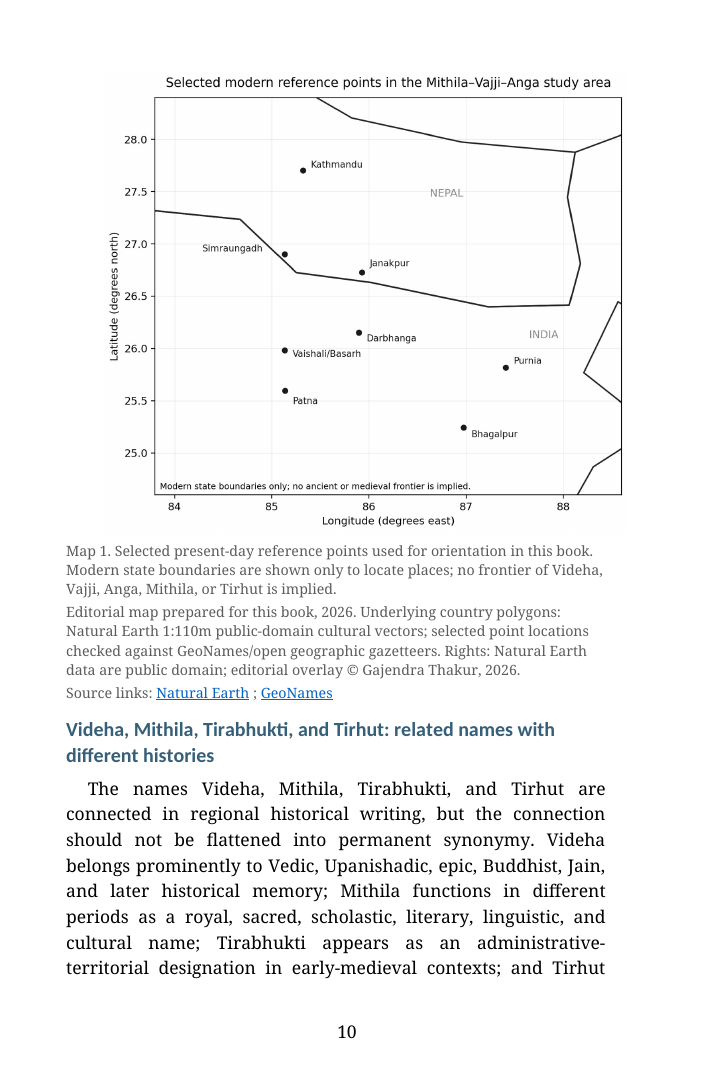
Chapter-specific source notes
- Primary chapter witness. Gajendra Thakur, Decoding the Panji of Mithila — Volume II, formal Chapter 31, PDF pp. 349-362; formal Chapter 31. The HTML transcription is generated from the commit-pinned source PDF and retains the chapter boundary recorded in this edition.
- Internal structure. The repository source-heading inventory records no separately encoded subordinate heading for this chapter.
- Digital editorial method. The page keeps the preserved source text distinct from generated navigational, concordance, visual, and provenance apparatus. The synthetic reconstruction is explanatory only and is not evidence for an individual lineage or a determination of social or marital status.