Decoding the Panji of Mithila · Volume III · Chapter 1
The Panji as Memory, Map, and Social Record
Chapter 1
  The Panji as Memory, Map, and Social Record
The Panji of Mithila is not merely a list of names. It is memory
arranged as lineage. It is geography preserved through
marriage. It is social history compressed into formulas. It is a
record of fathers, sons, daughters, villages, scholars, titles,
movements, alliances, and remembered houses. A person
unfamiliar with the Panji may first see only a dense chain of
names and numbers. But behind that compact surface lies a
long civilizational habit: the habit of remembering who came
from where, who was connected with whom, which village
became linked to which family, and how knowledge, ritual
status, marriage, and migration were transmitted across
generations.

   This book, Decoding the Panji of Mithila, is written for that
reason. The Uptip Panji material is too important to remain
locked inside abbreviated entries. It must be opened carefully.
Every term has to be explained. Every repeated sign has to be
understood. Every village name has to be read not as a bare
place but as a genealogical marker. Every number has to be
treated as a clue. Every gap must be respected as a gap, not
filled by imagination. Every variant spelling has to be noticed.
Every “suta,” “sutau,” “suto,” “apara,” “dauhitra,”
“gramarambha,” and “U.T.” must be made intelligible to the
modern reader.

   The Panji tradition belongs to the learned documentary
culture of Mithila. In ordinary modern language, it may be
called a genealogical register, but that phrase is not enough. A
genealogy usually shows descent from ancestor to descendant.
The Panji does more. It records descent, but it also records
marriage connections, village movements, scholarly titles,

                  Decoding the Panji of Mithila, Volume III | Page 7
                    Decoding the Panji of Mithila Volume III

branch identities, ritual eligibility, and social memory. It is a
register of continuity. It shows that a person is not only the
son of a father but also a member of a locality, a participant in
a marriage network, and a bearer of inherited identity.

   The Uptip material used here is especially dense. It belongs
to a section titled “Uptip,” and it appears as a numbered
sequence of entries. Each entry often begins with a heading
that names a village, a branch, or a locality cluster. After the
heading, the record moves quickly from one person to
another. It may begin with one ancestor, name his sons, then
show where those sons or daughters were linked by marriage,
then point to another village, then cite a cross-reference
number, then introduce a new branch, and then return to a
related family. The movement is not always linear. The Panji
is not written like a modern family tree on a single page. It is
written like a network.

   That network is the central subject of this book.

   To decode the Panji, one must first understand its language
of compression. A single line may contain the work of several
paragraphs. A phrase such as “फलाँ सुतो अमुक” may indicate a
line of descent. A phrase such as “फलाँ सुता अमुक” may show a
daughter-link, often carrying the record toward another
family or village. A village followed by “सँ” is not an incidental
address; it is a genealogical bridge. The names before and
after the village must be read together. When the entry says
that one person or branch is connected with Darbhanga,
Soderpur, Pali, Karamha, Naruan, Harianb, Khandbala, or
another village, the place-name helps identify the path of the
lineage or alliance.

   The reader must also be prepared for multiple layers of
time. Some names belong to older remembered lineages. Some
                 Decoding the Panji of Mithila, Volume III | Page 8
                     Decoding the Panji of Mithila Volume III

entries preserve medieval or early modern patterns. Some
additions clearly belong to recent centuries or even to very
modern times. A Panji is not one moment frozen in ink. It is a
cumulative record. It grows. It absorbs additions. It preserves
older formulae while receiving new names. It may contain
Sanskritized phrases beside colloquial Maithili forms. It may
preserve the prestige title of a scholar, the local identity of a
village, and the remembered name of a family elder in one
continuous breath.

   The title of the larger source, “Genome Mapping (450 A.D.
to 2009 A.D.) – Mithila’s Panji Prabandh,” indicates the
ambition of the work: to map continuity over a very long span
of historical memory. The phrase “genome mapping” should
not be read narrowly in a biological sense. In this context, it
suggests the mapping of inherited identity: social,
genealogical, intellectual, and regional. Mithila’s Panji
tradition is, in that sense, a civilizational genome. It records
not chromosomes but remembered connections. It tracks not
DNA but descent, marriage, settlement, learning, and
legitimacy.

   This does not mean that every statement in the Panji
should be treated in the same way as a modern archival
certificate. A responsible reader must distinguish between
source, interpretation, and historical conclusion. The Panji
preserves tradition. It gives evidence of how families
remembered themselves, how marriage connections were
recorded, how learned status was attached to names, and how
villages formed networks. But it also contains abbreviations,
scribal variations, missing names, uncertain readings,
repeated references, and entries that require comparison with
other records. Therefore, this book will not exaggerate
certainty. It will decode what is present, mark what is

                  Decoding the Panji of Mithila, Volume III | Page 9
                     Decoding the Panji of Mithila Volume III

uncertain, and leave unexplained nothing that can be
responsibly explained.

   One of the most important words in this volume is “Uptip,”
written in the source as “उपटीप” or abbreviated as “उ.टी.” The
term points to a subsidiary or supplementary record
connected with the main Panji tradition. An Uptip entry often
functions like a cross-linked note. It does not stand alone in
isolation. It may refer backward, forward, sideways, or into
another branch. A number written after a name or village
may guide the reader toward another register, branch, or
entry. Thus, the Uptip is not a minor appendix. It is a key to
the interconnectedness of the whole system.

   The entries are often introduced by expressions such as
“अथ … ग्रामारम्भ,” meaning that the record of a particular village
or branch begins here. This formula is important. It tells the
reader that a new locality-centered record has begun. But
even after such a beginning, the entry may soon move into
other villages. That is not disorder. That is the nature of Panji
logic. The village of origin, the village of marriage, the village
of settlement, and the village of reference may all appear in
quick succession.

   For example, a heading may identify a Sarisab-related
branch, but the entry may mention Pahitola, Soderpur,
Karamha, Naruan, Mandar, Khandbala, or other places. A
modern reader may ask: Why does one entry contain so many
places? The answer is that the Panji records relation, not
residence alone. A place-name may show origin. It may show
the family into which a daughter married. It may show a
branch settlement. It may identify a known house. It may
distinguish one person with a common name from another
person with the same or similar name. In a region where

                 Decoding the Panji of Mithila, Volume III | Page 10
                     Decoding the Panji of Mithila Volume III

names repeat across generations, place is one of the chief
instruments of identification.

   The Panji must therefore be read as a map. It is a map, but
not in the ordinary cartographic sense. It does not draw
rivers, roads, and boundaries. It draws lines of relation.
Mithila appears through its villages: Sarisab, Pahitola, Ujan,
Durgaganj, Rajgram, Badhiyam, Soderpur, Pali, Mahishi,
Gangoli, Ratauli, Rajoura, Sihauli, Bhattpura, Behat, Ruchouli,
Tripurauli, Loam, Chanaur, Darbhanga, Khandbala, Bhaur,
Shubhankarpur, Garhbanaili, and many others. These places
are not decorative. They are the framework through which
memory is organized.

   The Panji must also be read as a social document. It records
not only birth but rank, learning, and recognition. Terms such
as Pandit, Vaidik, Vaiyakarana, Mimansaka,
Mahamahopadhyaya, Babu, Thakur, Raja, and Maharaja
appear in such records because lineage memory in Mithila
was linked with learning and public standing. A family did not
merely remember who begot whom. It remembered who
studied, who taught, who held status, who married where, and
which house became known by which title.

   This is especially important for Mithila. The region’s
intellectual tradition produced grammarians, ritualists,
logicians, poets, commentators, Sanskrit scholars, Maithili
writers, and learned householders. The Panji does not always
pause to narrate their achievements, but it preserves their
names and titles. A brief phrase like “महा वैयाकरण” or “भाषाशास्त्री”
may carry enormous cultural weight. In a modern prose
history, such a figure might deserve a full paragraph or even a
full chapter. In the Panji, the title appears compressed into a

                 Decoding the Panji of Mithila, Volume III | Page 11
                     Decoding the Panji of Mithila Volume III

genealogical line. Decoding requires restoring the significance
of such compressed references.

   The Panji is also a marriage record. In Mithila, marriage
has historically depended on careful knowledge of lineage,
village, gotra, and prohibited relationship. The Panji helped
preserve that knowledge. This is why daughter-links are so
important. Many modern readers expect genealogy to be
mainly patrilineal, moving from fathers to sons. The Panji
does preserve male descent, but it also gives crucial
information through daughters. A daughter’s marriage can
connect two houses, two villages, or two branches. The word
“सुता” must therefore never be passed over casually. It may be
the hinge of the entry.

   The term “अपरा” is another important sign. It often
introduces another branch, another wife, another connection,
or an alternative line related to the preceding material. It tells
the reader not to stop too early. The record may be giving a
second path, a collateral line, or a different marriage
connection. Similarly, repeated names must be read with
caution. A name such as Raghunath, Gopal, Durganand,
Lakshminath, Shivanand, or Govind may appear many times.
The Panji distinguishes such persons through father-name,
village, title, and cross-reference. Without those clues, one
may easily confuse two different individuals.

   The numbers in the records are also part of the decoding
task. They may appear in forms such as २८६/०१, २०२/०५, १०३/१०, or
with double slashes and variant forms. These numbers should
not be treated casually as page numbers only, nor should they
be forced into a single meaning without checking context. In
many cases they function as register references, entry
references, branch references, or cross-links within the Panji

                 Decoding the Panji of Mithila, Volume III | Page 12
                     Decoding the Panji of Mithila Volume III

system. This book will treat them as navigational devices.
Where their exact function is clear, it will be explained.
Where uncertain, the uncertainty will be marked.

   Another feature of the source is the use of dots or blank
spaces: “. . .”. These are not to be treated as empty decoration.
They may represent missing names, illegible portions, unfilled
data, or deliberately omitted parts. A responsible editor must
not invent content to fill them. This book will keep them
visible. When a gap affects interpretation, it will be discussed.
When a name is missing but the structure remains clear, the
structure will be explained without supplying a false name.
The dignity of the source requires honesty about its silences.

   Spelling variation is also expected. A village or name may
appear in more than one form. This may result from scribal
habit, oral pronunciation, manuscript transmission, typing,
scanning, or regional variation. For example, the same locality
may appear with slight orthographic changes. A name may
appear with a Sanskritized ending in one place and a
colloquial form in another. This book will preserve the source
reading when discussing a passage, but it will also provide
standardized index forms so that readers can follow the same
person or place across entries.

   The Panji’s language itself is a mixture of Sanskritic,
Maithili, and documentary forms. It is not ordinary
conversational prose. It is a technical register. The word order
is shaped by formula. Plurals may appear in compact forms. A
group of sons may be named together and followed by a single
village-link. A title may intervene between father and son. A
daughter-link may interrupt a male descent chain. The reader
must learn this grammar. Without it, the Panji seems chaotic.
With it, the same text becomes intelligible.

                 Decoding the Panji of Mithila, Volume III | Page 13
                     Decoding the Panji of Mithila Volume III

   This book will therefore proceed in two movements. First,
it will explain the system: the terms, abbreviations, formulae,
numbers, place logic, and editorial principles. Then it will
decode the entries cluster by cluster. The early chapters will
prepare the reader to read the source. The later chapters will
move through the numbered Uptip entries, grouping them by
village and branch clusters. Each decoding chapter will
identify the covered entry numbers, principal villages, key
persons, cross-references, uncertain readings, and social-
historical observations.

   The aim is not to simplify the Panji by flattening it. The aim
is to make its complexity visible. A simplified genealogy may
show one straight line. The Panji rarely works in one straight
line. It works like a woven cloth. Each thread is a family line.
Each knot is a marriage. Each color is a village. Each repeated
pattern is a social rule. Each title marks remembered status.
Each number points to another part of the weave. To decode
it, one must respect the weave.

   For the modern reader, this is not only a matter of
ancestry. It is also a matter of cultural history. The Panji
shows how Mithila remembered itself. It reveals the
importance of village identity, the authority of learned
families, the regulation of marriage, the spread of branches
into new regions, and the role of record-keeping in sustaining
community structure. It also shows the tension between
continuity and change. Old titles survive beside modern
names. Ancient-looking formulae carry recent additions. A
traditional register becomes a bridge between manuscript
culture and modern documentation.

   This bridge is especially valuable today. Many families
remember fragments of their ancestry but not the full
structure. Many names survive in oral memory but are
                 Decoding the Panji of Mithila, Volume III | Page 14
                     Decoding the Panji of Mithila Volume III

detached from place or branch. Many village connections
have weakened because of migration, urban life, or diaspora.
The Panji can help restore context. But it must be read
carefully. A family cannot responsibly claim a connection
merely because a familiar name appears somewhere in the
record. The full formula must be followed: name, father,
branch, village, cross-reference, and associated marriage line.
Only then can a connection be proposed.

   This book will therefore be useful to different kinds of
readers. A family researcher may use it to understand how to
trace a line. A scholar may use it to study Mithila’s social
history. A historian of literature may use it to identify learned
figures and intellectual households. A student may use it to
understand how traditional records are structured. A general
reader may use it to appreciate the depth of Mithila’s
documentary culture. The book will not assume that the
reader already knows Panji terminology. Every technical
expression will be introduced and explained.

   The method of this book rests on five principles.

   First, preserve the source. Names, terms, and entries will
not be modernized beyond recognition. The original
Devanagari form will remain central.

   Second, explain the structure. The book will not merely
translate words. It will explain how the entry works.

   Third, distinguish certainty from interpretation. Where the
source is clear, the explanation will be firm. Where the source
is doubtful, the doubt will be stated.

   Fourth, respect gaps. Missing or illegible data will not be
invented.

                 Decoding the Panji of Mithila, Volume III | Page 15
                     Decoding the Panji of Mithila Volume III

   Fifth, build usable tools. The book will include glossaries,
indexes, abbreviation keys, place lists, and guidance for
reconstructing family lines.

   The Panji deserves this treatment because it is one of
Mithila’s great memory systems. It is not a casual document. It
is a disciplined cultural instrument developed to preserve
social order, marriage rules, ancestry, and status across time.
Its difficulty is part of its nature. It was written for people
trained in its conventions. But today, if the Panji is to remain
alive, it must be explained for readers who did not inherit that
training.

   The title Decoding the Panji of Mithila therefore describes
both the need and the method. To decode is not to replace the
original. It is to open it. It is to show why a small abbreviation
matters, why a village name cannot be skipped, why a
daughter-link may change the direction of the record, why a
number may be a key, and why a missing name must remain
visibly missing. Decoding is an act of respect.

   The Uptip Panji is a record of people, but it is also a record
of relationships. It tells us that Mithila was remembered
through connection: father to son, daughter to husband’s
house, scholar to title, village to village, branch to branch, and
past to present. In that sense, the Panji is memory, map, and
social record at once.

   The following chapters will begin by explaining the
technical system in detail. Only after the reader has learned
the grammar of the Panji will the book move into the entry-
by-entry decoding. That order is necessary. Without the key,
the record is dense. With the key, it begins to speak.

                 Decoding the Panji of Mithila, Volume III | Page 16
                     Decoding the Panji of Mithila Volume III
Source structure and verification apparatus
Editorial source apparatus. This apparatus is descriptive, not interpretive. It records the source-controlled structure used to verify that this page corresponds to formal Chapter 1 of Decoding the Panji of Mithila — Volume III. The chapter text above is preserved from PDF pp. 8-18; formal Chapter 1 in the commit-pinned authoritative source. It is not merged with a neighboring chapter, appendix, annexure, or independent front/back-matter unit. The internal headings below come from the repository’s source-heading inventory and are retained as navigational and audit evidence; showing them here does not turn those headings into separate publications or add claims that are absent from the source.
Internal source headings
No subordinate heading was separately encoded in the repository source-heading inventory for this chapter.
Source-text concordance
Memory · Social · Record · merely · list · names · arranged · lineage · geography · preserved · marriage · history · compressed · formulas · fathers · sons · daughters · villages · scholars · titles · movements · alliances · remembered · houses · person · unfamiliar · first · dense · chain · numbers · behind · compact · surface · lies · long · civilizational · habit · remembering · came · connected · village · became · linked · family · knowledge · ritual · status · migration · transmitted · across · generations · book · Decoding · written · reason · Uptip · material · important · remain · locked · inside · abbreviated · entries · must · opened · carefully · Every · term · explained · repeated · sign · understood · name · read · bare · place · genealogical · marker · number · treated
Boundary verification. In the formal sequence this chapter follows the beginning of this volume’s formal chapter sequence and precedes Volume III Chapter 2, “What Is Uptip?”. The chapter extractor begins at the verified formal Chapter 1 marker and stops at the next verified formal chapter marker; for a final chapter it stops before recognized book-level back matter. The concordance above is generated only from distinct terms already present in this chapter’s preserved source text. It is provided for discovery, comparison, and audit, not as an automated judgment about persons, lineages, status, kinship, marriage eligibility, or historical truth.
Illustrated research apparatus
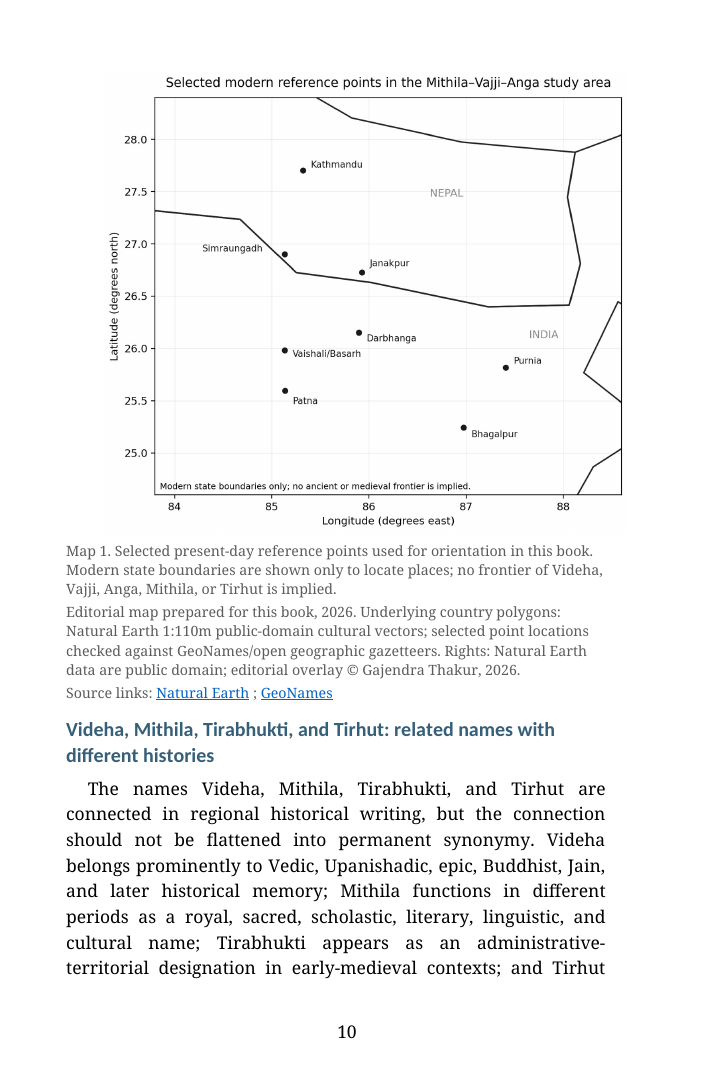
Mithila · Vajji · Anga
Chapter-specific source notes
- Primary chapter witness. Gajendra Thakur, Decoding the Panji of Mithila — Volume III, formal Chapter 1, PDF pp. 8-18; formal Chapter 1. The HTML transcription is generated from the commit-pinned source PDF and retains the chapter boundary recorded in this edition.
- Internal structure. The repository source-heading inventory records no separately encoded subordinate heading for this chapter.
- Digital editorial method. The page keeps the preserved source text distinct from generated navigational, concordance, visual, and provenance apparatus. The synthetic reconstruction is explanatory only and is not evidence for an individual lineage or a determination of social or marital status.