Decoding the Panji of Mithila · Volume III · Chapter 2
What Is Uptip?
Chapter 2
  What Is Uptip?
The word “Uptip,” written in the source as उपटीप and often
abbreviated as उ.टी., is one of the keys to the whole Panji
system used in this volume. A reader who misses the meaning
of this term will miss the internal architecture of the record.
The Uptip is not merely a note. It is not a casual marginal
remark. It is not a detachable appendix that can be read after
the main genealogy. In the material before us, Uptip is a
working device of genealogical connection. It carries the
reader from one family line to another, from one village
cluster to another, and from one numbered register point to
another.

   At the simplest level, the term may be understood as a
supplementary genealogical note. But even that definition is
incomplete. The Uptip is supplementary only in relation to a
larger Panji structure. Within its own system, it is central. It
records branches, clarifies links, preserves marriage-paths,
and points toward other entries. It helps the reader see how a
name belongs not only to a father but also to a village, a
branch, a marriage network, and a remembered social
location.

   In the source used here, the section itself is marked as खण्ड
२, उपटीप. This means that the reader is not entering an ordinary
prose chapter. The reader is entering a numbered body of
subsidiary genealogical entries. The first entries immediately
show the pattern: a heading names a locality or branch, then a
dense string of father-son, daughter-link, village-link, and
reference-number data follows. The entry may contain many

                 Decoding the Panji of Mithila, Volume III | Page 17
                     Decoding the Panji of Mithila Volume III

generations in very few words. The heading is therefore only
the doorway. The actual Uptip is the web that unfolds after it.

   The abbreviation उ.टी. appears in several forms: उ.टी., उo टीo,
उ० टी०, and similar typographical variants. These variants
should not be treated as different terms. They are scribal or
typographical forms of the same reference idea. In a modern
edited book, one may standardize the explanation as “U.T.” or
“Uptip,” but the original forms should be preserved where
source transcription is being discussed. The reader must learn
to recognize all these variants as signals that the text is
referring to the Uptip register or to a related Uptip entry.

   The most important function of Uptip is connection. A main
lineage may show descent in one place, but an Uptip may
preserve a side branch, a daughter’s marriage, a later
settlement, or a cross-reference that would otherwise be lost.
The Uptip works like a bridge between entries. Sometimes it
connects a person with a father. Sometimes it connects a
daughter with a marriage family. Sometimes it connects a
village with another village. Sometimes it connects the present
entry with another numbered location in the same or related
register. This is why the reader will repeatedly encounter
numbers after names and places.

   A modern reader may ask: why not write this clearly as a
family tree? The answer is that the Panji was not designed as a
modern chart. It was designed as a compact professional
record. It had to preserve large quantities of information in a
form that trained readers could understand quickly. In that
system, an Uptip number, a village name, and a kinship
formula could carry the meaning of several sentences. The
density is not accidental. It is part of the documentary
economy of the Panji.

                 Decoding the Panji of Mithila, Volume III | Page 18
                       Decoding the Panji of Mithila Volume III

   The structure of an Uptip entry usually contains several
elements. First comes the heading. The heading may include
the word उपटीप, the abbreviation उ.टी., a branch-name, and one
or more place-names. Examples of such headings include
forms like उप-टीप सकु री सरिसव-पाहीटोल or उ.टी. खांगुड़ सरिसब-पाहीटोल. The
heading gives the reader an initial field of reference. It tells us
that the entry is concerned with a particular locality or
connected locality cluster. But it does not mean that the entry
will remain confined to that place.

   Second comes the opening formula. In many entries, a
phrase such as अथ … ग्रामारम्भ appears. The word अथ indicates a
formal beginning: “now,” “here begins,” or “from here.” The
word ग्रामारम्भ means the beginning of the village record. It tells
the reader that the Panji is opening the account of a village-
related branch. But because Panji memory is relational, the
record soon moves beyond the named village. Marriage,
descent, and branch movement require that other places be
named.

   Third comes the genealogical chain. This is the heart of the
entry. The words सुत, सुतो, सुतौ, and सुता appear again and again.
They mark descent and connection. सुत means son. सुतो or सुतौ
may introduce one son or a group of sons in a compressed
form. सुता may indicate daughter or daughter-linked issue,
depending on context. These forms must be read carefully
because the direction of the record may shift at exactly this
point. If the reader mistakes a daughter-link for a son-link, the
genealogy will be wrongly reconstructed.

   Fourth comes the place-link, usually through the word सँ. In
ordinary Maithili, सँ means “from,” “with,” or “by,” depending
on context. In the Panji, it often functions as a relational
                   Decoding the Panji of Mithila, Volume III | Page 19
                     Decoding the Panji of Mithila Volume III

marker. It may indicate that a person or marriage connection
belongs to, comes from, or is associated with a particular
village or house. It should not be translated mechanically
every time. Its meaning must be inferred from the
genealogical formula around it.

   Fifth comes the reference number. Numbers such as २८६/०१,
२०२/०५, १०३/१०, २७९/०२, or similar forms appear throughout the
material. These numbers are navigational clues. They may
point to another entry, register, branch, or section. Sometimes
they appear after a person’s name; sometimes after a village-
link; sometimes after an Uptip marker. The reader must not
ignore them. At the same time, the reader must not force a
single interpretation on every number without context. The
safest method is to treat them first as cross-reference markers
and then interpret their exact function through repeated
comparison.

   Sixth comes the confirming or closing expression, often
represented by forms such as दौ and द्दौ. These are among the
most difficult signs for an untrained reader because they do
not behave like ordinary modern prose words. In the Panji
context, they function as documentary markers within the
record. They may mark the completion of a link, confirmation
of a relation, or closure of a genealogical unit. Their precise
use may vary by scribal habit and register convention, but
they are never meaningless. This book will keep them visible
in transcription and explain their function when decoding a
passage.

   The Uptip is especially important because it preserves
collateral relationships. A direct genealogy may move from
father to son. But a real family network contains brothers,
daughters, daughters’ marriage lines, alternative branches,

                 Decoding the Panji of Mithila, Volume III | Page 20
                       Decoding the Panji of Mithila Volume III

later settlements, and repeated names. The word अपरा often
introduces such an additional line. It may mean “another,”
“further,” “other branch,” or “alternative connection,”
depending on the context. In Uptip entries, अपरा is a warning to
the reader: the record has not finished with the first line. A
second connected line is being introduced.

   Another important term is दौहित्र, meaning daughter’s son or
maternal grandson. Its presence shows why the Panji cannot
be reduced to a purely male descent chart. Maternal
connections matter. Daughter-lines matter. Marriage-lines
matter. A person may enter the record because he is linked
through a daughter, through a maternal line, or through
marriage into a remembered house. Therefore, every
occurrence of दौहित्र must be treated as a genealogical signal of
high importance.

   The Uptip also preserves social memory through titles. A
person may be identified as पंडित, वैदिक, वैयाकरण, मीमांसक, भाषाशास्त्री,
बाबू, ठाकु र, राजा, or by another title. These titles are not
ornamental. They help identify the person and his
remembered status. In some cases, a title may distinguish one
individual from another with the same name. In other cases, it
preserves the intellectual or social reputation of a branch. The
Uptip thus records not only biological descent but cultural
distinction.

   One must also notice that Uptip headings often contain
more than one place. A heading may join Sarisab with
Pahitola, or Ujan with Durgaganj, or Ratauli with Gangoli and
Najira, or later entries may gather several named localities
into one heading. This does not mean the heading is confused.
It means the branch itself is spread through more than one

                   Decoding the Panji of Mithila, Volume III | Page 21
                     Decoding the Panji of Mithila Volume III

relational site. The Panji is recording a cluster, not a single
isolated village. When a heading contains two or three place-
names, the reader should expect a networked entry.

   The distinction between a village of origin and a village of
connection is often subtle. Suppose an entry begins with a
Sarisab-related heading but later names Karamha, Soderpur,
Naruan, Mandar, Pali, or Khandbala. The initial heading may
identify the branch being discussed, while the later place-
names may identify marriage partners, descendants’
settlements, or cross-linked houses. In a modern index, all
these places should be recorded, but not all should be treated
as the same type of place. Some are origins. Some are
destinations. Some are marriage houses. Some are reference
points. The decoding must separate these roles.

   Uptip entries also show how Panji records accumulate over
time. A traditional formula may sit beside a modern title such
as Dr., Professor, Engineer, or M.A. This mixture should not
surprise us. A living register receives additions. It may
preserve old Sanskritic formulae while also accepting modern
educational or professional identifiers. The presence of
modern titles does not weaken the record; rather, it shows
that the Panji continued to function as a living memory
system into recent times.

   The reader must be careful with repeated names. The Uptip
may contain several persons named Gopal, Lakshminath,
Raghunath, Shivanath, Durganand, or Govind. Without the
Uptip’s father-name, village-link, title, or reference number,
confusion is inevitable. This is why the Panji gives multiple
identifiers. A name alone is rarely enough. A safe
identification requires the whole formula: name, father,
branch, village, title if present, and cross-reference.

                 Decoding the Panji of Mithila, Volume III | Page 22
                     Decoding the Panji of Mithila Volume III

   The same caution applies to variant spellings. A name or
village may appear in slightly different forms because of
regional pronunciation, scribal variation, typographical error,
or later copying. The Uptip must be read generously but not
carelessly. A variant spelling may still refer to the same place
or person, but the editor must demonstrate why. This book
will use standardized index forms for reader convenience,
while preserving source forms in the decoding discussion.

   The blank marks, usually shown as “. . .”, are part of the
Uptip’s documentary condition. They may represent missing
names, uncertain data, illegible portions, or unfilled entries.
They should never be silently removed. They should also
never be filled by guesswork. If the structure of the line
remains clear despite the blank, the explanation may proceed.
If the blank prevents certainty, the uncertainty must be stated.
The honest preservation of gaps is one of the duties of this
book.

   In practical terms, the reader should approach every Uptip
entry through a fixed method. First, identify the entry
number. Second, read the heading and list all place-names in
it. Third, identify the opening ancestor or first named person.
Fourth, mark each occurrence of सुत, सुतो, सुतौ, and सुता. Fifth,
separate son-lines from daughter-lines. Sixth, record every
village named after सँ. Seventh, note every cross-reference
number. Eighth, mark every अपरा as a possible additional
branch. Ninth, preserve every uncertain or missing portion.
Tenth, only after all this, summarize the entry in prose.

   This method prevents the two main errors that occur in
reading Panji material. The first error is over-simplification:
turning a network into a single line. The second error is over-
interpretation: inventing certainty where the source gives

                 Decoding the Panji of Mithila, Volume III | Page 23
                    Decoding the Panji of Mithila Volume III

only a hint. The correct approach lies between these extremes.
The Uptip must be unfolded, but not forced. It must be
explained, but not rewritten into something it is not.

   The Uptip is also a reminder that genealogy in Mithila is
not merely private family memory. It is social memory. It
exists because marriage rules required knowledge. It exists
because learned status mattered. It exists because villages
were not isolated units but parts of a larger kinship
geography. It exists because names had to be distinguished
and relationships had to be preserved across generations. In
this sense, the Uptip is a public instrument of social order,
even when it records private family lines.

   The reader may imagine the Uptip as a set of small bridges
built across a vast river system. The main Panji is one bank; a
village branch is another; a marriage house is another; a
daughter’s line is another; a later settlement is another. The
Uptip bridge allows movement between them. Without it,
many connections would remain separated. With it, the
genealogical landscape becomes traversable.

   For this reason, this book will treat Uptip entries not as
footnotes but as active records. Each entry will be decoded
according to its own structure. When an entry begins with a
place-cluster, that cluster will be mapped. When an entry uses
a cross-reference number, that number will be noted. When
an entry introduces a daughter-link, the shift will be
explained. When a title appears, its significance will be
discussed. When a gap appears, it will remain visible. When a
variant spelling appears, it will be indexed and compared.

   To understand Uptip is to understand the working
intelligence of the Panji. It is a system of compression, but not
confusion. It is a system of memory, but not mere nostalgia. It

                Decoding the Panji of Mithila, Volume III | Page 24
                     Decoding the Panji of Mithila Volume III

is a system of social documentation, but not modern
bureaucracy. It belongs to a world in which lineage, learning,
village, marriage, and status were recorded together. The
Uptip is the thread that helps the reader move through that
world.

   The next chapter will therefore turn from the meaning of
Uptip to the grammar of the entries themselves. Once the
reader knows what Uptip is, the next task is to learn how to
read a Panji entry line by line.

                 Decoding the Panji of Mithila, Volume III | Page 25
                      Decoding the Panji of Mithila Volume III
Source structure and verification apparatus
Editorial source apparatus. This apparatus is descriptive, not interpretive. It records the source-controlled structure used to verify that this page corresponds to formal Chapter 2 of Decoding the Panji of Mithila — Volume III. The chapter text above is preserved from PDF pp. 18-27; formal Chapter 2 in the commit-pinned authoritative source. It is not merged with a neighboring chapter, appendix, annexure, or independent front/back-matter unit. The internal headings below come from the repository’s source-heading inventory and are retained as navigational and audit evidence; showing them here does not turn those headings into separate publications or add claims that are absent from the source.
Internal source headings
No subordinate heading was separately encoded in the repository source-heading inventory for this chapter.
Source-text concordance
Uptip · word · written · often · abbreviated · keys · whole · system · used · reader · misses · meaning · term · miss · internal · architecture · record · merely · note · casual · marginal · remark · detachable · appendix · read · main · genealogy · material · working · device · genealogical · connection · carries · family · line · another · village · cluster · numbered · register · point · simplest · level · understood · supplementary · even · definition · incomplete · relation · larger · structure · Within · central · records · branches · clarifies · links · preserves · marriage-paths · points · toward · entries · helps · name · belongs · father · branch · marriage · network · remembered · social · location · section · marked · means · entering · ordinary · prose · body · subsidiary
Boundary verification. In the formal sequence this chapter follows Volume III Chapter 1, “The Panji as Memory, Map, and Social Record” and precedes Volume III Chapter 3, “How to Read a Panji Entry”. The chapter extractor begins at the verified formal Chapter 2 marker and stops at the next verified formal chapter marker; for a final chapter it stops before recognized book-level back matter. The concordance above is generated only from distinct terms already present in this chapter’s preserved source text. It is provided for discovery, comparison, and audit, not as an automated judgment about persons, lineages, status, kinship, marriage eligibility, or historical truth.
Illustrated research apparatus
Mithila · Vajji · Anga
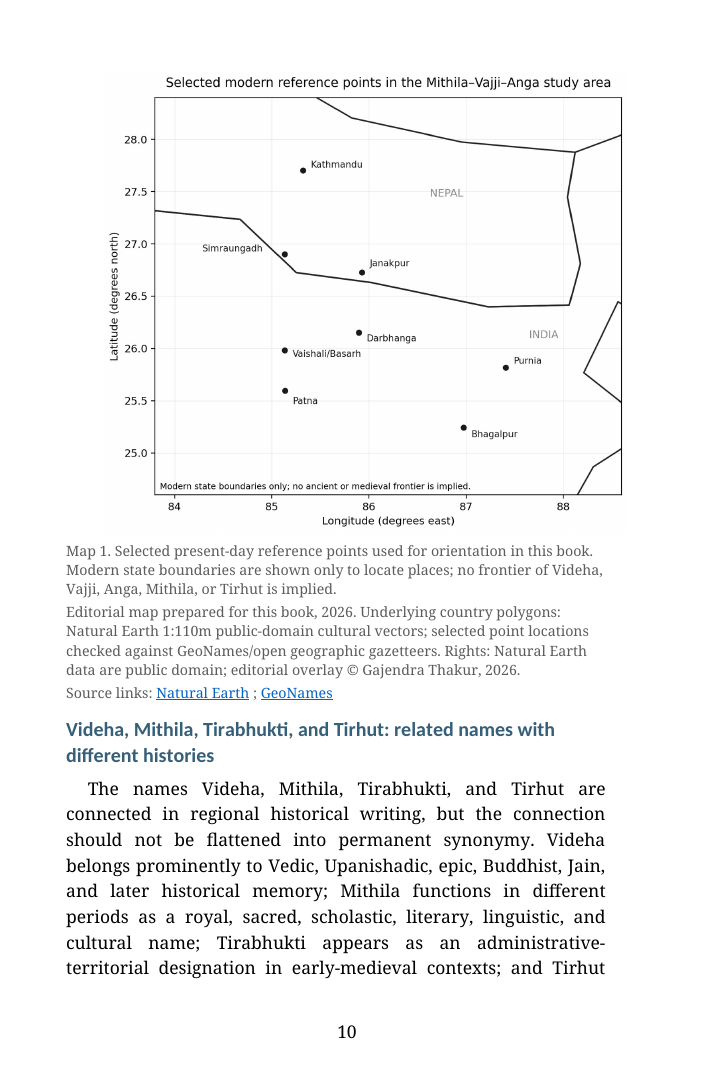
Chapter-specific source notes
- Primary chapter witness. Gajendra Thakur, Decoding the Panji of Mithila — Volume III, formal Chapter 2, PDF pp. 18-27; formal Chapter 2. The HTML transcription is generated from the commit-pinned source PDF and retains the chapter boundary recorded in this edition.
- Internal structure. The repository source-heading inventory records no separately encoded subordinate heading for this chapter.
- Digital editorial method. The page keeps the preserved source text distinct from generated navigational, concordance, visual, and provenance apparatus. The synthetic reconstruction is explanatory only and is not evidence for an individual lineage or a determination of social or marital status.