Decoding the Panji of Mithila · Volume III · Chapter 5
The Time Frame: 450 A.D. to 2009 A.D.
Chapter 5 - The Time Frame: 450 A.D. to 2009 A.D.

   by Gajendra Thakur

  Chapter 5
  The Time Frame: 450 A.D. to 2009 A.D.
The title of the source used for this volume gives a long span:
450 A.D. to 2009 A.D. That span must be read with care. It does
not mean that every line in the Uptip Panji can be converted
into a modern date, nor does it mean that each named person
belongs to a single fixed year. The time frame points instead to
the depth of the memory system. The Panji preserves old
lineage memory, later settlement memory, scholarly and
status memory, marriage memory, and modern additions in
one documentary body. To read it well, the reader must learn
to recognize time as a layered structure.

   The preceding chapters explained the words, signs,
headings, kinship forms, and village anchors through which
the Panji should be decoded. This chapter explains the time
logic behind those signs. A name is never only a name; it
stands at a point where descent, place, marriage, title, and
branch-continuity meet. The same rule applies to time. A Panji
entry may preserve an older ancestral line, then move
through a daughter-link into another village, then record a
later scholar, then attach a modern title or professional
identity. Such movement is not disorder. It is the way a living
register gathers generations.

                Decoding the Panji of Mithila, Volume III | Page 44
                     Decoding the Panji of Mithila Volume III

   The first discipline is to avoid treating the Panji as a year-
by-year chronicle. A chronicle usually moves in sequence: first
one year, then the next. The Panji moves by relationship. It
follows descent, village attachment, marriage, branch, title,
and reference. Because relation is its organizing principle,
older and later layers may stand close together in the same
entry. A reader who expects strict chronological prose will be
confused. A reader who understands genealogical time will
see why the source can move from an old remembered house
to a later settlement, from a classical title to a modern
professional marker, and from a village origin to a recent
branch connection without stopping to narrate centuries in
between.

  A civilizational time frame
   The span from 450 A.D. to 2009 A.D. should therefore be
understood as a civilizational time frame. It signals the
ambition to map continuity across a very long period of
Mithila's remembered social life. The Panji does not merely
preserve the beginning of a line. It preserves the way lines
remained intelligible across time. A branch could be
remembered because of its ancestor, because of its village,
because of a marriage connection, because of a scholar,
because of a title-bearing house, or because of a later
settlement. The source brings those memories into one
compressed record.

   This is why the time frame must be handled differently
from a modern historical table. Modern history often asks for
exact dates, documented events, political reigns, and
chronological sequence. The Panji gives a different kind of
evidence. It gives the evidence of remembered relationship. It
tells us that a family line was placed in a village field, that
certain sons or daughters connected the line to other houses,

                 Decoding the Panji of Mithila, Volume III | Page 45
                     Decoding the Panji of Mithila Volume III

that a title or learned identity was preserved, and that later
additions extended the branch into additional settlements.
These facts are historical, but they are historical in the mode
of genealogical memory.

   The long span also protects the reader from thinking that
only the most recent names matter. A modern family
researcher may begin with a known ancestor and then look
backward. The Panji often does the opposite. It begins from an
older branch field and then allows the record to expand
outward. A name in the middle of an entry may carry an old
descent memory; a later name may preserve a modern title; a
village-link may connect the two. If the reader removes the
older part because it lacks a modern date, or removes the later
part because it looks like an addition, the continuity of the
record is broken.

  Layered rather than linear time
   Panji time is layered rather than linear. In one layer, the
record remembers descent: father, son, sons, daughter-link,
maternal grandson, collateral branch. In another layer, it
remembers place: origin village, marriage village, settlement
village, reference village, estate seat. In another layer, it
remembers recognition: scholar, ritual authority, grammar
expert, title-holder, public figure, or status-bearing house. In
yet another layer, it remembers the mechanics of the register
itself: numbers, abbreviations, cross-references, gaps, and
repeated signs. These layers may appear in the same line.

   For this reason, the reader must not ask only, 'When did
this person live?' The better first question is, 'What layer of the
record is this name performing?' The name may be preserving
descent. It may be opening a marriage route. It may be
identifying a village branch. It may be distinguishing one
person from another person of the same name. It may be
                 Decoding the Panji of Mithila, Volume III | Page 46
                     Decoding the Panji of Mithila Volume III

carrying a title into a later section. It may be a cross-reference
point. Only after the function is understood can the reader
begin to ask how the name fits into the larger time frame.

   The same principle applies to places. A village may belong
to the older memory of the line, but it may also appear as a
later marriage field or a later settlement. When Sarisab,
Pahitola, Ujan, Mahishi, Pali, Soderpur, Karamha, Naruan,
Mandar, Khandbala, Gangoli, Ratauli, Rajoura, Sihauli,
Chanaur, Darbhanga, Purnea, Katihar, Araria, or Garhbanaili
appears in a record, the place is not merely an address. It is a
time-bearing marker. It tells the reader where memory has
attached itself at a particular stage of the branch.

  The early layer of the record
   The early layer of the Panji should be read as foundational
memory. It may not always provide the modern historian with
the kind of date that can be entered into a table. But it gives
the genealogical field from which later connections become
meaningful. An early ancestor, an early village heading, or an
early branch name is the anchor. Without that anchor, later
movement appears floating and accidental. With that anchor,
later settlements, marriages, and titles can be understood as
continuations.

   The phrase 'early expansion' should therefore be read
carefully. It does not mean only the first few names in an
entry. It means the opening field from which the branch
begins to unfold. The record may begin with a locality cluster,
then identify sons, then move through daughters, then send
the reader toward another village through the word सँ, then
add a number, then introduce a collateral line through अपरा.
The early expansion gives the reader the first map. The later
sections show how that map stretches.

                 Decoding the Panji of Mithila, Volume III | Page 47
                      Decoding the Panji of Mithila Volume III

   When the source opens a village record with a formula
such as अथ ... ग्रामारम्भ, the time logic begins at that point. The
formula announces a beginning, but not necessarily the
beginning of all memory. It means that the record is now
being opened from that village or branch point. The names
that follow may include older remembered persons and later
linked persons. The formula is therefore both spatial and
temporal. It tells us where to enter the memory and from
what point the unfolding should be followed.

  Subsequent settlement and branch movement
   After the early expansion, the line often moves into
additional settlements. This movement must be followed
patiently. A branch may first be anchored in one village, then
connected with another through marriage, then associated
with another through settlement, and then attached to a
fourth through a title or reference number. The reader must
not reduce this to a list of places. The sequence is the route.
Each new place asks a question: is this the place of origin, the
place of marriage, the place of settlement, the place of a
collateral branch, the place of a learned house, or the place of
a cross-reference?

   The method must remain the same at each step. Every
name should be read through descent, place, marriage, title,
and branch-continuity. Descent tells us who belongs to whom.
Place tells us where the identity is anchored. Marriage tells us
how one house enters relation with another. Title tells us how
a person or branch was remembered in learning, ritual,
estate, or public status. Branch-continuity tells us how the
record preserves connection across generations. If any one of
these five elements is removed, the line becomes thin and
unreliable.

                  Decoding the Panji of Mithila, Volume III | Page 48
                     Decoding the Panji of Mithila Volume III

   This is especially important when the source moves beyond
the early cluster into later settlements. The later name may
look distant from the opening ancestor, but the Panji may be
preserving a real connection through a daughter-link, a
collateral branch, or a cross-reference number. The reader
must therefore avoid impatient simplification. A compact line
that contains a father, a village, a daughter, another village, a
title, and a number may represent several generations of
remembered movement. It must be unfolded, not summarized
away.

  Marriage as a bridge across time
   Marriage is one of the principal ways in which the Panji
carries memory across time. A son-line preserves one kind of
continuity; a daughter-link preserves another. In many
modern genealogical habits, the daughter's line is treated as
secondary. In the Panji, that habit would be a serious mistake.
The daughter-link may explain why another village enters the
record. It may show how a branch became connected with
another house. It may preserve a maternal route that is
essential for identification. It may also explain why a later
name appears where a reader expected only male descent.

   The word सुता must therefore be read as a temporal signal
as well as a kinship signal. It may move the record from one
generation to another and from one village to another. It may
carry earlier memory into a new marital field. When the line
then continues through another name, another village, or
another title, the reader should ask whether the route has
passed through marriage. If so, the time of the entry has not
simply advanced from father to son. It has crossed into
another house and returned through remembered relation.

                 Decoding the Panji of Mithila, Volume III | Page 49
                          Decoding the Panji of Mithila Volume III

    The same is true of दौहित्र where it appears. A daughter's son
stands at the meeting point of two houses. He is a person in
his own line, but his presence in the record may be explained
through the maternal connection. This makes him a time
bridge. He carries forward memory that would vanish in a
purely male chart. The long time frame of the Panji is
therefore sustained not only by fathers and sons, but also by
daughters, maternal grandsons, and marriage houses.

  Titles, scholars, and the time of recognition
    Titles introduce another layer of time. A person may be
remembered not only because he descends from a line, but
because he held a learned, ritual, administrative, estate, or
public identity. Terms such as पंडित, वैदिक, वैयाकरण, मीमांसक,
महामहोपाध्याय, भाषाशास्त्री, बाबू, ठाकु र, राजा, महाराज, डा., प्रो., or similar
descriptors are not decorative. They are evidence of
recognition. They show how a person or branch was known at
a particular stage of memory.

    Scholarly branches are especially important in the time
frame of Mithila. A learned person may belong to an old
village line, but his reputation may be preserved in a later
register layer. Another member of the branch may be known
through a title attached to teaching, grammar, ritual learning,
commentary, or public office. When such titles appear, the
reader should not separate intellectual history from
genealogy. In the Panji, learning travels with family memory.
A title may be the clue that identifies which person among
repeated names is being recorded.

    The time of recognition is not always the same as the time
of descent. A descent line may be older, while the title
attached to one descendant may belong to a later period. The
record keeps both because both are necessary. If the reader

                      Decoding the Panji of Mithila, Volume III | Page 50
                     Decoding the Panji of Mithila Volume III

reads only descent, the social weight disappears. If the reader
reads only title, the genealogical foundation disappears. The
correct method is to hold the title within the branch. This is
how the Panji becomes a record not only of who came from
whom, but also of how knowledge and status were
transmitted.

  Numbers and cross-references as time devices
   Numbers in the Panji are not merely technical clutter. They
are also devices for moving across the record. A number may
point to another entry, a branch, a register location, or a
related source position. Because the record spans many
layers, these numbers help the reader move through time
without requiring continuous prose. A cross-reference can
carry the reader backward to an older point, sideways into a
collateral branch, or forward into a later connection.

   This is why numbers must be copied exactly. A form such
as २०२/०५, २८६/०१, १०३/१०, २७९/०२, or a double-slash form may not
be safely normalized. The exact mark is part of the register's
navigation. The reader should first preserve the number, then
ask what function it performs in the surrounding unit. Does it
follow a name? Does it follow a village? Does it appear with
उ.टी. or शा.? Does it close one unit or open another? These
questions are chronological as well as textual because the
number may connect separate layers of the record.

   A modern reader may be tempted to ignore a number
when writing prose. That would weaken the decoding. The
number may be the very evidence that a later settlement
belongs to an older branch, or that a marriage line should be
connected with another entry. In a record that spans centuries
of remembered continuity, cross-reference is the machinery

                 Decoding the Panji of Mithila, Volume III | Page 51
                     Decoding the Panji of Mithila Volume III

of time. It allows the register to remain compact while keeping
its branches connected.

  Modern additions and the end point of 2009
   The end point 2009 A.D. is also significant. It reminds the
reader that the Panji tradition did not remain locked in a
remote past. The register continued to receive later names,
modern titles, educational markers, professional identities,
and recent branches. Such additions should not be dismissed
as impurities. They show the continuing life of the
genealogical system. At the same time, they must be
distinguished from older layers. The reader should recognize
a modern marker as modern without cutting it away from the
older branch.

   Modern names and titles may appear beside older
formulae. This can create a striking effect: a traditional
kinship chain may suddenly contain a modern educational
marker, a professional title, or a public designation. The
source is not confused by this. It is doing what a living register
does. It is preserving continuity while absorbing new forms of
identification. The old formula gives the structure; the new
title gives the later recognition. Both belong to the record, but
they belong to different layers of time.

   This layered reading protects the editor from two errors.
The first error is antiquarianism: treating only the oldest layer
as authentic and the later layer as negligible. The second error
is presentism: treating only the most recent information as
useful and ignoring the older structure. The Panji requires a
third method. It asks the reader to preserve the whole chain,
to mark the layers, and to explain how old descent, later
settlement, marriage movement, scholarly status, and modern
identity remain connected.

                 Decoding the Panji of Mithila, Volume III | Page 52
                      Decoding the Panji of Mithila Volume III

  How to read a long-span entry
   The practical method for reading a long-span entry may be
stated in several steps. First, identify the heading and
principal village or cluster. This gives the entry point. Second,
identify the first named person or group. This gives the
opening genealogical unit. Third, mark every kinship word:
सुत, सुतो, सुतौ, सुता, दौहित्र, and related forms. These show the
direction of descent or connection. Fourth, mark every place-
name and attach it to the nearest kinship unit. Fifth, preserve
every title, because it may indicate the time and status of
recognition.

   Sixth, copy every number and abbreviation exactly.
Seventh, identify each occurrence of अपरा. Each अपरा may open
another line or route. Eighth, note where the record moves
from one settlement to another. Ninth, decide whether that
movement is direct descent, marriage, maternal connection,
collateral branch, learned relocation, estate association, or
uncertain. Tenth, write the prose decoding without pretending
that all layers belong to one simple moment. The final prose
should show the sequence of relation, not flatten it.

   This method is especially useful when the entry proceeds
after its early expansion into additional settlements. Instead of
asking why the record has become crowded, the reader
should ask what kind of route is being built. Does a daughter
carry the branch into another village? Does a title attach a
later scholar to an older line? Does a number point back to an
earlier source position? Does a ड्योढ़ी reference mark an estate-
linked layer? Does a repeated village show several branches
connected to the same place? These are the questions that
make the long time frame readable.

                  Decoding the Panji of Mithila, Volume III | Page 53
                     Decoding the Panji of Mithila Volume III

  Continuity without false certainty
   The time frame from 450 A.D. to 2009 A.D. gives the volume
its large horizon, but it must not lead to false certainty. The
Panji is a powerful source, but it is not a modern dated ledger
in every line. Some parts preserve exact reference forms.
Some parts preserve older tradition. Some parts contain gaps.
Some names are missing. Some places appear in variant
spellings. Some numbers require comparison. Some titles
clearly belong to later stages. A responsible editor must
distinguish these layers.

   To distinguish layers is not to weaken the Panji. It is to read
it honestly. The dignity of the record lies in its complexity. It
preserves the memory of a civilization through compressed
signs. It does not need to be forced into a false simplicity.
Where the source is clear, the decoding should be clear.
Where the source is uncertain, the uncertainty should be
stated. Where the time layer is older, it should be treated as
older memory. Where the layer is modern, it should be
treated as modern addition. Where the route is visible but the
exact date is not, the route should still be explained.

   This approach also helps prevent genealogical confusion.
In a long time frame, names repeat. A reader may encounter
several Gopals, Raghunaths, Lakshminaths, Shivanaths,
Durganands, Govinds, or Bhavanaths. The name alone is not
enough. Time must be read through father, place, marriage,
title, reference number, and branch-continuity. These
elements prevent one person from being mistaken for
another. They also allow the reader to follow a branch across
many generations without inventing links.

                 Decoding the Panji of Mithila, Volume III | Page 54
                     Decoding the Panji of Mithila Volume III

  Conclusion: time as remembered continuity
   The time frame of this volume is therefore not a decorative
subtitle. It is a guide to method. It tells the reader that the
Uptip Panji must be read as a long memory system. That
system begins from old lineage fields, opens through village
records, moves by descent and marriage, preserves scholarly
and social recognition, and continues into modern names and
titles. Its time is cumulative. Its order is relational. Its evidence
is compressed. Its continuity is maintained through branch
memory.

   The next chapters will move more directly into places,
lineages, and movement. Chapter 6 will treat villages as
genealogical anchors. Chapter 7 will follow migration and
marriage routes. Those chapters depend on the time logic
explained here. A village is not only a place. It is a time-
bearing anchor. A marriage is not only an alliance. It is a route
across generations. A title is not only praise. It is a mark of
recognition within a branch. A number is not only a mark. It is
a path through the register. A name is never alone. It must
always be read through descent, place, marriage, title, and
branch-continuity.

                 Decoding the Panji of Mithila, Volume III | Page 55
                     Decoding the Panji of Mithila Volume III
Source structure and verification apparatus
Editorial source apparatus. This apparatus is descriptive, not interpretive. It records the source-controlled structure used to verify that this page corresponds to formal Chapter 5 of Decoding the Panji of Mithila — Volume III. The chapter text above is preserved from PDF pp. 45-57; formal Chapter 5 in the commit-pinned authoritative source. It is not merged with a neighboring chapter, appendix, annexure, or independent front/back-matter unit. The internal headings below come from the repository’s source-heading inventory and are retained as navigational and audit evidence; showing them here does not turn those headings into separate publications or add claims that are absent from the source.
Internal source headings
- A civilizational time frame
- Layered rather than linear time
- The early layer of the record
- Subsequent settlement and branch movement
- Marriage as a bridge across time
- Titles, scholars, and the time of recognition
- Numbers and cross-references as time devices
- Modern additions and the end point of 2009
- How to read a long-span entry
- Continuity without false certainty
- Conclusion: time as remembered continuity
Source-text concordance
Time · Frame · Gajendra · Thakur · title · used · gives · long · span · must · read · care · mean · every · line · Uptip · converted · modern · date · named · person · belongs · single · fixed · year · points · instead · depth · memory · system · preserves · lineage · later · settlement · scholarly · status · marriage · additions · documentary · body · well · reader · learn · recognize · layered · structure · preceding · chapters · explained · words · signs · headings · kinship · forms · village · anchors · decoded · explains · logic · behind · name · never · stands · point · descent · place · branch-continuity · meet · rule · applies · entry · preserve · older · ancestral · move · daughter-link · another · record · scholar · attach
Boundary verification. In the formal sequence this chapter follows Volume III Chapter 4, “Symbols, Abbreviations, and Formulae” and precedes Volume III Chapter 6, “Villages as Genealogical Anchors”. The chapter extractor begins at the verified formal Chapter 5 marker and stops at the next verified formal chapter marker; for a final chapter it stops before recognized book-level back matter. The concordance above is generated only from distinct terms already present in this chapter’s preserved source text. It is provided for discovery, comparison, and audit, not as an automated judgment about persons, lineages, status, kinship, marriage eligibility, or historical truth.
Illustrated research apparatus
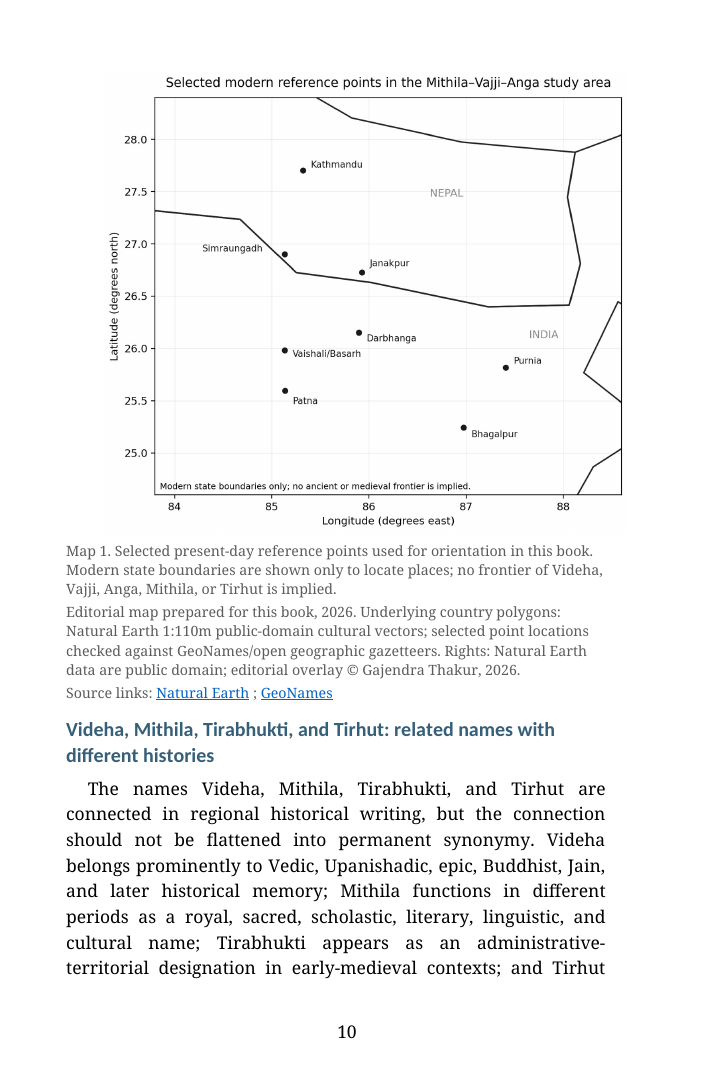
Mithila · Vajji · Anga
Chapter-specific source notes
- Primary chapter witness. Gajendra Thakur, Decoding the Panji of Mithila — Volume III, formal Chapter 5, PDF pp. 45-57; formal Chapter 5. The HTML transcription is generated from the commit-pinned source PDF and retains the chapter boundary recorded in this edition.
- Internal structure. The repository source-heading inventory records 11 subordinate headings for this chapter: “A civilizational time frame”; “Layered rather than linear time”; “The early layer of the record”; “Subsequent settlement and branch movement”; “Marriage as a bridge across time”; “Titles, scholars, and the time of recognition”; “Numbers and cross-references as time devices”; “Modern additions and the end point of 2009”; ….
- Digital editorial method. The page keeps the preserved source text distinct from generated navigational, concordance, visual, and provenance apparatus. The synthetic reconstruction is explanatory only and is not evidence for an individual lineage or a determination of social or marital status.