Decoding the Panji of Mithila · Volume III · Chapter 6
Villages as Genealogical Anchors
Chapter 6
  Villages as Genealogical Anchors
A Panji entry is never only about a person. It is also about a
place. The person’s name, father’s name, title, and branch
become fully meaningful only when the village-link is
understood. For this reason, the villages in the Uptip Panji are
not background scenery. They are genealogical anchors. They
hold the record in place.

   In modern reading, a village-name may appear to be a
simple address. In the Panji, it is much more. A village may
identify origin, settlement, marriage connection, branch
affiliation, learned household, estate seat, or cross-reference
point. The same village may appear in different roles in
different entries. Therefore, the first discipline of decoding is
to treat every place-name as evidence.

   The source begins with headings that immediately show
this place-based structure. An entry may be headed by a
cluster such as Sakuri-Sarisab-Pahitola or Khangur-Sarisab-
Pahitola. This tells the reader that the entry does not belong to
an abstract family line floating outside geography. It belongs
to a branch placed within a locality network. The village
cluster is the doorway through which the genealogy must be
entered.

   A heading, however, is not a wall. It does not restrict the
entry to only one village. Once the entry begins, it may move
to Darhara, Soderpur, Karamha, Naruan, Mandar, Pali,
Harianb, Khandbala, Pabouli, Budhwal, Ghosaut, Valias, or
many other places. This movement is not a defect in the
record. It is the record’s main purpose. The Panji preserves
relationships, and relationships in Mithila were often
expressed through place.
                 Decoding the Panji of Mithila, Volume III | Page 56
                     Decoding the Panji of Mithila Volume III

   The word सँ is the bridge between a person and a place.
When the text says that someone is linked with a village
through सँ, the reader must ask what kind of link is being
recorded. Is the person from that village? Is the marriage
connection from that village? Is the father or spouse from that
village? Is the village identifying the branch rather than the
individual? The answer depends on the surrounding formula.

   Because of this, the decoding of village-names cannot be
mechanical. The phrase “Karamha सँ” may mean one thing in
a daughter-link and another thing in a son-line. “Soderpur सँ”
may mark a marriage house in one place and a branch
identity in another. “Pali सँ” may connect a learned or ritual
family in one entry and a different collateral branch in
another. Each occurrence must be read in its own genealogical
unit.

   The Panji uses place to distinguish names. In a long
tradition, names repeat frequently. There may be several
persons named Gopal, Lakshminath, Raghunath, Shivanath,
Govind, Durganand, or Bhavanath. The village-link helps
prevent confusion. A name without its place may be
ambiguous. A name with father, title, reference number, and
village becomes identifiable.

   This is why the editor must never remove place-names
from the prose explanation. A short modern summary that
says “X was the son of Y” is often insufficient. The correct
summary should say that X, son of Y, is linked with a
particular village or branch through the source formula. The
village is part of the identity.

   The village also preserves migration. When a branch
appears first under one locality and then is repeatedly linked

                 Decoding the Panji of Mithila, Volume III | Page 57
                    Decoding the Panji of Mithila Volume III

with another, the Panji may be preserving movement from
one settlement zone to another. This does not always mean
physical migration by one person. It may mean a branch
settlement, a marriage route, a learned family’s relocation, or
a later association. But the movement of place-names across
entries is evidence of social geography.

   The Uptip entries repeatedly connect Mithila’s older
intellectual and marriage centers with places in present-day
Bihar and neighboring regions. Names such as Sarisab, Ujan,
Mahishi, Pali, Soderpur, Karamha, Naruan, Mandar, Harianb,
Khandbala, Gangoli, Ratauli, Rajoura, Sihauli, Chanaur,
Darbhanga, Purnea, Katihar, Araria, and Gadhbanaili show
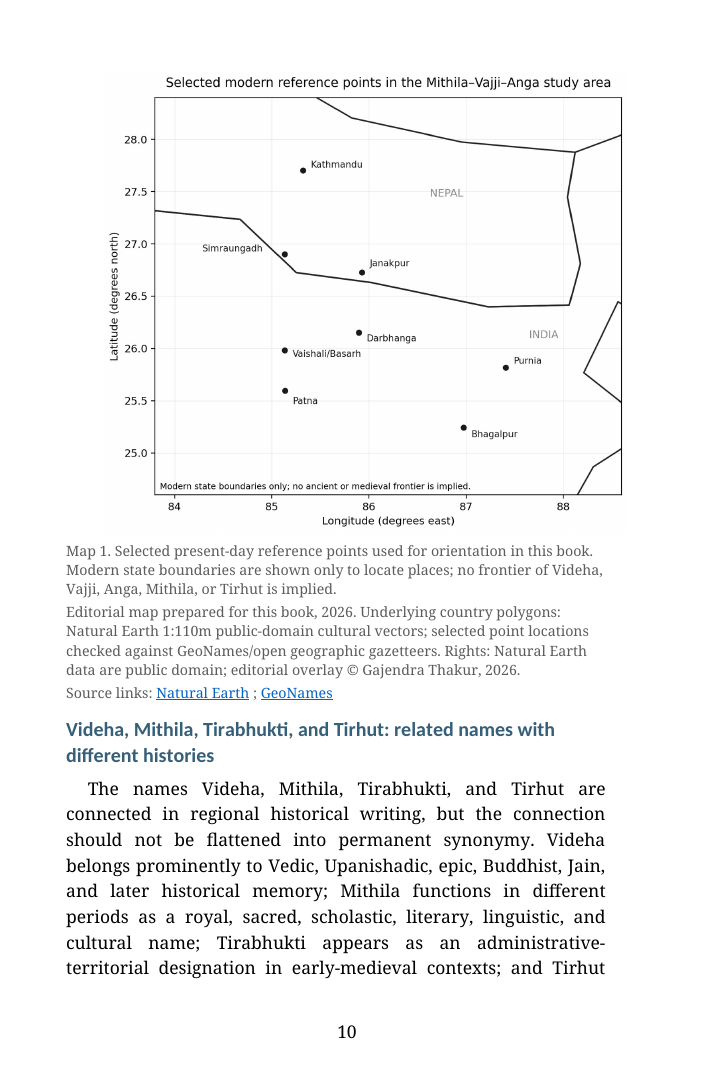
that the Panji is a map of extended Mithila memory. It records
not only the village where a branch began but also the places
where relationships were recognized.

   A village heading may be simple or compound. A simple
heading may name one locality. A compound heading may
join two or more localities with hyphens or descriptive
phrases. Such compound headings are especially important
because they suggest that the entry itself belongs to a linked
cluster. For example, a heading joining Sarisab and Pahitola
should be read as a branch-field, not as two unrelated place-
names accidentally placed together.

   Some headings contain regional indicators such as
Puwaripar or Fawaripar. These indicators deserve attention
because they place the entry within a wider geographical
orientation. They may distinguish one side of a river, one
regional route, or one branch-distribution from another. In
decoding, such terms should be preserved rather than
flattened into vague phrases.

                Decoding the Panji of Mithila, Volume III | Page 58
                     Decoding the Panji of Mithila Volume III

   Other headings contain references to a ड्योढ़ी. This term
points to a recognized household, estate, or status-bearing
seat. A ड्योढ़ी reference is not simply a door or gateway. In Panji
context, it often identifies an elite or historically remembered
house. When an entry names a ड्योढ़ी, the place has social
weight. It may mark the seat of a family whose status was
known beyond ordinary village identity.

   The reader must also be alert to variant spellings. A place
may appear with slightly different forms because of
pronunciation, copying, typing, or regional usage. Behat may
appear with a related variant. Harianb may appear in forms
that reflect local pronunciation. Khandbala and similar names
may show orthographic variation. These variations should not
be erased. The source-form should be preserved, while the
index may provide a standardized search form.

   Place-name variation is not merely a spelling issue. It can
affect identification. Two similar-looking names may refer to
different places; one place may have more than one written
form; a scribal error may resemble a genuine variant.
Therefore, standardization must be cautious. A responsible
index will record the source spellings and then group them
only when the evidence supports grouping.

   Some villages appear as major anchors. Sarisab is one such
anchor in the early entries. It appears not merely as a locality
but as a repeated branch-field. Pahitola, Ujan, Durgaganj,
Rajgram, Badhiyam, and other names similarly organize
sections of the material. When a village appears in a heading,
the reader should treat it as a principal anchor for that entry
or cluster.

   Other villages appear mainly inside the body of entries.
These may be marriage-link villages, branch-link villages, or
                 Decoding the Panji of Mithila, Volume III | Page 59
                    Decoding the Panji of Mithila Volume III

reference villages. They are no less important, but their role is
different. A village inside the body may explain how the
branch is connected to another family. It may show where a
daughter was married. It may point to the house from which a
spouse or maternal link came.

   The distinction between heading-place and body-place is
therefore essential. Heading-place gives the field of the entry.
Body-place gives the movement within that field. If the reader
confuses the two, the structure of the entry becomes unclear.
A decoding chapter should therefore list both: principal
heading places and internal relational places.

   In practical decoding, every entry should begin with a
place inventory. Before interpreting the names, list all place-
names in the entry. Then classify them provisionally: heading-
place, origin-place, marriage-place, branch-place, reference-
place, estate-place, or uncertain-place. This classification may
change as the entry is decoded, but the initial inventory
prevents omissions.

   The next step is to attach each place to the nearest kinship
unit. A village-name must not be allowed to drift freely. Ask:
which name does this village modify? Which daughter-link
does it follow? Which son-line does it confirm? Which
reference number accompanies it? If the place is between two
genealogical units, does it close the first or open the second?
These questions are necessary because the Panji compresses
syntax.

   A place may also be repeated within the same entry.
Repetition may indicate several branches linked to the same
village, not accidental duplication. For example, if Karamha
appears several times, it may be because different sons or
daughters are connected with Karamha through different

                Decoding the Panji of Mithila, Volume III | Page 60
                     Decoding the Panji of Mithila Volume III

lines. The editor should not delete or merge repeated place
references unless the source clearly shows a copying error.

   The Panji’s village geography also reveals social networks.
Marriage alliances did not occur at random. Certain villages
appear repeatedly because they belonged to recognized
networks of eligible and known families. The Panji preserves
this network by recording the village-links. In this way, it
becomes a social map of matrimonial circulation.

   Village names also preserve intellectual geography. When a
person is identified as a grammarian, Vaidik, Mimansaka,
Pandit, or Mahamahopadhyaya, the village-link may show the
scholarly household or region with which he was associated.
Mithila’s learned tradition was not abstract. It lived in villages,
houses, paths of teaching, and marriage networks. The Panji
captures that rootedness.

   A place can also preserve status. The appearance of titles
such as Babu, Thakur, Raja, or Maharaja alongside certain
place-names may indicate a landed or elite association. This
does not automatically prove political sovereignty, but it does
show how the family was remembered in social terms. A place
connected with such a title should be read with care.

   The late entries show especially complex locality clusters,
including estate-like and regional references. Such clusters
demonstrate that the Uptip Panji extends beyond a single
village genealogy. It gathers houses, branches, settlements,
and status locations into one documentary field. The reader
must therefore resist the urge to reduce the text to a local
family list.

   For researchers, the place index will be one of the most
important tools in this book. A reader may not know a
person’s full line, but may know a village. Starting from the

                 Decoding the Panji of Mithila, Volume III | Page 61
                    Decoding the Panji of Mithila Volume III

village index, the reader can locate all entries where that
village appears. Then the surrounding names, father-links,
daughter-links, and reference numbers can be examined. This
is often the safest way to begin a search.

   A place index should contain several columns:
standardized place-name, source spelling, entry number,
whether the place appears in the heading or body, associated
persons, associated reference numbers, and notes on
uncertainty. Such an index transforms the Panji from a dense
textual sequence into a navigable research instrument.

   The index must also distinguish major anchors from
passing links. A village that appears as a heading should be
marked differently from a village that appears once in a
marriage formula. Both are valuable, but they do not have the
same structural role. The reader should be able to see whether
a village organizes an entry or merely participates in one
relationship within it.

   In some cases, a modern political district name appears,
such as Katihar, Purnea, Araria, or Darbhanga. These names
help modern readers locate the geography, but the
genealogical meaning may be older or more specific than the
modern district boundary. The Panji’s geography should not
be forced into present administrative maps without caution.
Traditional village identity may outlast changing districts.

   Similarly, when the source names a place now associated
with Nepal-side Mithila or with border regions, the reader
should remember that the Panji’s world is cultural and
genealogical, not merely modern political. Mithila’s marriage
and scholarly networks crossed boundaries that later
administrations may have formalized differently.

                Decoding the Panji of Mithila, Volume III | Page 62
                    Decoding the Panji of Mithila Volume III

   The rivers, routes, and regional divisions behind the names
are also important, even when not explicitly described. Terms
like Puwaripar or Fawaripar may preserve orientation across
riverine geography. A branch’s appearance in a far-off locality
may suggest movement through marriage, patronage,
scholarship, landholding, or service. The Panji gives clues;
historical reconstruction must follow them carefully.

   A good decoding of a village cluster should therefore
include four levels. First, identify the source heading. Second,
list all internal place references. Third, connect each place to
the relevant kinship unit. Fourth, summarize what the place
pattern suggests about branch movement or marriage
geography. This four-level method will be used throughout the
entry-by-entry chapters of this volume.

   Let us take the opening pattern as an example. The first
entries do not simply say that certain persons existed. They
locate them in Sarisab, Pahitola, Darhara, Soderpur, Karamha,
Naruan, Mandar, Khandbala, Harianb, and related places. The
genealogy is therefore already a network. The place-names
tell the reader how the branch is distributed and how its
relationships are recorded.

   This has implications for family reconstruction. A person
searching for an ancestor should not search only by name. He
should search by name plus village. If the name is common,
the village may be decisive. If the village is common, the
father-name may be decisive. If both are common, the
reference number may be decisive. The Panji works through
combined identifiers.

   The villages also help identify possible errors. If a name
appears with a village-link that never appears elsewhere in
that branch, the reader should not immediately reject it; but

                Decoding the Panji of Mithila, Volume III | Page 63
                    Decoding the Panji of Mithila Volume III

he should mark it for comparison. It may be a new branch
connection, a marriage link, or a scribal confusion. Place-
pattern analysis helps detect such questions.

   In this volume, every decoding chapter will therefore treat
villages as evidence. The chapter will not merely paraphrase
names. It will ask: where does the entry begin? Which places
does it connect? Which places recur? Which places appear
only once? Which places are attached to daughter-lines?
Which places are attached to sons? Which places are
accompanied by titles? Which places have uncertain readings?

   The Panji of Mithila is a memory-map. It tells us that
lineage was remembered through land, settlement, learning,
marriage, and place. The village is not outside the genealogy.
The village is one of the genealogy’s main instruments. To
decode the Panji without decoding the villages would be to
read only half the record.

   The next chapter will build on this place-based
understanding and examine migration and marriage routes.
Once the villages are recognized as anchors, the movement
between them can be studied as a network of alliance,
settlement, and remembered continuity.

                Decoding the Panji of Mithila, Volume III | Page 64
                    Decoding the Panji of Mithila Volume III
Source structure and verification apparatus
Editorial source apparatus. This apparatus is descriptive, not interpretive. It records the source-controlled structure used to verify that this page corresponds to formal Chapter 6 of Decoding the Panji of Mithila — Volume III. The chapter text above is preserved from PDF pp. 57-66; formal Chapter 6 in the commit-pinned authoritative source. It is not merged with a neighboring chapter, appendix, annexure, or independent front/back-matter unit. The internal headings below come from the repository’s source-heading inventory and are retained as navigational and audit evidence; showing them here does not turn those headings into separate publications or add claims that are absent from the source.
Internal source headings
No subordinate heading was separately encoded in the repository source-heading inventory for this chapter.
Source-text concordance
Villages · Genealogical · Anchors · entry · never · person · place · person’s · name · father’s · title · branch · become · fully · meaningful · village-link · understood · reason · Uptip · background · scenery · hold · record · modern · reading · village-name · appear · simple · address · much · village · identify · origin · settlement · marriage · connection · affiliation · learned · household · estate · seat · cross-reference · point · different · roles · entries · Therefore · first · discipline · decoding · treat · every · place-name · evidence · begins · headings · immediately · show · place-based · structure · headed · cluster · Sakuri-Sarisab-Pahitola · Khangur-Sarisab · Pahitola · tells · reader · belong · abstract · family · line · floating · outside · geography · belongs · placed · within · locality · network · doorway
Boundary verification. In the formal sequence this chapter follows Volume III Chapter 5, “The Time Frame: 450 A.D. to 2009 A.D.” and precedes Volume III Chapter 7, “Migration and Marriage Routes”. The chapter extractor begins at the verified formal Chapter 6 marker and stops at the next verified formal chapter marker; for a final chapter it stops before recognized book-level back matter. The concordance above is generated only from distinct terms already present in this chapter’s preserved source text. It is provided for discovery, comparison, and audit, not as an automated judgment about persons, lineages, status, kinship, marriage eligibility, or historical truth.
Illustrated research apparatus
Mithila · Vajji · Anga
Chapter-specific source notes
- Primary chapter witness. Gajendra Thakur, Decoding the Panji of Mithila — Volume III, formal Chapter 6, PDF pp. 57-66; formal Chapter 6. The HTML transcription is generated from the commit-pinned source PDF and retains the chapter boundary recorded in this edition.
- Internal structure. The repository source-heading inventory records no separately encoded subordinate heading for this chapter.
- Digital editorial method. The page keeps the preserved source text distinct from generated navigational, concordance, visual, and provenance apparatus. The synthetic reconstruction is explanatory only and is not evidence for an individual lineage or a determination of social or marital status.