Decoding the Panji of Mithila · Volume III · Chapter 8
Titles, Scholarship, and Status Index Link Box
Chapter 8
  Titles, Scholarship, and Status
  Index Link Box
Index cluster: Method chapter for all Khand 2 roots and village clusters.
Khand 2 source entries: All entries 1-224, because titles and status-markers occur across the
whole Uptip sequence.
Index roots and routes: सरिसब, पवौली, खण्डबला, सोदरपुर, पाली, हरिअम्ब, घुसौत, करमहा,

बुधवाल, खौआल, सकराढ़ी, दरिहरा, माण्डर, वलियास, नरउन, सुरगन, कु जौली, and एकहरा.
Coverage status: Reading method established before the entry-cluster chapters begin.

The preceding chapters established the grammar of the Uptip
Panji. A name is not read alone. It is read with father-name,
village-link, daughter-link, marriage route, cross-reference
number, and branch-continuity. Chapter 6 showed why
villages anchor the genealogy. Chapter 7 showed how those
anchors become routes through migration and marriage. This
chapter adds the next necessary layer: titles, scholarship, and
status. In the Panji, a title is not decoration. It is evidence. It
helps identify a person, distinguish one branch from another,
and preserve the social or intellectual memory through which
a family became known.

    The chapter must be placed here, before the decoding of
the numbered entry clusters, because many later entries
contain names that cannot be understood by descent and
place alone. The same personal name may appear in more
than one branch. A village-link may narrow the identification,
but a title can complete it. A person described as पंडित, वैदिक,
वैयाकरण, मीमांसक, महामहोपाध्याय, बाबू, ठाकु र, राजा, महाराज, डॉ., प्रो., न्यायाधीश,
अधिवक्ता, or by another marker is being situated inside a
remembered social world. That marker must be read together
with descent, place, marriage, and branch-continuity.

                         Decoding the Panji of Mithila, Volume III | Page 81
                     Decoding the Panji of Mithila Volume III

   The rule of this chapter is therefore simple but strict: no
title should be removed from the genealogical explanation. If
the source preserves a title, the decoder must ask why it is
there. Does it identify a scholar? Does it mark a ritual
specialist? Does it distinguish a landholding or estate-linked
house? Does it record a modern profession attached to an
older branch? Does it show how learning moved from one
village into another? Does it help separate two men with the
same name? Until those questions are asked, the title has not
been decoded.

  Titles as genealogical evidence
   Modern readers often divide genealogy and social history
into separate subjects. The Panji does not. It records a name as
a genealogical person and as a bearer of remembered identity.
That identity may include learning, public rank, estate
standing, ritual authority, or professional recognition. A title
therefore belongs to the same field as a father-name or a
village-name. It is not outside the genealogy. It is one of the
ways the genealogy becomes identifiable.

   This is especially important in long records where names
repeat. A line may contain several persons named Gopal,
Lakshminath, Raghunath, Shivanath, Durganand, Govind,
Bhavanath, Rameshwar, or Janardan. The name alone is
insufficient. The father-name helps; the village helps; the
marriage route helps; the reference number helps. A title may
also help. If one person is remembered as पंडित and another as
बाबू, or one as वैयाकरण and another as ठाकु र, the difference may
guide the reader toward the correct branch.

   A title may also tell the reader which layer of time is being
encountered. Some titles belong to older scholastic culture.
Others belong to estate and public status. Still others belong to

                 Decoding the Panji of Mithila, Volume III | Page 82
                       Decoding the Panji of Mithila Volume III

modern education, administration, law, medicine, teaching, or
literature. The appearance of a modern title does not destroy
the older genealogy. It shows that the record has continued to
absorb later social memory. The line is older than the title, but
the title is part of the later identity of the line.

  Scholarly titles and learned memory
   Mithila was not only a region of villages and lineages. It
was also a region of learning. The Panji preserves this through
scholarly titles. Terms such as पंडित, वैदिक, वैयाकरण, मीमांसक, न्यायविद्,
भाषाशास्त्री, महामहोपाध्याय, आचार्य, and कवि should be treated as
intellectual markers. They identify the person by a form of
learning, but they also identify the branch by remembered
reputation. A family line may become visible in the record
because one of its members was known for grammar, ritual,
logic, language, literature, or teaching.

   The title वैयाकरण, for example, should not be flattened into a
mere honorific. It points toward grammatical learning. मीमांसक
points toward a ritual-philosophical discipline. वैदिक may
indicate Vedic learning or ritual qualification. महामहोपाध्याय
signals a recognized height of scholastic status. भाषाशास्त्री points
toward language scholarship. When such words appear, the
decoder should preserve the source term and then explain its
function. The purpose is not to modernize the title away, but
to make its genealogical value visible.

   A scholarly title often links descent with intellectual
inheritance. The source may name a father, then a son or
group of sons, then a village, and then a title. The title may
belong to one person, but its significance can extend to the
branch. It may show why that person was remembered. It
may show how the family’s identity entered a wider learned

                   Decoding the Panji of Mithila, Volume III | Page 83
                        Decoding the Panji of Mithila Volume III

network. It may also explain why the same branch appears in
another village or marriage field: learned service, teaching,
patronage, or reputation could carry a line beyond its original
anchor.

   The decoder should also be cautious. A title does not
automatically prove that every descendant carried the same
status. It proves that the source preserved that identity at that
point. The proper method is to attach the title to the nearest
name and then ask whether the surrounding entry extends
that status to a branch, a house, or a later settlement. Where
the text is clear, the conclusion may be clear. Where the text is
compressed, the title should be marked as identifying
evidence, not expanded into unsupported biography.

  Social titles and public status
   The Panji also preserves social and public titles. Words
such as बाबू or वाबू, ठाकु र, सिंह, राय, राजा, महाराज, कु मार, and related
forms may indicate family status, estate association, landed
position, public recognition, or a title-bearing house. These
words must be treated with the same seriousness as scholarly
titles. They show how a branch was remembered in the social
order of Mithila and beyond.

   A title like ठाकु र or सिंह may appear with a personal name,
but the decoder must not assume only a modern surname
function. In different contexts it may mark a family title, a
branch identity, a status line, or a particular historical house.
Similarly, बाबू or वाबू may identify a person of standing within a
branch or estate-linked world. राजा, महाराज, and कु मार must be
read especially carefully, because they may carry public or
dynastic memory into the genealogical record.

                    Decoding the Panji of Mithila, Volume III | Page 84
                        Decoding the Panji of Mithila Volume III

   The same method applies to झा, मिश्र, उपाध्याय, पाठक, ठाकु र, राय,
and similar name-forms. Some may function as surnames,
some as caste or learned-family designations, some as title-like
identifiers, and some as part of a personal or branch identity.
The reader should not detach them from the entry. The full
name-form must be preserved until the surrounding descent,
place, marriage, and title pattern is understood.

   Social titles often become important when the record
moves into additional settlements. A branch may begin under
one village, then enter a marriage route, and later appear
connected with a titled house. The title helps explain why the
later place is significant. The movement is not merely from
one locality to another. It may be movement into a
remembered social seat, an estate connection, or a public
status-field. This is one reason why the Index must control the
reading: root, village, title, and movement have to be kept
together.

  Modern professional titles
   The long time-frame of the larger project means that
modern titles also appear. Terms such as डॉ., प्रो., न्यायाधीश,
अधिवक्ता, प्रशासक, अभियंता, साहित्यकार, समाजशास्त्री, भाषाविद्, and similar
professional markers should not be dismissed as late clutter.
They are later identifying layers attached to older genealogy.
They show that the Panji did not stop with ancient or
medieval memory. It continued to receive modern names,
professions, public identities, and scholarly reputations.

   A modern title should be read in two directions. First, it
identifies the person in the present or near-present layer of
the record. Second, it sends the reader backward to the
branch into which that person belongs. If the title is removed,
the person may become indistinct. If the branch is removed,

                    Decoding the Panji of Mithila, Volume III | Page 85
                      Decoding the Panji of Mithila Volume III

the title becomes only a modern biographical label. The Panji
requires both movements at once: backward into descent and
outward into public identity.

   For example, a person marked as professor or doctor may
be remembered because that professional status distinguished
him within a larger family. But the status alone is not the
genealogy. The decoder must still ask: whose son is he? What
village is attached? Does the line pass through a daughter-
link? Is there an Uptip number? Does the entry use अपरा to
open another branch? Does the title belong to the person
alone, or does it signal a learned family pattern? Only after
these questions can the title be explained responsibly.

  Titles and marriage networks
   Titles often become visible through marriage networks. A
daughter-link may connect one village branch with a scholarly
house, a title-bearing house, or an estate-linked family. The
entry may not explain this in modern prose. It may simply
place a daughter-link, a village-name, and a titled person in
sequence. The decoder must unfold that sequence. Marriage is
the bridge, the village is the route, the title is the recognition,
and the branch-continuity is the thread that keeps the record
intelligible.

   This is why a daughter-linked title should never be treated
casually. If a daughter of one branch is connected with a
person known as पंडित, महामहोपाध्याय, बाबू, ठाकु र, राजा, or another
title, the record may be preserving more than a spouse-name.
It may be preserving an alliance between houses of
recognized status. It may also explain why a later descendant
appears in a place that is not the original heading-place. The
title becomes part of the marriage route.

                  Decoding the Panji of Mithila, Volume III | Page 86
                       Decoding the Panji of Mithila Volume III

   A maternal or daughter-line route may also bring a title
back into the record through दौहित्र or other maternal signs.
When this happens, the status of one house may illuminate
the identity of another. The Panji is not a narrow patrilineal
list. It is a record of connected houses. Titles help show which
connected house is being invoked. The decoder should
therefore read सुता, दौहित्र, अपरा, village-link, and title together.

  Estate houses and ड्योढ़ी references

   Some titles are tied to houses rather than to individual
learning alone. References to ड्योढ़ी, राजग्राम, हेमनगर, गढ़बनैली, धनौलिया,
or other status-bearing places may signal an estate, house, or
remembered seat. In such passages, a title may identify the
social weight of the place. A person connected with a ड्योढ़ी is
not merely assigned an address. The record may be pointing
to a house whose public standing was recognized beyond one
village.

   This becomes important in later Khand 2 clusters where
the line moves into additional settlements and public houses.
The decoder must not reduce these passages to lists of names.
They should be read as convergence points: descent reaches a
branch; marriage connects a house; place locates the route;
title preserves status; branch-continuity explains why the
connection remains in the record. The five-part method is
especially necessary here.

   In the presence of estate and house titles, the editor should
avoid two mistakes. The first is exaggeration: turning every
title into a full historical claim without supporting evidence.
The second is minimization: treating every title as a mere
courtesy word. The correct approach is to preserve the term,
attach it to the nearest person or house, and explain its

                   Decoding the Panji of Mithila, Volume III | Page 87
                       Decoding the Panji of Mithila Volume III

probable function in the entry. Where certainty is not
possible, the uncertainty should be visible.

  How to read a titled name
   A titled name should be read in a fixed sequence. First,
identify the full name as written, including title and variant
spelling. Second, identify the father-name or preceding
kinship unit. Third, identify the village-link and ask whether it
marks origin, marriage, settlement, branch, or reference.
Fourth, identify whether the name comes through a son-line,
daughter-link, maternal line, collateral branch, or अपरा line.
Fifth, identify the title and ask whether it is scholarly, ritual,
social, estate-related, modern professional, or uncertain. Sixth,
check the number or Uptip reference if one is present.

   This sequence prevents false conclusions. A title without its
place may be misread. A title without its descent unit may be
attached to the wrong person. A title without its marriage
route may hide the reason why another village appears. A title
without its reference number may be separated from the very
entry that explains it. The Panji’s compression requires that
all clues remain together until the prose decoding is written.

   The same sequence should be used in the later entry-
cluster chapters. Each time a title appears, the decoding
should ask: What is the title? Whose title is it? Which village
anchors it? Does it arise in direct descent or through
marriage? Does it connect a scholarly branch, a ritual branch,
a titled house, or a modern profession? Does it mark a
continuation from the preceding line or a new branch opened
by अपरा? These questions turn a bare name into a readable
historical unit.

                   Decoding the Panji of Mithila, Volume III | Page 88
                       Decoding the Panji of Mithila Volume III

  Titles and the Index
   The Index helps prevent titles from floating free. It gives
the root clusters: सरिसब, पवौली, खण्डबला, सोदरपुर, पाली, करमहा, बुधवाल,
माण्डर, वलियास, नरउन, सुरगन, कु जौली, एकहरा, and others. When a title
appears in an entry, the decoder should ask which root-cluster
is active. A scholar from a पाली-root route should not be
confused with a similarly named person in a सोदरपुर-root route.
A titled house connected with खण्डबला or भौर should not be
detached from that root field.

   This also explains why the future Scholar, Title, and Status
Index will be necessary. The same title may appear in
different branches. The same personal name may appear with
different titles. The same village may contain both scholarly
and status-bearing houses. A separate index will allow the
reader to see where titles occur, which entry numbers contain
them, and how they relate to place and descent. But the index
should be built after careful decoding, not before it.

   Chapter 8 therefore prepares the reader for two later tasks.
First, the entry-cluster chapters must decode titles where they
appear. Second, the final title index must gather those titled
figures without removing them from their genealogical
context. The index should show title, name, variant spelling,
entry number, village association, and branch route wherever
the evidence allows.

  Common errors in title-reading
   The first error is ornamental reading. This occurs when the
editor leaves a title in the transcription but does not explain
its function. A title preserved without explanation is only half-
decoded. The second error is biographical expansion. This
occurs when the editor turns a title into a long life story

                   Decoding the Panji of Mithila, Volume III | Page 89
                     Decoding the Panji of Mithila Volume III

without evidence from the source. The third error is modern
flattening. This occurs when all titles are treated as ordinary
surnames or honorifics. The fourth error is social
exaggeration. This occurs when a status term is made stronger
than the entry supports.

   The safer method is to state what the source gives and what
can be inferred from it. If the source says वैयाकरण, the decoder
can say that the person is marked by grammatical learning. If
the source says बाबू or ठाकु र, the decoder can say that the person
is marked by a status-bearing identifier or house-related title,
depending on context. If the source gives डॉ. or प्रो., the decoder
can say that a modern professional or academic layer has
entered the record. The explanation should go as far as the
evidence permits, and no farther.

   Another error is detaching titles from women’s links. When
a title appears after a daughter-link, it may identify the house
into which a woman married or the branch that became
connected through her. Removing the title from that route
weakens the reading. The Panji often preserves marriage as a
route of status, learning, and recognition. The titled person
may be the key to understanding why the entry leaves the
opening village and enters another house.

  Preparation for the decoding chapters
   With this chapter, the introductory method is complete.
Chapter 1 explained why the Panji is memory, map, and social
record. Chapter 2 explained Uptip as a cross-linked register.
Chapter 3 taught the unit-by-unit reading of an entry. Chapter
4 explained the signs and formulae. Chapter 5 explained time
as layered continuity. Chapter 6 anchored names in villages.
Chapter 7 followed migration and marriage routes. Chapter 8

                 Decoding the Panji of Mithila, Volume III | Page 90
                     Decoding the Panji of Mithila Volume III

now adds the title and status layer. The reader is ready to
enter the numbered clusters.

   From Chapter 9 onward, the book should apply the same
method to each source range. Each chapter must begin with
an Index Link Box. It must identify the entry numbers, source
headings, principal villages, branch routes, title markers,
marriage links, and uncertainties. Titles should not be
gathered only at the end. They should be decoded where they
occur, and then later indexed in the Scholar, Title, and Status
Index.

   The method must remain stable even when the source
becomes crowded. A long entry may contain older ancestors,
several sons, a daughter-link, a titled scholar, a modern
professional, a village migration, a ड्योढ़ी reference, and several
numbers. The answer is not to simplify the entry into a short
summary. The answer is to separate the layers and then show
how they join. Descent, place, marriage, title, and branch-
continuity must remain together.

  Conclusion: title as remembered identity
   A title in the Uptip Panji is a sign of remembered identity. It
may preserve learning, ritual authority, public standing,
estate association, literary reputation, modern profession, or
branch distinction. It may be small in the line, but it can be
large in meaning. It tells the reader that the person was not
remembered only as someone’s son. He was also remembered
as a scholar, householder, title-bearer, public figure, or
member of a recognized branch.

   The next part of the book begins the entry-cluster decoding.
The reader should now be prepared to follow the line as it
moves from the early expansion into additional settlements,
scholarly branches, and marriage networks. The method must

                 Decoding the Panji of Mithila, Volume III | Page 91
                    Decoding the Panji of Mithila Volume III

remain the same in every chapter: every name should be read
through descent, place, marriage, title, and branch-continuity.
Only then can the dense Panji entry become a clear historical
and genealogical explanation.

                Decoding the Panji of Mithila, Volume III | Page 92
                             Decoding the Panji of Mithila Volume III
Source structure and verification apparatus
Editorial source apparatus. This apparatus is descriptive, not interpretive. It records the source-controlled structure used to verify that this page corresponds to formal Chapter 8 of Decoding the Panji of Mithila — Volume III. The chapter text above is preserved from PDF pp. 82-94; formal Chapter 8 in the commit-pinned authoritative source. It is not merged with a neighboring chapter, appendix, annexure, or independent front/back-matter unit. The internal headings below come from the repository’s source-heading inventory and are retained as navigational and audit evidence; showing them here does not turn those headings into separate publications or add claims that are absent from the source.
Internal source headings
- Index Link Box
- Titles as genealogical evidence
- Scholarly titles and learned memory
- Social titles and public status
- Modern professional titles
- Titles and marriage networks
- Estate houses and ड्योढ़ी references
- How to read a titled name
- Titles and the Index
- Common errors in title-reading
- Preparation for the decoding chapters
- Conclusion: title as remembered identity
Source-text concordance
Titles · Scholarship · Status · Index · Link · cluster · Method · Khand · roots · village · clusters · entries · 1-224 · status-markers · occur · across · whole · Uptip · sequence · routes · करमह · नरउन · एकहर · Coverage · Reading · established · entry-cluster · chapters · begin · preceding · grammar · name · read · alone · father-name · village-link · daughter-link · marriage · route · cross-reference · number · branch-continuity · showed · villages · anchor · genealogy · anchors · become · migration · adds · next · necessary · layer · title · decoration · evidence · helps · identify · person · distinguish · branch · another · preserve · social · intellectual · memory · family · became · known · must · placed · decoding · numbered · entry · many · later · contain · names · cannot · understood
Boundary verification. In the formal sequence this chapter follows Volume III Chapter 7, “Migration and Marriage Routes” and precedes Volume III Chapter 9, “Entries 1-14 - The Sarisab-Pahitola-Ujan-Durgaganj Opening Cluster Index Link Box Index cluster: सरिसब / खांगुड़ / सकु री / पाहीटोल / उजान, with later movement toward”. The chapter extractor begins at the verified formal Chapter 8 marker and stops at the next verified formal chapter marker; for a final chapter it stops before recognized book-level back matter. The concordance above is generated only from distinct terms already present in this chapter’s preserved source text. It is provided for discovery, comparison, and audit, not as an automated judgment about persons, lineages, status, kinship, marriage eligibility, or historical truth.
Illustrated research apparatus
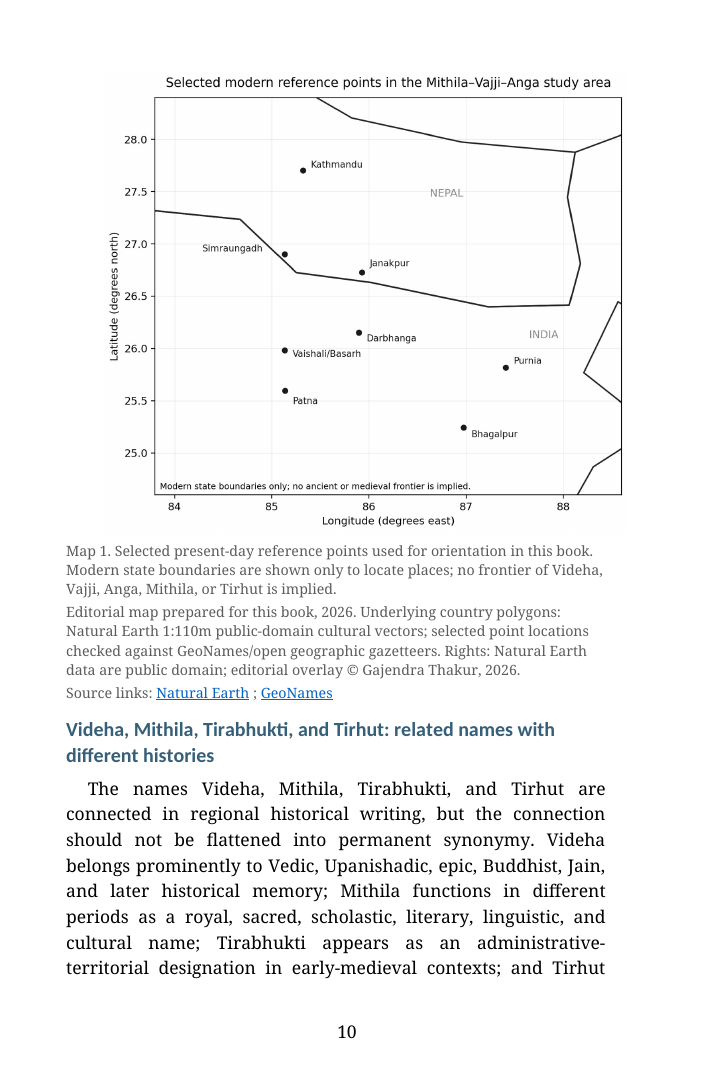
Mithila · Vajji · Anga
Chapter-specific source notes
- Primary chapter witness. Gajendra Thakur, Decoding the Panji of Mithila — Volume III, formal Chapter 8, PDF pp. 82-94; formal Chapter 8. The HTML transcription is generated from the commit-pinned source PDF and retains the chapter boundary recorded in this edition.
- Internal structure. The repository source-heading inventory records 12 subordinate headings for this chapter: “Index Link Box”; “Titles as genealogical evidence”; “Scholarly titles and learned memory”; “Social titles and public status”; “Modern professional titles”; “Titles and marriage networks”; “Estate houses and ड्योढ़ी references”; “How to read a titled name”; ….
- Digital editorial method. The page keeps the preserved source text distinct from generated navigational, concordance, visual, and provenance apparatus. The synthetic reconstruction is explanatory only and is not evidence for an individual lineage or a determination of social or marital status.