Decoding the Panji of Mithila · Volume III · Chapter 7
Migration and Marriage Routes
Chapter 7
  Migration and Marriage Routes
   Chapter 6 established the first discipline of reading the
Uptip Panji: a name must be held in place by its village. This
chapter moves one step further. Once a village has been
recognized as a genealogical anchor, the reader must ask how
the line travels from that anchor into other places, houses,
titles, and marriage fields. The Panji does not present
movement as a modern travel narrative. It preserves
movement in a compressed genealogical form. A branch may
begin under one settlement, become visible through another
village by marriage, acquire recognition through a learned
title in a third place, and be cross-referenced through a later
branch in a fourth. The route is therefore not a road on a map.
It is a chain of remembered relations.

   The word migration must be used carefully. In ordinary
modern language migration may suggest that one person
physically left one village and settled in another. The Panji
may indeed preserve such movement, but it more often
records a wider social geography. A family line can migrate
through marriage. A learned branch can migrate through
teaching, patronage, service, or scholarly reputation. A title-
bearing house can migrate into the record when its public
status becomes attached to a new place. A daughter-link may
carry memory from the natal house to the marital house. A
son-line may remain connected to the earlier branch while
also being identified through a later settlement. For this
reason, migration in the Panji must be read as branch
movement, marriage movement, and status movement
together.

                Decoding the Panji of Mithila, Volume III | Page 65
                     Decoding the Panji of Mithila Volume III

   The method of this chapter is the same method that must
be used throughout the book. Every name has to be read
through descent, place, marriage, title, and branch-continuity.
A name without a father is incomplete. A father without a
place may still be ambiguous. A place without a kinship
formula may be only a loose clue. A marriage link without the
daughter or maternal signal may be misread as male descent.
A title without the surrounding branch may become
ornamental when in fact it is identifying evidence. The
editor’s task is to keep all five elements together. Only then
does a compressed Panji line begin to open into historical
prose.

  From Anchor to Route
   A village anchor gives the point from which the entry
begins. A route shows where the record goes after that
beginning. This distinction is essential. A heading such as a
compound village cluster may identify the entry’s initial field,
but the body of the entry may soon move toward several other
settlements. That movement should not be treated as
confusion. It is the internal logic of the Panji. The branch is
being followed through relations, not through a single fixed
address. A modern reader may expect the first named village
to control every later name. The Panji works differently. It
opens from one place and then follows descent and marriage
wherever the record requires.

   The most common mistake is to read the heading as a wall.
It is not a wall. It is an entrance. When the source begins from
Sarisab, Pahitola, Ujan, Mahishi, Ratauli, Behat, Ruchouli,
Tripurauli, Loam, Bhaur, or another locality, the heading tells
the reader where to begin reading. It does not tell the reader
where to stop. Within the same record, Soderpur, Pali,
Karamha, Naruan, Mandar, Harianb, Khandbala, Pabouli,

                 Decoding the Panji of Mithila, Volume III | Page 66
                        Decoding the Panji of Mithila Volume III

Budhwal, Ghosaut, Valias, Darhara, or other places may
appear as marriage houses, branch settlements, scholarly
associations, or cross-reference fields. The route is made by
the sequence of those appearances.

   The route is therefore a sequence of attachments. The first
attachment may be a descent attachment: a person is named
as the son of another person. The second may be a place
attachment: the person or the related branch is linked with a
village through सँ. The third may be a marriage attachment: a
daughter-link or maternal relation carries the line into
another house. The fourth may be a status attachment: a title
such as पंडित, वैदिक, वैयाकरण, मीमांसक, महामहोपाध्याय, बाबू, ठाकु र, राजा, or
महाराज identifies the remembered social standing of the line.
The fifth may be a register attachment: a number or Uptip
reference sends the reader to another recorded point. To
follow a route, all these attachments must be kept visible.

  Marriage as Movement
   Marriage is one of the chief engines of movement in the
Panji. The record is not satisfied with listing fathers and sons.
It must also preserve which house became connected with
which other house. This is why the word सुता is so important.
When the record moves through a daughter, it may open a
marriage route that would be invisible in a purely patrilineal
chart. A daughter may connect two villages, two branches, or
two learned houses. If that link is ignored, the route collapses.
The reader will see names but not the social bridge between
them.

   The daughter-link should never be treated as a secondary
detail. In many entries, the daughter-link is the hinge on
which the whole movement turns. A male descent line may
establish the branch’s earlier memory, but the daughter’s
                    Decoding the Panji of Mithila, Volume III | Page 67
                     Decoding the Panji of Mithila Volume III

marriage may explain why another village appears in the
body of the entry. The village after सुता may not be a new
origin; it may be the marriage field. The persons named after
it may belong to the house into which the daughter was
linked, or to a branch remembered through that marriage.
The exact reading must be decided from the surrounding
formula, but the principle is fixed: सुता marks a route, not
merely a name.

   The term दौहित्र, where it occurs, makes this even clearer. A
daughter’s son or maternal grandson appears because the
record has crossed into a maternal line. That crossing is not
accidental. It shows that maternal continuity could be
important enough to preserve in the Panji. A modern editor
who reduces genealogy to male descent alone will miss this
movement. The Panji’s route may run from father to son, but
it may also run from father to daughter, from daughter to
another house, from that house to a grandson, and then into a
new village or title-bearing branch. The route is not a straight
line. It is a governed movement through recognized
relationship.

   Marriage also explains why the same village can appear in
several different roles. A place may be the origin of one
branch, the marriage destination of another, the maternal link
of a third, and the scholarly or estate association of a fourth.
This is why every occurrence has to be read in context. The
same phrase cannot always be translated in the same way. A
village followed by सँ may mean from that place, associated
with that place, married into that place, or identified by that
branch. The surrounding words decide the function. The
editor should not flatten all of them into a single English
phrase.

                 Decoding the Panji of Mithila, Volume III | Page 68
                    Decoding the Panji of Mithila Volume III

  Collateral Lines and the Sign of अपरा

   Migration and marriage routes are often expanded by the
word अपरा. This word usually signals that the record is opening
another connected line. The first line may have named one
son, one daughter, or one village-linked branch; अपरा tells the
reader that another route must now be followed. It may
introduce another daughter-link, another son-line, another
settlement, another branch of the same house, or an
alternative connection that the Panji considered worth
preserving. It is a warning against premature closure.

   When अपरा appears, the reader should pause and ask three
questions. First, what unit has just closed? Second, what new
unit is being opened? Third, how is the new unit connected
with the preceding unit? The answer may be direct descent,
collateral descent, marriage, maternal connection, or village
association. If the editor merely translates अपरा as ‘another’
and moves on, the deeper function is lost. In a migration-and-
marriage reading, अपरा is a route marker. It shows that the
branch does not end at the first visible path.

   Collateral movement is especially important in entries
where several sons or several daughters are grouped together.
The record may first give the group as a whole, then separate
one line, then return through अपरा to another line. This makes
the text appear circular to a modern reader, but it is not
aimless. The Panji is preserving multiple routes from a shared
genealogical point. One route may lead toward a marriage
village, another toward a learned branch, another toward an
estate house, and another toward a cross-reference number.
The sequence is compact, but it is not random.

                Decoding the Panji of Mithila, Volume III | Page 69
                       Decoding the Panji of Mithila Volume III

  Scholarly Branches and Learned Movement
   The movement of a line is not only geographical. It can also
be intellectual. Mithila’s Panji tradition preserves names of
scholars, ritual specialists, grammarians, commentators,
learned householders, and public figures through titles and
descriptors. A person identified as पंडित, वैदिक, वैयाकरण, मीमांसक,
भाषाशास्त्री, महामहोपाध्याय, डा., प्रो., or by another learned sign is not
being decorated with a casual label. The title may be one of
the principal clues by which that person is distinguished from
another person of the same name. It may also show the
reputation through which the branch became known.

   Scholarly movement can create a route even when physical
migration is uncertain. A learned person may belong by
descent to one village but become associated in memory with
another because of teaching, patronage, debate, service, or
settlement. A title-bearing branch may be recorded under one
locality while its marriage links lead elsewhere. A later
descendant may be known through a professional or learned
title that preserves a new layer of identity. The editor should
therefore read titles as route evidence. They show how
reputation moved with the family line.

   This does not mean that every title proves a migration. It
means that a title must be placed beside descent and place. If a
person is named as the son of a particular father, linked with
a village, and given a scholarly title, the title helps identify
which branch is being followed. If a later line carries the same
title or a related intellectual identity into another locality, the
Panji may be preserving the movement of learning as well as
blood. In Mithila, family memory and intellectual memory
were often interwoven. A genealogy that omits learning

                   Decoding the Panji of Mithila, Volume III | Page 70
                      Decoding the Panji of Mithila Volume III

becomes thin. A social history that ignores descent becomes
ungrounded. The Panji preserves both.

  Estate Houses, ड्योढ़ी, and Status Routes

   Some routes move through estate houses and status-
bearing seats. A reference to ड्योढ़ी is especially important. In
ordinary language the word may suggest a doorway or
entrance, but in the Panji context it often points to a
recognized house, estate, or remembered seat. When such a
term appears, the place is not a casual address. It carries
social weight. The line may be moving toward a house whose
standing was known beyond the immediate branch. The
editor must therefore read ड्योढ़ी references as part of the
route.

   Status terms such as बाबू, ठाकु र, राजा, महाराज, कु मार, or similar
designations also contribute to route-reading. They may
identify an estate-related branch, a recognized family seat, or
a public standing attached to a particular house. The same
descent line may appear differently once it enters a status-
bearing location. This does not remove the genealogical
foundation; it adds another layer. A name has to be read
through father, place, marriage, title, and branch-continuity.
Status is one of those elements because it can explain why a
certain branch is remembered with special emphasis.

   In later sections of the Uptip material, where the record
moves into additional settlements and recognized houses, this
status dimension becomes especially important. The line may
move from an older village anchor toward a Rajgram, a
Hemnagar, a ड्योढ़ी, or another estate-linked locality. Such
movement must not be reduced to a list of places. It may show
how a branch entered a wider public memory. It may also

                  Decoding the Panji of Mithila, Volume III | Page 71
                     Decoding the Panji of Mithila Volume III

show how marriage connected a scholarly or ritual branch
with a landed or title-bearing house. The Panji compresses this
movement; the decoder must unfold it.

  Regional Corridors: Puwaripar and Fawaripar
   Regional indicators such as Puwaripar and Fawaripar
require special attention. They are not empty prefixes. They
place the entry within a wider orientation. Such terms may
distinguish one side of a river, one geographical belt, one
branch distribution, or one remembered social corridor from
another. When a heading says that an Uptip branch belongs to
a Puwaripar or Fawaripar field, the editor should preserve the
term and use it to understand the direction of movement. It
may be the broad route within which several village links are
being placed.

   A regional corridor does not erase the smaller village links.
Instead, it gives them a field. Within that field, the entry may
name several settlements, marriage houses, and branch
points. The larger regional term tells the reader that these
places are being remembered as part of a wider distribution.
The smaller village names show where the actual genealogical
contacts occur. A good decoding therefore works at two scales
at once: the corridor scale and the village scale. Without the
corridor, the list of places may look scattered. Without the
village details, the corridor becomes too vague.

   This is also why the editor should not silently modernize or
replace regional expressions. Even if a term is difficult, it must
remain visible. The reader can then see that the Panji is not
merely naming isolated households. It is organizing memory
through zones. The movement from one place to another may
be meaningful because both places belong to a remembered
corridor. When that corridor crosses marriage fields, learned

                 Decoding the Panji of Mithila, Volume III | Page 72
                     Decoding the Panji of Mithila Volume III

branches, or estate houses, the route becomes a social
geography rather than a simple itinerary.

  Following the Line into Additional Settlements
   After the early village anchors have been recognized, the
next task is to follow the line as it moves into additional
settlements. This is where many readings fail. The reader may
stop at the first place and treat later places as incidental. The
Panji demands the opposite discipline. Later places often
explain the earlier line. A branch that begins under one
heading may become intelligible only when its later marriage,
settlement, or title-bearing connection is read. The subsequent
settlement is not an afterthought. It may be the evidence that
identifies the branch.

   A settlement route should be reconstructed slowly. First
identify the heading-place. Then identify the first named
ancestor or branch marker. Then mark the son-lines and
daughter-links. Then list every village that appears after those
kinship markers. Then classify each place provisionally:
origin, settlement, marriage house, branch association,
learned house, estate seat, regional corridor, or uncertain
reference. The classification may later change, but the initial
inventory prevents the loss of evidence. Every route begins
with an inventory.

   Once the inventory is made, attach each place to the
nearest genealogical unit. A village name must not drift freely.
If it follows a daughter-link, ask whether it marks the
marriage house. If it follows a son-line, ask whether it marks
settlement, origin, or branch identity. If it follows a title, ask
whether it identifies the house through which that title was
remembered. If it is accompanied by a number, copy the
number exactly and keep it with the unit. If it appears after

                 Decoding the Panji of Mithila, Volume III | Page 73
                      Decoding the Panji of Mithila Volume III

अपरा, ask what collateral branch it opens. This is how
movement becomes readable.

   The additional settlements may also show the widening of
Mithila’s remembered geography. Some places belong to older
intellectual or ritual centers. Some belong to marriage
networks. Some belong to later regional expansions into
districts such as Purnea, Katihar, Araria, Darbhanga, or other
areas named in the material. These references should not be
treated merely as modern administrative locations. In the
Panji, they are memory fields. They show where relationships
were recognized, where branches became visible, and where
older lineages acquired new associations.

  Marriage Networks as Social Cartography
   A marriage network is a map without drawn lines. The
Panji draws this map through repeated daughter-links, place-
links, and branch references. A daughter from one house may
connect to another village. Her descendants or related lines
may then appear with another title or settlement. A later अपरा
line may show a second marriage path from the same branch.
Over time, such links form a network. The Panji does not
explain the network in modern prose, but it preserves its
nodes. The decoder must connect them carefully without
inventing links that the source does not support.

   The word सुता is the principal doorway into this network,
but it is not the only one. दौहित्र, अपरा, village-links through सँ,
and reference numbers also help identify marriage
movement. In some cases the marriage route is explicit. In
others it is implied by the formula. The safest method is to
preserve the wording, identify the probable function, and
mark uncertainty where certainty is not possible. A
responsible reading does not force every village-link into a
                  Decoding the Panji of Mithila, Volume III | Page 74
                     Decoding the Panji of Mithila Volume III

marriage interpretation. It asks whether the surrounding
kinship language supports that reading.

   Marriage networks also help explain why unrelated-
looking villages appear together. The Panji is not arranging
places by distance. It is arranging them by relation. A place far
away on a modern map may be close in marriage memory. A
nearby village may be absent because no relevant branch in
the entry passes through it. The record follows kinship, not
cartographic convenience. Therefore the editor must resist the
temptation to impose a modern map too quickly. Geography
matters, but it is genealogy that gives the map its meaning.

  Numbers as Route Markers
   Reference numbers are part of the route. They may appear
after a name, a village, a title, an Uptip marker, or a status
reference. They may point toward another entry, a branch
record, a register location, or a related source layer. The exact
function may vary, but the numbers must always be
preserved. If a line moves from a father to a son, then through
a village-link, then to a number, that number may be the key
to the next step of the route. A wrong digit may lead the
reader into the wrong branch.

   In migration and marriage reading, numbers are especially
useful because they can show that a connection is not isolated.
A branch may appear in one place, but the reference number
may send the trained reader to another record where the
same family, village, or marriage line is continued. This is why
the Panji cannot be reconstructed from names alone. The
number belongs to the route just as much as the village name
does. The editor should copy it exactly, including slashes,
double slashes, zero forms, and uncertain spacing.

                 Decoding the Panji of Mithila, Volume III | Page 75
                     Decoding the Panji of Mithila Volume III

   The presence of a number should also make the editor
cautious. If the number is not yet fully understood, it should
not be explained beyond the evidence. It can be described as a
cross-reference marker or navigational sign. Later
comparison may clarify whether it points to a page, entry,
branch, or register layer. Until then, preservation is the first
duty. Interpretation should follow evidence, not replace it.

  Repeated Names and the Need for Full Identification
   Migration and marriage routes become dangerous to read
when names repeat. The Panji contains many recurring
names: Gopal, Raghunath, Lakshminath, Shivanath,
Durganand, Govind, Bhavanath, and many others. A repeated
name is not a repeated person. The reader must use father,
village, title, reference number, and branch context to
distinguish one person from another. This is why a route
cannot be summarized as a sequence of names alone. A name
without its coordinates is often insufficient.

   The full identification should therefore include the person’s
relation, the linked place, the relevant title if present, and the
branch context. Instead of writing only that one person is the
son of another, the decoder should explain that the person
appears in a particular branch, through a particular village-
link, and within a particular route. If the source gives a title,
that title should be retained. If the source gives a number, that
number should remain attached. If the source gives अपरा, the
collateral nature of the movement should be noted. This
method prevents confusion between persons of the same or
similar names.

   The same discipline applies to places. A repeated village is
not always the same function. Karamha may be an origin in
one unit, a marriage link in another, and a branch identifier

                 Decoding the Panji of Mithila, Volume III | Page 76
                    Decoding the Panji of Mithila Volume III

in a third. Soderpur may close one relation and open another.
Pali may appear through a ritual or learned line. Budhwal
may mark one marriage path and another branch elsewhere.
The route must be read unit by unit. Repetition is evidence,
not clutter.

  Gaps, Dots, and Uncertain Movement
   The route is sometimes interrupted by gaps, dots, damaged
readings, or missing names. These gaps must not be filled by
imagination. A gap may hide a person’s name, a village, a title,
or a relation. If the surrounding formula remains clear, the
editor may explain the structure without inventing the
missing content. For example, the record may clearly show
that a daughter-link moves toward another village, even if the
name of the intervening person is missing. In such a case, the
route can be described, but the missing name must remain
missing.

   Dots and blank spaces also affect migration reading. They
may interrupt the line just where a settlement or marriage
connection would have been named. The editor should
therefore state what is visible and what is not. If a branch
appears to move toward a place but the connecting name is
absent, the place can be recorded as a visible link, while the
exact relation remains uncertain. This honesty protects the
source. It also protects the reader from false certainty.

   Variant spellings must be handled with the same caution.
One village may appear in different forms because of
pronunciation, copying, typing, or manuscript transmission.
Another similar-looking form may refer to a different place.
The editor should not merge them too quickly. The source
spelling should be preserved in discussion, while a
standardized index form may be used only when evidence

                Decoding the Panji of Mithila, Volume III | Page 77
                     Decoding the Panji of Mithila Volume III

supports the grouping. Route reconstruction depends on
accurate place identification.

  A Practical Method for Chapter-by-Chapter Decoding
   Each later decoding chapter should begin by asking what
routes are active in the entry cluster. The first route is the
descent route: who is named as father, son, daughter, or
maternal descendant? The second is the place route: what
village or regional field gives the heading, and what other
places appear in the body? The third is the marriage route:
where do सुता, दौहित्र, and related formulas carry the line? The
fourth is the title route: what scholarly, ritual, public, or estate
title identifies a person or branch? The fifth is the reference
route: what numbers or Uptip markers point beyond the
immediate line? These five routes together form the decoding
frame.

   The chapter-by-chapter decoder should not rush to
narrative before completing this frame. First list the entry
number and heading. Then identify the principal villages.
Then identify the major persons and their relation words.
Then mark daughter-links and अपरा openings. Then copy
numbers. Then note titles. Only after this preparation should
the prose explanation begin. The prose should not merely
translate the line. It should explain how the line moves. The
goal is not to reduce the Panji to modern sentences but to
make its compressed logic visible.

   When the line moves into additional settlements, the
decoder should explain whether the movement appears to be
settlement, marriage, branch association, learned relocation,
estate affiliation, or uncertain reference. Sometimes more
than one function may be present. A person may be linked
with a village through descent and later connected to another

                 Decoding the Panji of Mithila, Volume III | Page 78
                    Decoding the Panji of Mithila Volume III

through marriage. A scholarly title may identify the same
branch in a third place. The entry’s meaning lies in this
layered movement. The prose should preserve the layers
rather than forcing a single explanation.

  Continuity Across Generations
   Migration and marriage routes are also routes of
continuity. A branch does not lose its earlier identity merely
because it appears in a later place. The Panji often preserves
both: the older anchor and the newer association. This is why
a route may contain several places in quick succession. The
earlier place carries memory of origin or branch; the later
place carries marriage, settlement, title, or recognition. The
connection between them is the historical value of the record.

   Generational continuity can be seen when names pass
through father-son formulas and then widen through
daughters or collateral lines. A branch may first be identified
by a founding or remembered ancestor. The next generation
may be divided among several sons. A daughter-link may
connect one branch to another village. A later descendant may
acquire a title or enter an estate house. A reference number
may point to a parallel record. All of this belongs to one route
of continuity. A modern chart may flatten it; the Panji
preserves its complexity.

   This continuity is also cultural. The Panji remembers not
only who descended from whom but also how houses
maintained status, learning, marriage eligibility, and regional
identity. A family’s memory could travel through settlement,
through education, through ritual authority, through
marriage alliance, through estate association, and through
repeated recognition in the register. The chapter’s central
lesson is therefore simple: movement in the Panji is not the

                Decoding the Panji of Mithila, Volume III | Page 79
                        Decoding the Panji of Mithila Volume III

opposite of continuity. Movement is one of the ways
continuity is preserved.

  Transition to the Next Chapter
   This chapter has shown how to read the movement of a
line after the village anchor has been identified. Chapter 6
taught that villages hold the record in place. Chapter 7 has
shown that the same villages also open routes: routes of
descent, marriage, settlement, scholarship, title, and branch-
continuity. The reader is now prepared to understand why
titles and status signs must be treated as evidence rather than
decoration. The next chapter will therefore turn to titles,
scholarship, and status. It will explain how words such as पंडित,
वैदिक, वैयाकरण, मीमांसक, महामहोपाध्याय, बाबू, ठाकु र, राजा, and महाराज help
identify persons, branches, and remembered houses within
the Panji system.

   The practical rule remains unchanged. Do not detach a
name from its father. Do not detach a father from his village.
Do not detach a village from its marriage route. Do not detach
a marriage route from branch-continuity. Do not detach a title
from the person it identifies. Do not detach a number from the
unit it marks. When all these elements are read together, the
Panji ceases to look like a crowded list. It becomes what it
truly is: a map of remembered descent moving through the
villages, marriages, learning, and social institutions of Mithila.

                    Decoding the Panji of Mithila, Volume III | Page 80
                             Decoding the Panji of Mithila Volume III
Source structure and verification apparatus
Editorial source apparatus. This apparatus is descriptive, not interpretive. It records the source-controlled structure used to verify that this page corresponds to formal Chapter 7 of Decoding the Panji of Mithila — Volume III. The chapter text above is preserved from PDF pp. 66-82; formal Chapter 7 in the commit-pinned authoritative source. It is not merged with a neighboring chapter, appendix, annexure, or independent front/back-matter unit. The internal headings below come from the repository’s source-heading inventory and are retained as navigational and audit evidence; showing them here does not turn those headings into separate publications or add claims that are absent from the source.
Internal source headings
- From Anchor to Route
- Marriage as Movement
- Collateral Lines and the Sign of अपरा
- Scholarly Branches and Learned Movement
- Estate Houses, ड्योढ़ी, and Status Routes
- Regional Corridors: Puwaripar and Fawaripar
- Following the Line into Additional Settlements
- Marriage Networks as Social Cartography
- Numbers as Route Markers
- Repeated Names and the Need for Full Identification
- Gaps, Dots, and Uncertain Movement
- A Practical Method for Chapter-by-Chapter Decoding
- Continuity Across Generations
- Transition to the Next Chapter
Source-text concordance
Migration · Marriage · Routes · established · first · discipline · reading · Uptip · name · must · held · place · village · moves · step · recognized · genealogical · anchor · reader · line · travels · places · houses · titles · fields · present · movement · modern · travel · narrative · preserves · compressed · form · branch · begin · settlement · become · visible · another · acquire · recognition · learned · title · third · cross-referenced · later · fourth · route · therefore · road · chain · remembered · relations · word · used · carefully · ordinary · language · suggest · person · physically · left · settled · indeed · preserve · often · records · wider · social · geography · family · migrate · teaching · patronage · service · scholarly · reputation · bearing · house · record
Boundary verification. In the formal sequence this chapter follows Volume III Chapter 6, “Villages as Genealogical Anchors” and precedes Volume III Chapter 8, “Titles, Scholarship, and Status Index Link Box”. The chapter extractor begins at the verified formal Chapter 7 marker and stops at the next verified formal chapter marker; for a final chapter it stops before recognized book-level back matter. The concordance above is generated only from distinct terms already present in this chapter’s preserved source text. It is provided for discovery, comparison, and audit, not as an automated judgment about persons, lineages, status, kinship, marriage eligibility, or historical truth.
Illustrated research apparatus
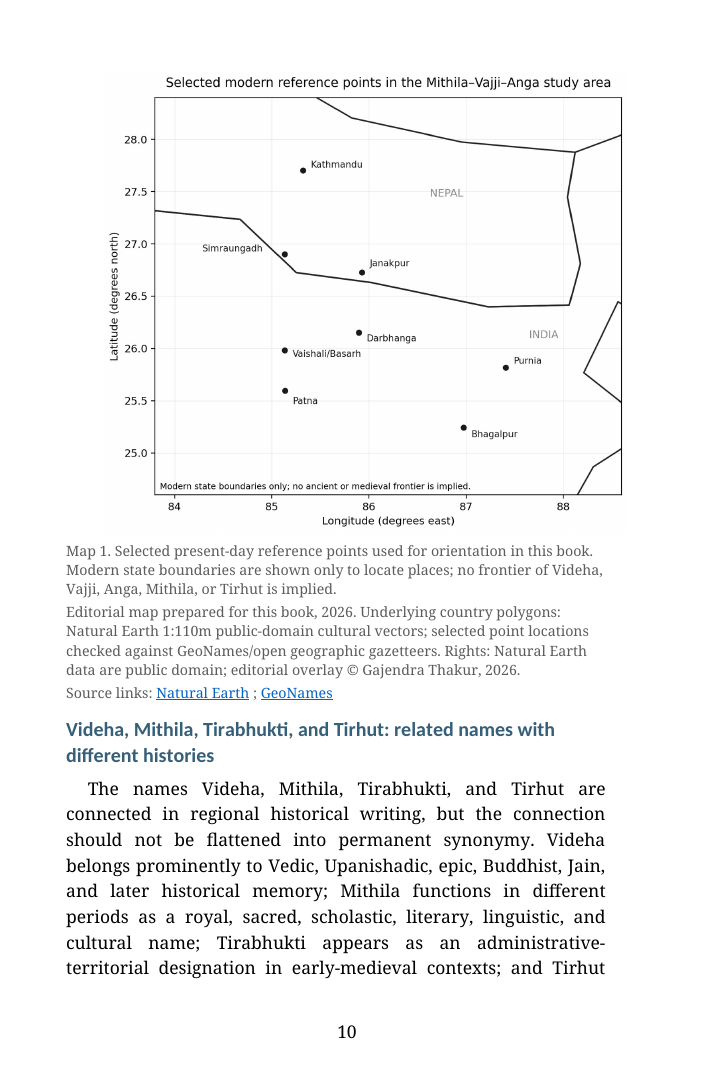
Mithila · Vajji · Anga
Chapter-specific source notes
- Primary chapter witness. Gajendra Thakur, Decoding the Panji of Mithila — Volume III, formal Chapter 7, PDF pp. 66-82; formal Chapter 7. The HTML transcription is generated from the commit-pinned source PDF and retains the chapter boundary recorded in this edition.
- Internal structure. The repository source-heading inventory records 14 subordinate headings for this chapter: “From Anchor to Route”; “Marriage as Movement”; “Collateral Lines and the Sign of अपरा”; “Scholarly Branches and Learned Movement”; “Estate Houses, ड्योढ़ी, and Status Routes”; “Regional Corridors: Puwaripar and Fawaripar”; “Following the Line into Additional Settlements”; “Marriage Networks as Social Cartography”; ….
- Digital editorial method. The page keeps the preserved source text distinct from generated navigational, concordance, visual, and provenance apparatus. The synthetic reconstruction is explanatory only and is not evidence for an individual lineage or a determination of social or marital status.