Decoding the Panji of Mithila · Volume III · Chapter 10
Entries 15-24 - Badhiyam, Parvapalli, Rupouli, and Related Branches Index Link Box Index cluster: वढ़ियाम / पर्वपल्ली / रूपौली, with transitional support from जोंकी-सरिसब and
Chapter 10
 Entries 15-24 - Badhiyam, Parvapalli, Rupouli, and
Related Branches
  Index Link Box
Index cluster: वढ़ियाम / पर्वपल्ली / रूपौली, with transitional support from जोंकी-सरिसब and

the later बड़का गाम continuation.

Khand 2 source entries decoded: 15-24.
Principal source heading forms: “उ.टी. जोंकी-सरिसब, बढ़ियाम पर्वपल्ली”; “उजान हलधर झा

उ.टी. ८ बढ़ियाम-उजान, शारदापुर”; “उ.टी. बढ़ियाम”; “उ.टी. बढ़ियाम पर्वपल्ली”; “उ.टी.
बढ़ियाम-रूपौली”; and “उ.टी. बढ़ियाम-बड़का गाम.”
Index roots and routes: पवौली-root वढ़ियाम; सरिसब-root जोंकी transition; repeated

movement through पाली, दरिहरा, माण्डर, पबौली, नरउन, खण्डबला, घोसौत, खौआल, करमहा,

सोदरपुर, बुधवाल, हरिअम्ब, वलियास, एकहरा, कु जौली, सुरगन, माड़रि, जमदौली, and related
settlement fields.
Coverage status: Entries 15-24 decoded in this chapter; the next chapter begins at Entry 25 with
the renewed Sarisab-Soderpur cluster.

Chapter 9 ended by showing how the Sarisab-Khanguṛ
opening cluster spread into many allied houses. Chapter 10
continues from that early expansion. The line now moves into
Jonki-Sarisab, Badhiyam, Parvapalli, Rupouli, and Badka Gam.
This is not a break in the method. It is the same method
applied to the next field: every name must be read through
descent, place, marriage, title, and branch-continuity.

    The chapter is controlled by the Index. The Index assigns
Badhiyam to the Pavoli root field, while Jonki remains
attached to the Sarisab root. The source begins the chapter by
joining Jonki-Sarisab with Badhiyam-Parvapalli. That joining
is important. It means the Panji is not moving from one
unrelated village to another. It is moving from one index-
controlled field to another through recorded descent,
daughter-links, collateral branches, and marriage routes.

                        Decoding the Panji of Mithila, Volume III | Page 111
                        Decoding the Panji of Mithila Volume III

    The entries decoded here repeatedly show the transition
from a heading-place to body-places. Badhiyam may be the
field of the entry, but Pali, Darhara, Mandar, Pabouli, Naruan,
Khandbala, Ghosaut, Khoaāl, Karamha, Soderpur, Budhwal,
Harianb, Valias, Ekhara, Kujouli, Surgan, Madari, and
Jamdauli appear inside the body. Each of these place-names
must be attached to the nearest kinship unit. If a place is
allowed to drift freely, the genealogy becomes confused. If it is
attached to the correct son-line, daughter-line, title, or branch,
the entry opens clearly.

  Chapter overview
    Entries 15-24 form the first major movement after the
opening Sarisab-Khanguṛ sequence. Entry 15 bridges Jonki-
Sarisab into Badhiyam-Pavoli. Entries 16-17 continue
Badhiyam through Ujan and related daughter-lines. Entries
18-19 enlarge the Badhiyam-Parvapalli field and introduce
prominent status-bearing and scholarly signs. Entries 20-21
move into Rupouli, where many daughter-lines and uncertain
gaps must be preserved carefully. Entries 22-24 move into
Badka Gam and then close the Badhiyam range before Entry
25 begins the next Sarisab-Soderpur cluster.

    The social logic of these entries is movement. Branches are
not held inside one village. They are remembered through
marriage, collateral descent, learned titles, and status-bearing
houses. A son-line may remain within one named field while a
daughter-link carries the record toward another village. A title
such as वैयाकरण, नैष्ठिक, उपाध्याय, बाबू, राजा, कु मार, or के शरे हिन्द may
identify a person or branch in a way that ordinary names
alone cannot. The decoder must therefore keep titles beside
fathers, villages, and marriage routes.

                    Decoding the Panji of Mithila, Volume III | Page 112
                     Decoding the Panji of Mithila Volume III

  Entry 15: Jonki-Sarisab and the opening of Badhiyam-Pavoli
   Entry 15 begins with “उ.टी. जोंकी-सरिसब, बढ़ियाम पर्वपल्ली.” The
heading itself is transitional. Jonki belongs to the Sarisab-root
field, while Badhiyam points toward the Pavoli-root field. The
source first opens Jonki-Sarisab through Haradatt and
Mathuranath. Mathuranath is then linked with Budhwal
through Parmanand and Devkrishna, and with Darhara
through Bale. The first lesson is that Jonki is not left as a bare
village name. It is immediately tied to named persons, filial
movement, and external village links.

   Mathuranath’s sons Rupnath, Prasiddhanand, and Anand
move the line toward Mandar-Mahinath-Shobhakar and
Pabouli-Garib. Vireshwar’s daughter-link then moves toward
Valias-Raja-Krishnapati and Soderpur-Aniruddh. This is the
first important daughter-route of the chapter. The daughter-
link does not merely add a name; it carries the Jonki-Sarisab
field into another house and another village field.

   Lakshmidatt opens another route. His son Krishnadatt is
linked through Valias-Chaturbhuj-Harishwar and Sarisab-
Hrishikesh. Through an अपरा unit, Lakshmidatt’s son
Ganeshdatt goes again to Mandar-Mahinath-Shobhakar and
Pabouli-Garib. The repetition of Mandar and Pabouli is not
accidental. It shows branch recurrence, not careless
duplication. The same route may be used by more than one
related line.

   The entry then formally opens Badhiyam-Pavoli. Bhaiya’s
daughter-linked group - Pyare or Narayanadatt, Shri Krishna
or Hridayamani, and Paṇḍit Halghar - moves to Pandua,
Banshidhar, and Achyut, then to Ghosaut-Chhatrapati.
Pyare/Narayanadatt moves through Mandar-Hiyan-Bhavnath
and Sarisab-Shyamnath. Shri Krishna/Hridayamani leads to

                 Decoding the Panji of Mithila, Volume III | Page 113
                   Decoding the Panji of Mithila Volume III

Motinandan, whose daughter-link brings Naruan-Ghoghi-
Gaurinath into the record.

   The closing section of Entry 15 gives the Badhiyam field its
wider route. Gaurinath is linked with Khandbala-Maninath-
Dharmanath and Ghosaut-Kalanath. Gaurinath’s daughter-
link moves to Khoaāl-Devkrishna-Matinath and then
Karamha-Matinath. Another route moves through Naruan-
Gopal-Vanshinath. The Badhiyam opening is therefore already
a network of Pavoli, Mandar, Sarisab, Naruan, Khandbala,
Ghosaut, Khoaāl, and Karamha.

  Entry 16: Ujan Haladhar Jha, Badhiyam-Ujan, and
Sharadapur
   Entry 16 is headed by Ujan Haladhar Jha and connects
Badhiyam-Ujan with Sharadapur. It begins from the
continuation of Vanshinath’s daughter-linked material.
Markandey and Baldev appear with Soderpur-Chitradhar-
Vedghar and Harianb-Balah. This is the first signal that the
Badhiyam cluster will not remain in Badhiyam alone. It
immediately carries the line toward Ujan, Soderpur, Harianb,
and Sharadapur-related memory.

   Paṇḍit Halghar’s sons are grouped: Babuan or
Chhatraghar, Umanand, and Jivghar. Their route moves
through Darhara-Yadunath-Hridaynath and Karamha-Shyam.
The grouped sons must not be separated too quickly. The
phrase controls them as a unit before the source begins to
separate daughter-linked routes. Babuan’s daughter-linked
group - Durgadhar, Ruchidhar, and Shivdhar - moves to
Harianb-Harshamani-Bachharan and Soderpur-Bachkan.

   Durgadhar’s daughter-linked group - Giridhar,
Lakshmidhar, and Gundhar - moves through Darhara-
Chitranath-Jayabhadra and Harianb-Damodar. Giridhar’s

               Decoding the Panji of Mithila, Volume III | Page 114
                   Decoding the Panji of Mithila Volume III

daughter-linked line then carries Bhaktidhar, Dinesh, and
Suresh toward Karamha-Bitu-Bhupnath. The next lines
contain blanks after Bhaktidhar, Dinesh, and Suresh. These
blanks must be kept visible. They show that the Panji records
the shape of the route even where personal names are not
fully preserved.

   Lakshmidhar’s son Jagaddhar is linked with Valias-
Rameshwar-Raghunath and Soderpur-Hemdatt. Gundhar’s
daughter-linked line brings Ramesh and Kamesh toward
Karamha-Moti-Jhalanand and Darhara-Lakshminath.
Ruchidhar’s son Shashidhar moves through Karamha-
Hemdatt-Govardhan and Naruan-Shivnandan. Shivdhar’s sons
Dayadhar and Chandradhar move to Pali, where the title नैष्ठिक
appears with Gharanath and Babu Vijayanath. The title नैष्ठिक
and the Babu marker must be preserved because they identify
a status and ritual memory within the branch.

  Entry 17: Badhiyam and the expansion through Umanand
   Entry 17 continues Badhiyam through Umanand. The
opening daughter-linked material moves to Khoaāl-Gopinath.
Jhotan’s daughter-linked group - Banshi Bihari, Gopinath, and
Raghunath - moves to Karamha-Durbhanjan-Mitrnath.
Mitrnath’s son Dinanath is linked with Soderpur-Jiveshwar-
Shobhan. Shobhan’s daughter-linked route moves to Darhara-
Aniruddh-Keshav and Soderpur-Chhabnu. This is a dense but
regular movement: a daughter group creates one route, then
each named person opens additional attached lines.

   Gopinath’s daughter-linked group - Lajyanath,
Chandranath, Tilaknath, and Lekhnath - moves through
Soderpur, Lakshmidatt, and later Pali-Gokulnath-Parivaya.
Lakshmidatt’s son Harakhi leads to Parivaya’s son Biharilal;
Biharilal is then connected with Khandbala-Maninath-Keshav

               Decoding the Panji of Mithila, Volume III | Page 115
                    Decoding the Panji of Mithila Volume III

or Mitrnath, Naruan-Chhatrapati-Gokulnath, and Mandar-
Durgadatt. The repeated Khandbala and Naruan links show
that the Badhiyam field is being woven into the same wider
network already visible in Chapter 9.

   An अपरा unit introduces Umanand’s sons Shyamanand and
Mayanand. Shyamanand moves through Pali-Liladhar-Sadhu;
Sadhu leads to Naruan-Lakshmidatt and Mandar-Chanu.
Sadhu’s son Kaladhar moves through Naruan-Manmohan-
Ganganath, and Ganganath’s daughter-linked group -
Krishnaji/Chetnath, Vidyanath, Riddhinath, Tilaknath, and
Keshavnath - moves to Soderpur-Chitradhar-Bhuvandhar and
Mandar-Gokul. The line is long, but the structure is still
governed by descent and daughter-link formulae.

   Shyamanand’s sons Nityanand and Poshanand move to
Harianb-Feku-Gunanath and Khandbala-Babu Yogipati Singh.
Mayanand’s daughter-linked group - Premanand,
Vinodanand, Lilanand, and Vidyanand - moves to Karamha-
Baldev-Jaydev and Khandbala-Babu Ghaneshwar Singh. The
Babu titles attached to Khandbala branches again show why
status cannot be removed from genealogy. The title is part of
the route by which the branch is recognized.

  Entry 18: Badhiyam, Parvapalli, and the Vijay Govind Singh
route
   Entry 18 returns to Badhiyam and opens with Chandrapati.
Chandrapati’s sons Raghunandan and Jagannath are linked
through Karamha-Madhusudan-Bhoranath and Mandar-Anai.
Through an अपरा unit, Chandrapati’s son Rameshwar moves
through Pali-Ratidev-Ghonge and Soderpur-Krishnanand.
Another son, Kaladhar, moves through Darhara and a Babu-
marked line. The entry is therefore organized around multiple
sons of Chandrapati, each carrying a separate route.

                Decoding the Panji of Mithila, Volume III | Page 116
                    Decoding the Panji of Mithila Volume III

   Raghunandan’s daughter-link moves to Mandar-Damai-
Ghanashyam and Budhwal-Krishna. Rameshwar’s son
Rudradatt is linked with Karamha-Sundar-Lochan and
Soderpur-Mahipati. Rudrapati’s daughter-linked group -
Bhaiya, Auravi, and Yagyadatt - moves to Mandar-Dashrath-
Ghananand and Karamha-Rameshwar. Here the daughter
group becomes the hinge for a large status-bearing movement.

   Bhaiya’s line introduces Raja Vijay Govind Singh. This title-
bearing figure is connected with Pali-Devkrishna-Banshidhar
and Naruan-Saraswati-Rudrapati. Through separate daughter-
linked units, Raja Vijay Govind Singh moves toward Parhar-
Sakaradhi-Dullah-Devidatt, Harianb-Meghnath-Balah, and
Harianb-M.M. Vaiyakarana Mohan-Abhayanath. The title राजा
and the scholarly marker म.म. वैयाकरण must both be kept with
the genealogy. They identify public status and learned status
in the same branch field.

   Another अपरा unit gives the sons Kumar Vijay Gopal Singh
and Kumar Vijay Bhupal Singh. Their line moves to Budhwal-
Dulli-Baun and Khoaāl-Hridayphool. Vijay Gopal’s daughter-
link moves to Naruan-Chandranath-Manbharan and Pali-
Atmaram. The entry also introduces a Parvapalli-Badhiyam
route toward Fadkiya in Purnia-Araria. This geographical
expansion is important because it shows the Badhiyam cluster
stretching beyond the immediate older village field into wider
regional settlement memory.

   The closing section of Entry 18 brings Kalidas, Bhirvani,
Parmanand, Sadanand, and Purushottam into Mandar and
Soderpur routes. Parmanand’s son Bhairavdatt moves to
Kujouli-Gangadash-Chandrashekhar and Khandbala-
Gharaghar. Bhairavdatt’s daughter-linked group - Kamaladatt,
Gharbharan/Jalpadatt, and Chandradatt - moves toward

                Decoding the Panji of Mithila, Volume III | Page 117
                    Decoding the Panji of Mithila Volume III

Sakaradhi-Chhatrapati. Entry 18 thus links Badhiyam-
Parvapalli with royal titles, learned titles, Purnia-Araria
movement, Kujouli, Khandbala, and Sakaradhi.

  Entry 19: Badhiyam-Parvapalli and the Kamaladatt-
Janakidatt-Girjadatt lines
   Entry 19 continues Badhiyam-Parvapalli. Kamaladatt’s
daughter-linked routes move first toward Mandar-Dhir-Gokul
and Budhwal-Dullah, then through an अपरा unit toward
Khoaāl-Bhushan-Hemnath and Sarisab-Hireshwar.
Kamaladatt’s son Janakidatt moves through Karamha-
Lakshmidatt-Kishor and Mandar-Prannath. Janakidatt’s son
Girjadatt then moves through Karamha-Gokul-Hemkar and
Khandbala-Jagat Singh. The entry is a clear example of the
Panji using both sons and daughters to expand one branch.

   Girjadatt’s daughter-linked route to Kanhauli-Ekhara and
Damodar-Manmohan is especially important because it brings
the Ekhara-root field into a Badhiyam-Parvapalli context.
Manmohan’s sons Dayanidhi/Chanchal and Padmadatt move
through Ghosaut-Durmil-Achchhar and Sarisab-Kamaladatt.
Another Girjadatt daughter-link moves through Harianb-
Abhayanath-Manmohan and Sarisab-Kulanand. These
repetitions show that Sarisab remains active even after the
chapter has moved into Badhiyam and Parvapalli.

   Gharbharan/Jalpadatt’s daughter-linked group - Jaydatt,
Mandhan, and Shitaladatt - moves through Khoaāl-Bhushan-
Hemnath. An अपरा unit then opens Gharbharan’s son Tapasi
and a Karamha-Lakshmidatt-Keshav route. Jaydatt’s daughter-
link moves toward Darhara-Khagnath-Shulpani; Shulpani’s
son Umarupani moves through Pali-Durivaya-Atmaram and
Surgan-Raja Shri Narayan. Here again a status-bearing royal
title appears as part of a movement route.

                Decoding the Panji of Mithila, Volume III | Page 118
                    Decoding the Panji of Mithila Volume III

   Mandhan’s son Subhadra moves to Mandar-Manik-Kanhai
and Naruan-Pushpanath. Subhadra’s daughter-linked group -
Mukteshwar, Punyeshwar, Laliteshwar, Jasesthwar,
Kapileshwar, and Videshwar - moves to Naruan-Rishi-Buchan.
Buchan’s daughter-link moves through Karamha-Krishnadatt-
Gopinath and Khandbala-Pandit Chandramani. Subhadra’s
sons Suresh and Gangesh move through Karamha-Mahadev-
Markandey, and Markandey’s line moves toward Madari-
Valias-Rudrapati-Indrapati and Khandbala-Anupnath. Entry
19 is therefore a major route chapter inside a single entry.

 Entry 20: Badhiyam-Rupouli and the Jhalhan-Ruchouli-
Karamha line
   Entry 20 opens Badhiyam-Rupouli. It begins with many
daughter-linked names followed by gaps: Laliteshwar,
Jasesthwar, Kapileshwar, Videshwar, Suresh, and
Gangeshwar. These gaps should not be ignored. They tell the
reader that the branch structure is present but the personal
links are partly missing. The editor must preserve the gap and
explain only the visible route.

   Shitaladatt’s daughter-link moves to Pali-Baun-Kalaru.
Kalaru’s son Loknath is then linked with Khandbala-Ugra
Singh-Jagat Singh and Valias-Mani. Tapasi’s daughter-linked
routes move in three directions: Darhara-Vidyanath-Nanu and
Soderpur-Jivdhar; Mandar-Thothi-Balah and Sarisab-
Amritnath; and Harianb-Harshamani-Yogilal and Mandar-
Lotni. The same person therefore opens several place-routes.

   Chandradatt’s son Jhalhan is one of the central figures of
Entry 20. He is linked with Ruchouli-Karamha and Gangadatt-
Shankardatt, then Soderpur-Nena. Through an अपरा unit,
Chandradatt’s daughter-link moves to Naruan-Soni-
Chintamani. Chintamani’s daughter-link moves through

                Decoding the Panji of Mithila, Volume III | Page 119
                    Decoding the Panji of Mithila Volume III

Soderpur-Damodar-Juraun and Valias-Durganand. Another
daughter-link moves through Mandar-Nidhi-Upadhyaya Kashi
Nath and Pavoli-Bholan. The title उपाध्याय is an identifying title
and should be indexed later under scholar and title markers.

   Jhalhan’s son Haridrambar or Durvaran moves through
Darhara-Khagnath-Thithar. Thithar’s daughter-link goes to
Alay and Raja Lilanand Singh, then to Khoaāl-Hemnath.
Haridrambar’s daughter-linked group - Nilambar/Nilkanth,
Digambar/Nrityambar, Sitikanth/Pitambar,
Shivkanth/Bhimambar - carries the line into Tisaut, Shri
Narayan, Soderpur-Faturi, Valias-Luchan-Aniruddh, Pabouli-
Ramanand, and Jamdauli-Pali. The sequence is dense, but it is
a controlled Rupouli expansion.

  Entry 21: Rupouli continuation and the learned Khuddi-
Taradatt marker
   Entry 21 continues the Rupouli field. Dukhmochan’s son
Kui or Harilal is linked with Valias-Rai Gangeshwar.
Nrityambar’s daughter-linked group - Arunambar,
Ratnambar, and Vindambar - moves to Nahas-Khoaāl and the
Vaiyakarana Khuddi-Taradatt line, then to Karamha-Narsingh.
The title वैयाकरण is important here because it identifies the
learned status of the branch inside a dense daughter-linked
route.

   Pitambar’s daughter-linked group - Sarunambar,
Hemambar, and Divyambar - moves through Nahas-Khoaāl-
Kulamani-Gonu and Soderpur-Jayanandan. Sarunambar’s son
Rahul Kumar is linked with Fanandah-Vanshamani-
Hitendramani and Digho-Kamalakant. Hemambar’s son points
toward Sharadapur, but the names are incomplete. The visible
structure is enough to show that Rupouli connects with

                Decoding the Panji of Mithila, Volume III | Page 120
                   Decoding the Panji of Mithila Volume III

Khoaāl, Soderpur, Fanandah, Digho, and Sharadapur, while
the missing names remain unfilled.

  Entry 22: Badhiyam-Badka Gam and the status-bearing
royal line
   Entry 22 opens Badhiyam-Badka Gam. Sadanand’s son
Gulli is linked with Mandar-Vireshwar-Mahadev and
Karamha-Shankar. Gulli or Kulanand’s daughter-linked group
- Krishnanand, Rudranand, Dharmanand, and Vaiyakarana
Manbharan - moves to Pali-Bodhan-Bhavnath and Khoaāl-
Ganga. The title वैयाकरण attached to Manbharan must be
preserved; it identifies a scholarly branch within the Badka
Gam movement.

   Dharmanand’s son Tekanand or Janardan moves through
Budhwal-Theghi-Parashmani and
Khandbala-Mohan/Premnath. Janardan’s daughter-linked
group - Buddhinath, Bhagirath, and Riddhinath - moves to
Darhara-Garibanand-Ghananand and Khandbala-Babu
Ramapati Singh. An अपरा unit then opens a royal and estate-
linked route: Janardan’s daughter-link moves to Alay, Raja
Lilanand Singh, Raja Padmanand Singh, and the title Keshre
Hind. This is not decorative status language; it marks a
recognized house and a public-status route.

   Raja Padmanand Singh’s son Kumar Chandranand Singh is
linked with Kanhauli-Soderpur and Vighneshwar-Vadan.
Vadan’s daughter-link moves to Pandua-Mansukh-Lachhi.
Lachhi’s son Suga moves to Sarisab-Balbhadra-Chandramani.
Chandramani then moves toward Jamdauli-Pali-Bachharu-
Umakant and Sarisab-Bhola. The route passes from Badhiyam-
Badka Gam into Alay, royal title memory, Soderpur, Pandua,
Sarisab, and Jamdauli-Pali.

               Decoding the Panji of Mithila, Volume III | Page 121
                    Decoding the Panji of Mithila Volume III

   The later section of Entry 22 gives several daughter-linked
routes through Buddhinath, Bhagirath, Riddhinath, and
related branches. Bhagirath’s daughter-link moves through
Harianb-Shridhar and Vaiyakarana Baldev; Riddhinath’s
daughter-linked group - Shashinath, Bhaktinath, and Shivnath
- moves to Pali, Naisthik Gharanath, and Babu Baidyanath.
Baidyanath’s son Tantranath moves through Sakaradhi-
Devidatt-Manmohan, and Manmohan’s daughter-link moves
to Karamha-Murlidhar-Girjadatt. Entry 22 therefore combines
scholarly markers, ritual markers, Babu status, and royal
status in one extended route.

 Entry 23: Badhiyam continuation and the Naruan-Sulhani-
Novtol movement
   Entry 23 continues Badhiyam through additional daughter-
linked and collateral routes. Bhagirath’s daughter-link moves
through Valias-Bhaiyo-Krishneshwar and Sarisab-Falahari.
Sheshinath or Indunath’s daughter-linked group - Sudhir,
Sushil, and Sunila - moves to Naruan-Kamalanath-Durganath
and Harianb-Indranath. These names should be read as a
connected group, not as isolated modern personal names.

   Bhaktinath’s sons Ratinath and Mohanath move toward
Ujan-Ruchouli-Karamha, though the route contains missing
names. Buddhinath’s son Amarnath leads to Shambhunath
and Bhavnath, again with gaps. Ratinath’s son Manoj is then
linked with Navtol-Sulhani-Naruan, Durganath, and
Vindunath; the route also touches Sihauli-Mandar and
Dinanand Singh. This is one of the important signs that the
Badhiyam cluster already points forward to later Naruan-
Sulhani material.

   Manbharan’s daughter-linked route moves through
Darhara-Keshav-Shrinath. Shrinath’s son Babuan is linked
with Harianb-Yar-Mohan. Mohan’s daughter-link moves
               Decoding the Panji of Mithila, Volume III | Page 122
                      Decoding the Panji of Mithila Volume III

through Darhara-Bandhu-Chintamani and Soderpur-
Mansukh. An अपरा route from Manbharan moves through
Harianb-Gangadatt-Shivi and then Khandbala-Ruchipati-
Bhaiya. The entry thus moves from Badhiyam into Naruan,
Harianb, Darhara, Soderpur, and Khandbala without
abandoning branch continuity.

   The second part of Entry 23 begins another Sadanand line
through Kalar. Kalar is linked with Darhara-Bhavanand-Ani
and Soderpur-Larvai. Kalar’s son Dayanidhi moves through
Karamha-Bhagirath-Shivdatt and Sarisab-Shankar. Kalar’s son
Narayanadatt moves through Valias-Haray-Kalyan and
Sarisab-Sadashiv. The entry therefore prepares the short
closing Entry 24, where these lines are completed before the
chapter closes.

  Entry 24: Closing Badhiyam before the Sarisab-Soderpur
sequence
   Entry 24 is short but important. It completes the Badhiyam
range before Entry 25 begins the next Sarisab-Soderpur
cluster. Devkrishna’s son Deonath is linked with Soderpur and
Damodar. Dayanidhi’s son Mohan moves to Karamha-
Baidyanath-Saheb and Soderpur-Ratnapati. Narayanadatt’s
son Vikal or Ishwaridatt moves through Mandar-Chethdu-
Durganath and Karamha-Saheb.

   Vikal’s son Feku is linked with Harianb-Mohan-
Abhayanath and Naruan-Umanath. Feku’s daughter-link then
moves toward Valias-Thedani-Damodar and Budhwal-
Bachcha. This brief ending contains the same five elements as
the longer entries: descent, place, marriage or daughter-link,
title-like identification, and branch continuity. The shortness
of the entry does not make it less important. It is the hinge

                  Decoding the Panji of Mithila, Volume III | Page 123
                        Decoding the Panji of Mithila Volume III

between the Badhiyam-Rupouli field and the next Sarisab-
Soderpur field.

  Cross-reference and route map for Entries 15-24
   The chapter’s principal movement is from Jonki-Sarisab
into Badhiyam-Pavoli, then into Ujan, Parvapalli, Rupouli, and
Badka Gam. Internally it moves through Pali, Darhara,
Mandar, Pabouli, Naruan, Khandbala, Ghosaut, Khoaāl,
Karamha, Soderpur, Budhwal, Harianb, Valias, Ekhara,
Kujouli, Surgan, Madari, Jamdauli, Alay, Pandua, Fanandah,
Digho, Sharadapur, Sakaradhi, and Sihauli. These places
should be indexed with their entry numbers and their role in
each entry.

   The title map is also rich. The chapter includes पंडित, वैयाकरण,
नैष्ठिक, उपाध्याय, बाबू, राजा, कु मार, के शरे हिन्द, and several Singh and Jha
status markers. These are not ornamental additions. In a
crowded genealogy where names repeat, a title may identify
the correct person or branch. A royal or estate title may also
explain why a route is remembered with special emphasis.

   The cross-reference numbers include उ.टी., शा., and slash-
number forms such as १८२//९, २६५/०४, १९५/०, १९३/०५, ५६/०७, ३७/१०,
१०७/०२, ८२/०२, १६४/०८, ९८//०६, and many others. These numbers
should be copied exactly. They are navigation devices within
the Panji system; they should not be flattened into ordinary
prose or treated as decorative parentheses.

  Important uncertainties
   Several entries in this chapter contain “. . .” gaps. These
occur after daughter-links, before village links, and within
partially preserved branches. The editor may often identify
the route even when the missing name is not preserved. The
proper wording is therefore: the line moves toward a named

                    Decoding the Panji of Mithila, Volume III | Page 124
                       Decoding the Panji of Mithila Volume III

place through a daughter-linked or son-linked structure, but
the intervening name is missing in the supplied reading. No
name should be invented.

   Place spellings also require caution. Badhiyam, Vadhiyam,
Vadhiyam-Pavoli, Parvapalli, Rupouli, Jonki, Ujan,
Sharadapur, Harianb, Khoaāl, and related forms may vary by
spelling or transcription. The chapter preserves source
readings in explanation and uses standardized forms only in
headings for navigation. The later Place Index must record
variants rather than erase them.

  Research summary
   Entries 15-24 show how the Panji moves from one index-
root field into another without losing continuity. Jonki-Sarisab
leads into Badhiyam. Badhiyam opens into Pavoli, Ujan,
Parvapalli, Rupouli, and Badka Gam. Daughter-links carry the
record to marriage houses; son-lines preserve descent; titles
identify scholar, ritual, estate, and public-status branches; and
cross-reference numbers keep the record attached to the
larger register.

   For researchers, the safe procedure remains the same.
Begin with the entry number. Identify the heading-place. List
the internal places. Mark every सुत, सुतो, सुतौ, सुता, अपरा, दौहित्र, प्र.,
शा., उ.टी., दौ, and द्दौ. Preserve every title. Copy every number
exactly. Then map the route from person to person and village
to village. If this method is followed, the Badhiyam-Parvapalli-
Rupouli cluster becomes readable as a structured genealogical
field rather than a crowded list of names.

   The next chapter will begin with Entry 25 and return to the
Sarisab-Soderpur field. That is not a reversal. It is the Panji’s
normal pattern: a root cluster expands, crosses into another
field, and then returns through a related branch. Chapter 11
                   Decoding the Panji of Mithila, Volume III | Page 125
                   Decoding the Panji of Mithila Volume III

will therefore continue the same index-led method, now with
the Sarisab, Bhaduar, Chapahi, Soderpur, Lalganj, and
Ramnagar records.

               Decoding the Panji of Mithila, Volume III | Page 126
                                  Decoding the Panji of Mithila Volume III
Source structure and verification apparatus
Editorial source apparatus. This apparatus is descriptive, not interpretive. It records the source-controlled structure used to verify that this page corresponds to formal Chapter 10 of Decoding the Panji of Mithila — Volume III. The chapter text above is preserved from PDF pp. 112-128; formal Chapter 10 in the commit-pinned authoritative source. It is not merged with a neighboring chapter, appendix, annexure, or independent front/back-matter unit. The internal headings below come from the repository’s source-heading inventory and are retained as navigational and audit evidence; showing them here does not turn those headings into separate publications or add claims that are absent from the source.
Internal source headings
- Index Link Box
- Chapter overview
- Entry 15: Jonki-Sarisab and the opening of Badhiyam-Pavoli
- Entry 16: Ujan Haladhar Jha, Badhiyam-Ujan, and Sharadapur
- Entry 17: Badhiyam and the expansion through Umanand
- Entry 18: Badhiyam, Parvapalli, and the Vijay Govind Singh route
- Entry 19: Badhiyam-Parvapalli and the Kamaladatt-Janakidatt-Girjadatt lines
- Entry 20: Badhiyam-Rupouli and the Jhalhan-Ruchouli-Karamha line
- Entry 21: Rupouli continuation and the learned Khuddi-Taradatt marker
- Entry 22: Badhiyam-Badka Gam and the status-bearing royal line
- Entry 23: Badhiyam continuation and the Naruan-Sulhani-Novtol movement
- Entry 24: Closing Badhiyam before the Sarisab-Soderpur sequence
- Cross-reference and route map for Entries 15-24
- Important uncertainties
- Research summary
Source-text concordance
Entries · 15-24 · Badhiyam · Parvapalli · Rupouli · Related · Branches · Index · Link · cluster · transitional · support · later · continuation · Khand · decoded · Principal · heading · forms · हलधर · म-उज · म-बड · roots · routes · root · सब-root · transition · repeated · movement · नरउन · करमह · एकहर · settlement · fields · Coverage · status · next · begins · Entry · renewed · Sarisab-Soderpur · ended · showing · Sarisab-Khanguṛ · opening · spread · many · allied · houses · continues · early · expansion · line · moves · Jonki-Sarisab · Badka · break · method · applied · field · every · name · must · read · descent · place · marriage · title · branch-continuity · controlled · assigns · Pavoli · Jonki · remains · attached · Sarisab · joining · Badhiyam-Parvapalli · important · means
Boundary verification. In the formal sequence this chapter follows Volume III Chapter 9, “Entries 1-14 - The Sarisab-Pahitola-Ujan-Durgaganj Opening Cluster Index Link Box Index cluster: सरिसब / खांगुड़ / सकु री / पाहीटोल / उजान, with later movement toward” and precedes Volume III Chapter 11, “Entries 25-40 - Sarisab, Bhaduar, Chapahi, Soderpur, Lalganj, and Ramnagar Index Link Box Index cluster: सरिसब / भदुआर / चपाही / सोदरपुर / बेहट / लालगंज / तारनगर / रामनगर”. The chapter extractor begins at the verified formal Chapter 10 marker and stops at the next verified formal chapter marker; for a final chapter it stops before recognized book-level back matter. The concordance above is generated only from distinct terms already present in this chapter’s preserved source text. It is provided for discovery, comparison, and audit, not as an automated judgment about persons, lineages, status, kinship, marriage eligibility, or historical truth.
Illustrated research apparatus
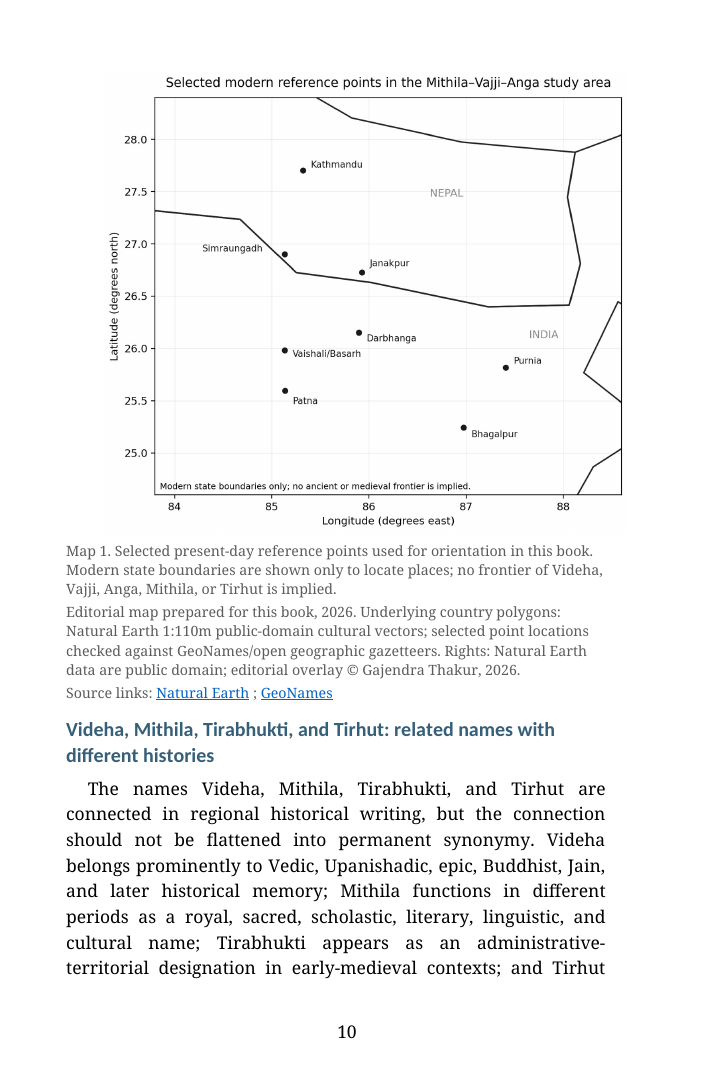
Mithila · Vajji · Anga
Chapter-specific source notes
- Primary chapter witness. Gajendra Thakur, Decoding the Panji of Mithila — Volume III, formal Chapter 10, PDF pp. 112-128; formal Chapter 10. The HTML transcription is generated from the commit-pinned source PDF and retains the chapter boundary recorded in this edition.
- Internal structure. The repository source-heading inventory records 15 subordinate headings for this chapter: “Index Link Box”; “Chapter overview”; “Entry 15: Jonki-Sarisab and the opening of Badhiyam-Pavoli”; “Entry 16: Ujan Haladhar Jha, Badhiyam-Ujan, and Sharadapur”; “Entry 17: Badhiyam and the expansion through Umanand”; “Entry 18: Badhiyam, Parvapalli, and the Vijay Govind Singh route”; “Entry 19: Badhiyam-Parvapalli and the Kamaladatt-Janakidatt-Girjadatt lines”; “Entry 20: Badhiyam-Rupouli and the Jhalhan-Ruchouli-Karamha line”; ….
- Digital editorial method. The page keeps the preserved source text distinct from generated navigational, concordance, visual, and provenance apparatus. The synthetic reconstruction is explanatory only and is not evidence for an individual lineage or a determination of social or marital status.