Decoding the Panji of Mithila · Volume III · Chapter 11
Entries 25-40 - Sarisab, Bhaduar, Chapahi, Soderpur, Lalganj, and Ramnagar Index Link Box Index cluster: सरिसब / भदुआर / चपाही / सोदरपुर / बेहट / लालगंज / तारनगर / रामनगर
Chapter 11
 Entries 25-40 - Sarisab, Bhaduar, Chapahi, Soderpur,
Lalganj, and Ramnagar
  Index Link Box
Index cluster: सरिसब / भदुआर / चपाही / सोदरपुर / बेहट / लालगंज / तारनगर / रामनगर

ड्योढ़ी / पूर्णियाँ / गढ़बनैली.
Khand 2 source entries decoded: 25-40.
Principal source heading forms: “उ.टी. सरिसब-सरिसब”; “उ.टी. सरिसब, भदुआर”; “उ.टी.

सरिसब, चपाही”; “उ.टी. सरिसब सोदरपुर चपाही”; “उ.टी. सरिसव सोदरपुर उजान”; “उ.टी.
सरिसब सोदरपुर-बेहट”; “उ.टी. सरिसब सोदरपुर-लालगंज”; “उ.टी. सरिसब सोदरपुर-तारनगर
रामनगर ड्योढ़ी पूर्णियाँ”; and “उ.टी. सरिसब-रामनगर ड्योदी, लालगंज, गढ़बनैली.”
Index roots and routes: सरिसब-root and सोदरपुर-root control the chapter; internal movement

passes through भदुआर, चपाही, पाहीटोल, बेहट, लालगंज, रामनगर ड्योढ़ी, तारनगर, पूर्णियाँ ,

गढ़बनैली, करमहा, पाली, दरिहरा, माण्डर, हरिअम्ब, नरउन, खण्डबला, घुसौत, बुधवाल,
वलियास, खौआल, सकराढ़ी, सुरगन, एकहरा, कु जौली, अलय, पण्डुआ, नडुआर, महिषी, and
related marriage/status fields.
Coverage status: Entries 25-40 decoded in this chapter. Entry 40 is a bare or blank heading in the
supplied reading; the next active cluster begins at Entry 41 with दिगउन्ध-सोदरपुर and will be

treated in Chapter 12.

Chapter 10 ended with Badhiyam, Parvapalli, Rupouli, and
Badka Gam. Chapter 11 returns to the Sarisab-Soderpur field,
but this is not a backward step. In the Panji, a branch may
move outward and then return through another related entry.
The movement is circular only to a modern eye. In the register
it is controlled by descent, village, marriage, title, and branch-
continuity.

    The Index places Sarisab and Soderpur among the
controlling anchors of this volume. Sarisab is linked with
Khanguṛ, Sakuri, and Jonki; Soderpur is linked with Sarisab,
Digaunth, Kanhauli, Mani, Hati, Teterihar, and Katka. Chapter
11 works inside this double field. The entries begin with

                          Decoding the Panji of Mithila, Volume III | Page 127
                    Decoding the Panji of Mithila Volume III

Sarisab-Soderpur material, then move through Bhaduar,
Chapahi, Behat, Lalganj, Ramnagar Deorhi, Purnia, and
Garhbanaili. Each place must be read as a genealogical
coordinate, not merely as an address.

   The method is the same as in the previous chapters. The
source must be opened unit by unit. A heading gives the first
field. A name gives a person. A father-name gives descent. A
village after सँ gives relation. A daughter-link gives marriage
movement. A title marks scholarship, office, status, or branch
identity. A cross-reference number keeps the line attached to
another part of the register. When all of these are read
together, the long Sarisab-Soderpur cluster becomes clear.

  Chapter overview
   Entries 25-40 form a large Sarisab-Soderpur expansion.
Entry 25 renews the Sarisab-Soderpur line. Entry 26 opens the
Bhaduar path and includes a modern professional layer. Entry
27 continues Sarisab through Darhara, Naruan, Pali, Ekhara,
Mandar, Karamha, and several scholarly or Babu-linked
branches. Entry 28 opens Chapahi and shows several
daughter-routes into Surgan, Mandar, Lohna-Sakaradhi,
Karamha, Budhwal, and Kujouli. Entries 29-30 carry the line
toward Soderpur, Chapahi, Ujan, Gangadhar Mishra, and
Vidyadhar Mishra. Entries 31-32 move to Behat and preserve a
dense Soderpur-linked branch with modern academic titles.
Entries 33-39 carry the Lalganj, Ramnagar Deorhi, Purnia, and
Garhbanaili expansion. Entry 40 is blank or unexpanded in
the supplied text and must be recorded honestly as such.

   The chapter is long because the source itself is not one
straight line. It repeatedly opens a person, then follows a
daughter-link, then introduces an अपरा branch, then returns to
a son-line, then cites another village, then brings in a title or

                Decoding the Panji of Mithila, Volume III | Page 128
                    Decoding the Panji of Mithila Volume III

status-bearing house. The reader must not demand a modern
chart too soon. The prose decoder should first separate the
units, then show how the units join into route-memory.

  Entry 25: Renewal of the Sarisab-Soderpur cluster
   Entry 25 begins with “उ.टी. सरिसब-सरिसब” and then opens “अथ
सरिसब सोदरपुर ग्राम.” The heading shows a renewal of the Sarisab
field through Soderpur. Ratnakar’s daughter-linked group -
Hridaynath, Modnath, and Narayanadatt - is connected with
Mandar, Bhadai, and Bhavesh, then with Pali and Vidyadhar.
This is the first sign that the renewed Sarisab entry
immediately depends on marriage and external village routes.

   Hridaynath’s son Bhiravan moves through Khoaāl-
Pitambar-Chhabnu and Soderpur-Mahesh. Bhiravan’s son
Gopal moves through Sakaradhi-Ranganath-Nakṭu and Pali-
Dharmanand. An अपरा unit from Bhiravan opens a daughter-
linked route to Karamha-Fakir-Yoganand and then Sakaradhi-
Nakṭu. This shows the governing rule of the chapter: the same
father-line can produce both direct descent and daughter-
linked expansion.

   The next unit gives Bhiravan’s sons Luchai/Premnath,
Keshi/Nandipati, and related lines. Luchai’s son Dwarikanath
moves toward Naruan-Umanath-Gopal and Sakaradhi-Jhau.
His daughter-link moves through Mandar-Bhavnath-Govind
and Sakaradhi-Badri. Bhaiyan/Riddhinath’s sons Revathinath
and Gopinath carry the line into Naruan-Durivaya-Buddhikar
and Khoaāl-Modnath. Revathinath’s son Bhavnath then moves
through Mandar and Babujan-Harshnath.

   The same entry contains several important status signals.
Khandbala appears with Babu Prajapati Singh. Pali appears
with Dharanath and Vindhyanath. Naruan appears with
Saraswati and Rudrapati. Ekhara appears with Bacha and
                Decoding the Panji of Mithila, Volume III | Page 129
                    Decoding the Panji of Mithila Volume III

Tirthadatt. The titles and place-links do not stand outside the
genealogy; they are the way the register distinguishes the
branch. The source also preserves blank segments, and those
gaps should remain visible rather than being repaired by
conjecture.

  Entry 26: Bhaduar, Pahitola, and modern professional
identifiers
   Entry 26 carries the heading toward Bhaduar, with Sarisab-
Soderpur and Pahitola in the line. Lakshman Mishra and
Dinesh open the entry; Dinesh’s sons Ajay, Sanjay, and Vijay
appear with Bhagirath. The entry quickly moves to Lilanath’s
daughter-link, which connects with Khandbala and Maharaj
Bahadur Chhatra Singh. The title Maharaj Bahadur is a status-
bearing marker and should be preserved in the explanation.

   Bhaiyan/Radhapati’s son Madhusudan moves through
Harianb-Shyamlal-Ranglal and Surgan-Rai Ramnarayan.
Shambhupati/Baldev’s son Lakshman moves through
Karamha-Shivanand-Vishwanand and Darhara-Indranand.
Indranand leads to Achyutanand and Nandalal, who are
linked with Budhwal-Narpati-Dullah and Darhara-
Durbhanjan. Each of these places is a route point, not an
address list.

   The entry becomes especially important when Lakshman’s
daughter-linked group appears: Chetanath, Mahesh, Dinesh,
Ramesh, chief engineer Suresh, and Ghanesh. The source
preserves modern professional marks such as a bank
chairman and a chief engineer. These modern identifiers do
not displace the old Panji structure. They are a later
documentary layer added to the same descent and marriage
framework.

                Decoding the Panji of Mithila, Volume III | Page 130
                    Decoding the Panji of Mithila Volume III

   Through Behat-Karamha the line reaches Babunath,
Jayanath, and Khandbala-Taranath. Chetanath’s sons Shivnath
and Bhavnath move through Karamha-Baldev-Jaydev and
Khandbala-Babu Ghaneshwar Singh. Ramesh’s daughter-
linked group Devash, Shailesh, and Mithilesh moves onward,
and engineer Suresh leads to Rajiv Ranjan and Pandit
Baidyanath. Entry 26 therefore shows how a Panji line can
carry medieval-style formulae and modern offices in the same
genealogical breath.

  Entry 27: Sarisab continuation and the scholar-status
branch
   Entry 27 continues Sarisab after the Bhaduar movement.
Pinaknath is first linked through Darhara-Yadunath-
Abhayanath and Harianb-Dhir. His son Damarunath moves
through Darhara-Devanarayan-Shrinarayan. Shrinarayan and
Sahadev lead toward Naruan-Gangadatt-Teknath, with a
daughter-linked route through Khoaāl-Durbhanjan-
Devkrishna and Naruan-Kalanidhi. The recurrence of Naruan
is significant because it links the Sarisab-Soderpur field to
later Naruan-root chapters.

   Shrinarayan’s line then moves toward Ekhara-Bhavadatt-
Damodar and Soderpur-Bachkan. Shrikant’s daughter-linked
line goes through Pali-Chandeshwar-Rameshwar and Valias-
Nidhi-Thitharu. Rameshwar’s daughter-link returns through
Mandar-Hridaydatt-Kishori and Khandbala-Babu Ramapati
Singh to Babu Punyapati Singh. Here the double Babu marker
and Khandbala link identify a status-bearing house inside the
Sarisab continuation.

   The entry also contains Ramakant/Viku, Harianb-
Harshnath-Shambhunath, Sarisab-Jhotahu, and a route
through Mandar-Jalghar-Khadgi and Naruan-Bholanath.
Jivanath’s line brings Jankinath, Bhaiyan, Kashinath, Harianb-
                Decoding the Panji of Mithila, Volume III | Page 131
                    Decoding the Panji of Mithila Volume III

Shivnath-Narayan, and Khandbala-Shivram. Jankinath’s sons
Lakshminath and Nanu/Dharmanath move into Budhwal-
Raghunath-Kalanath and Soderpur-Murlidhar. The reader
must preserve these chains because repeated names such as
Jankinath, Lakshminath, and Dharmanath are distinguishable
only through village and title context.

   The entry closes with several important scholarly signs.
Dharmanath’s daughter-link moves to Ekhara-Bacha-
Tirthadatt and Sarisab-Pandit Thotha. Another line marks
Vaiyakarana Shobhnath and Mahinath through Ekhara-
Bacha-Taradatt and Naruan-Lakshminath. Another branch
carries Narnath through Mandar-Chethdu-Durganath and
Karamha-Saheb. The title वैया. or Vaiyakarana should not be
removed; it identifies a learned branch and prepares the title
index of the finished volume.

  Entry 28: Chapahi and the multiple daughter-routes
   Entry 28 opens the Chapahi branch. Durivaya’s son Mohan
moves through Darhara-Durgadatt-Devidatt and Naruan-
Meghnath. An अपरा unit from Shobhnath’s daughter-link
moves toward Surgan-Raja Rupnarayan. Raja Rupnarayan’s
sons include Sonmani/Kamanarayan and Vedanarayan; the
line then reaches Khandbala-Revathinath-Shyamnath,
Mandar-Jamahir, and Harianb-Dullah. The royal title Raja is
an identifying branch marker, not a literary flourish.

   A second daughter-link from Shobhnath moves through
Mandar-Vechan-Totai, and Totai’s son Vanshilal reaches
Naruan-Tirthadatt-Lakshmidatt and Soderpur-Arvi. A third
daughter-link moves through Lohna-Sakaradhi-Amritnath-
Govind and Ekhara-Mahamahopadhyaya Gangesh. The title
Mahamahopadhyaya must be preserved. It identifies a major
scholarly memory within a marriage route.

                Decoding the Panji of Mithila, Volume III | Page 132
                        Decoding the Panji of Mithila Volume III

   Dwarikanath’s daughter-link moves through Mandar-
Thothi-Balah and then through Sarisab-Prannath-Pandit
Amritnath and Ghosaut-Mahidhar. Narnath’s daughter-link
moves through Karamha-Mahamahopadhyaya Subodh and
Ishdatt. The text then follows Ishdatt, Bholi, Khandbala-
Revathinath-Hemnath, and Harianb-Dullah. This compact line
is one of the chapter’s examples of how scholarship, place,
and daughter-link are interwoven.

   The later part of Entry 28 introduces Chhabnu and his
daughter-linked lines. Arvi, Thothi, and Bachchi move through
Budhwal-Narayan-Harishwar and Soderpur-Fakir. Another
daughter-linked group - Rudraghar, Kirtighar, and Chitradhar
- moves through Harianb-Shivnath-Narayan and Khandbala-
Shivram. Arvi moves through Darhara-Gopal-Vaidik Jivanath
and Sarisab-Ratnakar. Thothi moves through Pali-
Lakshmidev-Deonath and Naruan-Hasanu. The entry closes by
moving toward Karamha, Soderpur, Mandar, and Kujouli,
showing that Chapahi is an intersection rather than an
isolated village.

  Entry 29: Chapahi, Dayanath, Shrishnath, and Kanhauli-
Soderpur
   Entry 29 continues “Sarisab Soderpur Chapahi” and names
Dayanath and Shrishnath in the heading field. The entry
begins through Jhadula’s son Natthu, then moves to
Khandbala-Gunanand-Manikrishna and Mandar-Ishannath.
Natthu’s daughter-link goes to Pali-Deonath-Hibharan and
Soderpur-Babunath. Dayanath’s son Shankar then moves
through Pali-Krishna-Gangadhar. This is a typical Panji shift: a
heading names one field, but the body immediately follows
kinship routes into several villages.

   Kanhai’s sons Shrishtighar and Krishna move through
Soderpur-Chalbali-Premnidhi. Premnidhi’s daughter-link goes
                    Decoding the Panji of Mithila, Volume III | Page 133
                      Decoding the Panji of Mithila Volume III

to Harianb-Bhavkrishna-Dullah; Dullah’s sons Amritnath and
Lal move to Sarisab-Chaturbhuj-Vanshidhar and Valias-
Khagapati. Krishna or Gangadhar/Babuji moves through
Soderpur-Ishannath-Manohar. The familiar name Babuji after
Gangadhar is part of identification and should be preserved.

   The entry also contains Soderpur-Dalpati, Kanhauli-
Soderpur-Someshwar-Bhairav, Darhara-Vishnudatt-Gehnath,
and Sarisab-Vishram-Kariya. The Kanhauli-Soderpur phrase is
especially important because the Index links Soderpur with
Kanhauli as part of the same root field. Bhairav’s daughter-
linked group - Nirsu, Indranand, and Parmanand - moves
through Khoaāl-Sufal-Yuvraj and Harianb-Khagdatt.

   A final movement in Entry 29 brings Jivanath Mishra, Pali-
Harshi-Bachchan/Khagnath, Khandbala-Shri Nandan, and
Mandar-Bhuvanpati-Ram. Loknath’s daughter-link includes an
Ujan-resident reference and blanks. This must be stated
carefully: the source records Ujan-resident movement but
leaves some intervening names missing. The decoder should
describe the route but should not invent the omitted persons.

  Entry 30: Ujan, Gangadhar Mishra, and Vidyadhar Mishra
   Entry 30 is introduced in the supplied text with a
numbered note: “उ.टी सरिसव सोदरपुर उजान गंगाधर मिश्र, सरिसब विद्याधर मिश्र.”
This heading announces a Sarisab-Soderpur-Ujan route
through Gangadhar Mishra and Vidyadhar Mishra.
Murlidhar’s daughter-link moves through Budhwal-Kalanath-
Jayanath and Darhara-Bhavnath; an अपरा daughter-link moves
through Valias-Mani-Son and Khandbala-Indeshwar.

   Butan’s line opens Gangadhar through Mandar-
Ghananand-Rupnath and Karamha-Muni. Gangadhar’s
daughter-link moves through Sakaradhi-Dullah-Devidatt and
Pali-Durivaya. Kirtidhar’s line opens Bhudhar and Bachkan
                  Decoding the Panji of Mithila, Volume III | Page 134
                      Decoding the Panji of Mithila Volume III

through Darhara-Vaidik Jivanath and Sarisab-Ratnakar. The
title Vaidik is important because it marks ritual or learned
identity in the line.

   Bhudhar’s son Damodar moves through Karamha-Kalar-
Veni and Mandar-Lakshminath. Bhudhar’s daughter-linked
routes move to Naruan-Umanath-Gopal, Alay-Raja Dular
Singh, and Kujauli-Kulpati. The text marks multiple अपरा units,
showing that Bhudhar’s line is not single. It spreads through
marriage and estate-linked status routes, especially Alay and
the Raja title.

   Chitradhar’s daughter-linked group - Punyaghar,
Bhuvandhar, Vedbhar, Jivdhar, Tejdhar, and Devdhar - moves
through Karamha-Bhavdev-Durbhanjan and
Darhara-Vidhu/Devanath. Punyaghar’s daughter-link goes to
Mandar-Hirai-Thothi and Karamha-Chhotkani. Another route
goes through Valias-Vidyanath-Dharmadatt and Karamha-
Hemnarayan. Another route moves to Oini and the royal line
of Raja Fatehnarayan and Raja Girdhanarayan. This entry
therefore links Sarisab-Soderpur-Ujan with learned, royal, and
marriage networks.

  Entry 31: Sarisab-Soderpur-Behat
   Entry 31 opens “उ.टी. सरिसब सोदरपुर-बेहट.” The Behat movement
begins from Nikānand’s line through Falanand, Pabouli-
Bhaiya-Hridaymani, Mandar-Bhavnath, and then Lambodar’s
daughter-linked route to Naruan-Mitrnath-Kandu/Radhanath
and Khandbala-Babu Guneshwar Singh. This entry shows
Behat as a route label rather than a closed village history.

   An अपरा branch from Lambodar opens Jatadhar and
Kaladhar through Valias-Thedani-Damodar and Budhwal-
Bachcha. Jatadhar’s daughter-link moves through Mandar-
Babujan-Mannu/Harshnath and Pali-Vindhyanath. Kaladhar’s
                  Decoding the Panji of Mithila, Volume III | Page 135
                   Decoding the Panji of Mithila Volume III

sons Haladhar and Vanshidhar move through Khoaāl-Kari-
Badrinath and Khandbala-Babu Bheshdhari Singh. Again the
Babu title helps distinguish a status-bearing Khandbala
branch.

   Vedghar’s daughter-linked group - Gadadhar, Shashidhar,
Shambhudhar, Vaiyakarana Nanu/Dayadhar - moves through
Harianb-Meghnath-Balah and Soderpur-Bhiravan. Gadadhar’s
daughter-link reaches Karamha-Yagaddhar-Babujan and
Naruan-Chitranath; another route goes to Pali-Babu Kalanath
and Soderpur-Jhotan. Shashidhar’s daughter-link moves to
Valias-Jaga-Manhar, Khandbala-Ratneshwar-Indreshwar, and
Darhara-Shobhakar. The entry should be decoded as a Behat-
labeled network of Sarisab-Soderpur relations.

  Entry 32: Continuation of Behat and the modern academic
layer
   Entry 32 continues from Entry 31 rather than opening a
wholly new root. It begins with Markandey and Soderpur-
Jagdish, then follows Rajkumar and Sanjay Kumar through
blank or unfilled lines. Lekhdhar’s son Yugadhar moves
through Valias-Govardhan-Janardan and Khandbala-
Chumman Singh. Yugadhar’s daughter-link goes to Mandar-
Dinbandhu-Vaiyakarana Jivanath and Soderpur-Motinandan.
The Vaiyakarana title again marks a learned line.

   Nanu/Dayadhar’s son Eshdhar moves through Karamha-
Keshav-Lanhi and Pabouli-Dharmanand. An अपरा branch
opens Giridhar and Kirtighar through Mandar-Falahari.
Falahari’s line then reaches Naruan-Bhavnath-Mitrnath and
Harianb-Dullah. The daughter-linked group of Falahari -
Baldev, Vasudev, Bachchi/Hemkrishna - moves through
Khandbala-Gopal-Raghupati and Khoaāl-Dharmanath.

               Decoding the Panji of Mithila, Volume III | Page 136
                    Decoding the Panji of Mithila Volume III

   A third branch from Nanu/Dayadhar moves through
Darhara-Ghananand-Girijanand and Karamha-Fakir-
Bheshdatt. Bheshdatt’s son Hemnath moves through Darhara-
Harinath-Kishornath; Kishornath’s daughter-link goes to Pali-
Durivaya-Atmaram and Surgan-Raja Shrinarayan. This route
shows how a Sarisab-Soderpur-Behat entry can reach the
Surgan royal field through a daughter-linked chain.

   The most modern layer of Entry 32 appears with
Gangadhar’s line and Professor Anand. Bhuvaneshwar,
Bagat/Gangadhar, Budhwal-Parashmani-Bhuvaneshwar,
Khandbala-Babu Ganeshdatt Singh, and Karamha-Jalpādatt-
Fakir all lead toward a modern academic identity: M.A. in
Hindi, Maithili, Economics, and head of the Patna College
department. This information must not be discarded because
it identifies a person in a crowded lineage. It should be treated
as a later documentary title within an older Panji frame.

  Entry 33: Lalganj begins through Parivaya and scholarly
branches
   Entry 33 opens “उ.टी. सरिसब सोदरपुर-लालगंज.” Raghav’s son
Parivaya/Jankinath moves through Budhwal-Lakshmidev-
Mahesh and Khandbala-Soni. An अपरा route from Parivaya
moves to Sakaradhi-Bhavanand-Chhatrapati and Pali-
Lakshmikant. Another daughter-linked group -
Kanhai/Ganganath, Hemnath, Dhirnath, Mahamahopadhyaya
Durganath, and Ratinath - moves through
Karamha-Sadu/Jagannath-Venidatt and Sarisab-Pandit
Babanu. These titles mark learned status inside the Lalganj
route.

   Another अपरा branch from Parivaya opens
Chhotku/Yagyanath and Mahamahopadhyaya Gopinath
through Naruan-Vishweshwar-Gangadatt and Pali-Durgadatt.

                Decoding the Panji of Mithila, Volume III | Page 137
                      Decoding the Panji of Mithila Volume III

Kanhai’s son Vanshamani moves to Alay-Raja Dular Singh and
Sarisab-Bhaiyan. Hemnath’s daughter-linked branches move
through Budhwal-Deonath-Mahamahopadhyaya Krishnadatt,
Pabouli-Kavi Bholan, Ghosaut-Kalanath-Nanu, Soderpur-
Hridaynath, and Karamha-Gangadatt/Ugradatt. This is a
strong example of scholarly, poetic, and royal memory joined
to genealogy.

   The entry continues through Mahamahopadhyaya
Jayanath, Yadunath, Ambikanath, Harianb-Girijanath-
Keshilal, Darhara-Yagyanarayan-Vidyanath, Soderpur-
Thithar-Babujan, and Karamha-Radhanath-Kantir. The final
lines open Anantanand/Shaktinath, Kashinath, Goloknath,
Gokulnath, Poshnath, and Sadanand, then lead to Darhara-
Lilanand-Chanchal and Naruan-Eknath-Jagannath. The source
then moves to the next entry through Ramnagar Deorhi and
Purnia.

  Entry 34: Tarnagar, Ramnagar Deorhi, Purnia, and the
status house
   Entry 34 is headed “उ.टी. सरिसब सोदरपुर-तारनगर रामनगर ड्योढ़ी पूर्णियाँ.”
The heading is an important status route. It does not simply
add place names; it signals movement from Sarisab-Soderpur
into Tarnagar, Ramnagar Deorhi, and Purnia. The term ड्योढ़ी
points to a recognized house or estate seat, and Purnia
expands the route into a wider regional field.

   The entry begins with daughter-linked routes from
Premnath, Vijaynath, Virendranath, and Poshnath. Many of
these contain missing names, but the structure remains
visible. Poshnath’s daughter-linked group - Kalanath,
Indranath, Punyānath, and Chitranath - moves to Karamha-
Motidatt-Jhalanand and Darhara-Lakshminath. Gokulnath’s
daughter-linked group - Lalitnath, Parthivnath, and Mitranath

                  Decoding the Panji of Mithila, Volume III | Page 138
                     Decoding the Panji of Mithila Volume III

- moves through Pali-Piyushnath-Chetnath. These routes show
how the Lalganj field continues into multiple daughter-lines.

   The status-bearing movement becomes clear with
Goloknath’s daughter-linked group, which includes
Ravindranath and Narendranath, then reaches Nanduar-
Karamha and Raja Tanknath’s daughter-linked Kumar
Rudranath Chaudhary, with another link to Narsam-Valias-
Aniruddh. Gosain/Lakshminath’s daughter-link moves to
Naruan-Babu Manmohan-Tejnath and Soderpur-Bhuvandhar.
Another Gosain branch reaches Alay-Raja Shri Nandan Singh,
and through Rudranand Singh and Khandbala-Shyamu the
line becomes a recognized status route.

   The entry also includes Tantrik Babu Nityanand Singh,
Sarisab-Nanu-Pandit Jagaddhar, and Pali-Kamaladatt. Later,
Bheshnath/Kalar’s son Harshnath/Shrikrishna reaches
Naruan-Chumman-Bankhandi and Soderpur-Shakranath. An
अपरा daughter-linked route from Bheshnath introduces D.G.P.
Bhimnath, Buddhinath, and Ravaneshwarnath, then Alay-Raja
Padmanand Singh and Kumar Chandranand Singh. This is an
especially clear example of modern public status entering a
Panji line without breaking genealogical structure.

  Entry 35: Ramnagar Deorhi, Lalganj, Garhbanaili, and
public offices
   Entry 35 continues “सरिसब-रामनगर ड्योढ़ी, लालगंज, गढ़बनैली.” It
begins with Anmol, Chhabinath, and Devinath through Valias-
Bhaiyo-Chandeshwar and Soderpur-Shivnandan. Anmol’s
daughter-link reaches Pude-Naruan-Balbhadra-Virbhadra and
Pali-Ram. D.G.P. Bhimnath’s daughter-linked group -
Amarnath, Samarnath, Shekharnath, Mihirnath, and
Shishirnath - moves through Darhara-Lal-Ramanand. The title

                 Decoding the Panji of Mithila, Volume III | Page 139
                    Decoding the Panji of Mithila Volume III

D.G.P. must be kept because it identifies a modern status layer
in the genealogy.

   Ramanand’s daughter-linked group - Shyamanand,
Ratnanand, Sharadanand, and editor Hiranand - moves
through Alay, Sahitya Saroj Raja Kamalanand Singh, and the
royal Alay line. The word editor and the title Sahitya Saroj are
important because they show literary and public recognition
entering the record. Raja Shri Nandan Singh’s sons Kumar
Kamalanand Singh and Kumar Kalikanand Singh lead to
Soderpur-Nandishwar-Murli and Ghusaut-Ram.

   The entry then records Kumar Kamalanand Singh’s
daughter-linked group with several public identifiers:
education minister, vice-chancellor, Hindu Mahasabha
president, Swaraj Party member, and the names Kumar
Ganganand Singh, Ambikanand Singh, and Achyutanand
Singh. These should be treated as title/status evidence, not as
biographical ornament. The genealogical formula still controls
the line through Mandar-Ramdhan-Thithar and Khandbala-
Jirakhan.

   Further routes in Entry 35 include Babu Ravaneshwar
Nath, Belauch-Kumar-Brajmohan, Khandbala-Harinandan,
Harianb-Meghnath-Prabhunath, Naruan-Kulpati/Banka
Umanath, Karamha-Deonath, and several Gonu/Phaninath
lines. The entry later reaches Raja Kalanand Singh, Kumar
Ramanand Singh, Kumar Krishnanand Singh, Khoaāl-
Venidatt-Vanshamani, Soderpur-Ishannath-Gudar, and
Karamha-Hemnarayan. This makes Entry 35 a major node for
literary, political, royal, and marriage memory.

  Entries 36-38: Lalganj and the scholarly-branch expansion
   Entry 36 continues the Sarisab-Soderpur-Lalganj route.
Mahoshobhnath’s son Buddhinath moves through Darhara-

                Decoding the Panji of Mithila, Volume III | Page 140
                    Decoding the Panji of Mithila Volume III

Lokanand-Mokshanand and Karamha-Govardhan. Lalitnath’s
sons Yagyanath, Kailash, and Subhash move through Harianb-
Bhola-Ramnath and Khandbala-Nripateshwar. The daughter-
linked lines of Yagyanath, Kailash, and Subhash contain gaps,
so the structure is visible but not all names are recoverable.

   Nenān/Nityanath’s daughter-linked group -
Hanuman/Kirtinath, Muktinath, and Harshnath - moves
through Pali-Chandeshwar-Rameshwar and Mandar-Kishori.
Harshnath’s daughter-linked group - Setunath, Hetunath, and
Rithunath - moves through Budhwal-Nayanmani-Tirthamani
and Sarisab-Rashpati. Hedambnath’s daughter-linked group
includes Indunath and Vindunath; the route moves through
Naruan-Baidyanath-Brajnath and Soderpur-Damodar. These
names must be indexed because several recur in other
clusters.

   Entry 37 keeps Lalganj attached to Sarisab-Soderpur.
Mahojagdish’s son Nandinath moves through Pali-Shrinath-
Kumudnath and Khandbala-Babu Vanshdhari Singh.
Nandinath’s daughter-linked group - Umanath, Ramanath,
Indranath, Sindhunath, and Kamalnath - moves through
Budhwal-Bhaiyo-Nenmani. Durganath and Ravinath then
move through Naruan, Harianb, and Soderpur. This entry is
another example of how the same Lalganj route repeatedly
crosses into other root fields.

   Entries 37-38 also contain dense scholarly markers:
Mahamahopadhyaya Sudan, Vaiyakarana
Mahamahopadhyaya Shashthinath, Mahamahopadhyaya
Veninath, and other title-bearing figures. Their daughter-
linked lines move through Darhara-Garibanand-Ghananand,
Khandbala-Ramapati Singh, Naruan-Raghubar-Revathinath,
and Mandar-Bhuvanpati. Entry 38 continues the same thread
through Jayatrinath, Khadganath, Punyanath, Kumudnath,
                Decoding the Panji of Mithila, Volume III | Page 141
                     Decoding the Panji of Mithila Volume III

and Beni-related branches. The key point is that title and
descent must remain together.

  Entries 39-40: Closing Lalganj and the blank entry
   Entry 39 is short but meaningful. It is headed “उ.टी. लालगंज.”
Gopinath’s daughter-link moves toward Naruan-Jahli-
Durivaya. An अपरा route from Durivaya’s daughter-link
reaches Khandbala-Maharaj Madhav Singh and Naruan-
Gokul. The brevity of the entry does not make it unimportant;
it records a closing Lalganj route into Naruan and Khandbala
status memory.

   Entry 40 appears in the supplied source as “उ.टी. लालगंज”
without an expanded genealogical body before Entry 41
begins. This must be treated as a blank or unexpanded entry,
not silently filled. The correct editorial note is that Entry 40 is
present as a numbered Lalganj heading, but no complete line
is visible in the supplied reading. It should remain in the
coverage register as decoded for location and status, with
content marked as absent or unexpanded.

  Cross-reference and route map for Entries 25-40
   The principal route of the chapter is Sarisab-Soderpur.
From that root the chapter moves through Bhaduar, Chapahi,
Pahitola, Behat, Lalganj, Tarnagar, Ramnagar Deorhi, Purnia,
and Garhbanaili. Internal links connect the chapter to Pali,
Karamha, Darhara, Mandar, Harianb, Naruan, Khandbala,
Ghusaut, Budhwal, Valias, Khoaāl, Sakaradhi, Surgan, Ekhara,
Kujouli, Alay, Pandua, Nanduar, and Mahishi. These should all
be carried into the Place Index with entry numbers and
functional roles.

   The title map is also unusually rich. The chapter includes
Pandit, Vaidik, Vaiyakarana, Mahamahopadhyaya, Babu,

                 Decoding the Panji of Mithila, Volume III | Page 142
                        Decoding the Panji of Mithila Volume III

Maharaj Bahadur, Raja, Kumar, D.G.P., editor, Sahitya Saroj,
education minister, vice-chancellor, Hindu Mahasabha
president, Swaraj Party member, chief engineer, bank
chairman, professor, and M.A. markers. These titles should
not be separated from genealogy; they identify the person
within the branch and show how scholarship, public status,
and estate memory entered the Panji.

   The reference-number map contains many उ.टी., शा., slash-
number, and mixed-number forms. Examples include ९२//१०४,
१११/११, ४५/१२, ६३/०२, १०२/०३, ९१/०३, ३४/१०७, ११९/०३, १६४/०८, ९७/०२, १८१/०६,
७६/०, १०३/१०, १९८/०५, and others. These numbers must be copied
as source references and not normalized into a single style.

  Important uncertainties
   The chapter contains many “. . .” gaps. Some gaps occur
after daughter-links, some inside son-lines, and some before
village references. A gap does not erase the route. It means the
source preserves the shape of the connection but not all
names. The proper decoding should state what the visible
formula permits and stop there.

   Several headings also carry variant or partially broken
forms: सरिसव/सरिसब, सोदारपुर/सोदरपुर, ड्योदी/ड्योढ़ी, गढ़बनैली, पाही
टोल/पाहीटोल, and other spellings. The chapter preserves source
variants but uses a standard heading form for navigation. The
later Place Index must collect these variants so that a reader
can follow the same place across entries.

  Research summary
   Entries 25-40 show the Sarisab-Soderpur field at full
complexity. The chapter includes ordinary descent, daughter-
linked marriage routes, collateral branches, scholar lines,
estate houses, modern professional identifiers, public offices,
                    Decoding the Panji of Mithila, Volume III | Page 143
                    Decoding the Panji of Mithila Volume III

and blank entries. It proves why the Panji cannot be read as a
simple father-to-son list. It is a network record in which each
name is placed by descent, village, marriage, title, reference
number, and branch-continuity.

   For researchers, the safest method is to begin with the
heading, then list the persons, then attach each village to the
nearest kinship unit. Daughter-links must be marked before
any family tree is drawn. Titles must be copied beside the
names to which they belong. Cross-reference numbers must
be retained exactly. Missing names must remain missing. This
method keeps the Sarisab-Soderpur-Lalganj-Ramnagar cluster
readable without making unsupported claims.

   The next chapter begins with Entry 41: the Puwaripar
Uptip from Digaunth and the Digaunth-Soderpur opening.
Chapter 12 will therefore continue the same method into
Digaunth, Gangoli, Navtol, Batouri, Bairi, Bhattpura, and
Kachhua. The line will keep moving into additional
settlements, scholarly branches, and marriage networks, and
the method will remain unchanged.

                Decoding the Panji of Mithila, Volume III | Page 144
                             Decoding the Panji of Mithila Volume III
Source structure and verification apparatus
Editorial source apparatus. This apparatus is descriptive, not interpretive. It records the source-controlled structure used to verify that this page corresponds to formal Chapter 11 of Decoding the Panji of Mithila — Volume III. The chapter text above is preserved from PDF pp. 128-146; formal Chapter 11 in the commit-pinned authoritative source. It is not merged with a neighboring chapter, appendix, annexure, or independent front/back-matter unit. The internal headings below come from the repository’s source-heading inventory and are retained as navigational and audit evidence; showing them here does not turn those headings into separate publications or add claims that are absent from the source.
Internal source headings
- Index Link Box
- Chapter overview
- Entry 25: Renewal of the Sarisab-Soderpur cluster
- Entry 26: Bhaduar, Pahitola, and modern professional identifiers
- Entry 27: Sarisab continuation and the scholar-status branch
- Entry 28: Chapahi and the multiple daughter-routes
- Entry 29: Chapahi, Dayanath, Shrishnath, and Kanhauli-Soderpur
- Entry 30: Ujan, Gangadhar Mishra, and Vidyadhar Mishra
- Entry 31: Sarisab-Soderpur-Behat
- Entry 32: Continuation of Behat and the modern academic layer
- Entry 33: Lalganj begins through Parivaya and scholarly branches
- Entry 34: Tarnagar, Ramnagar Deorhi, Purnia, and the status house
- Entry 35: Ramnagar Deorhi, Lalganj, Garhbanaili, and public offices
- Entries 36-38: Lalganj and the scholarly-branch expansion
- Entries 39-40: Closing Lalganj and the blank entry
- Cross-reference and route map for Entries 25-40
- Important uncertainties
- Research summary
Source-text concordance
Entries · 25-40 · Sarisab · Bhaduar · Chapahi · Soderpur · Lalganj · Ramnagar · Index · Link · cluster · रनगर · मनगर · Khand · decoded · Principal · heading · forms · सब-सर · सब-र · roots · routes · सब-root · र-root · control · internal · movement · passes · करमह · नरउन · एकहर · related · marriage · status · fields · Coverage · Entry · bare · blank · supplied · reading · next · active · begins · treated · ended · Badhiyam · Parvapalli · Rupouli · Badka · returns · Sarisab-Soderpur · field · backward · step · branch · move · outward · return · another · circular · modern · register · controlled · descent · village · title · continuity · places · controlling · anchors · linked · Khanguṛ · Sakuri · Jonki · Digaunth · Kanhauli · Mani · Hati · Teterihar
Boundary verification. In the formal sequence this chapter follows Volume III Chapter 10, “Entries 15-24 - Badhiyam, Parvapalli, Rupouli, and Related Branches Index Link Box Index cluster: वढ़ियाम / पर्वपल्ली / रूपौली, with transitional support from जोंकी-सरिसब and” and precedes Volume III Chapter 12, “Entries 41-51 - Digaunth, Gangoli, Navtol, Batouri, Bairi, Bhattpura, and Kachhua Index Link Box”. The chapter extractor begins at the verified formal Chapter 11 marker and stops at the next verified formal chapter marker; for a final chapter it stops before recognized book-level back matter. The concordance above is generated only from distinct terms already present in this chapter’s preserved source text. It is provided for discovery, comparison, and audit, not as an automated judgment about persons, lineages, status, kinship, marriage eligibility, or historical truth.
Illustrated research apparatus
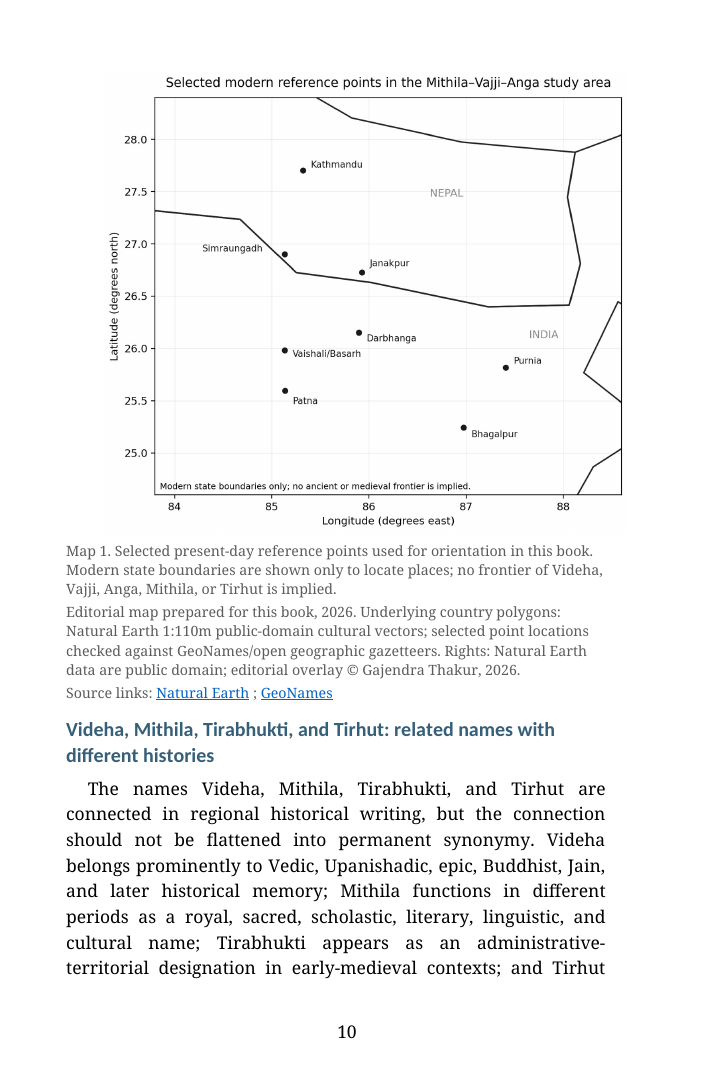
Mithila · Vajji · Anga
Chapter-specific source notes
- Primary chapter witness. Gajendra Thakur, Decoding the Panji of Mithila — Volume III, formal Chapter 11, PDF pp. 128-146; formal Chapter 11. The HTML transcription is generated from the commit-pinned source PDF and retains the chapter boundary recorded in this edition.
- Internal structure. The repository source-heading inventory records 18 subordinate headings for this chapter: “Index Link Box”; “Chapter overview”; “Entry 25: Renewal of the Sarisab-Soderpur cluster”; “Entry 26: Bhaduar, Pahitola, and modern professional identifiers”; “Entry 27: Sarisab continuation and the scholar-status branch”; “Entry 28: Chapahi and the multiple daughter-routes”; “Entry 29: Chapahi, Dayanath, Shrishnath, and Kanhauli-Soderpur”; “Entry 30: Ujan, Gangadhar Mishra, and Vidyadhar Mishra”; ….
- Digital editorial method. The page keeps the preserved source text distinct from generated navigational, concordance, visual, and provenance apparatus. The synthetic reconstruction is explanatory only and is not evidence for an individual lineage or a determination of social or marital status.