Decoding the Panji of Mithila · Volume III · Chapter 25
Full Glossary of Panji Terms Index Link Box Part Part IV - Tools for the Reader
Chapter 25
Full Glossary of Panji Terms
Index Link Box
Part Part IV - Tools for the Reader
Chapter purpose A working glossary of recurring Panji terms
needed to read Genome Mapping Volume I,
Khand 2.
Coverage base Terms drawn from the decoded Khand 2
source sequence, Entries 1-224.
Glossary fields Kinship, lineage, scholarly titles, social titles,
place-formulae, cross-reference markers,
Sanskritized endings, and Maithili genealogical
formulae.
Editorial rule Terms are explained for reading practice.
Uncertain abbreviations are marked as
uncertain instead of being silently expanded.
Next tool chapter Chapter 26 will separately treat
abbreviations and number keys such as उ.टी.,
शा., double slashes, and repeated references.
Chapter overview
The first twenty-four chapters decoded the full Khand 2
source sequence from Entry 1 through Entry 224. Chapter 25
changes function. It does not begin a new source-entry cluster. It
gives the reader a controlled glossary of the terms, abbreviations,
and formulae that recur throughout the Uptip Panji.
A Panji entry is compact because it assumes that the reader
already knows the grammar of the register. Words such as सुत,
सुता, अपरा, ग्रामारम्भ, उपटीप, उ.टी., शा., दौ, and द्दौ do much of the work.
Titles such as वैयाकरण, नैयायिक, मीमांसक, महामहोपाध्याय, बाबू, ठाकु र, राजा,
महाराज, डॉ., and प्रो. add status and historical context, but they do
not replace the genealogical structure.
This glossary is therefore practical. It explains what a reader
should do when one of these terms appears: follow a son-line,
Decoding the Panji of Mithila, Volume III | Page 268
Decoding the Panji of Mithila Volume III
follow a daughter-line, preserve a cross-reference, keep a place-
formula intact, or mark a dotted gap as an unresolved source
position. Where an abbreviation is uncertain or edition-specific,
the entry says so openly.
How to use this glossary
Use the glossary alongside the entry text, not as a substitute
for it. A term usually receives its meaning from its position in the
sentence.
Do not expand uncertain abbreviations beyond what the
source supports. In this glossary, 'probable' means useful for
reading, not final philological proof.
Do not normalize place names inside the source
transcription. Standard spellings can be supplied in indexes, but
the source spelling should remain visible.
Do not convert titles into modern biography unless the entry
itself supplies enough evidence. Titles help identify social,
scholarly, or public status; they do not authorize speculative life-
writing.
Do not fill dotted gaps. The sign '. . .' is part of the record and
must remain visible as an absence or damaged reading.
A. Source and structure terms
Term Basic sense Reading note
पंजी / Panji Genealogical register The record-system in which
family descent, marriage links,
village movement, titles, and
cross-references are
compressed into formulaic
entries.
उपटीप / Uptip Source subtype or register The principal label used in
label Khand 2. Treat it as a formal
register heading, not as an
ordinary adjective.
खण्ड Book or source division A large textual division. This
volume decodes Khand 2 of the
source sequence.
Entry number Running source unit The bracketed number
before a source passage. It is
the safest unit for citation and
Decoding the Panji of Mithila, Volume III | Page 269
Decoding the Panji of Mithila Volume III
cross-checking.
ग्रामारम्भ Village-opening formula Signals that the entry begins
a village or branch field: for
example, “अथ भौर रवण्डबला
ग्रामारम्भ”.
लिख्यते / लिख्यते : “is written/recorded” A source-opening formula
formula that introduces a named village
or branch field.
अथ Opening particle Marks the start of a new
source unit or subunit. It
should be preserved in
transcription.
फड़ / फड़े सँ Branch or sub-branch A local branch or
subdivision marker, used
where a line is being followed
from a particular branch.
शाखा Branch Indicates a lineage branch.
It may attach to a person, a
title-bearing line, or a village
cluster.
सन्तति Descendants Marks descendants or
continuation of a line. It should
not be treated as a single
personal name.
कु ल Family or lineage body Used in learned or social
compounds; it points to family
memory, not simply household
residence.
मूल Root/origin A root or origin label,
especially useful when
comparing the index to the
source entries.
क्रम / sequence Order of record The source order is
meaningful. A later index may
rearrange names, but the
source sequence should be
preserved.
B. Kinship and genealogical relation terms
Term Basic sense Reading note
सुत Son of The most common descent
marker. Read the name before
it as father or ancestor and the
name after it as the son in that
formula.
सुतौ Sons of Plural son-line marker. It
usually introduces multiple
Decoding the Panji of Mithila, Volume III | Page 270
Decoding the Panji of Mithila Volume III
male descendants from the
preceding person.
सुता Daughter or daughters of A daughter-line or
marriage-line marker. It often
leads to the village and family
into which the daughter-line is
connected.
पौत्र / पौत्री Grandson/granddaughter A generation marker. If
present, it should be preserved
because it changes the
generational reading.
कौ / का / क: Attached epithet or branch- Often follows a nickname,
name marker branch name, or identifying
form. Do not translate
mechanically; preserve and
interpret from context.
नी. Uncertain source Appears before some
abbreviation names. It should be preserved
unless the source tradition or
manuscript context fixes its
expansion.
प्र. Styled as / known as / A frequent abbreviation
probable name-marker before an alternate name or
style. It should be indexed but
not silently expanded beyond
the source.
प्रो. Professor A modern title. Unlike प्र.,
this one usually marks the
English-derived “Professor”
where the context is clearly
modern.
अपरा Another / further / collateral Introduces another son-line,
line daughter-line, or collateral
continuation. It is a major sign
for branch separation.
स्यैव / स्येव Same as previously A compact “same as
indicated above/same reference” signal.
Use it to avoid creating a false
new relation.
सँ From / by / linked through The main relational particle
in Maithili source formulae. It
links village, person, and
family relation.
दौ / द्दौ Marriage or relational A compact Panji marker
completion marker completing a relation, often
after the receiving
family/village. Preserve it in
transcription; read it as a
formula marker, not a personal
name.
Decoding the Panji of Mithila, Volume III | Page 271
Decoding the Panji of Mithila Volume III
कन्या-line Daughter-line pathway Not always named with a
single word. It appears through
सुता plus village and
receiving-family formulae.
वंश Lineage A larger descent frame. If a
name is called a वंश marker, it
should be indexed under
lineage, not only under
personal name.
C. Cross-reference and number markers
Term Basic sense Reading note
उ.टी. Uptip cross-reference A numbered cross-reference
inside the Uptip material.
Chapter 26 treats its number
patterns separately.
शा. Source cross-reference A recurring number label.
abbreviation Its exact expansion is edition-
specific, so the number should
be preserved exactly.
double slash, e.g. १०//० Compound or uncertain Preserve the double slash.
register number Do not silently convert it to a
single slash.
single slash, e.g. २४४/०९ Register-style number Usually a cross-reference or
source locator. It should be
copied exactly and compared
in the abbreviation chapter.
bracketed number Entry or sub-reference Numbers in parentheses
number can mark entries, branches, or
reference points. Their role
depends on position.
मो. न. Uncertain abbreviated Appears rarely and should
reference be preserved for later
abbreviation analysis.
... Gap, omission, or Never fill by conjecture.
unreadable source position Treat it as a real documentary
blank.
।। Sectional close or pause A strong
punctuation/closure sign. It
may divide sub-branches
inside an entry.
: Entry-opening or Frequently follows
explanation marker ग्रामारम्भ or a name. It helps
separate heading from body.
repeated reference Internal confirmation or If the same number recurs,
number repeated link preserve the repetition. It may
Decoding the Panji of Mithila, Volume III | Page 272
Decoding the Panji of Mithila Volume III
tie several branches to one
source reference.
D. Scholarly, religious, and intellectual titles
Term Basic sense Reading note
पंडित / पं . Learned scholar A learned-title marker. It
may indicate a named
scholarly household or
individual.
वैदिक Vedic scholar or Vedic- A learned or ritual status
status marker term. Keep separate from
ordinary personal names.
वैयाकरण Grammarian A scholarly title for a
grammar specialist.
महा वैयाकरण Great grammarian A heightened scholarly title.
It should be indexed under title
and under the person.
नैयायिक Nyaya scholar/logician A learned title connected
with Nyaya tradition.
मीमांसक Mimamsa scholar A learned title indicating
expertise in Mimamsa.
शास्त्रार्थ मार्तण्ड Major debate/scholastic title An honorific scholarly
designation; preserve as title
evidence.
महामहोपाध्याय High learned honorific Major Sanskritic scholarly
title. Often abbreviated as
म.म.उ. in the source.
म.म.उ. Abbreviation for Preserve the abbreviation
महामहोपाध्याय in source transcription; explain
in the glossary or title index.
आचार्य Teacher/scholar A learned or teaching title,
especially important when
attached to a named lineage.
भाषाविद् Linguist / language scholar Modern or scholarly title. It
belongs in the title index.
साहित्यकार Literary figure Modern literary status
marker. It should not be
confused with a family
surname.
कवि Poet A literary title. The entry
may preserve both name and
creative status.
सरसकवि Poetic honorific A stronger literary title;
index under scholar-title and
personal name.
Decoding the Panji of Mithila, Volume III | Page 273
Decoding the Panji of Mithila Volume III
समाजशास्त्री Sociologist Modern academic title,
often appearing with प्रो. or डॉ.
घटक Marriage A social-genealogical role. In
mediator/genealogical some contexts, it may be
functionary attached to a person as status
or profession.
नैष्ठिक Strict/observant learned or A status marker attached to
ritual designation some learned lineages.
Preserve without over-
expansion.
धर्मधुरीण Religious/scholarly High-status learned marker,
honorific especially when attached to
major figures.
डॉ. Doctor Modern educational or
professional title. Keep in the
title index and person index.
एम.ए. / पी.एच.डी. Modern degree marker A late educational status
marker; copy exactly in source-
based indexes.
आई.ए.एस. / आई.पी.एस. Modern administrative or Modern public-service
police service marker status. Record it as source
evidence, not as a full
biography.
E. Social, landed, and public titles
Term Basic sense Reading note
बाबू Babu; landed or public- Very frequent in late
status title branches. It marks status but
still remains inside Panji
descent grammar.
ठाकु र Thakur; lineage/status title May appear as a title or
surname-like marker. Index
carefully with the personal
name.
सिंह Singh; title/surname/status Frequent in Khandbala and
marker Rajgram branches. It can
indicate status-bearing family
identity.
झा Maithil Brahmin Common surname-like
surname/title form identity marker. It should be
indexed under the person, not
treated as a separate person.
मिश्र Mishra surname/title form Common scholarly-family
marker.
उपाध्याय Upadhyaya Scholarly or ritual family-
title marker.
Decoding the Panji of Mithila, Volume III | Page 274
Decoding the Panji of Mithila Volume III
राय Rai title Often appears in royal or
landed branches, especially
Loam-Surgan and related
clusters.
राजा King/Raja title Public or landed title.
Decode it inside the
genealogical formula.
महाराज Maharaj title High public or estate title.
Do not detach it from the
entry’s kinship grammar.
म.कु . / महाराज कु मार Maharaj Kumar A royal/estate title marker;
preserve abbreviation and
expanded form where clear.
कु मार Kumar May be a title, given-name
component, or public-status
marker depending on context.
चौधरी / चौ. Chaudhary Landed or local status title.
Preserve abbreviation where
used.
अलय Estate/house reference, Appears with some royal or
uncertain in expansion landed lines. Preserve and
index as a status/place marker.
ड्योढ़ी / ड्यौढ़ी Estate-house or Deodhi Important for late elite
reference branches. Record spelling
variants.
गढ़ Fortified/estate-place Appears in place names
component such as गढ़बनैली. Treat as part
of the place unless the context
says otherwise.
वासी Resident of / associated with Residence or association
marker; useful for later
settlement mapping.
F. Place-formulae and geography markers
Term Basic sense Reading note
ग्राम Village The basic territorial unit of
the entry.
गाम Village, Maithili form Variant form of ग्राम/गाँव
used in source headings or
body.
ग्रामारम्भ Beginning of a village A signal that a new place-
section based branch is starting.
टोला Hamlet or sub-village Marks a smaller locality
quarter inside or attached to a village,
e.g., गंगोली टोल.
Decoding the Panji of Mithila, Volume III | Page 275
Decoding the Panji of Mithila Volume III
पु / पू / पुर Place suffix or abbreviated Seen in headings such as
पुर-form इशहपुरपु or गोधनपुरपु.
Preserve in transcription and
normalize only in the place
index.
सँ + village From or through a village The most common place-
link formula. It may mean
origin, receiving line, marriage
link, or later settlement
depending on position.
फलाँसँ फलाँ Route formula A heading such as
लोआमसँ दुर्गागंज links one
branch/place field to another.
पूर्णियाँ / कटिहार / दरभंगा Regional or district-scale These often indicate later
references administrative or geographic
spread beyond the village core.
मधुबनी / राजग्राम / Local or estate-place Preserve spelling and entry
references number for place-index use.
हेमनगर
घुसौत, करमहा, सोदरपुर, Recurring relational villages These are not glossary
words, but their recurrence
पाली, दरिहरा makes them key route anchors.
पाहीटोल / पवौली / पबौली Variant recurring place Record variants; do not
forms collapse them silently before
index review.
भौर / भखरौली / भरवरौली Variant or related place- Keep source spelling visible;
forms the place index can add cross-
references.
G. Sanskritized endings and compact forms
Term Basic sense Reading note
-नाथ Name-forming suffix Common in male names; do
not treat as a separate title
unless context demands it.
-आनन्द / -नन्दन Name-forming suffixes Frequent in scholarly and
later branches. Index the full
name, not only the suffix.
-पति Name-forming and Appears in names such as
Sanskritic suffix कु लपति, निधिपति, योगपति.
Usually part of the name.
-दत्त Name-forming suffix Often part of personal
names such as दामोदरदत्त or
शिवदत्त; do not read it as the
Decoding the Panji of Mithila, Volume III | Page 276
Decoding the Panji of Mithila Volume III
marker दौ.
-कृ ष्ण / -देव / -धर Sanskritic name These are part of personal
components names; preserve them in full.
प्र. + nickname Known-as form A compact form such as प्र.
टूनाकौ or प्र. बच्ची marks a
style or nickname.
ठ. Thakur abbreviation Very common in
Khandbala/Bhaur Singh
branches. Preserve and expand
in indexes where safe.
महो Probable Appears in learned/status
honorific/abbreviated status contexts. Treat cautiously
form unless expansion is certain.
बै . / वै . Probable Do not expand
Vaidik/Vaiyakarana/Vaidya- automatically. The surrounding
type abbreviation depending title and name must guide the
on context reading.
ज्यो. Jyotishi/Jyotisha-type Likely marks an
abbreviation, probable astrology/learned title in some
contexts; preserve for
abbreviation chapter.
H. Editorial and reading terms used in this
volume
Term Basic sense Reading note
source transcription Copying the source wording The first layer of evidence.
It preserves spellings, gaps, and
abbreviations.
decoding Explaining how the entry The explanatory layer that
works follows descent, village,
marriage, and title grammar.
normalization Standard spelling for index Allowed in index fields, but
use not as a replacement for the
source form.
variant spelling Different written form of Record the variant; decide
the same or related name/place identity only after cross-
checking.
uncertain reading A damaged or doubtful Mark openly. Do not correct
source form silently.
false conclusion Unsupported reconstruction A conclusion that goes
beyond the source. This volume
avoids it by keeping evidence
and interpretation separate.
entry boundary Where one source unit ends Important for chapter
Decoding the Panji of Mithila, Volume III | Page 277
Decoding the Panji of Mithila Volume III
and another begins division and citation.
index link Connection between source The Index Link Box at the
entry and index heading start of chapters records this
connection.
route map Place-to-place relational A reading aid showing how
map villages and branches connect
across entries.
completion register Final source sequence Entries 215-224 function as
closure the final Khand 2 closure;
Chapter 25 begins the reader-
tool section.
Closing note
This glossary should be treated as a practical reader’s tool. It
is not a replacement for the source entries, the index, or the
abbreviation key. Its purpose is to help the reader recognize the
grammar of Panji prose before moving to the more technical
number-key and index chapters.
Chapter 26 should now take up the abbreviation and number-
key separately, especially उ.टी., शा., single slash, double slash,
repeated number references, and uncertain register references.
Decoding the Panji of Mithila, Volume III | Page 278
Decoding the Panji of Mithila Volume IIISource structure and verification apparatus
Editorial source apparatus. This apparatus is descriptive, not interpretive. It records the source-controlled structure used to verify that this page corresponds to formal Chapter 25 of Decoding the Panji of Mithila — Volume III. The chapter text above is preserved from PDF pp. 269-280; formal Chapter 25 in the commit-pinned authoritative source. It is not merged with a neighboring chapter, appendix, annexure, or independent front/back-matter unit. The internal headings below come from the repository’s source-heading inventory and are retained as navigational and audit evidence; showing them here does not turn those headings into separate publications or add claims that are absent from the source.
Internal source headings
No subordinate heading was separately encoded in the repository source-heading inventory for this chapter.
Source-text concordance
Full · Glossary · Terms · Index · Link · Part · Tools · Reader · purpose · working · recurring · needed · read · Genome · Mapping · Khand · Coverage · base · drawn · decoded · sequence · Entries · 1-224 · fields · Kinship · lineage · scholarly · titles · social · place-formulae · cross-reference · markers · Sanskritized · endings · Maithili · genealogical · formulae · Editorial · rule · explained · reading · practice · Uncertain · abbreviations · marked · instead · silently · expanded · Next · tool · separately · treat · number · keys · double · slashes · repeated · references · overview · first · twenty-four · chapters · Entry · changes · function · begin · source-entry · cluster · gives · controlled · recur · throughout · Uptip · compact · assumes · already · knows · grammar · register · Words
Boundary verification. In the formal sequence this chapter follows Volume III Chapter 24, “Entries 215-224 - Khandbala, Bhaur, Rajgram, Hemnagar, Deodhi, Shubhankarpur, Uchouri, Garhbaneli, and Dhanoulia Index Link Box” and precedes Volume III Chapter 26, “Abbreviation and Number-Key Index Link Box Part Part IV - Tools for the Reader”. The chapter extractor begins at the verified formal Chapter 25 marker and stops at the next verified formal chapter marker; for a final chapter it stops before recognized book-level back matter. The concordance above is generated only from distinct terms already present in this chapter’s preserved source text. It is provided for discovery, comparison, and audit, not as an automated judgment about persons, lineages, status, kinship, marriage eligibility, or historical truth.
Illustrated research apparatus
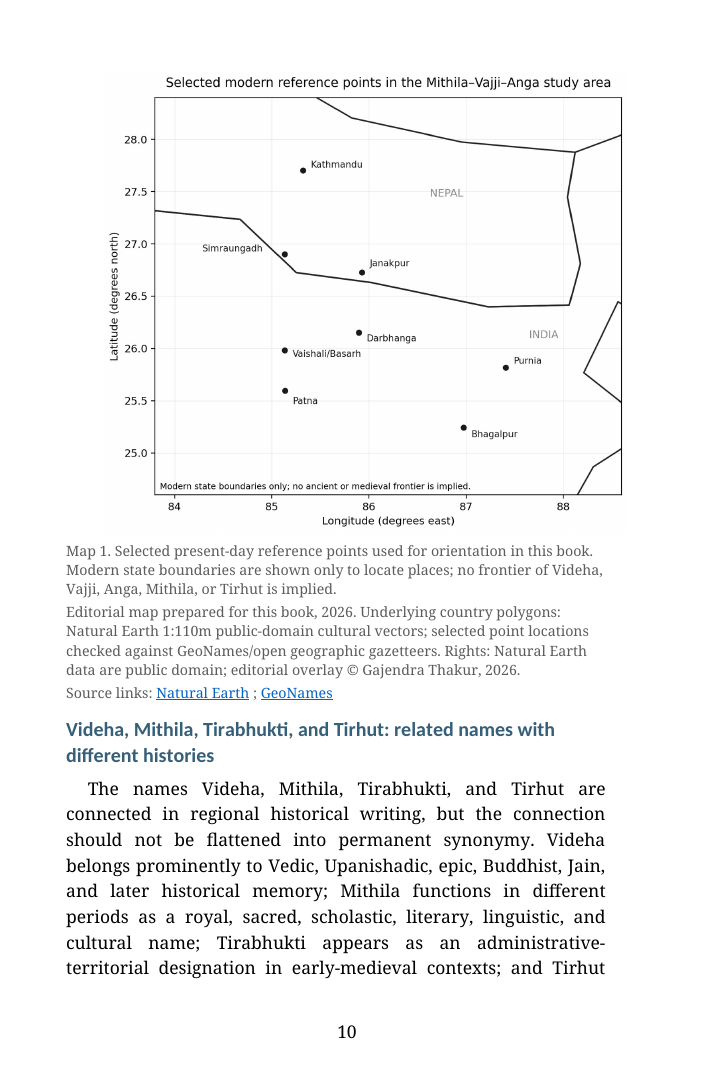
Mithila · Vajji · Anga
Chapter-specific source notes
- Primary chapter witness. Gajendra Thakur, Decoding the Panji of Mithila — Volume III, formal Chapter 25, PDF pp. 269-280; formal Chapter 25. The HTML transcription is generated from the commit-pinned source PDF and retains the chapter boundary recorded in this edition.
- Internal structure. The repository source-heading inventory records no separately encoded subordinate heading for this chapter.
- Digital editorial method. The page keeps the preserved source text distinct from generated navigational, concordance, visual, and provenance apparatus. The synthetic reconstruction is explanatory only and is not evidence for an individual lineage or a determination of social or marital status.