Decoding the Panji of Mithila · Volume III · Chapter 24
Entries 215-224 - Khandbala, Bhaur, Rajgram, Hemnagar, Deodhi, Shubhankarpur, Uchouri, Garhbaneli, and Dhanoulia Index Link Box
Chapter 24
 Entries 215-224 - Khandbala, Bhaur,
Rajgram, Hemnagar, Deodhi, Shubhankarpur,
Uchouri, Garhbaneli, and Dhanoulia
  Index Link Box
  Index cluster                                    खण्डबला / भौर / राजग्राम / हेमनगर /
                                               ड्यौढ़ी / शुभंकरपुर / उचौरी / गढ़बनैली /
                                               धनौलिया
  Khand 2 source entries decoded                   215-224

  Principal source heading forms                   "उपटीप-पुवारिपार खण्डबला भौर

                                               राजग्राम"; "उपटीप पुवारिपार भौर रवण्डबला
                                               राजग्राम हेमनगर पूर्णियाँ "; "उपटीप-पुवारिपार
                                               भौरसँ राजग्राम"; "उपटीप-पुवारिपार भौरसँ
                                               ड्यौढ़ी-मव्वी ड्योढ़ी"; "शुभंकरपुर, उचौरी,
                                               गढ़बनैली, धनौलिया ड्योढ़ी"
  Index roots/routes                              Khandbala-Bhaur; Bhaur-Ravandbala-
                                               Rajgram; Hemnagar-Purnia; Deodhi/Mavvi-
                                               Deodhi; Shubhankarpur-Uchouri-Garhbaneli-
                                               Dhanoulia

  Recurring relational villages                    दरिहरा, करमहा, सोदरपुर, पाली, कु जौली,
                                               हरिअम्ब, नरउन, वलियास, बुधवाल, सरिसब,
                                               पबौली, घुसौत, सकराढ़ी, रवौआल, फनन्दह,
                                               माण्डर, खौआल
  Coverage status                                 Decoded through Entry 224; this completes
                                               the Khand 2 source sequence.

  Chapter overview
    Chapter 24 begins at Entry 215, where the source opens the
final Khandbala-Bhaur field with the formula ' अथ भौर रवण्डबला
ग्रामारम्भ'. After the Loam, Sauria, Bhakharouli, Kanhauli, and

                       Decoding the Panji of Mithila, Volume III | Page 261
                    Decoding the Panji of Mithila Volume III

Ruchouli routes decoded in Chapter 23, the text now turns to the
concluding Khandbala-Bhaur-Rajgram complex.
   This chapter is not a minor tailpiece. It is the final
consolidation of the Puwaripar material in Khand 2. The entries
move through Bhaur, Ravandbala, Rajgram, Hemnagar, Purnia,
Deodhi, Shubhankarpur, Uchouri, Garhbaneli, and Dhanoulia,
while preserving the same Panji grammar used earlier: sons,
daughters, marriage routes, place attachments, titles, status
names, and dotted uncertainties.
   The chapter also contains a strong public-status layer. The
record includes Thakur, Babu, Raja, Maharaj, Maharaj Kumar,
Mahamahopadhyaya,      Professor,   Member      of    Legislative
Assembly, and Deodhi-related lineages. These titles are decoded
as part of the genealogical record rather than as separate
biographies.

  Entries 215-216: Khandbala-Bhaur opens the
final cluster
   Entry 215 opens the Bhaur-Ravandbala village beginning.
Bhaiyan or Gaurinath, Ajit Singh, Udhot Singh, Ugra Singh,
Mohan Singh, Jagat Singh, Padmanabh Singh, Jayanarayan Singh,
Ayodhyanath or Bengali Singh, Gaurinath Singh or Govind Ji,
Riddhinarayan Singh, Artinarayan Singh, Ghuran Singh,
Dwarkanath Singh, Anant Singh, Ravinath Singh, and allied
branches appear within the Khandbala-Bhaur frame.
    The entry repeatedly sends descendants into Darhara,
Karamha, Pali, Mandar, Khaual, Soderpur, Tisaunt, Belauch,
Kujouli, Alay, Ghosauth, and Babhaniam. This distribution shows
that the Khandbala-Bhaur branch is a hub at the end of Khand 2,
not a local-only register.
   Entry 216 continues Bhaur-Ravandbala-Rajgram and expands
toward Hemnagar and Purnia. Dwarkanath Singh, Gulab Singh,
Pratap Singh, Bholanath Singh, Jasmant Singh, Kishor Singh,
Devkinandan Singh, Mukund Singh, Deoraj Singh, Jairaj Singh,
Brajraj Singh, Raghuraj Singh, Giriraj Singh, Vijayraj Singh, Jagat

                Decoding the Panji of Mithila, Volume III | Page 262
                    Decoding the Panji of Mithila Volume III

Singh, Dayanath Singh, Damodar Singh, Mahamahopadhyaya
Krishna Singh, Gopinath Singh, Ruchinath Singh, Dhananath
Singh, Chetikanath Singh, Premnath Singh, and Medhnath Singh
appear as part of the expanding Singh branch.

  Entries 217-218: Bhaur-Rajgram and the scholar-
status continuation
    Entry 217 continues the Bhaur-Rajgram line through
Bhimnath Singh, Rupnath Singh, Govind Nath Singh, Chetanath
Singh, Arknath Singh, Bhishmnath Singh, Ratinath Singh,
Shilanath or Dharmanath Singh, Punyanath Singh, Faninath
Singh, Shivesh Nath Singh, Durganath Singh, Meghnath Singh,
Jayanath Singh, Harinath Singh, Professor Bhaktinath Singh,
Raghunath Singh, Chhatranath Singh, and Muninath Singh.
    The route remains deeply interlinked. Darhara, Kujouli, Pali,
Sakaradhi, Khandbala, Karamha, Soderpur, Naruan, Mandar,
Harianb, Valiyas, and Ruchouli-Ekhara recur as relational nodes.
The source is not merely listing descendants; it is showing how
the Bhaur-Rajgram branch exchanged ties with earlier routes
already decoded in this volume.
    Entry 218 introduces Dharmadhurin Mahamahopadhyaya
Krishna Singh and continues with Vireshwar Singh, Theghnath
Singh, Kashinath Singh, Poshnath Singh, Kamalnath Singh,
Kumudnath Singh, Kripanath Singh, Karmanath Singh, Tirthnath
Singh, Indranath Singh, Radhanath Singh, Kalyan Singh, Nandi
Singh, Chet Singh or Sarvjit Singh, Sureshwar Singh, Markandey
Singh, Amarnath Singh, Shivnandan Singh, Yadunandan Singh,
Giridhar Singh, Shridhar Singh, Gangadhar Singh, Chakradhar
Singh, and Madhesh Singh. The mention of legislative status is
kept as a documentary marker, but the chapter reads it inside the
lineage framework.

 Entries 219-221:               the        long        internal        Bhaur-
Rajgram skeleton

                Decoding the Panji of Mithila, Volume III | Page 263
                   Decoding the Panji of Mithila Volume III

   Entry 219 is the longest interior continuation of the Bhaur-
Rajgram cluster. It follows Giridhar Singh, Shridhar Singh,
Vanshamani Singh, the descendants of Ugra Singh, Rabuni or
Mitra Singh, Shankar Singh, Vishnu Singh, Shubhankar Singh,
Deonath Singh, Jagdish Narayan, Surendranarayan, Yoginath
Singh, Buchu or Ravinath Singh, Tejnarayan or Tejnath,
Nityanand Singh, Jai Singh, Rameshwar Singh, Chandeshwar
Singh, and allied branches.
   Entry 220 keeps the Bhaur-Rajgram heading and continues
through Jai Singh, Rameshwar Singh, Harinandan Singh,
Yadunandan      Singh,    Chandeshwar      Singh, Harikrishna,
Goravulnath, Revatinath, Bhavaninath, Ishannath, Vasudev,
Dullah or Gopinath, Anupnath, Bholanath, Vishwanath, Janardan
or Gujar, Yadunath, Brajnath, and the related Ravaal, Naruan,
Harianb, Pali, Darhara, and Soderpur ties.
    Entry 221 completes the inner Bhaur-Rajgram skeleton and
transitions toward the royal/Khandbala-Deodhi material. Dullah
or Gopinath, Anupnath, Revatinath, Hemnath, Shyamnath,
Loknath,     Jayanath,   Gaurinath,    Kedarnath,   Ganganath,
Dineshnath, Raghunath, Jivachh, Kumudnath, Maharaj Madhav
Singh, Maharaj Chhatra Singh, Babu Vasudev Singh, Maharudra
Singh, Ratan Singh or Taradatt Singh, and Maharaj Rudra Singh
appear. This entry is a major bridge between the Bhaur-Rajgram
branch and the Deodhi branch that follows.

  Entry 222: Bhaur to Deodhi and Mavvi-Deodhi
    Entry 222 is headed toward Bhaur to Deodhi and Mavvi-
Deodhi. It records Maharaj Rudra Singh, Maharaj Maheshwar
Singh, Maharaj Lakshmishwar Singh, Maharaj Rameshwar Singh,
Maharaj Kameshwar Singh, Babu Vishweshwar Singh, Babu
Jiveshwar Singh, Shubheshwar Singh, Babu Yajneshwar Singh,
Kishor Singh or Guneshwar Singh, Sureshwar Singh, Harishwar
Singh, Laliteshwar Singh, Bhaveshwar Singh, Modeshwar Singh,
Ratishwar Singh, Radheshwar Singh, Durgeshwar Singh,
Chandreshwar Singh, and Dhareshwar Singh.

               Decoding the Panji of Mithila, Volume III | Page 264
                    Decoding the Panji of Mithila Volume III

   This entry is the clearest point at which the Puwaripar
genealogical system intersects a Deodhi-centered lineage. The
chapter therefore treats Entry 222 as an extension of the same
Khandbala-Bhaur map, not as a separate royal chronicle. The
names and titles are important, but the grammar is still Panji
grammar: descent, daughter-lines, village receiving lines, and
cross-reference numbers.

 Entry     223:   Shubhankarpur,                                       Uchouri,
Garhbaneli, and Dhanoulia Deodhi
    Entry 223 carries the heading toward Shubhankarpur,
Uchouri, Garhbaneli, Dhanoulia Deodhi, and Babu Madneshwar
Singh. It includes Babu Ratishwar Singh, Umanandan or
Yugeshwar Singh, Krishneshwar Singh, Dineshwar Singh,
Harishwar Singh, Narmadeshwar Singh, Tirtheshwar Singh,
Revatishwar Singh, Sarveshwar Singh, Bhaveshwar Singh,
Yogeshwar Singh, Tuleshwar Singh, Bhadrashwar Singh,
Girijanandan Singh, Vijayanandan Singh, Rajivnandan Singh,
Sanjivanandan      Singh,    Deepaknandan,      Jyotinandan,
Maniknandan, Devkinandan or Hemeshwar Singh, Hireshwar,
Dhaneshwar, Bhagwatishwar, Laliteshwar Singh, Madneshwar
Singh, Mohaneshwar Singh, and Bhimeshwar Singh.
    The entry is significant because it carries the Khandbala-
Bhaur branch into named Deodhi and estate-like locations. The
notation also preserves a modern social detail, including an
inter-religious marriage marker, without using it to reconstruct
anything that the source does not explicitly say.

  Entry 224: the final Puwaripar closing register
   Entry 224 is the final entry in the Khand 2 source sequence. It
continues through Babu Tantreshwar or Devkinandan Singh,
Sevakeshwar Singh, Uttameshwar Singh, Ekeshwar Singh,
Rohiteshwar, Mithila Nandan Singh, Sumitranandan Singh,
Gajananad, Mayanand, Shathishkanandan Singh, Bhaveshwar
Singh, Yajneshwar Singh, Bhavanishwar Singh, Parameshwar
Singh, Netreshwar or Banmali, Raghunandan or Ekardeshwar

                Decoding the Panji of Mithila, Volume III | Page 265
                        Decoding the Panji of Mithila Volume III

Singh, Ramnandan Singh, Sitanandan Singh, Satinandan or
Chitteshwar Singh, Jwalanandan Singh, and related descendants.
    Because the source closes at Entry 224, this entry must be
read as a closure register. It does not begin a new chapter after
itself. Instead, it completes the final Khandbala-Bhaur-Deodhi
chain and therefore completes the Khand 2 decoding coverage.

  Cross-reference and route map
    The main route of Chapter 24 is: खण्डबला-भौर -> रवण्डबला-राजग्राम ->
हेमनगर-पूर्णियाँ -> भौर-राजग्राम -> भौर-ड्यौढ़ी/मव्वी ड्योढ़ी -> शुभंकरपुर-उचौरी-
गढ़बनैली-धनौलिया ड्योढ़ी -> final Puwaripar closing entry.

    The recurring relational villages and routes include दरिहरा,
करमहा, सोदरपुर, पाली, कु जौली, हरिअम्ब, नरउन, वलियास, बुधवाल, सरिसब, पबौली,
घुसौत, सकराढ़ी, रवौआल, फनन्दह, माण्डर, खौआल, अलय, दिधो, बेलउँ च, and तिसउँ त.

    The strongest status vocabulary in the chapter includes ठाकु र,
बाबू, राजा, महाराज, महाराज कु मार, म.कु ., महामहोपाध्याय, प्रो., धर्मधुरीण, and
assembly or modern title references. These markers should be
indexed because they help date and classify later branches.

  Important uncertainties
   The source contains many dotted blanks in Entries 215-224.
They must remain visible as uncertain or missing data. No father,
son, spouse, or village should be supplied from guesswork.
     Several spellings are unstable or damaged by OCR, including
रवण्डबला/रवण्डबला, ड्यौढ़ी/ड्योढ़ी, शुभंकरपुर, उचौरी/उचौदी, गढ़बनैली, धनौलिया,
modes of Babu/Maharaj abbreviations, and some Singh-line
names. Later proofreading should compare these directly with
source images or the original print.
   The chapter contains a high density of elite and modern
designations. These designations should be preserved as
documentary evidence, but they should not override the
genealogical reading of the entry.

                    Decoding the Panji of Mithila, Volume III | Page 266
                   Decoding the Panji of Mithila Volume III

  Research summary
    Chapter 24 decodes Entries 215-224 as the closing Khandbala-
Bhaur-Rajgram-Hemnagar-Deodhi complex of Genome Mapping
Volume I, Khand 2. It confirms that the closing entries are
structurally central to the Puwaripar map and are not detached
appendices.
    The chapter shows how royal, scholarly, landed, and Deodhi
branches are still embedded in the same Panji logic used
throughout the volume. Village movement, daughter-line
placement, status labels, and cross-reference numbers all remain
active.
    With Entry 224 decoded, the cumulative manuscript now
covers the entire Khand 2 source range from Entry 1 to Entry
224. A later editorial step can add a completion note,
concordance, or cross-volume apparatus, but the source decoding
itself is complete through this chapter.

               Decoding the Panji of Mithila, Volume III | Page 267
                          Decoding the Panji of Mithila Volume III
Source structure and verification apparatus
Editorial source apparatus. This apparatus is descriptive, not interpretive. It records the source-controlled structure used to verify that this page corresponds to formal Chapter 24 of Decoding the Panji of Mithila — Volume III. The chapter text above is preserved from PDF pp. 262-269; formal Chapter 24 in the commit-pinned authoritative source. It is not merged with a neighboring chapter, appendix, annexure, or independent front/back-matter unit. The internal headings below come from the repository’s source-heading inventory and are retained as navigational and audit evidence; showing them here does not turn those headings into separate publications or add claims that are absent from the source.
Internal source headings
No subordinate heading was separately encoded in the repository source-heading inventory for this chapter.
Source-text concordance
Entries · 215-224 · Khandbala · Bhaur · Rajgram · Hemnagar · Deodhi · Shubhankarpur · Uchouri · Garhbaneli · Dhanoulia · Index · Link · cluster · मनगर · Khand · decoded · Principal · heading · forms · roots · routes · Khandbala-Bhaur · Bhaur-Ravandbala · Hemnagar-Purnia · Mavvi · Shubhankarpur-Uchouri-Garhbaneli · Recurring · relational · villages · करमह · नरउन · Coverage · status · Entry · completes · sequence · overview · begins · opens · final · field · formula · Loam · Sauria · Bhakharouli · Kanhauli · Decoding · Page · Ruchouli · text · turns · concluding · Khandbala-Bhaur-Rajgram · complex · minor · tailpiece · consolidation · Puwaripar · material · move · Ravandbala · Purnia · preserving · grammar · used · earlier · sons · daughters · marriage · place · attachments · titles · names · dotted · uncertainties · contains · strong · public-status · layer
Boundary verification. In the formal sequence this chapter follows Volume III Chapter 23, “Entries 208-214 - Loam, Sauria, Durgaganj, Bhakharouli, Kanhauli, Ruchouli, and Katihar Index Link Box Index cluster लोआम / सुरगन / सौरिया / दुर्गागंज /” and precedes Volume III Chapter 25, “Full Glossary of Panji Terms Index Link Box Part Part IV - Tools for the Reader”. The chapter extractor begins at the verified formal Chapter 24 marker and stops at the next verified formal chapter marker; for a final chapter it stops before recognized book-level back matter. The concordance above is generated only from distinct terms already present in this chapter’s preserved source text. It is provided for discovery, comparison, and audit, not as an automated judgment about persons, lineages, status, kinship, marriage eligibility, or historical truth.
Illustrated research apparatus
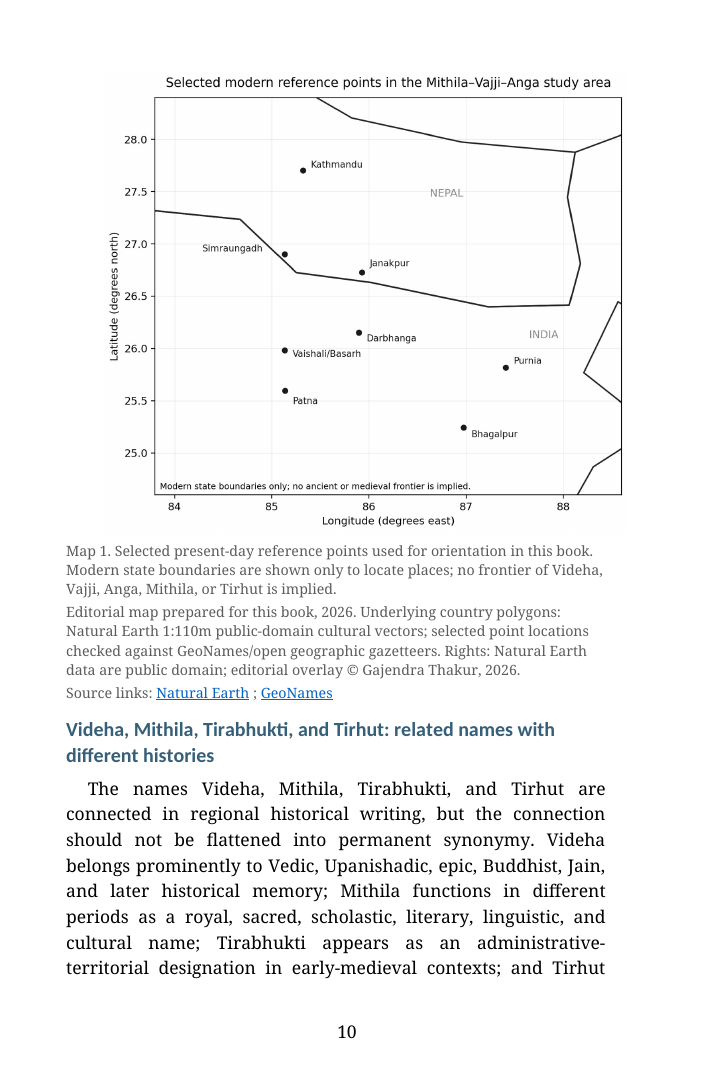
Mithila · Vajji · Anga
Chapter-specific source notes
- Primary chapter witness. Gajendra Thakur, Decoding the Panji of Mithila — Volume III, formal Chapter 24, PDF pp. 262-269; formal Chapter 24. The HTML transcription is generated from the commit-pinned source PDF and retains the chapter boundary recorded in this edition.
- Internal structure. The repository source-heading inventory records no separately encoded subordinate heading for this chapter.
- Digital editorial method. The page keeps the preserved source text distinct from generated navigational, concordance, visual, and provenance apparatus. The synthetic reconstruction is explanatory only and is not evidence for an individual lineage or a determination of social or marital status.