Decoding the Panji of Mithila · Volume III · Chapter 30
How to Reconstruct a Family Line from the Uptip Part Part IV - Tools for the Reader
Chapter 30
How to Reconstruct a Family Line from the
Uptip
Part Part IV - Tools for the Reader
Chapter purpose Give the reader a practical method for
reconstructing a family line from a compressed
Uptip Panji entry.
Core operations Start from one name; follow सुत and सुता;
use place-formulae; check उ.टी. and शा.; mark
uncertainty.
Primary source base Genome Mapping Volume I, Khand 2 -
Entries 1-224, already decoded in Chapters 9-24.
Required companion tools Chapter 25 glossary; Chapter 26 number-
key; Chapter 27 place index; Chapter 28
personal-name index; Chapter 29 title/status
index.
Editorial caution A reconstruction is a map of source
evidence, not a license to fill gaps or invent
missing ancestors.
Next tool chapter Chapter 31 will state limits, gaps, and
editorial principles for the whole volume.
Chapter overview
The Uptip Panji compresses a family line into a dense chain of
names, relation markers, places, cross-references, titles, and
damaged or dotted readings. A reader who tries to read it as a
modern paragraph will quickly lose the line. A safer method is to
treat each entry as a structured record and reconstruct the line step
by step.
This chapter gives that method. It shows how to begin with one
chosen name, identify the nearest father or son marker, follow सुत
and सुता, separate descent from marriage connection, use village
formulae, consult number references, and stop whenever the source
becomes incomplete. The goal is not to make the Panji easy by
simplifying it; the goal is to make it usable without falsifying it.
Decoding the Panji of Mithila, Volume III | Page 325
Decoding the Panji of Mithila Volume III
The method is deliberately conservative. A reader may make a
working family tree for private study, but the published
reconstruction must show its evidence. Names, places, numbers, and
uncertainty must travel together.
A. Basic reconstruction grammar
Term Working meaning How to use it in
reconstruction
सुत Usually son-of or Read forward and
descendant-line marker. backward around the word
before deciding father and son.
सुता Usually daughter-line or Treat it as a bridge; do not
marriage-link marker. automatically place it in the
male descent column.
अपरा Another branch, additional Start a side branch rather
line, or parallel continuation. than forcing it into the
previous chain.
प्र. Alias, short form, prominent Copy the visible form and
name, or source shorthand note its role; do not expand
depending on context. silently.
कौ / का Group or possessive marker Use only with the
often joining a family cluster. immediate phrase, not the
whole paragraph.
सँ From, through, by, or with; Distinguish origin, marriage
the most important place- destination, and reference
linking particle. place by grammar.
दौ / द्दौ Closure or recorded-link Treat as punctuation-like
marker at the end of many evidence that the local formula
formulae. has closed.
उ.टी. / शा. Number reference; see Use as a citation anchor, not
Chapter 26. as a person or place.
... Gap, damaged reading, or Leave blank or mark
unrecorded name. unknown; never supply a
guessed name.
B. Ten-step reconstruction method
Step Action Why it matters
1 Choose one source entry, A Panji reconstruction
not a broad family tradition. begins from a visible record,
not from memory.
2 Write the entry number and The heading gives branch,
heading first. village, and sometimes the
source route.
3 Identify the first stable A stable name is one not
name. hidden by dots and not merely
Decoding the Panji of Mithila, Volume III | Page 326
Decoding the Panji of Mithila Volume III
a title without a personal name.
4 Locate the nearest सुत This usually creates the first
vertical descent link.
phrase.
5 Locate सुता phrases These are often marriage or
daughter-line bridges; draw
separately. them sideways first.
6 Record every place after सँ . Places are not decoration;
they explain origin, connection,
or destination.
7 Copy number references. उ.टी., शा., slash references,
and repeated numbers are
evidence-locators.
8 Mark अपरा as a new Do not continue a line
straight through अपरा without
branch.
checking the grammar.
9 Consult the indexes. Use the Place, Name, and
Title indexes to check variants
and repeated names.
10 State the result as a cautious Use phrases such as “the
reconstruction. entry records”, “appears as”,
and “is linked through”.
C. Blank worksheet for one Panji line
Worksheet field What to record Rule
Entry number Write the source entry Example: Entry 208, Entry
number or cluster heading. 215, Entry 223.
Heading phrase Copy the village/branch Do not standardize until the
heading exactly. index note.
Anchor person Choose the first name that Do not choose a dotted
can be read safely. placeholder.
Father/son link Record the nearest सुत Keep both names and the
place phrase.
phrase.
Daughter/marriage link Record सुता phrases in a Do not place them as direct
male-line descent.
separate column.
Parallel branch Start a new line for अपरा. Number or indent the side
branch.
Place field List every place linked by Mark origin, marriage
सँ . destination, later settlement, or
unclear.
Title/status field Record बाबू, ठाकु र, राजा, Use Chapter 29 for title
handling.
म.म.उ., डॉ., प्रो. etc.
Decoding the Panji of Mithila, Volume III | Page 327
Decoding the Panji of Mithila Volume III
Number field Copy उ.टी., शा., and slash Do not normalize double
slashes.
references.
Uncertainty Mark dots, corrupt OCR, and Leave unknown names
ambiguous grammar. unknown.
D. Worked example type 1 - a royal or Rai cluster
Stage Reading method
Source situation A cluster begins with a village heading such
as लोआम-सुरगन and then gives a sequence of
royal or Rai names.
Anchor Select a visible personal name with title:
राजा देवनारायण, राजा श्री नारायण, राय
रामनारायण, or another local anchor.
Vertical link Read the nearest सुत phrase to establish
who is son of whom; copy the place attached to
that phrase.
Horizontal link Read सुता phrases as marriage or daughter-
line evidence, not as a simple son-line.
Status field Keep राजा, राय, and related title markers in
the note.
Resulting statement Safe wording: “In the Loam-Surgan cluster,
the entry records a royal/Rai line connected
through named sons and daughter-lines, with
place references to Pabouli, Karamaha, Sarisab,
Khandaubala, and related villages.”
E. Worked example type 2 - a Singh/Thakur branch
cluster
Stage Reading method
Source situation The Bhaur-Ravandbala/Rajgram cluster
contains many Singh and Thakur names,
repeated title markers, and multiple numbered
references.
Anchor Start with the nearest named figure under
the heading, for example भैयन प्र. गौरीनाथ or
a later ठ./सिंह name.
Branch discipline When अपरा appears, create a side branch;
do not continue the previous descent without
Decoding the Panji of Mithila, Volume III | Page 328
Decoding the Panji of Mithila Volume III
evidence.
Title discipline Keep ठ., सिंह, बाबू, महाराज, and similar
markers because they identify status-bearing
sub-branches.
Number discipline Do not merge two Singh names merely
because names repeat; compare number,
father, and place.
Resulting statement Safe wording: “The Bhaur-Rajgram
reconstruction must be made as a branch chart
rather than a single straight line, because the
entry repeatedly opens additional Singh/Thakur
branches.”
F. Worked example type 3 - a late ड्योढ़ी or estate-
house cluster
Stage Reading method
Source situation A final ड्योढ़ी or estate-house cluster
contains बाबू, वाबू, सिंह, and modern or late-
status names.
Anchor Start from the house heading first, then from
the named बाबू or सिंह figure.
Do not over-read A ड्योढ़ी heading is a location/status
marker; it is not by itself a complete genealogy.
Marriage links If a titled name appears after सुता, record it
as a marriage/daughter link until the grammar
proves otherwise.
Modern markers Copy modern titles and degree fragments
exactly, including damaged forms.
Resulting statement Safe wording: “The final ड्योढ़ी cluster
preserves a late elite-house network; its
reconstruction must keep house, title, and
relation markers together.”
G. Common errors in reconstruction
Common error Why it is wrong Safer correction
Turning every सुता into a सुता often signals daughter Draw a side connection
first.
son-line or marriage connection.
Decoding the Panji of Mithila, Volume III | Page 329
Decoding the Panji of Mithila Volume III
Ignoring the place after सँ Place may identify the other Record every place phrase.
family or branch.
Flattening अपरा अपरा starts another Begin a new sub-branch.
branch or continuation.
Normalizing numbers शा. २००/०३ and शा. Copy exactly.
२००/०/३ may not be the same.
Merging repeated names Many names recur across Require father, place, and
villages. number evidence.
Expanding title म.म.उ., ठ., प्र., वैया. may be Explain in a note, but keep
abbreviations source form.
context-dependent.
Filling dots Dotted names are not Mark unknown.
invitations to guess.
Dropping titles बाबू, ठाकु र, राजा, महाराज Keep titles attached to
names.
may distinguish two otherwise
similar names.
Quoting a line without entry The heading often tells the Always cite heading plus
heading route. local formula.
Treating a reconstruction as Panji reading is evidence- State the level of certainty.
final truth based and revisable.
H. Safe wording for reconstructed notes
Output type Model wording
Minimal note Entry X records A as linked to B through a
सुत phrase, with place reference C and number
D. The next सुता phrase should be read as a
marriage/daughter-line connection unless
further evidence confirms direct descent.
Branch note After the first line, अपरा opens a parallel
branch. The second branch should be charted
separately and later compared through its place
and number references.
Uncertain note The source gives dots before or after the
name. The missing name is left unknown; only
the visible relation and place are recorded.
Title note The title बाबू/ठाकु र/महाराज is retained as
part of the identifying phrase, but no external
biography is added.
Index note The reconstructed line should be checked
against Chapter 27 for place variants, Chapter
28 for repeated names, and Chapter 29 for
Decoding the Panji of Mithila, Volume III | Page 330
Decoding the Panji of Mithila Volume III
title/status evidence.
I. Final reconstruction checklist
• Have I copied the entry number and heading?
• Have I separated सुत from सुता evidence?
• Have I marked every अपरा as a separate or parallel branch?
• Have I copied every place after सँ ?
• Have I preserved all numbers exactly?
• Have I preserved titles and abbreviations exactly?
• Have I left dotted or corrupt names unknown?
• Have I checked repeated names against place and number evidence?
• Have I avoided adding biography from outside the Panji?
• Have I stated the reconstruction as evidence, not certainty beyond the
source?
Closing note
A Panji family line is not reconstructed by reading only the names.
It is reconstructed by reading the grammar of the record: headings,
relation markers, place formulae, branch markers, number
references, titles, and silences. The silences matter as much as the
names.
The safest reconstruction is therefore modest. It shows what the
source says, marks what the source does not say, and gives later
readers enough evidence to test the line again. Chapter 31 now turns
these practices into the general editorial rules for limits, gaps, and
uncertain readings.
Decoding the Panji of Mithila, Volume III | Page 331
Decoding the Panji of Mithila Volume IIISource structure and verification apparatus
Editorial source apparatus. This apparatus is descriptive, not interpretive. It records the source-controlled structure used to verify that this page corresponds to formal Chapter 30 of Decoding the Panji of Mithila — Volume III. The chapter text above is preserved from PDF pp. 326-333; formal Chapter 30 in the commit-pinned authoritative source. It is not merged with a neighboring chapter, appendix, annexure, or independent front/back-matter unit. The internal headings below come from the repository’s source-heading inventory and are retained as navigational and audit evidence; showing them here does not turn those headings into separate publications or add claims that are absent from the source.
Internal source headings
No subordinate heading was separately encoded in the repository source-heading inventory for this chapter.
Source-text concordance
Reconstruct · Family · Line · Uptip · Part · Tools · Reader · purpose · Give · practical · method · reconstructing · compressed · entry · Core · operations · Start · name · follow · place-formulae · check · mark · uncertainty · Primary · base · Genome · Mapping · Khand · Entries · 1-224 · already · decoded · Chapters · 9-24 · Required · companion · glossary · number · place · index · personal-name · title · status · Editorial · caution · reconstruction · evidence · license · fill · gaps · invent · missing · ancestors · Next · tool · state · limits · principles · whole · overview · compresses · dense · chain · names · relation · markers · places · cross-references · titles · damaged · dotted · readings · tries · read · modern · paragraph · quickly · lose · safer · treat
Boundary verification. In the formal sequence this chapter follows Volume III Chapter 29, “6 Do not merge on name Identical names must alone. remain separate until relation” and precedes Volume III Chapter 31, “Limits, Gaps, and Editorial Principles Part Part IV - Tools for the Reader”. The chapter extractor begins at the verified formal Chapter 30 marker and stops at the next verified formal chapter marker; for a final chapter it stops before recognized book-level back matter. The concordance above is generated only from distinct terms already present in this chapter’s preserved source text. It is provided for discovery, comparison, and audit, not as an automated judgment about persons, lineages, status, kinship, marriage eligibility, or historical truth.
Illustrated research apparatus
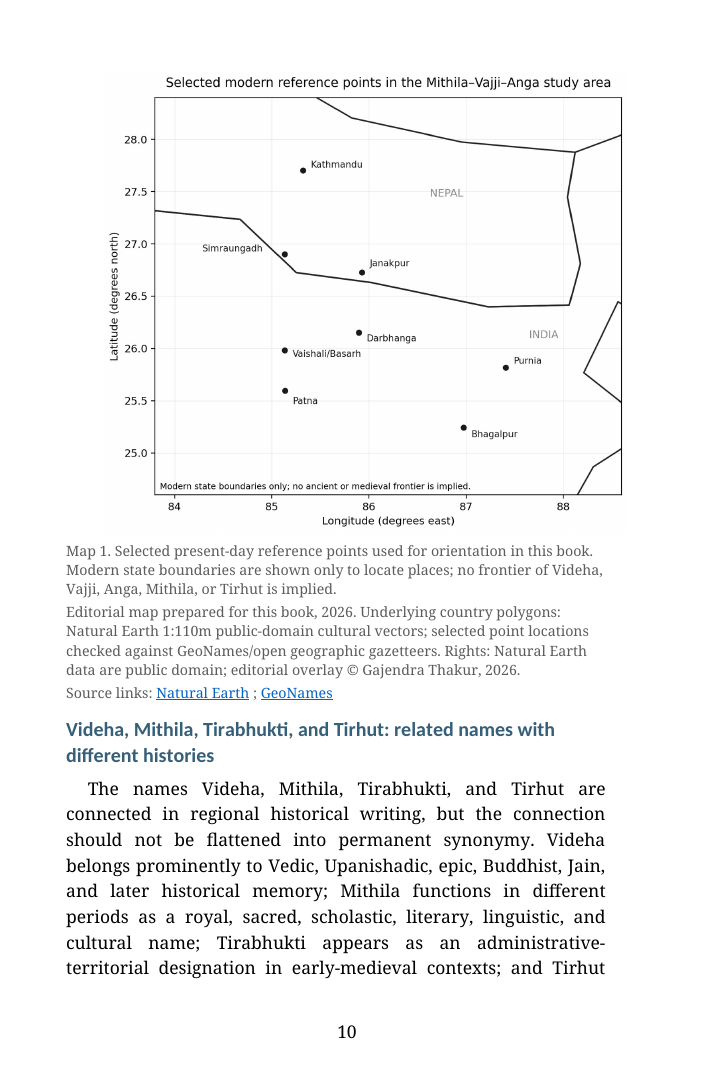
Mithila · Vajji · Anga
Chapter-specific source notes
- Primary chapter witness. Gajendra Thakur, Decoding the Panji of Mithila — Volume III, formal Chapter 30, PDF pp. 326-333; formal Chapter 30. The HTML transcription is generated from the commit-pinned source PDF and retains the chapter boundary recorded in this edition.
- Internal structure. The repository source-heading inventory records no separately encoded subordinate heading for this chapter.
- Digital editorial method. The page keeps the preserved source text distinct from generated navigational, concordance, visual, and provenance apparatus. The synthetic reconstruction is explanatory only and is not evidence for an individual lineage or a determination of social or marital status.