Decoding the Panji of Mithila · Volume III · Chapter 29
6 Do not merge on name Identical names must alone. remain separate until relation
Chapter 29.
6 Do not merge on name Identical names must
alone. remain separate until relation
and place agree.
7 Mark gaps. If the source says . . ., record
“gap in source.”
8 Create cross-references. For aliases, nicknames, and
title variants, make see-also
notes.
How to cite a person from this index
A proper citation of a Panji person should include the name, the
nearest father or son marker, the relevant place phrase, and the
entry or source-number field. A line such as “ जीवनाथ” without those
supports is not a usable identification. The index can point the
reader toward the entry, but the entry grammar must complete the
identification.
When the same name appears with a title, cite both forms if they
help disambiguate the person. For example, a title-bearing name
such as महा वैयाकरण दिनबन्धु, वैया. जीवनाथ, डा. सर गंगानाथ, डा. प्रो. अभयनाथ, or
महाराज लक्ष्मीश्वर सिंह should remain visible as a titled source form, even
if the lookup headword is simply दिनबन्धु, जीवनाथ, गंगानाथ, अभयनाथ, or
लक्ष्मीश्वर सिंह.
Closing note
The Personal Name Index turns the Panji from a continuous
genealogical stream into a usable reference tool. It does not replace
the entries; it guides the reader back to them. Every indexed name
must be tested against relation, place, number, and title before it is
used in reconstruction.
Chapter 29 will take the next step by separating scholar, title,
and status names. That separation is necessary because many names
in Khand 2 are not simply personal identifiers; they also record
scholarship, office, landholding, estate memory, modern education,
or public rank.
Decoding the Panji of Mithila, Volume III | Page 314
Decoding the Panji of Mithila Volume III
Chapter 29
Scholar, Title, and Status Index
Index Link Box
Part Part IV - Tools for the Reader
Chapter purpose Separate scholar, title, and status figures
from the general personal-name index.
Coverage base Genome Mapping Volume I, Khand 2 -
Entries 1-224, especially title-bearing forms
appearing in the completed decoding chapters.
Index fields Title or status marker; source form;
associated name; entry field; place field;
editorial note.
Primary caution A title is evidence of role or social memory,
not proof of biography outside the Panji entry.
Editorial rule Preserve title, name, place, and number
together. Do not modernize, expand, or silently
translate titles inside the index.
Next tool chapter Chapter 30 will demonstrate how to
reconstruct a family line from the Uptip.
Chapter overview
The Panji does not record persons only as private individuals. It
also records scholarship, ritual authority, landholding status, public
office, royal or estate-house association, and modern educational
rank. Chapter 29 gathers these status-bearing expressions so that the
reader can distinguish a simple personal name from a name
carrying a remembered function.
This is not a biographical dictionary. The Panji gives compressed
evidence: a title, a place, a relation marker, and often a number
reference. The index therefore records the source form and its
immediate genealogical setting. It does not expand a title into a life-
history unless the entry itself gives that information.
The chapter also protects the reader from over-reading. बाबू, ठाकु र,
सिंह, राजा, महाराज, डॉ., प्रो., आई.ए.एस., आई.पी.एस., म.म.उ., वैयाकरण, नैयायिक,
मीमांसक, वैदिक, and similar markers must be preserved because they
identify status fields; yet the same marker may occur in different
Decoding the Panji of Mithila, Volume III | Page 315
Decoding the Panji of Mithila Volume III
branches and periods. Each must be checked against the entry
number and place formula.
Editorial principles for title and status indexing
• Index the title exactly as it appears before converting it into an
English explanation.
• Keep the name and title together when the title is part of
identification.
• Record the village or estate-house field because status often travels
through place memory.
• Do not treat a title as proof of the same person in another entry
without relation evidence.
• Preserve modern initials such as M.A., Ph.D., I.A.S., and I.P.S. only in
the form supplied by the source.
• Separate Brahmanical scholarship titles from landholding, royal, and
modern administrative titles.
• Mark dotted or incomplete forms without supplying missing words.
• Use this chapter with Chapter 28: the personal name is indexed there,
while title/status meaning is indexed here.
A. Title and status vocabulary
Title or marker Meaning in the index Editorial handling
पंडित / पाँ Learned Brahman or Use only where the source
formally acknowledged gives the marker; do not add it
scholar; sometimes to ordinary learned names.
abbreviated or embedded in a
family phrase.
महा वैयाकरण / वैयाकरण Grammarian or grammar- Index both the title and the
scholar title; often attached to personal name; keep
/ वैया. learned Panji memory. abbreviated वैया. visible.
नैयायिक / न्यायाधीश Logic/scholastic or Do not merge the two fields;
juridical/modern legal status one belongs to scholastic
depending on context. learning, the other to modern
office.
मीमांसक Mimamsa-scholar marker. Record the title with the
linked name and entry field.
वैदिक / बै . Vedic or ritual-learning Do not expand बै . unless the
marker; बै . may appear as a
local context supports the
shortened form. reading.
म.म.उ. / महामहोपाध्याय High scholarly honorific Keep the abbreviation;
used for major learned figures. explain it in prose but do not
replace the source form.
Decoding the Panji of Mithila, Volume III | Page 316
Decoding the Panji of Mithila Volume III
साहित्यकार Literary figure marker. Cross-reference with the
personal name and place
association.
भाषाशास्त्री Language-scholar marker. Treat as scholarly status, not
as a surname.
समाजशास्त्री Sociologist or social-science Retain as a modern learned
scholar marker in modern title.
entries.
घटक Marriage broker or Index under status because
genealogically relevant it affects marriage memory.
matching role when visible.
ठ. / ठाकु र Status or landed-title Preserve abbreviation and
marker in Singh/estate-house full form; do not flatten into a
clusters. common surname.
बाबू / वाबू Elite, landholding, or estate- Keep source spelling
house title, frequently before बाबू/वाबू as printed.
Singh names.
राजा / राय Royal or princely title, Do not add extra royal
sometimes in regional-house history; record only Panji
clusters. evidence.
महाराज / म.कु . Royal and Record with name, place,
royal-kumar/status cluster and entry number.
markers.
चौ. / चौधरी Status-title or local elite Keep abbreviated form
marker. when the source uses it.
डॉ. / प्रो. Modern academic or Do not expand degrees
professional marker. beyond visible text.
आई.ए.एस. / आई.पी.एस. Modern administrative Retain as status evidence
service markers appearing in without external biography.
late entries.
एम.ए. / पी.एच.डी. Modern degree markers. Preserve dots and gaps; do
not fill missing university or
subject data.
B. Scholar, literary, and learned-title figures
Index Visible source Entry or Place Index note
headword form cluster field association
म.म.उ. गंगेश म.म.उ. गंगेश Ruchouli/ उजान, High scholarly
Kanhauli field honorific attached
around Entry 213 रूचौली, एकहरा to a major source
name; retain
abbreviation.
म.म.उ. म.म.उ. सद्दे प्र. Sulhani- हरिअम्ब, Title-bearing
Manglabani field learned figure
सदानन्द सदानन्द जजिवाल, with
nickname/variant;
सरिसब do not simplify.
Decoding the Panji of Mithila, Volume III | Page 317
Decoding the Panji of Mithila Volume III
म.म.उ. महो वच्ची कौ Sulhani- फनन्दह, Index title and
Manglabani field family clue
भवानीदत्त फनन्दह सँ दरिहरा together.
म.म.उ. भवानीदत्त
म.म.उ. अचल म.म. अचल Sulhani- बुधवाल Short title-
Manglabani field bearing form;
keep local context.
म.म.उ. म.म.उ. Sulhani/ सोदरपुर, Learned title in
Naruar and other a cross-linked
बालकृ ष्ण बालकृ ष्ण cross-links कु जौली source pattern.
म.म.उ. कृ ष्ण म.म. उ. कृ ष्ण Bhaur/Rajgram खण्डबला, Scholarly
and late title field honorific joined to
सिंह सिंह तिसउँ त Singh status;
cross-index both.
म.म.उ. सचल म.म.उ. सचल Bhaur and late हरिअम्ब, Repeated in
branches status-rich
दरिहरा branches; verify
place and relation.
सरसकवि सरसकविप्रो० Navtol/Behat सरिसब, पाली Literary-
field scholarly marker;
इशनाथ इशनाथ record title phrase
exactly.
सरसकवि सरसकविकु ल Naruar/ सोदरपुर, Compound
Sulhani field scholarly phrase;
कु लपति पति सुत माण्डर do not split
without context.
लक्ष्मीनाथ
साहित्यकार साहित्यकार Kansam- हरिअम्ब, Literary title
Mandar/Lalganj with alias; keep
भवनाथ भवनाथ प्र. दीपक field पबौली दीपक as source
alias.
साहित्यकार साहित्यकार Pude-Naruan/ खौआल, Modern
Koilkhaha field literary/professor
तंत्रनाथ प्रो० तंत्रनाथ खण्डबला marker; cross-
reference modern
title table.
वैयाकरण वैयाकरण Koilkhaha- पाली, दरिहरा Grammar-
Dhanerampur scholar marker;
मतिनाथ मतिनाथ field do not reduce to
personal name
only.
मीमांसक मिमांशक Gangoli- सोदरपुर, Preserve
Koilkhaha field source spelling
मेघानाथ मेघानाथ खौआल even where
normalized
spelling would be
मीमांसक.
Decoding the Panji of Mithila, Volume III | Page 318
Decoding the Panji of Mithila Volume III
डा. सर म.म.उ. डा. सर Behat-Navtol पाली, Modern
field honorific plus
गंगानाथ गंगानाथ सकराढ़ी scholarly prefix;
retain complete
form.
डा. प्रो. डा. प्रो. Ruchouli- सोदरपुर, Modern
Katihar field academic title
अभयनाथ अभयनाथ प्र. करमहा with alias भिक्टर;
भिक्टर keep both.
प्रो. भक्तिनाथ प्रो. भक्तिनाथ Bhaur-Rajgram माण्डर, Modern
field professor marker
सिंह सिंह रूचौली in Singh lineage;
index name and
status.
समाजशास्त्री समाजशास्त्री Dharampur/ सरिसब, Modern social-
Dhanerampur science marker;
प्रो. उग्रनाथ प्रो० उग्रनाथ field सोदरपुर, माण्डर preserve as
source category.
डा. प्रो. हेतुकर समाजशास्त्री Bhakharouli- फनन्दह, Modern status
Vittho field marker combined
डा. प्रो० हेतुकर खौआल with scholarly
label.
प्राचार्य डा. प्रो० Bharwarauli- नरउन, माण्डर Multiple
Sarisab field modern titles;
चेतकर साहित्यकार keep all visible
markers.
प्राचार्य डा०
चेतकर
भाषाविद् गोविन्द जी / early and करमहा, Use only
middle clusters where the chapter
गोविन्द language- अलय, सोदरपुर context identifies
associated learned language
name scholarship.
C. Royal, Babū, Thakur, Singh, and estate-house
figures
Index Visible Entry or Place Index note
headword source/status cluster field association
form
बाबू गणेशदत्त वाबू गणेशदत्त Khandbala, खण्डबला, Babū/Singh
Chanaur, Patnuka marker; title must
सिंह सिंह lines दरिहरा remain attached.
बाबू रमापति वाबू रमापति Bharwarauli खण्डबला, Frequent
and final clusters estate-status
सिंह सिंह करमहा name; check entry
field.
Decoding the Panji of Mithila, Volume III | Page 319
Decoding the Panji of Mithila Volume III
बाबू वासुदेव वाबूवासुदेव Bhaur/Rajgram खण्डबला, Occurs with
and royal lines Maharaj/royal
सिंह सिंह दरिहरा branch context.
बाबू पुण्यपति वाबूपुण्यपति Sharadapur खण्डबला, Do not confuse
and Bhakharouli with personal
सिंह सिंह fields करमहा पुण्यपति without
बाबू.
बाबू तीर्थेश्वर वाबूतीर्थेश्वर Final माण्डर, पंडुआ, Late estate-
Deodhi/Dhanoulia house status
सिंह सिंह field दिधो marker.
बाबू मदनेश्वर वाबू मदनेश्वर Final खौआल, Named in the
Dhanoulia Deodhi final source
सिंह सिंह heading पबौली, माण्डर heading; index as
status figure.
ठ. जगत सिंह ठ. जगत सिंह Bhaur-Rajgram पाली, ठ. marker
field
वलियास should not be
omitted.
ठ. दामोदर ठ. दामोदर Bhaur/Rajgram वलियास, Often appears
field with m.m.u.
सिंह सिंह सोदरपुर Krishna Singh;
preserve context.
ठ. रूपनाथ ठ. रूपनाथ Bhaur-Rajgram करमहा, Title marker
field distinguishes
सिंह सिंह सोदरपुर from ordinary
रूपनाथ.
ठ. हरिनाथ ठ. हरिनाथ Bhaur-Rajgram माण्डर, नरउन Links to
field professor/descend
सिंह सिंह ant group.
राजा राजा Loam-Surgan पबौली, Royal title in
field Loam branch;
देवनारायण देवनारायण खण्डबला keep राय/राजा
distinction.
राजा श्री राजा श्री Loam-Surgan पबौली, Source royal
field title; do not add
नारायण नारायण खण्डबला external history.
राजा राजा Loam/ करमहा, Royal title
Durgaganj and connected to
रामलोचन रामलोचन later fields एकहरा Durga Prasad line.
राजा राजा Loam/ करमहा, Retain as royal
Durgaganj field status figure.
दुर्गाप्रसाद दुर्गाप्रसाद पवौली
महाराज महाराज Pude and खण्डबला, Major
Bhaur/Rajgram royal/estate name;
Decoding the Panji of Mithila, Volume III | Page 320
Decoding the Panji of Mithila Volume III
माधव सिंह माधव सिंह fields करमहा do not merge
without entry
proof.
महाराज छत्र महाराज Chanaur, खण्डबला, Central royal
Bhaur/Rajgram, linkage in Khand
सिंह छत्रसिंह final branches दरिहरा, पाली 2.
महाराज रूद्र महाराज रूद्र Bhaur-Deodhi नरउन, पाली, Bridge from
cluster Rajgram to
सिंह सिंह कु जौली Deodhi cluster.
महाराज महाराज Deodhi-Mavvi कु जौली, Keep source
cluster status without
लक्ष्मीश्वर सिंह लक्ष्मीश्वर सिंह एकहरा, करमहा external
expansion.
महाराज महाराज Deodhi-Mavvi कु जौली, पाली, Index with
cluster Kameshwar/Visve
रमेश्वर सिंह रमेश्वर सिंह रवण्डबला shwar lines.
महाराज महाराज Deodhi-Mavvi करमहा, Late royal
cluster figure in source
कामेश्वर सिंह कामेश्वर सिंह सोदरपुर, पाली memory.
राय राय Dhanoulia/ सुरगन, Rai title
final cluster distinct from
लक्ष्मीनारायण लक्ष्मीनारायण करमहा ordinary personal
name.
चौ. जयलाल चौ० जयलाल Sulhani- अलय, पंडुआ Chaudhary
Manglabani field abbreviation;
preserve source
form.
कु मार बैद्यनाथ कु मार बैद्यनाथ Pude/ करमहा, Kumar status
Kharndbala field term in
खण्डबला royal/Babū
context.
कु मार कु मार Pude and Alay अलय, Retain कु मार
branch
श्यामानन्द सिंह श्यामानन्द सिंह कु जौली as status field.
D. Modern education, profession, and public-rank
markers
Modern marker Visible source type Where it appears Rule
M.A. / Ph.D. आचार्य रमानाथ Pude-Naruan field Do not complete
missing degree words
सुता M.A., Ph.D. style or institutions.
forms
I.A.S. नरे श चन्द्रा सुत Sulhani- Modern state-
Manglabani/Raima service marker;
I.A.S.
Decoding the Panji of Mithila, Volume III | Page 321
Decoding the Panji of Mithila Volume III
field preserve source
spelling and gaps.
I.P.S. भेषनाथ सुत I.P.S. Loam/Durgaganj Modern service
field marker; do not infer
भीमनाथ career details.
Member of Member of Bhaur-Rajgram Retain as source
Legislative Assembly legislative Assembly field modern public-status
Bihar note.
Lt. Colonel Lt C. ornel गुणाकर Bharwarauli- Treat source
Sarisab field segmentation as
corrupt but visible; do
not silently correct.
डॉ. डा. सर गंगानाथ; Multiple late Modern
clusters professional marker;
डा. प्रो. अभयनाथ; डा. index with full title
string.
चेतकर
प्रो. प्रो. तंत्रनाथ; प्रो. Multiple late Modern academic
clusters marker; cross-
उग्रनाथ; प्रो. भक्तिनाथ reference with
personal name.
सिंह
प्राचार्य प्राचार्य डा. चेतकर Bharwarauli- Educational office
Sarisab field title; retain in title
string.
E. Rules for using title evidence
Problem Example Rule
Same title, different person Two people may both be Use name, father/son, place,
बाबू, ठाकु र, डॉ., प्रो., or and entry field before
identification.
महाराज.
Same name, different title A name may appear once Do not merge unless the
without title and elsewhere surrounding evidence supports
with a title. it.
Abbreviated title ठ., म.म.उ., म.कु ., वैया., चौ. Copy the abbreviation and
explain it in the note.
Modern title in damaged Lt C. ornel, P H D, M A P H D Keep visible text and mark
OCR reading as uncertain if needed.
Royal title राजा, राय, महाराज, कु मार Treat as source status, not a
full political biography.
Estate-house label ड्योढ़ी, बाबू, सिंह groups Attach the place or house
reference to avoid false family
reconstruction.
Scholarly title म.म.उ., वैदिक, मीमांसक, Index under both title and
personal name.
Decoding the Panji of Mithila, Volume III | Page 322
Decoding the Panji of Mithila Volume III
साहित्यकार
Status in marriage line A title may appear after Record it as part of the
सुता or in a marriage- relational evidence, not as a
separate anecdote.
destination formula.
F. Method for citing a title-bearing person
Step Action Reason
1 Copy the source title The title form is itself
exactly. evidence.
2 Attach the nearest personal A title without a name is not
name. enough for reconstruction.
3 Record relation markers. सुत, सुता, अपरा, प्र., and नी.
help identify whether the titled
person is ancestor, descendant,
or marriage link.
4 Record the place formula. Status usually becomes
meaningful only inside a place
cluster.
5 Record the number field. उ.टी., शा., and other
numbers locate the evidence.
6 Cross-reference Chapter 28. Every title-bearing name
should also be reachable
through the personal-name
index.
7 Mark uncertainty. Dotted or corrupt source
forms should not be silently
repaired.
8 Avoid external biography. The Panji index records
source memory, not
unsupported modern claims.
How this index should be used with Chapters 27
and 28
The title index should always be used together with the Place
Index and the Personal Name Index. A titled name without its place
field may be misleading, and a place field without the title may hide
why the branch is important. The safest reading has three anchors:
name, title, and place.
Decoding the Panji of Mithila, Volume III | Page 323
Decoding the Panji of Mithila Volume III
When the source gives a titled person inside a marriage line, the
title may belong to the giver, receiver, father, son, or remembered
house. The reader must therefore examine the grammar around सुत,
सुता, अपरा, and the nearest place formula before stating any
relationship.
Closing note
This title and status index shows that Khand 2 preserves more
than descent. It preserves the social grammar by which descent was
remembered: scholarship, ritual authority, title, estate-house
connection, royal association, modern education, public office, and
professional rank. These markers do not replace genealogy, but they
often explain why a branch was memorable.
Chapter 30 will now move from indexing to reconstruction. It
will show how a reader can start with one name, follow सुत and सुता,
use place formulas and number references, and build a cautious
family line without inventing what the Panji does not state.
Decoding the Panji of Mithila, Volume III | Page 324
Decoding the Panji of Mithila Volume IIISource structure and verification apparatus
Editorial source apparatus. This apparatus is descriptive, not interpretive. It records the source-controlled structure used to verify that this page corresponds to formal Chapter 29 of Decoding the Panji of Mithila — Volume III. The chapter text above is preserved from PDF pp. 315-326; formal Chapter 29 in the commit-pinned authoritative source. It is not merged with a neighboring chapter, appendix, annexure, or independent front/back-matter unit. The internal headings below come from the repository’s source-heading inventory and are retained as navigational and audit evidence; showing them here does not turn those headings into separate publications or add claims that are absent from the source.
Internal source headings
No subordinate heading was separately encoded in the repository source-heading inventory for this chapter.
Source-text concordance
merge · name · Identical · names · must · alone · remain · separate · relation · place · agree · Mark · gaps · says · record · Create · cross-references · aliases · nicknames · title · variants · make · see-also · notes · cite · person · index · proper · citation · include · nearest · father · marker · relevant · phrase · entry · source-number · field · line · without · supports · usable · identification · point · reader · toward · grammar · complete · appears · forms · help · disambiguate · example · title-bearing · अभयन · visible · titled · form · even · lookup · headword · simply · Closing · note · Personal · turns · continuous · genealogical · stream · reference · tool · replace · entries · guides · back · Every · indexed · tested · number · used
Boundary verification. In the formal sequence this chapter follows Volume III Chapter 28, “Personal Name Index Index Link Box Part Part IV - Tools for the Reader” and precedes Volume III Chapter 30, “How to Reconstruct a Family Line from the Uptip Part Part IV - Tools for the Reader”. The chapter extractor begins at the verified formal Chapter 29 marker and stops at the next verified formal chapter marker; for a final chapter it stops before recognized book-level back matter. The concordance above is generated only from distinct terms already present in this chapter’s preserved source text. It is provided for discovery, comparison, and audit, not as an automated judgment about persons, lineages, status, kinship, marriage eligibility, or historical truth.
Illustrated research apparatus
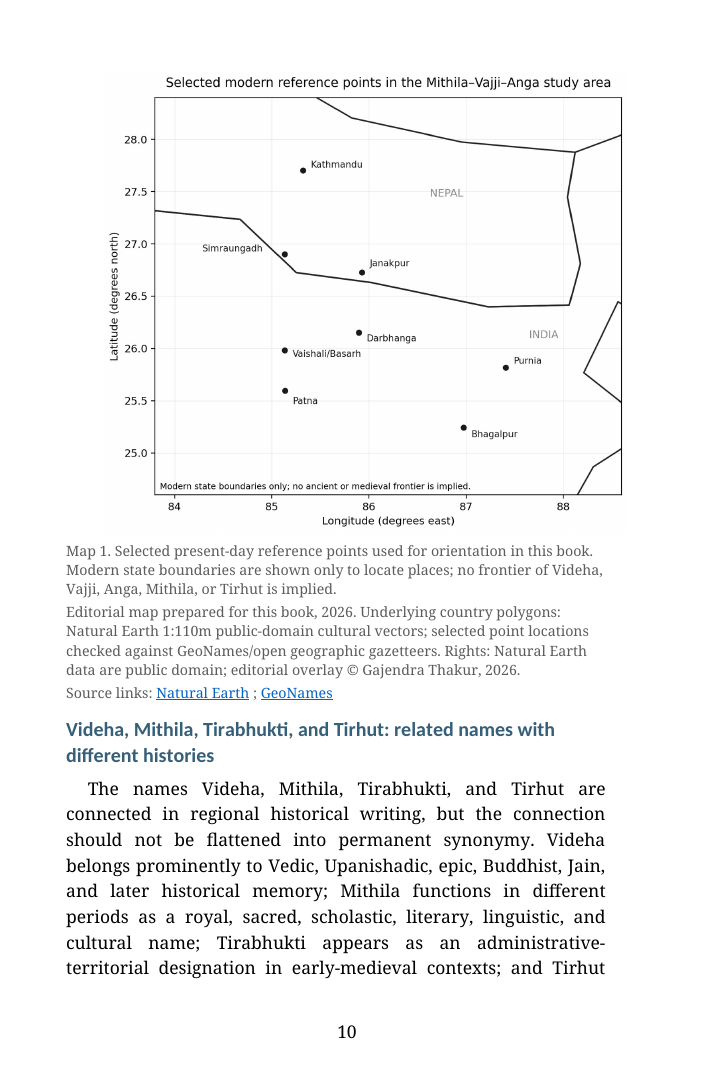
Mithila · Vajji · Anga
Chapter-specific source notes
- Primary chapter witness. Gajendra Thakur, Decoding the Panji of Mithila — Volume III, formal Chapter 29, PDF pp. 315-326; formal Chapter 29. The HTML transcription is generated from the commit-pinned source PDF and retains the chapter boundary recorded in this edition.
- Internal structure. The repository source-heading inventory records no separately encoded subordinate heading for this chapter.
- Digital editorial method. The page keeps the preserved source text distinct from generated navigational, concordance, visual, and provenance apparatus. The synthetic reconstruction is explanatory only and is not evidence for an individual lineage or a determination of social or marital status.