Decoding the Panji of Mithila · Volume IV · Chapter 1
Entering the Nagram Panji: What This Volume Decodes
Chapter 1
Entering the Nagram Panji: What This Volume
Decodes
   The Nagram Panji is not a simple genealogical register. It is
a compressed civilizational archive. At first glance it appears
to be a dense succession of names, villages, sons, branches,
marriage links, abbreviations, gaps, and cross-references. But
once its grammar is understood, it opens into a map of
Mithila’s social memory: who belonged to which lineage, how
families moved, how houses were joined through marriage,
how village identities were preserved, how scholarly and
ritual authority travelled, and how memory itself was
recorded when complete certainty was no longer available.
  This fourth volume of Decoding the Panji of Mithila is
devoted to the Nagram Panji material. The source is
voluminous, difficult, and unusually compact. It does not
narrate history in the modern manner. It records it in
genealogical signs. A single line may contain several

generations, multiple villages, a title, an alternative name, a
marriage relation, a cross-reference to another register, and a
broken or incomplete memory. If read hurriedly, such a line
looks like a list. If read patiently, it becomes a historical
statement.
  The purpose of this volume is therefore not merely to
reproduce the Nagram Panji, but to decode it.
  To decode, in this context, means five things.
   First, it means identifying the structure of the entry. A Panji
entry is rarely random. It usually begins with a route, a
village, a branch-name, or a sacred heading. Then it gives a
person, his sons or descendants, their affiliated village
connections, and sometimes their marital, scholarly, priestly,
or occupational identity. The arrangement may appear
irregular, but the irregularity often comes from the
compression of oral and documentary memory into a small
written space.
  Second, decoding means separating names from relational
markers. In the Nagram material, a reader constantly meets
forms such as suta, suto, sutah, apra or apara, pr., th., and
other abbreviated indicators. These are not decorative
expressions. They tell the reader whether the next name is a
son, a branch, an alternative form, a later descendant, a title-
holder, or another connected line. Without understanding
them, the reader cannot understand the genealogy.
   Third, decoding means recognizing the importance of
village movement. The repeated formula “from one village to
another” is central to this Panji. It records not merely
geography, but affiliation. A route such as Sandahpur to
Singhwar, Sandahpur to Shashipur, Hati to Satlakha, Tatail to
Nanour, or Bhakharouli to Porwarouni may indicate
settlement, matrimonial extension, ritual association, or a
remembered migration-line. The exact meaning must be

judged from context, but the formula is always meaningful.
The Panji is therefore both a genealogical text and a
geography of remembered kinship.
   Fourth, decoding means preserving uncertainty. The
Nagram Panji contains blanks, dotted omissions, damaged
names, variant spellings, and entries marked as empty. These
are not to be silently corrected or erased. A blank in a Panji is
itself historical evidence. It tells us that the compiler knew that
something belonged there, but did not have the complete
detail, or that the available manuscript tradition had already
lost part of the memory. A responsible edition must not
pretend certainty where the source gives uncertainty.
    Fifth, decoding means explaining the human world behind
the record. The Panji is not only about descent. It is also about
Mithila’s intellectual, ritual, social, and regional history. The
entries include scholars, priests, astrologers, householders,
title-holders, lawyers, engineers, doctors, and modern
professionals. They show the continuity of old lineage forms
into more recent social worlds. The Nagram Panji is therefore
not a dead list of ancestors; it is a record of continuity,
adaptation, and memory.

1.1 The Nagram Panji as a Genealogical Archive
   The word “Panji” refers to a genealogical register. In
Mithila, the Panji tradition has long been associated with the
preservation of family lines, marriage eligibility, village
affiliation, and social order. The Nagram Panji belongs to this
broader tradition, but its texture is particular. It is not
arranged like a modern family tree with neat boxes and
vertical lines. Instead, it is written as a running genealogical
chain.
  A typical entry may contain a numbered heading; a village
or route formula; a principal ancestor or branch-holder; sons
or descendants; affiliated villages; cross-references; titles,

nicknames, or alternate names; blank or uncertain portions;
and later additions or modern identifiers.
  The difficulty lies in the fact that these elements are not
always separated clearly. The Panji assumes that its trained
reader already understands its grammar. A modern reader,
however, needs that grammar to be made explicit. This
volume will therefore slow down the text and explain what
the source compresses.
   For example, when an entry gives a form equivalent to “X,
son of Y, connected with village Z,” the modern reader must
identify which is the person, which is the father, which is the
village of origin, which is the place of settlement, and which is
the related branch. A careless reading may confuse a village-
name with a person’s name, or a title with a lineage-name. The
purpose of this volume is to prevent that confusion.
  The Nagram Panji records people in relation. A person is
not presented as an isolated individual. He appears as
someone’s son, someone’s descendant, someone’s branch,
someone’s village relation, or someone’s marriage connection.
This is why the Panji is a social document as much as a
genealogical one. It shows how identity was understood
through relation.

1.2 Why Volume IV Requires Expansion
   This volume must be larger than the earlier volumes
because the Nagram material is unusually dense. Many entries
contain several internal layers. Some sections move rapidly
from one village to another, while others repeat the same
names in altered contexts. There are sacred headings, regional
expansions, incomplete entries, and modern occupational
markers. A brief treatment would leave too much
unexplained.

  The Nagram Panji also has a wide geographical spread. It
does not remain confined to a single village cluster. It begins
with Nagram and its early branches, then moves through
Sandahpur, Singhwar, Shashipur, Katka, Khangur, Pilkhwar,
Mangrauni, Hati, Samauli, Balirajpur, Siwa, Ahil, Rakhwari,
Vicharhi, Kua, Chanpura, Malichham, Mangrauni, Pilkhwar
again, Rohar, Tatail, Rajanpura, Ratauli, Dih, Bargam, Sihouli,
Rajoura, Bhakharouli, Malangia, Dadari, Tarauni, Brahmoli,
Ruchauli, Oda, Berma, Suday, and several other locations.
   This movement is not accidental. The Panji’s route-lines
show how families and branches were remembered across
space. In some cases, the route may indicate a movement of
residence. In other cases, it may indicate a matrimonial or
ritual connection. In yet other cases, it may preserve the
memory of a family’s known association with another village.
The meaning must be inferred with care from the
surrounding names and formulae.
   The expansion of this volume is also necessary because a
reader unfamiliar with Panji method may not know what to
do with repeated names. Names such as Gopal, Chitradhar,
Girdhari, Madhurapati, Raghunath, Devkinandan, Ramanath,
Shyamalal, Lakshminath, Shivanandan, Vishwanath, and
many others recur in multiple contexts. Repetition does not
always mean identity. Sometimes the same name belongs to
different persons in different branches. Sometimes the same
person is mentioned again because another route or marital
relation is being recorded. Sometimes a later descendant bears
the same name as an earlier ancestor. Each case must be read
contextually.

1.3 The Opening Movement: Nagram, Sandahpur, Singhwar,
and Shashipur
  The source opens with Nagram. The early headings
immediately establish the method of the Panji: the entry is not

merely “Nagram” but a route from one place to another,
beginning with Sandahpur to Singhwar. This is followed by
further Sandahpur-Singhwar entries and then by Sandahpur
to Shashipur. In other words, the opening already presents
Nagram not as a single isolated point, but as a network.
   The first entries contain several compact genealogical
clusters. Names appear in quick sequence, often with sonship
markers and village links. A modern explanatory chapter
must therefore do what the source does not stop to do: identify
the principal node, separate the descendant lines, and mark
the villages attached to each relation.
   The early Sandahpur-Singhwar section is especially
important because it establishes the style of the whole Nagram
material. It includes principal names, sons, branch-names,
alternative identifiers, and village affiliations. It also uses dots
and incomplete spaces, showing that the record preserves
both known and unknown portions of the line. These early
entries are a training ground for reading the rest of the
volume.
  The Sandahpur-Shashipur transition then widens the field.
Shashipur becomes a major secondary centre. The Panji
records not only one family movement but a set of related
branches. Some entries mention Pindaruch, Bachkun Thakur,
Survana Thakur, and other associated names. This indicates
that the Nagram Panji is not organized merely by direct
biological descent. It also records named branches,
remembered houses, and village-based affiliations.
   For that reason, Volume IV will not treat the entries as
isolated fragments. Each chapter will explain the local cluster,
then show how that cluster connects to the larger Panji
network.

1.4 The Meaning of “From” in the Panji
   One of the most important words in the Nagram material is
the word corresponding to “from.” It appears again and again
in the route formula: from one village to another. In a modern
travel record, “from X to Y” would usually mean physical
movement. In a Panji, the meaning is wider.
   It may mean origin and settlement; earlier village and later
village; bride-giving or bride-taking association; ritual or
priestly connection; branch migration; archival classification;
remembered affiliation between two houses; or a route by
which a lineage became known.
  The reader must therefore avoid reducing every “from X to
Y” expression to a simple migration statement. Some may
indeed record migration. Others may record matrimonial
extension. Others may preserve a line’s recognized place
within a wider network of Maithil Brahmin society.
   The Nagram Panji’s geography is relational geography.
Villages are not merely places on a map; they are memory-
nodes. Sandahpur, Singhwar, Shashipur, Mangrauni, Hati,
Samauli, Rohar, Tatail, Bhakharouli, Malangia, and other
places function as coordinates in a system of kinship. The task
of decoding is to read those coordinates.

1.5 Names, Branches, and the Problem of Compression
   The Panji compresses genealogical information in a way
that can be difficult for a modern reader. A single entry may
name a man, his sons, their sons, village connections, and
further branches without modern punctuation. Sometimes the
only clue is a small relational marker. Sometimes the end of
one branch and the beginning of another must be inferred
from repeated formulae.
  For example, the pattern may move from a principal person
to his sons; from one son’s branch to an inserted village

relation; from another son’s branch to an alternate name;
from there to a later descendant; and then to a cross-reference
or blank. This is why the same line can feel crowded. The Panji
was not written for literary ease. It was written for archival
economy. Its density is part of its function. But for the modern
reader, the density must be unfolded.
   In this volume, each major cluster will be handled through
a repeated explanatory method: identify the heading;
translate or explain the route formula; identify the first
named ancestor or node; separate the sons and branches;
mark the village connections; explain titles and abbreviations;
identify cross-references; record gaps and uncertainties; and
summarize the social meaning of the entry.
  This method will allow the reader to move through the
Panji without losing the structure.

1.6 Sacred Headings and Genealogical Order
  A striking feature of the later Nagram material is the
appearance of Shaiva invocation headings. These headings
invoke names such as Rameshwar, Vasukinath, Kedarnath,
Somnath, Kapileshwar, Adidev, Trilochan, and others. These
should not be dismissed as decorative piety. In a traditional
record, a sacred heading may serve several functions at once.
   It may mark the beginning of a new section. It may sanctify
the act of genealogical recording. It may indicate an archival
division. It may connect the lineage record to a broader
religious memory. It may provide a mnemonic marker for the
register.
   The presence of such headings reminds us that the Panji
tradition is not merely bureaucratic. It belongs to a world in
which lineage, ritual authority, sacred memory, and social
order were interconnected. The genealogy is therefore

recorded under divine invocation not as an ornament but as a
sign of legitimacy and continuity.
  At the same time, the sacred headings must be read
carefully. They do not always mean that the following families
belong to a temple, shrine, or priestly office associated with
that deity. Often the heading is a section marker. Each
occurrence must be judged according to the entry.

1.7 Gaps, Dots, and the Ethics of Editing
  The Nagram Panji contains many gaps. Some are
represented by dots. Some appear as missing names. Some
entries are explicitly empty. Some contain incomplete village
references. Some preserve a name but not the father. Others
preserve the village but not the branch. In editing such a text,
the greatest danger is false completion.
   A genealogical editor must resist the temptation to fill every
blank. Where the source is uncertain, the edition must remain
uncertain. To supply a missing name without evidence would
distort the record. To remove a blank would hide the history
of loss. To silently “correct” a spelling may erase a local form
or an important scribal variant.
   Therefore, this volume will follow an ethical editorial rule:
uncertainty will be explained, not concealed. If a name is
unclear, it will be marked as unclear. If a village reading is
doubtful, the doubt will be stated. If an entry is empty, it will
be recorded as empty. If a cross-reference exists but cannot be
fully resolved within the available source, it will be noted. If a
repeated name may refer to more than one person, the
distinction will be discussed.
  This is especially important because Panji records have
practical and emotional significance. They concern ancestry,
social memory, and identity. A careless modern edition may

create false genealogies. A careful edition must preserve the
integrity of the source, even when the source is incomplete.

1.8 The Human World Behind the Nagram Panji
  Although the Panji is written in compressed genealogical
language, it contains a large human world. It records fathers
and sons, but also teachers, scholars, priests, astrologers,
lawyers, engineers, doctors, householders, title-holders, and
remembered village elders. It shows older naming patterns
and later modern names existing in the same archive. It shows
how traditional genealogy continued to absorb new forms of
social identity.
   When the Panji mentions an engineer or a doctor, that does
not make the entry less traditional. On the contrary, it shows
that the Panji tradition remained capable of recording modern
life. The genealogy did not stop at the premodern period. It
continued to register family memory as social roles changed.
   Similarly, when the Panji mentions places beyond the
immediate core of Mithila, it shows the extension of Maithil
memory. Purnea, Champaran, Betia, Uttar Pradesh, Rajasthan,
Jamshedpur, and other places appear not as external
curiosities but as part of the lived geography of families.
Mithila’s genealogical world was never confined only to one
district. It moved with people, marriages, learning, service,
patronage, and settlement.
  This is one of the great values of the Nagram Panji. It allows
us to see continuity and movement together.

1.9 What This Volume Will Not Do
   This volume will not convert the Panji into a false modern
family tree where every relation is artificially simplified. It
will not erase uncertainty. It will not merge persons merely
because they share the same name. It will not treat every
village formula as literal migration without examining the

context. It will not ignore blank entries. It will not remove
sacred headings as irrelevant. It will not reduce the Panji to
caste enumeration or family pride.
    Instead, this volume will read the Nagram Panji as a layered
archive. It will preserve the source’s complexity while making
it intelligible. It will explain the grammar of the entries. It will
show the meaning of names, routes, titles, branches, and gaps.
It will identify major nodes and recurring patterns. It will give
the reader enough guidance to understand not only what the
entry says, but how the entry works.

1.10 How the Reader Should Use This Volume
   The reader should not approach this volume as a novel, nor
even as a conventional historical monograph. It is best read as
a guided archive.
  The opening chapters explain the method. The middle
chapters decode the village and lineage clusters. The later
chapters synthesize the major patterns. The appendices
provide tools for checking names, villages, titles, routes,
blanks, and cross-references.
  A reader interested in a specific village may go to the village
index. A reader interested in a family name may consult the
personal name index. A reader interested in movement may
consult the route tables. A reader interested in incomplete
entries may consult the list of blanks and rikta entries. A
reader interested in terminology may begin with the glossary.
   The final index, when checked against the source, will be
essential. Because the Nagram material is very large, the index
will serve not merely as a convenience but as a verification
instrument. It will help confirm whether every route, family
cluster, major name, blank entry, and cross-reference has
been accounted for.

1.11 The Central Argument of Volume IV
  The central argument of this volume is simple: the Nagram
Panji is a map of memory.
   It maps families through descent. It maps villages through
affiliation. It maps marriages through connection. It maps
learning through titles. It maps uncertainty through blanks. It
maps continuity through repetition. It maps change through
modern names and occupations. It maps Mithila not as a fixed
territory but as a living network.
   To decode the Nagram Panji is therefore to recover the
structure of a remembered society. Every name matters. Every
village matters. Every abbreviation matters. Every blank
matters. The record may be compressed, but it is not silent. It
speaks in the language of lineage, and this volume is an
attempt to make that language readable.
   The chapters that follow will begin with the grammar of the
Panji and then move into the first major cluster: Nagram,
Sandahpur, Singhwar, and Shashipur. There, the reader will
see the full method in action. The Panji will be opened line by
line, not mechanically, but interpretively, so that the hidden
order of the record becomes visible.
   Volume IV is therefore not only a continuation of the earlier
volumes. It is an expanded guide to one of the most
demanding and revealing parts of the Nagram genealogical
tradition. Its task is to leave nothing unexplained.
Source structure and verification apparatus
Editorial source apparatus. This apparatus is descriptive, not interpretive. It records the source-controlled structure used to verify that this page corresponds to formal Chapter 1 of Decoding the Panji of Mithila — Volume IV. The chapter text above is preserved from PDF pp. 11-22; formal Chapter 1 in the commit-pinned authoritative source. It is not merged with a neighboring chapter, appendix, annexure, or independent front/back-matter unit. The internal headings below come from the repository’s source-heading inventory and are retained as navigational and audit evidence; showing them here does not turn those headings into separate publications or add claims that are absent from the source.
Internal source headings
- 1.1 The Nagram Panji as a Genealogical Archive
- 1.2 Why Volume IV Requires Expansion
- 1.3 The Opening Movement: Nagram, Sandahpur, Singhwar, and Shashipur
- 1.4 The Meaning of “From” in the Panji
- 1.5 Names, Branches, and the Problem of Compression
- 1.6 Sacred Headings and Genealogical Order
- 1.7 Gaps, Dots, and the Ethics of Editing
- 1.8 The Human World Behind the Nagram Panji
- 1.9 What This Volume Will Not Do
- 1.10 How the Reader Should Use This Volume
- 1.11 The Central Argument of Volume IV
Source-text concordance
Entering · Nagram · Decodes · simple · genealogical · register · compressed · civilizational · archive · first · glance · appears · dense · succession · names · villages · sons · branches · marriage · links · abbreviations · gaps · cross-references · grammar · understood · opens · Mithila’s · social · memory · belonged · lineage · families · moved · houses · joined · village · identities · preserved · scholarly · ritual · authority · travelled · recorded · complete · certainty · longer · available · fourth · Decoding · devoted · material · voluminous · difficult · unusually · compact · narrate · history · modern · manner · records · signs · single · line · contain · several · generations · multiple · title · alternative · name · relation · cross-reference · another · broken · incomplete · read · hurriedly · looks · like · list
Boundary verification. In the formal sequence this chapter follows the beginning of this volume’s formal chapter sequence and precedes Volume IV Chapter 2, “The Language of the Panji: Terms, Abbreviations, and Formulae The Nagram Panji cannot be understood merely by”. The chapter extractor begins at the verified formal Chapter 1 marker and stops at the next verified formal chapter marker; for a final chapter it stops before recognized book-level back matter. The concordance above is generated only from distinct terms already present in this chapter’s preserved source text. It is provided for discovery, comparison, and audit, not as an automated judgment about persons, lineages, status, kinship, marriage eligibility, or historical truth.
Illustrated research apparatus
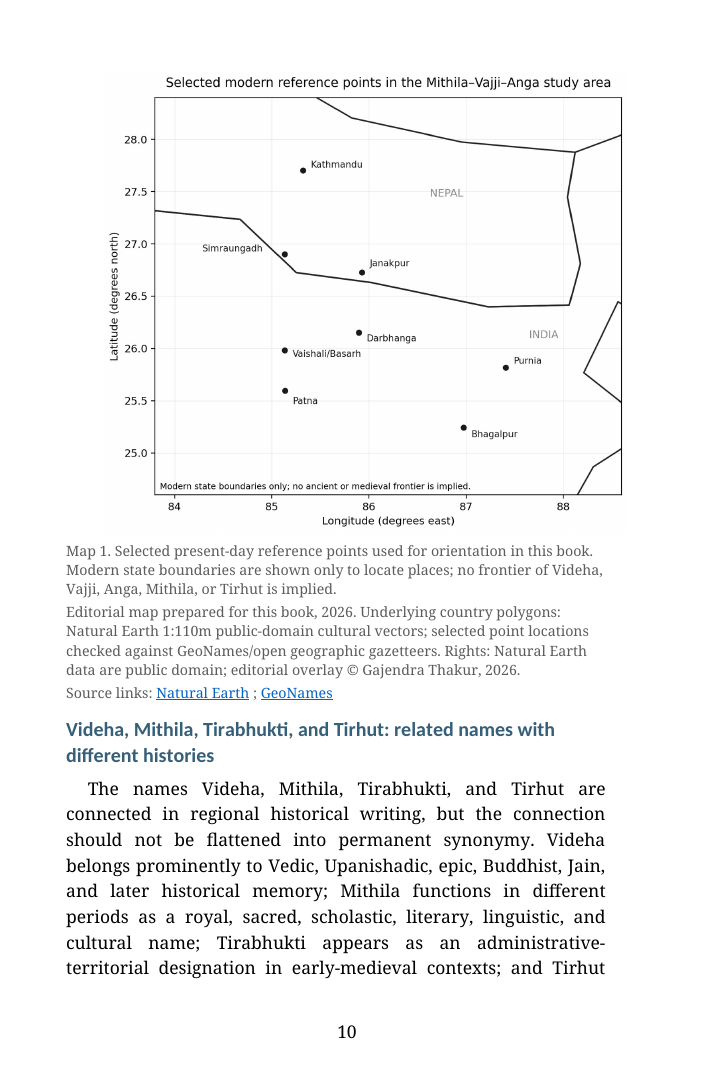
Mithila · Vajji · Anga
Chapter-specific source notes
- Primary chapter witness. Gajendra Thakur, Decoding the Panji of Mithila — Volume IV, formal Chapter 1, PDF pp. 11-22; formal Chapter 1. The HTML transcription is generated from the commit-pinned source PDF and retains the chapter boundary recorded in this edition.
- Internal structure. The repository source-heading inventory records 11 subordinate headings for this chapter: “1.1 The Nagram Panji as a Genealogical Archive”; “1.2 Why Volume IV Requires Expansion”; “1.3 The Opening Movement: Nagram, Sandahpur, Singhwar, and Shashipur”; “1.4 The Meaning of “From” in the Panji”; “1.5 Names, Branches, and the Problem of Compression”; “1.6 Sacred Headings and Genealogical Order”; “1.7 Gaps, Dots, and the Ethics of Editing”; “1.8 The Human World Behind the Nagram Panji”; ….
- Digital editorial method. The page keeps the preserved source text distinct from generated navigational, concordance, visual, and provenance apparatus. The synthetic reconstruction is explanatory only and is not evidence for an individual lineage or a determination of social or marital status.