Decoding the Panji of Mithila · Volume IV · Chapter 2
The Language of the Panji: Terms, Abbreviations, and Formulae The Nagram Panji cannot be understood merely by
Chapter 2
The Language of the Panji: Terms, Abbreviations,
and Formulae
The Nagram Panji cannot be understood merely by
translating names. Its true difficulty lies in its language of
compression. The register uses a compact genealogical idiom
in which a small word, a clipped abbreviation, a dot, a
repetition, or a village particle may carry a large amount of
meaning. Chapter 1 explained why the Nagram Panji must be
read as a layered archive. This chapter explains the working
language of that archive.
The reader must begin with one important caution: the
Panji is not written as modern English prose, nor even as a
modern genealogical table. It is written as a professional
record. Its intended readers were expected to know the
conventions already. For them, a word such as suta or a form
such as pr. did not require explanation. For the modern
reader, however, every such sign must be slowed down and
made visible.
The purpose of this chapter is therefore practical. It gives
the reader a decoding key for the chapters that follow. When
later chapters analyze Sandahpur, Singhwar, Shashipur,
Mangrauni, Hati, Samauli, Kua, Rohar, Tatail, Bhakharouli,
Malangia, and other clusters, the terms explained here will be
used repeatedly. This chapter should be read not as a glossary
only, but as a grammar of the Nagram Panji.
A glossary gives meanings. A grammar explains how those
meanings work together. The Nagram Panji needs both. A
term may have one general meaning, but its exact function
changes according to position. A sonship marker at the
beginning of a phrase may introduce a direct descendant. The
same marker after a group of names may introduce a new
branch. A village name after a person may indicate origin,
settlement, marriage relation, or archival classification. A
blank may indicate absence of information, not absence of a
person. Every sign must be interpreted within the line.
2.1 The Basic Unit: The Panji Entry
The basic unit of the Nagram Panji is the entry. Most entries
begin with a number, followed by a village-route heading, a
sacred invocation, or both. The number is not merely
decorative. It locates the entry within the sequence of the
register. The heading tells the reader where the genealogical
cluster begins, or which route or village relation is being
opened.
After the heading, the entry usually gives a person or a
group of persons. These persons may be ancestors, sons,
branch-holders, or later descendants. The entry then expands
by using relational words. It may say that someone has sons; it
may say that a branch goes from one village to another; it may
insert an alternative name; it may mark a later line; it may
include a cross-reference; it may end with a blank or an
incomplete continuation.
Thus an entry is not a sentence in the ordinary sense. It is a
packet of information. It may contain what a modern editor
would divide into several sentences, notes, and family-tree
boxes. The task of decoding is to unpack this packet without
changing the source’s meaning.
A safe method is to ask five questions of every entry: Who is
the first named person or branch? What relation is being
stated? Which village or villages are attached to the relation?
Are there titles, nicknames, or alternate names? Is any part
uncertain, blank, or cross-referenced? These five questions
prevent the reader from treating the entry as a mere list of
names.
2.2 Suta, Suto, and the Language of Sonship
The most frequent genealogical marker in the Panji is the
word represented in forms such as suta, suto, sutaḥ, or similar
manuscript/OCR variants. Its central sense is “son” or
“descendant,” but its function is wider than a simple English
translation. In the Panji, it introduces a relation of descent.
Depending on context, it may mean “son of,” “sons of,”
“descended from,” or “the line of.”
When a name is followed by suta or suto and then another
name, the usual sense is that the latter is the son or
descendant of the former. But the Panji does not always use
modern punctuation. If several names are grouped together
before the next relational marker, the reader must determine
whether they are brothers, sons, branch-members, or
successive descendants. This can only be done by reading the
surrounding formula.
The pluralizing force of the marker is important. In many
entries, a cluster of sons is given after a single ancestor. The
register may not repeat the word “son” before each name.
Instead, it may give one relational signal and then list several
names. A modern English explanation must restore the
implied structure: “His sons were…” or “From him came the
following branch…”
The reader must also avoid assuming that every occurrence
of a similar-looking form has exactly the same grammatical
value. The manuscript tradition, typographical conversion,
and OCR-like rendering may produce forms that look slightly
different. The editor’s task is not to normalize them
mechanically, but to understand their function in the entry.
2.3 Apara / Apra: The Other Branch
Another important term is apara, often appearing in
shortened or variant form such as apra or apra suta. Its basic
meaning is “other,” “another,” or “additional.” In genealogical
use it usually marks another branch, another son, another
line, or another continuation of the same family cluster.
This word is crucial because it prevents confusion. Without
noticing apara, a reader may think that the following names
belong to the immediately preceding person. In fact, the Panji
may be shifting to another branch of the same ancestor. In
English, such places should often be rendered as “another
branch,” “another son,” “another line,” or “in another line.”
The apara marker also shows that the Panji is not always
strictly linear. It may go down one branch for a while, then
return to another son or branch of an earlier person. A
modern family tree would show this visually by drawing
separate lines. The Panji shows it verbally by using markers
such as apara.
For this reason, every apara in the Nagram material must
be preserved in explanation. It is not filler. It is a branch-
divider.
2.4 Pr. and the Problem of Alternate Names
The abbreviation pr. appears repeatedly in the Nagram
Panji. In many contexts it seems to introduce a known,
alternative, shortened, popular, or practical name by which a
person was recognized. The exact expansion may vary
according to tradition and context, but its function is usually
clear: it points to another form of identification.
For example, a person may be recorded under a formal
name and then followed by pr. with a more familiar or
alternative name. In English, this may be rendered as “also
known as,” “popularly known as,” “called,” or “alias,”
depending on the specific context. The editor should not
flatten all such cases into one formula if the surrounding
wording suggests a different nuance.
Alternate names matter in genealogical records. A person
may be remembered in one village by a formal Sanskritic
name, in another by a household name, and in another by a
title or nickname. The Panji preserves these layers. When pr.
appears, it often tells us that the register is aware of more than
one identity-form for the same person.
This is especially important in sections where modern
names and older names appear together. The Panji may
preserve an older lineage name while also noting the name by
which the person or branch was locally recognized. A correct
decoding must not discard either form.
2.5 Th., Thakur, and Title-Markers
The abbreviation th. or forms equivalent to Thakur appear
frequently. In the Nagram Panji, such markers may indicate a
title, an honorific, a family style, or a socially recognized
designation. It should not always be treated as part of the
personal name in the same way that a modern surname is
used.
When the Panji says “Thakur X” or uses an abbreviated
form before a name, the editor must ask whether the title
belongs to the person’s status, to the family’s recognized
identity, or to a branch label. In some cases, the title may help
identify a remembered house. In others, it simply marks social
respect.
Similar care is needed with Chaudhary, Pandit, Jyotishi,
Mahamahopadhyaya, Vaidya, Vakil, Engineer, Doctor, and
other designations. These are not all of the same type. Some
are inherited social titles; some are scholarly; some are
occupational; some are modern professional labels. The Panji
uses them because they help identify persons in memory.
A major task of this volume is to preserve title-markers
without allowing them to obscure genealogy. A title is useful,
but it must not be mistaken for fatherhood, sonship, or village
relation.
2.6 Ka, Kau, and Group Attachment
Forms such as ka or kau often attach a group of names to a
previous person or branch. In many places they indicate that
the following names belong to the same family group. In
English, this may require words such as “of,” “belonging to,”
“his,” “their,” or “of the line of.”
The danger is that ka/kau may be visually small but
structurally important. It may connect a group of sons to a
father, a set of brothers to a household, or a branch to a
recognized ancestor. When ignored, the entry becomes a loose
list. When read correctly, it becomes a structured family unit.
Because the Nagram Panji often compresses several names
into one phrase, ka/kau helps hold the group together. It is one
of the small particles by which the text tells the reader where
a cluster begins and ends.
2.7 Daur / Ddau / Dau: The Closing or Linking
Marker
A recurring form appears as dau, daur, ddau, or similar
variants. The exact orthographic form may vary across the
files. In many entries it works as a closing or linking marker
after a relational statement. It may mark that a relation has
been stated, that an entry-clause is complete, or that the next
genealogical movement can begin.
This marker should not be translated mechanically every
time. In many English explanations it is better to let the
structure do the work: “X, son of Y, connected with village Z.”
The marker itself may be noted in the glossary, but the English
prose does not always need a separate word for it.
However, the marker is useful for parsing. It often tells the
editor that a small unit has ended. In a dense line, noticing the
marker can prevent the reader from joining two unrelated
clauses. It functions almost like a punctuation-sign within the
genealogical idiom.
2.8 Gramārambha: The Beginning of a Village
Section
The term gramārambha means the beginning or opening of
a village section. When the Panji says that a village begins, it is
not making a literary announcement. It is marking an archival
transition. A new village cluster is being opened, and the
following names must be read under that local heading.
This is important because the Nagram Panji often moves
across villages very quickly. A gramārambha marker gives the
reader a reset point. It says: from here, a new village-based
genealogy or route-cluster is being introduced.
In English, gramārambha should be explained rather than
merely translated. A phrase such as “the village section begins
here” or “here begins the record for the village” is usually
clearer than a literal Sanskritic rendering.
2.9 Rikta: The Empty Entry
Rikta means empty, vacant, or blank. In a Panji record, an
entry marked rikta is not useless. It tells the reader that a
numbered place exists in the register, but the details are
absent, lost, withheld, or not available in the surviving record.
Such entries must be preserved.
A modern editor may be tempted to omit rikta entries
because they contain no names. That would be a mistake. The
numbering itself may show that an entry once had a place in
the sequence. Its emptiness may reveal a gap in transmission.
It may also preserve the order of the register, allowing later
cross-checking against another index, manuscript, or family
record.
In this volume, rikta entries will be listed and interpreted.
They will not be treated as accidental whitespace. They are
part of the history of the Panji.
2.10 Dots, Ellipses, and Missing Names
The Nagram material contains many dotted spaces. These
dots may represent missing names, illegible names, unknown
fathers, absent village names, broken manuscript portions, or
editorial placeholders. Their presence is one of the most
important signs of the source’s honesty. The register indicates
that something belongs there, but that the information is
incomplete.
The editor must not invent a missing name merely to make
the entry smooth. If the source gives a dot, the English
explanation should say that the name or relation is missing. If
the context suggests the kind of missing information, that may
be explained cautiously: for example, “the father’s name is not
preserved here” or “the village name is missing in the source.”
Dots are therefore different from silence. A silent source
simply does not mention a fact. A dotted source signals that
the fact has a place but is unavailable. This distinction is vital
in genealogical work.
2.11 B-References and Numbered Cross-
References
The Nagram Panji frequently contains references such as B
followed by numbers, or numbers in parentheses. These are
cross-reference devices. They may point to another register,
another folio, another numbered entry, another branch-list, or
an internal reference system used by the compiler or later
editor.
The exact meaning of every reference cannot be assumed
without comparison to the full reference system. Therefore,
this volume will preserve these references carefully. When a
B-reference appears, it will be noted. If the referenced
material is identifiable within the available files, it will be
cross-linked in the explanation. If it is not fully identifiable,
the reference will be retained as evidence for future checking.
This is where the final index mentioned for the end of the
project will be especially useful. The index can be used to
check whether all numbered and B-referenced items have
been covered and whether any cross-reference requires a
later correction or expansion.
2.12 Sacred Invocation Formulae
Many later entries begin with sacred formulae such as Om
followed by a name of Shiva or a sacred epithet. These
headings include forms invoking Rameshwar, Vasukinath,
Kedarnath, Somnath, Kapileshwar, Adidev, Trilochan, and
others. In the Panji, such formulae are both devotional and
structural.
They remind the reader that genealogy in Mithila was not
merely a secular archive. It belonged to a ritual world. The
keeping of lineage, the regulation of marriage, the
remembrance of ancestors, and the authority of learned
households were all connected with sacred order.
At the same time, the editor must not over-interpret these
formulae. A sacred heading does not automatically prove that
every family listed beneath it served a specific shrine or
belonged to a temple office. In many cases, the invocation is a
section-heading. It sanctifies and organizes the record. The
detailed meaning must be judged from the surrounding entry.
2.13 Place-Names as Genealogical Evidence
Place-names in the Nagram Panji are evidence. They are not
background decoration. A village may identify origin,
settlement, marriage connection, branch affiliation, or social
recognition. When a line says that a person is connected from
one place to another, both places must be preserved.
The same village may appear in many entries. This
repetition shows that certain villages function as major nodes
in the genealogical network. Sandahpur, Singhwar, Shashipur,
Hati, Samauli, Mangrauni, Rohar, Tatail, Bhakharouli, and
Malangia are not isolated references; they are recurring
coordinates in the record.
Some place-names also appear with regional qualifiers such
as Purnea, Champaran, Betia, Uttar Pradesh, Rajasthan, or
Jamshedpur. These references show that the Nagram Panji
records a Mithila-based identity that moved beyond a narrow
geographic boundary. The Panji remembers people through
their continuing relationship to Mithila even when they are
associated with wider regions.
2.14 Names, Nicknames, and Modern Identifiers
The Nagram Panji preserves several kinds of names. Some
are classical Sanskritic names, such as Raghunath,
Vishwanath, Shivanandan, Madhurapati, or Devkinandan.
Some are shorter household or village forms. Some are titles.
Some are modern names, including names accompanied by
professional identifiers such as engineer or doctor.
This mixture is not a defect. It is evidence of continuity. A
living genealogical tradition does not freeze names at one
historical moment. It records families as they continue
through time. Older naming styles and modern professional
identities therefore appear together.
A proper English decoding should not modernize all names
into one form or translate them unnecessarily. Personal
names should be preserved, with explanation only where the
name functions as a title, alias, or branch-marker.
2.15 Repetition: Duplicate or Deliberate?
Repetition is one of the hardest features of the Panji. The
same name may occur repeatedly in different branches. The
same village-route may appear more than once. A person may
be mentioned under one relation and later under another. A
branch may reappear because another son or marriage-line is
being recorded.
The modern editor must not automatically treat repetition
as duplication. In genealogical writing, repetition often serves
a purpose. It may connect a branch to more than one route. It
may preserve the same person from different perspectives. It
may distinguish two persons with the same name. It may
return to an earlier ancestor after following another branch.
Therefore, this volume will read repetition structurally.
Where a repeated entry appears to be the same person or
branch, that will be noted. Where it may be a different person
with the same name, that uncertainty will be preserved.
Where repetition marks a route-link, it will be explained as
part of the Panji’s network logic.
2.16 Editorial Rules for This Volume
The following rules will guide the decoding of the Nagram
Panji in this volume:
Do not erase source uncertainty. Blanks, dots, and rikta
entries will be preserved and explained.
Do not merge repeated names unless the context clearly
supports identity.
Do not translate personal names into English, except when
explaining their function as titles, aliases, or sacred headings.
Do not treat every ‘from X to Y’ formula as literal migration
without contextual evidence.
Do not remove sacred invocation headings as irrelevant; they
are part of the register’s structure.
Do not normalize every variant spelling mechanically;
preserve meaningful variants and explain doubtful readings.
Do not silently correct the source. Any necessary editorial
clarification must be visible.
Do not reduce the Panji to a list of ancestors; read it as a
social, geographic, ritual, and genealogical record.
2.17 How This Grammar Will Be Used in the Next
Chapters
The next chapters will apply this grammar to the first major
Nagram cluster: Sandahpur, Singhwar, and Shashipur. The
reader will see how a heading is opened, how sons and
branches are separated, how village-links are interpreted, and
how uncertain portions are preserved.
The method will be deliberately repetitive at first. That
repetition is pedagogical. Once the reader learns how the
Panji’s language works, later chapters can move more quickly
through the entries while still explaining every important
sign.
In this way, Chapter 2 serves as the key to the whole
volume. The Nagram Panji speaks in a language of
compressed genealogy. This chapter has introduced that
language. The following chapters will demonstrate it line by
line, cluster by cluster, until the whole Nagram material has
been opened.
The central principle is simple: nothing in the Panji is to be
dismissed as meaningless merely because it is brief. A small
abbreviation may mark a branch. A dot may preserve a lost
name. A sacred invocation may open an archival section. A
village formula may reveal a network of memory. To decode
the Panji is to attend to these signs with patience.Source structure and verification apparatus
Editorial source apparatus. This apparatus is descriptive, not interpretive. It records the source-controlled structure used to verify that this page corresponds to formal Chapter 2 of Decoding the Panji of Mithila — Volume IV. The chapter text above is preserved from PDF pp. 23-35; formal Chapter 2 in the commit-pinned authoritative source. It is not merged with a neighboring chapter, appendix, annexure, or independent front/back-matter unit. The internal headings below come from the repository’s source-heading inventory and are retained as navigational and audit evidence; showing them here does not turn those headings into separate publications or add claims that are absent from the source.
Internal source headings
- 2.1 The Basic Unit: The Panji Entry
- 2.2 Suta, Suto, and the Language of Sonship
- 2.3 Apara / Apra: The Other Branch
- 2.4 Pr. and the Problem of Alternate Names
- 2.5 Th., Thakur, and Title-Markers
- 2.6 Ka, Kau, and Group Attachment
- 2.7 Daur / Ddau / Dau: The Closing or Linking Marker
- 2.8 Gramārambha: The Beginning of a Village Section
- 2.9 Rikta: The Empty Entry
- 2.10 Dots, Ellipses, and Missing Names
- 2.11 B-References and Numbered Cross-References
- 2.12 Sacred Invocation Formulae
- 2.13 Place-Names as Genealogical Evidence
- 2.14 Names, Nicknames, and Modern Identifiers
- 2.15 Repetition: Duplicate or Deliberate?
- 2.16 Editorial Rules for This Volume
- 2.17 How This Grammar Will Be Used in the Next Chapters
Source-text concordance
Language · Terms · Abbreviations · Formulae · Nagram · cannot · understood · merely · translating · names · true · difficulty · lies · compression · register · uses · compact · genealogical · idiom · small · word · clipped · abbreviation · repetition · village · particle · carry · large · amount · meaning · explained · must · read · layered · archive · explains · working · reader · begin · important · caution · written · modern · English · prose · even · table · professional · record · intended · readers · expected · know · conventions · already · suta · form · require · explanation · however · every · sign · slowed · made · visible · purpose · therefore · practical · gives · decoding · chapters · follow · later · analyze · Sandahpur · Singhwar · Shashipur · Mangrauni · Hati · Samauli
Boundary verification. In the formal sequence this chapter follows Volume IV Chapter 1, “Entering the Nagram Panji: What This Volume Decodes” and precedes Volume IV Chapter 3, “The Logic of “From Village to Village””. The chapter extractor begins at the verified formal Chapter 2 marker and stops at the next verified formal chapter marker; for a final chapter it stops before recognized book-level back matter. The concordance above is generated only from distinct terms already present in this chapter’s preserved source text. It is provided for discovery, comparison, and audit, not as an automated judgment about persons, lineages, status, kinship, marriage eligibility, or historical truth.
Illustrated research apparatus
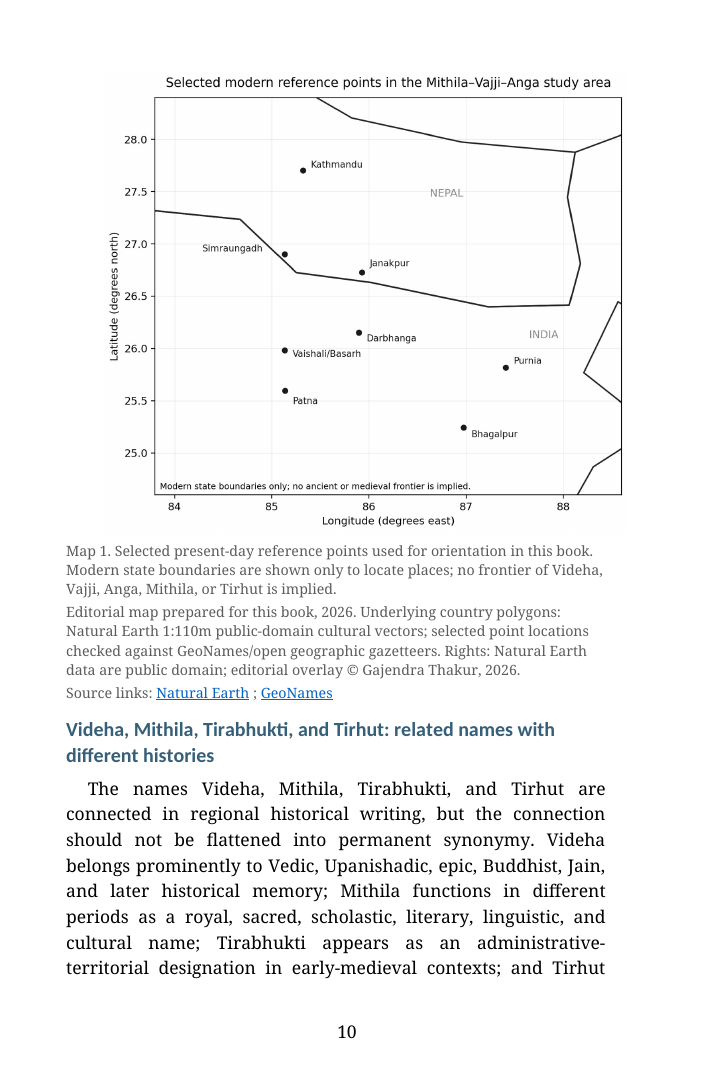
Mithila · Vajji · Anga
Chapter-specific source notes
- Primary chapter witness. Gajendra Thakur, Decoding the Panji of Mithila — Volume IV, formal Chapter 2, PDF pp. 23-35; formal Chapter 2. The HTML transcription is generated from the commit-pinned source PDF and retains the chapter boundary recorded in this edition.
- Internal structure. The repository source-heading inventory records 17 subordinate headings for this chapter: “2.1 The Basic Unit: The Panji Entry”; “2.2 Suta, Suto, and the Language of Sonship”; “2.3 Apara / Apra: The Other Branch”; “2.4 Pr. and the Problem of Alternate Names”; “2.5 Th., Thakur, and Title-Markers”; “2.6 Ka, Kau, and Group Attachment”; “2.7 Daur / Ddau / Dau: The Closing or Linking Marker”; “2.8 Gramārambha: The Beginning of a Village Section”; ….
- Digital editorial method. The page keeps the preserved source text distinct from generated navigational, concordance, visual, and provenance apparatus. The synthetic reconstruction is explanatory only and is not evidence for an individual lineage or a determination of social or marital status.