Decoding the Panji of Mithila · Volume IV · Chapter 17
Khangur-Dihiya Continuations and the Kailakh-Kakraud Turn: Entries (35)-(40)
Chapter 17
    Khangur-Dihiya Continuations and the Kailakh-Kakraud
                    Turn: Entries (35)-(40)
17.1 Scope of this Chapter
   This chapter resumes the Nagram Panji exactly where
Chapter 16 stopped. It covers only entries (35), (36), (37), (38), (39),

and (40). The movement remains within the Khangur-centered
record, but the nature of the material changes. The entries now
combine the Dihiya continuation, several modern family-name
layers, a renewed Khangur cluster, a movement toward Kailakh
and Kakraud, and finally the Adinath-to-Akaur-Nand branch.
    This is not a general chapter on Khangur. It is a controlled
decoding of a small but complicated sequence. The chapter reads
the late Dihiya lines, then the Chichan-Shivnath-Bhushan
material, then the Tilkeshwar-Lakheshwar and Chaturbhuj
learned branch, and finally the Faturan Jha and Adinath-Nand
transition. The index logic used here is the same as before:
Khangur is to be read under the Sarisab framework, while the
accompanying village markers such as Darihara, Khoa l,
Karmaha, Baliyas, Pali, Mandar, Narun, Sakararhi, Pabouli,
Khandbala, Belauch and Soderpur help locate each relationship
within the larger Genome Mapping system.
17.2 Entry (35): Khangur to Dihiya, the Bhaktinath and
Vaidyanath Lines
    Entry (35) is headed “Khangur to Dihiya.” It begins with
Bhaktinath and then turns to Bholanji, Shishir and a Bargaon-
Darihara connection. A modern naming layer immediately enters
the register: Bholanji, Shishir, Mohanji, Rajan, Kamalnath,
Acharya Vaidyanath, Abhayanath, Badrinath, Shobhanath and
Radhanath are not merely a row of unrelated names. They show
how the Dihiya continuation preserves both older Panji grammar
and later family-memory vocabulary.
    The entry is especially important because it combines three
kinds of record. First, there is the ordinary genealogical line: sons
and descendants are named in sequence. Second, there are
village-linked affiliations: Bargaon-Darihara, Nomgara-Naduar-
Karmaha, Karnapur-Sakuri-Baliyas, Pali, Narun and other
markers are used to identify relational placement. Third, there is
a learned or status-bearing layer: the phrase “Acharya
Vaidyanath,” followed by Abhayanath, Badrinath, Shobhanath

and Radhanath, indicates that the branch carries intellectual or
ritual distinction within the record.
    Govindji, also styled Shyamnath, and Madhavji, also styled
Revatinath, continue the line. The names Dilip, Deepak and
Shishir show a modern succession embedded within the older
Panji language. The entry records them with the same
seriousness with which it records older names, proving again
that the Panji is not frozen in the medieval past. It is a living
genealogical instrument into which later family names could be
incorporated.
    The dotted gaps in this entry must not be ignored. Several
relationships are known in outline but not fully completed in the
preserved text. The correct editorial treatment is to preserve the
names that are clear, preserve the village markers that remain,
and mark the incomplete portions as incomplete. Guessing the
missing father, village or relation would damage the record.
17.3 Entry (36): The Second Dihiya Continuation and the
Teacher-Narayanji Layer
    Entry (36) continues the Dihiya material. It begins with
Shobhanath and moves through Mahindrapur-Pandua,
Harshanand, Bholanath or Bhikhiya, Dighoy and Bhaiyalal, then
adds a Malangia-Kujouli connection. The pattern is no longer that
of a single straight descent line. It is a mesh: one part records
sons, another part records affinal or village relations, another
part carries learned or occupational memory.
    The line of Badrinath is particularly significant. Badrinath is
followed by Adhyapak Narayanji, Indu, also styled Bachchanji,
and a Ruchauli-Ekhara relationship. The word “Adhyapak” is not
incidental. It is a professional marker, and its presence shows
that the Panji records social identity as it evolved. Just as earlier
parts of the Panji preserve titles like Mahamahopadhyaya,
Pandit, Jyotishi and Vaidya, this modern layer preserves the
teacher as a recognized identity within the family record.

    The Radhanath branch then moves through Gopalji, also
styled Krishna Chandra, Yadavji, Vishwambhar and Kedarnath.
These names are attached to several village frames: Hariam,
Didho, Sihouli-Mandar, Khandbala, Tripurauli-Narun, Bhatpura-
Hariam, Mandar and Vishnupur-Ahil-Hariam. The abundance of
village markers is not disorder. It is the mechanism by which the
Panji keeps multiple relationship-lines visible at once.
    This entry also shows how late Panji entries often include
modern domestic names and honorific forms together: Narayanji,
Indu, Bachchanji, Sumanji, Gopalji, Krishna Chandra and Yadavji.
These forms should not be normalized away. They are evidence
of how the register accepted contemporary spoken or family
names while retaining the older grammar of “suta,” “suto,”
“apara” and village linkage.
17.4 Entries (37) and (38): Chichan, Shivnath, Bhushan,
Tilkeshwar, Lakheshwar and the Learned Chaturbhuj Line
    Entry (37) returns to the shorter Khangur form and begins
with Chichan. Chichan is connected through Narun and
Khandbala, then Shivnath appears with two major lines:
Vaidyanath and Bhushan. Vaidyanath is linked through Darihara,
Subodh and Nidhipani, while Bhushan is connected through
Karmaha, Chitradhar, Kanhai and Belauch. The entry is brief, but
it performs a crucial function: it closes part of the Dihiya material
and returns the reader to a compact Khangur node.
    Entry (38) is much denser. It begins with Tilkeshwar and his
son Lakheshwar. Lakheshwar is linked through Baliyas, Bechu,
Hemnath, Hariam, Bauk, Mandar, Bhavesh, Chudamani,
Karmaha and Khagpati. The entry then moves to Lal, Nenda,
Khoa l, Mahamahopadhyaya Santosh, Kamaladatta, Karmaha,
Lalit, Jaliwal, and Durmili. This is a classic example of Panji
compression: a few lines hold several generations and several
village relations.
   The second part of entry (38) is intellectually important.
Chaturbhuj is followed by Mahamahopadhyaya Dharanidhar,
Bhane, Vansadhar and related figures. The repeated use of

“Mahamahopadhyaya” and “Mahopadhyaya” indicates that this
branch preserves a learned identity. The line then goes through
Dharanidhar, Naunu or Dhareshwar, Chhunhu, Gopal, Kanhai,
Narasingh, Mandar, Ghusa ut, Karmaha, Soderpur, Lekheshwar
or Lalji, Chaturanand and Chumman.
    This is a place where the editor must avoid flattening the
record into an ordinary father-son list. The learned titles are part
of the genealogy. They help identify the branch, distinguish it
from similarly named persons elsewhere, and preserve the
prestige memory attached to the line. In the Genome Mapping
framework, such titles often operate like identifying tags: they do
not replace descent, but they help interpret descent.
17.5 Entry (39): Khangur to Kailakh and Kakraud, the Faturan
Jha Branch
   Entry (39) is headed “Khangur to Kailakh,” with Kakraud and
Faturan Jha also named. This heading marks an important turn.
Khangur is still the starting memory, but the route now reaches
Kailakh and Kakraud. The Panji thereby moves from the Sarisab-
Khangur base into another named regional and branch setting.
   The entry begins with Chaturanand, also styled Chumman,
and moves through Babulal, Banmali, Pabouli, Vishwanath,
Narasingh, Narun, Bhairavdatt, Bachchi, Soderpur, Chhotkinma,
and Lakshmikant. It then carries the line to Ramakant,
Radhakant and the Kailakh-Kako-Belauch relation. The
occurrence of Radhakant in relation to Kailakh is significant
because it shows the route formula becoming both a place
marker and a lineage bridge.
    The Faturan Jha branch enters through a different sub-line.
Hedu, Chand, Dharampati, Baliyas, Pabouli, Sakararhi, Pali,
Karmaha, Pandua, Alay and Didho appear in the same compact
passage. The names Bhikhi, Bhavnath, Devnath, Adinath and
Badrinath are arranged through village relations, not through a
modern sentence structure. Each name must therefore be read in
relation to the village marker immediately attached to it.

    The index logic is strong in this entry because Kakraud and
Kailakh are not merely places; they are branch identifiers. The
entry also uses the same moolgram vocabulary that the Genome
Mapping index uses elsewhere: Baliyas, Pabouli, Sakararhi, Pali,
Karmaha, Pandua, Alay, Didho and Khoa l. These markers keep
the branch anchored in the larger mool and mool-gram system.
17.6 Entry (40): Adinath Jha to Akaur Nand Jha
   Entry (40) is headed “Adinath Jha to Akaur Nand Jha.” It
begins with Adinath and gives a Khoa l connection through
Goshain and Venidatt, then a Khandbala-Gopinath relation. The
branch then passes to Nand, connected with Darihara, Bawanu,
Girdhari, Ghusa ut and Babulal. This is a concise transition entry,
but it is not minor. It names the passage from one identifiable
person, Adinath Jha, to another, Nand Jha of Akaur.
   The entry continues through Dharampati and his sons or
associated names: Bodhan, Chhavan, Shobhan and Kamal
Narayandatta. Pandua, Pashupati, Nandishwar, Budhwal, Mahi,
Karmaha, Satara, Jahali, Didho, Narottam, Faturan, Khoa l, Soni,
Lotan, Khandbala, Brajbhushan, Mukund, Madhav, Belauch,
Gangaram, Raman, Ghusa ut, Bacha, Dhan, Kodaria, Ishwaridatt,
Darihara, Dhananand, Shivn, Sakararhi, Sudhakar, Krishnaram,
Hariam, Subodh and Pali appear in rapid sequence.
    The density of entry (40) shows why this volume must
proceed slowly. The heading gives a seemingly narrow subject,
but the body expands into a broad network of names and
villages. A modern reader may be tempted to treat such a passage
as excessive detail. In Panji reading, however, this is exactly the
detail that matters. It gives the branch its place in the larger
system of mool, village, marriage and memory.
    Entry (40) also links back to entry (39) through Faturan. In
entry (39), Faturan appears in the heading connected with
Kakraud. In entry (40), Faturan reappears within the Adinath-
Nand passage. This recurrence suggests that Faturan is not an
isolated name but a connecting node between the Kailakh-
Kakraud turn and the Adinath-Akaur continuation.

17.7 Index Logic Applied to Chapter 17
    The index logic for this chapter works through three levels.
First, the Khangur-Sarisab frame remains the controlling
background. The Genome Mapping index identifies Khangur
under the Sarisab-related framework, and earlier it also lists a
Nagram branch reference to Khangur-Sarisab with Vishram and
Kariye. That reference is especially relevant because entry (30)
began with Vishram and Kariye, and entries (35)-(40) continue
the same broad Khangur field.
   Second, the moolgram controls are active throughout the
chapter. Darihara, Khoa l, Karmaha, Baliyas, Pali, Mandar,
Narun, Sakararhi, Pabouli, Khandbala, Belauch, Soderpur,
Budhwal, Ghusa ut, Pandua, Alay, Didho and Kujouli are not
casual place names. They are the system through which the Panji
records affiliation. When these names recur, the reader should
understand them as classification anchors.
    Third, the shreni and laukik framework explains why some
names are accompanied by titles or occupational markers.
Acharya, Adhyapak, Mahamahopadhyaya and Mahopadhyaya
are not separate from genealogy; they help identify the person
and branch. Likewise, later domestic names such as Bholanji,
Shishir, Narayanji, Bachchanji, Sumanji, Rajan and Pramod
preserve more recent family memory within the old Panji
structure.
17.8 Coverage Note
    This chapter covers entries (35), (36), (37), (38), (39), and (40)
only. It begins with the Khangur-Dihiya continuation after entry
(34), passes through the teacher and learned branches, returns to
Khangur through Chichan, Shivnath and Bhushan, decodes the
Tilkeshwar-Lakheshwar and Chaturbhuj-Mahamahopadhyaya
material, and ends with the Kailakh-Kakraud-Faturan and
Adinath-to-Akaur-Nand sequence.

   The next chapter should begin with entry (41), “Khangur to
Yamsam,” and continue through the following Khangur entries
without mixing them with the material already covered here.
Source structure and verification apparatus
Editorial source apparatus. This apparatus is descriptive, not interpretive. It records the source-controlled structure used to verify that this page corresponds to formal Chapter 17 of Decoding the Panji of Mithila — Volume IV. The chapter text above is preserved from PDF pp. 213-220; formal Chapter 17 in the commit-pinned authoritative source. It is not merged with a neighboring chapter, appendix, annexure, or independent front/back-matter unit. The internal headings below come from the repository’s source-heading inventory and are retained as navigational and audit evidence; showing them here does not turn those headings into separate publications or add claims that are absent from the source.
Internal source headings
No subordinate heading was separately encoded in the repository source-heading inventory for this chapter.
Source-text concordance
Khangur-Dihiya · Continuations · Kailakh-Kakraud · Turn · Entries · Scope · resumes · Nagram · exactly · stopped · covers · movement · remains · within · Khangur-centered · record · nature · material · changes · combine · Dihiya · continuation · several · modern · family-name · layers · renewed · Khangur · cluster · toward · Kailakh · Kakraud · finally · Adinath-to-Akaur-Nand · branch · general · controlled · decoding · small · complicated · sequence · reads · late · lines · Chichan-Shivnath-Bhushan · Tilkeshwar-Lakheshwar · Chaturbhuj · learned · Faturan · Adinath-Nand · transition · index · logic · used · read · Sarisab · framework · accompanying · village · markers · Darihara · Khoa · Karmaha · Baliyas · Pali · Mandar · Narun · Sakararhi · Pabouli · Khandbala · Belauch · Soderpur · help · locate · relationship · larger · Genome · Mapping · system · Entry
Boundary verification. In the formal sequence this chapter follows Volume IV Chapter 16, “Khangur to Pilkhwar, Yamsam and Dihiya: The Transition from Branch Genealogy to Modern Memory” and precedes Volume IV Chapter 18, “Khangur to Yamsam, Kakraud, Saurath, and the Noane-Gopinath Continuation This chapter continues the Khangur sequence from entry”. The chapter extractor begins at the verified formal Chapter 17 marker and stops at the next verified formal chapter marker; for a final chapter it stops before recognized book-level back matter. The concordance above is generated only from distinct terms already present in this chapter’s preserved source text. It is provided for discovery, comparison, and audit, not as an automated judgment about persons, lineages, status, kinship, marriage eligibility, or historical truth.
Illustrated research apparatus
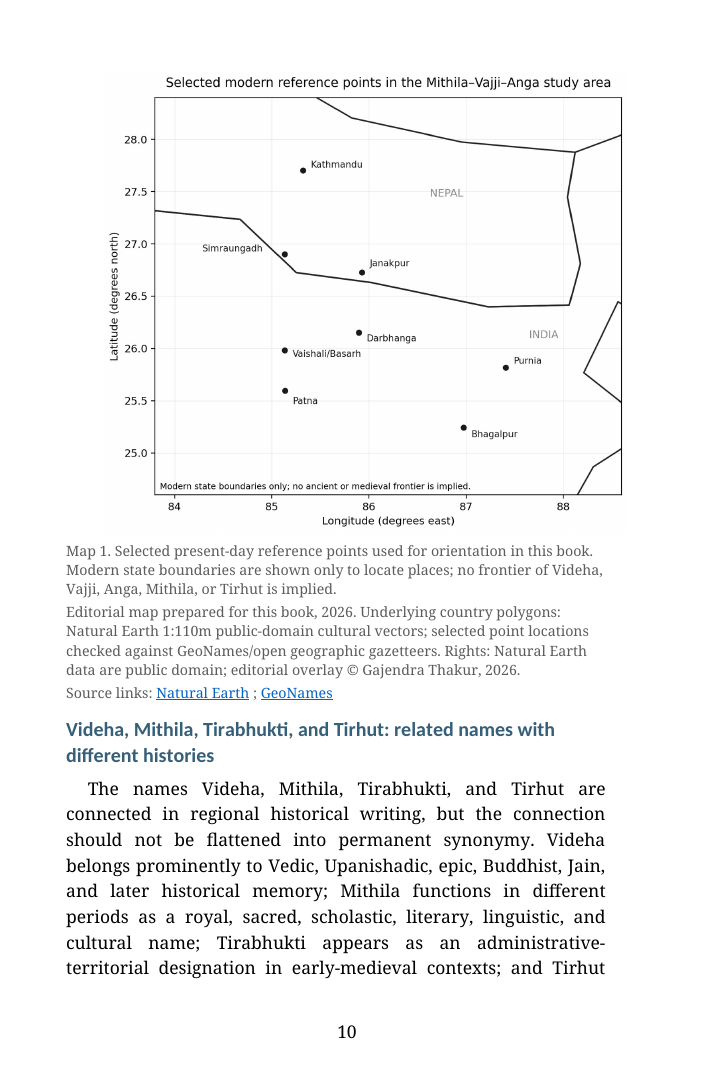
Mithila · Vajji · Anga
Chapter-specific source notes
- Primary chapter witness. Gajendra Thakur, Decoding the Panji of Mithila — Volume IV, formal Chapter 17, PDF pp. 213-220; formal Chapter 17. The HTML transcription is generated from the commit-pinned source PDF and retains the chapter boundary recorded in this edition.
- Internal structure. The repository source-heading inventory records no separately encoded subordinate heading for this chapter.
- Digital editorial method. The page keeps the preserved source text distinct from generated navigational, concordance, visual, and provenance apparatus. The synthetic reconstruction is explanatory only and is not evidence for an individual lineage or a determination of social or marital status.