Decoding the Panji of Mithila · Volume IV · Chapter 16
Khangur to Pilkhwar, Yamsam and Dihiya: The Transition from Branch Genealogy to Modern Memory
Chapter 16
Khangur to Pilkhwar, Yamsam and Dihiya: The
Transition from Branch Genealogy to Modern
Memory
Exclusive coverage in this chapter: Nagram Panji entries (30),
(31), (32), (33), and (34). Entry (30) begins after the heading
“Khangur to Pilkhwar” and entry (34) closes with the
Shantinath-Bhaktinath-Mohanji continuation into the modern
Dihiya register.
This chapter resumes the Khangur sequence exactly where
Chapter 15 stopped. Chapter 15 ended with entry (29), where
Khangur had extended toward Ranitole, Amauli, Sirsia in
Purnea, Baidyanath Jha, Haldhar Jha and Nar Singh Jha. The
present chapter begins with entry (30), headed “Khangur to
Pilkhwar,” and then follows the movement through Yamsam,
Kakraud, Jamasam or Jamsam, Apar-Dihiya, and Dihiya. The
entries are important because they show a change in the
density of the record. The older genealogical grammar
continues, but the entries now increasingly preserve learned
identities, ritual-ascetic markers, modern personal names,
professional labels, and contemporary family branches.
16.1 Entry (30): Khangur to Pilkhwar and the
Vishram-Kariye Line
Entry (30) continues from the Khangur-Pilkhwar heading
and opens with Kunai and Vishram. Vishram becomes a
crucial node because the Genome Mapping index
independently records “Nagram branch, Khangur-Sarisab,
Vishram son of Kariye Jha” as a named index point. This is a
major example of index control: the Panji body gives the
lineage movement, while the index confirms that this
Khangur-Sarisab-Vishram-Kariye cluster was important
enough to be separately identified in the classification register.
The body of entry (30) carries Vishram through Thakuri and
Kariye. Thakuri branches toward Bathaha, Muni and Sufal,
while Bathaha opens further through Kartik, Butkun and
Bachcha. The village coordinates include Mandar, Pali,
Darihara, Kujouli, Phanandah, Sarisab, Baliyas, Soderpur,
Sakararhi, Jajiwal, Pandua, Ghusa ut and other markers. In
terms of index logic, this is a true Khangur-Sarisab line
because the index places Khangur under the Sarisab frame,
and the presence of Vishram with Kariye strengthens the
identification.
The same entry then introduces Shubhankar and his sons
Mohan and Chhoke. Mohan carries several lines: Sadu Saheb,
Ghanshyam, Kashinath and Prannath. The entry also includes
Shyamnath, Amritnath, Vidyanath and Lalit. These names do
not function as a detached second list. They are part of the
extended Khangur-Pilkhwar mapping. The reader must
therefore understand entry (30) as a two-stage record: first,
the Vishram-Kariye branch, and second, the Shubhankar-
Mohan-Chhoke extension. Together they carry Khangur
memory across a wide moolgram field.
The title-like and respect markers in this entry must be
handled carefully. “Saheb” after Sadu may be an honorific or
nickname, not a separate father. “Pr.” continues to signal a
known alternative or styled form. Where the source gives
dots, the edition must retain uncertainty rather than invent
missing fathers or destinations.
16.2 Entry (31): Khangur to Yamsam-Kakraud and
the Prannath Expansion
Entry (31) is headed “Khangur to Yamsam-Kakraud, former
Yamsam.” The heading itself shows that the Panji is recording
a place-memory with historical layering: Yamsam appears
with a prior or older form, and Kakraud is joined to it in the
heading. The body continues from the late section of entry
(30), beginning with Soderpur-Nandishwar and then carrying
Lalit, Umakant, Lakshmikant, Kashinath, Prannath and many
other descendants.
Prannath becomes the major organizing figure in this entry.
His sons are listed as Hridaynath, Bachkan, Buddhinath,
Amritnath, Jivanath and Shivnath. From there the record
opens several internal streams: Tilakeshwar, Kamaladatt,
Bahoran, Babu Jan, Hridaynath’s own relations, Gopinath also
called Luchai or associated with Durvasa, and Eknath. The line
also includes learned and titled forms, including
Mahamahopadhyaya Dharanidhar in a Darihara context. Such
markers indicate that the Panji is preserving scholarly and
ritual reputation within the family network.
The index logic for entry (31) is broad. It uses the Khangur-
Sarisab frame but then travels through Budhwal, Soderpur,
Pandua, Sarisab, Sakararhi, Baliyas, Pabouli, Kujouli, Belauch,
Karmaha, Darihara, Hariamb, Ghusa ut, Mandar, Didho and
Khoa l. These should not be flattened into “places mentioned.”
They are moolgram signals. Each place-name is a genealogical
coordinate and must be treated as part of the relational proof
by which the branch is remembered.
The identification of Gopinath as Luchai and the
parenthetical Durvasa note is especially worth preserving.
Such parenthetical identities may record a reputation,
nickname, branch-style or ritual association. They should not
be removed as noise. The Panji often preserves precisely those
identifying details that allowed panjikars and family members
to distinguish one similarly named person from another.
16.3 Entry (32): Khangur to Jamsam, Apar-Dihiya
and the Ascetic-Self-Cooking Marker
Entry (32), “Khangur to Jamsam, Apar-Dihiya, Purnea,”
opens with Amritnath and the line of Bua or Shashinath and
Yadunath. It continues into Jivanath, Thadu or Modnath,
Mukund and others. This entry is important because it
connects the Khangur field to Apar-Dihiya and Purnea, just as
entry (29) had widened the branch toward Sirsia-Purnea.
These eastward references are part of a repeated pattern in
which Khand 3/Nagram preserves not only central Mithila
memory but also settlement and identification in the eastern
regional zone.
The most distinctive part of this entry is the description of
Lakshminath, also styled Dokai, as “Naishthik,” and the
association of Shyam with “Svayampaki,” meaning one who
cooks for himself or observes a self-cooking discipline. Such
markers are not ordinary genealogy. They preserve ritual life.
A naishthik identity may indicate strict observance, celibate
discipline, or a reputation for ascetic regularity depending on
context. A svayampaki marker indicates a ritual food-
discipline. The Nagram Panji therefore records not only who
descended from whom, but how a person was socially and
ritually remembered.
The village frame includes Ghusa ut, Pandua, Darihara,
Khandbala, Belauch, Didho, Pali, Baliyas, Khoa l, Sarisab,
Baheradahi and others. The Apar-Dihiya heading should not
be lost in the middle of these connections. It tells us that the
branch had a recognized Dihiya-related memory in Purnea,
and the body supplies the genealogical route by which that
memory was carried.
16.4 Entry (33): Khangur to Dihiya and the
Yantyajna/Modern Learned Branch
Entry (33) is headed “Khangur to Dihiya.” It begins with
Dayanath, Jayanath and Vasukinath, and then quickly
introduces a notable learned marker: Yantyajna Dayanath.
Whether read as a ritual-technical title or as a specialized
learned identity, it must be preserved. It shows that the entry
is not simply listing sons; it is preserving the intellectual or
ritual reputation attached to Dayanath.
The entry then moves to Taranand and Chandranand. A
modern genealogical layer appears immediately: Taranand
has Narendra and Amarendra, but parts of their marriage or
branch details are left blank. Chandranand leads to Sanjay,
with later references to Mahishi-Budhwal, Sakuri-Baliyas and
Chainpur-Balua. Jayanath is described with markers such as
Sadachari and Arthodyami, and his line gives Ramanand and
Suryanand. This is one of the clearest examples in this section
of the Panji preserving moral, learned and economic
descriptors alongside descent.
The line then includes Ramanand, Bachchun, Lalan or
Shyamanand, Vinodanand, Varun, Gunānand, Nagendra or
Nageshwar, and a striking modern reference: Dr. Professor,
economist, linked with Lakshmeshwar. These details show
that the Panji continued to absorb modern professional
identities. The presence of “Dr.,” “Professor,” and “economist”
should not be treated as a corruption of the older register.
They are part of the living continuation of the Panji’s
recording habit.
Index logic here works in two ways. First, Dihiya and
Purnea-related memory must be read as a continuation of the
eastward Khangur expansion. Second, moolgram markers
such as Uchati, Khoa l, Karmaha, Baliyas, Narun, Darihara,
Sarisab, Phanandah, Hariamb and Sukhait must be explained
through the broader gotra-mool and shreni framework rather
than reduced to plain locations.
16.5 Entry (34): The Second Dihiya Entry and the
Modern Family Register
Entry (34) continues the Dihiya material. It begins with
Khamgada, Ratipar, Belauch and Anantlal, son of Harekrishna,
then moves to Ahil-Hariamb and Tirthanand. The line of
Suryanand includes Bablu and then Nadwar-Karmaha with
Ramchandra and Devchandra. The entry then returns to
Vasukinath and lists Shantinath, Bhaktinath and Mohanji. A
series of modern names follows: Pappu, Vijay, Pramod and
others, with links to Sukh sena, Haripur-Pali, Ahil-Hariamb,
Vishnupur, Rajanpur-Darihara and additional incomplete
destinations.
This entry is genealogically different from the older
compact entries. It is full of modern family-style names and
incomplete placeholders. This does not make it less valuable.
On the contrary, it shows how the Panji system continued to
register contemporary branches even when every marital or
village detail was not yet available. The blank spaces show an
active but incomplete archive.
For the editor, the rule is clear: names such as Bablu, Pappu,
Vijay and Pramod are to be preserved as part of the modern
layer. They should not be Sanskritized or replaced by assumed
formal names. At the same time, incomplete “from ... to ...”
structures must not be filled from guesswork. The Panji gives
us exactly what it gives: a living record in progress.
16.6 Index Logic Applied to Chapter 16
The Genome Mapping index is especially important for
Chapter 16 because entry (30) corresponds to a separately
visible index point: the Nagram branch of Khangur-Sarisab
with Vishram, son of Kariye Jha. This confirms that the
Vishram-Kariye cluster is not a minor incidental line. It is a
control item in the classification register.
Entry (30): Khangur-Pilkhwar, Vishram and Kariye,
confirmed by the index’s Nagram branch Khangur-Sarisab
reference.
Entry (31): Yamsam-Kakraud, the Prannath sons, and the
learned/ritual marker around Gopinath-Luchai/Durvasa.
Entry (32): Jamsam/Apar-Dihiya/Purnea, with Naishthik
and Svayampaki markers that preserve ritual discipline.
Entry (33): Dihiya, Yantyajna Dayanath,
Sadachari/Arthodyami Jayanath, and the modern Dr.-
Professor-economist layer.
Entry (34): the modern Dihiya continuation with Bablu,
Pappu, Vijay and Pramod, preserving living family
memory despite blanks.
16.7 Coverage Note
This chapter covers entries (30), (31), (32), (33), and (34)
only. It begins with the body of “Khangur to Pilkhwar” and
ends with the second Dihiya entry containing the Shantinath-
Bhaktinath-Mohanji and Pappu-Vijay-Pramod continuation.
Entry (35), “Khangur to Dihiya,” begins the next cluster and
will be treated in the following chapter so that the modern
Dihiya branches are not compressed into a single
undifferentiated summary.Source structure and verification apparatus
Editorial source apparatus. This apparatus is descriptive, not interpretive. It records the source-controlled structure used to verify that this page corresponds to formal Chapter 16 of Decoding the Panji of Mithila — Volume IV. The chapter text above is preserved from PDF pp. 207-213; formal Chapter 16 in the commit-pinned authoritative source. It is not merged with a neighboring chapter, appendix, annexure, or independent front/back-matter unit. The internal headings below come from the repository’s source-heading inventory and are retained as navigational and audit evidence; showing them here does not turn those headings into separate publications or add claims that are absent from the source.
Internal source headings
- 16.1 Entry (30): Khangur to Pilkhwar and the Vishram-Kariye Line
- 16.2 Entry (31): Khangur to Yamsam-Kakraud and the Prannath Expansion
- 16.3 Entry (32): Khangur to Jamsam, Apar-Dihiya and the Ascetic-Self-Cooking Marker
- 16.4 Entry (33): Khangur to Dihiya and the Yantyajna/Modern Learned Branch
- 16.5 Entry (34): The Second Dihiya Entry and the Modern Family Register
- 16.6 Index Logic Applied to Chapter 16
- 16.7 Coverage Note
Source-text concordance
Khangur · Pilkhwar · Yamsam · Dihiya · Transition · Branch · Genealogy · Modern · Memory · Exclusive · coverage · Nagram · entries · Entry · begins · heading · closes · Shantinath-Bhaktinath-Mohanji · continuation · register · resumes · sequence · exactly · stopped · ended · extended · toward · Ranitole · Amauli · Sirsia · Purnea · Baidyanath · Haldhar · Singh · present · headed · follows · movement · Kakraud · Jamasam · Jamsam · Apar-Dihiya · important · show · change · density · record · older · genealogical · grammar · continues · increasingly · preserve · learned · identities · ritual-ascetic · markers · personal · names · professional · labels · contemporary · family · branches · Vishram-Kariye · Line · Khangur-Pilkhwar · opens · Kunai · Vishram · becomes · crucial · node · Genome · Mapping · index · independently · records · Khangur-Sarisab · Kariye
Boundary verification. In the formal sequence this chapter follows Volume IV Chapter 15, “Pilkhwar, Bhatsimri, Ranitole and the Later Khangur Expansion” and precedes Volume IV Chapter 17, “Khangur-Dihiya Continuations and the Kailakh-Kakraud Turn: Entries (35)-(40)”. The chapter extractor begins at the verified formal Chapter 16 marker and stops at the next verified formal chapter marker; for a final chapter it stops before recognized book-level back matter. The concordance above is generated only from distinct terms already present in this chapter’s preserved source text. It is provided for discovery, comparison, and audit, not as an automated judgment about persons, lineages, status, kinship, marriage eligibility, or historical truth.
Illustrated research apparatus
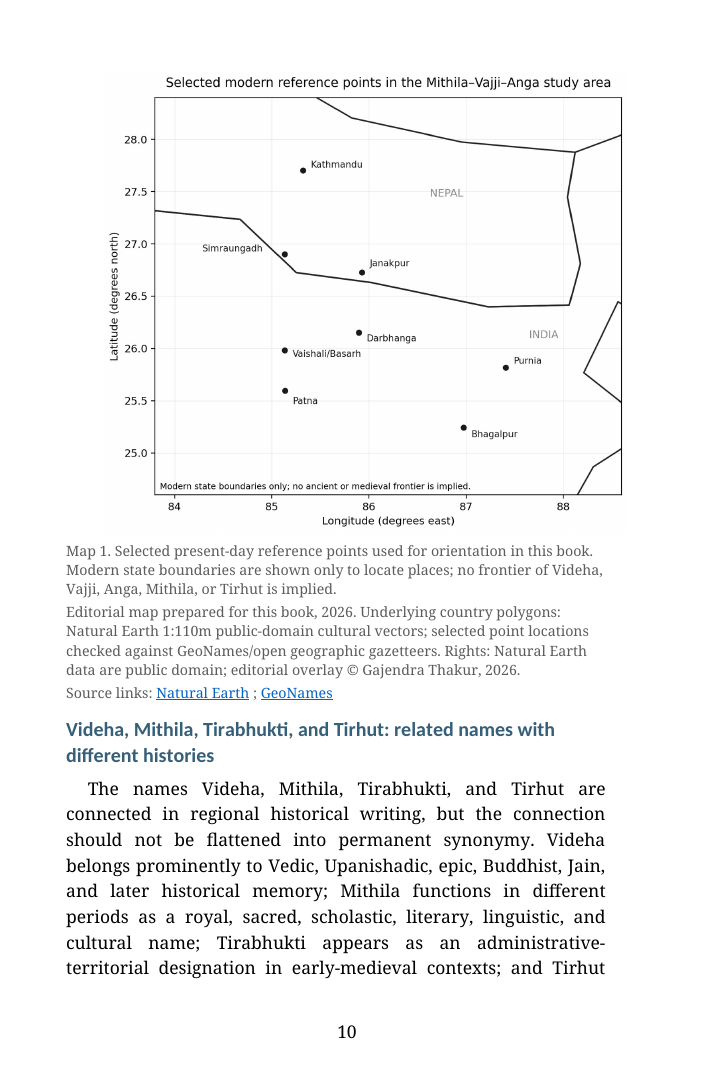
Mithila · Vajji · Anga
Chapter-specific source notes
- Primary chapter witness. Gajendra Thakur, Decoding the Panji of Mithila — Volume IV, formal Chapter 16, PDF pp. 207-213; formal Chapter 16. The HTML transcription is generated from the commit-pinned source PDF and retains the chapter boundary recorded in this edition.
- Internal structure. The repository source-heading inventory records 7 subordinate headings for this chapter: “16.1 Entry (30): Khangur to Pilkhwar and the Vishram-Kariye Line”; “16.2 Entry (31): Khangur to Yamsam-Kakraud and the Prannath Expansion”; “16.3 Entry (32): Khangur to Jamsam, Apar-Dihiya and the Ascetic-Self-Cooking Marker”; “16.4 Entry (33): Khangur to Dihiya and the Yantyajna/Modern Learned Branch”; “16.5 Entry (34): The Second Dihiya Entry and the Modern Family Register”; “16.6 Index Logic Applied to Chapter 16”; “16.7 Coverage Note”.
- Digital editorial method. The page keeps the preserved source text distinct from generated navigational, concordance, visual, and provenance apparatus. The synthetic reconstruction is explanatory only and is not evidence for an individual lineage or a determination of social or marital status.