Decoding the Panji of Mithila · Volume IV · Chapter 21
Badhiyam after Saurath: Navani, Chanpura, Shashipur, Tedhra, Jagati, Rajey, and Sakuri-Gangoli Chapter 20 ended with the Badhiyam-Parvapalli line
Chapter 21. Badhiyam after Saurath:
Navani, Chanpura, Shashipur, Tedhra,
Jagati, Rajey, and Sakuri-Gangoli
  Chapter 20 ended with the Badhiyam-Parvapalli line
moving through Saurath and Manour. Chapter 21 begins
immediately after that point and covers entries (69) through
(89). The chapter is deliberately confined to this block. It does
not import the later entries, and it does not repeat the
Khangur cluster already decoded in Chapters 14 to 19. Its
purpose is to explain how the Badhiyam-Parvapalli sequence
moves into Navani, Chanpura, Shashipur, Dhanga, Tedhra,
Jagati-Vishnudattpur-Chiknauta, Rajey, and finally the Sakuri-
Gangoli material.
  The governing index logic is important. In the Genome
Mapping control, Parvapalli is placed under Badhiyam, so the
Badhiyam entries must be treated as the operative moolgram
continuation of Parvapalli. At the same time, Sakuri belongs to
the Sarisab set; therefore the later Sakuri-Gangoli entries must
be indexed through the Sarisab-Sakuri logic, not merely under
the surface village name Sakuri. Jagati-Vishnudattpur-
Chiknauta, on the other hand, carries the Nagram linkage
through a named branch and must be separately indexed
because the source itself gives the Muzaffarpur association.

21.1 Entries (69) and (70): Navani and Badhiyam
to Navani
  Entry (69) is headed Navani. It begins with Baburaiya and
then turns to Bhaiu and Nena, with Karmaha, Sakararhi,
Samauli-Pali, Baliyas, Uchiti, Panichobh, Darihara, Mahnaura-
Khoal, and Beherarhi appearing as linked route markers. The
important feature of the entry is the movement from a named
Navani heading into a series of descendants whose names

preserve both older and newer naming patterns: Nilambar,
Vedambar, Dinambar, Hirambar, Sita Kant, Jeev Kant,
Mahadev, Haridev, Krishna Dev, Vishnu Dev, Batuhan, Hiralal,
Kanheyalal, Haridardatt, Rajmani, Achambhit, Bhagwandatt,
Lakshman, Ram, and Sarbana. This is not a single straight
chain. It is a multi-branch record held together by Navani and
by its repeated marriage or affiliation routes.
   Entry (70) explicitly changes the heading to Badhiyam to
Navani. It therefore clarifies that the Navani material must be
read inside the Badhiyam-Parvapalli framework rather than
as a detached village list. The names Nilambar, Krishnambar,
Vedambar, Dinambar, Hirambar, Shiva Kant, Jeev Kant,
Kumar Kant, Sahadev, and Haridev show the later
continuation of the family lines. The entry also contains
modern or semi-modern locations and uncertain blanks.
These blanks should not be filled by conjecture. Their
presence shows that the Panji compiler knew the branch
existed but did not have the complete marriage-route
information for every descendant.
  The index implication is that Navani should be entered
under Badhiyam-Parvapalli, with cross-references to
Karmaha, Sakararhi, Pali, Baliyas, Khoal, Beherarhi,
Panichobh, Darihara, and the other recurring moolgram
markers. The names Nilambar, Vedambar, Dinambar,
Hirambar, Sita Kant, Jeev Kant, Krishna Dev, Vishnu Dev, and
Singheshwar should be separately retrievable in the personal-
name index because they function as internal branch
markers.

21.2 Entries (71), (72), and (73): Badhiyam to
Chanpura and Teldiha-Munger-Banka
  Entry (71) gives the heading Badhiyam to Chanpura,
naming Hiralal Jha and also linking the material to Teldiha.
The opening continues the preceding Navani material through

Madhusudan and Sarvan, then brings in Raghuvansh, Govind,
Jagendra, Devendra, Surendra, Hiralal, Gopal, Chhatradhari,
Kuli, Kanhaiyalal, Badari, Purandar, and associated
descendants. The sequence then explicitly introduces Teldiha-
Munger-Banka. This is geographically significant because the
Panji is no longer confined to a local Mithila village route; it is
recording the continuation of the genealogical memory into a
wider regional zone.
    The Teldiha part of entry (71) begins with Kalidas and
Trilochan, followed by Devanath, Hridaynath, Madhu,
Prannath, Jyotishi Ratinath, Vaidya Bhupnath, and others. The
titles jyotishi and vaidya are important. They do not merely
decorate the names; they record scholarly and occupational
identity within the genealogical chain. For an English
decoding, such titles must be explained as functional
identifiers because they distinguish persons in a dense lineage
where names recur.
   Entry (72) continues the Teldiha-Chanpura block through
Prannath, Ratinath, Prabhunath, Yadunath, Kamalnath,
Ugranath, Brajnath, Jeevanath, Upadhyay Yatindranath,
Ravindranath,    Mahindranath,     Vibhutinath,    Prabhakar,
Kirtinath, Vaidya Siddhinath, Divakar, Vaidya Bhaskar,
Dinakar, and Karunakar. The entry contains the modern-
looking educational marker L.L.B. and the title shastracharya.
These details show that the Panji continued to absorb newer
forms of prestige and qualification without abandoning its
older sonship and route formulae.
  Entry (73) closes the Chanpura-Teldiha block by returning
to Trilochan, Adinath, Yadunath, Vaidya Bhupnath,
Bhavanath, Srinath, Loknath, and Karunakar. Its function is
not simply to add names; it completes the internal branching
begun in entries (71) and (72). The chapter therefore treats
entries (71), (72), and (73) as one interpretive unit: Badhiyam

to Chanpura, with a Teldiha-Munger-Banka extension and
learned-professional identifiers.

21.3 Entries (74), (75), and (76): Badhiyam to
Shashipur, Vedanand Jha, and Dhanga
  Entry (74) moves from Badhiyam to Shashipur. The branch
begins with Gatiram and proceeds through Chaturbhuj, Jeev,
Dukhran, Bhairav, Ramjeev, Paran, Vacha, Haripur-Pali,
Tarapati, Nityanand, Amritnath, Babunath, Bhainath, Nayan,
Nensur, and several further lines. Shashipur has already
appeared earlier in the Nagram material, but this entry is not
a repetition of the earlier Shashipur chapter. It is a new
Badhiyam-to-Shashipur route and must therefore be indexed
separately.
  Entry (75) names Vedanand Jha and continues the
Badhiyam-to-Shashipur block. It gives Babunandan leading to
Vedanand and then extends through Jeev, Tota, Gunapati,
Paduma, Dukhran, Hemkar, Bhavdatt, Punyashila, Dhairya
Narayan, Maherman or Premnath, Buddhinath, Umanath,
Rajnath or Bhailal, Bhola Nath, Adinath, Gopal, Govind,
Krishna Mani, Babuan, Rudik, Vishwanath or Thithar,
Baidyanath, and Singheshwar. This entry is dense enough that
the editor should not flatten it into a single line. It contains
several sibling sets and multiple route indicators.
   Entry (76) takes the Badhiyam line to Dhanga. It is shorter
but still important because it prevents the Shashipur branch
from being treated as the final point. Bhavdatt leads to Rajju;
Punyashila leads to Prabhunath, Rupi, and Sone; and the
routes include Har iamb, Soderpur, Kujouli, Pali, Beherarhi,
Darihara, Sakararhi, and related markers. The Dhanga entry
should therefore be indexed as a Badhiyam extension, not as
an isolated fragment.

21.4 Entries (77), (78), and (79): Badhiyam to
Tedhra and the Rikta Marker
   Entry (77) is headed Badhiyam to Tedhra. It begins with
Tengari and proceeds through Dhir, Sukhai, Kharag Narayan,
Kamal Kant, Shivdatt, Chandra Narayan, Rudai, Mahesh, Jai
Krishna, Buddhinath, Pinakpani, Sukhai, Kanhai, Ratinath or
Nena, Shashinath, Yognath, Shrikant, Divakant, Panchanand,
Tirthanand or Tikam, and a number of route connections. The
entry is especially useful because the Genome Mapping index
preserves Badhiyam as Parvapalli; the Tedhra movement
therefore shows a Parvapalli-Badhiyam branch expanding
into another route-zone.
   Entry (78) continues Badhiyam to Tedhra. It carries the line
through Radhakant, Sita Kant, Ramakant, Tarakant,
Vishweshwar, Gaurikant, Lutti, Bhailal, Garibnath, and
Padmanath. The entry also includes Sihouli-Mandar and
Mahishi-Pali references. These references matter because they
tie the Badhiyam-Parvapalli branch back to the larger
moolgram map of the Genome Mapping index. They should
therefore be cross-indexed under Mandar, Sihouli, Pali,
Mahishi, Darihara, Sakararhi, Karmaha, and Kujouli.
  Entry (79) is marked rikta. It must remain visible in the
edition. The blank does not mean that the entry is worthless. It
means that the register preserves a reserved place for a
branch or continuation whose details were absent, lost, or left
unrecorded in the available text. The ethical editorial rule is to
report rikta as a historical signal, not to remove it.

21.5 Entries (80), (81), (82), (83), and (84): Jagati to
Vishnudattpur-Chiknauta and the Second Rikta
  Entry (80) changes the village route to Jagati to
Vishnudattpur-Chiknauta, with the source identifying
Chiknauta in Muzaffarpur. This is a major transition. The line

begins with Shriram and Shankar, then proceeds through
Bhagirath or Raghudev, Baldev, Jagdish, Ramnath, Gaurinath,
Thakur, Bharat, Motiram, Sitaram, Krishnaram, Vachna,
Lakshmipati, Vishwanath, and several descendants. The
phrase indicating marriage within the same gotra is
particularly important because it shows the Panji’s regulatory
concern, not merely its genealogical interest.
  Entry (81) continues the same Jagati-to-Vishnudattpur-
Chiknauta line through Motiram, Kamaladatt, Bhailal, Vaidya
Vikram, Gonu, Jayanath, Vaidya Lalji, Nandalal, Vaidya
Kishori, Janardan, Mohan, Vanshidhar, Bhavanidatt, and
Dharmdatt. The professional marker vaidya again functions as
a distinguishing identity within the lineage. The entry also
contains cross-references such as B 80/3, which must be
retained because the entry is part of a wider referencing
system.
   Entry (82) continues the same cluster through Radhakant,
Rajnandan Shastri, Parmanand, Bholi or Shivchandra,
Kalanand, Rudranand, Meghanand, Sachchidanand, Nandalal,
Bauku, Aniruddh, Vaidya Kishori, Vishweshwar, Kapileshwar,
Pankaj Prasad, and others. The mention of a letter in
Aryavarta connected with Chutkulanand is a valuable note
because it shows the intrusion of documentary or public-
literary memory into the genealogical register. Such details
must be indexed as notes, not lost among ordinary personal
names.
  Entry (83) continues with Bachan, Mahogauri Datt, Garib,
Adinath, Ram, Kirti, Nena Kant, Vedanand, Ayodhyanath or
Sushil, Vishweshwar, Kamdev, Jaydev, Sahdev, Krishna Dev,
and Indra Dev. Entry (84) is rikta. This second rikta marker
ends the Jagati-Vishnudattpur-Chiknauta unit and should be
kept as a separate blank entry in the final coverage audit.

21.6 Entries (85), (86), (87), (88), and (89): Rajey to
Ranti and Sakuri-Gangoli
  Entry (85) is headed Rajey to Ranti. It begins with Pathak
Raghuvir and proceeds to Teknath, Thakure, Bhavanath,
Pathak Thakur, Pathak Bhavanath, Shivnath, and linked
descendants. The entry is shorter than the surrounding ones,
but it is important because it places a Rajey-to-Ranti route
immediately before the Sakuri material. Entry (86) is rikta and
must be listed in the blank-entry appendix.
  Entry (87) begins with Sakuri and then explicitly opens the
Sakuri-Gangoli register. This entry is long and structurally
complex. It contains Nena, Chiranjeev, Devan, Upati, Anant,
Kriparam, Sarvasva, Mahaval, Puran, Pakshadhar, Bandhav,
Dukhni, Lochan, None or Latadu, Shobhan, Devan or Latadu,
Puran, Vidyanath, Akhi, Bholan, Modan, and Chhotkani. The
key editorial point is that Sakuri must be interpreted through
the Sarisab-Sakuri control in the Genome Mapping index. It is
not merely a surface village heading; it is a moolgram position
within the Sarisab framework.
  Entry (88) continues the Sakuri material and adds the
Haripur-Dhanga connection. It includes Chiranjeev, Gatiram,
Rambhadra, Karu Narayan, Madhuram, Nilkanth, Dinbandhu,
Lochan, Bachnu, Santosh, Jeevanath, Grihimani, Nandkishor,
Kulanand, Bhavanand, and Sadanand. The B-number
references in this entry are important because they link the
Sakuri-Gangoli material to earlier or parallel branches. The
edition should preserve these references rather than
normalize them away.
  Entry (89) moves to Sakuri-Gangoli-Kailakh-Bhagwatpur.
Nandkishor leads to Achyutanand; Achyutanand links to
Kailakh; Vidyanath connects to Oda-Ekhara; and the entry
continues through Dukhni, Bahoran, Nandi, Bhairav, Babujan,
Lochan, Jeevanath, Buddhinath, Pinaki, and Modnath. This is a

fitting end to the chapter because it brings together Sakuri,
Gangoli, Kailakh, Bhagwatpur, Oda, Ekhara, Darihara, Baliyas,
Pali, and several other route markers.

21.7 Index Logic and Coverage Note for Chapter
  The chapter has three governing index principles. First,
entries (69) to (78) belong primarily under Badhiyam-
Parvapalli, even when the surface routes move to Navani,
Chanpura, Shashipur, Dhanga, or Tedhra. Second, entries (80)
to (83) must be indexed under Jagati-Vishnudattpur-
Chiknauta, with a note for Muzaffarpur and for the unusual
same-gotra marriage warning. Third, entries (87) to (89) must
be indexed under Sakuri-Gangoli and cross-referenced to
Sarisab-Sakuri, Kailakh, Bhagwatpur, Oda, Ekhara, Haripur,
and Dhanga.
  The personal-name index for this chapter should include, at
minimum, Nilambar, Vedambar, Dinambar, Hirambar, Hiralal
Jha, Trilochan, Jyotishi Ratinath, Vaidya Bhupnath, Upadhyay
Yatindranath, Divakar, Vaidya Bhaskar, Vedanand Jha,
Tengari, Kharag Narayan, Pinakpani, Rajnandan Shastri,
Parmanand, Vaidya Vikram, Vaidya Kishori, Pathak Raghuvir,
Chiranjeev, Kriparam, Sarvasva, Pakshadhar, Bandhav,
Grihimani, Achyutanand, and Vidyanath.
  Coverage for this chapter is limited to entries (69), (70), (71),
(72), (73), (74), (75), (76), (77), (78), (79), (80), (81), (82), (83), (84),
(85), (86), (87), (88), and (89). The next chapter begins with
entry (90), continuing the Sakuri-Gangoli-Kailakh-Bhagwatpur
material from the point where this chapter stops.
Source structure and verification apparatus
Editorial source apparatus. This apparatus is descriptive, not interpretive. It records the source-controlled structure used to verify that this page corresponds to formal Chapter 21 of Decoding the Panji of Mithila — Volume IV. The chapter text above is preserved from PDF pp. 246-253; formal Chapter 21 in the commit-pinned authoritative source. It is not merged with a neighboring chapter, appendix, annexure, or independent front/back-matter unit. The internal headings below come from the repository’s source-heading inventory and are retained as navigational and audit evidence; showing them here does not turn those headings into separate publications or add claims that are absent from the source.
Internal source headings
- 21.1 Entries (69) and (70): Navani and Badhiyam to Navani
- 21.2 Entries (71), (72), and (73): Badhiyam to Chanpura and Teldiha-Munger-Banka
- 21.3 Entries (74), (75), and (76): Badhiyam to Shashipur, Vedanand Jha, and Dhanga
- 21.4 Entries (77), (78), and (79): Badhiyam to Tedhra and the Rikta Marker
- 21.5 Entries (80), (81), (82), (83), and (84): Jagati to Vishnudattpur-Chiknauta and the Second Rikta
- 21.6 Entries (85), (86), (87), (88), and (89): Rajey to Ranti and Sakuri-Gangoli
- 21.7 Index Logic and Coverage Note for Chapter 21
Source-text concordance
Badhiyam · Saurath · Navani · Chanpura · Shashipur · Tedhra · Jagati · Rajey · Sakuri-Gangoli · ended · Badhiyam-Parvapalli · line · moving · Manour · begins · immediately · point · covers · entries · deliberately · confined · block · import · later · repeat · Khangur · cluster · already · decoded · Chapters · purpose · explain · sequence · moves · Dhanga · Jagati-Vishnudattpur-Chiknauta · finally · Sakuri · Gangoli · material · governing · index · logic · important · Genome · Mapping · control · Parvapalli · placed · must · treated · operative · moolgram · continuation · time · belongs · Sarisab · therefore · indexed · Sarisab-Sakuri · merely · surface · village · name · Jagati-Vishnudattpur · Chiknauta · hand · carries · Nagram · linkage · named · branch · separately · gives · Muzaffarpur · association · Entry · headed · Baburaiya · turns
Boundary verification. In the formal sequence this chapter follows Volume IV Chapter 20, “Sakuri, Sarisab-Sakuri, and the Badhiyam-Parvapalli Branches” and precedes Volume IV Chapter 22, “Sakuri-Gangoli, Bhadgam, Damodarpur, Ramnagar-Khajuri, and Jamuni-Ehu Chapter 21 brought the Badhiyam-Parvapalli material”. The chapter extractor begins at the verified formal Chapter 21 marker and stops at the next verified formal chapter marker; for a final chapter it stops before recognized book-level back matter. The concordance above is generated only from distinct terms already present in this chapter’s preserved source text. It is provided for discovery, comparison, and audit, not as an automated judgment about persons, lineages, status, kinship, marriage eligibility, or historical truth.
Illustrated research apparatus
Mithila · Vajji · Anga
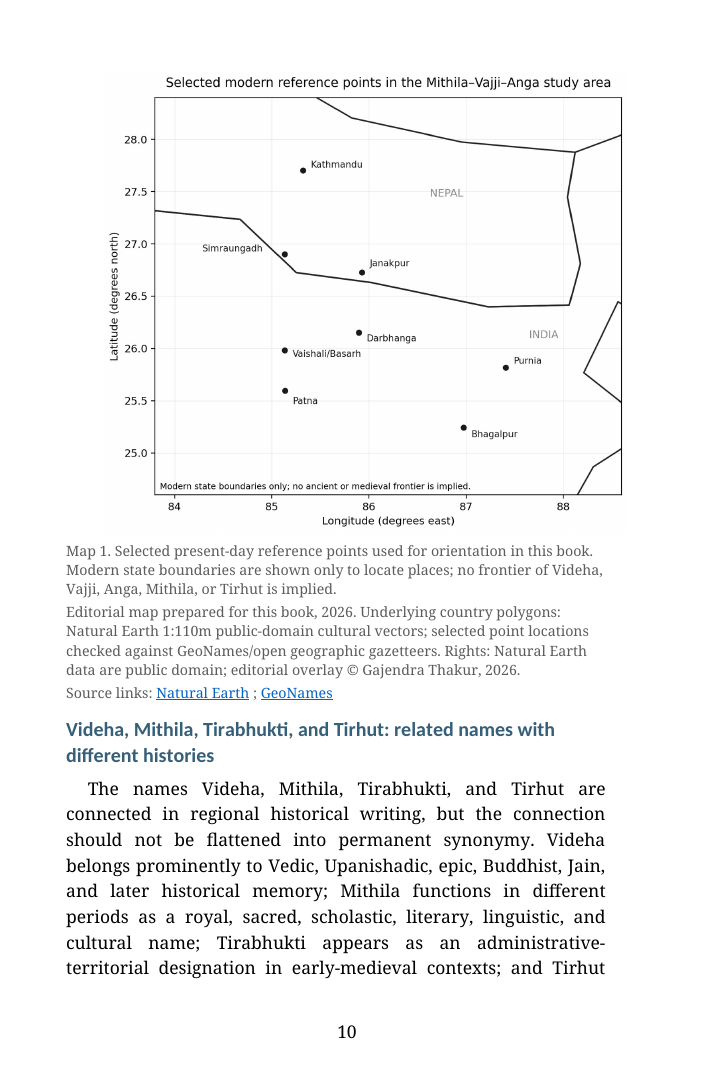
Chapter-specific source notes
- Primary chapter witness. Gajendra Thakur, Decoding the Panji of Mithila — Volume IV, formal Chapter 21, PDF pp. 246-253; formal Chapter 21. The HTML transcription is generated from the commit-pinned source PDF and retains the chapter boundary recorded in this edition.
- Internal structure. The repository source-heading inventory records 7 subordinate headings for this chapter: “21.1 Entries (69) and (70): Navani and Badhiyam to Navani”; “21.2 Entries (71), (72), and (73): Badhiyam to Chanpura and Teldiha-Munger-Banka”; “21.3 Entries (74), (75), and (76): Badhiyam to Shashipur, Vedanand Jha, and Dhanga”; “21.4 Entries (77), (78), and (79): Badhiyam to Tedhra and the Rikta Marker”; “21.5 Entries (80), (81), (82), (83), and (84): Jagati to Vishnudattpur-Chiknauta and the Second Rikta”; “21.6 Entries (85), (86), (87), (88), and (89): Rajey to Ranti and Sakuri-Gangoli”; “21.7 Index Logic and Coverage Note for Chapter 21”.
- Digital editorial method. The page keeps the preserved source text distinct from generated navigational, concordance, visual, and provenance apparatus. The synthetic reconstruction is explanatory only and is not evidence for an individual lineage or a determination of social or marital status.