Decoding the Panji of Mithila · Volume IV · Chapter 22
Sakuri-Gangoli, Bhadgam, Damodarpur, Ramnagar-Khajuri, and Jamuni-Ehu Chapter 21 brought the Badhiyam-Parvapalli material
Chapter 22. Sakuri-Gangoli, Bhadgam,
Damodarpur, Ramnagar-Khajuri, and
Jamuni-Ehu
  Chapter 21 brought the Badhiyam-Parvapalli material
through Navani, Chanpura, Shashipur, Tedhra, Jagati, Rajey,
and the early Sakuri-Gangoli entries. Chapter 22 begins
exactly where that sequence leaves off. It opens with entry
(90), a Sakuri entry that returns to Navani and then moves
through Sakuri-Gangoli; it then turns to Bhadgam, Kailakh,
Behedi, Bhaur, Shivnagar, Belhar Garh, Betia or Berwa, Barba,
Damodarpur, Ramnagar-Khajuri, and finally Jamuni to Ehu.
   This chapter is deliberately confined to entries (90) through
(109). That boundary is important. The previous chapter
already covered the Badhiyam and early Sakuri-Gangoli
framework up to entry (89). The next chapter will continue
from the later Jamuni material after entry (109). The present
chapter therefore acts as a bridge between the Sakuri-Gangoli
world and the Jajival/Bhadgam/Jamuni expansion that follows.
   The governing index logic is threefold. First, Sakuri remains
attached to the Sarisab group, because the Genome Mapping
control places Sarisab with Khangur, Sakuri, and Jonki.
Secondly, the Bhadgam entries must be read through the
Jajival frame, because the source itself opens entry (93) with
the statement that the Bhadgam-Jajival village begins there.
Thirdly, the later Jamuni material must be separated from
Bhadgam even though both belong to the same broader Jajival
field. The source changes the heading at entry (109), and the
book must respect that change.

22.1 Entries (90), (91), and (92): Sakuri after
Navani and the Sakuri-Gangoli Continuation
  Entry (90) is headed Sakuri and refers back to Navani. It
begins with Krishna Datt and Bhavani Datt and quickly brings
in Panichobh, Mandar, Budhwal, Khoa l, Belauch, Satlakha,
Sakuri-Baliyas, Khanda-Bala, Pali, Ekhara, and other markers.
The entry is not merely adding names after entry (89); it is
completing the Sakuri-Gangoli cluster by showing how the
Navani-linked line continues to produce fresh relational
routes.
   The most important feature of entry (90) is the way it uses
inherited names and scholarly titles without abandoning the
village grammar. Bandhan, Kishornath, Nandnath, Shivnath,
Abhiram, Raghunath, Ishannath, Jagannath, Jivanath,
Devanath, Loknath, and Ramanath all appear within a route-
structure. The presence of Mahamahopadhyaya Baburaiya,
Vaiyakarana Babulal, and Jyotishi Nandi shows that the
register is preserving intellectual and ritual authority as well
as descent.
   Entry (91) explicitly continues Sakuri-Gangoli. It is one of
the more scholarly sections of this block. Vaiyakarana Babulal
leads to a Shat-Shastri and Mahamahopadhyaya Bachcha;
Bachcha leads to Vaiyakarana Jagdish and Niranjan; Jagdish
leads to Satish Chandra; and Satish Chandra leads to Pramod,
Shambhunath, Avadhesh, Gangesh, and Arichalesh. The
scholarly titles matter. They show that the Sakuri-Gangoli
branch is not being remembered only through domestic
genealogy but through learned reputation.
  Entry (92) closes this Sakuri-Gangoli sub-block by returning
to Lochan or Machal, Ishannath, Anath Bandhu, Umanand,
Sadanand, Kalu, and Baidyanath. The repetition of Darbhanga-
region village markers such as Darihara, Pali, Mandar,
Sarisab, Budhwal, and Sakrarhi confirms the section's position

within the same moolgram network. For index purposes,
entries (90), (91), and (92) must be indexed under Sakuri,
Sakuri-Gangoli,        Navani,      Abhiram,      Babulal,
Mahamahopadhyaya Bachcha, Vaiyakarana Jagdish, and
Baidyanath.

22.2 Entry (93): Bhadgam-Jajival Village Beginning
   Entry (93) marks a decisive transition: the source explicitly
announces the beginning of the Bhadgam-Jajival village. This
is a gramaarambha, a village-beginning notice. Such a marker
is not decorative. It tells the reader that the Panji is shifting
from a continuation of Sakuri-Gangoli to a new village-register
frame.
  The entry begins with Nitai, followed by Lakshmidhar and
Kaladhar. It then expands through Manasukh, Bhim Datt,
Bhavani Datt, Devi Datt, Parameshwari Datt, Ishwari Datt,
Manmohan, Bhaiu, Lakshman, Keshav, Purnanand, Jagatmani,
Mukund, and Krishna Mani. The pattern is dense because the
entry is not simply one family line. It is establishing a
Bhadgam-Jajival node with multiple branches and multiple
external alliances.
   Bhim Datt is especially important because his descendants
form several relational routes: through Mandar, Karmaha,
Baliyas, Sarisab, Babhaniyam, Satlakha, Pandua, and others.
The entry also uses a B-reference connected with Bhim Datt's
line, showing that the Panji itself recognizes the need to
connect this branch with another register-location. In a
modern index, Bhadgam-Jajival must therefore have cross-
references to Nitai, Lakshmidhar, Kaladhar, Manasukh, Bhim
Datt, Parameshwari Datt, and the B-reference attached to the
Karmaha-linked branch.
  The logic of this entry is that Bhadgam becomes an
organizing village-name, while Jajival supplies the moolgram

identity. The two must not be separated in the index. Bhadgam
alone would be too broad; Jajival alone would not show the
local village-beginning. The correct indexed form should
include Bhadgam-Jajival.

22.3 Entries (94), (95), and (96): Bhadgam to
Kailakh and Behedi
  Entry (94) continues from Bhadgam to Kailakh. It carries
forward the descendants of Lakshman and Keshav, including
Balabhadra, Madhusudan, Jhingur, Ambika Datt, Pitambar,
Jaydatt, Shivdatt, Tirthdatt, Rudradatt, Vishnukant, Harikant,
and Umakant. The route has a strong marriage-and-affiliation
character, since the entry repeatedly connects Bhadgam
descendants with Alay, Khoa l, Darihara, Pabouli, Hariamb,
Pandua, and other houses.
  The figure of Vaidya Ambika Datt is noteworthy because it
shows a professional or learned marker inside a genealogical
block. Vaidya here should be retained as an index title, not
reduced to a personal name. The same is true of later
references to Vaidya Pitambar and other titled figures. This is
one of the recurring features of the Nagram material:
professional and intellectual identities enter the Panji through
the same syntax as descent.
   Entry (95) remains within Bhadgam to Kailakh. It continues
through Umakant, Paltu, Shivdatt, Ravtaru, Hemnath,
Tirthdatt, Loknath, Jagannath, Amarnath, and others. The
sequence shows a layered branch: first the Umakant-Paltu
route, then the Shivdatt line, then the Ravtaru-Hemnath
branch, then the Tirthdatt-Loknath branch. A compressed
reading would collapse these into a single line, but the
decoding must keep them separate.
  Entry (96) shifts Bhadgam to Behedi. This is an important
route marker. Rudradatt leads to Gopikant and Ramakant;

Gopikant connects through Pandua, Pali, Sakrarhi, and
Karmaha; Ramakant leads to Chandrakant, Devkant, and
Shobhakant. The entry then moves into Parmeshwari Datt and
through Kamal Narayan, Rup Narayan, Modan Narayan,
Pratap Narayan, and Ramchandra. In this section, Behedi is
the route-name, but the branch remains genealogically tied to
Bhadgam.

22.4 Entries (97), (98), (99), and (100): Bhadgam,
Bhaur, and Shivnagar near Chanpura
   Entry (97) continues the Bhadgam block without a
completed destination in the heading. It deals with the later
descendants of Rup Narayan, Modan Narayan, Pratap
Narayan, Ramchandra, Tej Narayan, Ishwari Datt, and
Jamahir. The entry ends by connecting Lakshmi Narayan and
Jitendra Narayan toward Ranti and Rajanpura-Darihara,
creating a later bridge to places that reappear elsewhere in
the volume.
  Entry (98) introduces Bhadgam to Bhaur. This is significant
because Bhaur belongs to the Khanda-Bala framework in the
Genome Mapping control. The entry begins through
Manmohan and Kaladhar and then moves to Manhar, Murli
Dhar, Dharu, Dharanidhar, Nehal, Mitrakar, Jivan, Ludi, and
others. The source names Bhaur in the heading, but internally
the entry still relies heavily on Khoa l, Ekhara, Sakrarhi,
Darihara, Sarisab, Satlakha, Babhaniyam, Mandar, and
Karmaha.
   Entry (99) continues the Bhaur-linked material. Dharani
leads to Harishwar and Jishwar; Kamalnayan appears as
another branch; Harishwar leads to Krishnamani and
Bansmani; Krishnamani leads to Tota and Nena; Jiveshwar
leads to Poshan and Bachcha; Kamalnayan leads to Baburaiya
and Atmaram; Atmaram leads to Sarvan, Tulsi Datt, Lakshmi
Datt, Devi Datt, Gauri Datt, and Kedar Nath. The line then

reaches Gaya Datt, which becomes the bridge to the next
heading.
  Entry (100) is headed Chanpura near Shivnagar. It begins
with Ramkrishna and Sone, then follows Gaya Datt to
Tarakant, Durika Nath, Pashupatinath, Basukinath, and
Ayodhyanath. This is also one of the sections where modern
institutional titles enter the Panji: Tarakant is marked with
administrative and institutional references. Such additions
must be retained, because they show the later extension of a
genealogical line into colonial or modern administrative
society.

22.5 Entries (101), (102), and (103): Bhadgam to
Belhar Garh, Betia-Berwa, and Barba
  Entry (101) moves from Bhadgam to Belhar Garh. The
heading says that the place is near Belhar Garh. The entry
begins with the line after Harsh Datt and then proceeds
through Lali, Phani, Kaviraj, Bachha, Ramdi, Sadai, Dukhni,
Govind, Chhakanu, Sanphool, Hirphan, Lakshminath,
Premnath, Shobhanath, Khagnath, Gopal, Bauku, Bhayaji,
Balabhadra, Thakur Datt, Vasudev, Revati Nath, Moti Nath,
and later modern-sounding descendants. This is a large entry
and must be indexed both as Bhadgam-Belhar Garh and under
the Kaviraj line.
   Entry (102) moves from Bhadgam to Betia, with Berwa
placed in parentheses. The reference to Betia signals a wider
geographic reach outside the immediate core villages of
Mithila. Shobhanath leads to Suga and Kumar; Kumar
connects to Dih-Darihara; Hīrphool leads to Kishor Nath;
Kishor Nath leads to Baliyas and Sarisab links; and Adinath
leads to Dinanath. The entry also mentions Sulhani-Narun and
Sukhait-Khoa l, showing that even when the route moves
toward Betia/Berwa, the underlying moolgram grammar
remains Maithil.

  Entry (103) is headed Bhadgam-Barba. It continues with
Lakshminath, Ghuran or Dayanath, Devanath, Rupnath,
Hridaynath, Baiju, Shyamanand, Krishnanand, Padmapati,
Nanuk, Shubh Pati, Durmil, Manmil, Sudhakar, and Makhaya.
The entry uses several B-references, including one attached to
Ramdi and one attached to Sadai, indicating that this branch
must be checked against other register-locations. It is
therefore not enough to list Bhadgam-Barba in a village index;
the personal-name index must also capture Padmapati,
Nanuk, Shubh Pati, Durmil, and Sudhakar.

22.6 Entries (104), (105), (106), (107), and (108):
Bhadgam to Damodarpur and Ramnagar-Khajuri
  Entry (104) is headed Bhadgam to Damodarpur and names
Bhikshuk Jha. The entry begins by connecting Ekhara and
Yadupati to Abhiram, then moves through Hari, Sabur Datt,
Durmil, Bechan, Hira, Lal, Dhyankar Narayan, Manmil,
Sudhakar, Akhiya, Bhairav Datt, and Bhikshuk. The name
Bhikshuk Jha in the heading is therefore not isolated; it
identifies a line within a wider Bhadgam-Damodarpur
movement.
   The index confirms the importance of Damodarpur by
preserving an Alay-2 to Rati Pati to Abhi Jha to Damodarpur
reference. This means the Damodarpur heading in the Panji
should be cross-indexed not only under Bhadgam but also
under Alay and Rati Pati/Abhi Jha. The chapter therefore
treats Damodarpur as a route-place with a separate index
value rather than as a casual destination.
   Entry (105) continues Bhadgam without a completed
destination. It follows Umapati, Akhi, Timangil, Toti, Anandi,
Shubh Pati, Fakir, Poshan, and other branches. The value of
this entry lies in its dense cross-linking: Ekhara, Sarisab,
Bithual, Mandar, Belauch, Baliyas, Hariamb, Khoa l, Pali,
Karmaha, Soderpur, Darihara, Ghusaut, and Sakrarhi all

appear as relational markers. Such a suspended heading must
not be read as empty or defective; it is a continuation entry
whose heading is supplied by the preceding Bhadgam block.
   Entry (106) introduces Bhadgam to Ramnagar-Khajuri. It
begins with Chhokar and his descendants Gangadhar, Chand,
Viru, and Babanu. Gangadhar leads to Barju; Barju leads to
Bhavani Datt and Butan; Butan leads to Devkinandan; and
Devkinandan connects to Uda-Ekhara and Mandar. The entry
also includes Musri, Bhagwan Datt, Pyare, Fakiran, Dhondhai,
and Gopali. It therefore has to be indexed under Bhadgam-
Ramnagar-Khajuri, Chhokar, Gangadhar, Barju, Bhavani Datt,
Butan, Devkinandan, Musri, and Bhagwan Datt.
   Entry (107) continues the Ramnagar-Khajuri material rather
than opening a fresh village. It completes the branches from
Musri, Fakiran, Dhondhai, Gopali, Babanu, Nathi, Shobhanath,
and Kamalnath. Entry (108) is a short Bhadgam continuation
stating only that another Kamalnath line runs through
Budhwal and Nakatu or Nidhi. Its shortness does not make it
unimportant. It is a residue of the same genealogical block and
must be listed as a continuation, not ignored.

22.7 Entry (109): Jamuni to Ehu and the Opening
of the Jamuni-Jajival Register
   Entry (109) begins a new village frame: Jamuni to Ehu. The
source explicitly announces the beginning of the Jamuni-
Jajival village. This is comparable to the Bhadgam-Jajival
opening in entry (93), but it is not the same branch. Jamuni
must therefore be indexed separately from Bhadgam even
though both are tied to the Jajival field.
   The entry begins with Bhaiu and then gives Hemu, Dullah,
Prem Narayan, Poshan, Rup Narayan, and Sahab. Hemu leads
to Dharmnath, Shivnath, Samar or Shyamnath, and Meghnath.
The line then expands through Babujan, Babulal, Vaiyakarana

Bhaiu, Bodhnath, Chandi Datt, Kalika Datt, Dullah, Shankar
Datt, Gauri Datt, Shiv Rudra, Srashtidhar, Ram, Nanu, Muspati,
Aniruddha, Pashupati, Baldev, Ratna, and others. The final
visible portion of the entry continues through Pashupati and
related branches.
  The index gives Jamuni-Jajival references in more than one
shreni context, including a Jamuni-Jajival reference to Shivni
son of Murari Mishra and another Jamuni-Jajival reference
associated with Hira and Chira Mishra under Nagram. These
index points confirm that Jamuni-Jajival is a controlled name,
not an accidental village mention. The chapter must therefore
identify entry (109) as the beginning of a new indexed cluster,
with the detailed continuation reserved for the next chapter.
   For this reason Chapter 22 stops at the opening of entry (109). It
records that the Jamuni-Jajival register has begun, but it does not absorb
the full later Jamuni sequence. The principle is simple: a large Panji
section must not be swallowed by summary when its internal branches
deserve line-by-line decoding.

22.8 Index Logic and Coverage Note for Chapter
   Chapter 22 is controlled by four index headings: Sakuri-
Sarisab, Bhadgam-Jajival, Bhadgam-Damodarpur, and Jamuni-
Jajival. Sakuri remains tied to Sarisab because the Genome
Mapping control places Sarisab with Khangur, Sakuri, and
Jonki. Bhadgam is not found as a simple top-level gotra
heading in the opening index table, but the Panji itself
identifies it as a Jajival village-beginning, and the index
preserves Jajival as part of the wider Shandilya mool
framework. Jamuni is independently supported by the index's
Jamuni-Jajival references.
  The place index for this chapter should include Sakuri,
Sakuri-Gangoli, Navani, Bhadgam, Jajival, Kailakh, Behedi,
Bhaur, Shivnagar, Chanpura, Belhar Garh, Betia, Berwa,

Barba, Damodarpur, Ramnagar, Khajuri, Jamuni, and Ehu. The
moolgram cross-index should include Sarisab, Jajival, Khoa l,
Sakrarhi, Darihara, Mandar, Baliyas, Pali, Ekhara, Soderpur,
Karmaha, Pandua, Belauch, Alay, Har iamb, Budhwal,
Satlakha, Babhaniyam, Ghusaut, Narun, and Panichobh.
   The personal-name index should include, at minimum,
Krishna Datt, Bhavani Datt, Bandhan, Kishornath, Nandnath,
Shivnath, Abhiram, Raghunath, Ishannath, Jagannath,
Jivanath, Babulal, Mahamahopadhyaya Bachcha, Vaiyakarana
Jagdish, Niranjan, Baidyanath, Nitai, Lakshmidhar, Kaladhar,
Manasukh, Bhim Datt, Parameshwari Datt, Ishwari Datt,
Balabhadra, Madhusudan, Ambika Datt, Pitambar, Umakant,
Paltu, Shivdatt, Tirthdatt, Loknath, Rudradatt, Gopikant,
Ramakant, Pratap Narayan, Tej Narayan, Gaya Datt, Tarakant,
Kaviraj, Bhikshuk Jha, Umapati, Timangil, Chhokar,
Gangadhar, Barju, Devkinandan, Musri, Bhagwan Datt, Bhaiu,
Hemu, Dullah, Prem Narayan, Poshan, Rup Narayan, and
Sahab.
   Coverage for this chapter is limited to entries (90), (91), (92),
(93), (94), (95), (96), (97), (98), (99), (100), (101), (102), (103),
(104), (105), (106), (107), (108), and the opening of (109). The
next chapter must continue from the Jamuni-Jajival material
after this point.
Source structure and verification apparatus
Editorial source apparatus. This apparatus is descriptive, not interpretive. It records the source-controlled structure used to verify that this page corresponds to formal Chapter 22 of Decoding the Panji of Mithila — Volume IV. The chapter text above is preserved from PDF pp. 254-263; formal Chapter 22 in the commit-pinned authoritative source. It is not merged with a neighboring chapter, appendix, annexure, or independent front/back-matter unit. The internal headings below come from the repository’s source-heading inventory and are retained as navigational and audit evidence; showing them here does not turn those headings into separate publications or add claims that are absent from the source.
Internal source headings
- 22.1 Entries (90), (91), and (92): Sakuri after Navani and the Sakuri-Gangoli Continuation
- 22.2 Entry (93): Bhadgam-Jajival Village Beginning
- 22.3 Entries (94), (95), and (96): Bhadgam to Kailakh and Behedi
- 22.4 Entries (97), (98), (99), and (100): Bhadgam, Bhaur, and Shivnagar near Chanpura
- 22.5 Entries (101), (102), and (103): Bhadgam to Belhar Garh, Betia-Berwa, and Barba
- 22.6 Entries (104), (105), (106), (107), and (108): Bhadgam to Damodarpur and Ramnagar-Khajuri
- 22.7 Entry (109): Jamuni to Ehu and the Opening of the Jamuni-Jajival Register
- 22.8 Index Logic and Coverage Note for Chapter 22
Source-text concordance
Sakuri-Gangoli · Bhadgam · Damodarpur · Ramnagar-Khajuri · Jamuni-Ehu · brought · Badhiyam-Parvapalli · material · Navani · Chanpura · Shashipur · Tedhra · Jagati · Rajey · early · entries · begins · exactly · sequence · leaves · opens · entry · Sakuri · returns · moves · turns · Kailakh · Behedi · Bhaur · Shivnagar · Belhar · Garh · Betia · Berwa · Barba · finally · Jamuni · deliberately · confined · boundary · important · previous · already · covered · Badhiyam · framework · next · continue · later · present · therefore · acts · bridge · world · Jajival · expansion · follows · governing · index · logic · threefold · First · remains · attached · Sarisab · group · Genome · Mapping · control · places · Khangur · Jonki · Secondly · must · read · frame · statement · Bhadgam-Jajival · village · Thirdly
Boundary verification. In the formal sequence this chapter follows Volume IV Chapter 21, “Badhiyam after Saurath: Navani, Chanpura, Shashipur, Tedhra, Jagati, Rajey, and Sakuri-Gangoli Chapter 20 ended with the Badhiyam-Parvapalli line” and precedes Volume IV Chapter 23, “Jamuni, Pachahi, Kanhauli, and Mahiya: From the Jajival Register to the Soderpur-Kanhauli and Mahiya Lines”. The chapter extractor begins at the verified formal Chapter 22 marker and stops at the next verified formal chapter marker; for a final chapter it stops before recognized book-level back matter. The concordance above is generated only from distinct terms already present in this chapter’s preserved source text. It is provided for discovery, comparison, and audit, not as an automated judgment about persons, lineages, status, kinship, marriage eligibility, or historical truth.
Illustrated research apparatus
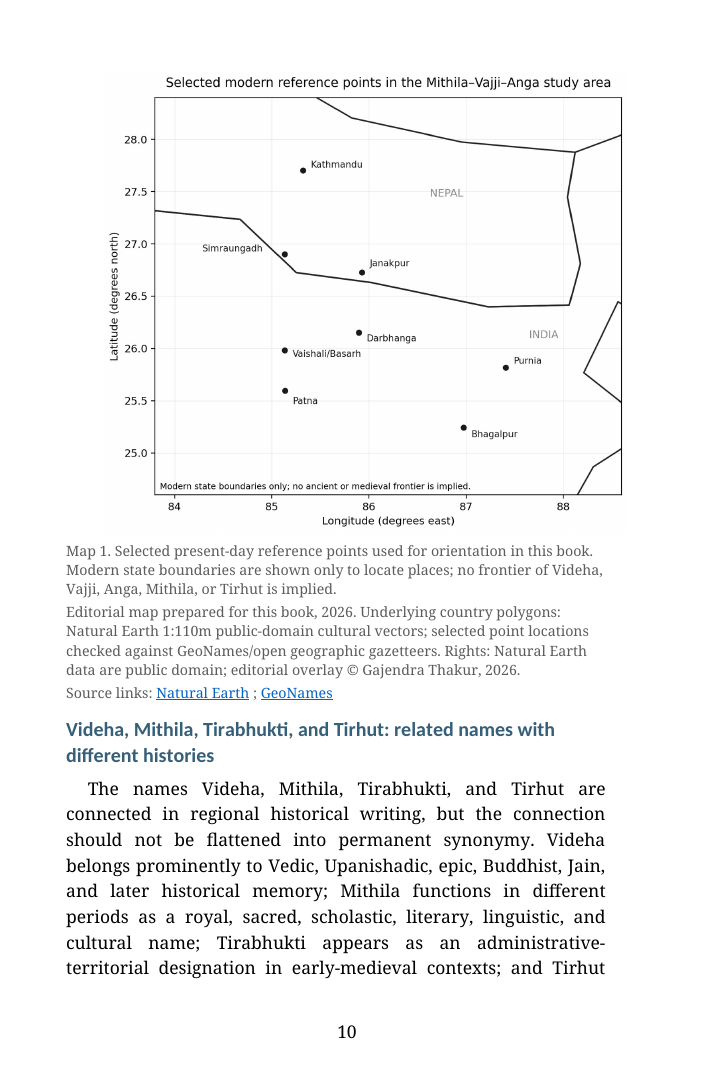
Mithila · Vajji · Anga
Chapter-specific source notes
- Primary chapter witness. Gajendra Thakur, Decoding the Panji of Mithila — Volume IV, formal Chapter 22, PDF pp. 254-263; formal Chapter 22. The HTML transcription is generated from the commit-pinned source PDF and retains the chapter boundary recorded in this edition.
- Internal structure. The repository source-heading inventory records 8 subordinate headings for this chapter: “22.1 Entries (90), (91), and (92): Sakuri after Navani and the Sakuri-Gangoli Continuation”; “22.2 Entry (93): Bhadgam-Jajival Village Beginning”; “22.3 Entries (94), (95), and (96): Bhadgam to Kailakh and Behedi”; “22.4 Entries (97), (98), (99), and (100): Bhadgam, Bhaur, and Shivnagar near Chanpura”; “22.5 Entries (101), (102), and (103): Bhadgam to Belhar Garh, Betia-Berwa, and Barba”; “22.6 Entries (104), (105), (106), (107), and (108): Bhadgam to Damodarpur and Ramnagar-Khajuri”; “22.7 Entry (109): Jamuni to Ehu and the Opening of the Jamuni-Jajival Register”; “22.8 Index Logic and Coverage Note for Chapter 22”.
- Digital editorial method. The page keeps the preserved source text distinct from generated navigational, concordance, visual, and provenance apparatus. The synthetic reconstruction is explanatory only and is not evidence for an individual lineage or a determination of social or marital status.