Decoding the Panji of Mithila · Volume IV · Chapter 28
Jamdauli to Dath and the Mahishi-Pali Register: Entries (207)- (220)
Chapter 28
Jamdauli to Dath and the Mahishi-Pali Register: Entries (207)-
                           (220)
28.1 Scope and Point of Resumption
    This chapter begins exactly where Chapter 27 stopped: entry
(207), the Jamdauli-to-Dath continuation. It carries the reading
through the end of entry (220), Mahishi to Ranti-Ladaur, and
deliberately stops before entry (221), which opens another
Mahishi-to-Dath unit. The chapter therefore has two main bodies:
the last Jamdauli-Pali cluster, entries (207)-(211), and the
beginning of the Mahishi-Pali register, entries (212)-(220).
   The working principle remains the same as in the preceding
chapters. A heading such as “Jamdauli to Dath,” “Mahishi to
Kailakh,” or “Mahishi to Ranti-Ladaur” is treated as a route or
destination label unless the index control clearly makes it a mool
or moolgram marker. The repeated formulas “suta,” “apara suta,”
“dau,” and “ddau” are read as lineage continuation and
sambandha recording, not as prose description. Blank or dotted
places are preserved in interpretation as absent or intentionally
unfinished register material.
28.2 Entries (207)-(211): The Closing Jamdauli-Pali Sequence
    Entry (207), Jamdauli to Dath, opens with the tail of a branch
in which Kumar, Bhikhiya, Aniruddh, Jhadula, Badan,
Parashuram, Bachharu, Manbodh, Poshana, Chhotku,
Bhagwandatt, Sundar, Dasharath, Ramchandra, and Lakshman
appear as carriers of the Jamdauli register. The texture of this
entry is important because it is neither a fresh mool beginning
nor a simple personal list. It is a compressed marriage-route
register: Jamdauli is the controlling Pali node, while Dath, Betia,
Saraya, Chanpura, Badhiyam-Pabauli, Teldiha, and related
destinations mark the outward spread of the branch.
   Within entry (207), Jhadula’s sons Patiram, Hiran, and
Durlalit are used to split the branch. Patiram runs through Nena
and Giridhari, while Hiran and Durlalit are less fully developed.

Badan’s line moves through Shivdatt. The Parashuram line is
more extensive: Bachharu and Manbodh lead into Poshana,
Chhotku, Bhagwandatt, Sundar, Dasharath, Ramchandra, and
Lakshman. The line also preserves local direction through
Chanpura, Badhiyam, Pabauli, and Teldiha, showing that the
Panji is tracking social location along with descent.
    Entry (208), Jamdauli to Dath, Betia-prant Saraya, continues
Manbodh and Saule, then gives a more layered Lakshmikant-
Hemangad-Bachharu-Umadatt structure. Umadatt’s sons
Kamaladatt, Cheta or Gauridatt, and Shambhudatt are followed
by a broad Jaleshwar group: Devidatt, Nanhku, Mahavir, Khadgu,
Panchu, Gulli, and Baddu. The detail is notable because it shifts
between direct male descent and a chain of sambandha
references. Kapileshwar’s sons Harinandan, Lokai, and Yadu are
also linked, and the record closes this unit with Harinandan’s
sons Bihari, Kashinath, and Divakar.
   Entry (209) continues Jamdauli without a separate destination
formula. Lokai’s sons Kishori, Chhaban, Madan, and Raghunath
appear first, followed by Yadu’s son Vishwanath and the
Dharoura-Baliyas line involving Mahodar, Kumar Singh, Ratan,
Chhakodi, Shriprakash, Khataru, and Vindhyanath. The same
entry then turns to Shambhudatt and to Jayanand, Vishnupati,
Lalbihari, Bhushan, Gangadatt, Kala, Diheshwar, and Tarapati.
Because the entry moves through multiple named branches
without changing the main heading, the safest reading is as a
continuation of the Jamdauli-Pali descent register with several
sub-branches, rather than as independent village openings.
   Entry (210), Jamdauli to Khaparpura-Fait, begins from the
Tarapati-Prandhan-Mukund-Buch route and then expands
through Andi, Dukhbhanjan, Kala, Manik Nandan, Bholanath,
Bhagvatnarayan, Bhaiyalal, Gopal, Lal, Bachchi, Gudar, Bhular,
Banmali, Kishor, Madhusudan, and Srishtinandan. The entry is
dense with secondary marriage routes: Darbhara/Darihara, Pali,
Khaparpura, and several other place labels appear in the role of
route markers. The essential point is that the source is still

following Jamdauli, but now through a Khaparpura-Fait
destination branch.
    Entry (211), Jamdauli to Khaparpura-Pariharpur-Chacharha,
closes the Jamdauli block in this chapter. Gujar’s sons Shaktinath
and Ghutar begin the entry. Bhular’s Baua Sahib line, Kala’s
Chhatrapati-Dullah-Bhikhiya group, and the Shri Lal-Ramlal
stream form the central structure. The entry also includes Fakir,
Markandey, Anantaram, Manasukh, Lalit, Ujandatt, and
Ramandatta. Its importance lies in the way Jamdauli-Pali is
projected into multiple destinations - Khaparpura, Pariharpur,
Chacharha, and related localities - while keeping a continuous
genealogical thread.
28.3 Entries (212)-(214): The Mahishi-Pali Register Begins
   Entry (212), Mahishi, is a new “gramarambha” within Pali.
Harinandan’s line is opened through Nath and Manasukh, and
another branch through Bhora and Chan. Dinanath’s sons and
descendants include Vishwanath, Shaktinath, Muktinath,
Lakshminath, Jhingur, Madhav, Badrinath, Bindhyanath,
Somnath, Ganganath, and others. The entry repeatedly brings in
Soderpur, Sarisab, Baliyas, Darihara, Pabauli, and Pandua as
sambandha controls. This is not a random expansion; it is a
Mahishi-Pali record that maps descent through successive
marriage-route anchors.
    Entry (213), Mahishi to Kailakh, narrows the Mahishi material
through Madhav, Kalikant, Digambar, Raghunath, Revati,
Siddhinath, Shantinath, Satinath, Chandinath, Muktinath,
Chunchun, Bouna, Punni, and Artinath. The route “to Kailakh” is
best read as a directional/destination marker within the Mahishi-
Pali register, not as a separate mool. This entry is also important
because it includes learned or status markers in the line of
Artinath and the related sambandha formulas.
   Entry (214), Mahishi, returns to a broader continuation. Lal’s
son Parameshwaridatt, and the lines through Krishnamani,
Rudramani, Kalru, Gulab, Markandey, Harisaran, and other
descendants are listed. The entry has many numbered “apara”

branches, which indicates alternate or collateral streams rather
than chronological prose. The Kalru portion is especially
complex: it uses Oini, Soderpur, Darihara, Baliyas, Pandua,
Sarisab, and other links to map secondary descent and marriage
ties. This makes entry (214) one of the structural bridges between
the first Mahishi opening and the later local expansions.
28.4 Entries (215)-(220): Mahishi Expands Through Chakauti,
Ranti, Ladaur, Chainpur, and Related Destinations
   Entry (215), Mahishi to Chakauti, Pokhrauni, and Srinagar, is
built around Vedanand, Indukar, Chandradev, Boku, Giri,
Diheshwar, Govind, Prandhan, Mannulal, and related names. The
entry mixes personal descent with precise destination markers.
Indukar is especially important because he gives a named
personal anchor to the route, while Chandradev and Boku/Giri
create lateral branches that move through Baliyas, Karmaha,
Rajanpura-Darihara, and Soderpur.
    Entry (216), Mahishi, continues Giri, Bathaha, Mannulal,
Chandradev, Lalit, Bhora, Dhan, Bodhi, Dukhiya, Neenan,
Sanand, Lali, Bhawanidatt, Gopal, and Banmali. The structure is
again a set of collateral lines. Bhora’s branch is divided through
Dhan, Bodhi-Dukhiya, Neenan, Sanand-Lali, and Bhawanidatt;
Dhan’s branch moves through Gopal and Banmali, and Banmali
then generates another Madhukar line. The effect is to thicken
the Mahishi register rather than to create a new gram heading.
    Entry (217), Mahishi to Shyam Sidha, Haridev Jha,
Champaran-desh Pakri, begins with Bodhi’s sons Dharbharan,
Pemu, and Judaun. Pemu’s son Ram and Judaun’s sons Jaladhar
and Gangadhar create the path to Haridev. The entry also
preserves a Neran/Neenan strand, a Sanand-Shitaladatt line, and
a set of Nanu and Genalal/Babualal/Umakant descendants. The
geographic label Champaran-desh Pakri should be retained as a
destination field in the register; it does not override the Mahishi-
Pali source heading.
   Entry (218), Mahishi to Tharhi-Chainpur in Saharsa, uses
Bhawanidatt as the organizing point. His sons Amritnath,

Gopinath, and Kirtinath lead to Chintamani, Dukhana, Bhikhana,
Ramkrishna, Kevalkrishna, Manohar, Govardhan, Chakradhar,
Mahidhar, Yogi, Nirsu, Gopinath, Siddhinath, and later Vijendra.
The entry also includes a modern-style continuation through
Raghuwar, Anugrah, Rameshwar, Ugramohan, Premamohan,
Mithilesh, Akhilesh, and Avadhesh. This is a good example of how
the register accommodates later family memory without
abandoning the old Panji formula.
   Entry (219), Mahishi, is a numbered collateral cluster. Mahi’s
sons Durgadatt and Bhawanidatt begin the entry, but most of its
weight falls on Bhawanidatt’s branches through Deonath,
Ramanath, Hibharn, Gopal, Apuch, Baddu, and the repeated
“apara” divisions. The source names numerous moolgram and
route references, including Soderpur, Sarisab, Darihara, Khanda-
bala, Mandar, Pabauli, and others. The entry is best read as a
preservation of multiple collateral fragments under the same
Mahishi-Pali umbrella.
    Entry (220), Mahishi to Ranti-Ladaur, begins with Gopal’s sons
Manmohan, Aniruddh, Nathuni, and Lakshman. Manmohan’s
line gives Jaykant, Shrikant, Harikant, Tarakant, Yogakant,
Rajkant, and related descendants. Aniruddh gives Dinesh and
Raghunath; Nathuni gives Baidyanath; Lakshman and Ramanath
supply further Soderpur and Sarisab links. The end of the entry
remains open-ended in the source, but the next numbered
heading begins a fresh Mahishi-to-Dath entry. For that reason,
Chapter 28 stops here and leaves entry (221) for Chapter 29.
28.5 Index Logic Applied
    The index logic for this chapter is straightforward but crucial.
Jamdauli is controlled under Pali, and Mahishi is also controlled
under Pali. The source’s transition from Jamdauli to Mahishi is
therefore a transition between two Pali-controlled registers, not a
shift to an unrelated gotra-mool system.
   Within the Jamdauli entries, Dath, Betia, Saraya, Khaparpura,
Pariharpur, Chacharha, and other place labels are treated as
route or settlement targets. Within the Mahishi entries, Kailakh,

Chakauti, Pokhrauni, Srinagar, Shyam-Sidha, Pakri, Chainpur,
Ranti, and Ladaur are treated in the same way unless the index
separately elevates them. This protects the reading from a
common error: treating every destination label as if it were a
new mool.
    The recurrent links to Soderpur, Sarisab, Darihara, Baliyas,
Karmaha, Pabauli, Narun, Khaual, Mandar, Budhwal, and other
named nodes serve as sambandha controls. They show how the
line is connected, but the controlling headings of this chapter
remain Jamdauli-Pali and Mahishi-Pali.
28.6 Coverage Ledger for Chapter 28
 • Entries (207)-(211): Jamdauli to Dath, Betia-prant Saraya,
    Khaparpura-Fait, Khaparpura-Pariharpur-Chacharha.
 • Entries (212)-(214): Mahishi-Pali opening, Mahishi to Kailakh,
    and the first broad Mahishi continuation.
 • Entries (215)-(220): Mahishi to Chakauti/Pokhrauni/Srinagar,
    Mahishi continuation, Mahishi to Shyam-Sidha/Champaran-
    Pakri, Mahishi to Tharhi-Chainpur, Mahishi numbered
    collateral cluster, and Mahishi to Ranti-Ladaur.
 • Reserved for Chapter 29: entry (221), Mahishi to Dath, and the
    subsequent Mahishi entries.
28.7 Transition to the Next Chapter
   The next chapter should begin with entry (221), “Mahishi to
Dath.” That entry is not absorbed here because it starts a new
numbered unit after the Ranti-Ladaur material of entry (220).
Keeping that boundary intact preserves the source order and
prevents the Mahishi-Dath branch from being prematurely
mixed into the present chapter.
Source structure and verification apparatus
Editorial source apparatus. This apparatus is descriptive, not interpretive. It records the source-controlled structure used to verify that this page corresponds to formal Chapter 28 of Decoding the Panji of Mithila — Volume IV. The chapter text above is preserved from PDF pp. 317-322; formal Chapter 28 in the commit-pinned authoritative source. It is not merged with a neighboring chapter, appendix, annexure, or independent front/back-matter unit. The internal headings below come from the repository’s source-heading inventory and are retained as navigational and audit evidence; showing them here does not turn those headings into separate publications or add claims that are absent from the source.
Internal source headings
No subordinate heading was separately encoded in the repository source-heading inventory for this chapter.
Source-text concordance
Jamdauli · Dath · Mahishi-Pali · Register · Entries · Scope · Point · Resumption · begins · exactly · stopped · entry · Jamdauli-to-Dath · continuation · carries · reading · Mahishi · Ranti-Ladaur · deliberately · stops · opens · another · Mahishi-to-Dath · unit · therefore · main · bodies · last · Jamdauli-Pali · cluster · beginning · working · principle · remains · preceding · chapters · heading · Kailakh · treated · route · destination · label · unless · index · control · clearly · makes · mool · moolgram · marker · repeated · formulas · suta · apara · ddau · read · lineage · sambandha · recording · prose · description · Blank · dotted · places · preserved · interpretation · absent · intentionally · unfinished · material · Closing · Sequence · tail · branch · Kumar · Bhikhiya · Aniruddh · Jhadula · Badan · Parashuram
Boundary verification. In the formal sequence this chapter follows Volume IV Chapter 27, “Pachadhi, Kodariya, Sakuri, Phuldaha, Parhi, Haripur, Samaya, and Jamdauli” and precedes Volume IV Chapter 29, “Mahishi to Dath and the Mangrauni-Madari Continuation: Entries (221)-(229)”. The chapter extractor begins at the verified formal Chapter 28 marker and stops at the next verified formal chapter marker; for a final chapter it stops before recognized book-level back matter. The concordance above is generated only from distinct terms already present in this chapter’s preserved source text. It is provided for discovery, comparison, and audit, not as an automated judgment about persons, lineages, status, kinship, marriage eligibility, or historical truth.
Illustrated research apparatus
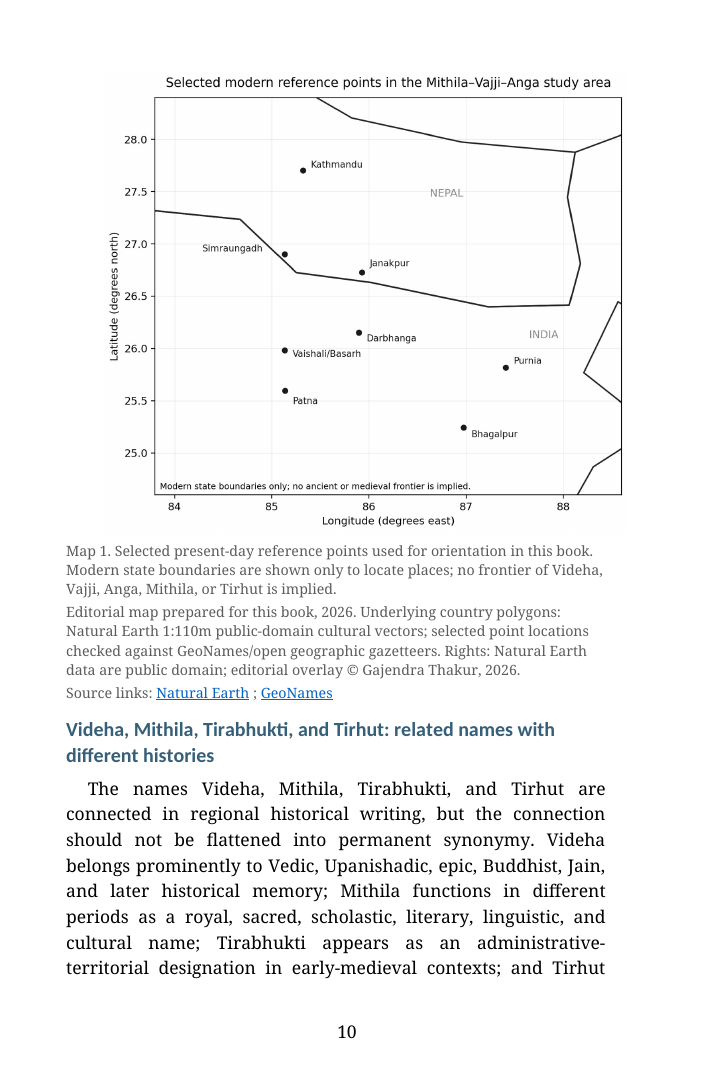
Mithila · Vajji · Anga
Chapter-specific source notes
- Primary chapter witness. Gajendra Thakur, Decoding the Panji of Mithila — Volume IV, formal Chapter 28, PDF pp. 317-322; formal Chapter 28. The HTML transcription is generated from the commit-pinned source PDF and retains the chapter boundary recorded in this edition.
- Internal structure. The repository source-heading inventory records no separately encoded subordinate heading for this chapter.
- Digital editorial method. The page keeps the preserved source text distinct from generated navigational, concordance, visual, and provenance apparatus. The synthetic reconstruction is explanatory only and is not evidence for an individual lineage or a determination of social or marital status.