Decoding the Panji of Mithila · Volume IV · Chapter 30
Hati-Pali and Samauli-Pali: From Satlakha and Pilkhwar to Sanha, Jhanjharpur and Bagahi
Chapter 30
Hati-Pali and Samauli-Pali: From Satlakha and
Pilkhwar to Sanha, Jhanjharpur and Bagahi
   This chapter resumes exactly where Chapter 29 stopped. Its
exclusive span is entries (230) to (247): the Hati-Pali register
from Satlakha through Pilkhwar, Chanpura, Saurath and
Dhanga; the rikta entry (237); and the Samauli-Pali register
from its first opening through Tarauni, Nanour, Vindhi, Sanha,
Jhanjharpur and Bagahi, ending with rikta entry (247). Entry
(248), the beginning of the Balirajpur-Hariamb register, is
deliberately left for the next chapter.

30.1 The Hati-Pali opening: entry (230)
   Entry (230) is introduced under the renewed Nagram rubric
as "Hati to Satlakha" and opens with the formula "atha Hati
Pali gramarambh". The wording is important because Hati
had earlier appeared in a Soderpur frame, but here the source
explicitly shifts the working base to Pali. The branch begins
with Bhagirath and his son Kalidash, then moves through
Nath into Bachha, Chhitari, Harikrishna, Bhikhiya, Nanu,
Baburaiya, Faturi, Chaturanand and related descendants. The
route formula repeatedly connects the Hati-Pali branch to
Mandar, Pali, Jajival, Satlakha, Soderpur, Valias, Sarisab,
Karmaha, Khoa l, Alay and Budhwal, showing that the register
is not a simple village list but a relational map of marriages,
descent, and indexed settlement points.
   The same entry also records cross-branch recurrence:
Sribhadra and Yugal Bhadra are tied to Sarisab through
Narayandatt and Kanhai, while Chhitari’s descendants move
through Khoa l, Pabouli, and Pali. Harikrishna’s line is then
carried through Sanphool, Balah, Hiya and Yadurai,
establishing the Yadurai axis that becomes the opening hinge
of the Pilkhwar section in the next entry.

30.2 Hati to Pilkhwar: entries (231) and (232)
   Entry (231) carries Hati to Pilkhwar. Yadurai’s sons are
listed as Prayagdatt, Hanumandatt, Bhagwandatt and Naubati.
Prayagdatt moves into Yashodhar, then Shivchandra, Buchchi
and Bhogendra. The formula makes the Pilkhwar line
geographically elastic: Bindhi-Mahnaura, Satlakha, Soderpur,
Belauch, Gangauli, Khoa l and Sakararhi appear as connecting
nodes. The register also records a continuation through
Manhar, Dharani, Narayan, Chhilka, Durbhanjan, Chhaban,
Gauri and Vidyanath. These names are not isolated; each is
paired with origin-route and destination-route markers,
allowing the Hati-Pali line to be checked against the wider
Panji grid.
  Entry (232), "Hati to Pilkhwar, Chanpura, Haridash Jha", is a
continuation of the same field but with a more explicit
Chanpura association. Dukhbhanjan’s sons Dhan and Dullah
anchor the first part. Dhan leads to Kanhai; Dullah leads to
Umanath. The source then records Andi’s descendants
Bandhuram, Ram, Rakani and Bhikhani, followed by Jhadula,
Muni, Mansukh, Keshavnarayan, Mandhan, Shyam, Hemnath,
Harivansh and later collateral names. The entry is dense
because it folds Pilkhwar and Chanpura into the Hati frame
without making either a new independent mool; the
continuing formula retains Hati as the governing register.

30.3 Hati to Saurath and Dhanga: entries (233) to (236)
  Entry (233) turns to "Hati to Saurath, Fekan Jha, Dhanga".
The first part completes the line of Buye through Fekan and
the Chhamu-Sakararhi connection, then the Bhikhani-Kanhai
branch moves through Darhara, Sarisab and Belauch. A
second branch begins with Shivdash and his descendants
Gonu, Hema, Ghanshyam, Yaduram and Parana. Gonu leads to
Hridik and then to Bodhi; Bodhi leads to Girdhari and Gangai.
The register is especially useful because it joins Saurath,

Dhanga and the older Hati-Pali skeleton through named
persons rather than through a bare locality heading.
  Entry (234), "Hati to Dhanga", expands the Gangai and
Yaduram line. Bandhav, Manmohan, Srikant, Murali, Jhotan,
Luchai, Jaydatt, Mansukh, Nanu, Bhaiya, Rohan, Parshi,
Shyam and Lala appear in a long relay. The source repeatedly
uses Sarisab, Soderpur, Satlakha, Naruan, Valias, Karmaha,
Ghusaut and Digho as route-points. The entry’s value lies in its
preservation of both biological descent and cross-registered
placement: the same line is made legible by father-son
sequence and by the repeated moolgram markers around it.
  Entries (235) and (236) complete the Dhanga material
before the blank entry. Entry (235) continues with
Shardanand, Suryanand, Dayanand, Vijayanand, Umanand,
Taranand, Shyamalal, Murlilal, Krishnalal, Nandishwar,
Padmeshwar, Lakshmeshwar, Ratneshwar and Laliteshwar.
Entry (236) moves through Mansukh’s sons Vishnudatt and
Shankardatt, then Gopal, Gumani, Banmali, Mahesh,
Nityanand, Dunanand, Shiva and Chandrakant. The entries
are suspended in places by scribal ellipses, but the line is still
readable because the route formula continues to name
Sarisab, Valias, Soderpur, Khoa l, Pali, Kujouli, Satlakha,
Belauch and Ghusaut. Entry (237) is marked rikta, so no
descent should be invented for it.

30.4 Samauli-Pali opening: entries (238) and (239)
  Entry (238) begins a new unit: "atha Samauli Palli
gramarambh". The entry starts with Pradyumna’s sons Rajiv
Lochan, Kamal and Ghoghan. Rajiv Lochan leads to
Harihardatt; Harihardatt’s descendants include Rajmani,
Sonmani and Parasmani, and a separate Thothari line.
Rajmani leads through Kanhai or Vishnumani and Bhavmani;
Sonmani leads to Hridaynath and Madhav; Hridaynath leads
to Jyotishi Eknath, Chandrashekhar, Lakshmikant and

Tarakant; and Madhav leads to Shashinath, Artinath and
Vaiya Raghunath. The entry establishes Samauli as a Pali-
based register, but its connecting markers include Jajival,
Mandar, Pabouli, Panichobh, Soderpur, Darhara, Khandbala,
Satlakha, Khoa l, Sarisab, Sakararhi and Hariamb.
   Entry (239) takes Samauli to Tarauni. Parasmani’s line is
carried through Chhatramani and Nityanand, then through
Parmanand and Kulanand. Thothari leads to Girdhari and
Leravmani, while related lines introduce Chhatrapati, Karu,
Vishnudatt, Horil, Dayanidhi, Shyamnath, Ram, Haridev,
Sridev, Basudev, Baldev, Dhodhan, Jhadula and Kotishwar.
This entry shows the typical Panji method of branching by
both descent and locality: Tarauni is not presented as a new
origin but as a destination-node within the Samauli-Pali
branch.

30.5 Samauli to Nanour and Vindhi: entries (240) and
(241)
   Entry (240), "Samauli to Nanour", begins from Pitambar’s
sons Palat, Garib, Khaggu and Machal. Palat, Garib and
Khaggu open several sub-lines through Pakhia, Muna, Meena,
Shambhunath, Nandi, Fuddi, Veni, Devi, Panchanand, Thadu,
Bachchi, Medhnath and Sahashramani. The register’s
emphasis is on transmission through Pali while also showing
repeated movement into Soderpur, Naruan, Khoa l, Alay,
Jajival, Satlakha, Belauch and Karmaha. The dense recurrence
of Pali at the receiving end confirms the governing frame.
   Entry (241), "Samauli to Vindhi, Haridev Mishra", continues
from Manhar’s descendants Dharani, Nayan, Harikrishna,
Bana and Rupnath. The branch then moves into Bhaiya, Kalpa,
Bhikhari, Bhola, Dukhiya, Hirphool, Mani, Bhagwandatt,
Kalyan, Shivnandan, Sundar, Bhavesh, Jivakarna, Rudradatt,
Bhairavdatt, Dular, Bachchan, Haridev, Thaiya, Harizardatt,
Gangadatt, Maharaj, Govinddatt and Jamahir. The Haridev

Mishra identification is therefore located within a much larger
genealogical spread, not as an isolated biographical label.

30.6 Samauli to Sanha, Jhanjharpur and Bagahi:
entries (242) to (246)
   Entry (242), "Samauli to Sanha (Begulal)", continues from
Bhairavdatt through Bholanath, Medhakar, Chhotku, Keshav,
Tufani, Gumani, Madhunandan, Amritnath, Vishwanath,
Lakshmikant, Shyamakant and Mahavir. The Sanha or Begulal
marker is embedded in a line that continues to cite Satlakha,
Alay, Valias, Soderpur, Sarisab, Darhara, Karmaha, Mandar,
Kujouli, Pabouli, Jajival and Khandbala. This confirms that the
local label is an applied destination within the Samauli-Pali
framework.
   Entry (243), "Samauli to Jhanjharpur", turns to the line of
Kulpati’s son Nand and then Mohan, Tarapati, Gangadhar,
Jivanath, Ratan, Chhilka, Madhupati, Bhavanidatt, Deonath,
Kirtinath, Shaktinath, Hridaynath, Hiralal, Durban and Nidhi.
The entry uses Jhanjharpur as a destination-marker, while the
active genealogy remains tied to Pabouli, Valias, Belauch,
Babhaniyam, Darhara, Mandar, Sarisab, Soderpur, Khoa l,
Gangauli, Kujouli and Karmaha.
   Entry (244) is a continuation without a new external village
label. It begins from Indrapati’s son Shankar and then moves
to Nilambar, Mahipati, Upe, Gauridatt, Sanphool, Fekan,
Chhota and Thakurdatt. The entry should not be separated
from Samauli: it is the tail of the same Samauli sequence,
preserving additional descendants before the Bagahi
transition.
   Entry (245), "Samauli to Bagahi, Champaran deshe", opens
with Mannu’s sons Bhavaditya and Jayaditya. Bhavaditya’s
line proceeds through Babunandan, Bhaiya, Ishwaridatt,
Shyamlal,     Ranglal,    Gadhadhar     and   Bhagwandatt.

Bhagwandatt’s sons Narsingh, Singheshwar, Vishweshwar and
Kapileshwar are placed through Darhara, Budhwal, Pandua,
Pali, Sarisab and Jamuni-Jajival connections. Entry (246)
completes the Jayaditya side through Jagannath, Baidyanath,
Chhakodi, Balihari, Bhagirath, Narayan and Sone. Entry (247)
is rikta; it closes the Samauli-Pali chapter unit without
creating a recoverable line.

30.7 Index logic applied in this chapter
   The controlling index logic is twofold. First, the source itself
labels Hati as Hati-Pali at entry (230), so the Hati material of
entries (230) to (237) must be read as a Pali-based register,
even though Hati has also appeared in other frames
elsewhere. Secondly, the index explicitly lists Samauli-Pali as a
gram-arambh, which confirms the frame for entries (238) to
(247). Therefore the chapter treats Hati and Samauli as two
consecutive Pali-governed registers, not as loose place-name
clusters.
  The recurrent names Sarisab, Soderpur, Mandar,
Khandbala, Satlakha, Darhara, Khoa l, Valias, Budhwal,
Pabouli, Jajival, Gangauli, Naruan and Ghusaut are retained as
route-markers because the Panji text uses them to locate each
descendant within the wider moolgram lattice. The chapter
therefore decodes every entry as a combination of descent,
route, and indexed settlement, rather than as a list of names.

30.8 Coverage note
  Chapter 30 closes at entry (247), the Samauli rikta entry. The
next chapter should begin with entry (248), "Balirajpur to
Ranitol", where the source shifts from the Pali-governed
Samauli unit to the Hariamb/Balirajpur register.
Source structure and verification apparatus
Editorial source apparatus. This apparatus is descriptive, not interpretive. It records the source-controlled structure used to verify that this page corresponds to formal Chapter 30 of Decoding the Panji of Mithila — Volume IV. The chapter text above is preserved from PDF pp. 329-334; formal Chapter 30 in the commit-pinned authoritative source. It is not merged with a neighboring chapter, appendix, annexure, or independent front/back-matter unit. The internal headings below come from the repository’s source-heading inventory and are retained as navigational and audit evidence; showing them here does not turn those headings into separate publications or add claims that are absent from the source.
Internal source headings
- 30.1 The Hati-Pali opening: entry (230)
- 30.2 Hati to Pilkhwar: entries (231) and (232)
- 30.3 Hati to Saurath and Dhanga: entries (233) to (236)
- 30.4 Samauli-Pali opening: entries (238) and (239)
- 30.5 Samauli to Nanour and Vindhi: entries (240) and (241)
- 30.6 Samauli to Sanha, Jhanjharpur and Bagahi: entries (242) to (246)
- 30.7 Index logic applied in this chapter
- 30.8 Coverage note
Source-text concordance
Hati-Pali · Samauli-Pali · Satlakha · Pilkhwar · Sanha · Jhanjharpur · Bagahi · resumes · exactly · stopped · exclusive · span · entries · register · Chanpura · Saurath · Dhanga · rikta · entry · first · opening · Tarauni · Nanour · Vindhi · ending · beginning · Balirajpur-Hariamb · deliberately · left · next · introduced · renewed · Nagram · rubric · Hati · opens · formula · atha · Pali · gramarambh · wording · important · earlier · appeared · Soderpur · frame · explicitly · shifts · working · base · branch · begins · Bhagirath · Kalidash · moves · Nath · Bachha · Chhitari · Harikrishna · Bhikhiya · Nanu · Baburaiya · Faturi · Chaturanand · related · descendants · route · repeatedly · connects · Mandar · Jajival · Valias · Sarisab · Karmaha · Khoa · Alay · Budhwal · showing · simple · village
Boundary verification. In the formal sequence this chapter follows Volume IV Chapter 29, “Mahishi to Dath and the Mangrauni-Madari Continuation: Entries (221)-(229)” and precedes Volume IV Chapter 31, “Balirajpur-Hariamb and Siva-Hariamb: Settlements, Scholarly Lines and Marriage Networks, Entries (248)- (265)”. The chapter extractor begins at the verified formal Chapter 30 marker and stops at the next verified formal chapter marker; for a final chapter it stops before recognized book-level back matter. The concordance above is generated only from distinct terms already present in this chapter’s preserved source text. It is provided for discovery, comparison, and audit, not as an automated judgment about persons, lineages, status, kinship, marriage eligibility, or historical truth.
Illustrated research apparatus
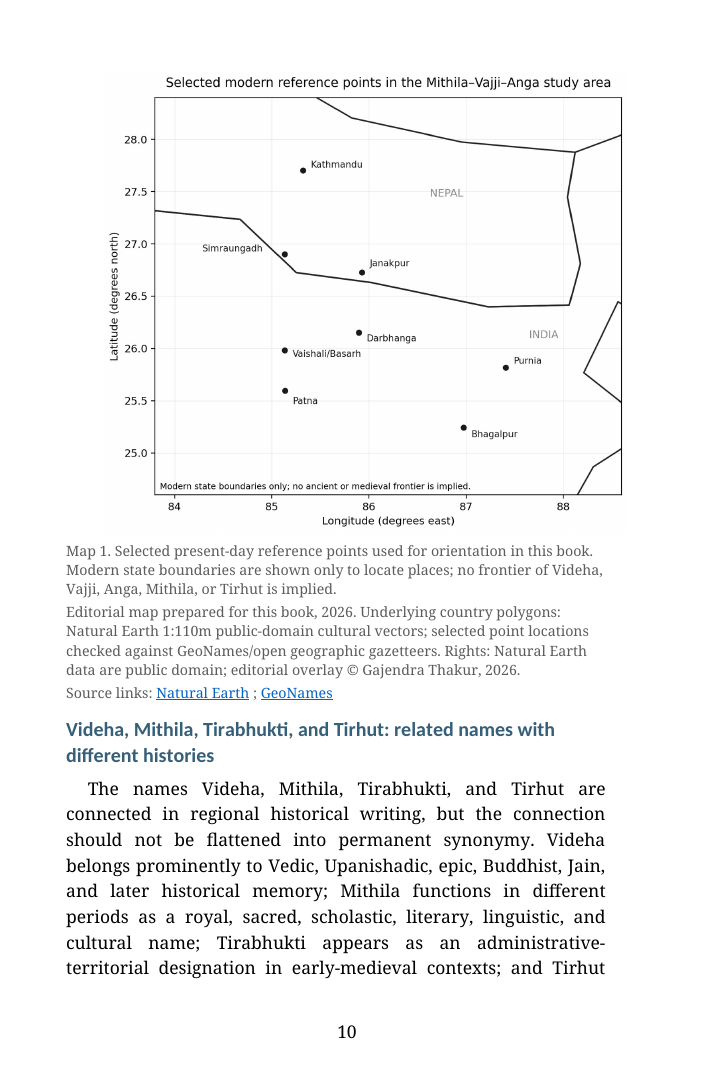
Mithila · Vajji · Anga
Chapter-specific source notes
- Primary chapter witness. Gajendra Thakur, Decoding the Panji of Mithila — Volume IV, formal Chapter 30, PDF pp. 329-334; formal Chapter 30. The HTML transcription is generated from the commit-pinned source PDF and retains the chapter boundary recorded in this edition.
- Internal structure. The repository source-heading inventory records 8 subordinate headings for this chapter: “30.1 The Hati-Pali opening: entry (230)”; “30.2 Hati to Pilkhwar: entries (231) and (232)”; “30.3 Hati to Saurath and Dhanga: entries (233) to (236)”; “30.4 Samauli-Pali opening: entries (238) and (239)”; “30.5 Samauli to Nanour and Vindhi: entries (240) and (241)”; “30.6 Samauli to Sanha, Jhanjharpur and Bagahi: entries (242) to (246)”; “30.7 Index logic applied in this chapter”; “30.8 Coverage note”.
- Digital editorial method. The page keeps the preserved source text distinct from generated navigational, concordance, visual, and provenance apparatus. The synthetic reconstruction is explanatory only and is not evidence for an individual lineage or a determination of social or marital status.