Decoding the Panji of Mithila · Volume IV · Chapter 31
Balirajpur-Hariamb and Siva-Hariamb: Settlements, Scholarly Lines and Marriage Networks, Entries (248)- (265)
Chapter 31
Balirajpur-Hariamb and Siva-Hariamb: Settlements,
Scholarly Lines and Marriage Networks, Entries (248)-
(265)

31.1 Scope and method of continuation
   This chapter resumes immediately after the Samauli-Pali
closure of Chapter 30. Its exclusive span is entries (248)-(265).
Entries (248)-(255) decode the Balirajpur-Hariamb material,
moving from Ranitol and Barouni through Kakraud, Dhagjari,
Chopta, Chopra and Rahua in Purnea. Entries (256)-(265) then
shift to the Siva-Hariamb register and carry the line through
Virsayar, Saurath, Lakshmipur, Singhwar, Vishnupur, Pilkhar,
Dath-Kachhuwa and the suspended Kharka heading. Entry
(266), Mangrauna-Hariamb, is not absorbed here and is
reserved for the next chapter.
   The interpretive method remains the same. Each name is
read as part of a descent chain; each place name is treated as
either a controlling gram/moolgram label or a route and
marriage-location marker; each title is preserved because it
tells us how the branch remembered learning, office,
profession or ritual status; and each repeated “apara” division
is treated as a separate collateral branch, not as a redundant
repetition. The chapter therefore follows descent, place,
marriage, title and branch-continuity at the same time.

31.2 Entries (248)-(251): Balirajpur opens from Ranitol
to Ramnagar
  Entry (248), Balirajpur to Ranitol, opens the Hariamb-
controlled Balirajpur register. Bhavkrishna is the first pivot.
His sons Prannath, Dayanath, Dullah and Bali divide the
branch. Prannath gives Rupnath; Rupnath gives Ramkrishna;
Ramkrishna gives Narsingh; and Narsingh gives Damodar. The

descent is never given alone: each generation is tied to a route
of marriage or connection, including Jajival-Banai-Nitai,
Sakararhi-Purushottam, Darihara-Harijiv-Shivdatt, Sarisab-
Mahadev, Baliyas-Kalyan-Bhavanath, Budhwal-Bachharu,
Jajival-Viru-Abhinand, Baliyas-Gopinath, Soderpur-Chanchal-
Babua and Pali-Gopal. These connections show the Ranitol line
as a Balirajpur branch spread through several older
matrimonial nodes.
   Dayanath’s line in the same entry runs through Modnath,
Bodhnath, Govind, Parmanand and Harivansh. Bodhnath’s
line is not merely a list of sons: Govind and Parmanand are
placed through Khaual, Khandbala and other marriage routes,
while Harivansh is connected through Mandar-Hardatt-
Tirthdatt and Panichobh-Gunanidhi. Madhav, Vishwambhar,
Ratan Singh, Chhakauri, Shri Prasad, Khataru or Uditnarayan,
Kuldeepnarayan and Bachnu then appear in the same branch.
The Ladaur and Dharora-Baliyas references make the line
mobile, and the named sons preserve continuity from a ritual
village heading into later settlement society.
  Entry (249), Balirajpur to Shanitol or Barouni, carries the
Uma branch. Uma gives a Jajival-Premnath-Gopal link and
then Durganand. Durganand is connected through Soderpur-
Babulal-Gangadhar; Gangadhar himself is then tied through
Karmaha-Loknath-Jivanath and Pandua-Rudramani. The
Parmanand branch introduces Vaiyakaran Thakkan and
Pandit Vedanand, adding a scholarly title layer to the descent.
Thakkan connects to Mahamahopadhyaya Babujan and
Kunjan; Vedanand gives Ravinandan, whose line moves
through        Digho-Sarvanarayan-Kulanand,           Satlakha-
Dwarikanath, Pandua-Nathuni-Sadupadhyaya Anand and
Khandbala-Lakshmikant. The source therefore records both
descent and intellectual status in the same genealogical chain.

   Entry (250), Balirajpur to Ranitol, Kailakh and Ladaur,
continues Lal’s line. Lal gives Ugranath, Chumman,
Vishwanath and Ayodhyanath. Ugranath gives Pandit Babue
or Shrikant and Pandit Domai or Lakshmikant; Babue’s
descendants include Palat and Rudrakant; Lakshmikant gives
Karunakant and Chhitan. The line is repeatedly attached to
Pandua, Budhwal, Mandar, Gangauli, Khaual and Soderpur.
Chumman’s line gives Markandey and, through Dharora-
Baliyas, Singheshwar, Nanheku and Rameshwar. Lanha’s line
gives Babuan, Shankar, Madhu and Sadashiv, with Shankar
moving to Binu and Vedanand. The repeated Soderpur,
Sarisab and Ghusaut references keep the branch within the
same wide marriage network even as the named settlements
multiply.
   Entry (251), Balirajpur to Ramnagar, begins from Bhaiya’s
sons Ramanath, Gonan, Kalanath and Raja. Ramanath gives
Bhawanidatt; Bhawanidatt gives Bhavadatt, Varju, Mannu,
Sadhu and Nandalal. The branch then proceeds through
Basudev, Shankardatt, Bhagirath, Vishwanath, Ramkrishna,
Devchandra, Garadchandra, Krishnachandra, Virchandra,
Gopalchandra, Sunilchandra and Sanjivchandra. The line is
especially modern in its memory of named individuals and
settlement extensions, but its formula remains the old one:
each son is linked through Baliyas, Karmaha, Oini, Jajival,
Kujouli, Pabauli, Narun, Valias, Pandua, Soderpur, Kapiya and
Digho. Vishwanath’s sons Shri Lal, Govardhan, Arjun, Dukhan,
Vedanand, Damodar and Vanshidhar close the entry by
showing several collateral paths under the same Balirajpur-
Ramnagar heading.

31.3 Entries (252)-(255): Balirajpur expands through
Kakraud, Chopta, Chopra and Rahua
  Entry (252), Balirajpur to Kakraud-Dhagjari, continues
through Mannu. Mannu’s sons Lootan and Luche create

separate lines. Lootan is connected through Satlakha-
Vanshidhar-Bhavan and Takbal-Gauridatt; Luche gives Ramji
and Lakshman, with Jajival-Dharmadatt-Bhimdatt and
Baheradhi-Venidatt links. Nandalal gives Upendra and
Yaduvir; Yaduvir is connected through Khaual-Kari-
Chaudhary Jhingur and Jajival-Bhikhi. Gonan’s son, styled Nat
Murlidhar, brings Bhailal and Babulal; that branch runs
through Sarisab-Rawantar-Bhol, Karmaha-Chitradhar and an
Oini royal reference to Raja Lakshminarayan’s line. Ratan
then returns the line to Soderpur-Rameshwar-Modnarayan
and Pandua-Manik.
   The second half of entry (252) is an important scholarly and
administrative extension. Kalanath gives Kauskidatt and
Venidatt; Kauskidatt gives Gulbadan, Manmohan and Muse.
Gulbadan gives Ganesh and Krishna, while Krishna gives
Jaldev, Lakshmikant and Kamalde. The sequence then brings
Kapileshwar, Kureshwar, Kishor, Santosh, Suryamohan,
Brajmohan, Girishmohan and Shishirmohan. The note on
Mahadev’s sons Samarendra, Dhirendra and Ramendra
includes the modern high-court chief-justice type title for
Prabodh, and Chandranath gives Prakash and Vikash. This is
precisely the kind of Panji moment where genealogy, title,
public office and marriage route must be read together, not
separated.
    Entry (253), Balirajpur to Chopta-Dhamdaha under Nawal
Kishor Mishra, is a named learned branch. Babua Ji or
Jaykrishna gives Kumar Ji, Amarnath, Pitambar, Nawal
Kishor, Jagdish and Satyanarayan. Kumar Ji gives Gopal,
Shivanandan and Jagannath; Amarnath gives Balakant, Buddh
or Kamalakant, Ramakant and Harikant. Pitambar gives
Vaiyakaran Padmanam, preserving a grammatical-learning
title inside the descent record. Nawal Kishor gives Professor
Shyamanand, Engineer Manoj Kumar and Subodh Kumar. The
next generation includes Sanjiv and Santosh under Engineer

Manoj Kumar. This entry is therefore a deliberate record of
scholarly and professional branching, not just a village-to-
village marital map.
  Entry (254), Balirajpur to Chopra, continues Satyanarayan.
His sons Harhar, Vishwambhar and Nilambar are placed
through Satlakha, Takbal, Pandua, Sarisab, Raiyam-Soderpur,
Gangauli, Baliyas and Karmaha. The title “Sahityacharya
Professor Dr. Vishwambhar Mishra Vagesh” is central: the
Panji preserves him as a learned figure while still requiring
his marriage and sambandha placement through Pandua and
Sarisab-Mukund.       Nilambar,     Mukund,      Rameshwar,
Madhusudan, Mahadev, Bhairav, Chandranath, Kamaldev,
Murari, Manohar and Suman extend the branch. The line
shows how a modern literary-academic identity remains
housed inside the older genealogy-formula.
   Entry (255), Balirajpur to Kakraud and Rahua in Purnea,
moves through Madhusudan, Muse, Sadanand, Bhikham,
Devanand, Dular, Hali, Raghu Nandan, Vaiyakaran
Suryanarayan, Jivanath, Madanmohan and Vijendranath. The
branch is dense with educational titles: Suryanarayan is
marked as a grammarian; Jivanath and Madan Mohan carry
M.Sc. professor titles; Vijendranath is marked with a medical
degree. Yet the line is still read by the older marriage formula:
Satlakha, Pali, Valias, Karmaha, Soderpur, Mandar, Sarisab,
Pandua, Darhara, Ghusaut and Baliyas all function as
relationship controls. The Purnea label gives the settlement
location, while the titles identify remembered status within
the branch.

31.4 Entries (256)-(258): Siva-Hariamb begins and
moves to Virsayar, Saurath and Lakshmipur
  Entry (256) opens a new register: Siva-Hariamb. Kasinath is
the first ancestor. His sons Nathe and Nena are followed by
collateral lines through Poshan, Tulsidatt, Baburaiya and Kirti.

Nathe gives Rampal and Babulal; Nena gives Raghuvir, Govind
and Bachche Lal. Govind gives Nilkanth and Narsingh, and
Nilkanth is linked through Sakararhi and Hariamb routes.
Narsingh gives Sudhakar. Bachche Lal gives Chiranjeev;
Chiranjeev gives Kalikanand, Nandan, Ramanand and
Satyadev. The entry uses Belauch, Karmaha, Soderpur,
Sakararhi, Mandar, Hariamb, Gangauli, Valias, Darhara, Alay,
Khaual, Pali, Pabauli and Kodariya to position every
descendant inside the matrimonial web.
   Entry (257), Siva to Virsagar or Virsayar-Saurath, continues
from Satyadev and Poshan. Satyadev gives Satishchandra,
Navinchandra, Hemchandra, Virchandra, Raman and Suman.
Poshan gives Rajnath, Jayanath, Pandit Lakshmikant, Bachnu,
Pandit Ganeshdatt, Pandit Chhotakani and Maheshdatt. The
Pandit titles matter: they show a learned sub-line within the
Siva register. Rajnath gives Manmohan, while Pandit
Ganeshdatt gives Pandit Vishnudatt; Vishnudatt gives
Bhairavdatt and Bhawanidatt, and also Pandit Shivdatt and
Bhimdatt. The line moves through Sakararhi, Jajival, Darhara,
Pali, Khaual, Pabauli, Pandua, Digho, Dahibhat, Mahishi-Pali,
Baliyas and Hariamb. Saurath is not a break in descent; it is a
settlement horizon inside the same branch.
   Entry (258), Siva to Lakshmipur-Saurath, begins with
Shyamnath’s descendants: Babumani, Radhamani and
Bhaiyamani. Babumani gives Ram Manohar, and Ram
Manohar is tied to Sarisab-Machal-Jalpadata and Panichobh-
Jhau. Radhamani moves through Belauch-Lakshmidatt-
Chhotkai and Babhania-Nandalal. A second sub-line continues
through Umanath, Bahadur, Bandhav, Mansukh, Hridayasukh,
Bengali and Durgadatt. The Bengali-Durgadatt branch is
linked to Oini through Raja Kirtinarayan and Kumar Durlabh,
showing how an older royal association can be recorded
inside a Hariamb branch while the marriage network remains

grounded in Pandua, Soderpur, Baheradhi, Sarisab, Ghusaut,
Sakararhi, Valias, Budhwal and Narun.

31.5 Entries (259)-(264): Siva to Singhwar, Vishnupur,
Pilkhar and Dath-Kachhuwa
  Entry (259), Siva to Singhwar-Saurath, begins from Kisuni’s
sons Devkrishna and Lakshmikant. Devkrishna gives
Rameshwar and Bauk; another Devkrishna line gives
Pauranik Machal and Thotha. Rameshwar gives Santoshmani,
Thengan, Gonan, Bhikhan and Hridaynath. Santoshmani gives
Babujan and several collateral lines: Raghuvir, Pandit
Indradatt, Bhikhari, Murlidhar and Kulmani. Babujan gives
Vaiyakaran Bhaiyo and Durbaran; Vaiyakaran Bhaiyo gives
Harivansh; Harivansh gives Raghunath. The genealogical text
keeps the title “Pauranik” with Machal and “Vaiyakaran” with
Bhaiyo because these titles are part of branch memory, while
the marriage markers keep the line linked to Gangauli,
Khaual, Baliyas, Jajival, Sakararhi, Babhania, Pali, Koderiya,
Darhara, Soderpur and Budhwal.
   Entry (260), Siva to Saurath-Singhwar, continues the same
cluster. Kulmani is linked to Sarisab and Khaual; Pandit
Indradatt gives Babua or Shridatt, Bhuttu or Lakshmidatt and
Mahindradatt. Shridatt gives Markandey, Kamalakant and
Shukdev; Lakshmidatt gives Chhitan or Dhairyanath;
Mahindradatt is connected through Mandar-Siddhinath-
Narsingh and Soderpur-Babue. Murlidhar, Thengan, Tulsidatt,
Chhotakani, Bamma, Purushottam, Mahottam, Narottam,
Kumar Ji and Kusheshwar follow. In this section the repetition
of titles is important: Vaiyakaran, Mahamahopadhyaya and
other honorifics occur beside ordinary descent names,
showing learned memory and collateral descent moving
together.
  Entry (261), Siva to Singhwar, develops Gonan’s sons
Narsingh and Jayanath. Narsingh gives Radhakant,

Lakshmikant, another Radhakant and Yadukant. Lakshmikant
gives Ramchandra, Thakkan and Mohan; Radhakant gives
Gangadhar. The entry then moves through Bhikhan, Bauk,
Pauranik Machal, Tikanath, Kishornath, Yogi and Chanan.
Tikanath gives Phaninath; Phaninath gives Leravanath;
Kishornath leads to Harshnath; Harshnath gives Suphal. Each
line is tied through Sarisab, Pali, Khaual, Alay, Soderpur,
Valias, Mandar, Darhara, Budhwal, Sakararhi, Karmaha,
Hariamb, Satlakha, Belauch and Jajival. Branch-continuity
here depends on reading the repeated Singhwar label together
with these marriage nodes.
   Entry (262), Siva to Vishnupur, begins from Yogi’s
descendants and then moves through Yagmohan, Madhav,
Yadav, Narsingh, Basant, Dinesh, Mahesh, Ramesh, Dhanesh,
Naresh, Vaiyakaran Suresh, Vaiyakaran Umesh, Gangesh,
Tarashwar, Ugreswar, Shiveshwar, Pramod, Premchandra,
Hemchandra, Dilipchandra and Shivanandan. The line is
notable for its repeated learned titles and modern personal
names. Vishnupur is thus not merely a place name; it is a
settlement endpoint for a line whose marriage and education
markers connect Sarisab, Darhara, Sakararhi, Soderpur,
Gangauli, Mandar, Pabauli, Khaual, Ghusaut, Digho, Jajival,
Panichobh, Valias and Belauch.
  Entry (263), Siva to Pilkhar, begins from Thotha and his
sons Nathe, Nena and Bhaiya. Nena gives Juraun, Prabhunath
and Dinanath. Juraun gives Ballar; Ballar gives Manrakravan.
Prabhunath and Dinanath lead to Bhushan, Sukhan, Mushai,
Kasinath, Gopinath, Vishwanath, Raghudube, Pratapnarayan,
Bachchan and Naresh. The entry contains a modern
professional note for Pratap Narayan, identified as a lawyer.
Yet the route remains fully Panji-like: Khandbala, Karmaha,
Sakararhi, Soderpur, Babhania, Darhara, Pandua, Jajival,
Sarisab, Pali, Khaual, Mandar, Digho and Narun all locate the
descent.

  Entry (264), Siva to Dath-Kachhuwa, follows Lakshmikant’s
sons Varju and Hari. Varju gives Bhola and Kashi; Hari gives
Nanu and Mannu. Nanu is placed through Jajival-Nitai-
Lakshmidhar and other routes; Mannu gives Thethan and
Kalikadatt, with later lines through Himran, Manbharan,
Doman, Jhagadu, Vishnukant, Ghuran, Ishwaridatt and
Gumani. Gumani gives Krishnakant, and Krishnakant gives
Chanchal Kishor and Awadh Kishor. The late part introduces
Babulal, Suresh, Gadadhar, Tarakant, Radhakant, Umakant,
Shashikant and Ajit Kumar. The Saharsa note attached to Ajit
Kumar’s line is a later settlement trace, while the descent
remains tied to Khaual, Pabauli, Soderpur, Belauch, Darhara,
Budhwal, Satlakha, Ghusaut, Pali, Sakararhi, Gangauli, Jajival
and Mandar.

31.6 Entry (265): Siva to Kharka as a suspended
heading
   Entry (265), Siva to Kharka, appears as a heading without a
developed body before the next numbered entry begins. It is
therefore treated as a suspended or effectively blank entry. It
must still be preserved in the coverage ledger because its
number records a place in the source sequence. The absence
of a body does not authorize moving the following Mangrauna
material backward into Siva-Kharka.

31.7 Index logic applied in this chapter
   The governing index rule is that Balirajpur is controlled
through Hariamb. The chapter therefore treats entries (248)-
(255) as a Hariamb/Balirajpur register, even when the line
travels to Ranitol, Barouni, Kakraud, Dhagjari, Chopta, Chopra,
Rahua, Ramnagar or Purnea. These settlement labels show
where branches moved or were remembered; they do not
cancel the Balirajpur-Hariamb control.

   The Siva material begins with the explicit source formula
“atha Siva Hariamb gramarambh.” Even where the separate
index search does not return Siva as an independent
headword, the source itself gives the controlling register.
Therefore entries (256)-(265) are read as Siva within the
Hariamb framework, not as a loose appendix. The recurring
links to Sarisab, Soderpur, Pali, Darhara, Valias, Khaual,
Mandar, Budhwal, Khandbala, Gangauli, Jajival, Narun,
Ghusaut, Koderiya, Panichobh and others are read as
marriage and relationship controls inside that framework.
   The titles are part of the index logic of memory. Vaiyakaran
Padmanam, Professor Shyamanand, Engineer Manoj Kumar,
Sahityacharya Professor Dr. Vishwambhar Mishra “Vagesh,”
Vaiyakaran Suryanarayan, Professor Jivanath, Professor
Madan Mohan, medical-degree Vijendranath, Pauranik
Machal and later Vaiyakaran figures are not ornamental
additions. They tell us which branch was remembered for
grammar, literature, education, medicine, public service or
ritual learning. The genealogical line must therefore be read
as descent plus social-intellectual continuity.

31.8 Coverage ledger for Chapter 31
  • Entries (248)-(251): Balirajpur-Hariamb from Ranitol and
Barouni through Kailakh-Ladaur and Ramnagar.
  • Entries (252)-(255): Balirajpur-Hariamb through Kakraud-
Dhagjari, Chopta-Dhamdaha, Chopra and Kakraud-Rahua in
Purnea, including the main scholarly and professional
branches.
  • Entries (256)-(258): Siva-Hariamb       opening   through
Virsayar, Saurath and Lakshmipur.
  • Entries (259)-(264): Siva-Hariamb through Singhwar,
Vishnupur, Pilkhar and Dath-Kachhuwa.

  • Entry (265): Siva to Kharka, preserved as a suspended or
blank heading.
  • Reserved for Chapter 32: entry (266), Mangrauna-
Hariamb, and the sequence of Mangrauna rikta entries before
the Ahil-Hariamb opening.

31.9 Transition to the next chapter
   The next chapter should begin with entry (266),
“Mangrauna to ...,” where the source explicitly opens “atha
Mangrauna Hariamb gramarambh.” That is a new settlement
register after the Siva-Kharka heading. Keeping Mangrauna
separate prevents the Siva branch from absorbing the
following Hariamb material and allows the next chapter to
treat the Mangrauna, rikta and Ahil sequence in its own order.
Source structure and verification apparatus
Editorial source apparatus. This apparatus is descriptive, not interpretive. It records the source-controlled structure used to verify that this page corresponds to formal Chapter 31 of Decoding the Panji of Mithila — Volume IV. The chapter text above is preserved from PDF pp. 335-345; formal Chapter 31 in the commit-pinned authoritative source. It is not merged with a neighboring chapter, appendix, annexure, or independent front/back-matter unit. The internal headings below come from the repository’s source-heading inventory and are retained as navigational and audit evidence; showing them here does not turn those headings into separate publications or add claims that are absent from the source.
Internal source headings
- 31.1 Scope and method of continuation
- 31.2 Entries (248)-(251): Balirajpur opens from Ranitol to Ramnagar
- 31.3 Entries (252)-(255): Balirajpur expands through Kakraud, Chopta, Chopra and Rahua
- 31.4 Entries (256)-(258): Siva-Hariamb begins and moves to Virsayar, Saurath and Lakshmipur
- 31.5 Entries (259)-(264): Siva to Singhwar, Vishnupur, Pilkhar and Dath-Kachhuwa
- 31.6 Entry (265): Siva to Kharka as a suspended heading
- 31.7 Index logic applied in this chapter
- 31.8 Coverage ledger for Chapter 31
- 31.9 Transition to the next chapter
Source-text concordance
Balirajpur-Hariamb · Siva-Hariamb · Settlements · Scholarly · Lines · Marriage · Networks · Entries · Scope · method · continuation · resumes · immediately · Samauli-Pali · closure · exclusive · span · decode · material · moving · Ranitol · Barouni · Kakraud · Dhagjari · Chopta · Chopra · Rahua · Purnea · shift · register · carry · line · Virsayar · Saurath · Lakshmipur · Singhwar · Vishnupur · Pilkhar · Dath-Kachhuwa · suspended · Kharka · heading · Entry · Mangrauna-Hariamb · absorbed · reserved · next · interpretive · remains · name · read · part · descent · chain · place · treated · either · controlling · gram · moolgram · label · route · marriage-location · marker · title · preserved · tells · branch · remembered · learning · office · profession · ritual · status · repeated · apara · division · separate · collateral · redundant
Boundary verification. In the formal sequence this chapter follows Volume IV Chapter 30, “Hati-Pali and Samauli-Pali: From Satlakha and Pilkhwar to Sanha, Jhanjharpur and Bagahi” and precedes Volume IV Chapter 32, “Mangrauna, Ahil, and Rakhwari under the Hariamb Line: Descent, Titles, and Marriage Circuits This chapter continues the cumulative decoding from the”. The chapter extractor begins at the verified formal Chapter 31 marker and stops at the next verified formal chapter marker; for a final chapter it stops before recognized book-level back matter. The concordance above is generated only from distinct terms already present in this chapter’s preserved source text. It is provided for discovery, comparison, and audit, not as an automated judgment about persons, lineages, status, kinship, marriage eligibility, or historical truth.
Illustrated research apparatus
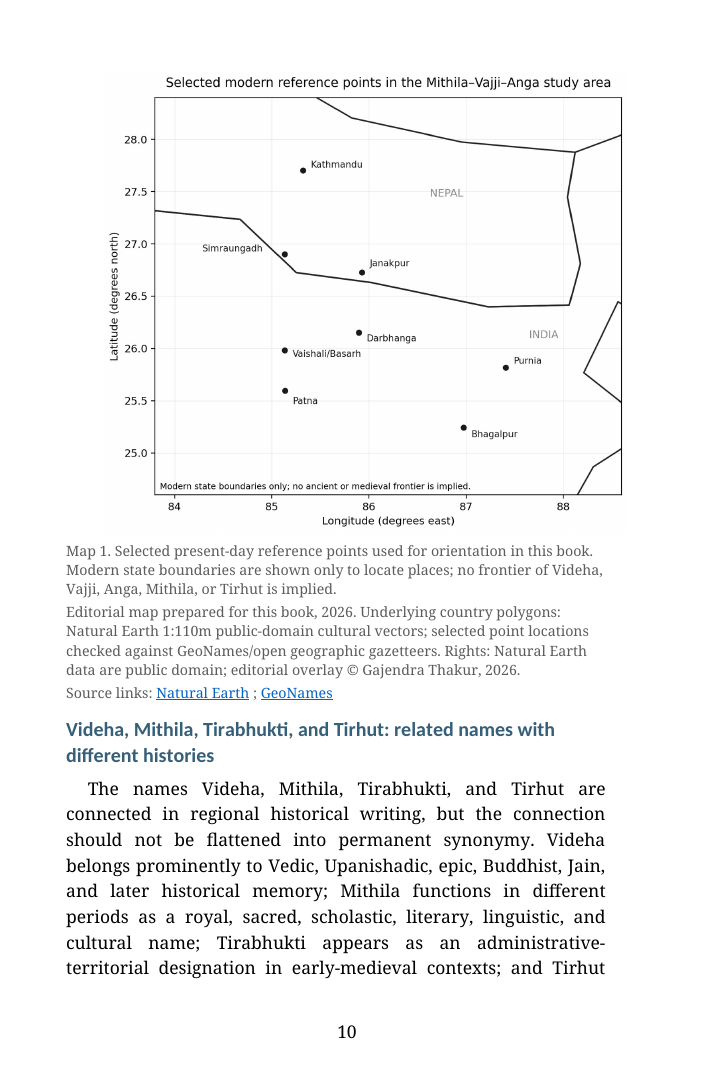
Mithila · Vajji · Anga
Chapter-specific source notes
- Primary chapter witness. Gajendra Thakur, Decoding the Panji of Mithila — Volume IV, formal Chapter 31, PDF pp. 335-345; formal Chapter 31. The HTML transcription is generated from the commit-pinned source PDF and retains the chapter boundary recorded in this edition.
- Internal structure. The repository source-heading inventory records 9 subordinate headings for this chapter: “31.1 Scope and method of continuation”; “31.2 Entries (248)-(251): Balirajpur opens from Ranitol to Ramnagar”; “31.3 Entries (252)-(255): Balirajpur expands through Kakraud, Chopta, Chopra and Rahua”; “31.4 Entries (256)-(258): Siva-Hariamb begins and moves to Virsayar, Saurath and Lakshmipur”; “31.5 Entries (259)-(264): Siva to Singhwar, Vishnupur, Pilkhar and Dath-Kachhuwa”; “31.6 Entry (265): Siva to Kharka as a suspended heading”; “31.7 Index logic applied in this chapter”; “31.8 Coverage ledger for Chapter 31”; ….
- Digital editorial method. The page keeps the preserved source text distinct from generated navigational, concordance, visual, and provenance apparatus. The synthetic reconstruction is explanatory only and is not evidence for an individual lineage or a determination of social or marital status.