Decoding the Panji of Mithila · Volume IV · Chapter 50
Kaivalakh-Nahas-Khaual and the Bharam Continuation: Entries (420)- (422)
Chapter 50
 Kaivalakh-Nahas-Khaual and the
Bharam Continuation: Entries (420)-
             (422)
1. Why entries (420) to (422) belong together
   Entries (420) to (422) form a compact but very dense
Kaivalakh-Nahas unit. Entry (420) opens with the heading
“Kaivalakh Nahas san” and immediately gives the operating
formula “Nahas Khaual gramarambh.” Entry (421) continues
the same Kaivalakh field and adds the local note “Bharam,”
while entry (422) again retains Kaivalakh as the heading. For
this reason the three entries are best read as one chapter: the
first entry establishes the Nahas-Khaual root, the second
explains the Bharam-facing continuation, and the third carries
the same house into late scholarly and administrative
branches.
   The chapter therefore does not treat “Kaivalakh,” “Nahas,”
“Khaual,” and “Bharam” as isolated place names. In Panji
method these terms operate together. Kaivalakh is the visible
heading; Nahas-Khaual is the moolgram control in entry (420);
Bharam is the localizing tag in entry (421); and the later lists in
entry (422) preserve the same descent while attaching modern
offices such as I.P.S., I.A.S., Railway I.G., Principal and Ex-G.P.
These titles are not ornamental. They show how an old
genealogical route continues to absorb modern professional
identity without abandoning the older dau and ddau
structure.

2. Entry (420): Kaivalakh-Nahas and the Nahas-Khaual
gramarambh
   Entry (420) begins with an invocation to Bhadra Kali and
marks the line as “Kaivalakh Nahas san.” The actual
genealogical opening is “Nahas Khaual gramarambh.” The
entry begins from Gunakar. Gunakar gives Man, called
Brahmadatt, and Dhan, called Rudradatt. Their first visible
route runs through Hariamb-Jagannath. Brahmadatt then
gives Gosain, Gangadatt and Bathna; the route attached here
runs through Ghusaut and Thakur Theghu. The register thus
anchors the chapter in Khaual while allowing the early path to
move through Hariamb and Ghusaut.
   Gosain is the central organizing ancestor in entry (420).
From him come Jyotishi Hridaydatt, Nanu, Kanh, Venidatt, Pa
Ram, Shankardatt, Ishwardatt and Nenmani. Their route is
written through Karmaha-Shivdatt-Mahidhar and Soderpur-
Vasudev. The presence of Jyotishi before Hridaydatt is
important: it is a professional designation carried inside the
genealogy, not a separate branch. It signals that scholastic and
ritual qualifications are part of the family’s recorded identity.
   Jyotishi Hridaydatt is connected through Belaunch-
Vidyanath-Jyotishi Bachna and Baliyas-Dharanath. Nanu is
linked through Hariamb-Ramanath-Bhavanidatt and Baliyas-
Ramanath. Venidatt then gives Babua, Vanshmani and Jyotishi
Gayadatt. Their line is placed through Khandbala-Govind-
Gopinath and Darihara-Lakshminath. Babua gives Janakinath
and Shreenath through Khandbala-Ugrasingh-Kamal Singh
and Baliyas-Dullah. This section makes clear that the Nahas-
Khaual line does not remain in one locality. It is a routed
house, with Khandbala, Darihara, Baliyas and Soderpur
repeatedly serving as corroborating marriage and settlement
links.

   Janakinath gives Baidyanath, Jagannath, Indranath,
Badrinath and Kedarnath. The route is Budhwal-Mandhan-
Chaudhary Gudar and Khaual-Apuch. Baidyanath gives
Kirtinath through Tisaut-Chiranjeev-Shri Narayan and
Soderpur-Faturi. The source then gives an apara branch
through Jagdish and Batesh, linked through Panichobh-
Govind-Awadh and Sakrarhi-Bhairavnath. Kirtinath is further
tied through Karmaha-Yogadatt-Hotrinath and Soderpur-
Gosain. Another daughter is routed through Soderpur-
Mandhan-Madhusudan and Bhadual-Mandar-Vishwanath,
while another connection moves through Alay-Kumar
Abhayanand Singh, called Narayan Ji, and Darihara-Nutan
Krishna. These multiple routes are not contradictions; they are
the Panji’s way of recording repeated valid attachments to
distinct houses.
   Jagannath gives Amarnath through Ghusaut-Jayvallabh-
Muni and Baliyas-Banmali. Amarnath gives Adityanath,
Dhairyanath and Vibhutinath through Soderpur-Bhairav-
Indranand and Pali-Krishnalal. Indranath then gives
Jitendranath, Kalendranath and Dhirendranath through
Sarisab-Shashidhar-Mahamahopadhyaya           Santgopal     and
Surgan-Rai Durga Narayan. The Santgopal route is especially
notable because it again carries learned status into the kinship
record. Badrinath gives Premnath through Soderpur-
Nityanand and Ghusaut-Keshav. Premnath is then linked
through Soderpur-Nanu, called Dayadhar, through Dhanudhar
and Darihara-Jaynandan. Kedarnath gives a branch through
Phandah-Chunchan-Manmohan and Pawali-Chaturbhuj, with
an apara branch through Chunchun, Naroun-Dhirnath-Apuch
and Budhwal-Jalli. Entry (420) therefore closes as an extended
Nahas-Khaual network whose branches are distributed across
Karmaha, Soderpur, Ghusaut, Pali, Surgan, Budhwal, Phandah
and Naroun.

3. Entry (421): Kaivalakh, Bharam and the Shreenath-
Bhimnath line
  Entry (421) is headed “Kaivalakh” and numbered 215; it
adds the locality “Bharam.” The first named ancestor in the
entry is Shreenath. Shreenath gives Chandranath, Suryanath
and Taranath through Sarisab-Dharbharan-Janardan and
Budhwal-Nandalal. Chandranath is routed through Phandah-
Sone-Lala and Khaual-Mahamahopadhyaya Babua, called
Dukhmochan. Suryanath gives Ganganath and Bhavanath
through      Soderpur-Vishwanath-Nehnath      and      Pali-
Raghunandan. Ganganath is further linked through Pawali-
Umanand-Mayanand and Karmaha-Jaydev.
  The most distinctive part of entry (421) comes through
Bhavanath and Taranath. Taranath is followed by Professor
Bhimnath, explicitly described as an author and poet in
Maithili. The register then records Daman, Suman and
Mitranath, with routes through Ghusaut-Madhusudan-
Damodar and Baliyas-Shreeraman. Bhimnath is linked
through    Karmaha-Baldev-Jaydev      and    Khandbala-Babu
Dhaneshwar Singh. His daughters are written as Archana,
Ratna and Sarjana. Daman gives Adarsh and a daughter Nidhi.
This is one of the clearest modern literary moments in the
chapter: the Panji does not merely name a professor; it
preserves his intellectual identity within the same
genealogical grammar as the older ritual and scholastic titles.
  Vanshmani gives Bhaiyanath, Teknath and Lekhnath
through Soderpur-Ishannath-Gudar and Karmaha-Horil.
Bhaiyanath is linked through Sarisab-Visuni-Munan and
Ghusaut-Shyam. Teknath gives Tejnath and Bheshnath
through Khandbala-Yognath-Durganath and Babhaniam-
Santalal. Tejnath gives Ganganath, Deonath, Dayanath,
Jaynath, Bholanath and Ugranath through Pali-Raghunandan-
Dinanand and Sarisab-Sant Gopal. Bheshnath gives Amarnath,

Balnath and Buddhinath through Ghusaut-Faturi-Ramanand
and Belaunch-Sundar. Amarnath gives Praveen through
Khandbala-Jayanarayan Singh-Govind Singh and Kujouli-
Indranand, with Digho-Manganu also written. Lekhnath gives
Taranath, Jyotishnath and Somnath through Soderpur-
Manhar-Gosain and Alay-Raja Shrinandan Singh. The
presence of Alay-Raja Shrinandan Singh at the end of entry
(421) ties this Kaivalakh-Bharam material back to the Alay-
royal network seen earlier in the volume.

4. Entry (422): Pa Ram, Khagdatt and the late
administrative branches
  Entry (422), again simply headed Kaivalakh, continues with
Pa Ram. Pa Ram gives Khagdatt through Pali-Bhavanidatt-
Khagnath and Soderpur-Vighneshwar. Khagdatt gives
Khadganath through Sarisab-Nanu-Pa Jagadhar and Pali-
Kamaladatt.    Khadganath     is  linked   through    Digho-
Avadhbihari-Gopal and Tisaut-Girdhari. Ishwardatt gives
Kamalmani, Bhayalal and Ugri through Soderpur-Vechu-
Shyamnath and Phandah-Shankardatt, with an apara route
through Khandbala-Hempati-Chhatramani and Pali-Umadatt.
  Kulmani gives Lochan, called Chitradhar, Gonu, called
Govardhan, and Pitambar through Phandah-Jhonti-Bhaiyan
and Soderpur-Bachchu. Lochan gives Arjun, Sahadev and
Balbhadra through Soderpur-Keshav-Prabhu and Naroun-
Hiramani. Arjun gives Kamalnarayan and Subodhanarayan
through Pawali-Babujan-Sudansh and Khaual-Nakchhed.
Kamalnarayan is placed through Sarisab-Mannu-Muchkand
and Khaual-Nandi. Chitru gives Trivenikant through Sarisab-
Lalji-Chaturanand and Baliyas-Banmali, while an apara
branch runs through Khandbala-Jagatkant-Bodhkant and
Hariamb-Govind.
  The closing portion of entry (422) is one of the most modern
registers in this chapter. Gonu, called Govardhan, produces

Mihir Kumar, described as I.P.S. and Ex-G.P. Bihar; Shankar
Kumar, Principal of Purnia College and I.P.S.; and Sudhir
Kumar, Railway I.G. Their route is Soderpur-Purushottam-
Jaynandan and Hariamb-Musahar. The entry then records the
next generation in modern administrative language. I.P.S.
Mihir Kumar’s son is written as an I.A.S. officer through
Soderpur-Bheshnath-Bhimnath      and   Darihara-Ramanand.
I.A.S. Sudhir Kumar gives I.A.S. Adhir Kumar and Pravir
Kumar, with the same route repeated.
   The final marriages are recorded with gotra logic rather
than ordinary local shorthand. I.A.S. Adhir Kumar’s
connection is written through Bharadvaj gotra and Kachhari,
with the woman described by descent from Shital Prasad,
Hridaydayal and Anand Kumar. I.A.S. Pravir Kumar’s
connection is written through Vats gotra and through the line
of Rameshwar Singh, Kameshwar Sharma and Mithileshwar
Sharma, naming Shailaja. This ending is important because it
shows the Panji adapting its grammar to late twentieth-
century professional and administrative identities while
continuing to preserve the older rules of gotra, lineage,
locality and ritual legitimacy.

5. Why the chapter stops before Manikouli
  The chapter stops before entry (423) because the next
heading changes the local field to Manikouli. Although the late
branches in entry (422) are modern and administratively
dense, they still belong to the Kaivalakh-Nahas-Khaual and
Bharam continuation. Entry (423) begins a new Manikouli
sequence and must therefore be treated separately. The
boundary is not simply numerical; it is structural. Entries
(420) to (422) close a Kaivalakh cluster, while entry (423)
opens the next unit.
Source structure and verification apparatus
Editorial source apparatus. This apparatus is descriptive, not interpretive. It records the source-controlled structure used to verify that this page corresponds to formal Chapter 50 of Decoding the Panji of Mithila — Volume IV. The chapter text above is preserved from PDF pp. 498-503; formal Chapter 50 in the commit-pinned authoritative source. It is not merged with a neighboring chapter, appendix, annexure, or independent front/back-matter unit. The internal headings below come from the repository’s source-heading inventory and are retained as navigational and audit evidence; showing them here does not turn those headings into separate publications or add claims that are absent from the source.
Internal source headings
No subordinate heading was separately encoded in the repository source-heading inventory for this chapter.
Source-text concordance
Kaivalakh-Nahas-Khaual · Bharam · Continuation · Entries · belong · together · form · compact · dense · Kaivalakh-Nahas · unit · Entry · opens · heading · Kaivalakh · Nahas · immediately · gives · operating · formula · Khaual · gramarambh · continues · field · adds · local · note · retains · reason · three · best · read · first · establishes · Nahas-Khaual · root · second · explains · Bharam-facing · third · carries · house · late · scholarly · administrative · branches · therefore · treat · isolated · place · names · method · terms · operate · visible · moolgram · control · localizing · later · lists · preserve · descent · attaching · modern · offices · Railway · Principal · Ex-G · titles · ornamental · show · genealogical · route · absorb · professional · identity · without · abandoning · older · ddau
Boundary verification. In the formal sequence this chapter follows Volume IV Chapter 49, “Simarwad-Khaual, Ahil-Gotham, Mahnaura-Bindhi, and Damodarpur-Kakraud” and precedes Volume IV Chapter 51, “Manikouli, Nahas-Kaivalakh, and Nahas-Dhamdaha: Entries (423)- (428)”. The chapter extractor begins at the verified formal Chapter 50 marker and stops at the next verified formal chapter marker; for a final chapter it stops before recognized book-level back matter. The concordance above is generated only from distinct terms already present in this chapter’s preserved source text. It is provided for discovery, comparison, and audit, not as an automated judgment about persons, lineages, status, kinship, marriage eligibility, or historical truth.
Illustrated research apparatus
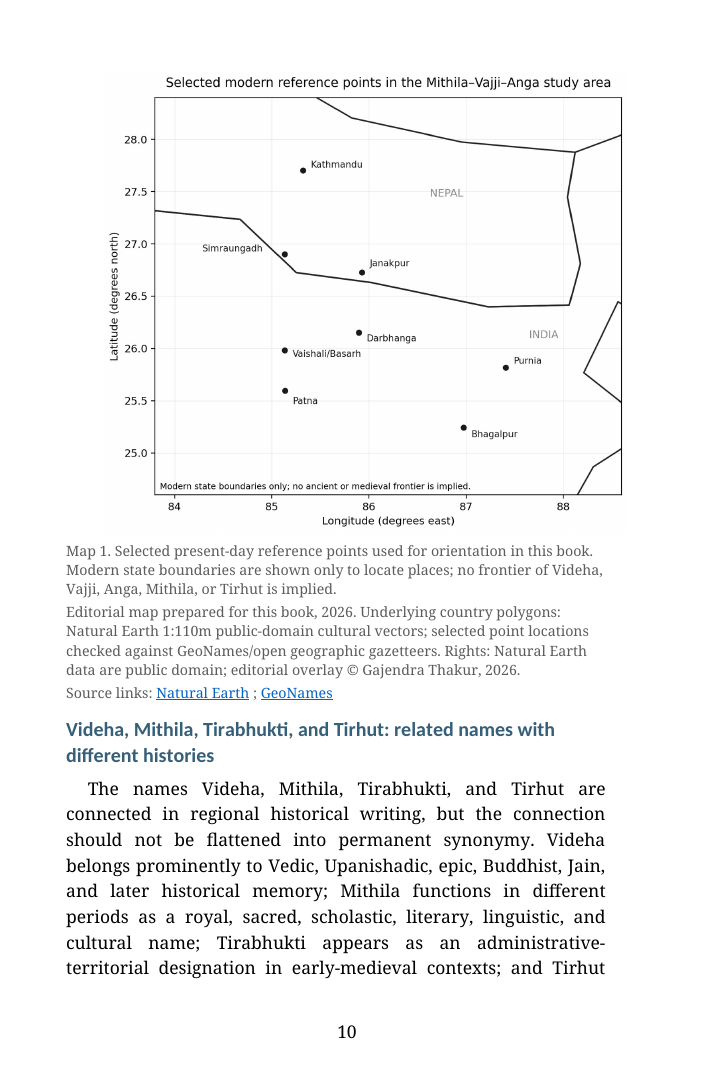
Mithila · Vajji · Anga
Chapter-specific source notes
- Primary chapter witness. Gajendra Thakur, Decoding the Panji of Mithila — Volume IV, formal Chapter 50, PDF pp. 498-503; formal Chapter 50. The HTML transcription is generated from the commit-pinned source PDF and retains the chapter boundary recorded in this edition.
- Internal structure. The repository source-heading inventory records no separately encoded subordinate heading for this chapter.
- Digital editorial method. The page keeps the preserved source text distinct from generated navigational, concordance, visual, and provenance apparatus. The synthetic reconstruction is explanatory only and is not evidence for an individual lineage or a determination of social or marital status.