Decoding the Panji of Mithila · Volume IV · Chapter 52
Chanpura and Basaith: Nahas- Khaual Continuities, Entries (429)- (432) This chapter takes up the next compact unit after the
Chapter 52
  Chanpura and Basaith: Nahas-
 Khaual Continuities, Entries (429)-
              (432)
    This chapter takes up the next compact unit after the
Nahas-Dhamdaha material: entries (429) to (432). The register
now turns to Chanpura and then to Basaith, but the operative
grammar remains that of the Nahas-Khaual field. The entries
are not isolated family anecdotes. They are bundles of descent,
marriage, and route-confirmation, each clause joining a
named son or daughter to another mool, village, or known line
by the formula “suta/suto … dau … ddau.” In these four entries
the principal movement is from Chanpura into Pali, Hariamb,
Soderpur, Alay, Belaunch, Jajival, Mandar, Budhwal, and
allied stations, with Basaith becoming the closing register in
entry (432).

Entry (429): Paramanand and the Chanpura
Opening
    Entry (429), headed with the invocation to Shiva and
simply marked Chanpura, opens with a large descent from
Paramanand. The sons listed are Hiranand, Shivram, Matiram,
Gatiram, Harpati, Dinaram, Rajaram, Hridayaram, and Chan.
Their shared linkage is registered through Soderpur, where
Gopal, son of Raghudev, appears as the receiving or allied
node. The entry therefore begins with a broad fraternal
spread, not with a single heir. It establishes Chanpura as a
many-branched household whose later clauses must be read
as subdivisions under this opening cluster.
   Hiranand carries the first developed subline. His sons
Ratish and Santoshi are joined through Soderpur: Shivpati’s

son Bachharu is the route on one side, and Karmaha-Shyam
on the other. Ratish then produces Dharmapati, who is tied to
Alay through Bhavani, son of Dharani, and to Mandar through
Aniruddh. Dharmapati’s sons Nehal and Hanumandatt
continue the widening. Their clause moves through Pali,
Sevak, and Bodh, while the ddau side records Pabauli-
Chintamani. Nehal in turn gives Ramnath and Faturi, linking
Hariamb-Ratnapati-Khadag with Darihara-Manbodh.
Ramnath’s son Shivcharan is placed through Panichobh-
Hasanu-Rajmani and Soderpur-Gana, and the same sentence
then records a daughter’s passage through Pali-Madhan-
Shyam and Belaunch-Hridaysut. An apara branch to Umakant
uses Pali-Nakat-Kanhai and Belaunch-Bhavan; Umakant’s own
daughter is then carried through Ekhara-Babunath-Panchu
and Soderpur-Durgadatt.
    Faturi’s son Bhushan is another important continuation.
He is placed through Kujouli-Gangadatt-Parashmani and Pali-
Bhaynath. Bhushan’s daughters and sons are named as
Gaurikant, Radhakant, and Shobhakant. Their alliances move
through Hariamb-Lutan Babu and Digho-Raghunath, after
which Gaurikant is expanded into Kishorchandra,
Hemchandra, Vimalchandra, Kamalchandra, Navchandra, and
Ratishchandra. This part of the entry is especially useful
because it shows the register moving from an older compact
patronymic style to a later series of modern -chandra names.
Radhakant is connected through Ghusaut-Govardhan-
Gangadhar and Baliyas-Shridatt, while Hanumandatt’s line
closes with an Ekhara-Gujar branch, a Babhaniam-Anathi-
Gangadatt reference, and a Baliyas-Chilka kasthut note. The
word kasthut here marks a formal confirmation or accepted
tie rather than an independent descent list.

Entry (430): Santoshi, Dullah, and the
Bholanath-Baduknath Group

    Entry (430) remains under Chanpura and begins from
Santoshi, whose sons are Saburdatt and Dullah. The receiving
linkage runs through Ghusaut-Hrishikesh-Theghu and
Naroun-Ghanshyam. Saburdatt’s son is Jhumkalal, placed
through Soderpur-Dubari-Girpati and Uchati-Mana. Dullah
produces Jayanath and Bholanath, using Belaunch-Manhar,
the grandson Chan and son Prannath, then Satlakha-Shubhai-
Gangu, while Pali-Narayan appears as a kasthut closing. The
entry also preserves an apara Dullah line to Sumiran through
Behera-Belaunch-Mana, Jagannarayana, Rai Lachha, and the
Gangoli-Abhiram-Raghu route; this again closes with Pali-
Narayan kasthut, showing that the Pali confirmation binds
more than one sub-branch.
    Jayanath’s daughter is tied through Belaunch-Padmapati,
Murli, and Sheetal, with the ddau side in Babhaniam-
Dinbandhu-Dhana. Bholanath then produces Baduknath,
Badrinath, Kedarnath, and Nenan. Their registration runs
through Alay-Lochan-Rameshwar-Banidatt and through
Satlakha-Sundar-Horil-Teknath, again ending with Pali-Jiut.
Baduknath’s daughter is connected to Hariamb-Harinarayan-
Nathe and Oini-Dukhiya-Bandhav. An additional daughter
goes through Sarisab-Akhi, Shridatt, Kalikadatt, and Khaual-
Dhir-Bokan, with Pali-Kala-Gangadatt as kasthut. Badrinath’s
sons Vishwanath and Narsingh are recorded through Gaul-
Karmaha-Husas-Chandidatt and Soderpur-Bacha. The clauses
then move through Pabauli-Hiralal-Gopal-Chhatradhari,
Karmaha-Garibnath-Shyam, Darihara-Baburam kasthut,
Panichobh-Lanha-Baladatt, and Sarisab-Govindmani. Nenan’s
daughter is routed through Baheradhi-Kanhai-Bhairavdatt
and Darihara-Kulmani. The importance of this entry lies in its
repeated balancing of active descent with kasthut closures,
making it a record of both lineage and juridical acceptance.
    The latter part of entry (430) returns to the broader
children of Shivram. Shivram’s sons are Narpati, Gana, Vagish,

and Sahab, tied through Hariamb-Nayan-Madan and
Darihara-Babu. Narpati’s daughter is left partly suspended
through a Pali-Kunai route; Gana’s daughter goes through
Jajival-Bhagirath-Nandalal and Darihara-Govardhan. Vagish
produces Dhir, placed through Naroun-Ghanshyam-Ratnapati
and Khaual-Bhavanand. Dhir produces Bokan, and Bokan’s
sons Baboolal and Bhaylal are linked to Pali-Kala-Gangadatt
and Soderpur-Ghani-Tula. Baboolal’s daughter then moves
through Alay and Soderpur-Duheshwar-Godhi, with Darihara-
Dukhiya as kasthut. Babuji’s daughter is entered through
Ekhara-Bhikshuk-Vidyanath and Baliyas-Dayanath. Sahab’s
son Kirtinath moves through Ekhara-Dashrath-Bala and
Karmaha-Kushan-Bahoran-Anand, with Sakararhi-Devanand
as kasthut. The sequence shows how the Chanpura register
preserves several sibling lines without collapsing them into a
single dominant line.

Entry (431): Chanpura-Basaith and the Nath-
Matiram Continuation
    Entry (431) is headed “Chanpura Basaith,” and it shifts the
local label while retaining the same kind of route-logic. It
begins with Nath, whose children are Pyare, Ghoghan,
Darwari, and Govardhan. The opening alliance is through
Panichobh-Yadupati-Khedan and Soderpur-Jahal. Pyare gives
Gangadhar, who is connected through Pabauli-Bhaiyan-Raja
and Baheradhi-Mathuranath. Gangadhar’s daughter is then
attached to Pali-Krishnamani-Gulab and a Maheshpur-
resident line. Ghoghan or Dhodhan produces Lakshmikant
through Belaunch-Bhairavdatt-Ishwardatt and Jajival-Akhi-
Fakir. An apara son Shrikant is tied through Soderpur-Juraun,
Dular, Uma, and Budhwal-Hira-Baburaiya. The Lakshmikant
and Shrikant branches demonstrate the text’s habit of pairing
one route with another even when one of the village links is
only lightly specified.

    Darwari’s sons Harinarayan and Jagatnarayan are then
entered through Tankbal-Datt-Gopinath and Mandar-Ranjan-
Kewal. Harinarayan’s daughter passes through Sarisab-
Faturan-Lal and Khaual-Modan. Jagatnarayan’s daughter is
linked to Haripur-Pali-Gadhu-Toti-Babujan and Mandar-Bhatu.
The entry then moves from Nath’s line to Matiram. Matiram’s
children are Dubari, Bhaiya, Yaddu, Digambar, Umain, and
Raiya; their collective route joins Budhwal-Ramabhadra-
Pradyumna with Soderpur-Dinmani. Dubari gives Jhadula,
Bhola, and Janaki through Naroun-Aniruddh-Kulpati and
Soderpur-Gopal. Jhadula’s son Brahmadatt is entered through
Tankbal-Gangadhar-Bodhkrishna and Jajival-Badlu.
Brahmadatt’s son Chandramani is then placed through Pali-
Sukhari, grandson Bech and son Babunidhi, with a B-
reference and Soderpur-Bhamar. Janaki gives Dukhiya, and
Dukhiya’s daughter is linked through Ratipad-Belaunch-
Gauripati-Umadatt. Bhaiya’s children Gonod, Parashmani, and
Soni move through Karmaha-Dinmani-Mahinath and
Satlakha-Narayan. Gonod’s children Shambhunath, Kanhai,
and Kalikadatt are tied to Belaunch-Hari-Mansukh and Jajival-
Abhiram. An apara daughter Kashinath-Harshadatt is routed
through Alay-Parashuram-Raghuni and Baliyas-
Lakshminarayan. This entry therefore marks Basaith not as a
new mool but as a localizing expansion of the Chanpura
material.

Entry (432): Basaith, Chandradatt-
Shankardatt-Nakchhedi, and the Prandhan-
Yokhan Branch
   Entry (432), headed with the invocation to Shri Nilakantha
and marked Basaith, begins with Kashinath and his children
Chandradatt, Shankardatt, and Nakchhedi. They are registered
through Ekhara-Kamlu-Dukhiya and Gangoli-Kriparam-
Dukhni. Chandradatt’s daughter is tied through Budhwal-

Jaydat-Baidyanath and Soderpur-Umanath. Shankardatt is
then connected through Baheradhi-Lal, Gangadatt, Durganath,
and the Malichham-Naroun-Kalar route. Geetakrishna
appears next, producing Bholi, Hridaysukh, and Lal, whose
link goes through Soderpur-Trilochan-Apuch and Darihara-
Khela. Bholi’s daughter is routed through Sarisab-Chhabban-
Boku and Pali-Bhairavdatt. Parashmani produces Vidyanath
through Soderpur-Chhakori-Sanphool and Pali-Misru.
    The same entry then develops Soni’s line. Soni’s children
are Prandhan, Tulsidatt, and Tufani, tied through Sarisab-
Jayshiv-Bhaiyan and Sakararhi-Gujar. Prandhan’s sons are
Jyotishi Yokhan and Nena, registered through Budhwal-
Khagpati-Hridaynath and Darihara-Meena. An apara
Prandhan sequence names Bhular, Gumani, and Nauvati and
joins them through Belaunch-Garban, the grandson Juraun,
and Durganath, with Sakararhi-Bhikhari as the ddau side.
Jyotishi Yokhan then gives Madhav and Jadav through
Sarisab-Bhavanidatt-Chhatramani and Hariamb-Kanhai; the
apara Yokhan line records Haladhar through Babhaniam-
Bacha-Pathak Kunji and Belaunch-Devidatt. Madhav’s
children Ramnaresh, Vagish, and Ananta are linked through
Kujouli-Bala-Srinath and Soderpur-Shivkrishna. The closing
part of the entry adds Ramesh, son of Bachchan, and
Vijaychandra through Soderpur-Mitrnath, Lala, and Jyotishi
Babua Ji, with Baliyas-Nath; Bachchan, also styled
Shubhchandra, connects to Alay-Fekanlal, Viloch,
Chandranand, and Soderpur-Hridayanand. Nareshchandra
then produces Hemchandra, Shivchandra, and Navinchandra
through Pabauli-Lakshman-Singheshwar and Panichobh-
Narsingh, with Hemchandra further linked to Alay-Vaiya
Achhelal-Navinchandra and Khaual-Chandrakant.
Vagishchandra and Ananta close the entry through Hariamb-
Jamahir-Jagdish with Pandua-Bhalle, and through Soderpur-
Shitaladatt-Pitambar with Sakararhi-Durganand. Entry (433),

beginning again with Basaith, is deliberately not included here
and begins the next chapter.

Interpretive Note
    Entries (429)-(432) are best read as a Chanpura-to-Basaith
bridge inside the Nahas-Khaual environment. The chapter
shows a dense pattern of sons, daughters, apara branches, and
kasthut confirmations. The register uses Chanpura as the
origin label in entries (429) and (430), then marks Basaith in
entries (431) and (432). Yet the actual movement of persons is
wider: Alay, Pali, Soderpur, Budhwal, Hariamb, Jajival,
Baliyas, Panichobh, Mandar, Belaunch, Ekhara, Baheradhi,
Gangoli, Tankbal, and Malichham-Naroun all appear. This is
precisely the function of the Panji record: the household is not
merely named; it is situated in a network of mool, village,
route, and ritual confirmation. The suspended or partial
clauses are therefore not omissions to be smoothed away.
They are part of the documentary texture and indicate places
where the older register preserved the existence of a tie even
when one side of the formula was no longer fully available.
Source structure and verification apparatus
Editorial source apparatus. This apparatus is descriptive, not interpretive. It records the source-controlled structure used to verify that this page corresponds to formal Chapter 52 of Decoding the Panji of Mithila — Volume IV. The chapter text above is preserved from PDF pp. 511-517; formal Chapter 52 in the commit-pinned authoritative source. It is not merged with a neighboring chapter, appendix, annexure, or independent front/back-matter unit. The internal headings below come from the repository’s source-heading inventory and are retained as navigational and audit evidence; showing them here does not turn those headings into separate publications or add claims that are absent from the source.
Internal source headings
No subordinate heading was separately encoded in the repository source-heading inventory for this chapter.
Source-text concordance
Chanpura · Basaith · Nahas · Khaual · Continuities · Entries · takes · next · compact · unit · Nahas-Dhamdaha · material · register · turns · operative · grammar · remains · Nahas-Khaual · field · isolated · family · anecdotes · bundles · descent · marriage · route-confirmation · clause · joining · named · daughter · another · mool · village · known · line · formula · suta · suto · ddau · four · principal · movement · Pali · Hariamb · Soderpur · Alay · Belaunch · Jajival · Mandar · Budhwal · allied · stations · becoming · closing · entry · Paramanand · Opening · headed · invocation · Shiva · simply · marked · opens · large · sons · listed · Hiranand · Shivram · Matiram · Gatiram · Harpati · Dinaram · Rajaram · Hridayaram · Chan · shared · linkage · registered · Gopal · Raghudev
Boundary verification. In the formal sequence this chapter follows Volume IV Chapter 51, “Manikouli, Nahas-Kaivalakh, and Nahas-Dhamdaha: Entries (423)- (428)” and precedes Volume IV Chapter 53, “Basaith, Baghdas-Chanpura, Nahas-Chanpura, Khojpur, and Mahinathpur”. The chapter extractor begins at the verified formal Chapter 52 marker and stops at the next verified formal chapter marker; for a final chapter it stops before recognized book-level back matter. The concordance above is generated only from distinct terms already present in this chapter’s preserved source text. It is provided for discovery, comparison, and audit, not as an automated judgment about persons, lineages, status, kinship, marriage eligibility, or historical truth.
Illustrated research apparatus
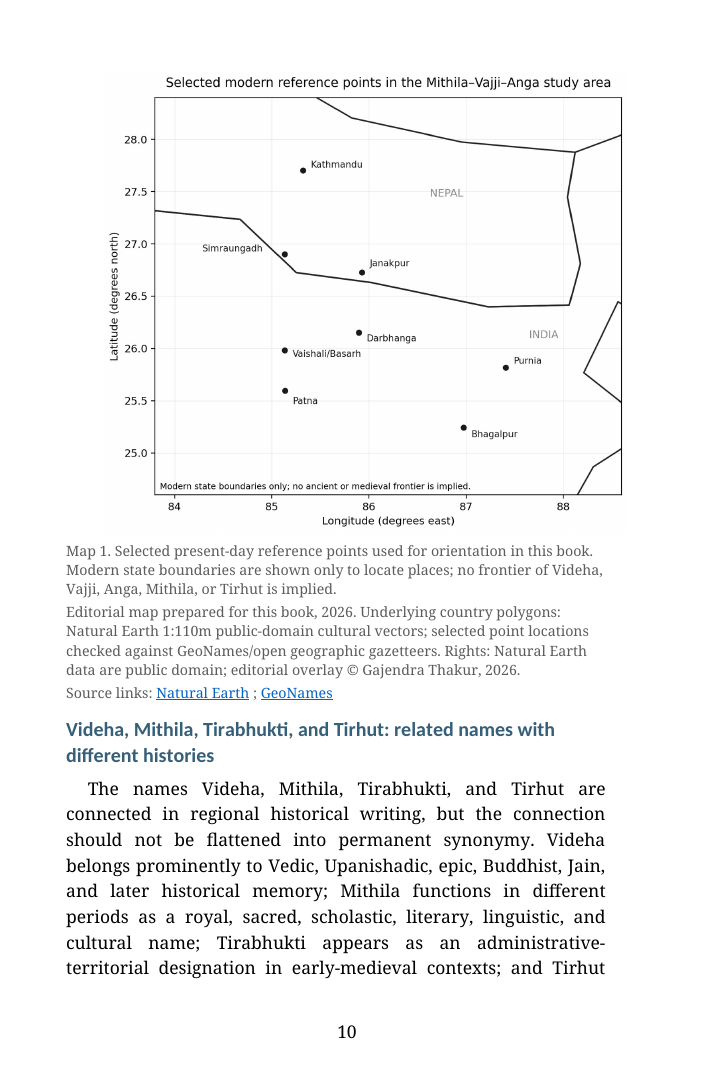
Mithila · Vajji · Anga
Chapter-specific source notes
- Primary chapter witness. Gajendra Thakur, Decoding the Panji of Mithila — Volume IV, formal Chapter 52, PDF pp. 511-517; formal Chapter 52. The HTML transcription is generated from the commit-pinned source PDF and retains the chapter boundary recorded in this edition.
- Internal structure. The repository source-heading inventory records no separately encoded subordinate heading for this chapter.
- Digital editorial method. The page keeps the preserved source text distinct from generated navigational, concordance, visual, and provenance apparatus. The synthetic reconstruction is explanatory only and is not evidence for an individual lineage or a determination of social or marital status.