Decoding the Panji of Mithila · Volume IV · Chapter 53
Basaith, Baghdas-Chanpura, Nahas-Chanpura, Khojpur, and Mahinathpur
Chapter 53. Basaith, Baghdas-Chanpura,
Nahas-Chanpura, Khojpur, and Mahinathpur
   This chapter continues the Nahas-Khaual and Chanpura sequence
from the preceding chapter and covers entries (433) through (446). The
source moves from Basaith into Baghdas-Chanpura, then into several
Nahas-to-Chanpura continuations, and finally into Nahas-to-Khojpur
and the Balah santati at Mahinathpur. Entry (446) is preserved as a
suspended invocation without genealogy. The chapter stops before entry
(447), where a new Sukhait-to-Pilkhwar register begins.

Entry (433): Basaith continuation
   Entry (433) is headed simply Basaith. It begins from Jadav, whose
sons are Dayanath and Meghnath. Dayanath is placed through Pabouli-
Bathan-Sakhan and a Pali-Sadanand route. Dayanath in turn gives a line
through Vabhaniam, Pathak Shivlal, and Pathak Devottam, with the
Khaual-Chaudhary Damodar control. Meghnath is linked through
Narun, Panch Lutan, Panch Nirsu or Vishwanath, and Satlakha-
Hemnath. This entry therefore continues the Basaith material already
opened in (432), but now it turns from the Jyotishi Yokhan and
Prandhan strands to the Jadav-Dayanath-Meghnath side of the family.
   The entry next gives Bhular, son of Srishtidhar, with Ananttal. The
route moves through Pabouli-Keshav Narayan-Babu Lal and Budhwal-
Gopinath. Tufani is tied through Pali-Narpati, Machal, and Purveshwar,
and then to Mandar-Kalikadatt. An apara branch gives Basudev through
Pali-Bhaiyan-Ram and Khaual-Modan. Basudev has an Alay route
through Abhi, Rupnath, and Jhumak, with Khaual-Amritnath. Yaddu
gives Balah, linked to Jajival-Murari-Badlu and Sakararhi-Narottam.
Digambar gives Dullah, Kari, and Chhatrapati through Pali-Bhavanand-
Bhuvan and Belaunch-Buddhinath.
   The Dullah branch gives Babunandan and Bhagwandatt, linked
through Alay-Gunay-Sahab and Khaual-Bhushan. Balah gives Jayanath,
and the entry records a partial Jayanath continuation. Babunandan then
gives Madhusudan through Ekahara-Girjadatt-Khadganath and
Panichobh-Baburaiya. Bhagwandatt gives Mahadev through Harianb-
Lal-Babuan and Soderpur-Baburaiya, and Mahadev is followed through
Sarisab-Faturan-Lalji and Khaual-Modan. The closing segment moves
through Kari, Dwarika, and Mukund; Dwarika is placed through
Vabhaniam-Bhaiya-Jagyapati and Darihara-Chalmani, while Mukund is

tied to Ekahara-Poshan-Paribaya and Khaual-Suba. The entry ends by
preserving a Jajival-Devidatt kasthut.

Entry (434): Nahas to Baghdas, Chanpura
   Entry (434) is headed Nahas to Baghdas, with Chanpura named as the
local frame. It begins from Gatiram, whose sons are Bodh and Chakor,
linked through Harianb-Nayan-Bachhai and Khaual-Bhavdev. Bodh
gives Bhanjan and Ranjan. Bhanjan is tied through Pabouli-Jai-Ram and
a Balias route marked by a B reference; Anant gives Bhoj in the same
cluster. Bhanjan then gives Bhairavdatt, Saburdatt, and Modan, through
Pabouli-Haridas-Chandrapati and Khaual-Ani-Harishwar. Bhairavdatt
gives    Bhaylal,   linked   to   Phandah-Gatiram-Madhuram-Lochan-
Baidyanath and Budhwal-Dukhni.
   Modan gives Lakshman, Faturi or Bachchu, and Kanhai, with Pali-
Revati Raman-Chaturbhuj-Gulab and Kujouli-Chhotku-Shiv, plus an
Ekahara-Nitan reminder. Lakshman gives Govardhan, who is linked to
Pali-Shrinath-Jaynath and Belaunch-Dayanath. Govardhan has a Digho-
Sanphool-Gangadatt-Bachchu route, and the same segment notes Pali-
Hridaynath-Dukhan and Jajival-Bhimdatt. Faturi gives Vishweshwar
through Pali-Girdhari-Bandhav and Soderpur-Mandhan. Kanhai is
linked through Mangrauni-Pali-Manik-Rudramani and Belaunch-
Girdhari, while Ranjan gives Shyamlal, whose descendants connect to
Pabouli-Upendra-Bani and Satlakha-Harinarayan.
   The second half of the entry turns to Dinaram and to Chaudhary
Chan. Dinaram is linked through Belaunch-Bachhani-Vir and Visfi-
Mohan. Chaudhary Chan gives Jagyapati, Sitaram, Chetu, and Kamalu
through Harianb-Musan-Bachharu and Satlakha-Guman. Jagyapati gives
Lakshminath and Kari or Baidyanath through Karmah-Raghudev-
Dukhni and Soderpur-Lochan. Lakshminath gives Babudatt and
Ishwaridatt; Babudatt gives Rajkumar through Alay-Chandrapati-
Deridatt and Belaunch-Vidyanath, while Ishwaridatt gives Raghav
through Pabouli-Ekan-Hiralal and Pali-Shobhnath. Raghav is further tied
to Sarisab-Rupnath-Bhola-Vishwanath and Khaual-Shambhunath-Gopal,
with Budhwal-Ratan and Belaunch-Sonmani-Shrinath as apara links.

Entry (435): Nagram, Nahas-Khaual to Chanpura
  Entry (435) is explicitly marked Nagram and headed Nahas-Khaual to
Chanpura. It begins from Chaudhary Kari or Baidyanath. His sons are
Mahapurush, Hiralal, Jhingur, Kauskidatt, and Saravana, linked through

Sarisab-Bhagirath-Machal and Harianb-Umanath. Mahapurush gives
Bauk and Maujelal through Belaunch-Sahab-Sonmani and Pali-
Nityanand. Bauk gives Surendra and Upendra through Pali-Bhavadatt-
Channa and Mandar-Barja. Surendra is tied to Balias-Harianb-Govind-
Madhav, Dharora-Balias-Shriprasad, and a Karmah-Babulal kasthut.
Upendra is tied through Pali-Machal-Shyamlal-Fenku-Yogdhar,
Soderpur-Girdhari-Phanilal, and Alay-Bhaylal.
   Hiralal gives Keshav and Yashodhar through Pabouli-Hemkar-
Premnath and Mandar-Bhavi. Keshav gives Chandrakant and Matikant
through      Belaunch-Lakshmidatt-Keshav     and    Darihara-Raghu.
Chandrakant is linked to Khandbala-Narayan-Hemdatt and Harianb-
Bhushan; Matikant is linked through Soderpur-Shridatt-Lutan and
Mandar-Makravan. Yashodhar has a Harianb-Kanhai-Lalji route and a
Jajival-Raghu control. Jhingur gives Prannath and Janardan through
Jajival-Kaladhar-Bhiravi   and    Satlakha-Nanu.   Prannath    gives
Devkinandan, Shrinandan, and Gorbullanand through Digho-
Sarvanarayan-Bhaylal and Satlakha-Dwarikanath. Devkinandan gives
Shivdatt and Gangadatt through Khandbala-Narayandatt-Hemdatt and
Harianb-Bhushan; Shivdatt then gives Manoj, Ajit, and Ajay through
Harianb-Suresh-Tareshwar and Balias-Chiranjeev. Shrinandan gives
Anand or Paltu, Sushilchandra, and Subhashchandra through Ekahara-
Manrakhan-Lilanand and Panichobh-Bhagwandatt, with later Jagati-
Pabouli, Radha Kant, Rajnandan, Karmah, and Chandra Shekhar links.

Entry (436): Nahas to Chanpura
   Entry (436) continues Nahas to Chanpura. Gokulanand gives Kailash
and Vyaschandra through Kujouli-Shrinath-Ramakant and Mandar-
Rukminidatt. Janardan, also styled Vaktavir in the text, is connected
through Narun-Manbharan-Chumman and Darihara-Banmali. An apara
branch gives Kameshwar through Jajival-Devidatt-Rudradatt and
Karmah-Mandhar, with Brahmpura-Dhirnath also preserved. Sakhan
gives Nujuk through Budhwal-Bhimdatt-Lalitlal and Darihara-Hema.
Sitaram gives Buddhinath and Mangaladatt through Karmah-Kalidas-
Chira and Belaunch-Bana.
  Buddhinath gives Hridaysukh, Thakurdatt, and Faturi through
Panichobh-Ghanshyam-Bachharan and Ekahara-Prannath. Hriday gives
Nunu through Soderpur-Umai-Faturi and Sakararhi-Gujar-Hemnath.
Nunu gives Markandey through Gangoli-Dharmdatt-Kulmani and
Vabhaniam-Swamidatt-Shitaladatt. Apara Nunu branches name

Haldhar, Chakradhar, and Jagaddhar through Karmah-Hemkant-
Pushpakant and Soderpur-Diheshwar-Godhi, with Pali-Mahangi.
Jagaddhar is also tied to Jajival-Atmaram-Devidatt-Kedardatt, Ghusaut-
Ghan-Vishwanath, and Mandar-Amritnath.
   The same entry follows Thakurdatt to Yadunandan and
Raghunandan through Pabouli-Karu-Kishori and Pali-Manik. Faturi
gives Jayanandan through Analpur-Karmah-Poshan-Grihinath and
Soderpur-Pashupati-Madhav, with Mandar-Ramakant. Mangaladatt
gives Nityanand through Kujouli-Gokulnath-Gangadatt and Karmah-
Chhatrapati. Poshan gives Lal and Gulab through Pali-Sevak-Bodh and
Pabouli-Chintamani. Lal gives Apuch and Raja through Digho-Nath-
Buleli and Karmah-Kalanand; Raja is linked through Joki-Sarisab-Karu-
Bhaiyo and Khaual-Saburdatt. Gulab gives Bhikhiya through Budhwal-
Juraun-Kalanath and Pabouli-Gangadatt. Bhikhiya gives Muktinath and
Shaktinath through Sarisab-Soderpur-Vanshidhar-Bhaylal and Pali-
Sanphool. Muktinath then gives Vilat through Tarouni-Karmah and
Bindhi-Khaual, proving that the Chanpura block remains tied to the
larger Khaual and Nahas framework.

Entries (437)-(439): Vaidyanath, Shankar, and Nahas-
Khaual continuations
   Entry (437), under the invocation to Vaidyanath, begins from
Chaudhary Chetu. Chetu gives Ravinath and Shambhunath through
Kujouli-Murli-Dharmu and Pali-Shivram. Ravinath gives Babainand and
Bamma through Pali-Manbodh-Shivan and Balias-Kunja. Babainand
gives Babua, Singheshwar, and Rajeshwar through Harianb-Mannu-
Kalikadatt and Ekahara-Bawanu. Babua or Vishweshwar gives
Chandrashekhar, Damodar, and Aniruddh through Karmah-Manik-
Babulal and Pabouli-Horil. Chandrashekhar gives Lakshmikant,
Harikant, and Shobhakant through Phandah-Goshai-Mangu and Sarisab-
Mukund.
   The entry then records several modern residential and professional
strands. Harikant gives Shravan Kumar through Mahishi-Pali-Manohar-
Jaykant. Shobhakant gives Shrikant, Sudhakar, Prabhakar, Nilambar,
and Pitambar through Kujouli-Haridev-Ramdev and Jajival-Harikant.
Shrikant gives Shivkumar at Haripur-Majarhi through Kua-Tisaut-
Mukul-Yugeshwar; Sudhakar gives Vishnu Kumar through Ranti and a
Shukdev route; Vishnu Kumar is localized at Lavapur near Hajipur.
Prabhakar gives Pranesh through Bhairav-Balia-Radhepura-Pabouli-

Shobhakant-Narayanji. Nilambar gives Navneet and Neelamani through
Kanakpur-Ujan-Ruchauli-Karmah-Divakar. Harikant also gives Dr.
Shravan, whose son Manish or Rinku is tied to Gajhara-Raiyam-
Soderpur and Dr. Umesh, with Mishra Krishnakant. Damodar gives
Parmakant through Karmah-Benidatt-Vishweshwar and Darihara-
Bachchi.   Parmakant     has   a   Pabouli-Narsinghdatt-Chakradhar-
Avadhbihari route, a Narbal-Rai Bahadur Shivshankar route, an Alay-
Raja Kirtyanand Singh-Kumar Shyamanand Singh route, and a Pali-
Ramashankar-Vindhyanath route.
   Entry (438), headed Shankaraya and Nahas to Chanpura, begins from
Kalar or Singheshwar. Tholhi, son of Singheshwar, is tied through
Harianb-Kauskidatt-Manmohan and Pandua-Jagatmani. Tholhi gives
Bhairav, Harikeshwar, Bhageshwar, and Jaykeshwar through Pali-
Jaleshwar-Gulli and Balias-Ram. Bhairav is linked to Pabouli-Gunanand-
Kalikanand and Mandar-Ramakant. Harikeshwar is linked through
Kanhauli-Soderpur-Nirsu-Suryakumar and Malang-Kujouli-Dharmnath.
Jaykeshwar produces Nandlal and Brajlal, and the entry records both
Ghusaut-Lakshmikant-Padmakant and Naduar-Karmah-Rudranath-
Ramanath routes. Rajeshwar gives Dhananjay and Jaykant through
Karmah and Darihara. Dhananjay is further tied to Soderpur-Govind-
Kishor and Khaual-Mahamahopadhyaya Chumme, with an apara
Pabouli-Vedanand-Nityanand and Alay-Chaudhary Shrikant route.
   Entry (439), again Nahas-Khaual to Chanpura, follows the sons of
Chaudhary Nand: Shivshankar and Devshankar, plus the apara Bhaiye
or Bande branch. Shivshankar gives Padmakar and Indrakar through
Digho-Ram-Bachkan and Ekahara-Panchu; another branch gives
Digambar and Bhalchandra through Digho-Chitradhar-Muktinath and
Balias-Jayram. Devshankar gives Vishwambhar through Pabouli-Janaki-
Nandlal and Visfi-Thakur Phanilal. The Bhaiye or Bande branch gives
Bachcha or Harishankar, Suryanarayan, Shyamshankar, Ramshankar,
Kartik, and Pradyumna through Karmah-Deonath-Doman and Balias-
Raja. Harishankar gives Abhimanyu, Dukharan, and Divakar, and
Divakar is tied to Soderpur-Bachchelal-Chakrapani and Darihara-
Madhusudan. Suryanarayan produces Umeshchandra, Sureshchandra,
Dharmeshwar, and Ratneshwar through Pali-Shaktinath-Madhav and
Balias-Ram. Umeshchandra gives Arun Kumar or Babuji through
Panichobh-Bhagwandatt-Radhakant and Darihara-Raghuvar-Lala; Arun
Kumar gives Deepak Kumar through Saurath-Malichham-Narun and
Balias-Harishchandra. The entry closes with Shyamshankar-Kashinath,

Ramshankar, Kartik, and the Bande-Jaybhadra line through Digho-
Chitradhar-Raghunath and Mandar-Ishannath.

Entries (440)-(442): Nahas to Chanpura and the short
modern closing
   Entry (440) continues Nahas to Chanpura from Chaudhary Bamma.
Bamma gives Madhusudan, Chunni, Babu Anant, Lokyanath, and
Dukhmochan through Karmah-Bhola-Amritpani and Soderpur-
Hiramani. Madhusudan gives Pushkar, Dasharath, Arjun, Ganesh,
Bhairav, Jayshankar, and Janak through Belaunch-Mani-Lalitlal and
Soderpur-Balkaram. Pushkar gives Jit Narayan and Hit Narayan through
Pabouli-Gopal-Babuan      and      Karmah-Naina.  Dasharath     gives
Dharanidhar through Ghusaut-Mukund-Babujan and Sakararhi-Jaylal.
Arjun gives Shobhakant through Vabhaniam-Pathak Santoshi-Pathak
Krishnalal and Digho-Muktinath. Bhairav, Jayshankar, Gopikant,
Ramendra Narayan, and Janak extend the entry through Ghusaut,
Sakararhi, Harianb, Digho, Khandbala, Pali, Pabouli, Alay, Mandar,
Jagati-Pabouli, and Khaual routes.
   The same entry also records Chunni and Trilokyanath. Chunni gives
Dinanath through Digho-Chandidatt-Baidyanath and Balias-Jayram.
Dinanath has a Bhuri-resident Garhu-Khandbala route and a Belaunch-
Chandramani route. Trilokyanath gives Mannu and Dayakant through
Soderpur-Hanumandatt-Keshav and Pandua-Lakshman. Dayakant gives
Ganganath and Srishtinath through Sarisab-Jaynath-Harinandan and
Vabhaniam-Krishnalal, while Ganganath is linked to Ghusaut-Banmali-
Krishnakumar and Khaual-Devkinandan.
   Entry (441), under Rameshwaraya, continues Nahas to Chanpura
through Dukhmochan. Dukhmochan gives Gandiveshwar through
Ghusaut-Ram-Nidhi and Balias-Jayram. Apara Dukhmochan gives
Maheshwar and Chandeshwar through Harianb-Lakshminath-Shrinath
and Soderpur-Barbedi. Gandiveshwar has a Raiyam-Soderpur-Poshan-
Bhavanand route and a Panichobh-Pujegari route. Maheshwar is tied to
Alay-Abhi-Rupnath-Jhumkalal-Dhanushdhari and Balias-Ramlal. The
same entry records Chaudhary Shambhunath, whose sons include
Grihinath, Banmali, Nakchhedi, and Mohan. Nakchhedi gives
Vishweshwar and Rameshwar through Pabouli-Ratnapati-Durganath
and Sakararhi-Amritnath; Vishweshwar gives Someshwar, Maheshwar,
and Dineshwar through Sarisab-Narayandatt-Thithar and Harianb-
Shashinath.    Rameshwar     gives  Chandeshwar,     Bhavneshwar,

Mukteshwar, Harikeshwar, and Jaykeshwar through Alay-Nena-Bhul
and Khaual-Chan.
   Entry (442), headed Nahas to Chanpura, is brief and modern in style.
It records Bhagirath to Chintamani and then to Vashishtha Narayan,
whose children are Parameshwar, Rajeshwar, and Jiveshwar. It notes
Singhya and the Budhwal-Bhagwat Jha line. Jiveshwar gives Santosh
and Minitosh, associated with Dhanga-Haripur-Hati-Pali-Raghuvar-
Vishwanath and Pursholia-Shrikeshwar. The entry also preserves two
daughter references, Poonam of Pindaruch and Rupam, with one
marriage line explicitly tied to Rameshwar and Manoj. Its value is not
volume but closure: it marks the late modern tail of the Nahas-Chanpura
block before the source turns to Khojpur.

Entries (443)-(445): Nahas to Khojpur and Balah
santati at Mahinathpur
   Entry (443) opens the Nahas to Khojpur sequence. It begins from
Bhora, whose sons are Harikrishna, Shrikrishna, Balkrishna, and
Chintamani. The route runs through Vabhaniam-Parmanand-Dharani
and Sakararhi-Aniruddh. Harikrishna gives Sahab and Ravedan through
Harianb-Pitambar-Nath and Katai-Kheli. Sahab gives Rupnath,
Bhavnath, and Mannu through Jajival-Manhar-Dharu and Mandar-
Gonu. Rupnath gives Ramkrishna, Kevalkrishna, Jagatmani, and Lalka
through     Phandah-Vishwanath-Mahipani         and    Darihara-Harijiv-
Manbodh, with Vidual-Shubhpat also noted. Bhavnath gives Shivdatt,
Gangadatt, and Gopal through Budhwal-Devkrishna-Mana and Jajival-
Gangadhar. Gopal gives Bhaiyo and Nandi through Soderpur and
Panichobh/Tisaut routes. The Bhaiyo branch gives Chunchun,
Ramakant, and Lakshmikant; Chunchun is linked to Soderpur-Mani-
Bahoran-Balbhadra and Karmah-Bhaiyaram-Nanulal. Ramakant and
Lakshmikant then carry the line through Sarisab, Pali, Harianb, Jajival,
and Karmah. Nandi gives Gokulnath, Umakant, Yugeshwar, Bachcha,
and Radhakant, and thereby extends the Khojpur block through Pabouli,
Pali, Soderpur, Tisaut, Budhwal, Sarisab, and Harianb.
  Entry (444), again Nahas to Khojpur, begins from Shrikrishna.
Shrikrishna gives Juraun through Pali-Mahesh-Gangadhar and Balias-
Bachharu. Juraun gives Babunandan through Alay-Vanshi-Mahi and
Darihara-Dhani.    Babunandan    gives   Govinddatt,   Bhagwandatt,
Shambhudatt, and Rudri through Khandbala-Brajbhushan-Chiri and
Darihara-Rajnu. Govinddatt gives Jaynath through Sarisab-Gunanidhi-

Chandidatt and Khandbala-Durbhirav; an apara branch gives Banu and
Indrajit through Narun-Barju-Dular and Khaual-Shivdatt. Jaynath is
connected to Khandbala-Ishwardatt-Chiranjeev and Karmah-Kalar-
Paribaya, with Darihara-Madan also preserved. Bachanu has a Jamdoli-
Pali-Prandhan-Mukund route and Satlakha-Janaki.
   The Rudri branch in (444) gives Rameshwar, Bhirvar, and
Vishweshwar through Sarisab-Narayandatt-Panchanand and Harianb-
Kanhai. Rameshwar is tied to Karmah-Lal-Thothan, Belaunch-
Babunandan-Jaynath, Harianb-Parshamani, and Jajival-Atmaram.
Bhirvar gives Harinarayan and Maheshwar through Karmah-Shridatt-
Babujan and Satlakha-Arjun-Lal, with Pali-Yadurai. An apara branch
gives Kameshwar through Soderpur-Shivkrishna-Buchchu-Hitkrishna
and Darihara-Devkinandan. Kameshwar gives Shivnarayan through
Pali-Panch Gudar-Kamalu and Satlakha-Lal; Shivnarayan is tied to
Ghusaut-Damodar-Brajmohan and Jajival-Loknath. Vishweshwar gives
Indranarayan through Harianb-Ugranath-Adinath, while the apara
Jivan-Ugranath line moves through Katai-Lakshmikant-Ranjan and
Pabouli-Chhabnu. Adinath is further tied to Balias-Dharmdatt-Yogdhar
and Pali-Bhaiya. The entry closes with the Balkrishna and Chintamani
daughter routes, the latter through Jajival-Manhar-Dharani and Tisaut-
Parshuram.
   Entry (445) is specifically headed Nahas to Khojpur, Balah santati,
Mahinathpur. It begins from Bula, whose sons are Bhaiyaram,
Hridayram, and Thad or Atmaram. The route is Harianb-Krishnapati-
Harishwar and Belaunch-Naro. Bhaiyaram gives Dullah, Balah, Gujan,
and Saravana through Pali-Revati Raman-Bhupati and Soderpur-
Govardhan. Hridayram is tied through Pali-Mahtha-Dina and Soderpur-
Harinandan. Balah gives Nenmani through Budhwal-Khedan-Maddu
and Soderpur-Dhir. Nenmani gives Shrinath and Babua through Digho-
Sanphool-Gangadatt and Panichobh-Jhadula. An apara Nenmani branch
gives Raja through Ghusaut-Bhairavdatt-Jalpadatt and Balias-Bhola.
Shrinath is tied through Karmah-Ganeshdatt-Manmohan and Mandar-
Prandhan. Babua has an Alay-Dharmdatt-Kanhaiya route and a
Darihara-Babunath control, plus an apara Khandbala-Jayan-Ravangi
route, Darihara-Badan-Modnath, and Belaunch-Neya. This entry
converts the general Khojpur sequence into a named Balah santati and
localizes it at Mahinathpur.

Entry (446): suspended Kapileshwaram invocation
   Entry (446) contains only the invocation to Kapileshwaram and gives
no genealogy in the available text. I have treated it as a preserved
suspended marker, not as a lost line to be reconstructed. Its placement is
important because it separates the Balah santati of Mahinathpur from
the next effective unit, entry (447), where the register begins Sukhait to
Pilkhwar.

Chapter conclusion
   Entries (433)-(446) complete a long Chanpura and Khojpur passage
inside the Nahas-Khaual frame. The chapter begins with Basaith, passes
through Baghdas and Chanpura, and then develops multiple Nahas-to-
Chanpura lines before turning to Khojpur. The final Khojpur segment is
not generic: it is specifically narrowed to Balah santati at Mahinathpur.
The important editorial point is that all dots, apara marks, kasthut notes,
partial modern localities, and suspended headings have been preserved
as evidence of how the register itself works. The next chapter begins
with entry (447), Sukhait to Pilkhwar.
Source structure and verification apparatus
Editorial source apparatus. This apparatus is descriptive, not interpretive. It records the source-controlled structure used to verify that this page corresponds to formal Chapter 53 of Decoding the Panji of Mithila — Volume IV. The chapter text above is preserved from PDF pp. 518-526; formal Chapter 53 in the commit-pinned authoritative source. It is not merged with a neighboring chapter, appendix, annexure, or independent front/back-matter unit. The internal headings below come from the repository’s source-heading inventory and are retained as navigational and audit evidence; showing them here does not turn those headings into separate publications or add claims that are absent from the source.
Internal source headings
- Entry (433): Basaith continuation
- Entry (434): Nahas to Baghdas, Chanpura
- Entry (435): Nagram, Nahas-Khaual to Chanpura
- Entry (436): Nahas to Chanpura
- Entries (437)-(439): Vaidyanath, Shankar, and Nahas-Khaual continuations
- Entries (440)-(442): Nahas to Chanpura and the short modern closing
- Entries (443)-(445): Nahas to Khojpur and Balah santati at Mahinathpur
- Entry (446): suspended Kapileshwaram invocation
- Chapter conclusion
Source-text concordance
Basaith · Baghdas-Chanpura · Nahas-Chanpura · Khojpur · Mahinathpur · continues · Nahas-Khaual · Chanpura · sequence · preceding · covers · entries · moves · several · Nahas-to-Chanpura · continuations · finally · Nahas-to-Khojpur · Balah · santati · Entry · preserved · suspended · invocation · without · genealogy · stops · Sukhait-to-Pilkhwar · register · begins · continuation · headed · simply · Jadav · whose · sons · Dayanath · Meghnath · placed · Pabouli · Bathan-Sakhan · Pali-Sadanand · route · turn · gives · line · Vabhaniam · Pathak · Shivlal · Devottam · Khaual-Chaudhary · Damodar · control · linked · Narun · Panch · Lutan · Nirsu · Vishwanath · Satlakha · Hemnath · therefore · material · already · opened · turns · Jyotishi · Yokhan · Prandhan · strands · Jadav-Dayanath-Meghnath · side · family · next · Bhular · Srishtidhar · Ananttal · Pabouli-Keshav · Narayan-Babu · Budhwal
Boundary verification. In the formal sequence this chapter follows Volume IV Chapter 52, “Chanpura and Basaith: Nahas- Khaual Continuities, Entries (429)- (432) This chapter takes up the next compact unit after the” and precedes Volume IV Chapter 54, “Sukhait-Pilkhwar and the Learned Khaual Line: Entries (447)-(450) This chapter takes up the sequence after the suspended”. The chapter extractor begins at the verified formal Chapter 53 marker and stops at the next verified formal chapter marker; for a final chapter it stops before recognized book-level back matter. The concordance above is generated only from distinct terms already present in this chapter’s preserved source text. It is provided for discovery, comparison, and audit, not as an automated judgment about persons, lineages, status, kinship, marriage eligibility, or historical truth.
Illustrated research apparatus
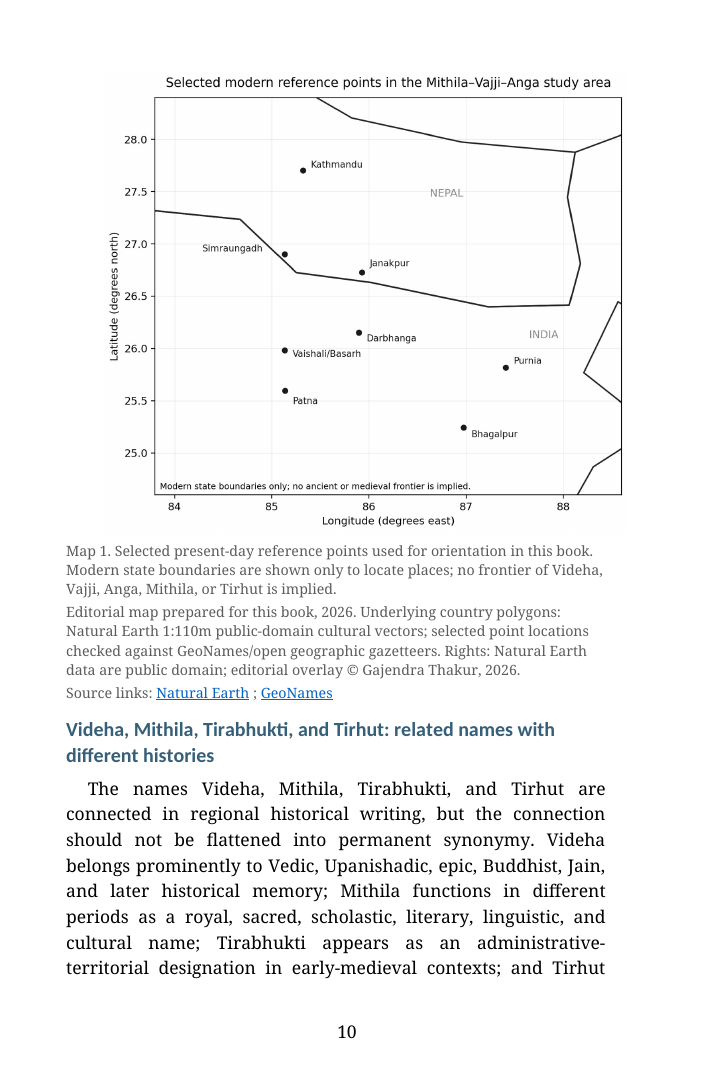
Mithila · Vajji · Anga
Chapter-specific source notes
- Primary chapter witness. Gajendra Thakur, Decoding the Panji of Mithila — Volume IV, formal Chapter 53, PDF pp. 518-526; formal Chapter 53. The HTML transcription is generated from the commit-pinned source PDF and retains the chapter boundary recorded in this edition.
- Internal structure. The repository source-heading inventory records 9 subordinate headings for this chapter: “Entry (433): Basaith continuation”; “Entry (434): Nahas to Baghdas, Chanpura”; “Entry (435): Nagram, Nahas-Khaual to Chanpura”; “Entry (436): Nahas to Chanpura”; “Entries (437)-(439): Vaidyanath, Shankar, and Nahas-Khaual continuations”; “Entries (440)-(442): Nahas to Chanpura and the short modern closing”; “Entries (443)-(445): Nahas to Khojpur and Balah santati at Mahinathpur”; “Entry (446): suspended Kapileshwaram invocation”; ….
- Digital editorial method. The page keeps the preserved source text distinct from generated navigational, concordance, visual, and provenance apparatus. The synthetic reconstruction is explanatory only and is not evidence for an individual lineage or a determination of social or marital status.