Decoding the Panji of Mithila · Volume IV · Chapter 56
Hadari-Sakararhi, Batsar-Munger, Lohna-Sakararhi and Rohar-Haripur: Entries (461)-(466)
Chapter 56. Hadari-Sakararhi, Batsar-Munger,
Lohna-Sakararhi and Rohar-Haripur: Entries
(461)-(466)
   This chapter continues from the suspended Parhar marker
and covers entries (461) through (466) only. The source first
turns to Hadari within the Sakararhi frame and then carries
that Hadari material through Saurath, Kakraud, and Batsar. It
then shifts to Lohna-Sakararhi and finally to Rohar-Haripur.
The index confirms the Hadari-Sakararhi control and also
records Rohar-Soderpur and Lohna-Sakararhi as independent
routing frames, so I treat this chapter as a boundary passage
in which one local Sakararhi register gives way to other
village-route registers.

Entry (461): Hadari to Saurath

Entry (461), headed Hadari to Saurath, explicitly
opens with ath Hadari Sakararhi gramarambh. The
first ancestor is Pa Yogi, whose son is Pa Tarapati.
Tarapati is joined through Baheradhi-Raghunath-
Manhar and Balias-Saday. Tarapati gives Pa
Ramanath and Pa Bhikhi through Belaunch-Dharu-
Janakinandan and Sakararhi-Nenu. Pa Ramanath
gives Pa Krishnadatt and Pa Shyamlal through Jajival-
Saday-Shubhupati and Sakararhi-Hari.
   Pa Krishnadatt gives Pa Chandradatt through Karmah-
Shambhunath-Prannath and Sarisab-Shobhnath. Chaudhary
Chandradatt gives Sundar and Pa Kumar; the register links
this section through Khandbala-Vitan and Bachharu-
Baidyanath. Bhavnath is then tied through Alay-Narpati, and
Kala is placed through Khaual-Ram-Dulli and Nikhuti-
Raghunath. The source is therefore not only listing sons; it is

showing how the Hadari branch is made acceptable through
repeated cross-village anchors.
   The Kala and Vitan lines further stabilize the entry. Vitan is
linked through Sakararhi-Baburam and through a Mangni-
Ratnapati continuation. Baburam gives a Budhwal-Harishiv-
Jivanath connection and a Mandar-Lochan route. Vitan’s
apara line moves through Khaual-Bauku-Kalmani, Ganpati,
Garib, and Bauku again, and then into Belaunch-Haldhar.
Kumar gives Bodhkrishna and Harikrishna through Ahpur-
Karmah and Mahamahopadhyaya Baksi Mukund. Mukund’s
son is Vaiyakaran Jaykrishna, and the source then follows the
Mandar-Mandhan-Govind and Hariamb-Jagatbandhu lines.
   The entry closes by retaining several learned and teacher-
like signals. M.M. Mukund, Vaiyakaran Jaykrishna, and the
later Govind strand make this a learned Sakararhi-Hadari
cluster rather than a simple residential list. Pa Bhikhi, at the
end of the entry, gives Venidatt through Vabhaniam-
Chaturbhuj-Pathak Madhurapati and Darihara-Ghananand.
This is the hinge into the next Hadari continuation.

Entry (462): Hadari to Kakraud

Entry (462) is headed Hadari to Kakraud. It begins
from Narpati, who gives Pa Jagannath, Pa
Raghunandan, and Pa Kamalnayan through Alay-
Ravikar-Vibhakar and Pabouli-Madhav. Pa Jagannath
gives Vighneshwar through Panichobh-Harinath-
Kashinath and Visfi-Vishwanath. The source then
brings in Pa Vishweshwar, whose issue includes Pa
Bhramar or Dasharath, Pa Lakshmipati, Ratidev, and
Mohan through Belaunch-Parmanand-Babudi and
Khaual-Babu.
   Pa Lakshmipati gives Dharmanand, Durgadatta, and
Jayadatta through Gangoli-Vishwanath-Jaykrishna and Balias-
Ramchandra. Jayadatta is linked through Vabhaniam-
Pitambar-Bandhav and Balias-Raghupati. Pa Ratidev gives
Ghanshyam through Vabhaniam-Kangali-Pitambar and
Ekhara-Jagati. Ghanshyam gives Pa Bachha, and Pa Bachha
gives Kirtinath through Sarisab-Hedu-Dharmpati and Pandua-
Nandishwar.
   The second side of (462) follows Pa Raghunandan and Pa
Kamalnayan. Pa Raghunandan gives Kashinath through
Ghusaut-Mukund-Jagdish        and      Soderpur-Vishwanath.
Kashinath gives Jivanath and Nathe through Panichobh-
Ramdev-Lakshman and Belaunch-Churamani. Pa Kamalnayan
gives Pa Gopal and Mahamahopadhyaya Shubhankar through
Hariamb-Vitu-Hardatt and Balias-Raghav. Pa Gopal gives Pa
Dhare or Dharadhar and Mahopadhyaya Lakshmidhar
through Panichobh-Mangai-Lakshman and Mandar-Gosain
Das.
  Pa Dhare gives Pa Banai, Pa Basudev, and Shatanjiva. Pa
Banai gives Jayanand through Panichobh-Pashupati-Dhani
and Satlakha-Purandar, with an apara branch through

Vabhaniam-Pakshadhar-Medani and Satlakha-Bhoranath.
Jayanand gives Nityanand through Soderpur-Pogal-Chalbal
and Pali-Manbodh. Nityanand has both Budhwal-Ghananand-
Grihimani and Ekhara-Chedan links, and an apara link
through     Soderpur-Balkaram-Hanumandatt    and   Balias-
Premnath. Pa Basudev gives Bachha through Karmah-Dukhan-
Kalanath and Sarisab-Balbhadra, with another Jajival-Sada-
Umapati and Ekhara-Jiv route. This closes the Kakraud
subsection.

Entry (463): Hadari to Batsar, Munger

Entry (463) shifts the register to Hadari to Batsar in
Munger. The line begins from Yashodhan and
Chakrapani, leading to Pitambar. Pitambar gives
Bhoranath through Pabouli-Chan, and Bhoranath is
linked through Talhanpur-Jagannath-Mahinath and
Karmah-Damodar. Bhoranath gives Mandhan and
Nilkanth through Alay-Bhikhi-Shivanandan and
Kujouli-Bhavani. Mandhan gives Vishweshwar and
Raghav through Soderpur-Mani-Bhramar and Khaual-
Kamal.
  Nilkanth gives Vaidyanath through Alay-Vishnuhari-Panchu
and Belaunch-Bhavani. Vaidyanath gives Bhavnath and
Naresh through Budhwal-Lakshmidev-Shankar and Darihara-
Chhitar. Bhavnath gives Brahmadatt and Chandradatt through
Pali-Ganesh-Bhikhari and Balias-Dhani. Naresh gives
Vidyanath    through    Soderpur-Maddu-Purushottam     and
Khaual-Girpati. Vidyanath’s sons are Lal, Gopinath, and
Bhayalal, linked through Pali-Manbodh-Modnath and
Darihara-Shridatt.
  The entry then follows Lal and Gopinath. Lal gives
Badrinath, Vishwanath, Rajnath, and Dwarikanath through
Pabouli-Baburaiya-Bhaiyo and Uchati-Horil. Badrinath gives

Lakshmikant, Chunchun, and Kunjan through Jajival-
Durgadatt-Pakshadhar and Budhwal-Bhaiyaram. Vishwanath
gives Bambhola, Harikant, Shivshankar, and Dukhmochan
through Pali-Sonma-Hridaynath and Khandbala-Ishwardatt.
Gopinath gives Triloknath through Budhwal-Ramkrishna-
Yugal and Mandar-Dharmeshwar-Premnath; Triloknath gives
Basudev and Ugramohan. Thus the Batsar-Munger entry
connects older Hadari movement with Batsar and Munger-
associated residence.

Entry (464): Hadari to Batsar-Mangrauni

Entry (464) continues Hadari to Batsar, now explicitly
adding Mangrauni. Bhayalal gives Babulal, Jaykant,
Muktinath, and Shyamsundar through Pabouli-
Janaki-Raja and Baheradhi-Mathuranath. Jaykant
gives Manilal, Kirtinarayan, and Chitradhar through
Takbal-Hridaynath-Bachchenath and Balias-Mukund.
Manilal gives Aniruddh, Govind, and Janardan
through Pali-Chhotku-Sundar and Khaual-Gopal.
Muktinath and apara Manmohan are also preserved;
Manmohan gives Purushottam and Subodh through
Ghusaut-Gopal-Harivansh and Pabouli-Kirtinath.
  Purushottam’s issue is Navneet, Vineet, and Gandharv, tied
through Ahil-Hariamb-Kalikadatt-Badrinath and Nahas-
Khaual-Devkinandan. Shyamsundar gives Jagdish, styled
Munindra, through Pabouli-Babunandan and Pali-Girdhari.
The apara side gives Upendra and Bhupendra through
Pabouli-Artinath-Banmali     and      Panichobh-Govinddatt.
Bhupendra is tied through Karmah-Kheli and Jyotishi Khuni
or Sudhakar, with Sakararhi-Tirthmani. Subodh gives Vivek,
and the record leaves a residential fente through Jamdauli-
Pali and Shashinath.

   The second half of (464) adds an apara Dalu line. Dalu gives
Vidyapati, Rudrapati, Ganapati, Vidyupati, Lakshmipati, and
Sarayuti through Budhwal-Suryakar-Babu and Surgan-Keshav.
Rudrapati gives Jor, Pa Parakhu, and Dubeka through
Sakauna-Gangeshwar-Raghu and Dih-Darihara-Govind. Jor
gives Vishwanath, Harinath, and Bhavnath through Kujouli-
Murli-Bage and Pakaniya-Gangu. Vishwanath gives Chiku or
Ratinath and Siddhnath through Uchit-Dube-Dinu and
Darihara-Ravi. Chiku or Ratinath gives Pa Arjun, Pa Madhav,
Pa Kona, and Narayan through Pabouli-Rupdatt-Surpati and
Narun-Surpati.
  Pa Arjun gives Shankar through Alay-Devnath-Balbhadra
and Soderpur-Kumar. Pa Shankar gives Mitrakar, Pa
Hemangad, and Bandhu through Soderpur-Vamdev-Shivdev
and Balias-Mahojagdish. The record also preserves Pa
Yashodhar and Pa Madhav’s descendants: Pa Madhav gives Pa
Purushottam, Nandu, and Gatiram through Soderpur-
Raghunath-Rami and Narun-Shrihari. Purushottam gives
Devkrishna and Bachha through Hariamb-Arjun-Krishnanand
and Balias-Rati. This completes the Batsar-Mangrauni
complex.

Entry (465): Lohna-Sakararhi to Sakhua, Supaul

Entry (465) leaves the Hadari sequence and opens ath
Lohna Sakararhi gram. The heading names Lohna-
Sakararhi to Sakhua in Supaul. Raghupati is linked
through Karmah-Hingu-Lal and Sakararhi-Shyam.
Apara Raghupati gives Girpati through Budhwal-
Kamalakant-Bachharu and Darihara-Ramakant.
Girpati gives Premnath through Pabouli-Nanu-Tegari
and Sakararhi-Gopal. Premnath gives Achyut through
Soderpur-Juraun-Lal and Budhwal-Brajnath.
   Achyut gives Durbal, styled Shri Narayan, through Pali-
Sonmani-Hridaynath and Khandbala-Ishwaridatt. Durbal is
linked through Hariamb-Dular-Jhalli and Khandbala-Hardatt.
The entry then adds Jagdish to Mahadev through Kujouli-
Umapati-Mangai and Sakararhi-Mathura. Mahadev gives
Chiranand through Ekhara-Saraswati-Manhar and Alay-
Purushottam. Chiranand is linked through Soderpur-
Abhinandan-Hari and Darihara-Abhinandan. The short Lohna
entry is therefore a compact Sakararhi-to-Supaul bridge.

Entry (466): Rohar to Haripur

Entry (466), headed Rohar to Haripur, begins from
Narsingh. Narsingh gives Bhavesh and Pati through
Panichobh-Gop-Ram and Soderpur-Mohan; an apara
son is Thegh through Pali-Hariram-Lakshman and
Khaual-Lakshman. Bhavesh gives Chilka through
Alay-Parashuram and Mandar-Pradyumna. Pati gives
Manbodh through Alay-Janardan-Anath and
Soderpur-Lakshman. Manbodh gives Kanhai, Horil,
and Bhavnath through Soderpur-Mahinath-Bachan
and Takbal-Mahidhar.
  Kanhai gives Narayandatt through Ekhara-Bhora-Somdatt
and Soderpur-Umai. Narayandatt gives Anuplal through
Sarisab-Bhaiyan-Muni and Pali-Devan. Anuplal gives Jaykant
through Pabouli-Bathan-Harihardatt and Karmah-Batah.
Jaykant is linked through Hariamb-Govind-Narsingh and
Sakararhi-Rangi. Horil is placed through Belaunch-Dunanand-
Hridaynath and Hariamb-Dulli. Theghu has a Belaunch-
Purushottam-Rit and Soderpur-Yogi route, and Pitambar gives
Nenu through Pali-Hariram-Pudhai and Mandar-Shrikrishna.
   Nenu gives Anantaram, Bhayaram, and Purandar through
Pali-Shivdas-Vaidyanath and Ekhara-Manhar. Anantaram
gives Mansukh through Alay-Janardan-Anath and Sakararhi-
Damodar. Mansukh gives Lalit through Soderpur-Chhabnu-
Bhavanidatt and Alay-Gangadatt. Lalit gives Faturi and Hira
through Alay-Hiya-Thakurdatt and Nahas-Khaual-Gonod, and
apara Lalit gives Pyare and Ajandatt through Jajival-Hira-
Chira and Pali-Bodh. The branch then follows Bhayaram to
Kariye and Ghana. Kariye gives Amritnath and Gokulnath
through Soderpur-Dharani-Gokulnath and Khaual-Bodh;
Amritnath gives Hridaynath, and Hridaynath gives Kailash.
Ghana gives Prannath and Vidyanath, while an apara line

gives Jagmohan through Pali-Vishnupati-Bhushan and
Soderpur-Vaishnav. This closes the Rohar-Haripur section.

Chapter conclusion
   Entries (461)-(466) form a transitional chapter. The first four
entries complete a Hadari-Sakararhi arc that moves through
Saurath, Kakraud, Batsar, Munger, and Mangrauni. Entry
(465) opens Lohna-Sakararhi toward Sakhua in Supaul, and
entry (466) closes with Rohar-Haripur. The source file itself
ends after this entry; I have not treated that container
boundary as an end of the Nagram material, but only as the
stopping point for this chapter before the next source segment
begins.
Source structure and verification apparatus
Editorial source apparatus. This apparatus is descriptive, not interpretive. It records the source-controlled structure used to verify that this page corresponds to formal Chapter 56 of Decoding the Panji of Mithila — Volume IV. The chapter text above is preserved from PDF pp. 543-551; formal Chapter 56 in the commit-pinned authoritative source. It is not merged with a neighboring chapter, appendix, annexure, or independent front/back-matter unit. The internal headings below come from the repository’s source-heading inventory and are retained as navigational and audit evidence; showing them here does not turn those headings into separate publications or add claims that are absent from the source.
Internal source headings
- Entry (461): Hadari to Saurath
- Entry (461), headed Hadari to Saurath, explicitly opens with ath Hadari Sakararhi gramarambh. The first ancestor is Pa Yogi, whose son is Pa Tarapati. Tarapati is joined through Baheradhi-Raghunath-Manhar and Balias-Saday. Tarapati gives Pa Ramanath and Pa Bhikhi through Belaunch-Dharu-Janakinandan and Sakararhi-Nenu. Pa Ramanath gives Pa Krishnadatt and Pa Shyamlal through Jajival-Saday-Shubhupati and Sakararhi-Hari.
- Entry (462): Hadari to Kakraud
- Entry (462) is headed Hadari to Kakraud. It begins from Narpati, who gives Pa Jagannath, Pa Raghunandan, and Pa Kamalnayan through Alay-Ravikar-Vibhakar and Pabouli-Madhav. Pa Jagannath gives Vighneshwar through Panichobh-Harinath-Kashinath and Visfi-Vishwanath. The source then brings in Pa Vishweshwar, whose issue includes Pa Bhramar or Dasharath, Pa Lakshmipati, Ratidev, and Mohan through Belaunch-Parmanand-Babudi and Khaual-Babu.
- Entry (463): Hadari to Batsar, Munger
- Entry (463) shifts the register to Hadari to Batsar in Munger. The line begins from Yashodhan and Chakrapani, leading to Pitambar. Pitambar gives Bhoranath through Pabouli-Chan, and Bhoranath is linked through Talhanpur-Jagannath-Mahinath and Karmah-Damodar. Bhoranath gives Mandhan and Nilkanth through Alay-Bhikhi-Shivanandan and Kujouli-Bhavani. Mandhan gives Vishweshwar and Raghav through Soderpur-Mani-Bhramar and Khaual-Kamal.
- Entry (464): Hadari to Batsar-Mangrauni
- Entry (464) continues Hadari to Batsar, now explicitly adding Mangrauni. Bhayalal gives Babulal, Jaykant, Muktinath, and Shyamsundar through Pabouli-Janaki-Raja and Baheradhi-Mathuranath. Jaykant gives Manilal, Kirtinarayan, and Chitradhar through Takbal-Hridaynath-Bachchenath and Balias-Mukund. Manilal gives Aniruddh, Govind, and Janardan through Pali-Chhotku-Sundar and Khaual-Gopal. Muktinath and apara Manmohan are also preserved; Manmohan gives Purushottam and Subodh through Ghusaut-Gopal-Har
- Entry (465): Lohna-Sakararhi to Sakhua, Supaul
- Entry (465) leaves the Hadari sequence and opens ath Lohna Sakararhi gram. The heading names Lohna-Sakararhi to Sakhua in Supaul. Raghupati is linked through Karmah-Hingu-Lal and Sakararhi-Shyam. Apara Raghupati gives Girpati through Budhwal-Kamalakant-Bachharu and Darihara-Ramakant. Girpati gives Premnath through Pabouli-Nanu-Tegari and Sakararhi-Gopal. Premnath gives Achyut through Soderpur-Juraun-Lal and Budhwal-Brajnath.
- Entry (466): Rohar to Haripur
- Entry (466), headed Rohar to Haripur, begins from Narsingh. Narsingh gives Bhavesh and Pati through Panichobh-Gop-Ram and Soderpur-Mohan; an apara son is Thegh through Pali-Hariram-Lakshman and Khaual-Lakshman. Bhavesh gives Chilka through Alay-Parashuram and Mandar-Pradyumna. Pati gives Manbodh through Alay-Janardan-Anath and Soderpur-Lakshman. Manbodh gives Kanhai, Horil, and Bhavnath through Soderpur-Mahinath-Bachan and Takbal-Mahidhar.
- Chapter conclusion
Source-text concordance
Hadari-Sakararhi · Batsar-Munger · Lohna-Sakararhi · Rohar-Haripur · Entries · continues · suspended · Parhar · marker · covers · first · turns · Hadari · within · Sakararhi · frame · carries · material · Saurath · Kakraud · Batsar · shifts · finally · index · confirms · control · records · Rohar-Soderpur · independent · routing · frames · treat · boundary · passage · local · register · gives · village-route · registers · Entry · headed · explicitly · opens · gramarambh · ancestor · Yogi · whose · Tarapati · joined · Baheradhi-Raghunath · Manhar · Balias-Saday · Ramanath · Bhikhi · Belaunch-Dharu · Janakinandan · Sakararhi-Nenu · Krishnadatt · Shyamlal · Jajival · Saday-Shubhupati · Sakararhi-Hari · Chandradatt · Karmah · Shambhunath-Prannath · Sarisab-Shobhnath · Chaudhary · Sundar · Kumar · links · section · Khandbala-Vitan · Bachharu · Baidyanath · Bhavnath · tied · Alay-Narpati · Kala · placed · Khaual-Ram-Dulli
Boundary verification. In the formal sequence this chapter follows Volume IV Chapter 55, “Nahar and Parhat-Sakararhi: From Tharhi-Satlakha to Teldihā-Munger, Entries (451)-(460)” and precedes Volume IV Chapter 57, “Rohar-Jhanjharpur, Tatail- Sakararhi and Chhamu-Sakararhi: Entries (467)-(474) This chapter begins a new source file after the Rohar-”. The chapter extractor begins at the verified formal Chapter 56 marker and stops at the next verified formal chapter marker; for a final chapter it stops before recognized book-level back matter. The concordance above is generated only from distinct terms already present in this chapter’s preserved source text. It is provided for discovery, comparison, and audit, not as an automated judgment about persons, lineages, status, kinship, marriage eligibility, or historical truth.
Illustrated research apparatus
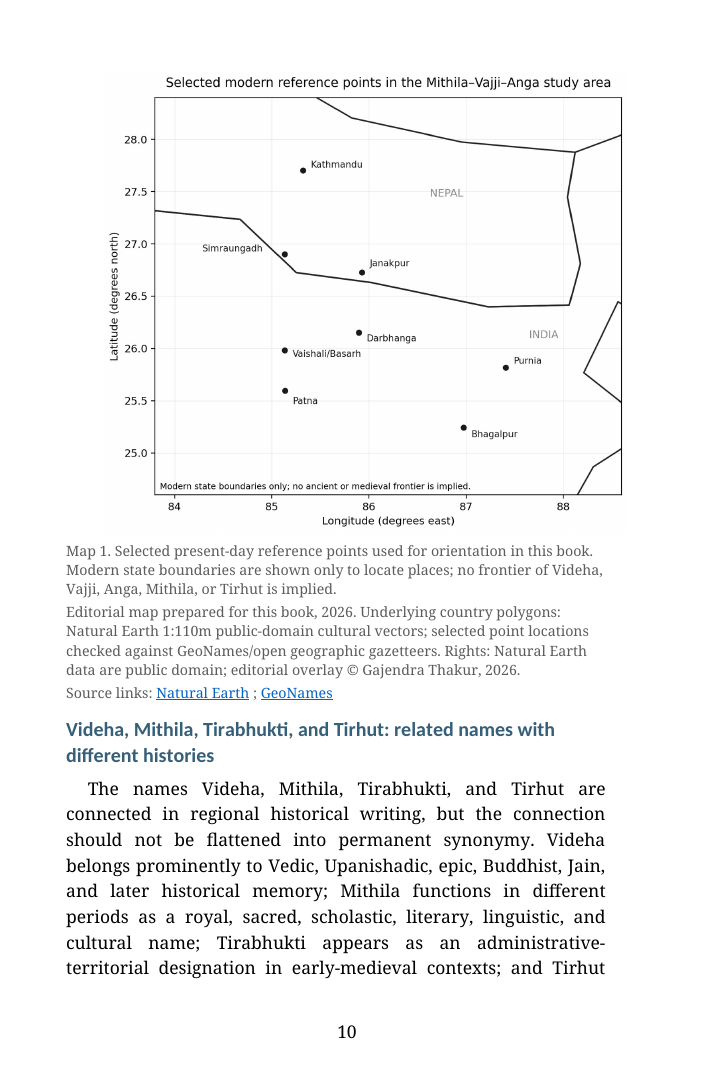
Mithila · Vajji · Anga
Chapter-specific source notes
- Primary chapter witness. Gajendra Thakur, Decoding the Panji of Mithila — Volume IV, formal Chapter 56, PDF pp. 543-551; formal Chapter 56. The HTML transcription is generated from the commit-pinned source PDF and retains the chapter boundary recorded in this edition.
- Internal structure. The repository source-heading inventory records 13 subordinate headings for this chapter: “Entry (461): Hadari to Saurath”; “Entry (461), headed Hadari to Saurath, explicitly opens with ath Hadari Sakararhi gramarambh. The first ancestor is Pa Yogi, whose son is Pa Tarapati. Tarapati is joined through Baheradhi-Raghunath-Manhar and Balias-Saday. Tarapati gives Pa Ramanath and Pa Bhikhi through Belaunch-Dharu-Janakinandan and Sakararhi-Nenu. Pa Ramanath gives Pa Krishnadatt and Pa Shyamlal through Jajival-Saday-Shubhupati and Sakararhi-Hari.”; “Entry (462): Hadari to Kakraud”; “Entry (462) is headed Hadari to Kakraud. It begins from Narpati, who gives Pa Jagannath, Pa Raghunandan, and Pa Kamalnayan through Alay-Ravikar-Vibhakar and Pabouli-Madhav. Pa Jagannath gives Vighneshwar through Panichobh-Harinath-Kashinath and Visfi-Vishwanath. The source then brings in Pa Vishweshwar, whose issue includes Pa Bhramar or Dasharath, Pa Lakshmipati, Ratidev, and Mohan through Belaunch-Parmanand-Babudi and Khaual-Babu.”; “Entry (463): Hadari to Batsar, Munger”; “Entry (463) shifts the register to Hadari to Batsar in Munger. The line begins from Yashodhan and Chakrapani, leading to Pitambar. Pitambar gives Bhoranath through Pabouli-Chan, and Bhoranath is linked through Talhanpur-Jagannath-Mahinath and Karmah-Damodar. Bhoranath gives Mandhan and Nilkanth through Alay-Bhikhi-Shivanandan and Kujouli-Bhavani. Mandhan gives Vishweshwar and Raghav through Soderpur-Mani-Bhramar and Khaual-Kamal.”; “Entry (464): Hadari to Batsar-Mangrauni”; “Entry (464) continues Hadari to Batsar, now explicitly adding Mangrauni. Bhayalal gives Babulal, Jaykant, Muktinath, and Shyamsundar through Pabouli-Janaki-Raja and Baheradhi-Mathuranath. Jaykant gives Manilal, Kirtinarayan, and Chitradhar through Takbal-Hridaynath-Bachchenath and Balias-Mukund. Manilal gives Aniruddh, Govind, and Janardan through Pali-Chhotku-Sundar and Khaual-Gopal. Muktinath and apara Manmohan are also preserved; Manmohan gives Purushottam and Subodh through Ghusaut-Gopal-Har”; ….
- Digital editorial method. The page keeps the preserved source text distinct from generated navigational, concordance, visual, and provenance apparatus. The synthetic reconstruction is explanatory only and is not evidence for an individual lineage or a determination of social or marital status.