Decoding the Panji of Mithila · Volume IV · Chapter 55
Nahar and Parhat-Sakararhi: From Tharhi-Satlakha to Teldihā-Munger, Entries (451)-(460)
Chapter 55. Nahar and Parhat-Sakararhi:
From Tharhi-Satlakha to Teldihā-Munger,
Entries (451)-(460)
  This chapter continues immediately after the suspended
Sukhait-Pilkhwar marker and covers entries (451) through
(460) only. The source first names Nahar, but then explicitly
opens the Parhat-Sakararhi gramarambh. The chapter
therefore follows the register as it moves from Nahar into
Parhat, then through Tharhi-Satlakha, Satlakha, Tedhra,
Patwaha-Bargaon-Irshad, Jhaua, Kachhua, Teldihā-Munger,
and Parhat-Teldihā, before closing on the suspended Parhar
marker of entry (460).

Entry (451): Nahar and the Parhat-Sakararhi
gramarambh
  Entry (451), headed Nahar, is the effective opening of the
Parhat-Sakararhi register. The source states ath Parhat
Sakararhi gramarambh and begins with Haridev, whose sons
are Abhinandan and Basudev. Abhinandan gives Umapati
through Hariamb-Yadupati-Damodar and Satlakha-Padum. An
apara Abhinandan line is connected through Pali-Shriram-
Lakshmikant and Darihara-Kishai. Another Abhinandan
branch gives Vanshidhar and Pa Bhavani through Jajival-
Dhanpati-Pathak Mahthu and Soderpur-Balli. The entry thus
uses Nahar as the surface heading but Parhat-Sakararhi as the
working gram-frame.
   Umapati gives Jyotishi Khakhnu and Tekan through Pali-
Ramkrishna-Shulpani and Darihara-Govardhan. Jyotishi
Khakhnu gives Harangi and Mohan through Soderpur-
Ghanshyam-Bandhu and Darihara-Madhav. Apara Umapati
gives Muni through Belaunch-Yadupati-Jiveshwar and
Budhwal-Dandpani. Tekan gives Bhikham through Ekhara-
Abhiram-Nehal and Soderpur-Kamalnayan. Bhikham gives

Jaydev through Alay-Baidyanath-Damodar and Soderpur-
Janaki; an apara Bhikham branch runs through Jajival-
Munshi-Gopali and Sakararhi-Shridhar. Jaydev gives
Madhukar through Soderpur-Parshuram-Umanath and
Khaual-Vanshidhar.
   The Madhukar portion then extends into Tejnath and
Lootan. Tejnath is linked through Panichobh-Feku-Babue and
Satlakha-Hibharan. Apara issue includes Lootan through
Sarisab-Modnath-Gopal and Karmah-Babue, and another
Lootan, Rumanji of Singhwad, through Hariamb-Narottam
with blanks left in the opposite route. Tejnath also gives a
Narun-Chhatri-Tufani-Madhav line and a Hariamb-Lekhnath
line. Lootan gives Raghuvansh and Pitambar through
Ghusaut-Mukund-Mathura        and   Soderpur-Bachche     Lal.
Raghuvansh is tied through Karmah-Narsingh-Khatrup or
Videshwar and, with the B reference, through Darihara-Vijay.
Pitambar is linked through Ahik-Am-Gunanand-Nageshwar
and Sukhait-Khaual-Pitambar. The entry therefore introduces
Parhat-Sakararhi by laying down both descent and long-range
route attachments.

Entries (452)-(453): Parhat to Tharhi-Satlakha and the
Satlakha continuation
   Entry (452) narrows the frame to Parhat to Tharhi-Satlakha.
Pa Bhavani gives Bahadur and Nanu through Pali-Shulpani-
Bachharan and Sarisab-Shyamram. Bahadur gives Pa
Duribaya through Karmah-Nakar-Lal and Soderpur-Benidatt.
Pa Duribaya gives Vaiyakaran Shrinandan, Pa Harinandan,
and Bhalchandra, also styled Kantira, through Takbal-
Hridaynath-Babulal and Balias-Udavi. Vaiyakaran Shrinandan
is connected through Karmah-Bachharan-Bholi and Gangoli-
Babulal; an apara line gives Umesh and Ramesh through
Kujouli-Punyadatt-Ishdatt and Soderpur-Govinddatt. Pa
Harinandan is tied through Karmah-Chhota-Dukhmochan and

Ekhara-Babulal. Bhalchandra gives Rameshwar through
Jajival-Premnath-Gopal and Satlakha-Ugri. Rameshwar is
further linked to Jajival-Jaldhar-Gayadatt and Mahishi-
Budhwal-Babunandan. Nanu gives Pa Yadunath through
Gangoli-Dukhni-Nandi and Hariamb-Kushal.
  The same entry then returns to Basudev. Basudev gives
Devkrishna through Vabhaniam-Dhanpati-Pathak Mahthu and
Soderpur-Balli. Devkrishna gives Shyamlal through Hariamb-
Hedu-Dharmpati and Pandua-Nandishwar. Shyamlal gives
Bokan, Guni, and Thithar through Hariamb-Bhaiya-Ramnath
and Darihara-Rohini. Bokan gives Babu Motilal, Hitlal,
Chhotakni, Mohanlal, Lalit, and Balli through Karmah-Rajju-
Bhardhi and Soderpur-Nandishwar. Apara Bokan gives Japlal
through Digho-Madhurapati-Shivnandan and Darihara-
Chitradhar; another apara Bokan line is linked to Baheradhi-
Maherman-Lakshan and Darihara-Nidhi. Jaylal, Moti, Kantu,
Markandey, Yugal, Brahmadev, and the Shastri Gopalji line
continue the entry through Ekhara, Sarisab, Ghusaut,
Budhwal, Kujouli, Pali, Khaual, Harianb, and Balias. The detail
shows how a single Satlakha-heading carries both Pa Bhavani
and Basudev sub-branches.
   Entry (453), Parhat to Satlakha, continues from Guni. Guni
gives Maujilal, Bachanu, Faturi, Pacham, and Rajendra
through Jajival-Gonan-Dharmdatt-Chalbal and Pali-Bhavadatt.
Maujilal is linked through Pali-Shankardatt-Banmali and
Sarisab-Pa Bhola. Bachanu has an Alay-Bhola-Banmali route
and a Balias-Fakiran route, while Faturi and Govind are both
tied through Pali-Krishnamani-Gulab and Khaual-Chaudhary
Nandi or Nand. Lalit gives Upendra, and Upendra gives
Yugpaltan through Hariamb-Vedanand and Soderpur-Mangu;
Yugpaltan then passes through Panichobh-Bhagwandatt-
Radhakant and Darihara-Lala. Thithar gives Lochan,
Govardhan, and Bunai through Narun-Saheb-Thakurdatt and
Karmah-Raja; Bechan gives Bachcha through Karmah-

Babujan-Rabushan and Khaual-Radhavallabh. Govardhan
gives Banmali through Jajival-Devidatt-Rudradatt and Pandua-
Chhatradhari. Bunai is again tied to Pali-Krishnamani-Gulab
and Khaual-Chaudhary Nand.
   Entry (453) then resumes the Basudev side through
Dinbandhu, Dukhni, Bhagirath, and Ram. Dinbandhu and
Dukhni are linked through Digho-Mahesh-Ram and
Vabhaniam-Chhatrakar. Bhagirath is tied through Pali-Jyotishi
Nilkanth-Badal and Sarisab-Shyam. Ram is tied through
Budhwal-Hingu-Haridash and Mandar-Bhagirath. Dinbandhu
gives Jaydatt through Karmah-Damu-Jagan and Satlakha-
Purandar. Jaydatt gives Bhaiyo or Keval Krishna through
Pabouli-Kaladhar-Machal and Balias-Bechu. An apara line
passes through Hariamb-Haripani-Dayaram and Karmah-
Narpati. Bhaiyo gives Doman, Madhukar, Babunandan,
Harinandan,      and    Grihinandan     through     Soderpur-
Parmeshwar-Tufani and Khaual-Rambhadra. Madhukar gives
Ganesh through Pali-Sonma-Kulmani and Belaunch-Jivanath,
while another Madhukar branch gives Bhola through
Hariamb-Babunath-Abhayanath or Bhaiya and Mandar-Gana.
This closes the Satlakha continuation and prepares the source
for Tedhra.

Entry (454): Tedhra and the extended Bhaiyo-
Harinandan lines
   Entry (454), marked Tedhra, begins with an apara Bhaiyo
branch. Bhaiyo gives Sinalal, Badrinath, and Anantalal
through Belaunch-Bechan-Chhota and Soderpur-Juri. Sinalal
gives Muktinath through Ekhara-Thakurdatt-Bhaiyan and
Balias-Shobhnath, with Karmah-Kanhai also recorded.
Muktinath is linked through Soderpur-Ram-Shrinath-Gopi and
Satlakha-Jayanand-Janaki. Badrinath is tied through Karmah-
Kamlakar-Pritinath-Gopal     and    Badgam-Darihara-Manik-
Bholanath. Anantalal is placed through Karmah-Ahpur-Saule-

Lal-Dinanath and Satlakha-Ratnu-Badri. These entries
demonstrate the register’s ability to append a second Tedhra
channel while keeping the preceding Satlakha lineage visible.
   The chapter then follows Babunandan, Harinandan, and
related modern branches. Babunandan gives Shyamsundar
through Hariamb-Santoshmani-Babujan and Jajival-Chalbal.
Apara Babunandan gives Gunadev through Alay-Chaudhary
Shivnath-Jagatlal and Sarisab-Bathan; a second apara branch
gives Badrinath through Karmah-Mangniram-Radhanath and
Mandar-Barja. Shyamsundar gives Umakant through Pali-
Shaktinath-Madhav and Balias-Ram. Gunadev is connected
through Hariamb-Dina-Bhushan and Darihara-Bachchu.
Yadunath is tied through Soderpur-Banmali-Madhusudan and
Budhwal-Shambhu. Harinandan gives Jahuri and Shrikrishna
through Belaunch-Bhushan-Harihardatt and Balias-Durmil.
Jahuri gives Vaiyakaran Gangadatt and Shubhchandra
through Jajival-Babujan-Bhaiye and Hariamb-Parmanandan;
an apara Jahuri branch gives Keshavchandra and
Yadavchandra through Ghusaut-Chandrashekhar-Kalishankar
and Pabouli-Parshamani. The source also records Shyam,
Shambhu, Shiva, Kamalanand, Chandranand, Suryanand,
Vidyanand, Vakil Damankant, Shubhkant, Bhuvankant,
Grihinandan, and Ratnamani routes, including Digaun-
Gangoli, Alay, Jalaya, Pandua, and Tisaunt connections. The
professional marker Vakil is preserved as an identifying title,
not translated away.

Entries (455)-(457): Parhar to Patwaha-Bargaon-
Irshad, Jhaua, and Kachhua
   Entry (455) is headed Parhar to Patwaha-Bargaon, with
Irshad-apara Kajhi. It first adds an apara Shrikrishna branch
giving Dhirendra at Bargaon. Dhirendra gives Neelendu,
marked M.A., connected to Bawalal at Chainpur-Kujouli, and
Neelendu gives Nilesh through Babubabhani and Ramji-

Mahendra Narayan Jha. A daughter of Dhirendra, Sujata, is
placed through Sadahpur-Digho-Durganand-Dilip Kumar. The
entry then turns to Bhagirath, whose children are Chitradhar,
Pankhi or Vidyadhar, Pannu or Pakshadhar, and Yashodhar
through Baheradhi-Sundar-M.M. Bhikhi and Soderpur-Anath.
Apara Bhagirath gives Gangadatt through Belaunch-
Lakshmipati-Bandhu, with a B-reference and Darihara-Dhani.
Chitradhar gives Krishnakant through Pabouli-Chaturbhuj-
Ramjiv and Karmah-Jagan. Pankhi or Vidyadhar gives
Vaiyakaran Akshdhar and Shridhar through Soderpur-
Bachharu-Juraun and Ghusaut-Ram. Vaiyakaran Akshdhar
gives Babulal through Pali-Manbodh; the subsequent Babulal-
Ramlal-Deolal-Jaydev-Jyotishi Sachchidanand sequence is
largely dotted and is therefore preserved as incomplete rather
than reconstructed.
   Entry (456), Parhat to Jhaua, continues Gangadatt’s line
through Ramadatt. Ramadatt is linked through Budhwal-
Parshamani-Mahipati and Khaual-Tulakrishna. Apara issue
includes Meghanath, Kanhai, and Chhota through Ekhara-
Panai-Hira and Soderpur-Keshav. Meghanath gives Kulmani
and Tirthmani through Karmah-Jagan-Gunpati and Sarisab-
Chhaban. Kulmani gives Yugeshwar through Pali-Nena-Gudar
and Sarisab-Bhaiya. Yugeshwar has both a Baheradhi-
Sansardhar-Bhaiye-Digho-Ram      route    and    a    Jalaya-
Avadhnarayan-Raghuvar Narayan-Mandar-Sonmani route.
Tirthmani is tied through Soderpur-Kodai-Thakurdatt and
Pali-Machal-Shyamlal. Kanhai is tied through Hariamb-Jivan-
Thakurdatt and Pabouli-Bathan. Ramadatt also has a Karmah-
Jagan-Mahapurush and Jajival-Tota line. Ram’s sons Lekhnath,
Horil, and Hridaynath continue through Soderpur-Harjiv-Kuli
and Pali-Bacha. Lekhnath has both Apuch through Pali-
Bachharu-Poshan and Soderpur-Nehal, and Babue through
Hariamb-Dayaram-Jivan and Kanhai-Ranjan. Hridaynath
gives Bachchu and Doman through Pali-Bachharu-Poshan and

Soderpur-Nehal; Bachchu gives Gayadatt and Prayagdatt,
while Doman gives Mahadev, Kashinath, Vaiyakaran
Lakshminath, and Jaynath. Horil is tied to Majhaura-Karmah-
Jivanath-Manbodh and Belaunch-Kauskidatt, with an apara
Hridaynath branch through Karmah-Pitambar-Sanphool and
Balias-Bhairav.
   Entry (457), Parhat to Kachhua, is explicitly associated with
Achchhdhar Jha. Gayadatt is linked through Soderpur-
Musahar-Gatinath and Pali-Girdhari. Prayagdatt is tied
through      Pabouli-Trilochan-Hridaynath-Bhupnath          and
Budhwal-Chaudhary Halla-Kalar. Mahadev has a Soderpur-
Gopal-Shrikrishna route and a Darihara-Muni-Madhusudan
route; an apara line runs through Ghusaut-Chitradhar-
Vaiyakaran Tejnath and Balias-Rai Chumman. Kashinath gives
Bharath through Kujouli-Babulal-Mukund and Soderpur-Bholi.
Lakshminath is connected to Belaunch-Tulsidatt-Jivchh-
Sadanand and to Khaual-Shrinath-Kanhai, with another
Belaunch-Phanindra notice. Gangadhar gives Bachh through
Fanandah-Umanand-Gunishwar and Khaual-Purandar. Apara
issue includes Ghana and Chhabnu through Pali-Lakhu-
Yashodhar and Darihara-Harinath. Bachh gives Gopal and
Gadi through Narun-Sudarshan-Sukhni and Khandbala-
Bhoranath. Gopal, Gadi, Vanshidhar, Ghana, Narayandatt, and
Badnu then carry the line through Budhwal, Khandbala,
Soderpur, Pali, Jajival, Ekhara, Kujouli, Karmah, Sakararhi,
Panichobh, and Balias. The entry preserves Kachhua as a
route label while keeping the internal lineage attached to
Achchhdhar Jha.

Entries (458)-(460): Teldihā-Munger, Parhat-Teldihā,
and the suspended Parhar marker
   Entry (458), Teldihā-Munger, begins from Jaykrishna. His
issue is Buddhimath, Vireshwar, Kripanidhi, Dinesh, and
Mahesh through Jajival-Nilkanth-Achyut and Hariamb-

Bhagirath. Buddhimath gives Dullah, Hira, and Sanphool
through Hariamb-Anandi-Chhabani and Mandar-Digambar.
Dullah gives Shankardatt, Hanumandatt, Khadganath, Nanu,
and Hiya through Panichobh-Narayan-Dharmpati and
Soderpur-Dukhbhanjan. Apara Dullah gives Premnath and
Gopinath through Narun-Bhairavdatt-Anhi and Uchati-
Hiranand. Hira gives Durganath through Budhwal-Nand-
Kaladhar and Balias-Raghudev. Durganath gives Vanshmani
through Fanandah-Ravinath-Godan, and the same passage
preserves Shatshastri Naiyayik Darshanshastragya Udaykant
through Takbal-Gopinath-Durvamjan and Jajival-Gauridatt.
This learned title is left intact because it is part of the Panji’s
identification of the person.
   The same Teldihā-Munger entry continues with apara
Lakshmikant, Matikant, and Udaykant’s descendants. Apara
Lakshmikant is linked through Panichobh-Bhikhari-Goni-
Sonelal and Khaual-Shivdatt-Govinddatt. Matikant is tied
through Jagati-Pabouli-Nandlal-Bauk and Darihara-Murlidhar.
Udaykant gives Vijaykant, Krishnakant, and Vinaykant
through Budhwal-Jagatlal-Yadunandan and Balias-Muktinath.
Krishnakant gives Atal Bihari and Lal Krishna, with blank
routes preserved. Vinaykant gives Jaymat, Hemant, and
Remant. Sanphool gives Dharanath through Panichobh-
Govind-Bawanu and Mandar-Anant-Shambhunath, with
Ekhara-Mahi also noted. Dharanath gives Bhairavnath and
Chandrashekhar through Karmah-Bhola-Bedpani and Pabouli-
Baburaiya. Bhairavnath gives Harshanath and Keshavnath
through    Mahishi-Budhwal-Chaudhary      Halli-Kalar  and
Darihara-Muni. Harshanath gives Baidyanath through
Ghusaut-Amoldatt-Babua and Sakararhi-Kallu. Baidyanath is
tied through Digho-Bachkun-Umesh and Balias-Lootan. Kedar
Nath gives Dharmnath through Chanpur-Malangia-Kujouli-
Bachchelal; Dharmnath is tied to Ghusaut-Yashodhar-Babuan
and Sakararhi-Shrinandan.

   Entry (459), Parhat to Teldihā, continues from
Chandrashekhar. Chandrashekhar gives Gangadhar through
Soderpur-Saburdatt-Musahar        and     Kujouli-Punyadatt.
Gangadhar gives Mush through Jajival-Atmaram-Gauridatt
and Belaunch-Hibharan. Apara Gangadhar gives Srishtidhar
through Pabouli-Vikram-Nandlal and Takbal-Bachchelal.
Mush is tied through Sarisab-Dhithar-Markandey and
Hariamb-Bhagirath. Srishtidhar has a dotted Sakuri-Pali-
Suvansh-Devi route, and an apara Srishtidhar branch gives
Rajshekhar and Balshekhar, with the note that Devi is in the
first-aparoksha position. Rajeshwar is linked through
Mangrauni-Pali-Ramanath or Ravharu-Premnath and Balias-
Neelambar. Kripanidhi gives Bhavanidatt, Subodh, Jaydatt,
and Shridatt through Panichobh-Purushottam-Ratnu and
Ekhara-Bahuri. Subodh is tied through Fanandah-Ravinath-
Godan and Balias-Premnath. Jaydatt gives Bhikshuknath and
Gokulnath through Budhwal-Raiya-Latun and Soderpur-Kalar-
Brahmadatt. Bhikshuknath gives Rajnath, Sarvanand,
Girjanand,    and     Mukund     through   Jajival-Durgadatt-
Pakshadhar and Budhwal-Bhaiya. Mukund gives Rangnath,
Prannath, and Umanath through Kahka-Soderpur-Kodai-
Vishweshwar-Damodar and Belaunch-Lal. Gokulnath gives
Yadadhar through Belaunch-Saheb-Mannu-Babujan, Darihara-
Dhanaram-Asharam, Karmah-Machal-Bhikham, and Balias-
Hridaynandan. Dinesh gives Poshan through Ekhara-Ramsut-
Bhramar and the Gangoli-Nil B-reference; Poshan gives
Shashinath and Rohinidatt through Budhwal-Yadupati-Gonar,
Ekhara-Dharni-Nath, and Khaual-Gatiram. The chapter closes
with entry (460), headed simply Parhar, where the source
supplies no additional genealogy in the available line. I have
therefore retained it as a suspended Parhar marker and stop
before entry (461), where a new Hadari-Saurath movement
begins.

Chapter conclusion
   Entries (451)-(460) form a coherent Parhat-Sakararhi
chapter. They begin with Nahar as the visible heading but
immediately declare Parhat-Sakararhi gramarambh, then
move through Tharhi-Satlakha, Satlakha, Tedhra, Patwaha-
Bargaon-Irshad, Jhaua, Kachhua, Teldihā-Munger, and Parhat-
Teldihā. The chapter preserves the Panji’s technical texture:
apara pathways, dotted incomplete routes, B-number cross-
notes, learned titles such as Jyotishi, Vaiyakaran, Shatshastri
and Naiyayik Darshanshastragya, professional titles such as
Vakil, and locality-embedded identities such as M.A. Neelendu
or Teldihā-Munger. Entry (460) is retained as a suspended
marker, and the next chapter begins with entry (461), Hadari
to Saurath.
Source structure and verification apparatus
Editorial source apparatus. This apparatus is descriptive, not interpretive. It records the source-controlled structure used to verify that this page corresponds to formal Chapter 55 of Decoding the Panji of Mithila — Volume IV. The chapter text above is preserved from PDF pp. 533-542; formal Chapter 55 in the commit-pinned authoritative source. It is not merged with a neighboring chapter, appendix, annexure, or independent front/back-matter unit. The internal headings below come from the repository’s source-heading inventory and are retained as navigational and audit evidence; showing them here does not turn those headings into separate publications or add claims that are absent from the source.
Internal source headings
- Entry (451): Nahar and the Parhat-Sakararhi gramarambh
- Entries (452)-(453): Parhat to Tharhi-Satlakha and the Satlakha continuation
- Entry (454): Tedhra and the extended Bhaiyo-Harinandan lines
- Entries (455)-(457): Parhar to Patwaha-Bargaon-Irshad, Jhaua, and Kachhua
- Entries (458)-(460): Teldihā-Munger, Parhat-Teldihā, and the suspended Parhar marker
- Chapter conclusion
Source-text concordance
Nahar · Parhat-Sakararhi · Tharhi-Satlakha · Teldihā-Munger · Entries · continues · immediately · suspended · Sukhait-Pilkhwar · marker · covers · first · names · explicitly · opens · gramarambh · therefore · follows · register · moves · Parhat · Satlakha · Tedhra · Patwaha-Bargaon-Irshad · Jhaua · Kachhua · Parhat-Teldihā · closing · Parhar · entry · headed · effective · opening · states · Sakararhi · begins · Haridev · whose · sons · Abhinandan · Basudev · gives · Umapati · Hariamb-Yadupati-Damodar · Satlakha-Padum · apara · line · connected · Pali-Shriram · Lakshmikant · Darihara-Kishai · Another · branch · Vanshidhar · Bhavani · Jajival · Dhanpati-Pathak · Mahthu · Soderpur-Balli · thus · uses · surface · heading · working · gram-frame · Jyotishi · Khakhnu · Tekan · Pali · Ramkrishna-Shulpani · Darihara-Govardhan · Harangi · Mohan · Soderpur · Ghanshyam-Bandhu · Darihara-Madhav · Muni · Belaunch-Yadupati-Jiveshwar · Budhwal-Dandpani · Bhikham
Boundary verification. In the formal sequence this chapter follows Volume IV Chapter 54, “Sukhait-Pilkhwar and the Learned Khaual Line: Entries (447)-(450) This chapter takes up the sequence after the suspended” and precedes Volume IV Chapter 56, “Hadari-Sakararhi, Batsar-Munger, Lohna-Sakararhi and Rohar-Haripur: Entries (461)-(466) This chapter continues from the suspended Parhar marker”. The chapter extractor begins at the verified formal Chapter 55 marker and stops at the next verified formal chapter marker; for a final chapter it stops before recognized book-level back matter. The concordance above is generated only from distinct terms already present in this chapter’s preserved source text. It is provided for discovery, comparison, and audit, not as an automated judgment about persons, lineages, status, kinship, marriage eligibility, or historical truth.
Illustrated research apparatus
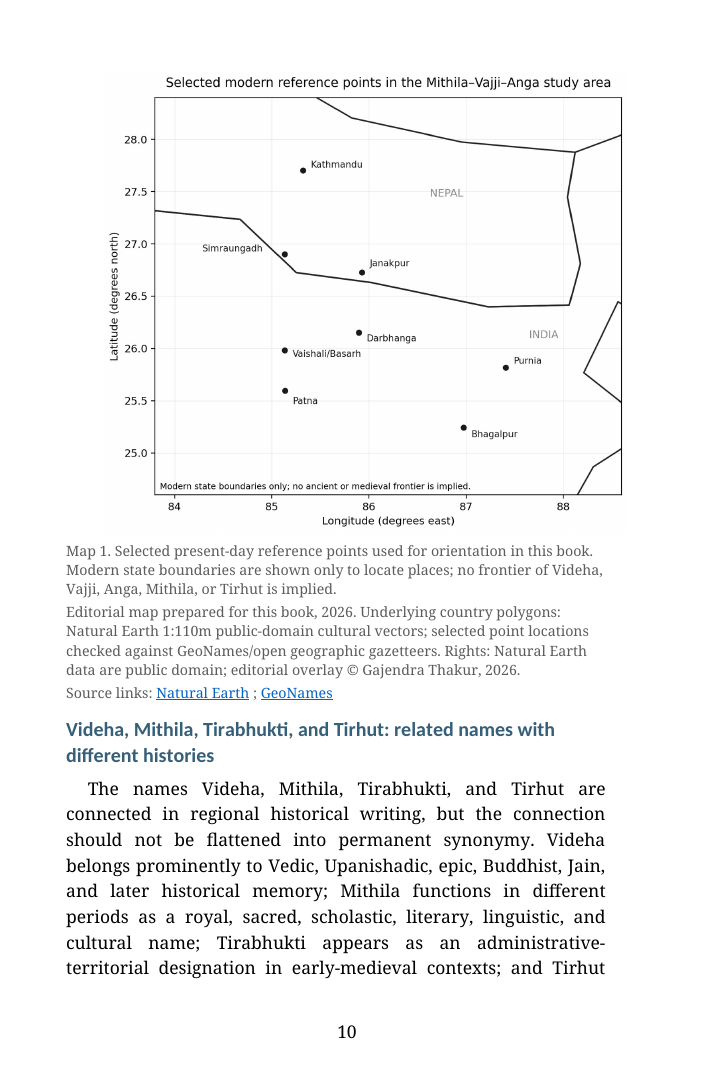
Mithila · Vajji · Anga
Chapter-specific source notes
- Primary chapter witness. Gajendra Thakur, Decoding the Panji of Mithila — Volume IV, formal Chapter 55, PDF pp. 533-542; formal Chapter 55. The HTML transcription is generated from the commit-pinned source PDF and retains the chapter boundary recorded in this edition.
- Internal structure. The repository source-heading inventory records 6 subordinate headings for this chapter: “Entry (451): Nahar and the Parhat-Sakararhi gramarambh”; “Entries (452)-(453): Parhat to Tharhi-Satlakha and the Satlakha continuation”; “Entry (454): Tedhra and the extended Bhaiyo-Harinandan lines”; “Entries (455)-(457): Parhar to Patwaha-Bargaon-Irshad, Jhaua, and Kachhua”; “Entries (458)-(460): Teldihā-Munger, Parhat-Teldihā, and the suspended Parhar marker”; “Chapter conclusion”.
- Digital editorial method. The page keeps the preserved source text distinct from generated navigational, concordance, visual, and provenance apparatus. The synthetic reconstruction is explanatory only and is not evidence for an individual lineage or a determination of social or marital status.