Decoding the Panji of Mithila · Volume IV · Chapter 58
Bhakhrauli-Ramnagar and the Rajanpura Cluster: Entries (475)-(485)
Chapter 58. Bhakhrauli-Ramnagar and the
Rajanpura Cluster: Entries (475)-(485)
   This chapter continues immediately after the Chhamu-
Mohana material and covers entries (475) through (485) only.
It begins with the Bhakhrauli-Sakararhi register at Ramnagar,
then moves through a long Rajanpura cluster: Mailam and
Dhamdaha, Kailakh, Saurath, Rajgram, Mangrauni-Tharhi, an
incomplete Rajanpura marker, and finally Shashipur-Vasant.
Entry (486), Rajanpura to Kaivalakh, begins the next unit and
is not included here.

Entry (475): Bhakhrauli to Ramnagar

Entry (475) opens with ath Bhakhrauli Sakararhi
gramarambh and places the branch at Ramnagar. The
first named ancestor is Budhai, whose son is
Lakshman. Lakshman gives Yogi through Karmah-
Govind-Yadai and Narun-Jagdish. Yogi gives
Mahipani, Abhiram, Chakai, and Machal through
Belaunch-Baliram-Bachharu and Mandar-Dhani, and
there is also an apara Yogi route through Ghusaut-
Manhar-Lakshmipati and Khaual-Nilkanth. The
opening therefore establishes Bhakhrauli not as an
isolated name but as a Sakararhi branch proven
through Karmah, Narun, Belaunch, Mandar, Ghusaut,
and Khaual links.
   Mahipani gives Gani or Guni and Raved through Sarisab-
Chaturbhuj-Shyamram and Belaunch-Gokulnath. Guni gives
Bhai through Panichobh-Ramkrishna-Bahoran and Darihara-
Indrapati. Bhai gives Doman and Bachha through Soder-
Garibnath-Venidatt and Sakararhi-Ramanath. Bachha is then
tied   through    Belaunch-Bhairavdatt-Ishwaridatt,  Pali-
Shyamdev-Grihimani, and Belaunch-Bhavnath. The Khendan

line gives Govind through Karmah-Soni-Rudranath and
Darihara-Shridatt.
   Abhiram gives Babua and Balah through Narun-Kulpati-
Ratnapati and Jajival-Nandalal. Babua gives Lal and Nena
through Karmah-Santoshi-Maniram and Satlakha-Ganga. Lal
gives Bhairav and Ram through Belaunch-Fakiran-Manilal and
Balias-Harinath. Ram is tied through Pali-Chhabna-Shyamlal-
Dwarikanath and Sarisab-Ramvallabh. Nena gives Garibnath
through Khandbala-Hardatt-Ratan-Shridatt, with additional
Belaunch-Saheb-Sonmani and Balias-Dharmadatt support.
Nena also gives Kalari and Madhusudan through Baheradhi-
Chhotai-Manasukh-Vidyanath      and   Pabouli-Dukhbhanjan.
Madhusudan gives Barji or Vaidyanath through Karmah-
Vedpani-Kanhaiya, Darihara-Brajnath-Babulal, and Gangoli-
Dukhni-Kari.
   The Balah strand adds Jamahir, Bute, and Bengali through
Uchati-Bodh-Horil and Sakararhi-Karia. Jamahir is linked
through Pali-Shiv-Devi-Vanshi, Satlakha-Lanha-Bachharan,
and Belaunch-Kuli. Chakai gives Dharmadatt through
Belaunch-Dharu-Janakinandan, Vithual-Pradyuman-Bana, and
Mandar-Dharani. This completes a compact but densely cross-
linked Bhakhrauli-Ramnagar unit.

Entry (476): Numeric or suspended marker

Entry (476) contains only the number marker (282)
and the figure 76, without a separate genealogical
body. I preserve it as a suspended or pagination-style
marker rather than creating an invented lineage. The
next genealogical body begins with entry (477).

Entry (477): Rajanpura to M.M. Chitradhar Jha,
Mailam Bachhi Jha and Dhamdaha

Entry (477) opens a Rajanpura line associated with
Mahamahopadhyaya Chitradhar Jha, Mailam Bachhi
Jha, and Dhamdaha or Dharmdih. The principal
learned ancestor is Mahamahopadhyaya Theghu,
styled Vanshidhar. His sons are Mahamahopadhyaya
Chitradhar, Mahamahopadhyaya Manodhar, and
Mahamahopadhyaya Rudradhar, linked through
Hariamb-Kamdev-Mohan and Pabouli-Kalidas. M.M.
Chitradhar is joined through Jajival-Nitai-
Lakshmidhar and Takbal-Bandhu. M.M. Manodhar is
tied through Belaunch-Bachha-Bhavnath and Jajival-
Nitai.
   M.M. Dharanidhar gives Yogdhar and Urvvidhar through
Pali-Harikrishna-Ramnath and Mandar-Vachaspati. Yogdhar
gives Taradhar through Khandbala-Vir-Brajbhushan and
Karmah-Chhabnu. Taradhar gives Rajje, Halli, Ballu, and
Malhana     through  Soderpur-Lakshmidatt-Kirtinath       and
Khaual-Dayaram. Rajje then gives Nena, Bhula, Bachhi, and
Luchmani through Soder-Deonath-Badri and Satlakha-
Chhakkan. Bachhi gives Vidyadhar, Srishtidhar, Kirtidhar, and
Muktidhar through Karmah-Lalpani-Jalpadatt and Digho-
Chandidatt. Vidyadhar gives Kedarnath, Kashinath, and
Indranath through Kujouli-Khagnath-Radhakant and Balias-

Bhaiyo; an apara Vidyadhar line gives Nirsu through
Khandbala-Lal-Bachharan.
   The entry then follows several sub-branches. Kedarnath is
tied through Alay-Chaudhary Feku-Vishnukant and Balias-
Raghunath; Kashinath through Soder-Bhairav-Indranath and
Pali-Krishnalal; Indranath through Soderpur-Prabhunandan-
Bhavdev and Kujouli-Dinanath. Nirsu gives Rajkumar,
Mahesh, and Dinkar through Belaunch-Babua-Sudarshan and
Ghusaut-Hiramani. Dinkar is placed through Baheradhi-
Thakur     Rudramani-Pramod        Kumar     and    Khaual-
Nagendranath. Muktidhar gives Dharmnath through Kujouli-
Khagnath-Radhakant and Balias-Bhaiyo. The entry closes with
further branches from Mani, Babuwa, Halli, and a partially
continued Punyashil trace.

Entry (478): Rajanpura to Mailam

Entry (478) continues the Mailam material. It begins
with the fragmentary “son Son” and moves through
Baheradhi-Lakshman, then Banu or Banu/Banu’s line
to Bholi through Soder-Nehal-Thothi and Pali-
Dharam. Apara Nanu is routed through Soderpur-
Dharam-Vishram and Darihara-Garib-Nanu, with Pali-
Nidhi. The entry then follows Bholi through Narun-
Amritnath-Manbharan and Balias-Lakshman, and
Malhan through Karmah-Rudranath-Shitaladatt and
Narun-Vitu. Another line goes through Alay-
Thakurdatt-Uma Datt and Pandua-Nityanand.
   Urvvidhar gives Avanidhar and Prithvidhar through
Vabhaniam-Krishnanand-Saheb and Narun-Bhikhi. Avanidhar
links through Karmah-Gauripati-Loknath and Balias-Brajnath;
Prithvidhar is also tied to Karmah-Loknath. The note explicitly
identifies M.M. Rudradhar as a barshakrit author and links his
line through Karmah-Dukharan-Vaidyanath and Balias-Girish.

The entry also preserves Harijiv and his descendants through
M.M. Ramabhadra, Sadupadhyaya Umanand, Khaual-Achyut,
and a large Shivdatt line. Shivdatt gives Banu, Gauridatt,
Vishnudatt, and Narayandatt; apara Shivdatt gives Hir,
Bachan, and Sachna; and another apara son Khadgapani is
linked through Pabouli-Raghunath-Kavi Hatthi and Sakararhi-
Pa Dhare.
   The close of entry (478) introduces Baban or Bawan’s sons:
Jyotishi Kanhai, Bathan, Ramdhan, Girdhari, and Judaun.
Kanhai gives Balle through Pali-Bhavanidatt-Arjun and
Soderpur-Bhavan. Balle gives Babua or Madhusudan,
Damodar, Jatadhar, Jagadhar, and others through Hariamb-
Santosmani-Babujan and Jajival-Chalbal. Madhusudan gives
Tejnath through Budhwal-Chhakori-Halli and Khandbala-
Chaturbhuj. Tejnath gives Shankar through Budhwal-
Vishwanath-Ramanand and Balias-Dedhan. This prepares the
transition to the Kailakh entry.

Entry (479): Rajanpura to Kailakh, Hrishikesh Jha,
Akaur Padmanam Jha and Kailakh Yoganand Jha

Entry (479) continues from the apara Madhusudan
line. Jaydev is linked through Khandbala-Thothi-
Jirakhan and Alay-Jaylal. Jaydev gives a Hariamb-
Govind-Uma route and a Balias-Harshanath route,
while Alay-Mitralal is also retained. Damodar is
linked through Soderpur-Manikanandan-Nityanand
and Belaunch-Ajit Narayan. Jatadhar gives Kartikeya
and Hrishikesh through Pali-Muktinath-Chunchun
and Khaual-Balgopal. Kartikeya gives Vachaspati
through Soderpur-Dukhi-Garja and Balias-Shriraman.
  Hrishikesh gives Vidyapati, Surpati, Prajapati, Ganapati,
Dhanpati, and Janapati through Fanandah-Lakshminath-Raja
and Pabouli-Yuddhi. Vidyapati is tied through Khandbala-

Jayanarayan Singh-Govind Singh and Mandar-Indranand.
Surpati is tied through Hariamb-Madhusudan-Buddhinath and
Mandar-Dinbandhu. The entry then follows Bathan’s
descendants: Latad and Yashodhar through Soder-Chalbal-
Bachhu and Pali-Arjun; Ramdhan gives Feku through Pabouli-
Ratnapati-Khelpati and a Nagram-Ghusaut-Babanu route.
Girdhari gives Dular through Ghusaut-Viku-Babulal and
Darihara-Manik, and an apara line through Raghunandan and
Bechan. Dular gives Padmanath through Pabouli-Bhaiyan-
Siddhi and Nagram-Ghusaut-Baban. Padmanath gives
Shashidhar through Karmah-Babujan-Shivdatt and Pandua-
Ramsevak.
  Raghunandan gives Shrinandan through Soderpur-Jagi-
Baba and Satlakha-Kirtinath, with an apara Hariamb-Nena-
Govind and Soder-Nanu route. Shrinandan gives Yoganand,
expressly called a litterateur, through Hariamb-Gulbadan-
Jaykrishna and Jajival-Babulal. Yoganand’s line is tied through
Pabouli and High Judge Lakshmikant. Bechan gives Radhakant
and Umakant through Khandbala-Lal-Bachharan and Balias-
Fakiran. This entry is unusually rich because it combines
Rajanpura routing with scholarly, judicial, and named literary
identity.

Entry (480): Rajanpura-Saurath, Govardhan Jha

Entry (480) is headed Rajanpura-Saurath and names
Govardhan Jha. Vishnudev’s line is first handled
through Sarisab-Krishnadev-Chan and Sakararhi-
Jayadatt. Apara sons include Kanhai through Soder-
Pogal-Chalbal and Pandua-Kedar, Gonod and
Hemnath through Pali-Bachharu-Chhabna and
Sakararhi-Ram, and another Pabouli-Garib-Ratnapati
and Karmah-Soni route. Kanhai is tied through
Budhwal-Ghananand-Fenkan and Sarisab-Bhaiyo.
Hemnath gives Dukhan through Jajival-Dharmnath-
Babujan and Pali-Horil, with a further Karmah-
Bokan-Bhai and Sarisab-Narayandatt route.
  Gauridatt gives Lakshman and Babue through Sarisab-
Mohan-Prannath and Balias-Nilambar. Apara routes connect
the same line to Pali-Bhavanidatt-Arjun and Soderpur-Bhavan;
another Gauridatt line passes through Sarisab-Jayshiv-
Bhaiyan and Satlakha-Manik. Hanumandatt is also listed
through Digho-Paran-Balkaram and Nagram/Pali-Manbodh.
Lakshman gives Yognath through Sarisab-Bhiriv-Bhavnath
and Pandua-Chan. Yognath then leads through Jajival-
Saburdatt-Bhikshuk and Mandar-Vanshidhar. Babue gives
Gulli through Pali-Mansukh-Chandradev and Soder-Nathe; an
apara son Manohar goes through Hariamb-Nidhi-Rudradatt
and Satlakha-Gauripati. Manohar gives Purushottam and
Jaykant, and the entry ends by opening Bhagwandatt and a
brief Dullah-Nena-Kujouli-Eknath line.

Entry (481): Rajanpura to Saurath, Shashinath Jha

Entry (481) continues Rajanpura-Saurath through
Shashinath Jha. The preceding Govardhan line gives
Jaidev through Pali-Bhikhiya-Shrilal and Mandar-
Bodh-Mani, with Karmah-Mani also noted. Apara sons
are Umakant, Yugalkant, and Ramakant. Yugalkant is
tied through Kujouli-Ganeshdatt-Dwarikanath and
Jajival-Chandidatt. Tarakant gives Tirthakant and
Prasannakumar through Sarisab-Janardan-
Lakshmikant and Alay-Chaudhary Shrikant.
   Shashinath gives Kamalakant, Suryakant, Chandrakant,
Tejkant, Bhanjakant, Indrakant, and Trivenikant through
Digho-Raghunath-Damodar and Nagram/Alay-Motinath. Halli
gives Hemnath through Hariamb-Bhagirath-Jangal and Soder-
Hridi. Kul gives Hirphul through Belaunch-Bachha-Bhavnath
and Jajival-Nitai; apara Kul branches go to Soderpur-
Pitambar-Raghuvir, Fanandah-Ishannath, and to Bhaiya,
Chonha, Bacha, Bengali, and other collateral lines. The entry
repeatedly uses numbered apara markers, so I treat it as a
layered expansion rather than a single direct succession.
  Hirphul gives Ghoghan and Mohan through Ghusaut-
Chanan-Bacha and Balias-Dukhiya. Apara Hirphul gives
Kanhai, Nand, Jayanand, Santosmani, and Rajmani through
Alay-Purandar-Chandrapati and Jajival-Dharu. Kanhai gives
Luch or Sufal and Durmil through Pali-Bhavadatt-Sonma and
Khaual-Brahmadatt. Sufal gives Jaydev through Jamdauli-Pali-
Manikanandan-Bhagwatnarayan and Balias-Rudranath, with
several apara Sufal lines through Pali, Soderpur, Panichobh,
Babhaniam, and Oini. The entry closes with Durmil and
Indranath links, keeping the Saurath-Shashinath branch open
toward Rajgram.

Entry (482): Rajanpura to Rajgram

Entry (482) begins with Indranath, whose son is
Triveni or Radhakant. Triveni/Radhakant gives
Ratnakant, Nareshkant, Pramodkant, Dayakant, and
Premkant through Pabouli-Natha-Buddhi and Alay-
Bechan Lal. Ratnakant is tied through Alay-
Jagannath-Vidyanath and Balias-Bhup. Jayanand gives
Nanu through Jamdauli-Pali-Dukhbhanjan-
Manikanandan, Belaunch-Chilka-Aankhi, and
Soderpur-Mahinath-Bachnu. Bhaiya gives Thithar
through Khandbala-Fakir-Hempati and Balias-
Vidyanath. Thithar gives Sudhakar and Divakar
through Khandbala-Ugrasingh-Kamalsingh and
Balias-Dullah. Divakar is tied through Karmah-
Chitradhar-Kanhai-Bhulan and Pandua-Hridaymani,
with another Soderpur-Gadadhar-Shridhar and Pali-
Bholanath route.
  The Chonha branch gives Musahadh through Khandbala-
Fakir-Hempati and Balias-Vidyanath. Apara Chonha gives
Harshadatt through Ratipar-Belaunch-Jiveshwar-Nanu and
Pabouli-Raghu. Musahadh gives Mukund, Madhav, and
Madhusudan       through    Sarisab-Bodhan-Srishtidhar  and
Belaunch-Raman. Mukund gives Babunandan through Jajival-
Sanphul-Premnath and Darihara-Prayagdatt. Harshadatt,
Madhav, and other apara lines continue to Sarisab,
Vabhaniam, and Balias. The entry functions as a Rajgram
consolidation of the preceding Rajanpura-Saurath lines.

Entry (483): Rajanpura to Mangrauni-Tharhi,
Dharanidhar Jha

Entry (483) is headed Rajanpura to Mangrauni-Tharhi
and names Dharanidhar Jha. It begins from Bacha,
whose line includes Shyamlal, Jhumkalal, Khedu, and
Rajkumar through Soder-Bhairav-Mansukh and
Darihara-Krishnapati. Apara branches move through
Budhwal-Raghav-Brajnath and Nar-Gunai. Jhumkalal
gives Khadganath or Sadhu, Kunjunath, and Rupnath
through Pabouli-Tengari-Sukhai and Budhwal-
Kamalnayan. Sadhu gives Tirthnath and Nidhinath
through Pali-Arjun-Mannu and Balias-Hridaynandan.
  Rajballabh Tirthnath gives Raghunath, Dayanath, and
Ramanath through Soder-Tufani-Jaynath and Hariamb-
Shyamnath. Raghunath gives Radhanath through Soder-
Govind-Kishor and Khaual-M.M. Chumme; an apara
Raghunath line gives Pramod Kumar through Digho-Bachkun-
Umesh and Balias-Lutan. Pramod Kumar is connected through
Alay-Harikant-Justice Ratikant and Mandar-Radhakant, a
modern professional marker that links this entry back to
earlier Harikant-Ratikant material. Dayanath is linked
through Mukhiya Ji, Gaurinath, and Bebi, with a Narun-
Shivnath-Balli and Karmah-Jagannath route, and another
Ghusaut-Madhav-Gunjeshwar and Balias-Chaturbhuj route.
   Ramanath, Khedu, Narayandatt, and Kamalpani are then
used to extend the Mangrauni-Tharhi register. Ramanath has
Budhwal-Nandishwar-Parmeshwar, Pabouli-Jhalhan, Narun-
M.M. Sadde-Batesh, and Khaual-M.M. Babua routes. Khedu is
tied through Jajival-Mansukh-Bhimdatt and Darihara-Manik.
Narayandatt gives Girdhari, Kamalpani, and others through
Hariamb-Jagannath-Umanath     and    Sakararhi-Pa   Dhare.
Kamalpani gives Pyare through Pali-Naresh-Brajlal and

Sarisab-Mana. Pyare gives Murlidhar and Dharanidhar
through Dumra-Budhwal-Premnath-Jhotan and Soder-Ram.
Dharanidhar gives Shrutidhar through Baligarh-Alay-Nena-
Gangadhar and Jajival-Rajvanshi. This is the core Dharanidhar
Jha line named in the heading.

Entry (484): Rajanpura continuation

Entry (484) is headed simply Rajanpura with number
(247), and continues through Rohini. Rohini gives
Lakshminath, Badan or Hemnath, and Revathinath
through Hariamb-Pati-Bhavkrishna and Jajival-Nitai.
Several apara Rohini lines are then enumerated:
Kujouli-Rami-Chhotku to Pali-Hira; Alay-Bhavdev-
Gangadhar to Balias-Rameshwar; Karmah-Raghudev-
Juraun to Darihara-Bhramar; Hariamb-Hrishi-
Hridayram to Belaunch-Khagesh; and Gidsu or
Dharmadatt-Jhau through Soderpur-Pitambar-
Raghuvir and Fanandah-Ishannath. More apara lines
include Dullah, Manik, Akali, Nanu, and others
through Karmah-Das-Narayan and Mandar-
Chakrapani.
   The entry then returns to Badan/Hemnath and
Bhagwatnarayan. Hemnath gives Janu through Sarisab-
Krishnadev-Pa Chan and Sakararhi-Jayadatt. Modnath is
linked through Digho-Madhurapati-Bachha and Pandua-Viku.
Bhagwatnarayan is tied through Ghusaut-Ram-Viku and
Belaunch-Dharmadatt, and another line through Ekhara-
Devidatt-Chhatrapati        and         Pabouli-Chandrapati.
Bhagwatnarayan gives Harivansh through Hariamb-
Rameshwar-Santosmani and Balias-Dharmadatt. Harivansh
gives    Basudev   through      Panichobh-Yadupati-Khendan-
Dwarikanath,    Soder-Chhakori-Kashinath,    and    Mandar-
Premnath. Basudev is finally tied through Pabouli-Amritnath-

Babujan and Khaual-Nakchhed. Entry (484) is a complex
continuation, dominated by multiple apara clauses.

Entry (485): Rajanpura-Shashipur, Vasant Jha

Entry (485) closes this chapter with Rajanpura-
Shashipur and Vasant Jha. Janu gives Radhanath
through Khandbala-Ugrasingh-Kamal Singh and
Balias-Dullah. Apara branches connect through
Chitradhar-Riddhi, Sarisab-Ratinath-Bachan, and
Bharav-Kujouli-Rayanand-Rai Shivdatt, with Ekhara-
Shivram-Vishwanath and Darihara-Dadani.
Radhanath is tied through Khandbala-Chhatramani-
Chaturbhuj and Khaual-Balbhadra. Bhagwatnarayan
gives Raghuvansh, Yaduvansh, and Harivansh
through Hariamb-Rameshwar-Santosmani, Balias-
Girish-Dharmadatt, and Kodariya-Akhiya.
   Raghuvansh gives Vani or Basundhar, Bhavsundar, Soni,
Chintamani, Nenu, Sadashiv, and Chandrashekhar through
Malichham-Baheradhi-Bhikshuk-Mathuranath and Balias-
Harisingh. Yadunath is tied through Karmah-Chitradhar-
Jalpadatt-Vanshi and Belaunch-Gujar-Balbhadra. Modnath
gives Maujelal, Rabubalal, and Phuddilal through Baheradhi-
Maherman-Aankhi and Pabouli-Bhavadatt. Maujelal is linked
through Pali-Mandhan-Shyam and Balias-Gangadhar. Bubalal
gives Vasant through Pali-Shyam; Phuddilal gives Vilat
through Kujouli-Hemnath-Gangadhar and Balias-Dullah-
Kirtinath. An apara Sadanand line then goes through Karmah-
Bachharan-Kheli, Soderpur-Harangi-Durganand, and Balias-
Raghuvir. This completes the Rajanpura-Shashipur/Vasant Jha
closure and stops before entry (486), Rajanpura-Kaivalakh.

Chapter conclusion
   Entries (475)-(485) are best read as a two-part transition.
First, Bhakhrauli-Ramnagar completes a Sakararhi branch
through dense Karmah, Khaual, Satlakha, and Mandar
controls. Second, the Rajanpura cluster expands outward
through Mailam, Dhamdaha, Kailakh, Saurath, Rajgram,
Mangrauni-Tharhi, and Shashipur. The recurrence of
Mahamahopadhyaya, Jyotishi, Kavi, Justice, and named
literary or professional markers shows that this section is not
merely a pedigree list; it also records learned status, social
mobility, and the long-range village routes by which the
Nagram Panji authenticates each branch.
Source structure and verification apparatus
Editorial source apparatus. This apparatus is descriptive, not interpretive. It records the source-controlled structure used to verify that this page corresponds to formal Chapter 58 of Decoding the Panji of Mithila — Volume IV. The chapter text above is preserved from PDF pp. 559-571; formal Chapter 58 in the commit-pinned authoritative source. It is not merged with a neighboring chapter, appendix, annexure, or independent front/back-matter unit. The internal headings below come from the repository’s source-heading inventory and are retained as navigational and audit evidence; showing them here does not turn those headings into separate publications or add claims that are absent from the source.
Internal source headings
- Entry (475): Bhakhrauli to Ramnagar
- Entry (475) opens with ath Bhakhrauli Sakararhi gramarambh and places the branch at Ramnagar. The first named ancestor is Budhai, whose son is Lakshman. Lakshman gives Yogi through Karmah-Govind-Yadai and Narun-Jagdish. Yogi gives Mahipani, Abhiram, Chakai, and Machal through Belaunch-Baliram-Bachharu and Mandar-Dhani, and there is also an apara Yogi route through Ghusaut-Manhar-Lakshmipati and Khaual-Nilkanth. The opening therefore establishes Bhakhrauli not as an isolated name but as a Sakarar
- Entry (476): Numeric or suspended marker
- Entry (476) contains only the number marker (282) and the figure 76, without a separate genealogical body. I preserve it as a suspended or pagination-style marker rather than creating an invented lineage. The next genealogical body begins with entry (477).
- Entry (477): Rajanpura to M.M. Chitradhar Jha, Mailam Bachhi Jha and Dhamdaha
- Entry (477) opens a Rajanpura line associated with Mahamahopadhyaya Chitradhar Jha, Mailam Bachhi Jha, and Dhamdaha or Dharmdih. The principal learned ancestor is Mahamahopadhyaya Theghu, styled Vanshidhar. His sons are Mahamahopadhyaya Chitradhar, Mahamahopadhyaya Manodhar, and Mahamahopadhyaya Rudradhar, linked through Hariamb-Kamdev-Mohan and Pabouli-Kalidas. M.M. Chitradhar is joined through Jajival-Nitai-Lakshmidhar and Takbal-Bandhu. M.M. Manodhar is tied through Belaunch-Bachha-Bhavnath a
- Entry (478): Rajanpura to Mailam
- Entry (478) continues the Mailam material. It begins with the fragmentary “son Son” and moves through Baheradhi-Lakshman, then Banu or Banu/Banu’s line to Bholi through Soder-Nehal-Thothi and Pali-Dharam. Apara Nanu is routed through Soderpur-Dharam-Vishram and Darihara-Garib-Nanu, with Pali-Nidhi. The entry then follows Bholi through Narun-Amritnath-Manbharan and Balias-Lakshman, and Malhan through Karmah-Rudranath-Shitaladatt and Narun-Vitu. Another line goes through Alay-Thakurdatt-Uma Datt a
- Entry (479): Rajanpura to Kailakh, Hrishikesh Jha, Akaur Padmanam Jha and Kailakh Yoganand Jha
- Entry (479) continues from the apara Madhusudan line. Jaydev is linked through Khandbala-Thothi-Jirakhan and Alay-Jaylal. Jaydev gives a Hariamb-Govind-Uma route and a Balias-Harshanath route, while Alay-Mitralal is also retained. Damodar is linked through Soderpur-Manikanandan-Nityanand and Belaunch-Ajit Narayan. Jatadhar gives Kartikeya and Hrishikesh through Pali-Muktinath-Chunchun and Khaual-Balgopal. Kartikeya gives Vachaspati through Soderpur-Dukhi-Garja and Balias-Shriraman.
- Entry (480): Rajanpura-Saurath, Govardhan Jha
- Entry (480) is headed Rajanpura-Saurath and names Govardhan Jha. Vishnudev’s line is first handled through Sarisab-Krishnadev-Chan and Sakararhi-Jayadatt. Apara sons include Kanhai through Soder-Pogal-Chalbal and Pandua-Kedar, Gonod and Hemnath through Pali-Bachharu-Chhabna and Sakararhi-Ram, and another Pabouli-Garib-Ratnapati and Karmah-Soni route. Kanhai is tied through Budhwal-Ghananand-Fenkan and Sarisab-Bhaiyo. Hemnath gives Dukhan through Jajival-Dharmnath-Babujan and Pali-Horil, with a f
- Entry (481): Rajanpura to Saurath, Shashinath Jha
- Entry (481) continues Rajanpura-Saurath through Shashinath Jha. The preceding Govardhan line gives Jaidev through Pali-Bhikhiya-Shrilal and Mandar-Bodh-Mani, with Karmah-Mani also noted. Apara sons are Umakant, Yugalkant, and Ramakant. Yugalkant is tied through Kujouli-Ganeshdatt-Dwarikanath and Jajival-Chandidatt. Tarakant gives Tirthakant and Prasannakumar through Sarisab-Janardan-Lakshmikant and Alay-Chaudhary Shrikant.
- Entry (482): Rajanpura to Rajgram
- Entry (482) begins with Indranath, whose son is Triveni or Radhakant. Triveni/Radhakant gives Ratnakant, Nareshkant, Pramodkant, Dayakant, and Premkant through Pabouli-Natha-Buddhi and Alay-Bechan Lal. Ratnakant is tied through Alay-Jagannath-Vidyanath and Balias-Bhup. Jayanand gives Nanu through Jamdauli-Pali-Dukhbhanjan-Manikanandan, Belaunch-Chilka-Aankhi, and Soderpur-Mahinath-Bachnu. Bhaiya gives Thithar through Khandbala-Fakir-Hempati and Balias-Vidyanath. Thithar gives Sudhakar and Divaka
- Entry (483): Rajanpura to Mangrauni-Tharhi, Dharanidhar Jha
- Entry (483) is headed Rajanpura to Mangrauni-Tharhi and names Dharanidhar Jha. It begins from Bacha, whose line includes Shyamlal, Jhumkalal, Khedu, and Rajkumar through Soder-Bhairav-Mansukh and Darihara-Krishnapati. Apara branches move through Budhwal-Raghav-Brajnath and Nar-Gunai. Jhumkalal gives Khadganath or Sadhu, Kunjunath, and Rupnath through Pabouli-Tengari-Sukhai and Budhwal-Kamalnayan. Sadhu gives Tirthnath and Nidhinath through Pali-Arjun-Mannu and Balias-Hridaynandan.
- Entry (484): Rajanpura continuation
- Entry (484) is headed simply Rajanpura with number (247), and continues through Rohini. Rohini gives Lakshminath, Badan or Hemnath, and Revathinath through Hariamb-Pati-Bhavkrishna and Jajival-Nitai. Several apara Rohini lines are then enumerated: Kujouli-Rami-Chhotku to Pali-Hira; Alay-Bhavdev-Gangadhar to Balias-Rameshwar; Karmah-Raghudev-Juraun to Darihara-Bhramar; Hariamb-Hrishi-Hridayram to Belaunch-Khagesh; and Gidsu or Dharmadatt-Jhau through Soderpur-Pitambar-Raghuvir and Fanandah-Ishann
- Entry (485): Rajanpura-Shashipur, Vasant Jha
- Entry (485) closes this chapter with Rajanpura-Shashipur and Vasant Jha. Janu gives Radhanath through Khandbala-Ugrasingh-Kamal Singh and Balias-Dullah. Apara branches connect through Chitradhar-Riddhi, Sarisab-Ratinath-Bachan, and Bharav-Kujouli-Rayanand-Rai Shivdatt, with Ekhara-Shivram-Vishwanath and Darihara-Dadani. Radhanath is tied through Khandbala-Chhatramani-Chaturbhuj and Khaual-Balbhadra. Bhagwatnarayan gives Raghuvansh, Yaduvansh, and Harivansh through Hariamb-Rameshwar-Santosmani, B
- Chapter conclusion
Source-text concordance
Bhakhrauli-Ramnagar · Rajanpura · Cluster · Entries · continues · immediately · Chhamu · Mohana · material · covers · begins · Bhakhrauli-Sakararhi · register · Ramnagar · moves · long · Mailam · Dhamdaha · Kailakh · Saurath · Rajgram · Mangrauni-Tharhi · incomplete · marker · finally · Shashipur-Vasant · Entry · Kaivalakh · next · unit · included · Bhakhrauli · opens · Sakararhi · gramarambh · places · branch · first · named · ancestor · Budhai · whose · Lakshman · gives · Yogi · Karmah · Govind-Yadai · Narun-Jagdish · Mahipani · Abhiram · Chakai · Machal · Belaunch-Baliram-Bachharu · Mandar-Dhani · apara · route · Ghusaut · Manhar-Lakshmipati · Khaual-Nilkanth · opening · therefore · establishes · isolated · name · proven · Narun · Belaunch · Mandar · Khaual · links · Gani · Guni · Raved · Sarisab · Chaturbhuj-Shyamram · Belaunch-Gokulnath · Bhai · Panichobh-Ramkrishna-Bahoran · Darihara · Indrapati
Boundary verification. In the formal sequence this chapter follows Volume IV Chapter 57, “Rohar-Jhanjharpur, Tatail- Sakararhi and Chhamu-Sakararhi: Entries (467)-(474) This chapter begins a new source file after the Rohar-” and precedes Volume IV Chapter 59, “Rajanpura-Kaivalakh, Shivipatti, Kanhouli, Navani, Ratauli, and Bhatsimari- Tharhi: Entries (486)-(497) This chapter continues the Rajanpura register from the”. The chapter extractor begins at the verified formal Chapter 58 marker and stops at the next verified formal chapter marker; for a final chapter it stops before recognized book-level back matter. The concordance above is generated only from distinct terms already present in this chapter’s preserved source text. It is provided for discovery, comparison, and audit, not as an automated judgment about persons, lineages, status, kinship, marriage eligibility, or historical truth.
Illustrated research apparatus
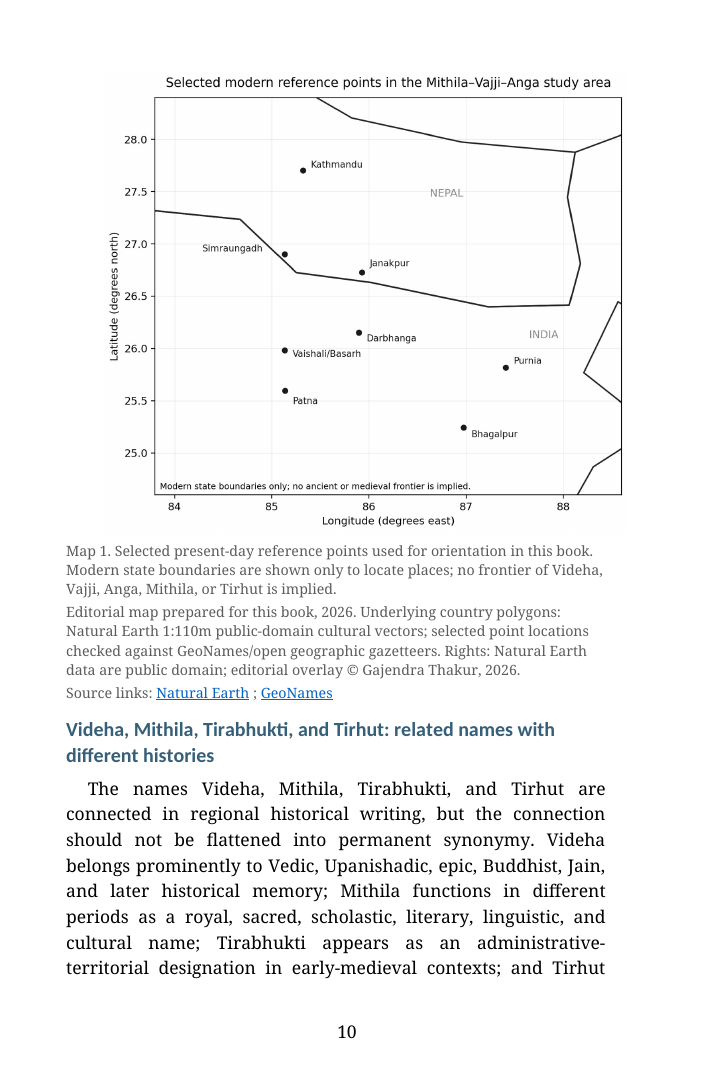
Mithila · Vajji · Anga
Chapter-specific source notes
- Primary chapter witness. Gajendra Thakur, Decoding the Panji of Mithila — Volume IV, formal Chapter 58, PDF pp. 559-571; formal Chapter 58. The HTML transcription is generated from the commit-pinned source PDF and retains the chapter boundary recorded in this edition.
- Internal structure. The repository source-heading inventory records 23 subordinate headings for this chapter: “Entry (475): Bhakhrauli to Ramnagar”; “Entry (475) opens with ath Bhakhrauli Sakararhi gramarambh and places the branch at Ramnagar. The first named ancestor is Budhai, whose son is Lakshman. Lakshman gives Yogi through Karmah-Govind-Yadai and Narun-Jagdish. Yogi gives Mahipani, Abhiram, Chakai, and Machal through Belaunch-Baliram-Bachharu and Mandar-Dhani, and there is also an apara Yogi route through Ghusaut-Manhar-Lakshmipati and Khaual-Nilkanth. The opening therefore establishes Bhakhrauli not as an isolated name but as a Sakarar”; “Entry (476): Numeric or suspended marker”; “Entry (476) contains only the number marker (282) and the figure 76, without a separate genealogical body. I preserve it as a suspended or pagination-style marker rather than creating an invented lineage. The next genealogical body begins with entry (477).”; “Entry (477): Rajanpura to M.M. Chitradhar Jha, Mailam Bachhi Jha and Dhamdaha”; “Entry (477) opens a Rajanpura line associated with Mahamahopadhyaya Chitradhar Jha, Mailam Bachhi Jha, and Dhamdaha or Dharmdih. The principal learned ancestor is Mahamahopadhyaya Theghu, styled Vanshidhar. His sons are Mahamahopadhyaya Chitradhar, Mahamahopadhyaya Manodhar, and Mahamahopadhyaya Rudradhar, linked through Hariamb-Kamdev-Mohan and Pabouli-Kalidas. M.M. Chitradhar is joined through Jajival-Nitai-Lakshmidhar and Takbal-Bandhu. M.M. Manodhar is tied through Belaunch-Bachha-Bhavnath a”; “Entry (478): Rajanpura to Mailam”; “Entry (478) continues the Mailam material. It begins with the fragmentary “son Son” and moves through Baheradhi-Lakshman, then Banu or Banu/Banu’s line to Bholi through Soder-Nehal-Thothi and Pali-Dharam. Apara Nanu is routed through Soderpur-Dharam-Vishram and Darihara-Garib-Nanu, with Pali-Nidhi. The entry then follows Bholi through Narun-Amritnath-Manbharan and Balias-Lakshman, and Malhan through Karmah-Rudranath-Shitaladatt and Narun-Vitu. Another line goes through Alay-Thakurdatt-Uma Datt a”; ….
- Digital editorial method. The page keeps the preserved source text distinct from generated navigational, concordance, visual, and provenance apparatus. The synthetic reconstruction is explanatory only and is not evidence for an individual lineage or a determination of social or marital status.